Tag Archives: Somerset

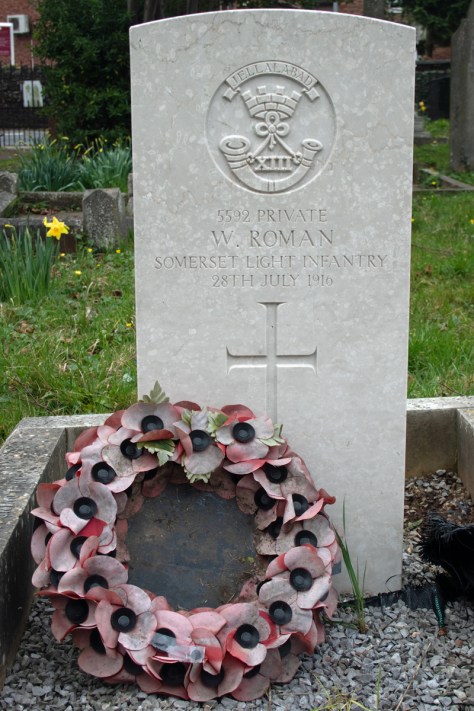
Private Walter Roman

Private Walter Roman

Walter James ‘Rattler’ Roman was born in July 1880, one of six children to George and Betsy Roman. George was a labourer in a brickyard, and the family lived in Bridgwater in Somerset.

Walter’s passion was rugby football, and he made the Bridgwater & Albion first team at the age of 15. Two years later had reached county level, and was playing for Somerset.

Walter enlisted in the army in around 1897, joining the Somerset Light Infantry. He spent several years abroad, serving as a Private in India and South Africa and fighting at Cawnpore and in the Second Boer War.

When Walter’s service ended, he returned to England, and continued his rugby career. He was a regular for the Bridgwater and Somerset teams, gaining the nickname ‘Rattler’, before being signed up by Rochdale Hornets in 1910.

Walter married Henriette Washer in Bridgwater in April 1911, and the couple had two children, Edna – born in 1912 – and Leonard – who was born a year later.

Continuing with rugby union, Walter was called to county level, where he joined Lancashire for a number of games. Walter also played for England, receiving a cap in the international match against Wales in February 1914, and he toured Australia and New Zealand the same year.

War broke out, and Private Roman was re-enlisted, one of twenty-five Hornets players to enlist. He served on the Western Front with the 1st Battalion of the Somerset Light Infantry and was caught up in the engagements at Ypres and Armentieres. Fighting at in the Battle of the Somme, he went over the top at Beaumont-Hamel at the start or fighting, on 1st July 1916 – his 36th birthday.

In that initial charge, he was shot several times, in both arms, a leg and the torso. Initially treated at a local field hospital, he was evacuated to England and admitted to the Voluntary Aid Hospital in Cheltenham. His condition initially improved, and he wrote letters to Henrietta, who was living back in Rochdale.

Sadly, Walter’s contracted sepsis and his health deteriorated; Henrietta was called to the hospital in Cheltenham on 27th July 1916. It is likely that she didn’t make it in time, as Walter passed away at 1pm the following day. He was just 36 years old.

Walter James Roman lies at rest in the Wembdon Road Cemetery in his home town of Bridgwater, Somerset, one of may sporting heroes to perish in the First World War.


Walter Roman (courtesy of findagrave.com)

Walter was one of 25 Rochdale Hornets players to enlist when war broke out. Of those men, five did not return: Private Walter Roman; Sergeant John Twigg; Private Archie Field; Private Tom West and Private CJ Burton.
Second Lieutenant William Bradbeer

Second Lieutenant William Bradbeer

William James Bradbeer was born in the spring of 1888, the youngest of eight children to Alfred and Jane Bradbeer from Bridgwater in Somerset. Alfred was a carriage trimmer, fitting out the train coaches for the local railways.

Sadly, William lost both of his parents in 1910; by this point he was 22, and was working as a schoolmaster along with his older brother Alfred. Five of the Bradbeer siblings were living together by this point, along with Sidney Palfrey, a photographer, who was boarding with them.

On 27th December 1911, William married Selina Nurse, who was also from Bridgwater, and whose father was a master mariner. The couple did not have any children together.

There is little evidence of William’s life after his marriage. He was enlisted in the Royal Garrison Artillery during the war, although no details of his military service are available. The battalions provided support in key forts primarily along the south coast of England, but also in places like the Channel Isles, Malta and Sierra Leone. Without Second Lieutenant Bradbeer’s records, it is impossible to know specifically where he served, but it would seem likely that he remained in England during the war.

The last years of William’s are also shrouded in mystery; he passed away on 8th August 1920, at the age of 32. I have been unable to uncover a cause of death, but it seems likely to have been an illness, as there is nothing in the contemporary media to suggest anything unusual or untoward.

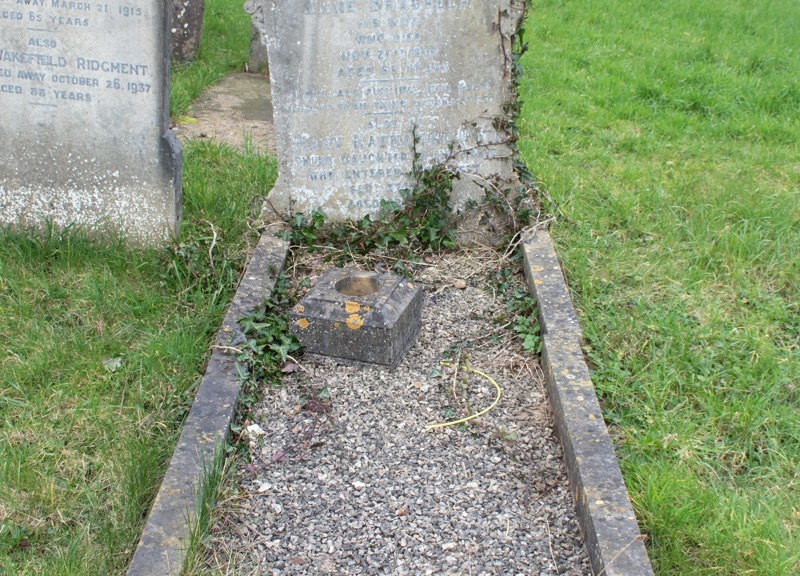
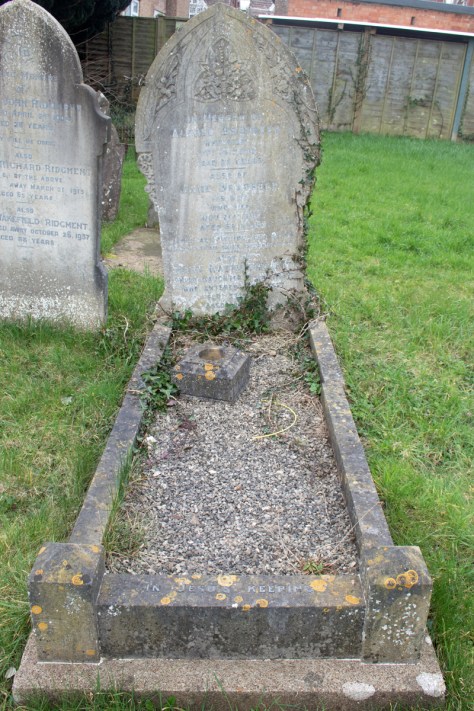
William James Bradbeer lies at rest in the Wembdon Road Cemetery in his home town of Bridgwater. Sadly, though, his grave is also lost to time, and I was unable to pinpoint its location. In death, as in his later years, William remains a mystery.


Note: The grave at the top of this page, however, is of a couple of his Bradbeer relatives, buried in the same cemetery.


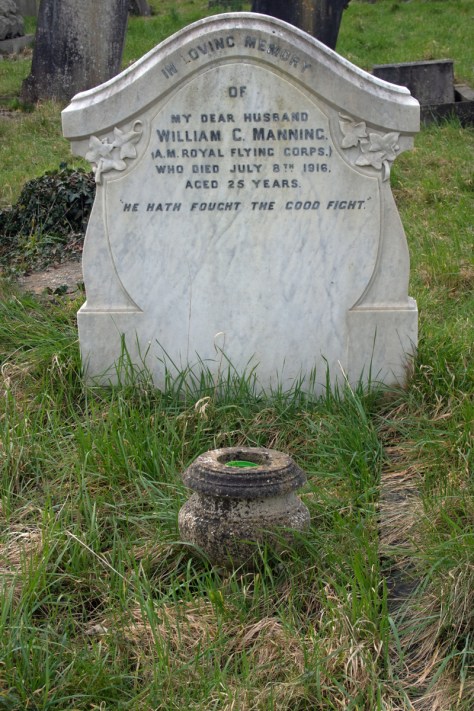
Air Mechanic William Manning

Air Mechanic William Manning

William Charles Manning – known as Willie – was born in Bridgwater in 1890, one of ten children to Samuel and Emily Manning. Samuel was a cabinet maker, and at least of three of his sons, Willie included, went into the family business.

There is little information available on Willie’s life, but he married Nellie Dodden, also from Bridgwater, in November 1915. Sadly, this was around the time that Nellie’s father passed away; tragedy for Nellie was still close by.

Willie’s military records are minimal, although details of his passing can be determined from the subsequent newspaper report.

He had enlisted in the Royal Flying Corps around October 1915, certainly around the time he and Nellie married. He was an air mechanic, something his woodworking skills probably drew him to and was based at Manston Airfield in Kent.

On 8th July 1916, Willie was a passenger in a flight piloted by Lieutenant Bidie. It seems that Bidie was turning the plane while at low altitude, while attempting to land. The plane crashed, and both Bidie and Willie were killed. Air Mechanic Manning was just 25 years old.

William Charles Manning lies at rest in the Wembdon Road Cemetery in his home town of Bridgwater, Somerset.


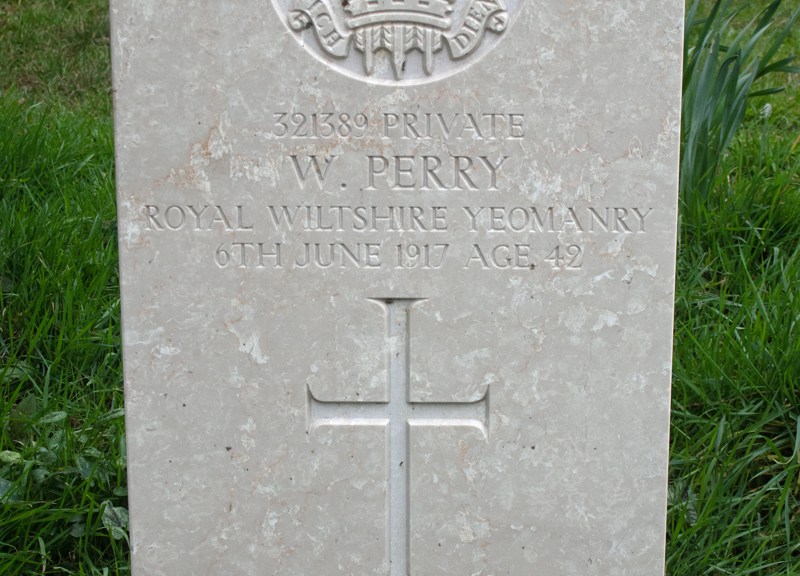
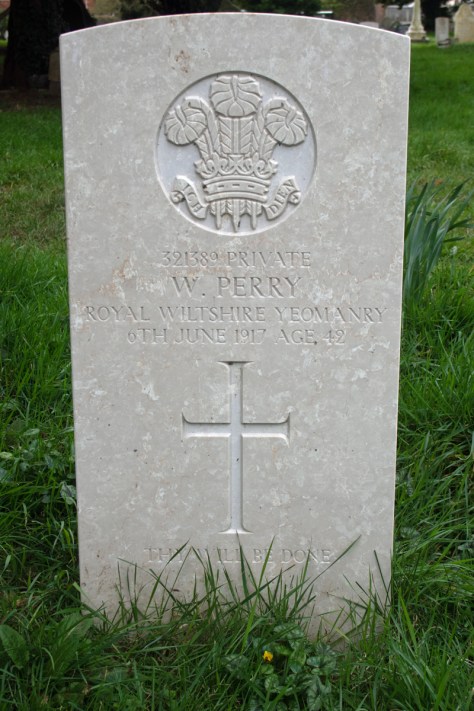
Private Walter Perry

Private Walter Perry

Walter Perry was born in Bridgwater, Somerset, in 1874. He was one of ten children to James Perry, a general dealer, and his wife Hannah. After he had left school, Walter became a labourer; his older siblings had all become labourers or factory workers in the area.

In November 1899, Walter married Rebecca Cavill; their first child, Hilda, was born at the end of March the following year. By this time, Walter was working for a brewery, while his new wife was working at a shirt collar factory. The young couple went on to have two further children – Walter and Beatrice – before Rebecca tragically passed away in June 1906.

Walter married again in November 1908, this time to a Mary Ann Reed also from Somerset. The couple went on to have two children, Joseph and Edna, and the family lived together in the centre of Bridgwater.

The Great War was on the horizon. While details of Walter’s military service are not readily available, it is unlikely that he was called up as soon as hostilities broke out – he turned 40 in 1914, and so was too old to qualify immediately.

Walter enlisted in the 2/1st Royal Wiltshire Yeomanry; he was based primarily in England, where his battalion acted as a training/reserve for the 1st Battalion, who were serving on the Western Front. It was while Private Perry was based in Essex, that he contracted appendicitis; he was admitted to the General Military Hospital in Colchester, but passed away on 6th June 1917. He was 43 years old.

Walter Perry lies at peace in the Wembdon Road Cemetery in his home town of Bridgwater.


Lance Corporal Stanley Southwood

Lance Corporal Stanley Southwood

Stanley James Southwood was born in 1896, the oldest of six children to John and Florence Southwood from Bridgwater, Somerset. John was a labourer and ship’s mate, while Stanley, who was the only boy in the family, started work loading barrows in a brickyard.

Military life was pulling Stanley, however. According to another researcher, he enlisted in the Special Reserves of the Somerset Light Infantry in October 1912. Six months later he joined the regular army, and was there when the war began.

While I have not been able to corroborate this information, it appears that Southwood was reported missing on 11th September 1915, after being wounded in the chest. He was taken prisoner of war, and, while being held, he developed tuberculosis in both lungs.

After his release (no documents confirm when this was) he was discharged from the army as medically fit to continue. He was in a military hospital at the time – the beginning of November 1918 – suffering from tuberculosis, which had been exacerbated by the chest wound he had received three years earlier. At the time he was discharged, he had the rank of Lance Corporal.

Sadly, it seems that Stanley never fully recovered from his wartime experience. He died on 8th September 1919 from consumption (tuberculosis), aged just 23 years old.

Stanley James Southwood lies at rest in the Wembdon Road Cemetery in his home town of Bridgwater in Somerset.


Guardsman Joseph Steadman

Guardsman Joseph Steadman

Joseph Richard Steadman was born in Ellesmere Port, Cheshire, in 1892. One of seven children to William and Mary Ann Steadman, his father worked as a slab maker for the local council.

Sadly, Joseph’s mother died in 1899, at the age of just 40. William had moved the family to Birmingham by this point, and, on leaving school, Joseph found work at a jeweller’s as a scratch brusher.

Moving to London, Joseph met Ethel May Tambling, who was originally from Somerset, and the couple married at the beginning of 1914. Ethel already had a child – Frederick – and the young couple also had a son, Alfred, who was born in July 1914.

War was on the horizon, and Joseph was quick to enlist. He joined the Coldstream Guards, embarking for France a month after Alfred was born. An elite force, the Coldstream Guards were involved in some of the heaviest fighting of the war, including the Battles of Mons, Ypres, Loos, Somme, Passchendale and Cambrai. It is likely that Guardsman Steadman was caught up in many of these engagements.

His luck was to run out, however, and Joseph was injured towards the end of October 1917. Shipped back to England for treatment, he was admitted to the King George Hospital in London. Sadly, Guardsman Steadman did not recover from his wounds; he died on 1st November 1917, aged just 25 years old.

Joseph Richard Steadman lies at rest in the Wembdon Road Cemetery in Bridgwater, Somerset.


Joseph and Ethel Steadman (from Ancestry.com)

As a sad aside to this story, two of Joseph’s brothers also died in the war. William Steadman was 29 when he was killed at Ypres in April 1915, while Charles Steadman was just 19 when he died at Armentieres.


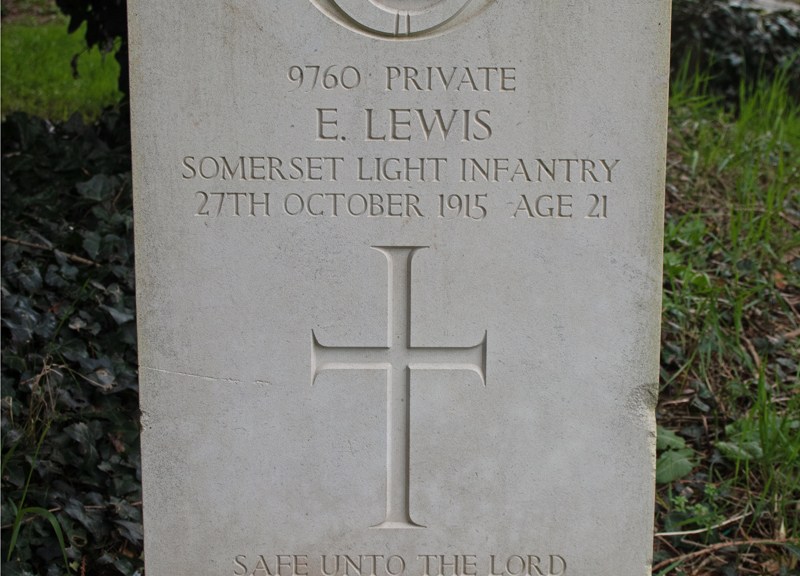
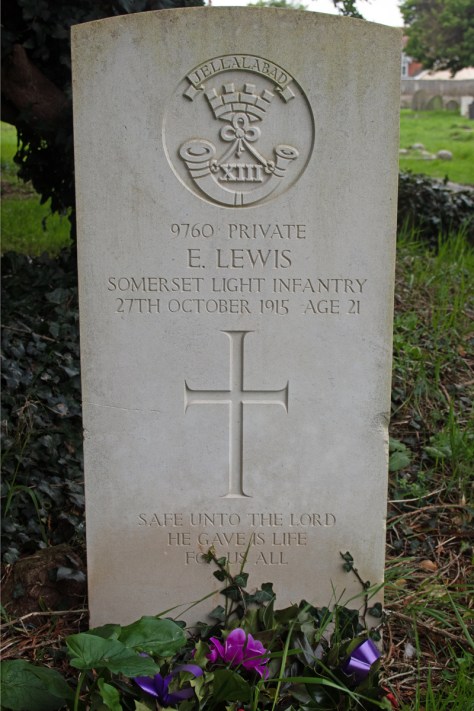
Private Ernest Lewis

Private Ernest Lewis

Ernest George Lewis was born in Bridgwater, Somerset, in the spring of 1895, one of fourteen children to labourer Frederick and his wife Harriett Rose. Two of his older brothers went to work for the local brickworks, but Ernest hauled coal to earn a living once he left school.

When war broke out, he was eager to do his part; he enlisted in the Somerset Light Infantry early on, serving as a Private in the 1st Battalion. His troop was to see some of the fiercest fighting in the conflict, including the Battles of Le Cateau, the Marne, the Aisne, Messines within the first six months.

Private Lewis’ troop was also involved in the Second Battle of Ypres in the spring of 1915, but it was later that year that his fate became sealed. At some point he was caught up in a German gas attack; he was evacuated home, but there is no confirmation whether he was hospitalised as a result (although it seems likely).

The gas was to damage his lungs to the extent that he would not recover. There are conflicting reports as to the cause of Private Lewis’ passing, with one source identifying the gas in France, while another put it down to pneumonia and typhoid. (It seems probable that the attack ultimately resulted in Ernest catching pneumonia, although this is not clear.)

Either way, Private Lewis passed away at home on 27th October 1915. He was just 20 years old.

Ernest had eleven brothers, four of whom would have been old enough to be enlisted to fight. Ernest was the only one of the family to perish.

Ernest George Lewis lies at peace in the Wembdon Road Cemetery in his home town of Bridgwater.


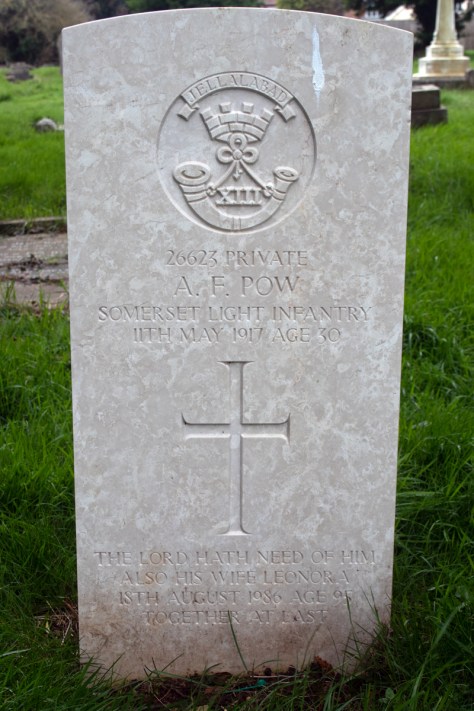
Private Albert Pow

Private Albert Pow

Albert Francis Pow was born in the autumn of 1886, one of five children to Albert and Annie Pow from Somerset. Albert Sr. was a farm labourer, but by the time he left school, Albert Jr. started work as a porter in the Singer sewing machine factory in Bridgwater.

Albert’s father passed away in 1905, at the age of 51, and his son – who was by this time repairing the sewing machines – became head of the household.

He was obviously good at what he did, because, by the time he married in 1913, he was able to support his wife Leonora as branch manager for the Singer store in the town. The young couple soon moved on, as, when war broke out, he was manager of the shop in Barnstaple.

War came calling, and while the date of his enlistment is absent from his records, Private Pow joined the 1st Battalion of the Somerset Light Infantry. Sent to the front, he quickly became ill, suffering from dysentery and trench foot, which led to him being hospitalised for nearly two months.

Returning to his troops, Private Pow’s health remained unsteady, and he soon contracted trench fever. He was evacuated back to England for treatment, and was admitted to the Canadian Red Cross Memorial Hospital in Taplow, Buckinghamshire.

Sadly, Albert was not to recover this time; he died at the hospital on 11th May 1917 as a result of empyema (pleuritis) and an abscess of the axilla (armpit). He was just 30 years old when he died.

Albert Francis Pow lies at rest in the Wembdon Road Cemetery in Bridgwater.


Albert left behind his widow, Leonora and their child Vanessa. Leonora was to be reunited with her late husband; she died in August 1986, and is buried with her beloved.


Private Tom Cox

Private Tom Cox

Thomas Cox was born in September 1900, the oldest of four children to William and Ellen Cox from Bridgwater, Somerset. On Thomas’ baptism records, William listed himself as a manufacturer, but there is nothing to confirm what he made.

Sadly, William died in 1905, leaving Ellen to raise four children under five years old – including a babe-in-arms. Determined to look after her young family, however, by the time of the 1911 census, she gave her occupation as a grocer.

War was on the horizon and, while his full records are not evident, it is clear that Thomas must have looked to enlist as soon as his age would allow. He was assigned to the 53rd (Young Soldier) Battalion of the Hampshire Regiment, a training unit based not far from Warminster.

Sadly, Private Cox’s service was not to be a long one. While training, he contracted pneumonia, and passed away on 31st October 1918. He had just turned 18 years old.

Thomas Cox lies at rest in the Wembdon Road Cemetery in his home town of Bridgwater, Somerset.


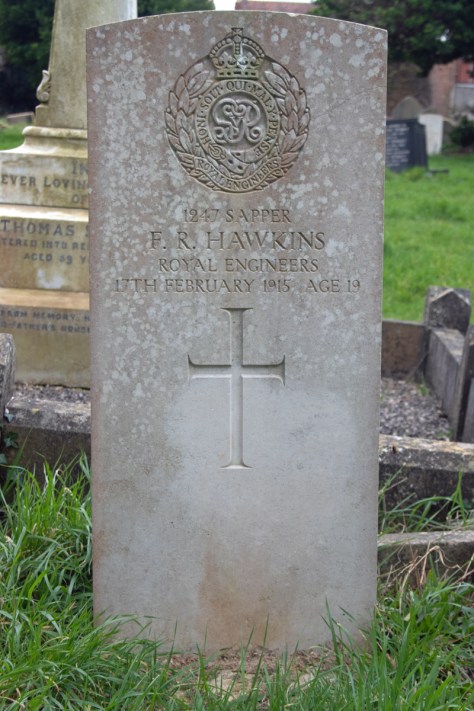
Sapper Francis Hawkins

Bridgwater (Wembdon)

Francis Ralph Hawkins was born in Somerset in March 1895 and was one of twelve children to Charles and Jane Hawkins. Charles was a police sergeant and the family lived in Bishop’s Lydeard, a village to the west of Taunton.

By the time of the 1911 census, Charles had retired from police work, and was operating as a licenced victualler in nearby Bridgwater. While Jane was supporting her husband running the business, Francis was apprenticed to a local clothier.

When war broke out, Francis was quick to enlist – he joined the Royal Engineers, and was appointed a Sapper. He wasn’t with the company for that long, however, as by February he had been admitted to the Red Cross Hospital in Christchurch, Dorset, with a fever.

Sadly, he was not to recover; Sapper Hawkins passed away from spinal meningitis on 17th February 1915. He was just 19 years of age.

Francis Ralph Hawkins lies at rest in the Wembdon Road Cemetery, Bridgwater.