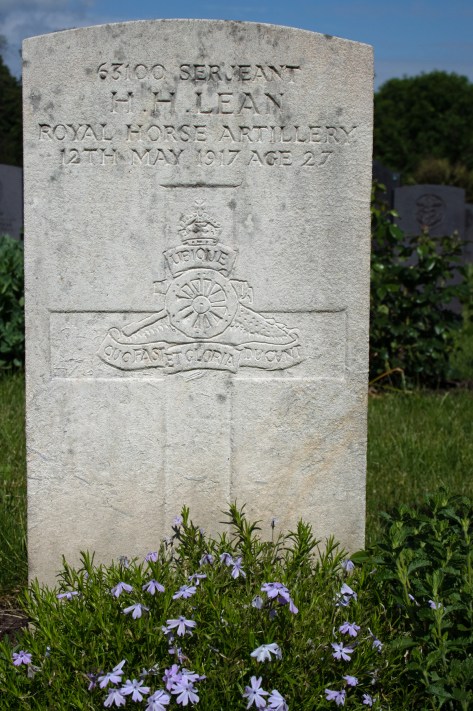
Harold Henry Lean was born in Gillingham, Kent, in the summer of 1890. The youngest of eight children, his parents were tailor Robert Lean and his wife Sarah. His siblings followed a variety of trades – coachman, painter, shoemaker – but Harold was keen to follow a more long-term career.
When he left school (and after his father’s death in 1901), he enlisted in the army, becoming a Gunner in the Royal Horse Artillery. Little remains of his service documents, but at the time of the 1911 census, he was firmly ensconced in the Artillery Barracks in Leeds.
The next record for Harold comes, sadly, in the form of a news report, detailing the inquest surrounding his death:
SUICIDE OF A SERGEANT AT TOPSHAM BARRACKS
Mr Hamilton Brown, Deputy Coroner for Exeter, held an inquest at Topsham Barracks last evening touching the death of Acting-Sergt. Harold Henry Lean, 26, of the [Royal Field Artillery], who died on Saturday as a result of a self-inflicted wound in the throat.
The evidence given by Bombardier JE Driscoll, of the [Royal Military Police], Trumpeter Sydney Russell, deceased’s batman, Bombardier Biddlescombe and Corporal J Williams signalling instructor was that Sergeant Lean, who had some time ago been ill, on Saturday morning was in his room with Russell, but did not speak all the morning.
Shortly after eleven o’clock he took his razor from a shelf in the corner of the room where he kept his shaving materials. Going to his bed he lay across it with his knees nearly touching the floor and drew the razor across his throat. Russell ran to him and caught him by the shoulders, but deceased pushed him away. Russell then called the assistance of Driscoll and Biddlescombe from an adjoining room.
Williams, who was a personal friend and worked with deceased as a signaller, said that deceased worried about the illness from which he had suffered, and two days previously said he thought he was going insane. He had never threatened to take his life.
Captain RW Statham, [Royal Army Medical Corps], said deceased joined that unit in October 1916, and a month later he reported sick. He was sent away to a military hospital, but was returned this year cured and reported for full duty. The illness had a tendency to create mental depression.
On Saturday morning had entered his name on the sick list, but did not attend the sick parade at 9am. At 11:10 when witness was called to him he found him dead. Witness described the wound, which was a very severe one.
The jury returned a verdict of “Suicide during temporary insanity”.
Wester Times: Tuesday 15th May 1917
Serjeant Harold Henry Lean’s body was brought back to Kent from Devon. He was laid to rest in the Woodlands Cemetery in Gillingham.
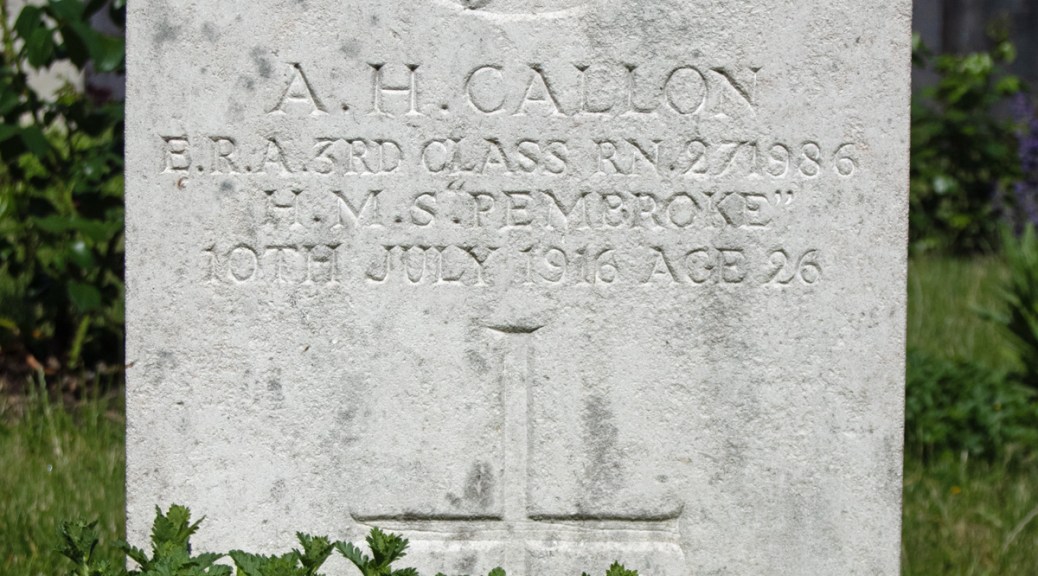
Archibald Hubert Callon – also known as Archie – was born on 2nd January 1890 in Pembroke Dock, South Wales. One of eight children, his parents were shipwright Michael Callon and his wife, Mary. Soon after Archie was born, Michael moved the family to Gillingham, Kent, presumably as work at the nearby Naval Dockyard was plentiful.
The sea was clearly in his blood as, in 1905, Archie joined the Royal Navy, initially as a Boy Artificer, before taking on full employment there once he reached the age of 18. The 1911 census found him working as an Engine Room Artificer 4th Class, one of a crew of 57 aboard the torpedo destroyer HMS Swale, moored in Grimsby.
Archie slowly rose through the ranks and, by 1913, had become Engine Room Artificer 3rd Class, while serving on HMS Clio. He remained on this vessel through to April 1916, before returning to HMS Pembroke, the shore-based naval establishment in Chatham, Kent.
Sadly, Archie’s time back home was short. The next record for him is stark; it is noted that on 10th July 1916, he committed suicide, during temporary insanity. I have been unable to uncover anything further about his passing. He was just 26 years old.
Archibald Hubert Callon was laid to rest in the Woodlands Cemetery in Gillingham, Kent, not far from where his family lived.
Charles Edward Nesbit Clarke was born in December 1884, the son of Ralph Clarke. Sadly, there is little documentation to flesh out his early life. He had at least one sibling, a sister called Nellie, and was born in London, possibly in Hampstead.
Charles seemed to have been mechanically minded; when he left school, he found work with a motor vehicle fitter, before going on to get employment as an electrical engineer.
He met a woman called Elizabeth Bertha Gould, and the couple married in Islington in November 1908. Four years later, the couple had a child, Edward. The boy’s baptism record shows that the family were living in the St John’s Road Workhouse in Islington, so things seemed to have been really tough for them. (There are no other workhouse records available, so it may be that it was a temporary residence, while Edward was born, but this cannot be confirmed either way.)
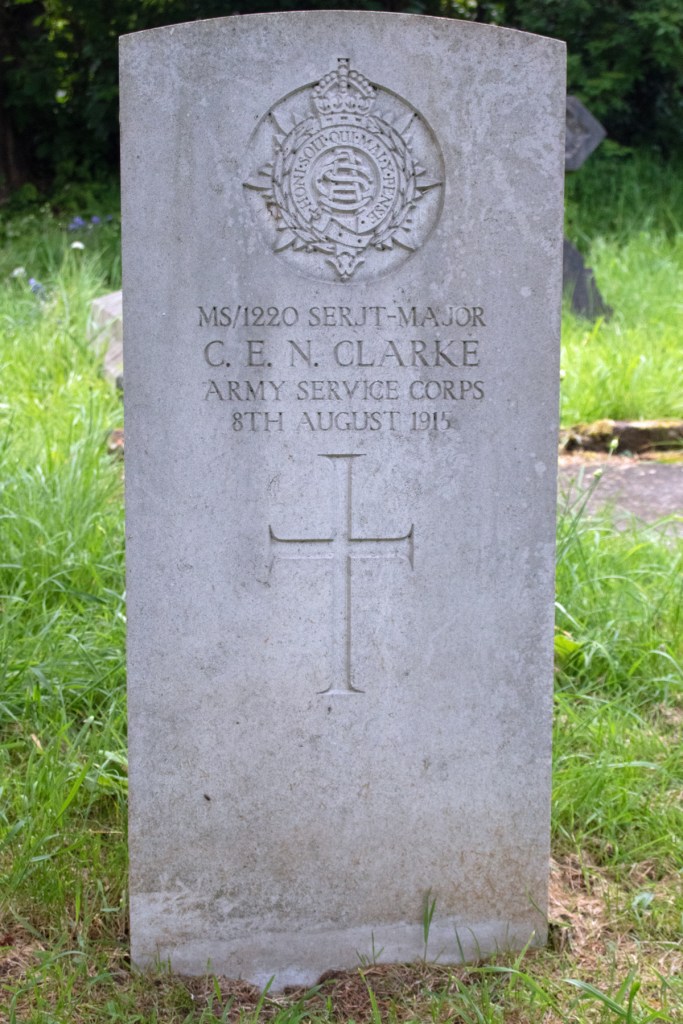
The Great War broke out, and Charles enlisted straight away. He had found employment as aforeman fitter by this point, and joined the Army Service Corps, in the Motor Transport Division. He was sent to France a week later, as part of the British Expeditionary Force, and served there for seven months.
When he returned to England, having gained the 1914 Star and the British and Victory Medals for his service, he was assigned to the military camp at Burnham-on-Sea, Somerset.
Five months later, a local newspaper picked up the sorry story of what happened next.
At Weston-super-Mare Hospital… Dr S Craddock held an inquest on the body of Staff Sergeant Major Charles Clark [sic], Army Service Corps, who was admitted to that institution suffering from a mortal and self-inflicted wound received at the Burnham military camp on Sunday morning.
Captain Budibent deposed that at the time the deceased was detained in camp as the result of having been absent from duty for four days without leave. On hearing of his return, witness (who liked the man and recognised his great value, having served with him in France) went to the tent to see him. Deceased was very upset, and in reply to a question said “I can’t account for staying away; I must have been mad.” Witness tried to cheer him up, reminding him that is was not “a hanging matter”, to which Clark replied “No, sir, I wish it was.” When they were in France together Clark confided to witness that a girl who once lived with him desired him to marry her on his returning from the Front, but he stated that he could not do so, as he loved another girl. As he was depressed, witness advised him on returning home to see the girl who considered she had a claim upon him, and, if it were a matter of money, to settle it, and then marry the other girl. On later returning to the Front from England, deceased said his troubles were over, that he had married the other girl, and that he could now do his work with a good heart. Witness, however, believed other troubles had arisen.
Sergeant Belt, ASC, said he had slept in the same tent with the deceased. Clark had a good night, but next morning became very depressed over the fact that half the Company were leaving the came for another destination, and would be losing close friends. He remarked “The last hour has been the worst in my life.” Later, when outside the tent, witness heard a rifle shot and, rushing in, found Clark lying in bed with a rifle wound in his chest. Deceased admitted that he had fired the rifle himself. Death occurred in Weston Hospital, whither he was removed the same night. The medical evidence revealed terrible internal injuries, the bullet having practically severed deceased’s liver.
The jury returned a verdict that Clark committed suicide while temporarily insane.
Taunton Courier & Western Advertiser: Wednesday 18th August 1915
The report, particularly Captain Budibent’s comments, raises some questions. By the time of the First World War, Charles was married to Bertha. There is no record of him having married anyone else, so where the girl he loved, and the other who loved him came into it, it is impossible to say.
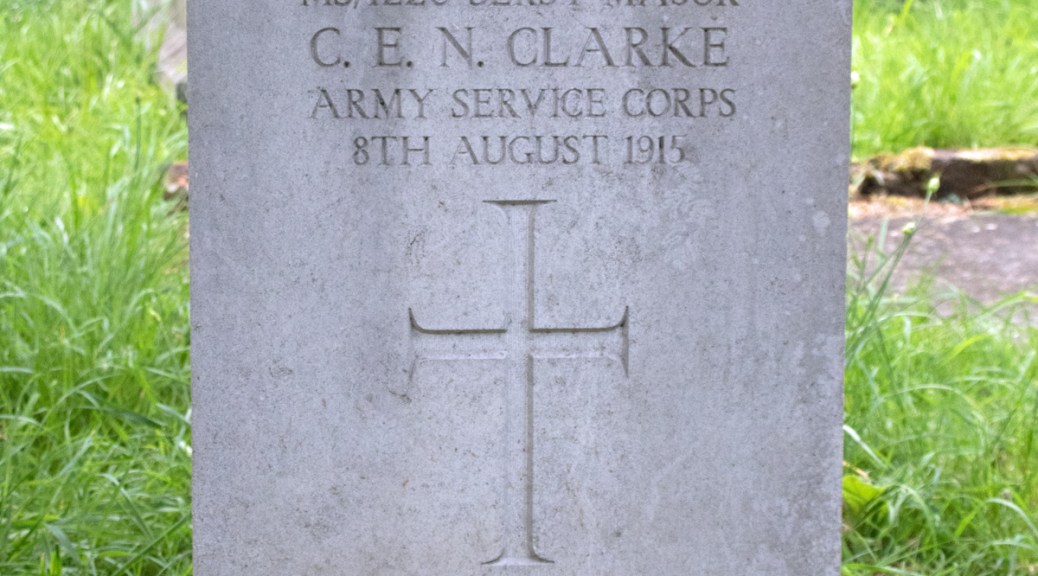
Sergeant Major Clarke had taken his own life at the age of just 31 years old. Bertha and their son were living in Chatham, Kent, at the time, and it seems likely that the cost of moving him closer to home may have ruled that out.
Charles Edward Nesbit Clarke’s body was buried instead in the Milton Cemetery in Weston-super-Mare.
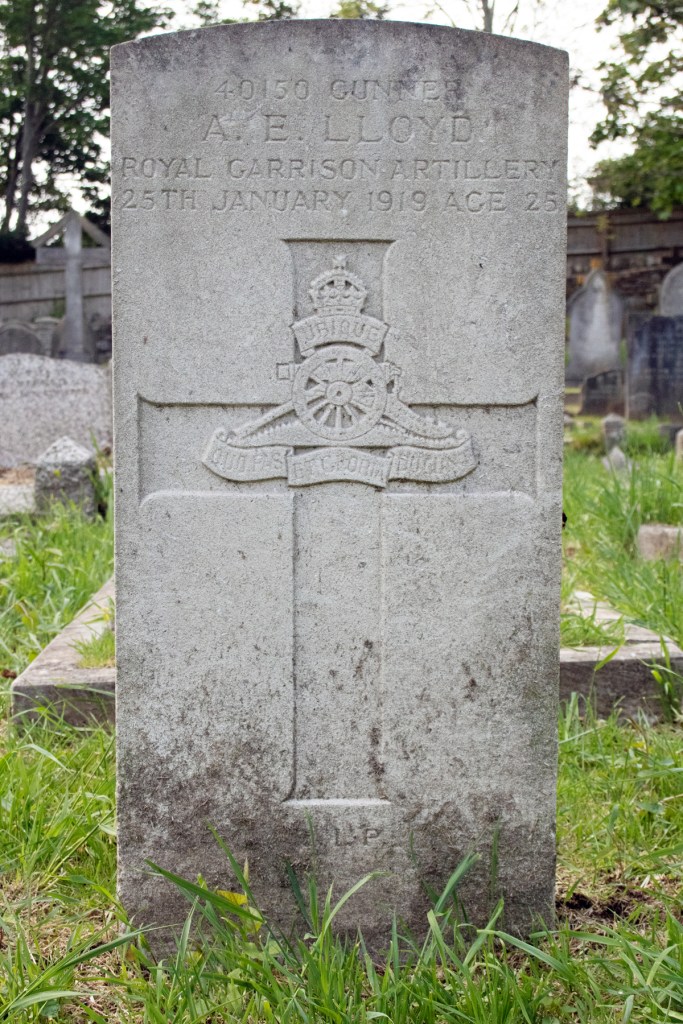
Albert Edward Prankard Lloyd was born in Somerset on 25th September 1893, in the Somerset village of Kewstoke (now a suburb of Weston-super-Mare). He was one of eight children to Jabez and Charity Lloyd. Jabez was initially a mason, but later went on to find work as a miner in South Wales. Charity worked as a laundress to help bring in extra money.
When Albert left school, he found employment as a labourer, remaining at home with Charity, with Jabez working away, and three of his sisters working as housemaids or laundresses. By 1911, however, he had moved to Wales with his father to work as a miner; steady employment that brought in a little more money because of the risks involved.
War, however, was on the horizon, and Albert enlisted before hostilities broke out. Joining up on 12th January 1914, his military records show him as standing 5ft 7ins (1.7m) tall and weighing in at 166lbs (75.3kg). He joined the Royal Garrison Artillery and, over the next five years, served three tours of duty in France, totalling just over three years on the Western Front.
Gunner Lloyd’s military service was not without incident, however. In November 1914 he was admitted to hospital for a week, suffering from shock. In April 1917, a shell exploded close to him and he was again found to be suffering from shock. His records note that, following the injury, he had had suicidal thoughts, and wished he was dead.
Just a month later, back on the battlefield, Albert received a gunshot wound to his right thigh. Nine months later, he was admitted to the Hermitage General Hospital in Higham, Kent for three weeks. (The ailment is a mystery, with just the term SCT Toe to identify it.)
When the Armistice came, Gunner Lloyd remained in France, finally returning home on 13th January 1919 ready to be demobbed. While not clear in his records, it seems that the initial ‘shock’ he had suffered from in 1914 had continued throughout the war.
One of the last comments on Albert’s service records is stark. “Found dead on Great Western Railway near Weston-super-Mare. 25.01.19“. Frustratingly, there is no other documentary evidence to expand on this curt phrase, no contemporary newspapers seem to have reported on the event, and nothing more than a scribbled police report was provided for the inquest (again, of which nothing remains).
It seems that the effects of five years of conflict proved too much for Gunner Lloyd; he committed suicide at the age of just 25 years old.
Albert Edward Prankard Lloyd lies at peace at last in the Milton Cemetery in his home town of Weston-super-Mare.
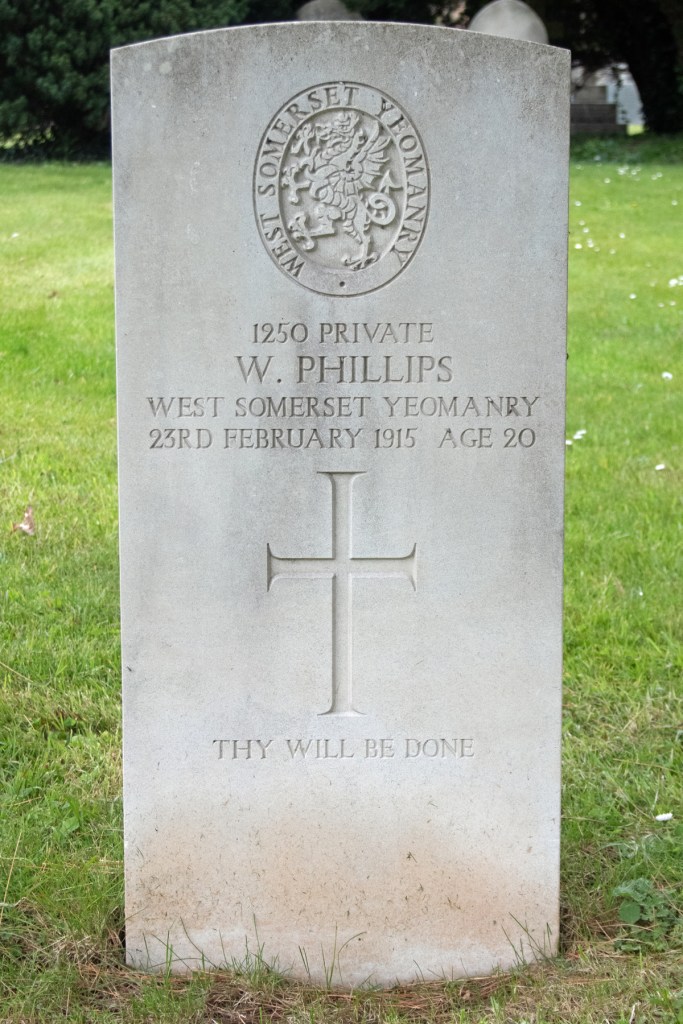
William Phillips was born in 1895, the youngest of seven children to Frank and Emily Phillips. Frank was a joiner and carpenter and, while his young family initially grew up in his home village of Thurloxton, Somerset, he and Emily soon moved them to nearby Taunton, where there would be more work and more opportunities.
By the time of the 1911 census, the young family were all tied up with different jobs. While William had become an office boy for an accountant when he left school, his siblings all had varying different roles: one was a boiler cleaner, another a mason, a third a cellarman and the fourth a shop assistant. With Frank’s own work, this meant that there were five wages coming into the home, albeit on a much smaller scale that we are used to these days.
War was coming, however, and, at the beginning of 1915, William enlisted in the West Somerset Yeomanry. Little information remains of his military service, but it is known that Private Phillips’ experience as a clerk was made use of, and he worked in admin at the reserve depot in Minehead.
William had, by this time, got himself a lady friend, who worked at the hospital in Taunton, and, while they did not see each other a lot, they corresponded regularly.
His new-found freedom from the family home seemed to have led to William being a bit freer with his money than his parents would like, and it appears that he may have run up a few debts He reassured his mother that he did not want to worry them with any business that he had. However, financial matters may well have played on his mind more than he would have liked to admit.
On Saturday 20th February 1915, Private Phillips travelled to Taunton to see his girlfriend; she was working, but he caught up with his sister instead, before returning to the base in Minehead that evening.
The following Tuesday morning, he received a letter from his girl and was last seen heading to breakfast in the hotel digs where he was billeted.
That afternoon, a local engineer was walking along the seafront, when he saw a body lying on the foreshore, about four feet (1.21m) from the high-water mark. The body – which was later identified as William – was wearing some clothing, but other bits were scattered around him. The police were called and Private Phillips’ body was taken to nearby Dunster.
The coroner confirmed William had drowned; the letter he had received was amongst his clothing, but there was nothing in it to suggest that anything was amiss. At the inquest, he suggested that “he could hardly suppose at this time of year that the deceased had taken off his clothing in order to bathe. [His conclusion was that William] got into the water with intent to drown himself.” [Taunton Courier and Western Advertiser: Wednesday 3rd March 1915]
The jury at the inquest returned the verdict of ‘found drowned’. Private Phillips was just 20 years old.
William’s body was brought back to Taunton for burial. He lies at rest in the St James Cemetery there.
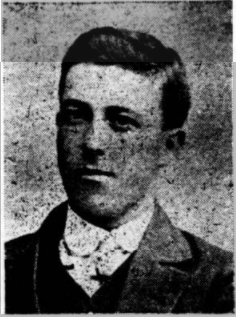
William Phillips (from britishnewspaperarchives.com)
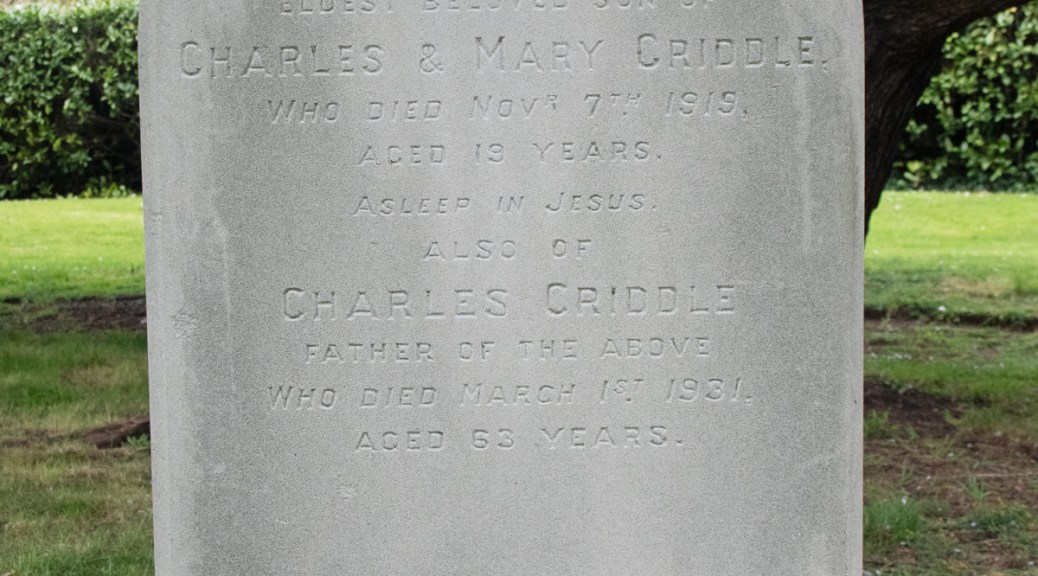
Charles Pretoria Criddle was born on 18th June 1900, the second of five children to Charles and Mary Criddle. Charles Sr was an army reservist, who worked as a labourer for the local council, and the family lived in Taunton, Somerset.
Sadly, little detail of Charles Jr’s life is documented. The Great War broke out when he was only 14, so was too young to enlist at the beginning of the conflict. However, he did volunteer, albeit later on, and joined the 15th Battalion of the Hampshire Regiment at some point in 1918.
Private Criddle’s was one of those lives to be cut tragically short, not by conflict, but by illness. He survived the war, but was subsequently admitted to a military hospital in Brighton, Sussex, where he passed away ‘from disease’ on 7th November 1919. He was just 19 years of age.
Charles Pretoria Criddle lies at rest in the St James Cemetery in his home town of Taunton, Somerset.
Tragedy was to strike again for Charles Criddle Sr. Less than a week after his son had passed, he was called upon to identify the body of his sister, Emma Cable. She had taken her own life after suffering an increasing number of fits over the previous few years.
Emma was a widow, and, since the previous winter, had become increasingly depressed and less physically able, having suffered a debilitating bout of influenza. Early on the morning of Sunday 16th November 1919, she took herself out, dressed in only her nightgown and a pair of boots, and had drowned herself in the River Tone.
At the inquest into her passing, her doctor noted that he had seen her on the previous Thursday “but her condition was not such that he could certify her as insane, but she had been violently hysterical.” [Taunton Courier and Western Advertiser: Wednesday 19th November 1919]
The Coroner recorded a verdict that the deceased drowned herself while of unsound mind.
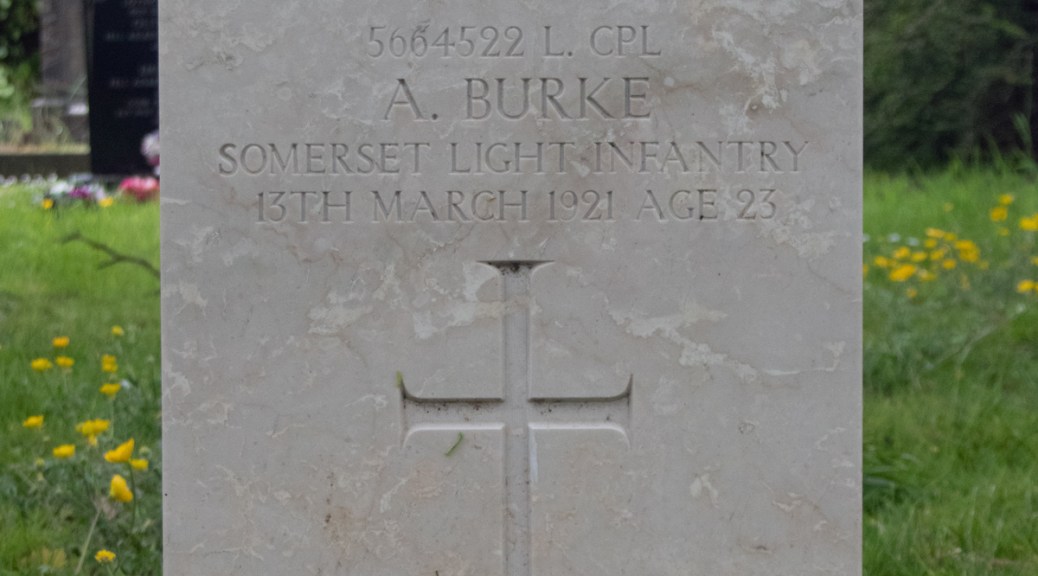
Sometimes, researching war graves can throw a bit of a curve ball, and the things you uncover can make you stop in your tracks. Such is the story surrounding Lance Corporal Albert Burke, and a media report surrounding his death in March 1921.
SCHEME OF VENGEANCE
Taunton Suicide’s Amazing Last Letter
Toll On Young Women
A sensational affair has occurred at Taunton Barracks. On Sunday morning, Albert (or Alfred James) Burke, aged 23, a Lance Corporal in the Somerset Light Infantry, was found to have taken his life by inhaling chloroform, his dead body being found on a bed at the military hospital, where he was employed as an orderly.
On Saturday night, according to the evidence, deceased appeared to be in his usual health and spirits. The next morning, a comrade found his dead body with a chloroform bottle by its side and near his face a large piece of cotton wool which he had evidently used for the purpose of inhaling the poison.
Some light was thrown on the tragedy by a letter addressed to a Taunton young woman, found on his clothing, and which was read at the inquest yesterday.
It was of an extraordinary character, and began “You wish to know what my intentions are in regard to you. Well, in the first place let me tell you I am not, as the coroner who holds the inquest will adjudge me, insane. In fact I don’t think I was ever so rational or level-minded as at the present moment, although I have had a glass or two.
“Well, Beatrice, mine is a rather long and interesting story. I married Louisa Wills some time in 1917, and I think the least said about her the better, but I wish to say this, that I have never knocked across a beast to equal her for violence. I am afraid the people around Brentford, Middlesex, could give you a far better account of her than I can.”
The writer went on to make certain allegations against the woman, and then referred to other towns where, he said, he had ruined girls before coming to Taunton and joining the Somerset Light Infantry. He added that he spent Friday night, when he was supposed to go out with Beatrice, with another girl in the barracks.
He said his father committed suicide owing to a “thing” who called herself a woman, and he (deceased) got a feeling with him that he would like to pay it back on a few girls. In conclusion, Burke expressed his satisfaction at knowing the condition Beatrice was in, and that he had been able to add another to the list of those on whom he wished to have his revenge.
Evidence was given by Alec Treeby, civilian orderly at the Barracks, who found deceased. In reply to the coroner, witness said that he knew the man was keeping company with a girl, but was not aware that there was any trouble about her.
PC Carter stated that the police had made enquiries, and a telephone message had been received that nothing was known of the man or of a wife and family of the name at Brentford…
[The] medical officer at Taunton Barracks said deceased was a steady, hard working man, and, so far as he knew, perfectly sane.
The jury returned a verdict of “suicide while of unsound mind”.
Western Times: Wednesday 16th March 1921
The newspaper report confirms the Lance Corporal’s name as either Albert or Alfred James Burke; the coroner also went on to say that he had also used the aliases of Povery and Pavey. Sadly, research around these names – and that of Louisa Wills – have either led to frustrating dead ends, or to results too vague to concretely connect them to Lance Corporal Burke.
The life and loves of Lance Corporal Burke are destined to remain a mystery. All that can be confirmed is that he took his own life on 13th March 1921; he was 23 years old.
Albert Burke lies at peace in St Mary’s Cemetery in Taunton, Somerset. He was accepted for commemoration as war dead on 27th May 2016 and was afforded a gravestone by the Commonwealth War Graves Commission.
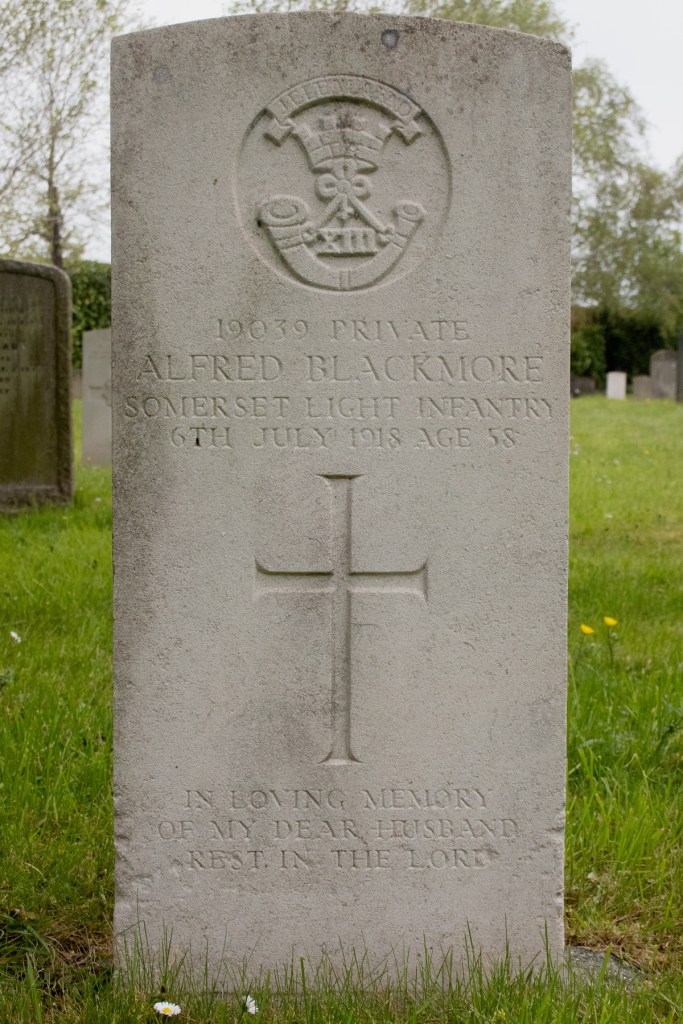
Alfred Blackmore was born on 25th October 1868 in the village of Thurlbear, near Taunton. Documentation varies and names cross over, but it appears that he was one numerous children to farm labourer William Blackmore and his wife, Mary Ann.
Details of Alfred’s early life are a bit hazy – again, in a rural location, names often cross over, so it is a challenge to totally confirm that they relate to the right person. His mother appears to have passed away by the time of the 1881 census, and Alfred was living with his father and three of his siblings and working as a farm hand.
Alfred again disappears off the radar for a while; in July 1894, he married Lucy Charlotte Yard, and the couple went on to have two daughters, Lucy and Beatrice. By 1901, the young family were living in the village of Frampton Cotterell, just to the north of Bristol, and Alfred had found employment as a marine fireman.
Ten years later, Lucy and the girls were still living in Frampton Cotterell, but Alfred was back in Taunton, lodging with a 75-year-old widow called Mary Croker and working as a labourer. This separation may have signalled the beginning of the end for the couple’s marriage.
War broke out, and it is evident that Alfred enlisted as a Private in the Somerset Light Infantry. Sadly, his service records are lost to time, but it appears that he served for at least three years.
The next time Alfred appears in documentation, it is a newspaper report on his passing, under the heading “Taunton Soldier’s Death”.
FOUND DROWNED AT BLACKBROOK
Mr F Foster Barham, coroner for West Somerset, held an inquest at the Blackbrook Inn, Ruishton, on Monday, relative to the death of Alfred Blackmore, aged 49, a private in the Labour Company at Taunton Barracks, whose body was found in the stream at Blackbrook on Saturday morning.
William Cozens, farmer… gave evidence of identification, and stated that on Friday he saw the deceased sitting by the hedge… about 400 yards from where the body was found.
William Richard Radnidge, butcher… stated that on Saturday morning he found the body in the stream dividing Ruishton from Taunton St Mary’s… His cap, belt and cape were on the bank. The deceased was lying face downward, his face and arms being in the mud below the surface.
PC Jenkins stated that at 10:45am on Saturday he received a communication from PC Wathen, in consequence of which he proceeded to Blackbrook, where he found the body lying under a hedge. He searched the body, and on it found a summons, returnable at Taunton on 29th June, for having failed to comply with a maintenance order obtained by his wife, Lucy Blackmore, on 25th September 1915, the sum of £2 13s [approx. £300 today] being due. On the back of the summons was written: “This is what my old cow has done for me.”
There was also the following letter: “When my body is found, don’t you give a farthing to my old cow. What I have got to come give to my brother, Edward Blackmore… Signed A Blackmore.” At the back of the letter was written: “Goodbye to all that I love.”
The deceased had left his lodging at nine a.m. on June 29th to attend the Taunton Police Court, but did not do so.
An officer stated that the deceased’s conduct during the three years he had been in the army had been satisfactory.
The Foreman of the jury said that according to the evidence they found that the deceased met with his death by drowning whilst temporarily insane.
Taunton Courier and Western Advertiser: Wednesday 10th July 1918
Alfred Blackmore took his own life on 6th July 1918. He was 49 years old [the war grave gives a different age].
Alfred lies at peace in St Mary’s Cemetery in Taunton, Somerset.
Frank Antell was born in 1880, one of seven children – six sons – to Thomas and Harriett Antell. Thomas was a groom, and Harriett a dressmaker and the family lived in the village of Martock in Somerset.
After Thomas died in 1893, Frank left school and became a carpenter. By the time of the 1901 census, he was living with his mother and youngest brother. Income seems to have been short – there were three other people boarding and lodging with the family.
In August 1904, Frank married Augusta Ring, and together they had five children – Lily, Ada, Leslie, Ronald and Freda.
Frank enlisted in the 13th (Works) Battalion of the Devonshire Regiment; this had been formed in the summer of 1916, so it can only be assumed that he was called up at the start. The battalion was based in Plymouth, so it is likely that Private Antell did not see fighting on the Western Front.
Private Frank Antell’s death is also a bit of a mystery. All that there is to confirm what happened is one stark sentence on his pension ledger:
Wounds self-inflicted during temporary insanity whilst on active service.
This one statement covers a multitude of sins, but does nothing to explain the mystery of what happened. There is no coverage of the incident or funeral in contemporary newspapers, so I have been unable to find any further explanation.
Frank Antell was a man with a young family. His regiment was based in England and was to be so for the duration of the war. One cannot imagine what thoughts were going through his head at the time he took his own life. That the 37 year old felt this was his only option is tragic.
Frank Antell lies at rest in the graveyard of All Saints’ Church in his home village of Martock in Somerset.
Frank’s widow Augusta went on to marry again in 1919, to a Joseph Maunder. She died in 1951 at the age of 73 years old.
When carrying out research on the Commonwealth War Graves, information remains tantalisingly elusive.
Sometimes just you can chance upon one document and the life of the person behind the name is laid out in front of you.
But in the majority of cases, the someone’s history has to be pieced together from a combination of sources.
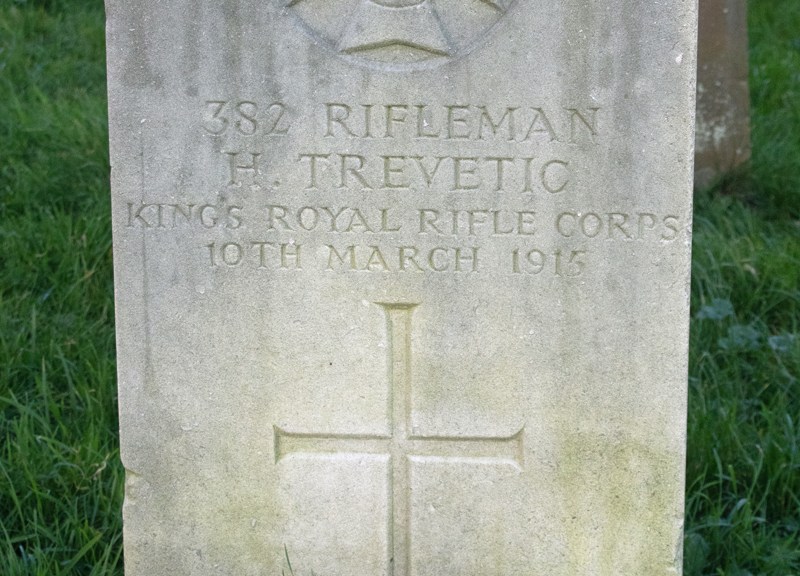
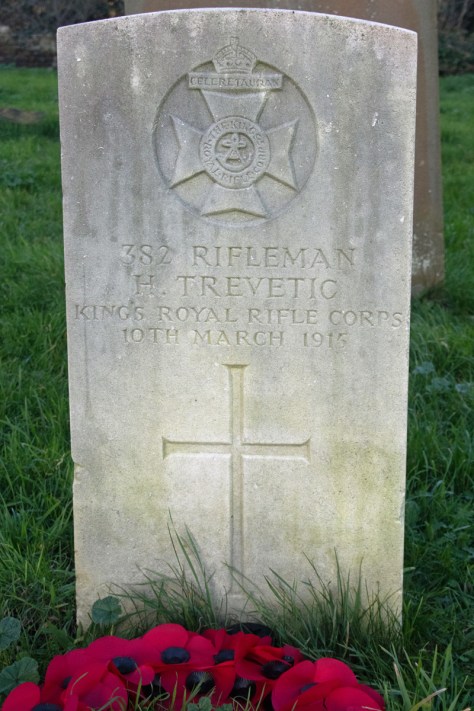
Henry Harry Trevitic was born in around 1879 in Burton-upon-Trent, Staffordshire.
There are no records of Trevetics in and around that area at that time, nor are there any permutations of his surname – Trevethick or Trevithick, for example.
The first evidence I have found of Harry is on his military service records. He enlisted in the King’s Royal Rifles in August 1897, listing himself as a ‘cycle fitter’. The document asks if the applicant has previously served in the armed forces; Harry’s reply is that he is in the militia – the 4th Worcestershire Regiment.
Rifleman Trevetic’s military career is extensive; his records show continual service in the King’s Royal Rifles from 1897 to his death in 1915. This included three years in South Africa, two in India and eight months as part of the British Expeditionary Force within weeks of the outbreak of World War One.
The 1901 census finds Rifleman Trevetic at a convalescent home in Hanbury, near Droitwich, along with eleven other soldiers. He is marked as a Visitor, rather than a Resident, so it can be assumed that the owner of the home, whose brother is party of the military party, has put them up for the night (or longer).
Harry next turns up in 1902 when, in December, he married Frances Boyes in Southampton. His military career continued, however, and moving to the 1911 census, and Rifleman Trevetic is barracked in Woolwich. He is listed as married, while Frances is also based in the town, in female quarters.
While the details of his early life are pretty scarce, those surrounding his passing are much more in depth. Because of the circumstances, an inquest into his passing was ordered into his death; this included four pretty in-depth witness statements.
In January 1914, Rifleman Trevetic was appointed as an assistant to Captain Adjutant Makins in Winchester. In August of that year he was shipped with Makins to France and remained his servant.
On 14th September, Captain Makins was badly injured, and Harry helped carry him to the church in the village of Soupir in France, which was acting as a dressing station.
In Makins’ own words “there were 300 wounded closely packed, occupying the whole of the floor space. The groans and the smell, night and day were most distressing. Fresh wounded were constantly being carried in and dead carried out. Shell fire was constant and the general conditions were such as would severely try a highly strung man. During all this time, [Rifleman Trevetic] was my only attendant.”
Makins was moved to various hospitals in France, always accompanied by Rifleman Trevetic and eventually invalided home. Given the seriousness of Captain Makins’ injury, he was permitted to bring Harry back home with him.
On 1st March 1915, Captain Makins was passed fit for general service, and rejoined his battalion, along with his servant. Conscious that he may be sent back to the Front at any point, he warned Harry to be prepared for France again.
Captain Makins’ testimony takes up the tragic story.
On March 9th, he came to me and asked if I would see the Doctor on his behalf privately. He told me that every since his time in the dressing station at Soupir, his nerves had been ajar, and that he could neither eat nor sleep. He asked whether I could get the Doctor to do something for him, as he feared if he went sick in the ordinary way, he would be passed unfit for the front, and be unable to accompany me there, which he was very keen on doing.
Later in the day he came to me and asked me to take no notice of what he had said in the morning, that as a matter of fact he had taken to drink, which was the true cause of his trouble, and that he was entirely giving it up and would be right within a week.
His whole manner was strange and he appeared under the impression that I had discharged him. This was the first intimation I had of any strangeness in his manner.
Being busy I did not pay the attention to it that perhaps I should, more especially as I knew him to be a thoroughly sober and reliable man.
The following day he called me as usual.
About 8:30 am I was called from the mess and asked to proceed to my room at once. On arrival, I found the door locked, and various Officers’ servants outside. The key was on the inside of the door but so turned that the body of Rifleman Trevetic could be seen through the keyhole lying on the floor.
I broke open the door and found Rifleman Trevetic shot through the heart, my revolver lying by his side. The revolver contained one empty shell, I cannot say where this was obtained. There were a few rounds of ammunition in the room, but the marks did not correspond nor am I able to trace any similar ammunition in the Fort.
Captain G Makins’ statement, Inquest from Rifleman Trevetic’s service records
Three other servicemen gave statements into the tragic events of that day, and all summed up Harry’s demeanour in the same way as Captain Makins.
Rifleman Trevetic has throughout his service to me, been a model servant, and had during my time in hospital not only been invaluable to me, but also to the hospitals themselves. He was very happily married, and constantly spoke affectionately of his wife and as far as I can tell, was in no financial difficulties.
Captain G Makins’ statement, Inquest from Rifleman Trevetic’s service records
The inquest found that his death was self-inflicted and “at the time he shot himself he was temporarily insane, and that his mental condition was clearly caused by what he saw and went through when on Active Service in France, and that there was no other contributory cause.”
Temporary insanity, shell shock, war neurosis, combat stress, cowardice; however it was badged Post Traumatic Stress Disorder is commonly recognised these days, but was frowned upon in the Great War.
Sadly, while appearing eager to accompany his superior, it seems that the thought of actually returning to the Western Front was so terrifying to Rifleman Trevetic, that he felt there was only one route out. He was 36 years old.
Harry Trevetic lies at rest in the quiet graveyard of St James’ Church on the Isle of Grain, metres from the fort where he ended his life.
Harry’s widow Frances lived on. Whilst there was no mention of her husband’s death in the newspapers of the time, she received a handsome war gratuity and a pension that reflected Harry’s long service. She went on to marry again in 1917, to Jack Finch, a Sergeant in Harry’s battalion.
Given the stigma around mental health in the early twentieth century, and, it is amazing that the documents have survived as part of the Harry’s military records. The inquest into his death was carried out within days of his passing, and I find the findings of the report forward thinking in the way that it was written.
Harry was obviously a man who experienced way more than his mind was able to cope with – the trauma of that dressing station must have been so much worse than he had seen before during his two decades’ military service. But the report is clear in that it apportions blame for his death on the fighting and bloodshed in France; this was clearly out of character for Harry, and it was his experiences in the field of battle that drove him to his death.
What is less clear is how much Frances was told of his death. While the inquest was decisive, suicide was as much of a stigma as shell shock at that time. Would the King’s Royal Rifles have be honest with her about how he died? Or, while they where internally open, would they have pulled ranks around their own and protected Frances from the truth and themselves from rebuke?










 Death and Service