Tag Archives: tragedy

Rifleman Ernest Parsons

Rifleman Ernest Parsons

Ernest Charles Parsons was born in 1881, and was one of six children to bricklayer Robert Parsons and his wife Mary Ann. Robert was a labourer and bricklayer from Watford, while Mary Ann was born in Arundel, West Sussex. The couple moved to where his work was, having their first children in Hertfordshire and Sussex They finally settled in London, which was where Ernest was born.

Where he first left school, Ernest worked as a painter, but soon found a career as a postman., something he would continue to do through to the outbreak of war.

Ernest married Frances Olive Eynott on 28th February 1904; they went on to have a daughter, Doris, the following year. It seems, however, that their marriage was destined to be a short one; Frances passed away within a couple of years.

With a daughter to raise and a living to earn, Ernest married again. Elizabeth Kate Dew was born in Fulham in 1883, and the couple married in the spring of 1907. Again, however, their happiness was to be short; Elizabeth died eighteen months later.

Widowed twice, and with Doris now a toddler, Ernest moved back in with his parents in Chiswick. He continued his work as a postman, but alongside this had been an active volunteer in the London Regiment (Post Office Rifles) since early 1908.

Rifleman Parsons’ initial year’s service was extended and extended and, by the time of the outbreak of the First World War, had been serving for some six years.

By 1914, Ernest had found love for a third time, and married Lilian Frances Cromie on 25th March that year. With war imminent, his time was take up more with military duties; while part of the territorial force, Rifleman Parsons had been officially mobilised.

The sudden intermingling of men from different parts of the country in small, packed training camps made the perfect environment for illness and disease to circulate. Ernest had initially contracted bronchitis while on service in 1912; this had dogged him intermittently oved the next few years until, in March 1915, it was serious enough for the Medical Examination Board to declare him unfit for military service.

Ernest moved his family to Worthing, in West Sussex, presumably as the air was fresher there than in the bustling capital. He may also had had family in the area, as his mother had been born just up the road in Arundel. Sadly, though, it seems that his health was not to recover sufficiently, and he passed away on 4th October 1918, at the age of 37.

Ernest Charles Parsons was buried in the Broadwater Cemetery in the town, not far from where his widow and daughter were then living.


Coincidentally, when researching another soldier, Lance Corporal Edgar Godden, this turns out to be the address where he also died, just ten months earlier on 22nd December 1917. There is no apparent other link between the two men.

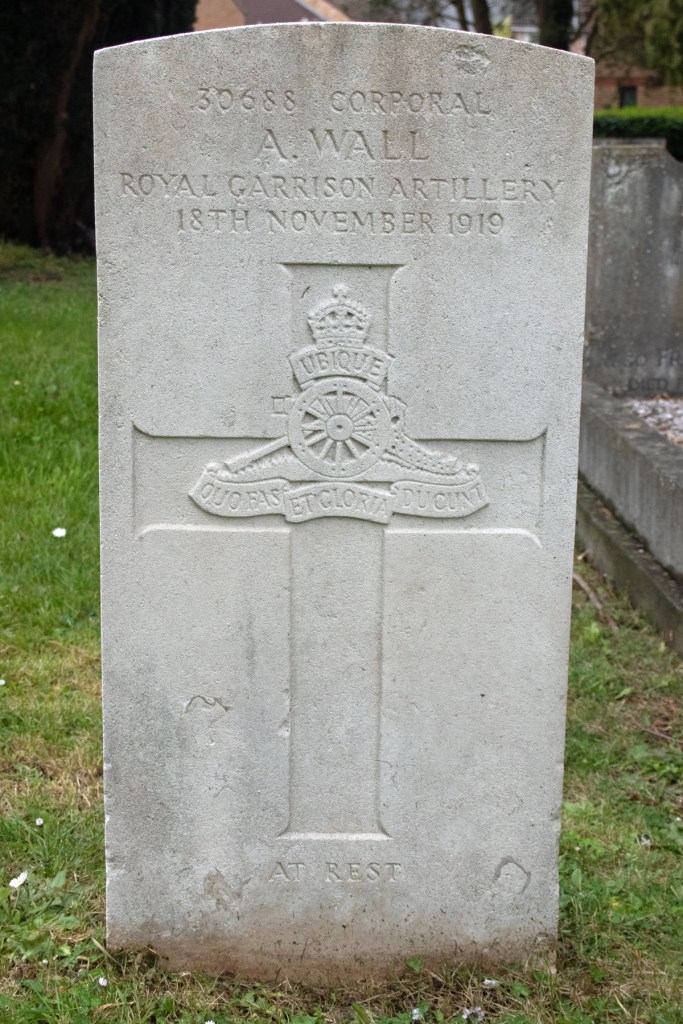
Corporal Albert Wall

Corporal Albert Wall

Albert Wall was born in the spring of 1890, one of eight children to James Wall and his wife Louise. James was a mason’s labourer from Taunton, Somerset, and brought his family up in his home town.

Details of Albert’s life are tantalisingly absent. It appears that he had a sense of adventure, and joined the Royal Garrison Artillery when his age allowed. By 1911, he was stationed at Port Royal in Jamaica, and was listed as a Gunner.

Gunner Wall’s involvement with the Royal Garrison Artillery extended into the Great War. He was sent to Egypt in April 1915, and, as part of his service, gained the Victory and British Medals and the 1915 Star. Albert seems to have been luck in that he saw out the war fairly unscathed, and was promoted to the rank of Corporal.

In the winter of 1918, Albert married Beatrice Salter. The war over, he was subsequently discharged from active service in April 1919.

Life on civvy street was not destined to be a long one, however, as, on 18th November 1919, he passed away from kidney disease. He was just 29 years of age.

Albert Wall was laid to rest in the St James Cemetery in his home town of Taunton.


As a sad footnote to this story, on 5th March 1920, Beatrice gave birth to a little boy, who she called Gordon. Albert was never to see his son.


Private Charles Criddle

Private Charles Criddle

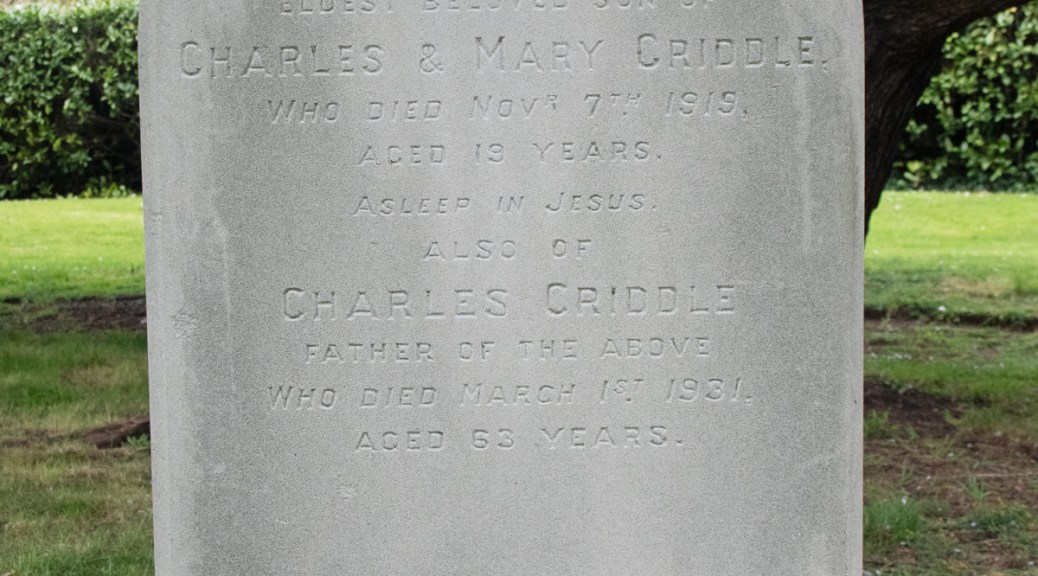
Charles Pretoria Criddle was born on 18th June 1900, the second of five children to Charles and Mary Criddle. Charles Sr was an army reservist, who worked as a labourer for the local council, and the family lived in Taunton, Somerset.

Sadly, little detail of Charles Jr’s life is documented. The Great War broke out when he was only 14, so was too young to enlist at the beginning of the conflict. However, he did volunteer, albeit later on, and joined the 15th Battalion of the Hampshire Regiment at some point in 1918.

Private Criddle’s was one of those lives to be cut tragically short, not by conflict, but by illness. He survived the war, but was subsequently admitted to a military hospital in Brighton, Sussex, where he passed away ‘from disease’ on 7th November 1919. He was just 19 years of age.

Charles Pretoria Criddle lies at rest in the St James Cemetery in his home town of Taunton, Somerset.


Tragedy was to strike again for Charles Criddle Sr. Less than a week after his son had passed, he was called upon to identify the body of his sister, Emma Cable. She had taken her own life after suffering an increasing number of fits over the previous few years.

Emma was a widow, and, since the previous winter, had become increasingly depressed and less physically able, having suffered a debilitating bout of influenza. Early on the morning of Sunday 16th November 1919, she took herself out, dressed in only her nightgown and a pair of boots, and had drowned herself in the River Tone.

At the inquest into her passing, her doctor noted that he had seen her on the previous Thursday “but her condition was not such that he could certify her as insane, but she had been violently hysterical.” [Taunton Courier and Western Advertiser: Wednesday 19th November 1919]

The Coroner recorded a verdict that the deceased drowned herself while of unsound mind.

Emma Cable was 52 years old.


Private Thomas Winter

Private Thomas Winter

Thomas Henry Winter was born in 1887, one of six children to James and Mary. James was a farmer, and the family lived in Milverton, in the Somerset countryside to the west of Taunton.

James died in 1900, and Thomas found his way into farm work as well. He met and married a local woman called Ada Thynne in February 1909, and the couple went on to have five children: Beatrice, James, Charles, Frank and Thomas.

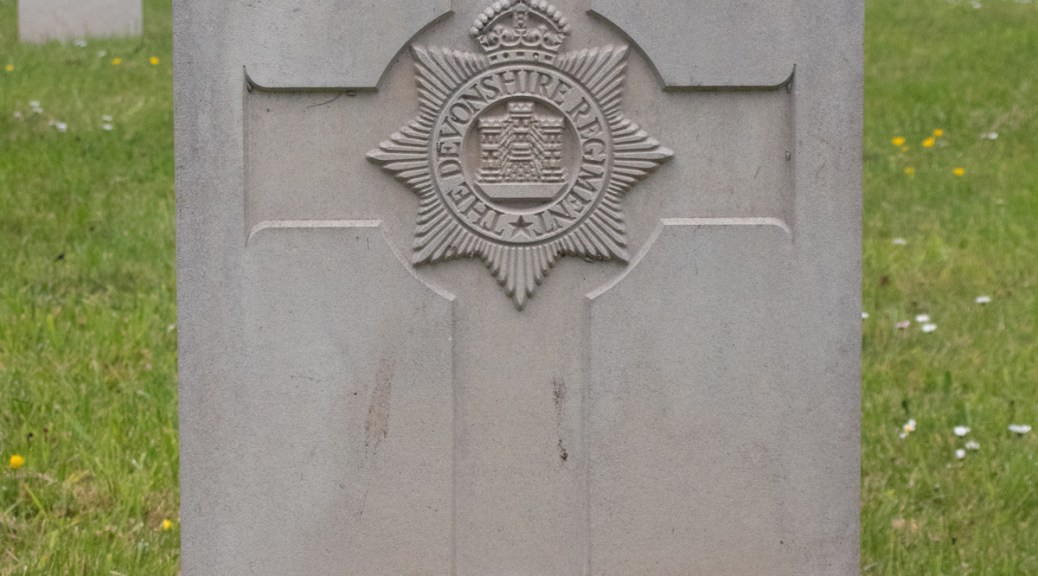
There is little confirmed information about Thomas’ military career. When he joined up, he enlisted in the 13th Battalion of the Devonshire Regiment, although, as his service records no longer exist, it is not possible to identify when this was.

Private Winter later transferred to the Labour Corps – again there are no records to confirm the dates – and this is the division in which he remained.

Illness was to dog Thomas, however; in early 1918, he contracted enteric fever (known nowadays as typhoid), and was hospitalised. Sadly, he succumbed to the disease, and passed away on 14th February 1918. He was 30 years of age.

Thomas Henry Winter lies at rest in St Mary’s Cemetery in Taunton, Somerset.


An additional tragic turn to Thomas’ story is that Ada was pregnant when he passed away. His youngest son, whom Ada named after him, would never know his father.


Lance Corporal Albert Burke

Lance Corporal Albert Burke

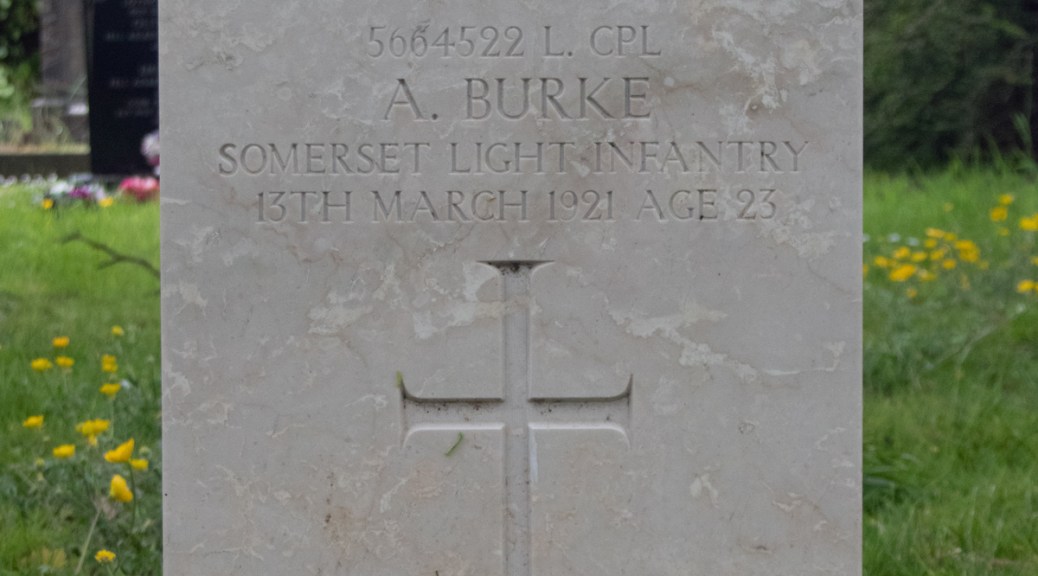
Sometimes, researching war graves can throw a bit of a curve ball, and the things you uncover can make you stop in your tracks. Such is the story surrounding Lance Corporal Albert Burke, and a media report surrounding his death in March 1921.


SCHEME OF VENGEANCE

Taunton Suicide’s Amazing Last Letter

Toll On Young Women

A sensational affair has occurred at Taunton Barracks. On Sunday morning, Albert (or Alfred James) Burke, aged 23, a Lance Corporal in the Somerset Light Infantry, was found to have taken his life by inhaling chloroform, his dead body being found on a bed at the military hospital, where he was employed as an orderly.

On Saturday night, according to the evidence, deceased appeared to be in his usual health and spirits. The next morning, a comrade found his dead body with a chloroform bottle by its side and near his face a large piece of cotton wool which he had evidently used for the purpose of inhaling the poison.

Some light was thrown on the tragedy by a letter addressed to a Taunton young woman, found on his clothing, and which was read at the inquest yesterday.

It was of an extraordinary character, and began “You wish to know what my intentions are in regard to you. Well, in the first place let me tell you I am not, as the coroner who holds the inquest will adjudge me, insane. In fact I don’t think I was ever so rational or level-minded as at the present moment, although I have had a glass or two.

“Well, Beatrice, mine is a rather long and interesting story. I married Louisa Wills some time in 1917, and I think the least said about her the better, but I wish to say this, that I have never knocked across a beast to equal her for violence. I am afraid the people around Brentford, Middlesex, could give you a far better account of her than I can.”

The writer went on to make certain allegations against the woman, and then referred to other towns where, he said, he had ruined girls before coming to Taunton and joining the Somerset Light Infantry. He added that he spent Friday night, when he was supposed to go out with Beatrice, with another girl in the barracks.

He said his father committed suicide owing to a “thing” who called herself a woman, and he (deceased) got a feeling with him that he would like to pay it back on a few girls. In conclusion, Burke expressed his satisfaction at knowing the condition Beatrice was in, and that he had been able to add another to the list of those on whom he wished to have his revenge.

Evidence was given by Alec Treeby, civilian orderly at the Barracks, who found deceased. In reply to the coroner, witness said that he knew the man was keeping company with a girl, but was not aware that there was any trouble about her.

PC Carter stated that the police had made enquiries, and a telephone message had been received that nothing was known of the man or of a wife and family of the name at Brentford…

[The] medical officer at Taunton Barracks said deceased was a steady, hard working man, and, so far as he knew, perfectly sane.

The jury returned a verdict of “suicide while of unsound mind”.

Western Times: Wednesday 16th March 1921

The newspaper report confirms the Lance Corporal’s name as either Albert or Alfred James Burke; the coroner also went on to say that he had also used the aliases of Povery and Pavey. Sadly, research around these names – and that of Louisa Wills – have either led to frustrating dead ends, or to results too vague to concretely connect them to Lance Corporal Burke.

The life and loves of Lance Corporal Burke are destined to remain a mystery. All that can be confirmed is that he took his own life on 13th March 1921; he was 23 years old.

Albert Burke lies at peace in St Mary’s Cemetery in Taunton, Somerset. He was accepted for commemoration as war dead on 27th May 2016 and was afforded a gravestone by the Commonwealth War Graves Commission.


Private Alfred Blackmore

Private Alfred Blackmore

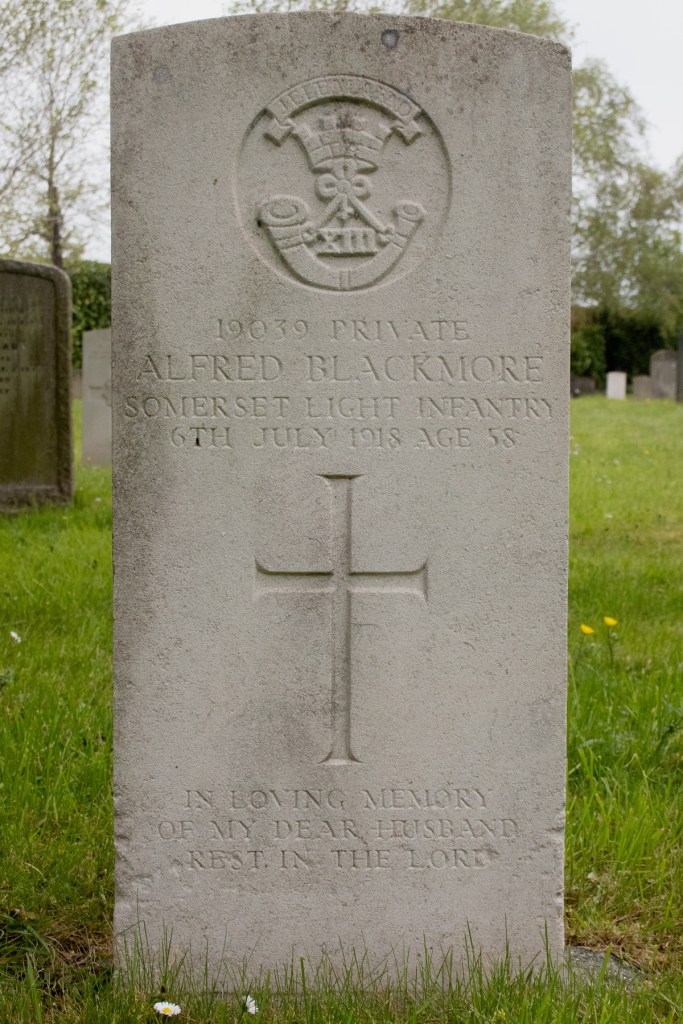
Alfred Blackmore was born on 25th October 1868 in the village of Thurlbear, near Taunton. Documentation varies and names cross over, but it appears that he was one numerous children to farm labourer William Blackmore and his wife, Mary Ann.

Details of Alfred’s early life are a bit hazy – again, in a rural location, names often cross over, so it is a challenge to totally confirm that they relate to the right person. His mother appears to have passed away by the time of the 1881 census, and Alfred was living with his father and three of his siblings and working as a farm hand.

Alfred again disappears off the radar for a while; in July 1894, he married Lucy Charlotte Yard, and the couple went on to have two daughters, Lucy and Beatrice. By 1901, the young family were living in the village of Frampton Cotterell, just to the north of Bristol, and Alfred had found employment as a marine fireman.

Ten years later, Lucy and the girls were still living in Frampton Cotterell, but Alfred was back in Taunton, lodging with a 75-year-old widow called Mary Croker and working as a labourer. This separation may have signalled the beginning of the end for the couple’s marriage.

War broke out, and it is evident that Alfred enlisted as a Private in the Somerset Light Infantry. Sadly, his service records are lost to time, but it appears that he served for at least three years.

The next time Alfred appears in documentation, it is a newspaper report on his passing, under the heading “Taunton Soldier’s Death”.

FOUND DROWNED AT BLACKBROOK

Mr F Foster Barham, coroner for West Somerset, held an inquest at the Blackbrook Inn, Ruishton, on Monday, relative to the death of Alfred Blackmore, aged 49, a private in the Labour Company at Taunton Barracks, whose body was found in the stream at Blackbrook on Saturday morning.

William Cozens, farmer… gave evidence of identification, and stated that on Friday he saw the deceased sitting by the hedge… about 400 yards from where the body was found.

William Richard Radnidge, butcher… stated that on Saturday morning he found the body in the stream dividing Ruishton from Taunton St Mary’s… His cap, belt and cape were on the bank. The deceased was lying face downward, his face and arms being in the mud below the surface.

PC Jenkins stated that at 10:45am on Saturday he received a communication from PC Wathen, in consequence of which he proceeded to Blackbrook, where he found the body lying under a hedge. He searched the body, and on it found a summons, returnable at Taunton on 29th June, for having failed to comply with a maintenance order obtained by his wife, Lucy Blackmore, on 25th September 1915, the sum of £2 13s [approx. £300 today] being due. On the back of the summons was written: “This is what my old cow has done for me.”

There was also the following letter: “When my body is found, don’t you give a farthing to my old cow. What I have got to come give to my brother, Edward Blackmore… Signed A Blackmore.” At the back of the letter was written: “Goodbye to all that I love.”

The deceased had left his lodging at nine a.m. on June 29th to attend the Taunton Police Court, but did not do so.

An officer stated that the deceased’s conduct during the three years he had been in the army had been satisfactory.

The Foreman of the jury said that according to the evidence they found that the deceased met with his death by drowning whilst temporarily insane.

Taunton Courier and Western Advertiser: Wednesday 10th July 1918

Alfred Blackmore took his own life on 6th July 1918. He was 49 years old [the war grave gives a different age].

Alfred lies at peace in St Mary’s Cemetery in Taunton, Somerset.


Private Thomas Grabham

Private Thomas Grabham

Thomas William Grabham was born in September 1883, one of six children to Thomas Richard Grabham and his wife Emma. Thomas Sr was a labourer and drayman for a brewery and the family lived in Taunton, Somerset.

When Thomas Jr left school, he found work as a grocer’s porter, before he too found work in a brewery, working as a maltster. He married a local woman, Maria Rowsell, and the couple went on to have a son, who they named after Thomas’ father.

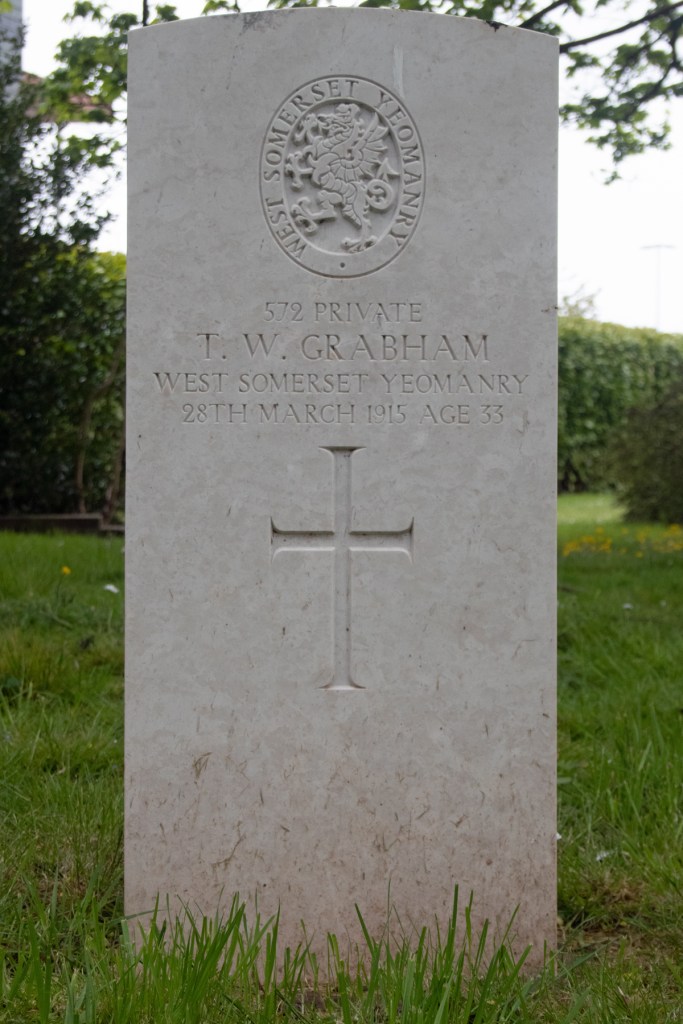
Details of Thomas’ military service are sketchy; he enlisted in the West Somerset Yeomanry, but there are no details of when this was.

Sadly, Private Grabham’s period of service was short; his pension records show that he passed away from a perforated gastric ulcer on 28th March 1915. He was just 32 years old.

Thomas William Grabham lies at peace in St Mary’s Cemetery in his home town of Taunton.


Sadly, the tragedy for the young Grabham family was not to end there. Maria, Thomas’ widow, died just five months after her husband.

Young Thomas was just eight years old when his parents died; he seems to have been brought up by a Mrs Kate Barnes, possibly a maternal aunt. Here, however, the family’s trail goes cold.


Sapper Percy Burleton

Sapper Percy Burleton

Percy Edward Burleton was born on 24th July 1885, the youngest of seven children to George and Lucy Burleton. George was a quarryman, and the family lived in the village of Draycott, near Wells in Somerset.

Percy’s older brother Lewis worked for the railways, and this is a trade that his younger sibling followed. By the time of the 1911 census he was living with his brother in Glastonbury and worked as a carman, delivering goods to and from the local station.

In February 1914, Percy appeared as a witness in an inquest about the death of a colleague, George Gillett. George had gone missing one night after the two had met for a drink in a local pub. The alert was raised when George’s coat was found hanging on a branch on the banks of the River Brue, to the south of the town; the waters were dredged and George’s body found.

At the inquest, Percy confirmed that the two men had had a drink in a local pub, and that George had seemed a little strange, but not the worse for drink. He reported that the deceased man had been quieter than usual at the railway stables for a week or so. George had left the pub at 10:55 that evening, and that was the last time that Percy had seen him.

Part of a carman’s duty was to collect money for the goods they had delivered; this was then paid to the station clerk on a daily basis. In the week leading up to his death, the stationmaster had been advised of some financial discrepancies, and on the day he drowned, he had been spoken to and advised the matter would be reported to the police if the missing amount was not paid back.

The place where George’s coat was found was not on his way home from the pub, and he would have had to have gone out of his way to get there. When considering their findings, the jury returned a verdict of suicide during temporary insanity, citing that the financial situation George had apparently gotten himself into.

When war broke out, Percy seemed to have been keen to get involved. Initially joining the Devonshire Regiment in September 1914, his experience with his job saw him transferred to the Railway Operating Division of the Royal Engineers.

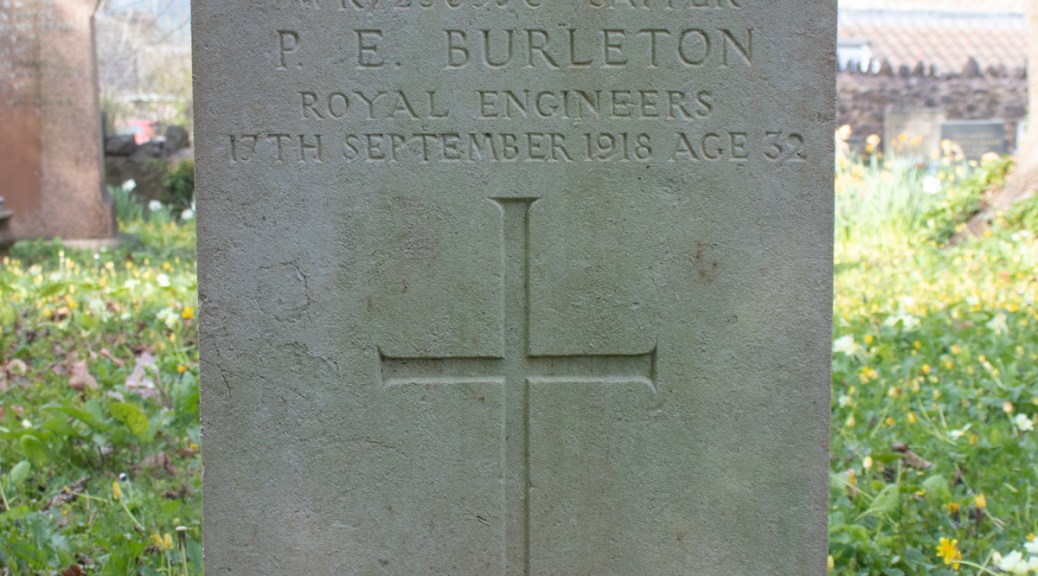
Shipped to France on 22nd September 1915, his service saw him awarded the Victory and British Medals and the 1915 Star. Sapper Burleton was moved to the Eastern Front and served in the Balkans for three years. According to the Central Somerset Gazette, which reported his passing, he contracted ‘a chill’ on the boat back to England and was admitted to Frensham Hill Hospital in Surrey.

Sadly, the chill seems to have been more severe than the report suggested, and Sapper Burleton passed away on 17th September 1918. He was 32 years old.

Percy Edward Burleton lies at rest in the graveyard of St Peter’s Church in his home village of Draycott, Somerset.


Private Walter Millard

Private Walter Millard

Walter John Millard was born in the summer of 1887, the youngest of nine children to Robert and Elizabeth. Robert was a farmer, and brought his family up in the village of Wedmore, Somerset. Walter followed in his father’s footsteps, and by the time of the 1911 census, was listed as a farm labourer in Wedmore, working for a William Millard, who presumably was a cousin of the family.

In March 1915, Walter married Jessy Masters, daughter of a grocer in nearby Wells. The couple set up home in the neighbouring village of Wookey, but would later make their home in Westbury-sub-Mendip.

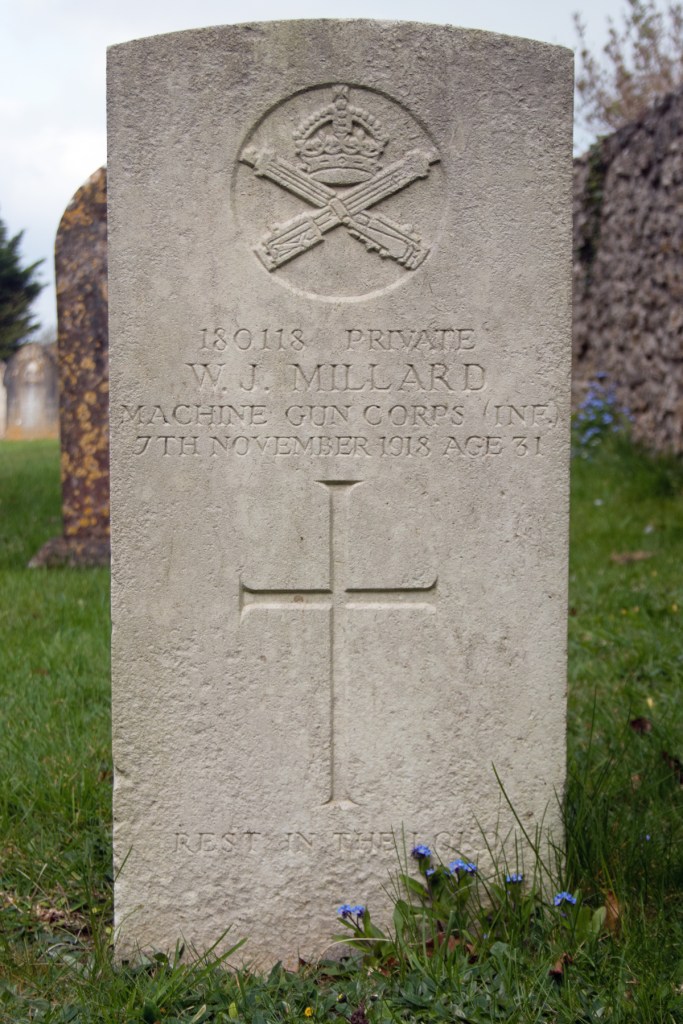
In December 1915, aged 28, Walter was called up, and assigned to the Reserve Machine Gun Corps. He was not formally mobilised for almost three years when, in October 1918, he was shipped to Rugeley, Staffordshire, for training.

During this time, Private Millard was taken ill, and was admitted to the Military Hospital at Cannock Chase within weeks with influenza. His health deteriorated and, on 7th November 1918, he died from pneumonia. He was 31 years of age.

Had it not been for the quirk of fate of having been mobilised a month before the war ended, tragically, this would likely not be a story that needed to be told.

Walter John Millard was brought back to Somerset, and lies at rest in the graveyard of St Lawrence Church in Westbury-sub-Mendip.


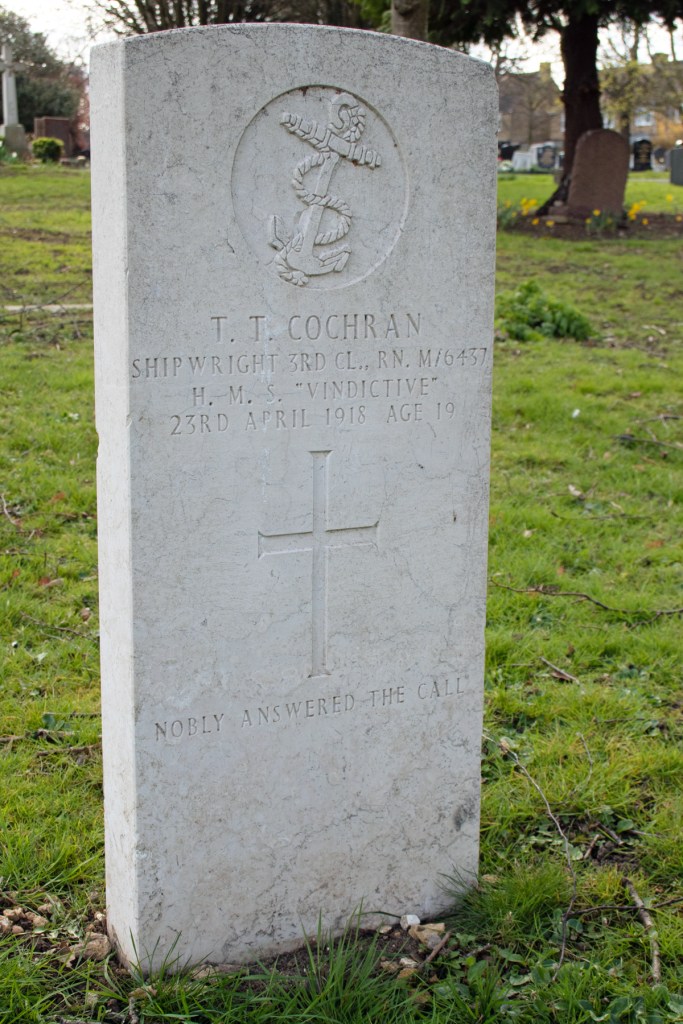
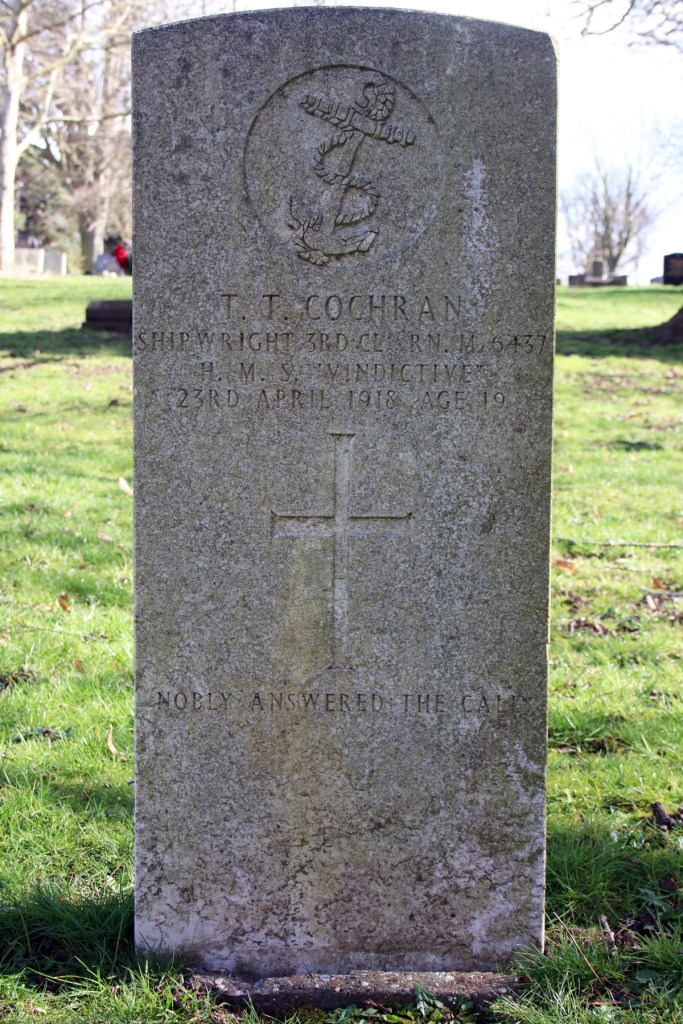
Shipwright 3rd Class Thomas Cochran

Shipwright Thomas Cochran

Thomas Tannahill Cochran was born on 28th February 1899, in Gillingham, Kent. He was one of nine children to Woodrow Cochran and his wife, Janet, née Tannahill. Woodrow was an engine fitter and both he and Janet were from Paisley in Scotland; they moved to Kent not long after getting married, presumably as Woodrow found work in the Naval Dockyard in Chatham.

Thomas followed his father and older brothers into the Navy, initially enlisting as a Boy Shipwright on 12th August 1913. He served most of his time at the local dockyard, before setting out to sea in March 1918.

At this point, Shipwright Cochran’s service records need a bit of translation. Tragedy certainly occurred, but the details are a bit disparate.

According his naval service records, Shipwright Cochran was aboard HMS Pembroke II when he was killed in action off the Belgian coast on 23rd April 1918. However, HMS Pembroke II was actually a land-based vessel in Kent.

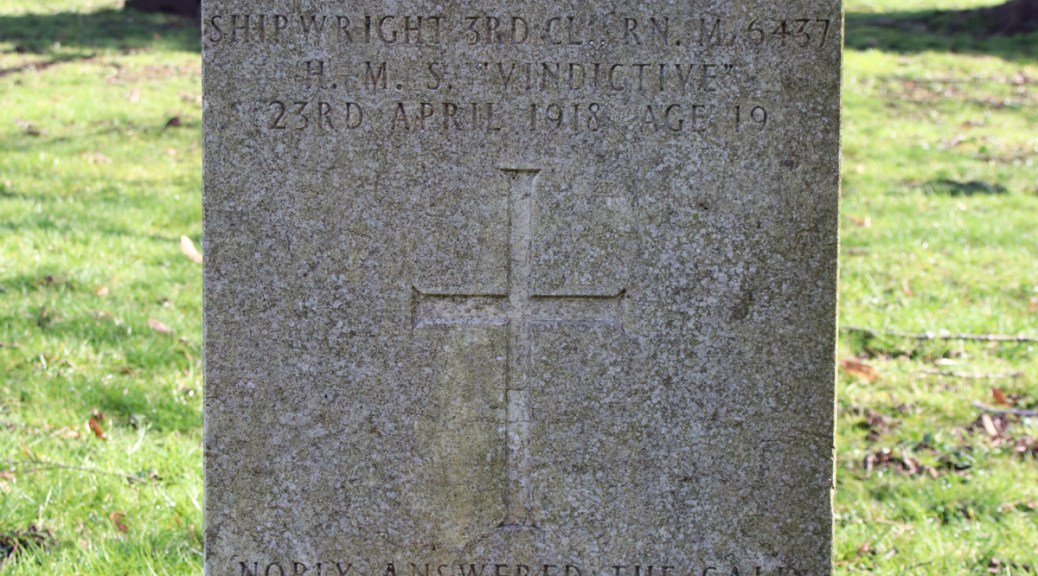
His gravestone, however suggested that he was assigned to another ship – HMS Vindictive. This was one of the vessels involved in the “Zeebrugge Raid”, an attempt by the Royal Navy to block the Belgian port by scuppering obsolete vessels in the canal entrance.

The Vindictive was to lead a diversion, drawing any attack away from the raid’s true target. However, bad weather blew the ship off course, which brought her within reach of enemy guns. Sadly, casualties were numerous, and Shipwright Cochran was one of those who fell in the German attack. He died on 23rd April 1918 at just 19 years old.

Thomas Tannahill Cochran’s body was recovered, and he lies at rest in the Woodlands Cemetery in his home town of Gillingham, Kent.


Shipwright Thomas Cochran