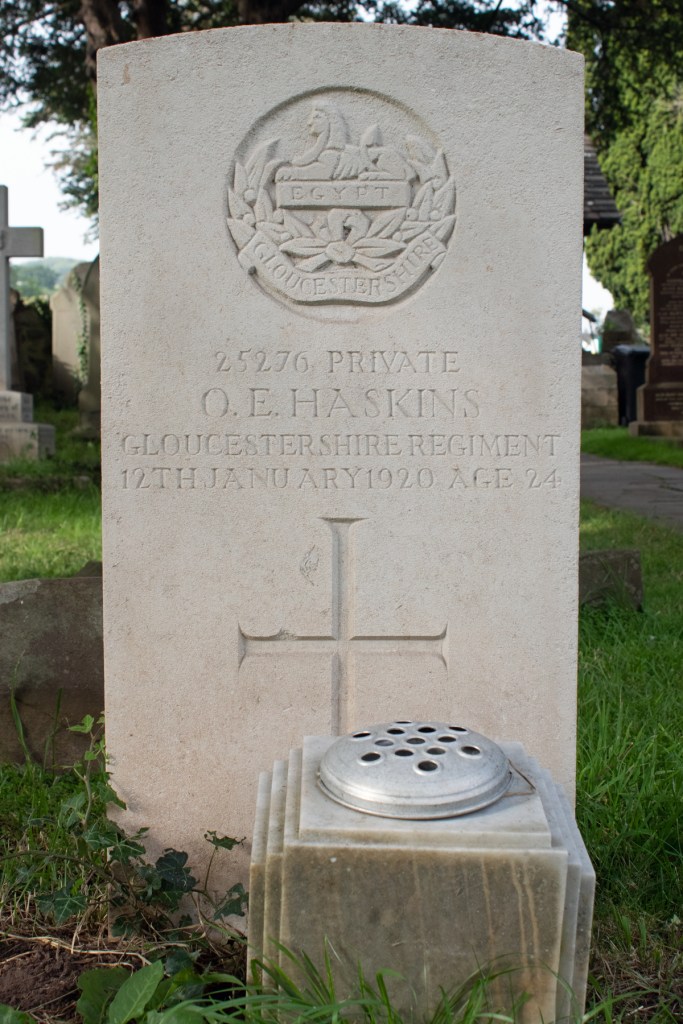
Oliver Edgar Haskins was born in 1896 in Portbury, Somerset. One of ten children, his parents were John and Hester Haskins. John was a gardener, and the 1911 census noted that Oliver was ‘working at home’, although no trade is listed.
When war came to Europe, Oliver stepped up to serve his King and Country, and was one of six Haskins brothers to fight in the conflict. He joined the Gloucestershire Regiment, and was initially assigned to the 15th (Reserve) Battalion. Based on home soil, his unit were barracked at Chiseldon Camp on the fringes of Salisbury Plain, Wiltshire.
At some point Private Haskins transferred to the Labour Corps, and became attached to the 207th Employment Company. It is not possible to identify exactly where he served, but he remained on home soil during the conflict.
The funeral took place at Portbury on Saturday of Mr Oliver Haskins… He was very popular in the village and at business, by virtue of his cheerful disposition and sterling qualities, and was beloved by everybody who came into contact with him. Mr Haskins was taken ill some ten days ago, and confined to his room, but he apparently made a quick recovery until Monday last, when he was suddenly taken worse and died in a few hours, at the age of 24.
Bristol Times and Mirror: Monday 19th January 1920
Oliver Edgar Haskins died on 12th January 1920. He was laid to rest in the once peaceful graveyard of St Mary’s Church in Portbury.
Harry Udall Gannett was born in the autumn of 1900, the second of four children to Charles and Clara. Charles was an agricultural labourer from Somerset, and it was here that the family were raised.
The 1901 census found Clara living with her brothers and two children in the village of Fivehead, while Charles was living and working just a few miles away in North Curry.
Charles passed away in 1906, aged just 48, leaving his widow to raise their now four children. The next census, in 1911, found Harry living in North Curry with his aunt and uncle, Francis and Emily Lee. Francis was noted as being a thatcher and hurdle maker. Harry’s mother was living elsewhere in the village with his three siblings. She was working as a farm labourer, while her brother, Russell, was also living there, helping support the family through his work, also as a hurdle maker.
Harry was keen to play his part when war broke out. His age initially prevented him from doing so, but he had enlisted by the late summer of 1918, joining the 53rd (Young Soldier) Battalion of the Devonshire Regiment. His service records are no longer available, but his unit was based at Rollestone Camp in Wiltshire, and this is likely where he was sent to be trained.
Little further information is available for Private Gannett. He contracted influenza while billeted in the cramped army barracks and died on 13th January 1919. He was just 18 years of age.
Harry Udall Gannett was brought back to Somerset for burial. He was laid to rest in the peaceful graveyard of St Peter & St Paul’s Church in North Curry. His headstone reads “our dear nephew”, and it is likely that is was paid for by Francis and Emily Lee, the relatives who had taken him in after his father’s death.
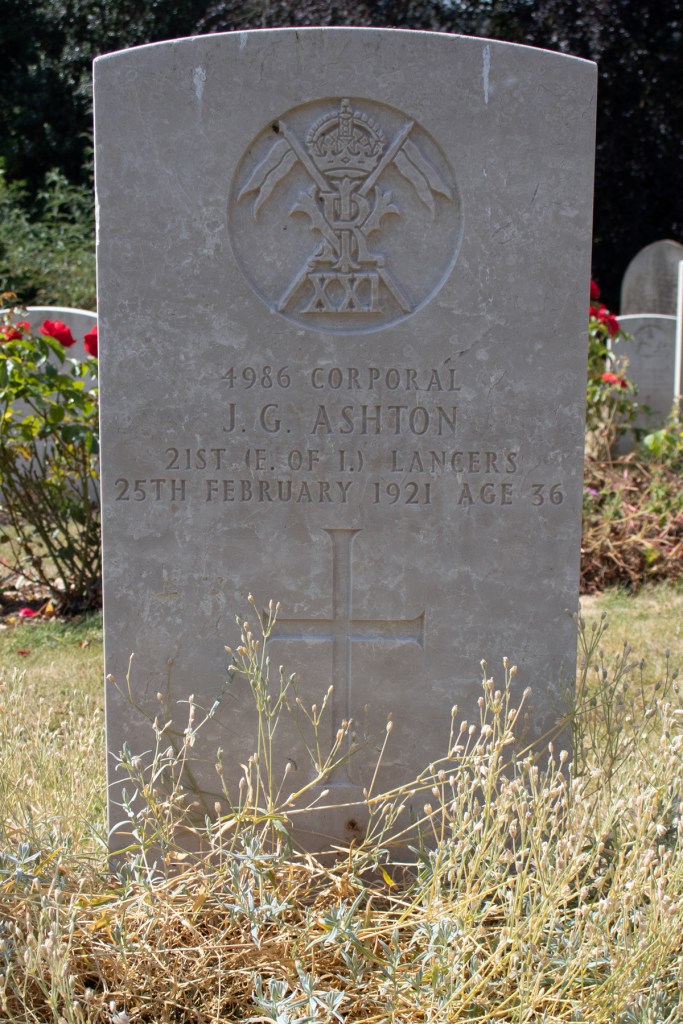
John Gordon Ashton was born at the start of 1885, and was one of at least two children to John and Elizabeth. Little information is available about his early life, although later records confirm that he was born in Newcastle-upon-Tyne, and that the family were living on Elswick Road, leading west out of the city, by 1900.
John found work as a musician, but sought a bigger and better career for himself. On 3rd October 1900, he enlisted in the army, joining the 21st (Empress of India’s) Lancers. His service records show that, at not yet sixteen years of age, he was just 5ft 1in (1.55m) tall, and weighed 101lbs (46kg). He had brown hair, grey eyes and a dark complexion, and two moles on the front of his left shoulder.
Private Ashton joined up for a period of 12 years’ service, and spent most of it on home soil. The army seemed to suit him, and he steadily rose through the ranks. By August 1901, John was promoted to Bandsman; five years later, he took the rank of Trumpeter; the start of 1908 brought with it a promotion to Lance Corporal.
In September 1910, John’s unit was sent to Egypt: the move brought him a further promotion. Corporal Ashton spent two years in Cairo, before returning to Britain in the autumn of 1912. He had completed his contract of service with the 21st Lancers, and was formally discharged from service on 4th October.
Back on civvy street, John once again found work as a musician. Life outside of the army seemed not to suit him, however, and he joined the reserve forces in March 1913. The now Lance Sergeant’s service records show the man he had become: he now stood 5ft 9ins (1.75m) tall, and bore a large oval scar on the underside of his right knee.
When war was declared the following summer, John was formally mobilised once more. He was attached to the 9th (Queen’s Royal) Lancers and, by 27th August 1914, was in France. Lance Sergeant Ashton’s time overseas was not to last long, however; he returned to Britain just before Christmas that year, and was based at Tidworth Camp in Wiltshire.
John’s military record was not without its hiccups. On 11th March 1910, while based in Canterbury, he was severely reprimanded for being in neglect of his duty whilst in charge of a barrack room. In 1915, however, he received a more severe punishment: on 23rd January, he was found guilty of using insubordinate language to his superior officer – in front of six ranking witnesses – and was demoted to Corporal.
It would seem that John’s health was beginning to suffer, and, after a career of nearly sixteen years, he was medically discharged from the army because of a heart condition.
At this point, his trail goes cold. He remained in the Wiltshire area, and seems to have been receiving ongoing medical treatment. At some point, he married a woman called Mary, although no other information is readily available for her.
Early in 1921, John was admitted to the Pensions Hospital in Bath, Somerset, having contracted pneumonia. He passed away there on 25th February following an aneurysm of the heart. He was 36 years of age.
John Gordon Ashton was laid to rest in the sweeping Locksbrook Cemetery in Bath.
Frederick Charles Witt was born on 19th June 1888 in Amesbury, Wiltshire. The second youngest of eight children, his parents were journeyman baker Richard Witt and his wife, Elizabeth.
By the time of the 1901 census, Richard had set up a bakery in North Tidworth, ten miles north-east of Amesbury, with Frederick’s older brother, Alfred, helping out. This was a line of work that Frederick was also to go into when he completed his schooling: the next census return, in 1911, noted him as being his father’s assistant.
On 26th December 1912, Frederick married a woman called Kate Howard. The marriage took place at St Luke’s Church, Enfield, Middlesex. Kate was living in Enfield at the time, while hew new husband was based in Southampton, Hampshire. How a connection was made between the two is unclear, but the couple settled back in Southampton, and went on to have two children: Ivy and Doris.
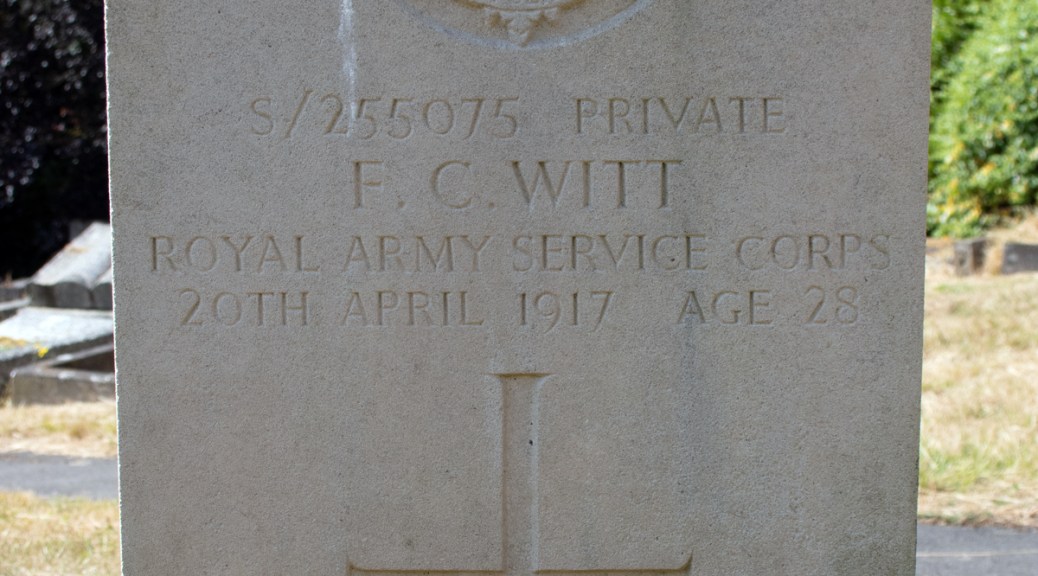
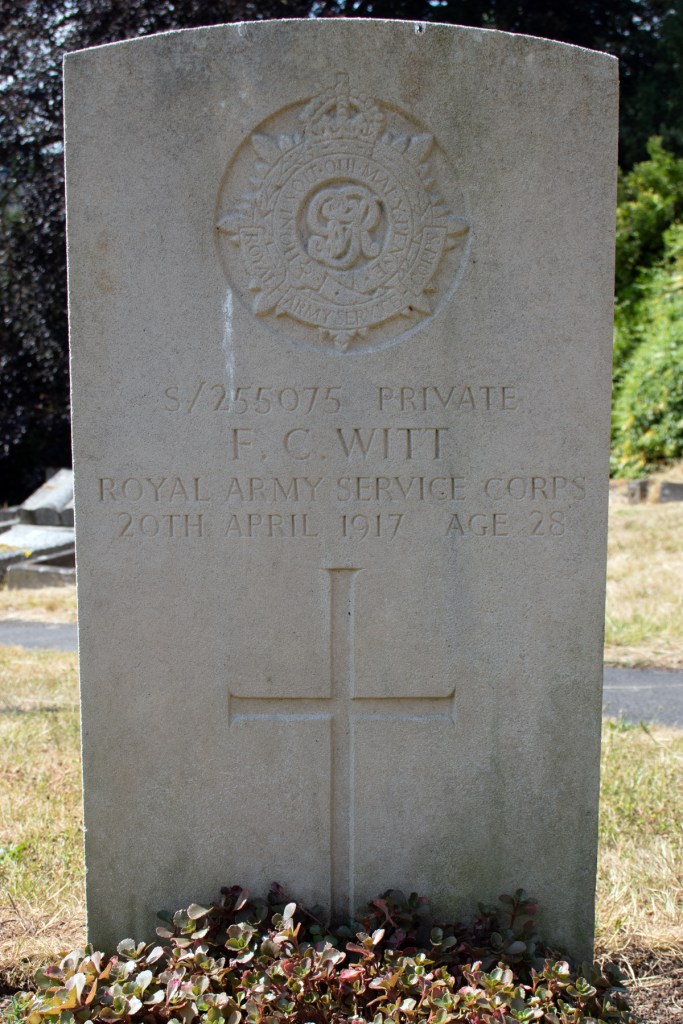
When war was declared, Frederick was called upon to play his part. Full details of his service are unclear, but he had joined the Royal Army Service Corps by the start of 1917. Private Witt was attached to the Reserve Supply Personal Depot in Bath, Somerset, but, soon after enlisting, he contracted pneumonia.
Frederick was admitted to the Bath War Hospital in April 1917, but the condition was to prove too severe. He passed away on 20th April, at the age of 28 years old.
Frederick Charles Witt was laid to rest in Bath’s sweeping Locksbrook Cemetery. Interestingly, a newspaper report of his funeral did not mention the attendance – or existence – of Kate or their children; instead his parents seemed to take centre stage.
Ephraim Alex Jacobs was born in the summer of 1883 in Birmingham, West Midlands and was the youngest child to Morris and Mary Jacobs. Morris was a tailor, but when he finished his schooling, Ephraim followed in his older brother’s trade, becoming a hairdresser.
This was not to prove a long-term career, however and, by the time of the 1911 census, things had changed. Ephraim, who now went by his middle name, had moved to Seend, near Melksham, Wiltshire. The document confirms that he had been married for four years by this point, although full details of his wife, the London-born Ethel, remain elusive. Alex was employed as a rubber worker in a factory in Melksham.
When war broke out, Alex stepped up to play his part. His service records no longer exist, but it seems that he enlisted in the Royal Army Service Corps, and was attached to one of the Mechanical Transport units. He seems not to have served overseas, and was demobbed on 14th September 1919. At this point Private Jacobs was suffering from neuritis, or nerve damage.
Alex’s trail goes cold at this point. He seems to have spent some time at the Pensioner’s Hospital in Bath, Somerset, and this is where, on 22nd December 1920, he passed away. The cause of his death was noted as being a cerebral tumour and asthma. He was 37 years of age.
With finances seemingly leaving Ethel unable to bring her late husband back to Wiltshire, Alex Ephraim Jacobs was instead laid to rest in the sweeping Locksbrook Cemetery, Bath.
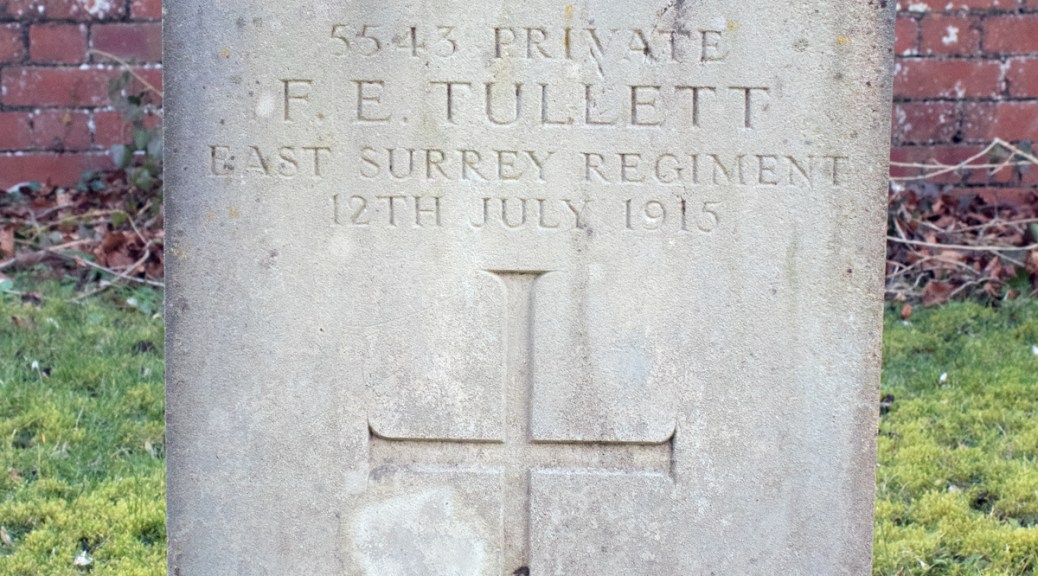
Frederick Edward Tullett was born in 1885 in Islington, Middlesex. The seventh of nine children, he was the fourth son of house painter John Tullett and his wife, Sarah.
When he completed his schooling, Frederick found work as an errand boy for a greengrocer. This appears to have been a trade he enjoyed: by the time of the 1911 census, he was employed as a greengrocer’s porter; while his marriage certificate records him as a fully-fledged grocer.
Frederick’s betrothed was Eliza Gundry, the daughter of a bricklayer from Wimbledon, Surrey. The ceremony was held on 18th April 1915 in the town’s All Saints’ Church. The couple were already living at 15 Dryden Road at this point.
It would appear that Frederick had already stepped up to serve his King and Country by the time of his marriage and, while his profession was listed as greengrocer, it may be that this was the job he continued while waiting to be formally mobilised.
Frederick had enlisted in the army by the start of 1915, and was assigned to the 8th (Service) Battalion of the East Surrey Regiment. The unit was based on Salisbury Plain, Wiltshire, and this is where Private Tullett would end up by that summer.
Crowded barracks were notorious as breeding grounds for infections diseases, and Frederick, sadly, was not to be immune. He contracted pneumonia, and was admitted to a military hospital in Codford. The condition was to prove his undoing: he passed away on 12th July 1915, at the age of 30 years old.
Finances may have prevented Eliza, who had been widowed after just 12 weeks of marriage, from bring her husband back home. Instead, Frederick Edward Tullett was laid to rest in the graveyard of St Peter’s Church in Codford, Wiltshire.
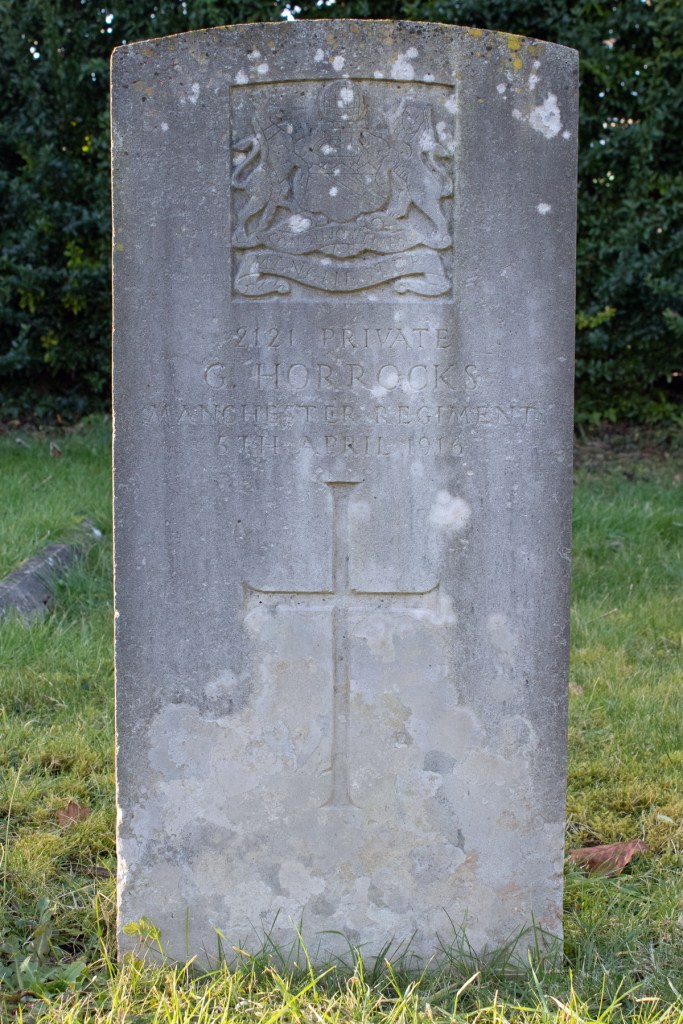
Granville Horrocks was born in Heywood, Lancashire in around 1872. His early life is difficult to piece together, but by the time of the 1901 census, he was living with his widowed mother, Jane Horrocks, and his wife of a year, Mary.
The family were living in Rock Street, Oldham, where Granville was working as a labourer in an ironworks. Mary was also working, and was employed as a cotton reeler in one of the local mills.
Granville and Mary went on to have five children – Mary, Lilian, Ellen, Wilfred and Jessie. The 1911 census records the family living in two rooms in Bloom Street, Oldham. Granville was employed as an iron turner in the local factory, while Mary remained at home to look after the house and the family.
Conflict broke out in Europe in the summer of 1914, and Granville opted to serve his King and his Country. Sadly, full details of his service are lost to time, but it is clear that he had enlisted in the Manchester Regiment by the autumn of 1915. Private Horrocks was assigned to the 10th Battalion, which saw active service at Gallipoli, and it is likely that Granville spent time in that part of the Mediterranean.
Private Horrocks’ army pension ledger provides details of his passing. The date was 5th April 1916, and the cause given was “suicide by drowning whilst of unsound mind due to disease contracted on [active service].” Little additional information is available about the incident and, surprisingly, there is nothing reported in contemporary newspapers.
Granville was based near Wylye, Wiltshire, when he took his life. He was around 44 years old at the time. Finances must have limited Mary’s options regarding his burial: rather than being taken back to Oldham, he was laid to rest in the peaceful graveyard of St Mary’s Church in the village where he passed.
Ivy Pretoria May Hibberd was born in the spring of 1900 in the Wiltshire village of Wylye. One of nine children, she was the daughter of bricklayer Edwin Hibberd and his wife, Elizabeth.
There is little information available about young Ivy’s life. She enlisted in the Women’s Royal Air Force on 14th October 1918, and was sent off to Handsworth College in Birmingham for training.
Member Hibberd’s time in service was to be tragically brief. Having contracted a combination of influenza and pneumonia, she died on 6th November 1918. She was just 18 years of age and passed away just over three weeks after signing up.
Ivy Pretoria May Hibberd’s body was taken back to Wiltshire for burial. She was laid to rest in the peaceful graveyard of St Mary’s Church in her home village, Wylye.
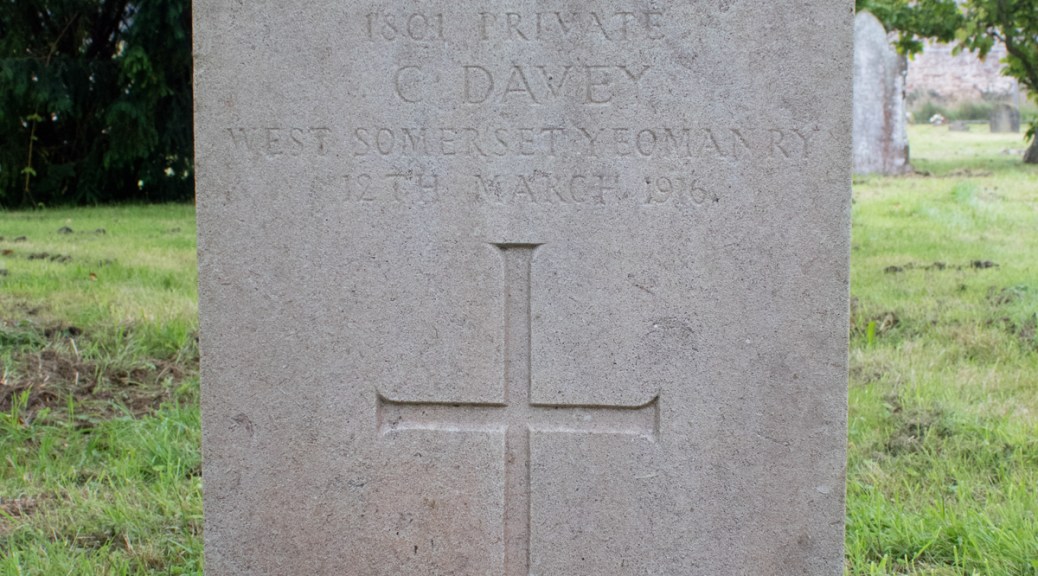
Charles Davey was born in Nether Stowey, Somerset, in the autumn of 1893. The second of six children, his parents were publican-turned-labourer Charles Davey and his wife, Mercy. The 1911 census found the family living in a four-roomed house, with Charles Sr and Jr and the younger Davey son, Walter, all employed in farm work.
When war came to Europe, Charles was called upon to play his part for King and Country. Sadly his service records have been lost to time, but it is clear that, by September 1915, he had enlisted in the West Somerset Yeomanry. Attached to the 3rd/1st Battalion, Private Davey would have been employed on home service. He was billeted at the Aliwal Barracks at Tidworth, Wiltshire.
The only other record relating to Private Davey is his entry in the Army Register of Soldiers’ Effects. This confirms that he passed away in Taunton, on 12th March 1916. The cause of his death is not recorded, but he just was 22 years of age.
The body of Charles Davey was taken back to Somerset for burial. He was laid to rest in the peaceful graveyard of St Mary’s Church in Nether Stowey.
Arthur Edward Devas was born in Devizes, Wiltshire, on 29th July 1877. One of ten children, his parents were Reverend Arthur Devas and Louisa. Arthur Sr was chaplain at the County House of Correction, the prison a short walk away from the family home, over the Kennet and Avon Canal. The 1881 census showed the Devas’ were living to the south of the town centre, and were supported by three servants.
Arthur standing as a vicar’s son earned him an education. He was sent to the prestigious Haileybury College in Hertfordshire. When his father died in 1901, he felt a pull to see more of the world, and joined the army. Enlisting in the Essex Regiment in September 1902, he was taken on as a Second Lieutenant.
Promoted to the rank of full Lieutenant in January 1906, the next census, in 1911, recorded Arthur at the Warley Barracks in Billericay. When war broke out in August 1914, he was based in Mauritius: he remained there for the next five months, before his battalion – the 1st – were brought back to England.
Setting up camp in Banbury, Oxfordshire, the aim was to train the battalion in readiness for an assault in Gallipoli. For Lieutenant Devas, however, this was not to be. He had fallen ill on the journey back to Blighty and, having contracted typhoid, he was admitted to the 3rd Southern General Hospital in Oxford. He died at the hospital on 15th February 1915, at the age of 37 years old.
Louisa and some of her children had moved to Minehead, Somerset, after her husband’s death, and this is where Arthur Edward Devas’ body was brought for burial. He was laid to rest in the extensive Minehead Cemetery, to be reunited with his mother when she passed away some eighteen years later.












 Death and Service