Category Archives: story

Lieutenant Colonel Thomas Bingham Day

Lieutenant Colonel Thomas Bingham-Day

Thomas Hulkes Bingham Day was born on 2nd January 1855 in Frindsbury, Kent. The youngest of four children, his parents were Thomas and Emma Day. Thomas Sr was a banker and a justice of the peace. He died when his youngest was just a child, and Emma was left to raise the family, albeit with the help of five servants.

Thomas sought out a life in the military. After volunteering in the local militia, for a number of years, he gained a commission in the Dorsetshire Regiment. He took on the role of Lieutenant on 29th November 1876.

Over the next two decades, Thomas served around the world, spending time in Malta, Gibraltar, and the East Indies. He was also promoted through the ranks, rising to Captain in 1883 and Major in 1893.

On 25th March 1884, while serving in India, Thomas married Katharine Watts. The couple had a daughter, Winifred, who was born in July 1885, and, eventually they settled in Wiltshire as their base in Britain.

Major Bingham Day served in South Africa during the Boer War, taking part “in the operations at Parde Kraal, and in the operations at Poplar Grove… Vet River, Zand River, Johannesberg and Pretoria. He had the Queen’s and the King’s medals with five bars.” [Lincoln Leader and County Advertiser – Saturday 28 April 1917]

Thomas retired in 1903, and his trail goes cold until the time of the 1911 census. He and Katherine were on holiday when it was taken, and they were listed as boarding at the Beach Lodge on Roseville Street in St Helier, Jersey.

When war broke out, Thomas stepped up to play his part once more. He was put in charge of the 4th (Reserve) Battalion of the Devonshire Regiment, which was based at Sutton Veny in Wiltshire. It seems that he lived off site, as he and Katherine moved into a house in nearby Warminster.

A military funeral took place… on Monday, when Lieutenant-Colonel TH Bingham-Day, in command of a regiment at Sutton Veny, was laid to rest in the churchyard. The deceased officer died suddenly while at mess, as the result of a seizure.

[Devizes and Wilts Advertiser: Thursday 19th April 1917]

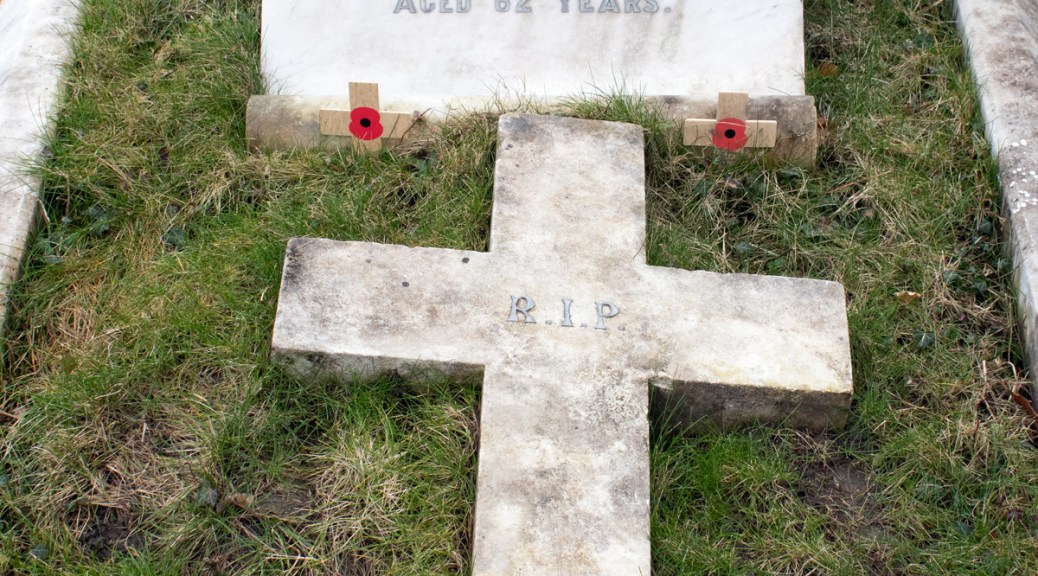
Lieutenant Colonel Thomas Hulkes Bingham Day was 62 years of age when he passed away on 11th April 1917. He was laid to rest in the graveyard of St Aldhelm’s Church in Bishopstrow, Wiltshire, not far from the base at which he had so dutifully served.

Corporal James Davies

Corporal James Davies

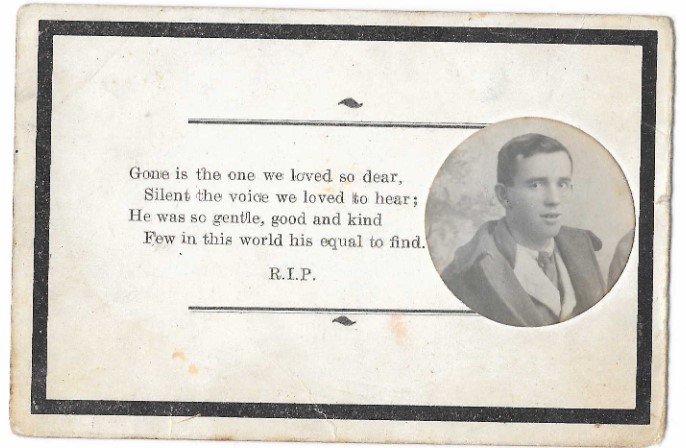
James Lloyd Davies was born in Dyffryn, Llanwnda, Pembrokeshire, early in 1897. One of six children, his parents were Hugh and Margaret Davies. Hugh was a farm worker, but when he died in 1907, Margaret was left to raise the family on her own.

The 1911 census found the family living in a 4-roomed house on Cross Street. Margaret had found work as a charwoman, while James was employed as a butcher’s errand boy. His three younger siblings were still at school.

When war broke out, James stepped up to play his part. He enlisted in the Royal Garrison Artillery, but from here on in his trail goes cold. All that can be confirmed is that he had risen to the rank of Corporal by the end of the conflict.

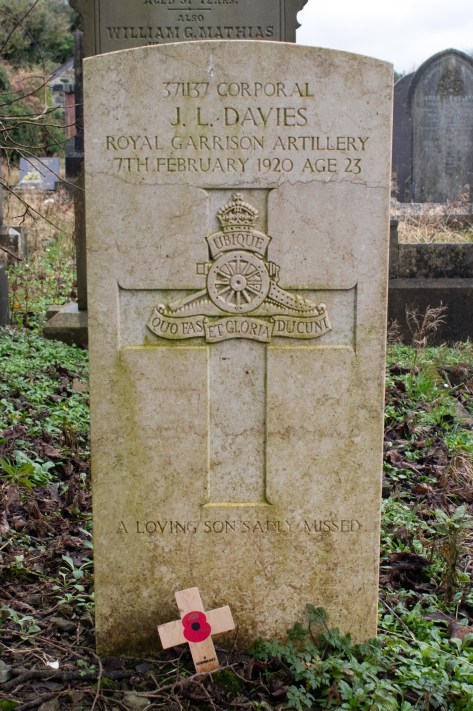
James Lloyd Davies returned home after the war, and passed away on 7th February 1920. He was 23 years of age. He was laid to rest in the Hermon Baptist Burial Ground in Fishguard, Pembrokeshire.


James was only accepted for commemoration as war dead in 2012. It was at this point that the Commonwealth War Graves Commission erected a headstone in his honour.


Corporal Tom Morse

Serjeant Tom Morse

Thomas Morse was born in St Nicholas, Pembrokeshire, in the summer of 1885. One of thirteen children, his parents were Thomas and Mary Morse. Thomas Sr was an agricultural labourer, but when he completed his schooling, his son found work as a mason and, by the time of the 1911 census, he was boarding with his older sister Maria and her family.

When war broke out, Thomas Jr – who was better known as Tom – stepped up to play his part. Full details about his service have been lost to time, but it is clear that he enlisted in the Royal Army Service Corps. It is unclear whether he spent any time overseas, but towards the end of the war, he found himself based in Essex in the Mechanical Transport Division.

In the autumn of 1918, Tom, who had risen to the rank of Acting Corporal, fell ill. He came down with pneumonia, and was admitted to Colchester Hospital. The condition would prove fatal, and he passed away on 26th October 1918: he was 33 years of age.

The body of Thomas “Tom” Morse was brought back to Pembrokeshire for burial. He was laid to rest in the Hermon Baptist Burial Ground in Fishguard.


Intriguingly, the Commonwealth War Graves Commission have Tom’s rank as Serjeant. What remains of his service papers, however, all suggest he was an Acting Corporal.

Equally intriguing are the details of Tom’s dependents. His entry on the Army Register of Soldiers’ Effects gives his father, Thomas Sr, as his beneficiary. His Dependents’ Pension Record, however, gives his mother, Mary, and Miss M Nicholas, who is listed as the guardian of his illegitimate child. There no further information on them.


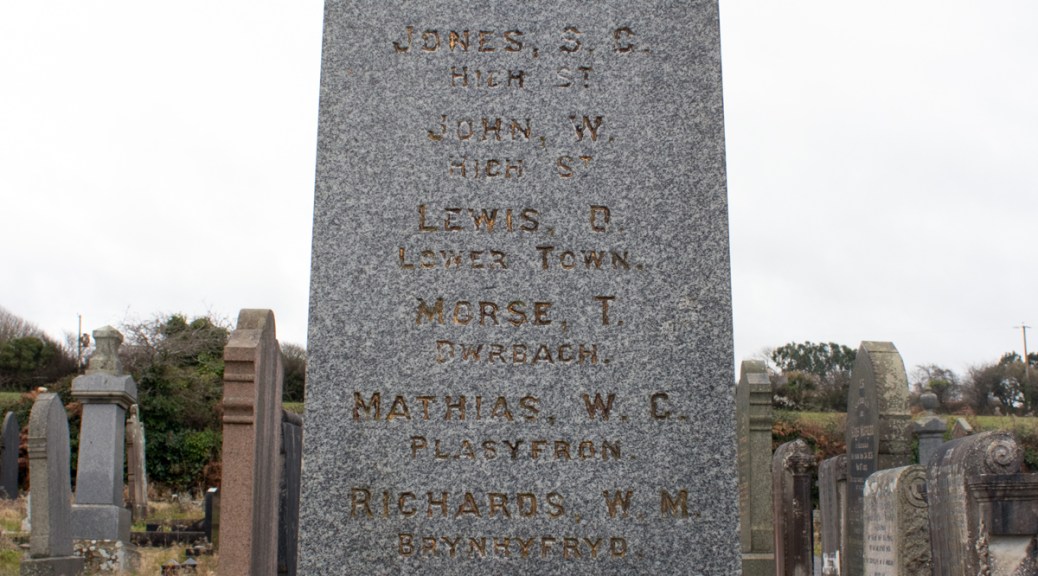
Private William Mathias

FishguPrivate William Mathias

William George Mathias was born in the Pembrokeshire village of Littleston early in 1885. The oldest of five children, his parents were John and Sarah Mathias. John was a farm worker, but when he finished his schooling William found work as a rabbit trapper. This meant a move from home, and the 1901 census found him as a servant for the Evans family, in nearby Mathry.

Agricultural work was not employment that William wanted to dedicate his life to, and he soon found a new opportunity. He took a job as a police constable in Glamorganshire. There is little information about this part of his life, but the 1911 census recorded him as being one of 26 police officers boarding in the village of Gilfach Goch. Interestingly the census includes the annotation “The above are police quartered at the Ogmore Arms, Gilfach Goch, temporarily during the coal strike.”

The Miner’s Strike of 1910/11 resulted in the temporary closure of South Wales mines. Police were shipped in, but this only resulted in riots breaking out. In November 1910 disorder broke out in Tonypandy, Pontypridd and Gilfach Goch, amongst other locations. Nearly 80 police and more than 500 civilians were injured, although the exact number of miners wounded is unclear, as many refused to seek medical treatment for fear of being singled out.

As the strike moved into 1911, the army was called in, with four detachments of the Somerset Light Infantry being called into Penygraig, Llwynpia, Clydach Vale and Gilfach Goch. Stones were thrown by the rioters, and a number of William’s police colleagues were injured: thirteen of the Gilfach miners were arrested and prosecuted for their involvement in the unrest.

The decision to send troops in was contentious, and anger became directed at the then Home Secretary, Winston Churchill, for the decisions he took. Ultimately, the miners were defeated, their calls for better living conditions and higher wages went unanswered.

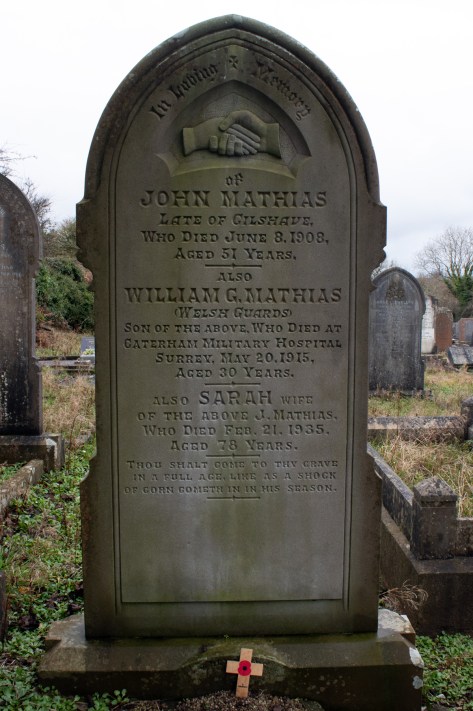
William continued in the police force until war broke out. His time in the army is lost to history, but it is clear that he enlisted in the Welsh Guards as a Private. Sent to Caterham, Surrey, for his training, his time serving King and Country was not to be a lengthy one. In May 1915 he was admitted to a military hospital, though the cause is not clear. He passed away on 20th May 1915: he was 30 years of age.

The body of William George Mathias was taken back to Pembrokeshire for burial. He was laid to rest in Fishguard’s Hernon Baptist Burial Ground.


Private William Mathias
(from findagrave.com)

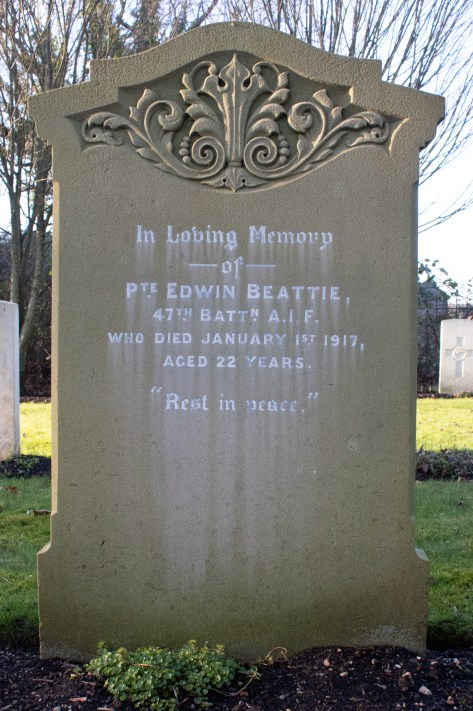
Private Edwin Beattie

Private Edwin Beattie

Edwin Beattie was born on 14th March 1894, in the town of Coomera, Queensland, Australia. He was the youngest of three children to John and Mary Beattie.

There is little information available about Edwin’s early life, but when he completed his schooling, he took up farm work. When war broke out, he was keen to play his part, and enlisted in the Australian Imperial Force on 28th March 1916.

Private Beattie’s service records show that he was 5ft 9.5ins (1.65m) tall, and weighed 136lbs (61.7kg). A Methodist, he was recorded as having brown hair, blue eyes and a medium complexion. He also had a birthmark on the small of his back, and scars on both knees.

Edwin was assigned to the 44th Battalion of the Australian Infantry. His After training, his unit boarded the SS Seang Choon in Brisbane, and set off on the ten month voyage to Britain, arriving in Devonport, Devon, on the 9th December 1916.

During the voyage, Private Beattie had fallen ill, and, on disembarking, he was taken to the local hospital for treatment. By 23rd December, he was moved to the Military Hospital connected to the ANZAC camp in Codford, Wiltshire. His condition – pneumonia – worsened over the coming days, and Edwin would eventually succumb. As a new year began, he breathed his last, passing away on 1st January 1917, at the age of just 22 years of age.

Thousand of miles from home, Edwin Beattie was laid to rest in the newly extended graveyard of St Mary’s Church, Codford.


Private Edwin Beattie
(from findagrave.com)

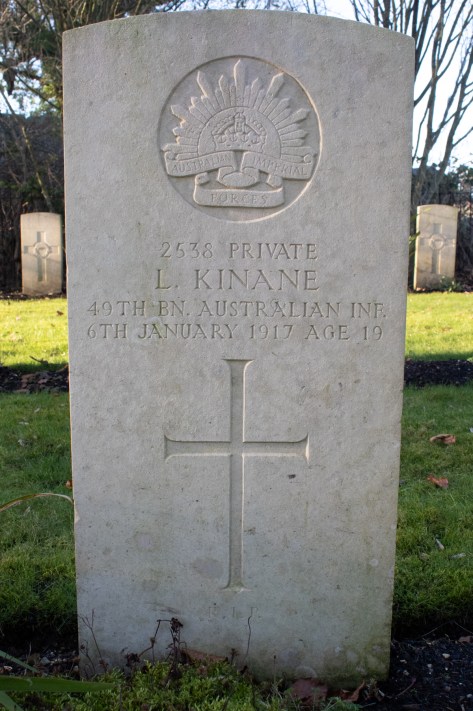
Private Lawrence Kinane

Private Lawrence Kinane

Lawrence Kinane was born in Tipperary, Ireland, in 1896. One of eight children, his parents were Daniel and Catherine Kinane. Daniel was a farmer and, when Catherine died when Lawrence was just 10 years old, he was left to raise the support the family on his own.

At this point, the family’s trail goes cold, and it later picked up in an unexpected way. Daniel and some of the children seem to have emigrated to the United States, and he died in Brooklyn in March 1914. Lawrence, meanwhile, seems to have gone further, seeking a new life in Australia. A cousin, Mary Mulcahey, was living with her husband in Warwick, Queensland, and, by the time war broke out, he had moved to Brisbane.

Lawrence was working as a labourer when, on 10th June 1916, he enlisted in the Australian Imperial Force. His service papers show that he was 5ft 11ins (1.8m) tall and weighed 147lbs (66.7kg). A Roman Catholic, he had dark brown hair, grey eyes and a medium complexion. Under Distinctive Marks, he was recorded as having a large patch of scars on his left side, about 7ins (18cm) above his buttock.

Private Kinane’s unit – the 49th Battalion of the Australian Infantry – set sail from Brisbane on the 19th September 1916. His ship – the SS Seang Choon – would take ten weeks to reach its destination – Devonport, Devon, and Lawrence finally arrived at the ANZAC base in Codford, Wiltshire in mid-December.

The lengthy sea voyage had taken its toll on a lot of the soldiers being transported, and Private Kinane was not to be immune. Within weeks of arriving, he came down with pneumonia, and was admitted to the No. 3 New Zealand General Hospital in nearby Sutton Veny on 31st December. Lawrence’s condition worsened, and he finally succumbed to it on 6th January 1917. He was just 20 years of age.

Thousands of miles from Australia, and with no family close by, the body of Lawrence Kinane was instead laid to rest in the graveyard of St Mary’s Church in Codford, not far from the base that had been his home for just a few short weeks.


Private Lawrence Kinane
(from findagrave.com)

Driver David McGregor

Driver David McGregor

David Edward McGregor was born in Bega, New South Wales, Australia, in the summer of 1880. One of fourteen children, his parents were John and Isabella McGregor.

There is little information about David’s early life, but when he completed his schooling, he found work in a dairy, eventually becoming employed as a cheesemaker.

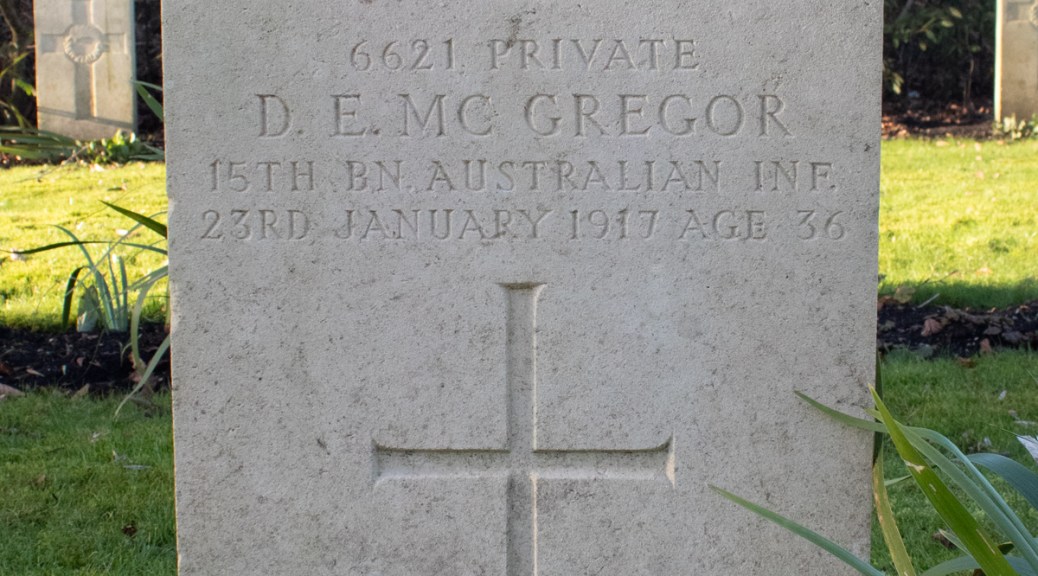
When war broke out, David stepped up to serve his King and Empire, enlisting in the Australian Imperial Force as a Driver on 7th July 1916. His service records show that he was 5ft 10.5ins (1.79m) tall and weighed in at 168lbs (76.2kg). A Presbyterian, he was noted as having black hair, brown eyes and a medium complexion.

Driver McGregor’s unit – the 15th Battalion of the Australian Infantry – set sail from Brisbane on the SS Boonah on 21st October 1916. Their journey would take ten weeks, arriving in Devonport, Devon, on 10th January 1917. From here David was marched in to the ANZAC camp at Codford, Wiltshire.

The lengthy sea voyage had taken its toll on a lot of the troops, and David was not to be immune. He came down with pneumonia and, after initially being treated in the camp hospital, he was admitted to the military hospital in Codford in a moribund condition. Driver Brooks’ move was to prove too little, too late, and he passed away on 23rd January 1917, just a day after being admitted. He was 36 years of age.

David Edward McGregor was laid to rest in the ANZAC extension to St Mary’s Churchyard in Codford, Wiltshire, not far from the base he had so briefly called home.


Private Harold Brooks

Private Harold Brooks

Harold Vincent Brooks was born in Ipswich, Queensland, Australia, in the spring of 1898. One of ten children, his parents were William and Mary Brooks.

Little information is available about Harold’s early life, but when he completed his schooling, he found work as a labourer. When war broke out, he was initially turned down for military service because of poor eyesight, but as the conflict rolled on, he tried to enlist again and was accepted into the Australian Imperial Force.

Private Brooks’ service records show that he was 5ft 4.5ins (1.63m) tall, and weighed 136lbs (61.7kg). A Roman Catholic, he had brown hair, hazel eyes and a medium complexion.

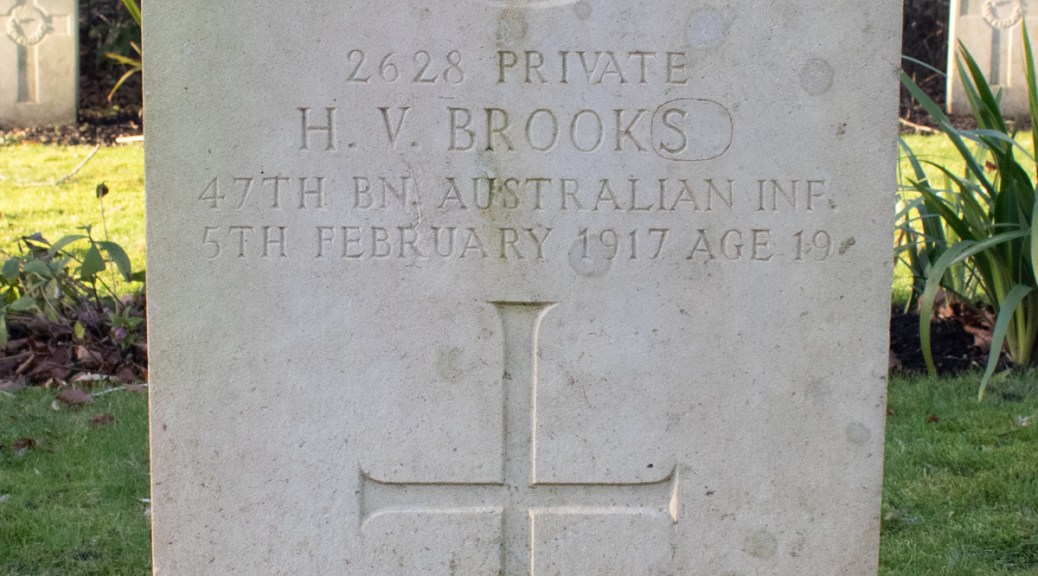
Assigned to the 47th Battalion of the Australian Infantry, Harold left his home country from Brisbane on the 27th October 1916. The ship his unit was sailing on – the Marathon – took just over ten weeks to reach Britain, eventually docking in Devonport, Devon. From there Private Brooks was marched to the ANZAC camp in Codford, Wiltshire.

Harold’s time in Britain was not to be a lengthy one. He contracted pneumonia, and was admitted to the nearby Sutton Veny Military Hospital on 24th January. Private Brooks’ condition worsened, and he passed away on 5th February 1917. He was just 19 years of age.

Thousands of miles from home, the body of Harold Vincent Brooks was buried in the newly extended St Mary’s Churchyard, Codford.


Private Alfred Parkinson

Private Alfred Parkinson

Alfred Henry Parkinson was born in Reedy Creek, South Australia, on 20th October 1880. One of nine children, his parents were William and Isabella Parkinson.

There is little concrete information about Alfred’s early life, but when he finished his schooling he found work in the mines. When war broke out, however, he stepped up to play his part, joining the Australian Imperial Force on 2nd November 1916.

Private Parkinson’s service records show that he was 5ft 9ins (1.65m) tall, and weighed in at 10st 4lbs (65.3kg). He was noted as having brown hair brown eyes and a fair complexion. After a month’s training, he left Australia on board the SS Berrima, bound for Europe.

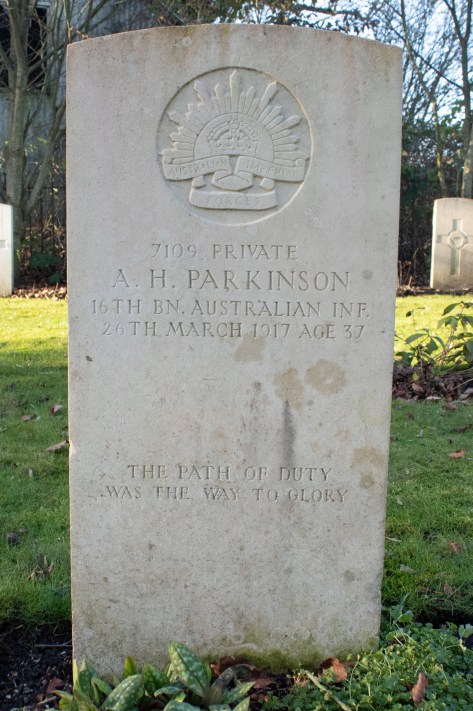
Alfred’s unit – the 16th Battalion of the Australian Infantry – arrived in Devonport, Devon, on 16th February 1917. Within a matter of days he arrived at the ANZAC camp at Sutton Veny, Wiltshire.

Illness amongst the Australian troops was rife by the time they arrived in Britain, and Private Parkinson was not to be immune. He was admitted to the Military Hospital connected to the camp on 20th March, suffering from bronchial pneumonia. The condition worsened, and he died just six days later. Alfred was 36 years of age.

Thousands of miles from home, the body of Alfred Henry Parkinson was laid to rest in the newly extended graveyard of St Mary’s Church, Codford, not far form the base in which he had breathed his last.


Carpenter’s Mate George Land

Carpenter’s Mate George Land

George William Land was born early in 1891, and was the only child to George and Caroline Land. George Sr was a greengrocer from Dagenham, Essex, and the family were living in Ilford when his son was born.

Caroline seems to have died a few months after George Jr’s birth, and, by the time of the 1901 census, he was in the care of her parents. His father was still running the shop, and was supported by George Jr’s aunt.

The 1911 census found George Jr employed as a greengrocer, and it seems likely that he was working alongside his father by this point. He was living with his maternal and uncle, who was also employed in the same line of work.

When war was declared, it seems that George Jr wated to play his part. Full details of his service have been lost to time, but it seems that he joined the Merchant Navy and, by the summer of 1918, he was working as a Carpenter’s Mate on board the SS Mesaba. She was a cargo liner, requisitioned by the Admiralty for transport duties.

On 31st August 1918, the Mesaba left Liverpool, Lancashire, for Philadelphia. The following day, she was torpedoed by the German submarine U-118, and foundered. She sunk off the coast of County Wexford, with the loss of 20 souls, Carpenter’s Mate Land included. George Jr was 27 years of age.

The body of George William Land was laid to rest in St David’s Parish Cemetery, Pembrokeshire. It is unclear whether his body had been brought to Wales with the seventy survivors who had been rescued, or whether it had washed ashore there some time after the sinking.