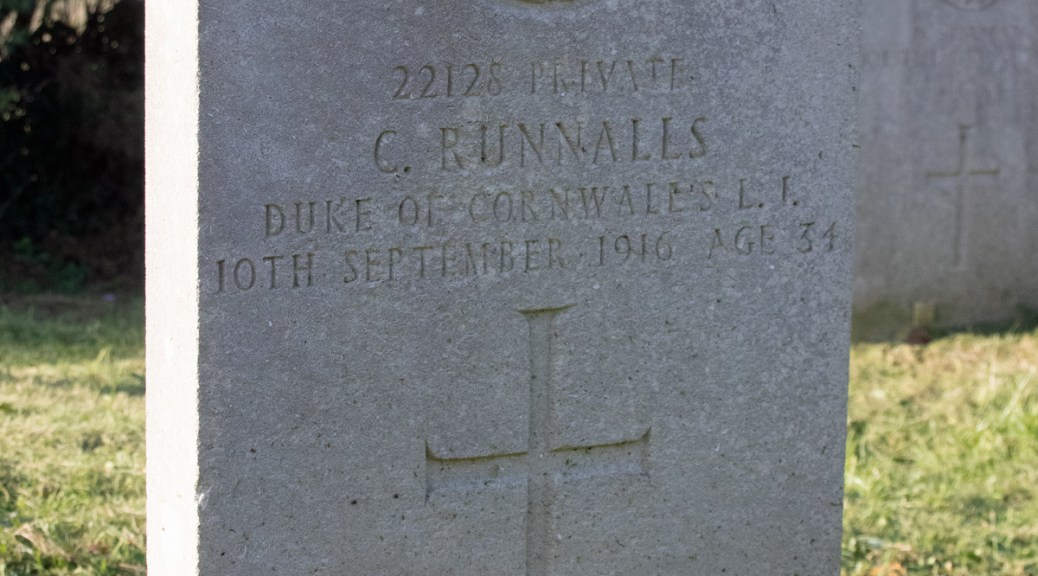
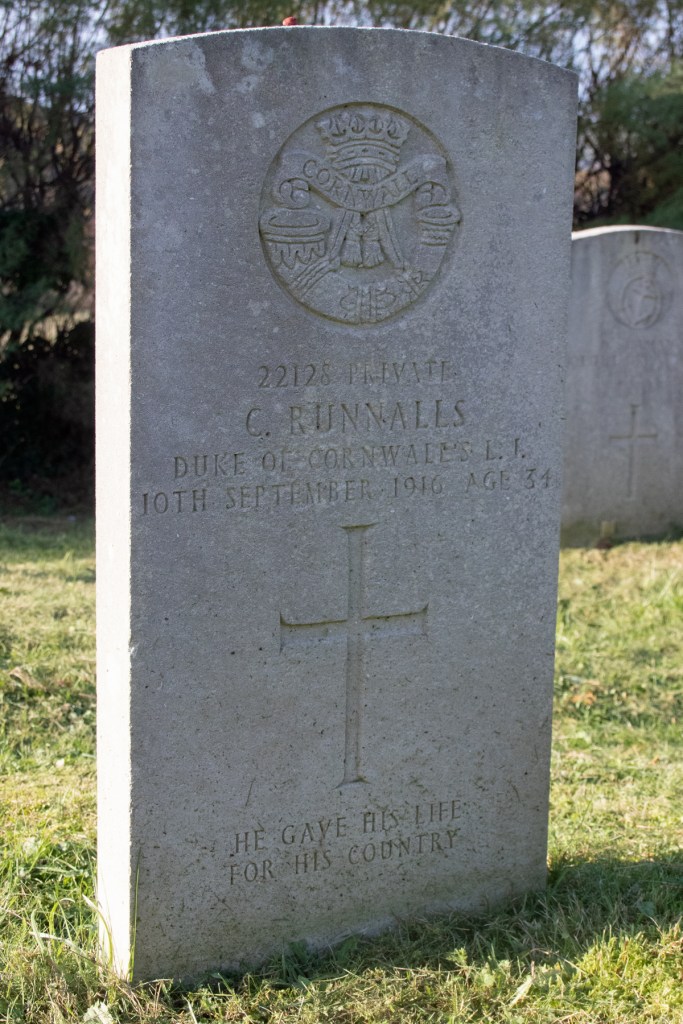
Christopher Runnalls was born in the village of Cardinham, Cornwall, in 1892. The fourth of five children, his parents were game keeper John Runnalls and his wife, Mary. Christopher – who was better known by the nickname Kitt – didn’t follow in his father’s footsteps, instead finding work as a stone mason when he finished his schooling.
Kitt moved to St Minver, near Wadebridge, for work and, in 1907, he married Susan Buse. The couple set up home in a small cottage in the village, sharing their home with Susan’s niece, Vivian.
When war was declared, Kitt stepped up to play his part. He enlisted in the Duke of Cornwall’s Light Infantry, and, as a Private, was assigned to the 10th (Service) Battalion, also known as the Cornwall Pioneers. He soon found himself on the Western Front and, in the summer of 1916, was caught up in the Somme.
Pte. Kitt Runnals [sic], of the DCLI, who was wounded in France on August 10th, and was brought to Leeds Great Northern Hospital, died at that institution on September 10th. The body was brought to St Minver and buried at [St Enodoc’s Church] on Thursday, the 14th.
[He] was one of the most respected men in the parish. He was a mason by trade. When war broke out he thought it his duty to join up. He was a member of the United Methodist Church. He leaves a widow but no family.
Newquay Express and Cornwall County Chronicle: Friday 22nd September 1916
Christopher ‘Kitt’ Runnalls was 34 years old when he passed. He lies at rest in the peaceful landscape of St Enodoc’s Church, Cornwall.
John Leslie Mably was born on 21st May 1899, the only son to Elizabeth Janie Mably. Elizabeth lived with her widowed mother and two older brothers, in the Cornish parish of St Minver.
There is scant information available for John’s short life. The 1911 census showed that he was still at school, and when war broke out, he enlisted in the Royal Engineers, although the date for this happened is unclear. Sapper Mably was assigned to the 69th Division Signal Company, but records do not confirm whether he served overseas or on home soil.
At some point later in the conflict, John was in Yorkshire, as he was admitted to the general hospital in Sheffield. Again, details are sketchy, and it is not possible to identify if he was based in the area, or medically evacuated there from overseas. Either way, it was in the hospital that he breathed his last, passing away on 15th August 1918, at the age of just 19 years old.
John Leslie Mably’s body was taken back to Cornwall for burial. He was laid to rest in the picturesque setting of St Michael’s Churchyard in the village of Rock.
William James Profitt was born on 20th August 1894 in Collingwood, Victoria, Australia. The oldest of ten children, his parents were Cornish-born Francis Profit and his Australian wife Mary.
Little information is available about William’s early life. When he finished his schooling, he found work as a salesman, and this is the work he was doing when war was declared in Europe.
William felt duty bound to serve his King and Empire, and, on 5th July 1915, he enlisted in the Australian Imperial Force. His service records confirm that he was just 5ft 2.5ins (1.59m) tall, weighing 8st 4lbs (52.6kg). He was noted as having cark brown hair, blue eyes and a fresh complexion: he had a scar on his left cheek.
After initial training, Private Profitt arrived in Alexandria, Egypt. He was assigned to the 23rd Battalion of the Australian Infantry and, by 30th March 1916, he was in France. William’s unit was one of the many to become entrenched at the Somme, having been evacuated from Gallipoli just weeks before he had arrived in Europe.
On 2nd August Private Profitt was admitted to a camp hospital in Boulogne with a sprained ankle. The medical report noted the injury as trivial, having occurred when, on ‘being relieved from trenches [he] slipped and fell into an old German dugout.’ By 21st August he was back with his unit, now based in Etaples.
Just a week later, William was sent to a casualty clearing station in Rouen, having been shot in his right elbow. Less trivial an injury this time round, he was medically evacuated to Britain for treatment, and was admitted to the Cambridge Military Hospital in Aldershot, Hampshire.
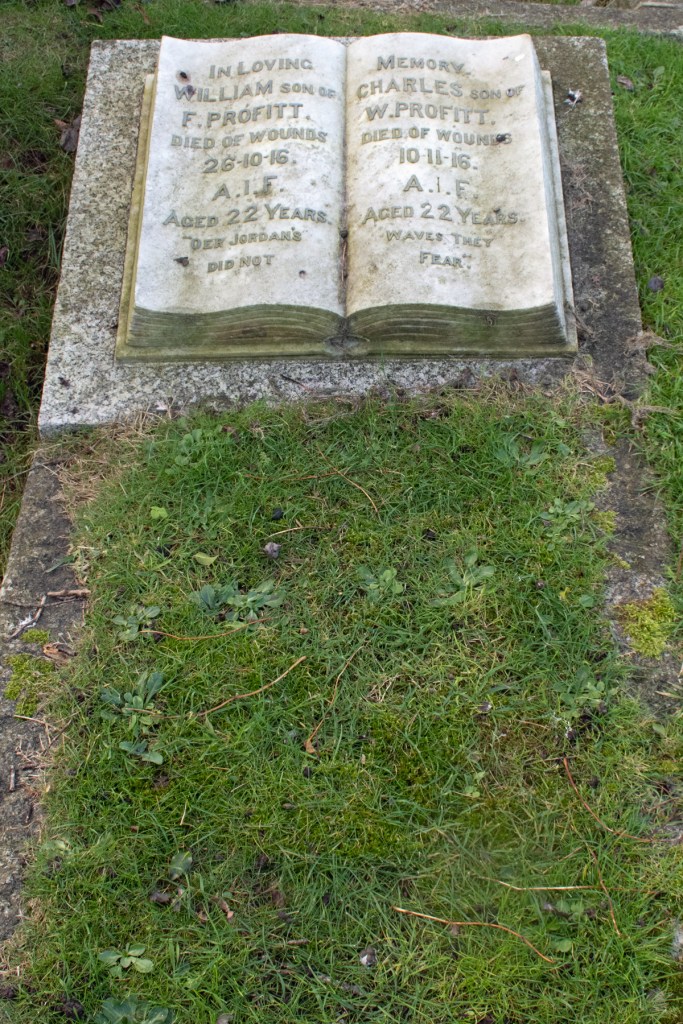
Private Profitt’s injury should not have been a life-threatening one, but septicaemia set in. His condition worsened, and he passed away on 25th October 1916. He was just 22 years of age.
With William James Profitt’s family more than 10,000 miles (17,000km) away, it was not possible to him to be buried at home. Instead, his body was taken to the peaceful and picturesque graveyard of St Michael’s Church in Rock, Cornwall, close to where his father’s family still lived.
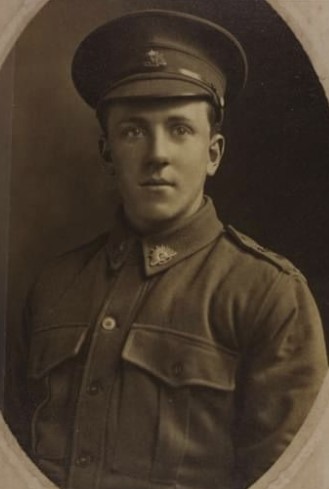
Private William Profitt (from findagrave.com)
William’s grave shares a dedication with Charles Profitt, who died just a fortnight after him.
John Walter Charles Profitt – better known as Charles – was born in the summer of 1894 Geelong, Victoria, Australia. The oldest of three sons to William and Harriet Profitt, it is likely that his father was William’s uncle, and that the two siblings had both travelled to Australia to earn their fortunes.
Working as a teacher at the time, Charles enlisted just days after his cousin, joining the 6th Field Ambulance unit. His service records show that he had dark brown hair, grey eyes and a fresh complexion, no dissimilar to William. Standing 5ft 8ins (1.73m) tall and weighing 10st 6lbs (66.2kg), it is clear that his side of the family had markedly different genes.
Private Profitt arrived in France on 27th March 1916, and his dedication to the role showed when he was promoted to the rank of Lance Corporal in August.
On 9th November he was badly wounded while carrying out his duties, receiving a severe gun shot wound to his abdomen. He was admitted to the 1st Anzac Medical Station, but died of his injuries just two days later. He was just 22 years of age.
Lance Corporal Charles Profitt was laid to rest in Heilly Station Cemetery to the south of Méricourt-l’Abbé. He is commemorated with his cousin, William, in St Michael’s Church, Rock.
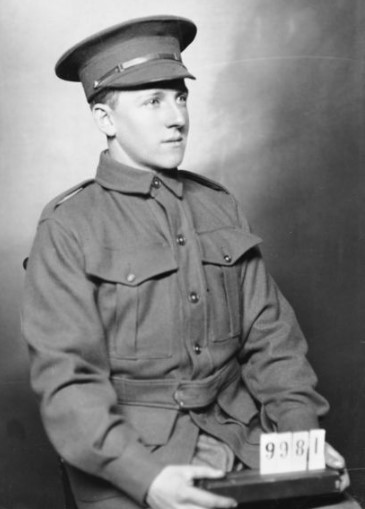
Lance Corporal Charles Profitt (from findagrave.com)
Angus MacIver was born in 1887 in the isolated hamlet of Geshader (Geisiadar), on the Isle of Lewis, Scotland. His parents were Murdo and Marion MacIver, and he was one of seven children.
Detail of Angus’ early life are a challenge to uncover. It would seem that he worked with boats when he completed whatever schooling he undertook. Given Geshader’s proximity to the coast, it is likely that Murdo was a fisherman, and that his three sons – Angus included – followed suit.
By the time war broke out in 1914, Angus had joined the Canadian Merchant Navy. He held the rank of Sailor: records suggest that he would have been an Able Seaman, had he been in the Royal Navy.
In the spring of 1918, Sailor MacIver was serving on board the SS Tagona, a Canadian steamer, ferrying goods across the Atlantic. The ship was en route for Glasgow, having sailed from Bilbao, Spain, and, on 16th May she was passing close to the North Cornish coast. Five miles (8km) from Trevose Head, Tagona was torpedoed by the German submarine U-55, and sank. Eight crew members, including Angus, drowned. He was 31 years of age.
The body of Sailor Angus McIver washed ashore in the Camel Estuary: the remains were identifiable, but his family were unable to bring him back to Lewis. Instead, he was laid to rest in the peaceful graveyard of St Menefreda’s Church in St Minver, Cornwall.
Richard Ezra Baron White was born in the autumn of 1886 in the Cornish village of St Minver. The third of four children, his parents were Joseph and Zillah White. Joseph was a ship’s carpenter by trade, and Richard served an apprenticeship as a woodworker. By the time of the 1911 census, however, the Whites were working as farmers on the outskirts of the village.
When war was declared, Richard stepped up to serve King and Empire. It is unclear when he enlisted, but he joined the Gloucestershire Regiment, and was attached to the 3rd (Reserve) Battalion. Private White was based in Kent during the conflict, his unit being attached to the Thames and Medway Garrison.
Richard survived the conflict, but the winter of 1918/19 was to prove his undoing. He contracted pneumonia, and was admitted to the military hospital in Aylesford. The condition was to get the better of him: he passed away on 20th February 1919, at the age of 33 years.
The body of Richard Ezra Baron White was taken back to Cornwall for burial. He was laid to rest in the peaceful graveyard of St Menefreda’s Church in his home village, St Minver.
George Henry Buse was born in the Cornish village of St Minver in 1880. One of four children, his parents were Richard and Angelina. Richard was an agricultural labourer, but his son followed a different trade, finding employment as a stonemason.
In the summer of 1904, George married a woman called Mary. They went on to have a daughter, Olive, who was born in 1906, and set up home in Splatt, on the outskirts of the village.
When war came to Europe in the summer of 1914, George stepped up to play his part. He enlisted by the summer of 1916, and joined the 2nd Battalion of the Devonshire Regiment. Private Buse’s unit served on the Western Front, but it is unclear whether he fought overseas.
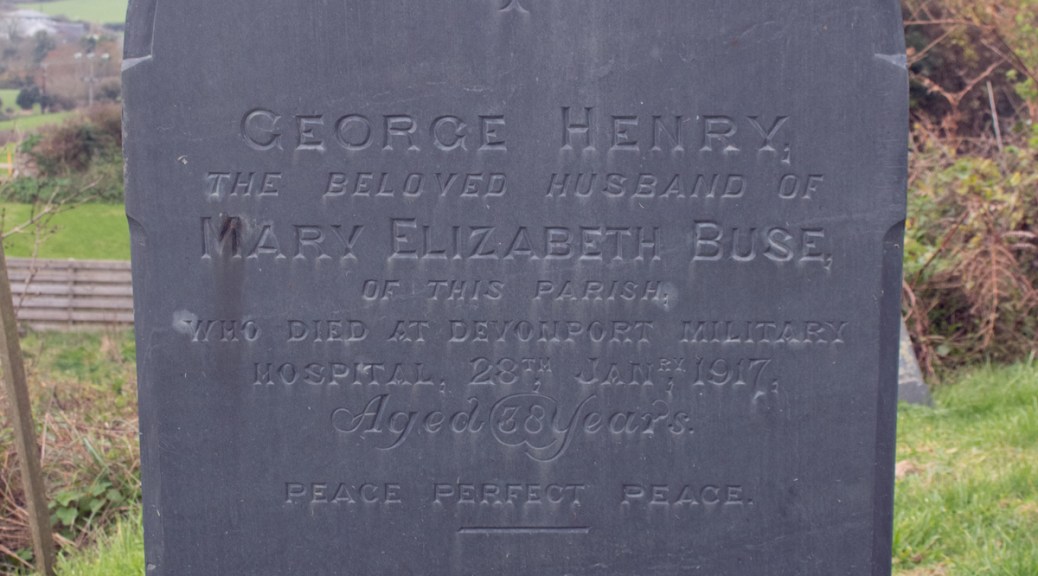
By the winter of 1916, George had fallen ill. He contracted pneumonia, and was admitted to the military hospital in Devonport, Devon. The condition was to prove too severe, however, and he passed away on 28th January 1917: he was 36 years of age.
George Henry Buse was brought back to Cornwall for burial. He was laid to rest in the peaceful graveyard of St Menefreda’s Church in St Minver.
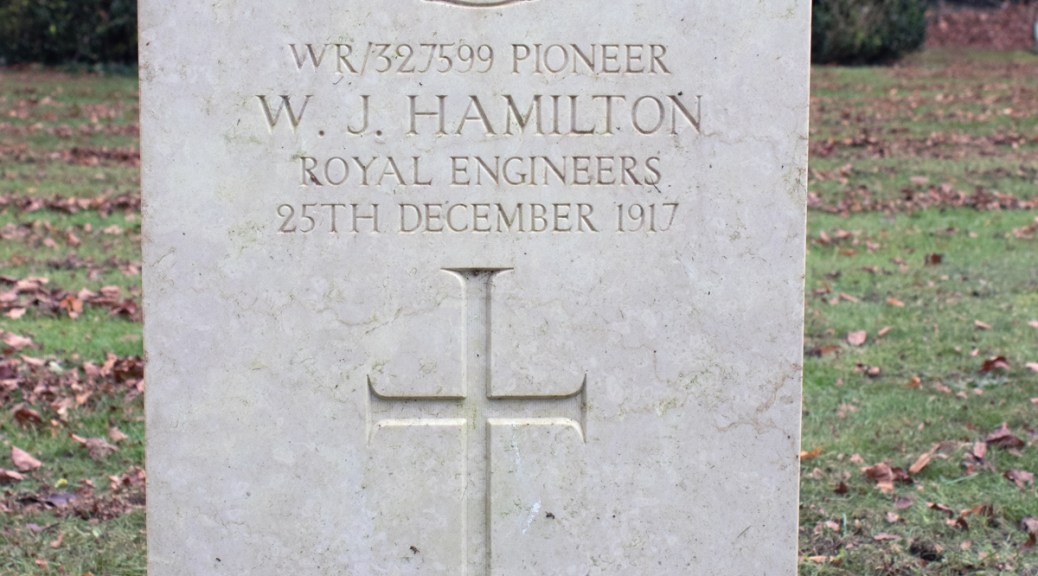
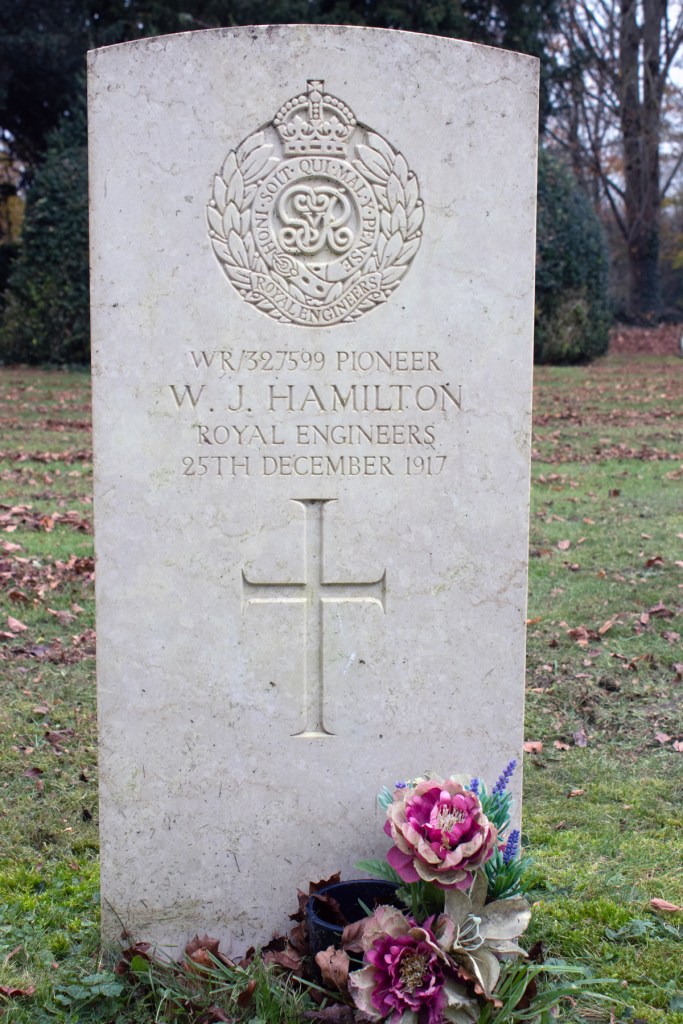
William John Hamilton was born in Urney, County Tyrone, in 1870. One of ten children, his parents of John and Bella. Little further information is available about his early life, but on 29th September 1895, William married Sarah McLaughlin.
The couple set up home in Ballycolman Lane, Strabane, and had at least six children. William worked as a shop porter, while Sarah kept house for the family.
By the time of the 1911 census, William was working as a general labourer. War was brewing over the continent by this point, however, and when hostilities were declared, he stepped up to play his part.
Full details of William’s service are lost to time. What documents remain, however, confirm that he enlisted no earlier than June 1917, and that he joined the Royal Engineers as a Pioneer. He was attached to an Inland Water Transport unit and sent to Salisbury Plain, Wiltshire, for training.
Pioneer Hamilton’s Pension Ledger Card provides a tantalising insight into his passing. On 25th December 1917, he died from “suffocation from submersion accidentally drowned while on active service.” There is no other documentation to expand on what happened, and no contemporary newspaper report on his passing. William was 47 years of age.
It would appear that Sarah was unable to afford the cost of bringing her late husband’s body back to Ireland for burial. Instead, William John Hamilton was laid to rest in Amesbury Cemetery, close to where he had passed away.
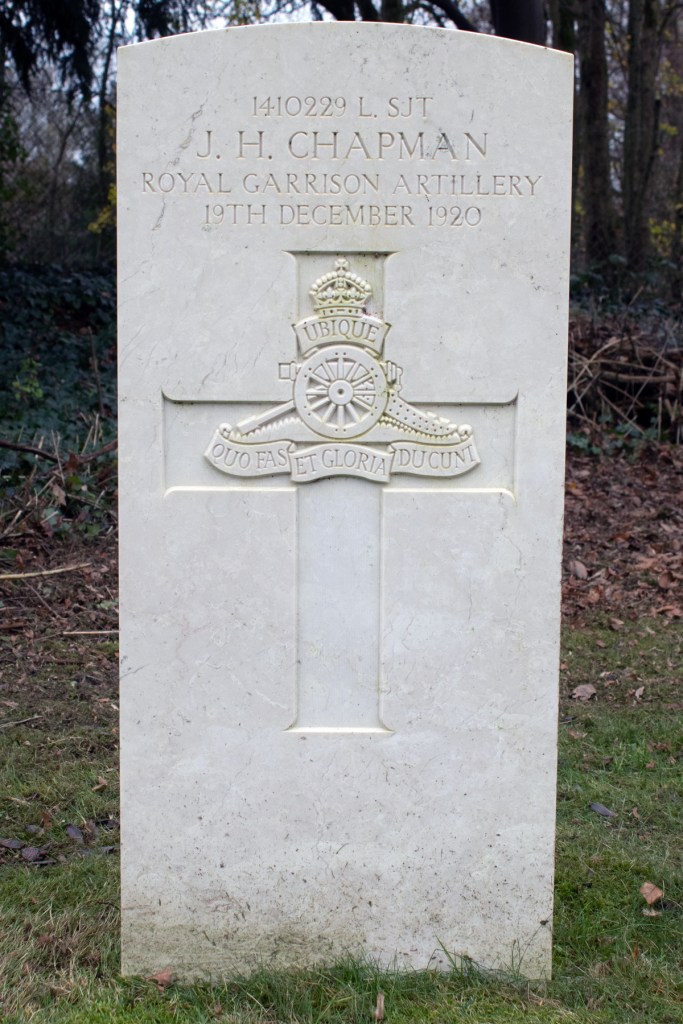
There is little concrete information available on the life of John Henry Chapman. His headstone, in Amesbury Cemetery, Wiltshire, confirms that he was a Lance Serjeant in the Royal Garrison Artillery, and that he died on 19th December 1920.
John’s pension ledger gives his widow’s name, Caroline, date of birth, 25th August 1900, and her address, High Street, New Romney, Kent. It also gives a cause of death for John, who passed away from pneumonia.
The record for Lance Serjeant Chapman’s headstone gives his next of kin as Mrs C Chapman, c/o Mrs Savage, which would suggest that that was Caroline’s maiden name. The Civil Registration Marriage Index records the union of a John H Chapman to someone with the surname of Savage in the summer of 1920: the wedding took place in Richmond, Yorkshire, although there does not appear to be any direct connection between the Lance Serjeant, Caroline and the town.
There are no further clear documents relating to John Henry Chapman. He lies at rest in the peaceful anonymity of Amesbury Cemetery.
Charles Millson was born in Scullcoates, Yorkshire, in the summer of 1897. One of nine children, his parents were called Charles and Eliza. Charles Sr was a general labourer and while still at school, his son found work as a newsboy, hawking papers for a local newsagent.
Sadly, there is little more concrete information about young Charles’ life. When war broke out, he stepped up to enlist, although the exact dates of his service are lost to time. He joined the Royal Field Artillery and, as Driver, was assigned to the 107th Brigade.
By the summer of 1915, Driver Millson was based on Salisbury Plain, near Amesbury, Wiltshire. This is where he was to breathe his last. Charles died on 7th June 1915, through causes unknown: he was just 18 years of age.
It would seem that the Millsons were unable to bring their son back to Yorkshire for burial. Instead Charles was laid to rest in Amesbury Cemetery, not far from where he had passed away.
On Tuesday morning another member of the Royal Flying Corps, Second Lieutenant Henry Roland Fleming, lost his life at Upavon. Lieutenant Fleming, who was 28 years of age, and married, having his home at Ripley, Surrey, was attached to the Central Flying School early last month, having volunteered for service on the outbreak of war, joining the Special Reserve Air Service. Nearly four years ago he gained the Aero Club’s certificate at Brooklands, but for nearly two years prior to the outbreak of war had not practiced aviation. On Tuesday morning the conditions were very favourable for flying, and the deceased’s flight was watched by Major Webb-Bowen, assistant commandant at the school, and Captain Stopford, who was flying at the same time. Lieutenant Fleming was about 1200ft [365m] up when the attitude of his machine first attracted the attention of the officers. They noticed it dive in an almost vertical position, after which it turned over on its back and glided for some distance upside down. Then it turned its nose to ground again, and from a height of some 450 feet [137m] dived straight into the earth. Death was instantaneous. The officers found Mr Fleming dead in the remains of the machine, with the strap broke in the fall still about his waist. Medical examination showed that he had dislocated his neck and fractured his skull. Lieutenant Fleming, who comes from a well-known family, was one of the first in the country to take up aviation. His father went through the Crimean Campaign in the 4th Irish Dragoon Guards, and a brother was killed in the South African War.
Salisbury and Winchester Journal: Saturday 28th November 1914
Henry Roland Fleming was born in the summer of 1884 in Farnham, Surrey. There is scant information about his early life, but the 1911 census recorded him as boarding at the New Inn in Amesbury, Wiltshire, where he was employed as an aviator.
Henry gained his wings on the 25th April 1911 – shortly after the census – flying a Bristol biplane. He married Ivy Wyness-Stuart, a widow six years his senior, in the spring of 1913, but after this, the couple’s trail goes cold.
When war broke out, Henry stepped up to play his part. He gained a commission to the Royal Flying Corps and, once again found himself based on Salisbury Plain. Tragically it was only a matter of months because the fatal accident.
While his widow was living in Surrey, her Henry Roland Fleming was laid to rest in Amesbury Cemetery, not far from airfield where he had developed his flying skills.
Second Lieutenant Henry Fleming (from findagrave.com)









 Death and Service