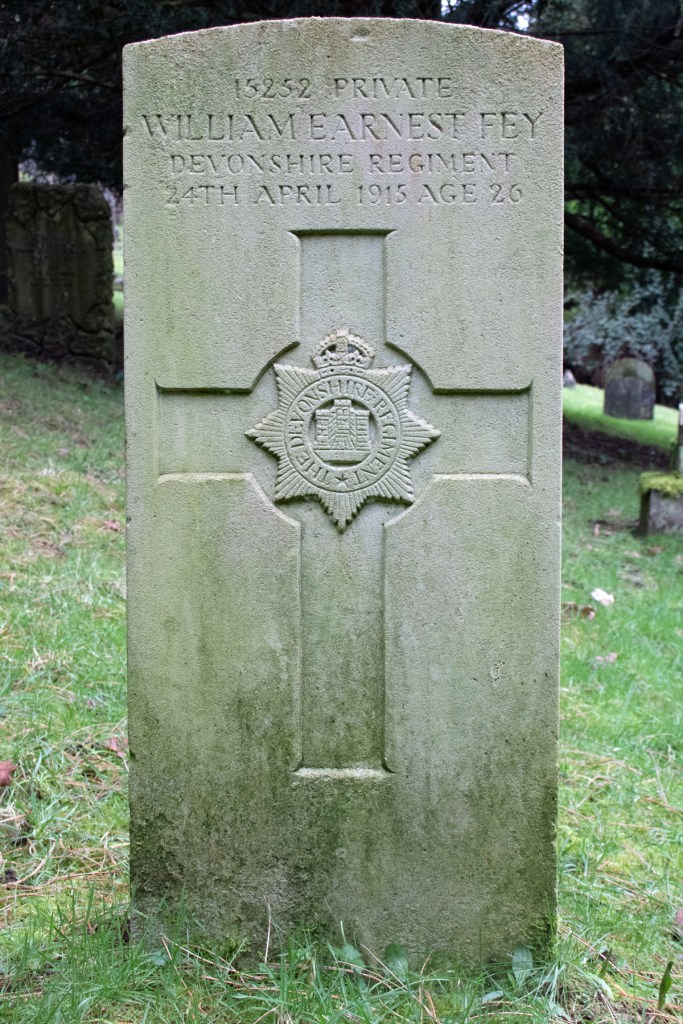
William Ernest Fey was born in Harburton, Devon, in the spring of 1889. The oldest of eight children, his parents were John and Margaret Fey. John was a farm labourer and, when he left school, William also took up work on the farm. By the time of the 1911 census he was listed as a horseman.
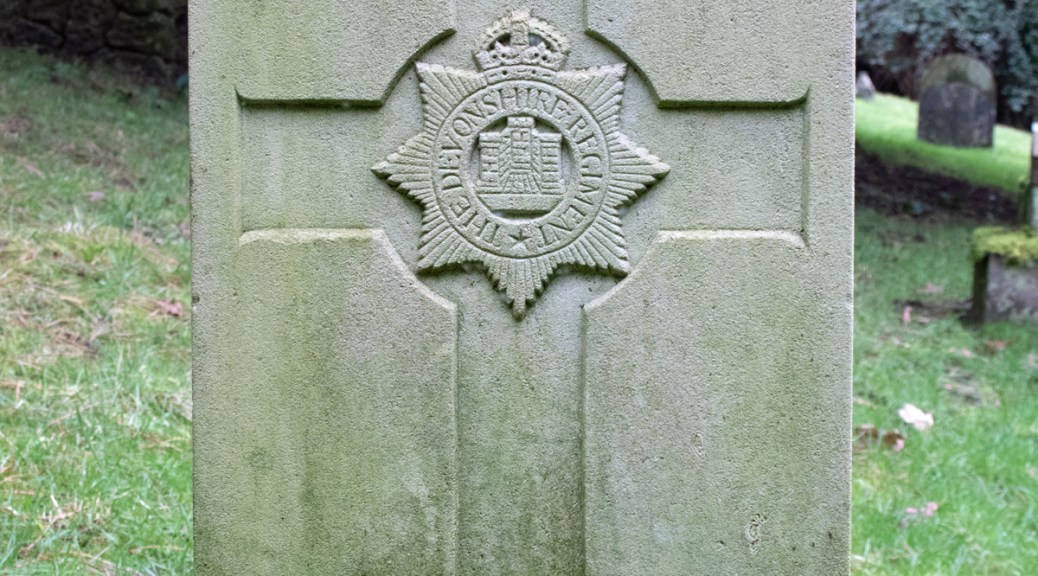
When was came to Europe, William was one of the first to step up and play his part. He enlisted in the Devonshire Regiment in the autumn of 1914, and was assigned as a Private in the 10th (Service) Battalion.
For part of his training, he was billeted in Bath, Somerset, and it was here, in April 1915, that he contracted meningitis. Private Fey was admitted to the city’s Red Cross Hospital, but the condition was to prove too much. He passed away on 24th April 1915, aged just 26 years of age.
Financial restraints may have limited John and Margaret’s ability to bring their boy back to Devon. Instead, William Ernest Fey was laid to rest in the quiet and picturesque Smallcombe Vale Cemetery on the outskirts of the city where he died.
The death occurred on Thursday of Mr Eric Cyril Guillebaud. Deceased was the youngest son of the late Rev. ED Guillebaud, Rector of Yatesbury, near Calne. On the outbreak of war he joined the Army, and was given a commission in the 11th (Service) Battalion of the Worcestershire Regiment. His physical strength not being equal to his patriotic zeal, he broke down under the strain of military duty. He came to rest at Combe Royal, Bathwick Hill, where his brother, Mr H Guillebaud, resides, but on medical advice entered a nursing home. Mr Guillebaud was 22 years of age. He was officially invalided from the Army six weeks ago. Deceased was a nephew of the late Mr Charles Marshall, of The Sycamores, Bathford, and the interment will take place in the churchyard there on Tuesday next.
Bath Chronicle and Weekly Gazette: Saturday 5th June 1915
Little further information is available on the life of Eric Guillebaud. The 1901 census confirms that he was living at The Rectory in Yatesbury, with an extended family: his parents, Reverend Erneste and Mabel Guillebaud; his maternal grandfather, William Marshall; his maternal uncle, Charles; and his cousin, William. The family also employed four servants: a nurse, cook and two housemaids.
There is no information relating to Eric’s military service, although it is clear from his headstone that he reached the rank of Second Lieutenant. His troop – the 11th Battalion of the Worcestershire Regiment – was based on Salisbury Plain and, from subsequent reports, uniforms and equipment were not provided until the spring of 1915: everything up to then was improvised.
The 11th Battalion did not leave for France until September 1915, three months after Eric’s passing: he would not, therefore, have seen any action overseas.
The only other document relating to Second Lieutenant Guillebaud is his probate record. This confirms that he died on 3rd June 1915 at 15 Somerset Place, Bath. His effects – totalling £5041 18s 10d – were left to his brother, Harold, who was listed as a gentleman.
Eric Cyril Guillebaud was 32 years old when he died. He was laid to rest in the graveyard of St Swithun’s Church, Bathford.
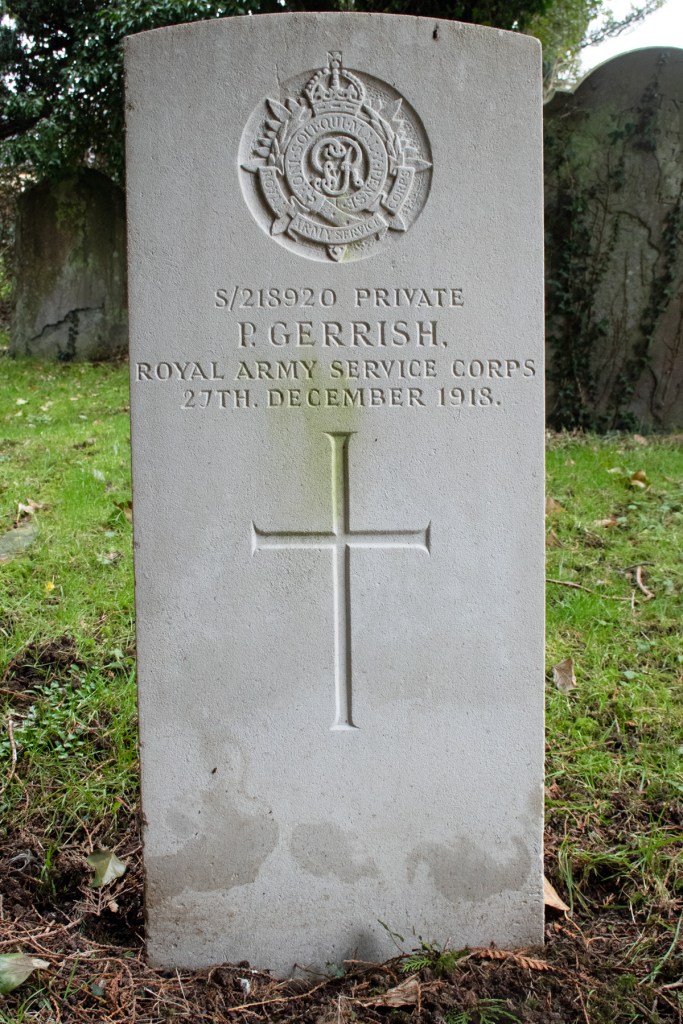
Percy Gerrish was born on 22nd August 1890 in Bath, Somerset. The youngest of three children – all boys – his parents were Alfred and Charlotte Gerrish. Alfred was painter and decorator by trade but, by the time of the 1911 census, the family had moved to Batheaston, and he was employed as a school attendance officer.
Alfred and Charlotte had raised their children well: the same census recorded their oldest son, also called Alfred, was employed as a clerk; their middle son, Reginald, was a printer; Percy, then 20 years old, was working as a draughtsman for an engineering company,
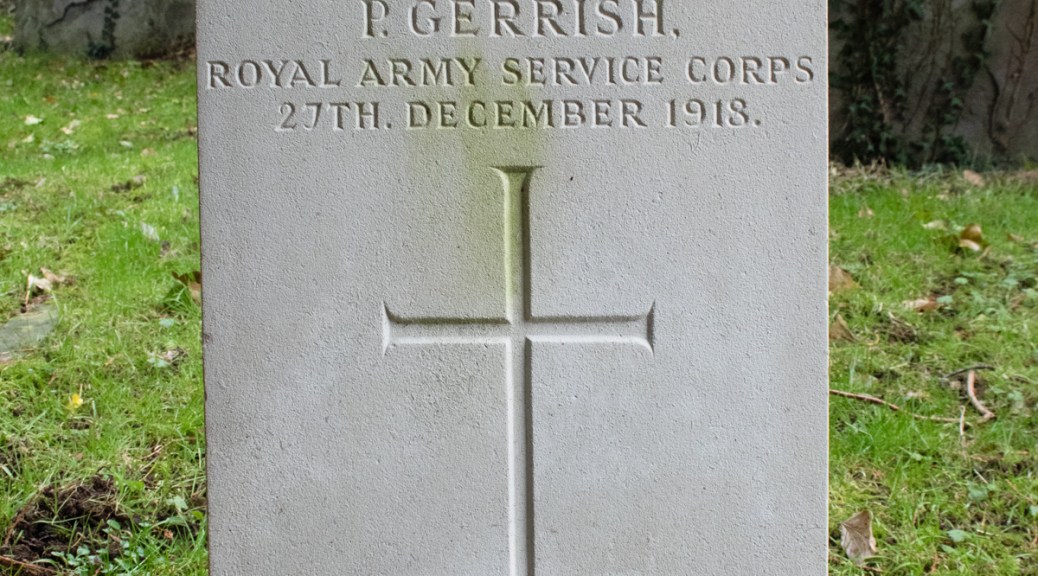
War came to Britain’s shores in 1914, and while he did not join up at once, when the Military Service Act of 1916 came in, Percy found himself conscripted. He enlisted on 24th November 1916 and, while he noted a preference for the Royal Field Artillery or Royal Garrison Artillery, his previous employment made him ideal for work as a clerk in the Army Service Corps.
Private Gerrish’s time in the army was spent on home soil. Full details are not available, but he certainly served in camps around Codford, Wiltshire. This may have been how he met a young woman called Ada Cox, who lived in Bemerton, on the outskirts of Salisbury. On 21st July 1917, the couple married in the new Mrs Gerrish’s local church.
Percy’s army career went well, although during 1918 illness was to dog him. He spent a week in a hospital in Fovant, near Salisbury in June, suffering from influenza, before being readmitted for a month just a week later, having contracted pharyngitis – an inflammation of the pharynx.
By the late summer of 1918, Private Gerrish had been moved to Newport Pagnell, Buckinghamshire. His ongoing health conditions were still an issue, however, and on 23rd October he was admitted to the Tickford Abbey Auxiliary Hospital. He had contracted laryngitis by this point, but, as the weeks in hospital progressed, he was soon also bogged down by tuberculosis.
Sadly, this was to prove Percy’s undoing. He passed away on 27th December 1918, aged just 28 years old.
Percy Gerrish’s body was brought back to Somerset for burial. He was laid to rest in the graveyard of St John the Baptist Church, in a plot next to his father, Alfred, who had died seven months before.
Theophilus Walter Burdock was born on 18th June 1871 in Whitminster, Gloucestershire. One of nine children, his parents were painter and decorator Nathaniel Burdock and his wife, Mary.
While he found labouring work when he left school, Theophilus – who went by his middle name, Walter – decided that he wanted bigger and better things and, on 30th December 1889, he enlisted in the Royal Artillery. His service records show that he was 5ft 5ins (1.65m) tall and weighed 115lbs (52kg). The document also records that he has a tattoo of a man, star and crown on his left forearm.
Initially assigned to the 1st Depot 2nd Battery as a Driver, over the next couple of years Walter made solid progress within the regiment. By September 1892, he was promoted to Gunner, within a couple of years he was raised to Bombardier, and by April 1895 he had made the rank of Corporal.
By his last formal year in the ranks, things seemed to take a different turn. On 9th March 1896, Corporal Burdock received a contusion to his face. He was formally transferred to the Army Reserve when his contract of service ended in December 1896, but within eighteen months he re-enlisted.
At this point, however, Corporal Burdock’s conduct began to race downhill. In August 1898 he was tried for an undisclosed reason, and his rank was reduced to Bombardier. Within a couple of months, he was tried for a second crime, and reduced in rank again, back to Gunner.
For a time Walter kept his nose clean, and, in February 1900, he was promoted back to the rank of Bombardier. This was to be only a fleeting move, however, as he reverted back to Gunner less than two months later.
Over the next couple of years, Walter generally kept his head down. On 30th April 1901 he was injured by a kick in the eye, although, again, details are tantalisingly scarce. By April 1902, his contract came to an end and this time he was stood down and formally demobbed.
Civilian life seemed to be something to which Walter was not to be destined. He enlisted again almost immediately, joining the Imperial Yeomanry in May 1902. He lasted less than a year with the regiment, however, having served ten months in South Africa.
In January 1904, was recalled to the Royal Artillery for further service in South Africa. His medical report showed the man he had become in the fifteen years since he had first joined up: he was now 5ft 7ins (1.7m) tall, and weighed 141lbs (64kg).
Private Burdock served six months on home soil, but in July 1904, he was sent to South Africa, having never actually seen any overseas service before. He returned to Britain in September 1905, and was discharged from service, specifically so that he could re-enlist with the Royal Artillery and complete his fourteen years’ service with them.
Gunner Burdock remained with the Royal Artillery until February 1906, presumably as he had finished his fourteen years. Interestingly, his discharge papers noted his conduct as ‘indifferent’.
Walter’s trail goes at this point. His mother, Annie, passed away in Gloucestershire in the spring of 1908. His father, Nathaniel, died Bristol in 1912. The next evidence for their son comes in September 1914, in attestation papers for the Canadian Expeditionary Force.
Walter was, by this point, living in Victoria, British Colombia, and working as a lumberjack. He had been unable to completely leave his army days behind him, and his service records give his year of birth as 1876, five years younger than he actually was at the time.
Those service records give similar physical characteristics to his 1904 papers, and confirm the presence of some additional tattoos: a butterfly and pair of hands with the words true love.
Walter was assigned to the Royal Canadian Horse Artillery, and given the rank of Gunner. He arrived back in Britain in October 1914, but his previous indifference seems to have recurred. He was imprisoned for a week from 21st October for having been absent without leave, and was found to be absent again at reveille on the morning of 30th October.
Yesterday afternoon the body of a man was found floating in the Avon just below Bathampton Weirs, and close to the entrance to the back-water on the Batheaston side of the river.
The body was floating face downwards some yards from the bank, and only the top of the head was visible.
The body was recovered shortly before five o’clock. It appeared to be that of a middle-aged man of medium height. The trousers had something of the appearance of a mechanic’s overall and deceased was wearing a sleeve vest.
The conjecture naturally arises whether the body is that of the missing Canadian soldier Burdock, whose clothes were discovered on the bank at Batheaston on Saturday, October 31st, and of whom nothing has been heard since. Burdock was a member of the Canadian contingent now in training on Salisbury Plain. It is known that the missing soldier had several tattoo marks on his arms… so the question will not long remain in doubt when the body has been brought to the bank.
Bath Chronicle and Weekly Gazette: Saturday 14th November 1914
The body did indeed turn out to be that of Gunner Burdock. An inquest reached a verdict of suicide while temporarily insane. He was 43 years of age.
Theophilus Walter Burdock was laid to rest in the graveyard of St John the Baptist Church in Batheaston. Interestingly, while his next of kin was identified as his brother Frederick Burdock, Walter’s service records add a further dimension to his passing:
A maple tree has since been planted at the head of the grave by Miss Henderson, The Hill, Batheaston, who took a great interest in the case. Miss Henderson also sent a beautiful wreath when deceased was buried.
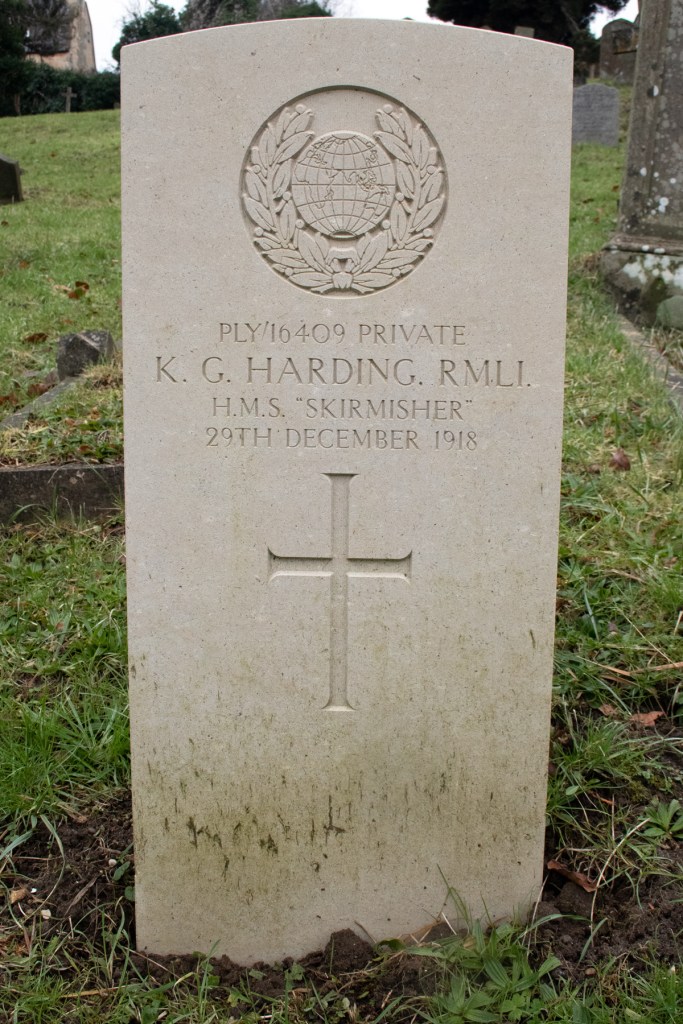
Kenneth Gordon Harding was born in the autumn of 1896, in the Somerset village of Batheaston. The oldest of nine children, his parents were Lawrence and Fanny Harding. Lawrence was a market gardener when Kenneth was born, but by the time of the 1911 census – and with a growing family to support – he found other employment as a roadman.
When he left school, Kenneth found work as a gardener, but he had his sight set on distant shores. On 25th September 1913 he enlisted in the Royal Marine Light Infantry, determined to see the world. His service records show that he was 5ft 3ins (1.6m) tall, with light hair, blue eyes and a light complexion.
For the duration of his naval career, Private Harding was based out of Plymouth Dockyard, returning there in between each of his voyages. Over the next four years, he served on three different vessels – HMS Heroic, HMS Duke of Edinburgh and HMS Skirmisher. His service records shows that he maintained a satisfactory level of conduct, and that his general character was very good.
By January 1917, Kenneth had fallen ill, and was medically discharged from the army, having contracted tuberculosis. He returned home, but his illness continued to dog him.
On 22nd May 1918, Kenneth’s younger brother, Leonard Harding, who was serving with the Royal Inniskilling Fusiliers, was killed while fighting in France. Private Leonard Harding was just 19 years old. He was laid to rest in the Duhallow ADS Cemetery at Ypres.
With Kenneth’s own health not looking good, his parents must have feared the worst. The worst was to some, sadly, when he breathed his last at home on 29th December 1918. He was just 22 years of age.
Kenneth Gordon Harding was laid to rest in the graveyard of St John the Baptist Church in his home village, Batheaston.
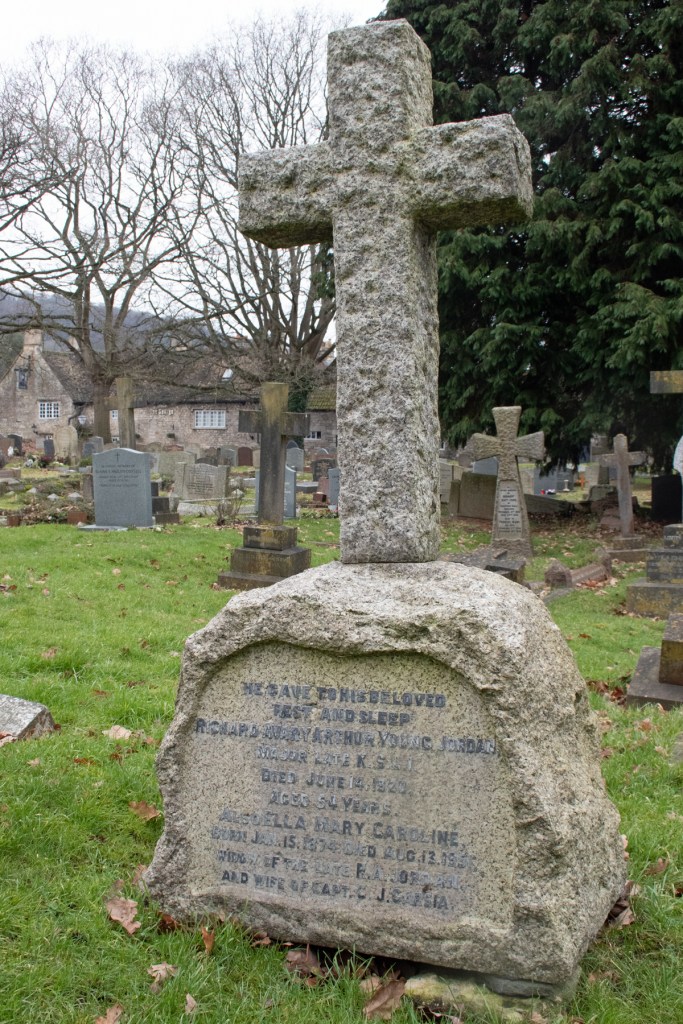
Richard Avary Arthur Young Jordan was born on 24th May 1866 in Cashel, Tipperary, Ireland. His father, Richard Jordan, died a week after his son’s birth, leaving his mother, Annabella, to raise him.
The 1871 census records mother and son living in Woolwich, London, with Annabella’s widowed mother, Grace. They were obviously a well-connected family, with Grace living as an annuitant, or pensioner, one son a Surgeon Major in the army and another as a Colonel in a different regiment. Annabella herself was recorded as a landowner, and the family had support with a cook and housemaid living in.
Surrounded by army servicemen as he was, it is no surprise that a military career called to Richard. He enlisted on 10th November 1886, joining the King’s Shropshire Light Infantry as a Lieutenant. Assigned to the 1st Battalion, his service records confirm that he had attended Burney’s Gosport School – a military academy – and was 5ft 7.5ins (1.71m) tall.
Richard was sent to Egypt just before Christmas that year, and over the next five years, he served both there and in Malta. On 11th May 1889 he attained the rank of Captain and, in December 1891 he was sent further afield, to Hong Kong.
After three years in the Far East, returned to Britain, and spent the majority of 1895 back on home soil. His travels were not at an end, however, and by the end of the year, Captain Jordan found himself in India. He spent three-and-a-half years in the sub continent, returning to the UK in May 1899.
At this point, details of Richard’s life get a little sketchy. He seems to have settled in Pembroke Dock, South Wales, and, on 18th April 1904, he married Ella Mary Caroline Grove. She was eight years his junior, and the daughter of a late Lieutenant in the Highland Light Infantry. The couple married at St George’s Church, Hanover Square, London.
Richard’s trail goes gold again, for a couple of years. He retired from the army on 8th August 1906, after nearly twenty years’ service. By the time of the 1911 census, he and Ella had set up home in Heywood House, on the outskirts of Tenby, Pembrokeshire, with two servants – Beatrice and Edith – as two live-in staff.
War came to Europe in the summer of 1914, and Richard seemed to keen to play his part once again. He enlisted again in August 1915, and was assigned the rank of Major in his former regiment. While it is not possible to determine Major Jordan’s complete service at this time, he definitely arrived in France the following month. If he remained in France, it is likely that he saw fighting at the Somme in 1916, Cambrai in 1917 and at Lys and on the Hindenburg Line in 1918.
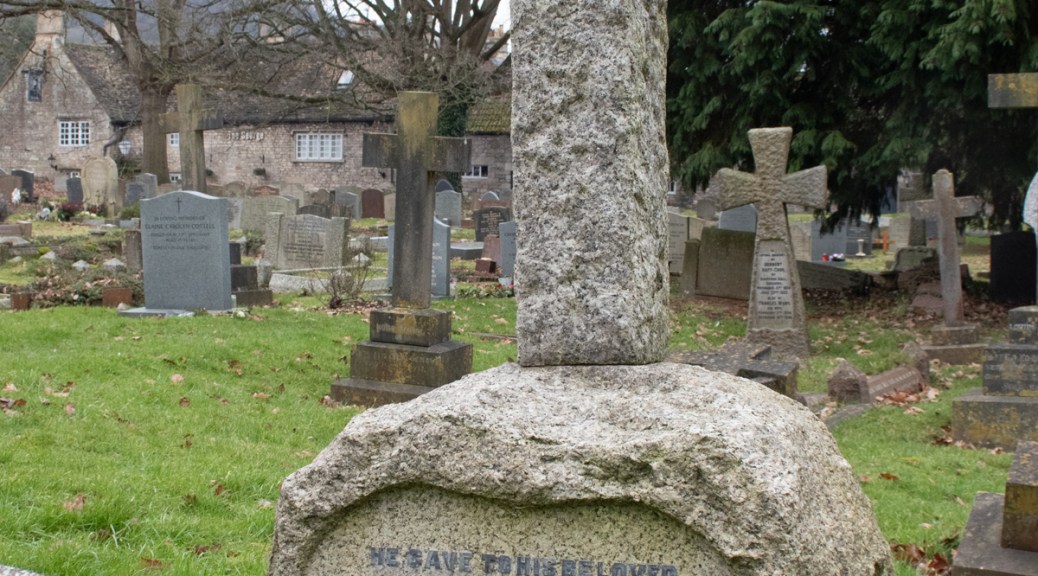
Again, Major Jordan’s post-war life remains tantalisingly elusive. By the summer of 1920, he and Ella were living at Holcombe Lodge in Bathampton, on the outskirts of Bath. It was here on 14th June, that Richard passed away. He was 54 years of age.
Despite all his travelling, it seems that Ella was comfortable living in Bathampton, and this is where she laid her late husband to rest. Richard Avary Arthur Young Jordan was buried in the graveyard of St Nicholas’ Church in the village.
The widowed Ella married again, to Captain Clare Garsia, on 9th October 1921. She remained in Bathampton, and lived to the age of 77, passing away on 13th August 1951. She was laid to rest in the same plot as her late husband.
When Captain Garsia died the following year, he was also buried in St Nicholas’ Churchyard, in a neighbouring plot to his beloved Ella.
Iva Victor Brewer was born on 2nd May 1886, the fourth of four children to James and Annie Brewer. James was a farm labourer from Weston-super-Mare, but the family were living in Bathampton by the time of Iva’s birth. James died in 1887, and Annie remarried three years later. Her new husband, Thomas Dolman, was the manager of the George Inn in Bathampton, and the couple went on to have four children of their own, half-siblings to Iva.
Tragedy struck again when Annie passed away in February 1897, at the age of just 37 years old. By the time of the next census in 1901, Iva was boarding with his stepfather’s parents; the following year, however, Thomas also passed away, and the children were left to build their own lives.
Iva – who was now going by his middle name, Victor – found an escape in the army and, according to the 1911 census was an Acting Bombardier in No. 69 Company of the Royal Garrison Artillery, based in Colaba, at the tip of the Mumbai peninsula.
By the time war was declared, Victor had cemented his military career. Full details of his service are no longer available, but the summer of 1916 he had left India for Aden, and was then mentioned in dispatches that October for his bravery in the field at the Somme.
In November 1917, the now Battery Quartermaster Sergeant Brewer was injured in fighting at Passchendaele, and was medically evacuated to Britain for treatment. It seems that he was treated in South Wales, and it seems a whirlwind romance set in when he was living in Pontardawe, near Swansea. On 2nd January 1918, Victor married Laura Seddon, a railway inspector’s daughter from the village of Ystalyfera, just up the valley from Victor.
The couple moved to Bathampton before Victor returned to the fighting. He was badly wounded and, having been evacuated back to Britain in May 1918, he was admitted to the Northern Central Hospital in London where his shattered leg was amputated. Sadly, bronchial pneumonia set in while he was recovering, and he passed away from the subsequent sepsis. Quartermaster Sergeant Brewer passed away on 7th May 1918, days after his 32nd birthday.
Iva Victor Brewer was brought back to Bathampton for burial. He was laid to rest in the quiet graveyard of St Nicholas’ Church in the village.
Tragedy was to strike again, sadly. After his funeral, Laura returned to Wales and found employment at a draper’s store.
…the loss of her husband played on her mind.
On Monday she set off for Bathampton, and on her way posted two letters to her late husband’s relatives.
One ran: “I cannot live without my husband. If you don’t hear from me, search Bathampton, as I shall be there somewhere.” Another letter asked her relatives to let her mother in the Swansea Valley know.
She reached Bath, and it is thought she there took a taxi to Bathampton. She then paid a visit to the cemetery, and placed her hat and handbag on her husband’s grave. At the canal-side nearby she laid her fur coat on the bank, and, it is supposed about midnight, plunged into the water
Western Gazette: Friday 9th April 1920
Laura was just 27 years old when she died: she was buried with Victor, husband and wife reunited again.
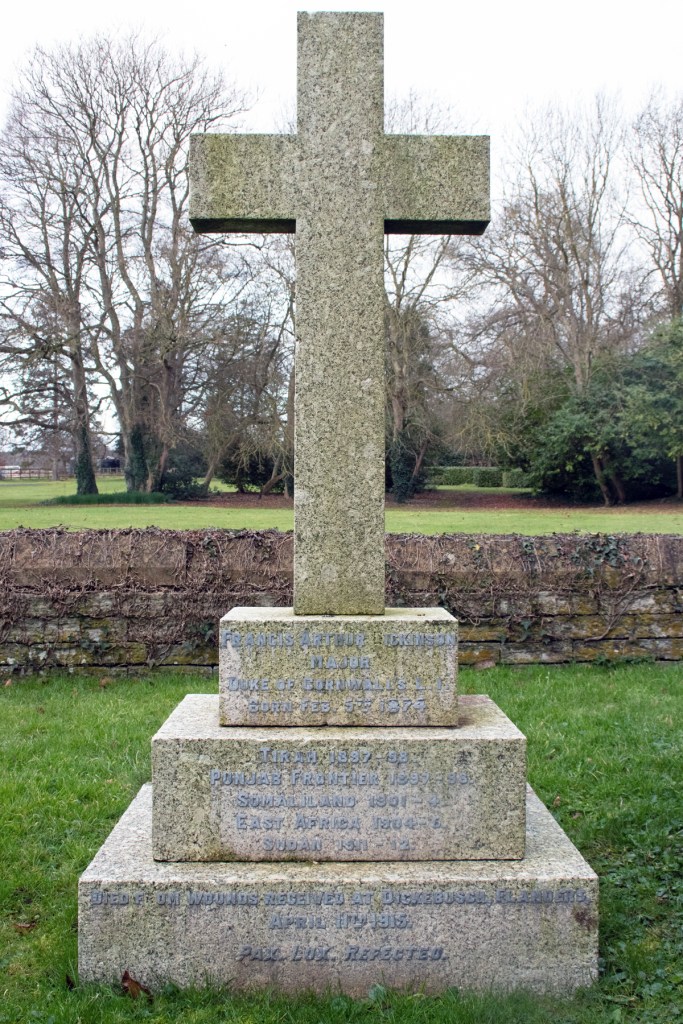
Francis Arthur Dickinson was born on 5th February 1874 in Lufton, near Yeovil, Somerset. The elder of two children, his parents were banker Arthur Dickinson, and his wife, Alice.
Francis was drawn to a military life. The 1891 census lists him as an army student at a boarding school in Cornwall, and by the end of the decade, he had enlisted in the Duke of Cornwall’s Light Infantry.
Over the next fifteen years, Francis served around the world, fighting in India, South and East Africa and in the Middle East. By the end of his term of service, he had risen to the rank of Major. During this time, he had been awarded a number of decorations, and had been mentioned in dispatches twice for his gallantry.
On 23rd July 1914, Francis married Clare Phipps, the daughter of a man of private means from Dilton Marsh, near Westbury, Wiltshire. The couple married in Clare’s home village, but set up residence in the Dickinson family home in Kingweston, Somerset.
When war was declared in 1914, the newlyweds were on their honeymoon. Francis returned to the army and was offered the rank of Colonel, but turned it down, in order to return to the Duke of Cornwall’s Light Infantry. He soon found himself in the thick of things again, and was caught up in the fighting at Mons, Marne, Aisne and Messines.
In April the following year, Major Dickinson was wounded. Evacuated to a camp hospital in Boulogne, he was not to survive his injuries this time round. He passed away at the hospital on 11th April 1915, at the age of 41 years old.
Due to the masses of servicemen being killed, a decision had been taken by the government of the time to not repatriate the dead to Britain, but to bury them in cemeteries close to where they fell. However, whether because of his family’s connections, or because he passed on the Channel coast, Major Dickinson’s body was, in fact, brought back to Somerset.
Francis Arthur Dickinson was laid to rest with full military honours in the graveyard of All Saints’ Church. He was buried alongside other family members, and in the shadow of the family manor.
Ernest Stanley Bailey was born in the autumn of 1900 in the quiet Somerset village of Barton St David. The oldest of three children, his parents were stonemason William Bailey and his wife, Fanny.
Ernest was only 14 years old when war broke out, but his time to serve his King and Country came in the summer of 1918. He enlisted in the Devonshire Regiment and was assigned to the 53rd (Young Soldier) Battalion.
Private Bailey was sent to the Rollestone Camp, near Shrewton in Wiltshire for training. With the war in its closing months, army barracks were still places rife with disease, and Ernest was not to be immune from this. He contracted influenza, which then became pneumonia, and was admitted to the camp hospital. Sadly, the conditions were to prove too much for his young body to bear, and he passed away on 6th November 1918. He was just 18 years of age.
Ernest Stanley Bailey was brought back to Somerset for burial. He was laid to rest in the peaceful graveyard of St David’s Church in his home village, Barton St David.
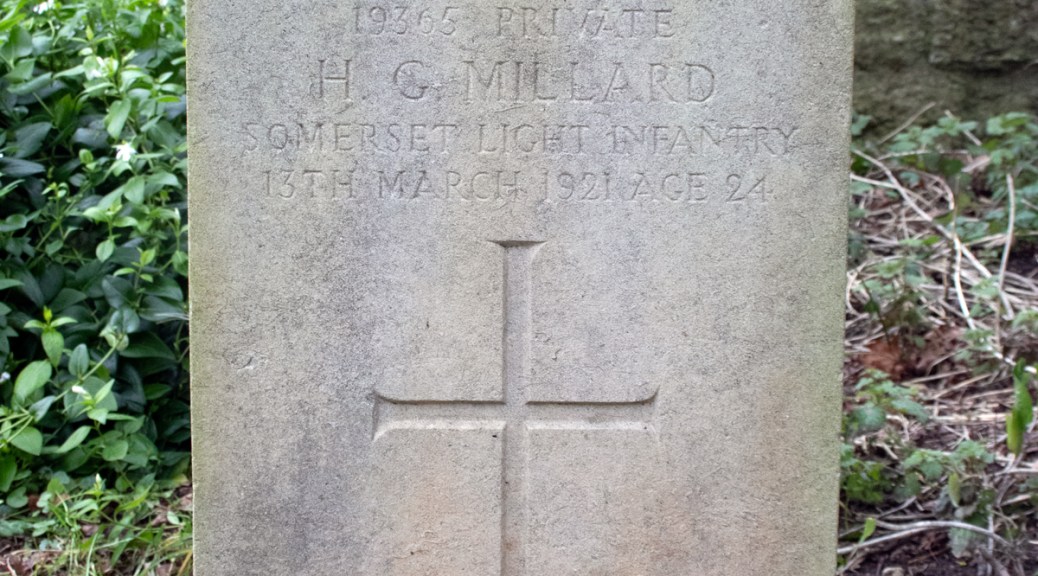
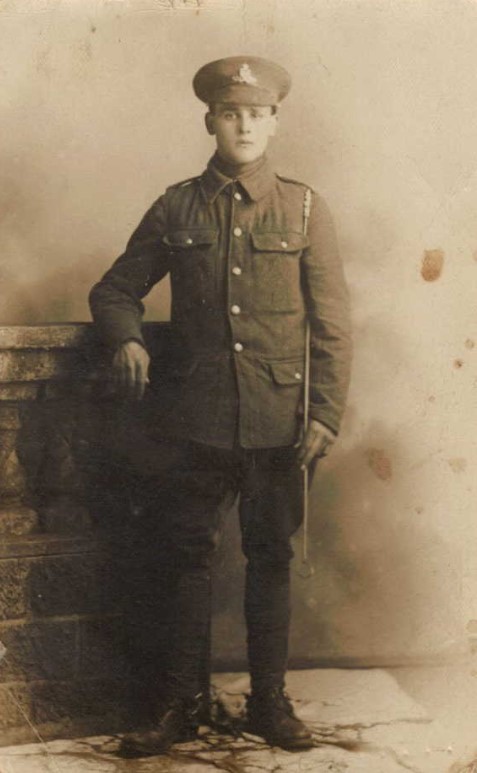
Herbert George Millard was born on 8th February 1897 in Wells, Somerset, and was the second of six children to John and Alice Millard. John was a cowman, and, as Herbert grew, the family moved with his father’s work.
By the time of the 1911 census, the family had set up home at the Castle of Comfort Public House in East Harptree, to the south of Bristol. John, by now, was recorded as being a farmer and inn keeper, while his three oldest sons, Herbert included, were all employed as farm hands.
When the war broke out, Herbert was keen to play his part. He enlisted on 8th February 1915, his eighteenth birthday, and was assigned to the Royal Field Artillery. Initially posted for training in Glasgow, within a couple of months, Gunner Millard had been transferred to the Somerset Light Infantry.
The now Private Millard was sent to France in July 1915, and ended up serving three separate periods on the Front Line: July 1915 to October 1916, May 1917 to August 1917 and March 1918 to June 1918.
At some point during his service, he received gunshot wounds to his chest and ‘upper extremities’. It is unclear when this happened, but it may have been what led to Private Millard’s ultimate discharge from service in August 1918.
At this point Herbert’s trail goes cold. He appears to have returned to Somerset, and was living with his family, who had now moved to Baltonsborough, to the south of Glastonbury. The next record for him is that of his passing: he died on 13th March 1921, aged just 24 years old.
Herbert George Millard was laid to rest in the quiet St Dunstan’s Churchyard in Baltonsborough.










 Death and Service