Frederick James White was born in the autumn of 1898, one of four children to Frederick and Emma White. Frederick Sr was a gas fitter from Frome, and the Somerset town was where the family were raised.
As a youngster, Frederick Jr attended the Primitive Methodist Sunday School in the town. He also acted as treasurer for the local YMCA. He was only 15 when war broke out, so was not able to enlist immediately.
However, by 1916 he had joined the 1st Battalion of the Devonshire Regiment as a Private and, at some point, was assigned to the Royal North Devon Hussars.
Either way, in whichever regiment he served, Frederick saw fighting in France, and was wounded in the autumn of 1917. Medically evacuated back to England, he was admitted to the temporary military hospital at Collegiate Hall in Sheffield.
The local newspaper shed a little more light into Frederick’s life:
Deceased, who was in the North Devon Hussars, died on November 22nd, at Sheffield, of wounds he received on November 5th. He was brought back to England three weeks to the day from the time he sailed for France.
Somerset Standard: Friday 30th November 1917
Private White’s wounds were too much; he passed away at the age of just 19 years old.
Frederick James White’s body was brought back to his home town. He was laid to rest in the Dissenters’ Cemetery in Vallis Road, Frome.
Frederick Sr and Emma White would have been understandably saddened by their son’s passing. They had four children; their eldest, Florence, had passed away before reaching her first birthday. Their youngest, Reginald, had died in childbirth. Frederick had died as a result of the First World War.
Sadly, the tragedy wasn’t yet over. Their only surviving child, Frederick’s younger brother William, passed away in August 1919, aged just 17 years old.
Frederick Sr and Emma had outlived all of their children, none of whom had reached or survived their teenage years.
Lionel James Fowler Bennett was born on 2nd September 1899, in the village of Cainscross, near Stroud in Gloucestershire. He was the only child of insurance agent Harry Bennett and his wife Louisa, who was a weaver.
By the time of the 1911 census, the young family had moved to the Somerset town of Frome. Louisa’s widowed mother had lived with the family since Lionel’s birth, and had moved to Somerset with her son-in-law. The family had also, by this time, taken in a boarder, presumably to help pay the rent.
With the move, Harry had also changed jobs, and was working as a power loom tuner, honing and fixing the weaving equipment. Lionel went into a similar role when he left school but, by now, war was imminent and, as soon as he was able to, he enlisted for King and Country.
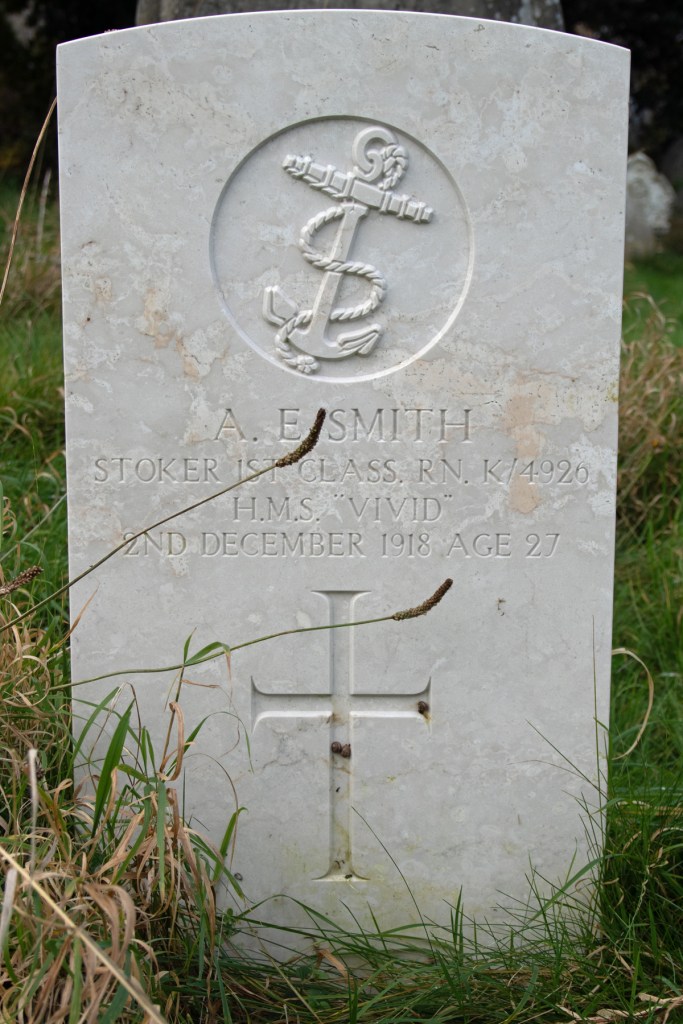
Harry joined up shortly after his eighteenth birthday, serving as a Stoker in the Royal Navy. He was sent to HMS Vivid in Devonport for training in November 1917, but, sadly, this was to be his undoing.
Barracks were notorious breeding grounds for infections and, within weeks, Stoker Bennett had been admitted to the Naval Hospital in Plymouth, suffering from pneumonia. He passed away on 5th January 1918, aged just eighteen years old and having served for just sixty days.
Brought back to his home in Frome, Lionel James Fowler Bennett was laid to rest in the Vallis Road Burial Ground (also known as the Dissenters’ Cemetery).
Edwin Lloyd was born at the start of 1885 and was the youngest of ten children. His father, Henry, was from Bristol; while his mother, Mary, had been born in Ireland.
Henry had been a Serjeant in the armed forces, and his postings are reflected in the places where Edwin and his siblings were born. Henry and Mary’s oldest two children were born in Aden, Arabia (now Yemen), but by 1875, the family were back in England and their next oldest child was born in Dover, Kent. Sarah, the youngest of Edwin’s sisters, was born in Colchester, Essex the following year, but by 1879, Henry had left the army, and had moved the family to Frome, Somerset.
In his retirement, Henry took a job as a grocer, the family living above the shop on the main thoroughfare into the town. Edwin did not follow his father’s trade when he left school; instead the 1901 census lists him as a metal engineer, one of only two of the siblings still living above Henry’s shop.
Henry died in 1907 – a lot of the documentation about his life suggests he was a bit free about his age. The notice in the Somerset Standard announcing his passing gives his age as 69, although it is likely that he was closer to 80.
The following year, Edwin married Florence Emily Letchford in St Matthew’s Church, Bristol. Florence was the daughter of a travelling salesman, but their marriage record sheds more light onto Edwin’s life by this stage and he was recorded as a police constable.
Edwin’s time in the police seems to have been short-lived, however, as, by the census three years later, his role had reverted to memorial brass engraver.
War was coming to Europe, and, while Edwin’s full service records are not available, it’s possible to piece together some of his life in the army. He enlisted in 1915, joining the Dorsetshire Regiment, and was assigned to the 5th (Service) Battalion.
Edwin’s battalion fought at Gallipoli and served in Egypt, moving finally to France in the summer of 1916. He was obviously a diligent soldier, as, by the end of the conflict, he had made the rank of Serjeant.
A local newspaper reported on the end of his army life:
He had served with the forces for about four years, and on his way home from France he was taken ill, and was, when he arrived at home, in a somewhat critical condition. The fatigue of the journey told still further upon him, and he passed away three days after his arrival.
Somerset Standard: Friday 7th March 1919
Serjeant Lloyd’s pension record gives the cause his passing as influenza, pneumonia and syncope, sadly none of which were uncommon for soldiers returning from the front. He was just 34 years old when he died on 25th February 1919.
Edwin Lloyd was laid to rest in the Vallis Road Cemetery (also known as the Dissenters’ Cemetery) in Frome.
Hugh Cyril Arthur Brooking was born on 15th September 1870 and was one of six children (although he also had three further half-siblings through his father’s first marriage). His father, Arthur Brooking, was the vicar of the Hertfordshire village of Bovingdon, and it was in the vicarage that he and his wife Marian raised their family (with the help of seven servants).
Hugh led a life befitting of a reverend’s son; he was educated at St Mark’s School in Windsor, Lancing College and Down College, both in Sussex. He continued his studies at the Mining College in London (now part of Imperial College London), and went out to South Africa to further that work.
The local newspaper reporting on his funeral takes up the story:
When the Boer War broke out he joined the Imperial Light Horse, and was engaged in the battles of Elandslaagte, Wagon Hill and others, was in Ladysmith during the siege, and the relief of Mafeking. He was several times mentioned in despatches, and obtained the Queen’s medal and six clasps, and the King’s medal with two clasps. He then joined the South African Constabulary, under General Baden Powell.
He had previously held a commission in the North Somerset Yeomanry, and after leaving it for a short time he re-joined a soon as the [First World War] was declared, and was in France with his regiment when it made its famous stand against the Prussian Guards. All his superior officers were killed or wounded, and he was temporarily in command of the regiment.
He received the ribbon of the 1914 Star of Mons, but did not live to get the star. He served with the regiment 20 years. He was latterly attached to the Labour Corps at West Ham.
Captain Brooking came to Frome with his parents as a boy. In his youth he was a thorough sportsman, well known in the hunting field, genial and kindly, ready with a pleasant word, and courteous to all, he won friendly appreciation from all classes of townsfolk.
He had seen a great deal of fighting, though from exposure and other causes his health suffered, and he was employed on home service.
He was in command of the 371st Labour Company, and second in command of his battalion, when he met with the slight accident which led to his death. He grazed his knuckles, causing bleeding, but of so slight a character that no notice was taken of it. A few hours later he again struck his hand, and fresh paint appears to have affected the wound, and blood poisoning supervened.
Somerset Standard: Friday 7th June 1918
In his personal life, Hugh had met and married Florence Day, a farmer’s daughter seventeen years his junior from Somerset. The wedding was in the autumn of 1912, and they would go on to have two children, Granville and Hugh Jr. The boys would both go on to lead distinguished lives, Granville in the armed forces and Hugh as a ‘King’s Messenger’ in South America.
Following Captain Brooking’s injury, he was admitted to the Military Hospital in Purfleet but the treatment he received there was to do no good. Three months after the accident, on 31st May 1918, he passed away; he was 47 years of age.
Hugh Cyril Arthur Brooking’s body was taken back to Frome; he was laid to rest in the graveyard of St John the Baptist Church in the town.
Henry Thomas Preece was born in the summer of 1884, one of seven children to agricultural labourer Tom Preece and his wife, Sarah. Thomas had been born in the Somerset village of Nunney, and it was here that he raised his family.
When Henry left school, he chose not to follow in his father’s agricultural footsteps. By the time of the 1911 census, he was recorded as a baker and, as such, would have been at the heart of village life in Nunney.
Henry married local woman Ellen Stone in 1909, who was a dressmaker with her own account. The couple would go on to have four children between 1909 and 1916.
With war looming, Henry felt the need to play his part. He joined the King’s Royal Rifle Corps in January 1916 and, after training, was sent to France a couple of months later.
He was wounded on July 25th, when out with a wiring party erecting barbed wire obstacles. He received a gun-shot wound in the abdomen, which also injured the spinal cord and his back. He was first taken to the South African Hospital at the base, and after being there for several days he was removed to England and take to the Netley Hospital where he died…
Somerset Standard: Friday 8th September 1916
Lance Corporal Preece died on 3rd September 1916, at the age of 32 years old. His body was brought back to Nunney, where he was laid to rest in the family grave at All Saints’ Church.
Lance Corporal Henry Preece (from britishnewspaperarchive.com)
Henry’s brother Walter also served in the First World War:
Last weekend Mrs Preece, of the Market-place, Nunney, was officially informed of the death of her son, Pte. Walter Preece, of the 1st Wilts, and the sad news was confirmed in the following letter received by Miss Preece from Segt. Banning…
“Just a few lines to let you know how poor Walter was killed in action, as I know you are very anxious to learn. Well, he was killed by a bit of shell, which killed him almost instantly. The poor chap did not suffer any pain at all. You don’t know how I felt it when I saw him lying dead on the ground. It made me feel ill for days, and I am sure is must have broke you and your mother’s hearts when you heard of it, but cheer up and bear it well. I only wish I was coming home, as then I would tell you more about it. I received a parcel which you sent to him. As they won’t send back any parcels which were intended for any killed or wounded, I took it, and must thank you very much for it. I am sending back all Walter’s photos to you, as I thought you would like them. I am very sorry I cannot stop to say any more, so I will now close, with my deepest sympathy with you and your mother in the loss of your dear brother, Walter.”
Pte. Preece had served nine years with the Colours, and of these three were spent in India and three in South Africa. He had just started work at Hallatrow Station as a porter when the war broke out and he was called up to join his regiment. He went through the battle of Mons, in which the Wilts suffered badly. He was slightly wounded at Loos, and was in hospital at Rouen some months with bronchitis. Pte. Preece was one of five brothers serving with the Colours, and the greatest sympathy is felt for Mrs Preece and family in their loss.
[Somerset Standard: Friday 28th July 1916]
While he was obviously a military man, full details of his prior service have been lost to time. The 1911 census found him in South Africa, and based on the newspaper report, he would have enlisted in 1905, as soon as he turned 18 years of age.
When war broke out, Walter was called upon to play his part once more. Attached to the 1st Battalion of the Wiltshire Regiment again, he was sent out to France during the first weeks of the conflict.
Private Walter Preece , he was killed at the Battle of Albert on 6th July 1916: he was 29 years of age. He was buried at the Thiepval Memorial.
Private Walter Preece (from britishnewspaperarchives.com)
The Sergeant who had written to Walter and Henry’s sister was Frederick John Banning. Born in Stow-on-the-Wold, Gloucestershire, in 1893, he was one of five children to John and Caroline.
Frederick joined up in the early weeks of the war, and had reached the rank of Sergeant by that fateful summer of 1916. Medically discharged from the army on 3rd July 1917, Frederick survived the war, and returned to Gloucestershire.
The autumn of 1918 was a tragic one for the Banning family, with three of Frederick’s siblings dying over a matter of weeks. No details are available about their deaths, but, given the time period, it seems likely that they succumbed to the flu pandemic running rampant at the time. Frederick’s older sisters Polly and Dora were 30 and 29 when they passed, while his younger brother, George, was just 17 years of age.
After the war had ended, Frederick married Mary Ann Brennan (known as Annie). A dock labourer’s daughter from Liverpool, it is unclear how the couple met. They exchanged vows in June 1919, and would go on to have ten children.
The 1921 census recorded the family living on Well Lane in Stow-on-the-Wold, with Frederick now working as a cattle dealer with his father. This he continued to do through to the 1939 Register, and the outbreak of the Second World War.
During the conflict, Frederick and Annie’s son, Frederick Jr, joined the Royal Navy, rising to the rank of Able Seaman. HMS Manners, the ship he was serving on was sunk by the German submarine U-1051 on 26th January 1945. His parents were desperate for news of their son:
BANNING – Frederick Anthony Banning AB No. 62490, reported missing at sea January 1945. Can anyone help with information? If so, kindly reply to Mr FJ Banning, No. 1 King George’s Field, Stow-on-the-Wold.
[Gloucestershire Echo: Friday 2nd February 1945]
News later came that Frederick Jr had been killed in the attack.
Frederick John Banning lived on until 1964. He died in Warwick on 2nd September that year: he was 71 years of age.
Henry Preece’s brother-in-law, James Robert Parsons, also served his country.
James – who was known by his middle name – was born in Frome, Somerset, in the summer of 1873, and was the middle of nine children to Nunney farm labourer Henry Parsons, and his wife, Mary.
Robert sought out a career, and enlisted in the 1st Battalion of the Somerset Light Infantry. Details of his service have been lost, but a later report suggests he spent sixteen years in the army.
It seems that Robert had returned to Somerset by the spring of 1912 taking up a job as a farm labourer. On 27th April he married Henry’s older sister Bessie. They lived in Nunney, but did not go on to have any children.
In March [1915] he volunteered for active service and joined the 6th Somersets, and he had only been 17 days at the Front when he met his death.
[Somerset Standard: Friday 17th September 1915]
James Robert Parsons was 42 years of age when he died. He is commemorated at the Menin Gate in Ypres. His suprerior wrote to Bessie as soon as he was able.
“Dear Madam, Just a line as I think it my place to write to you on behalf of your beloved husband, who was in my section. I am sorry to inform you that he was killed on Friday morning, 3rd September, and I may say we put him to rest in peace respectfully. I was very sorry to lose him, and the other men were also, as he was respected by all here. It is very hard luck on your part and his, as he was the only one we lost while up in the firing line. I am also sending photo, which I took from his pocket. I knew it was there, as he showed it to me a few days before we went into the trenches, so I thought it was my place to send it to you, as very likely you will be pleased to receive it. I sympathise with you in your loss and hope you will bear it as best you can. I should have written before, but we have only just come out of the trenches, so this is my first chance of writing. I remain, yours respectfully, Corpl. E Jones, 1st Co. 6th Somts.”
[Somerset Standard: Friday 17th September 1915]
His brother-in-law, Henry, died a year to the day after him.
Three members of the same family – two brothers, and a brother-in-law – had died within exactly a year. The impact on the Preece and Parsons families, and on Nunney as a community, must have been immeasurable.
Donald Mather Mees was born on 14th July 1900, the only child of Arthur and Mary from Mells, Somerset. Arthur was a grocer and wine merchant, who, by the time of the 1911 census, had set the family up in Warminster.
Given his young age, there is little documented about Donald’s early life; most of the information available comes from the newspaper reports of his passing:
The military funeral which passed through Frome on Wednesday afternoon was a very sad one. It was that of Private Donald Mather Mees, only son of Mr AH Mees, grocer… formerly of Mells…
The deceased was a somewhat delicate lad, and had only joined up a few weeks – less, we believe, that a month – when he was taken ill and succumbed to pneumonia at King George V Hospital at Dublin on 15th inst.
His parents had been notified of his illness and were preparing to visit him when their journey was interrupted by the news of his death.
Somerset Standard: Friday 23rd August 1918
Private Donald Mather Mees, of the Wiltshire Regiment, had died on 15th August 1918, at the age of 18. He was laid to rest in the graveyard of St Andrew’s Church in the village of his birth, Mells.
Basil Scott-Holmes was born on 2nd February 1884 in the Somerset village of Wookey. The oldest of two children, his father was Liverpool-born Thomas Scott-Holmes and his wife, Katherine. When Basil was born, Thomas was the vicar of St Matthew’s Church, Wookey, but by 1901, he had risen to the role of clergyman – and subsequently Chancellor – at Wells Cathedral.
Basil’s pedigree stood him in good stead. Initially educated in Llandaff, South Wales, he subsequently attended Sherborne School in Dorset. Sent up to Cambridge, he studied history at Sidney Sussex College.
After leaving university, Basil spent time in Europe learning German and French. He was then assigned the role of Assistant Commissioner in North Nigeria but, after a year there he was invalided home taking up a teaching role at the Bristol Grammar School in 1912.
In July 1913, Basil married Barbara Willey, a surgeon’s daughter from Reigate, Surrey. The marriage record shows that Basil was registrar for an architectural association by this point; the couple went on to have two children, daughters Annette and Prudence.
When the war broke out, he was obviously keen to do his bit. In September 1914 he enlisted in the Royal Army Service Corps, before gaining a commission in the King’s Royal Rifle Corps a couple of months later. In the spring of 1916, Lieutenant Scott-Holmes had been seconded to the Machine Gun Corps, although it is unclear whether he served abroad during any of his time in the army.
On the evening of 24th October 1916, Lieutenant Scott-Holmes was riding in a motorcycle sidecar through central London, on the way back to camp. A local newspaper picked up the story:
…they stopped when going through Wandsworth to re-light the near light, and in the dark a motor omnibus ran into them, and Lieutenant [Scott-Holmes], who was strapped in the side-car, was, with the car, flung across the road. He died as he was being taken to Wandsworth Hospital. At the subsequent inquest, a verdict of “accidental death” was returned.
Central Somerset Gazette: Friday 3rd November 1916
Basil Scott-Holmes was just 32 years old. His body was brought back to Somerset; he was laid to rest in the cemetery at Wells Cathedral.
Cuthbert Kean was born on 2nd October 1862, the eldest of four children to John and Jane Kean. John was a tailor from Manchester, who brought his young family up in the town of Crook, County Durham.
Cuthbert followed in his father’s footsteps and, by the time of the 1891 census – when he was 26 years old – was lodging in central Edinburgh, and was working as a tailor.
There is little more information available on Cuthbert’s early years. When war broke out, he enlisted in the Royal Navy, joining up on 26th October 1914. His papers show that he stood 5ft 2ins (1.57m) tall, had a fair complexion and grey eyes.
By 1917, having turned 55, he was transferred to the Royal Naval Reserve, and worked as a Trimmer – an alternative title for a Stoker. He had served on a number of vessels, joining HMS Firefly towards the end of the war.
Early in 1919, Trimmer Kean was admitted to the Royal Naval Hospital in Chatham, Kent, suffering from a sarcoma of the neck. Sadly, he was to succumb to this, and he passed away on 4th March 1919. He was 58 years old. His records give his next of kin as his sister Mary, who was living in Durham.
Cuthbert Kean was laid to rest in the Woodlands Cemetery in Gillingham, Kent.
Henry Teahen (or Teahan) was born in around 1898 in Castlegregory, County Kerry, Ireland. One of twelve children – eight of whom survived infancy – his parents were John and Catherine Teahan.
John was a wayman (or road surveyor), who was born in Kerry. Catherine was born in Wandsworth and it was in London that the couple met and married. By the time Henry was born, the family had moved back to Ireland, although Catherine had made the journey back to England in the early 1900s, after John passed away.
The 1911 census found the family living in Forest Gate in the east of the capital; Henry’s oldest brother, Joseph, was head of the household and, at 24, was working as a police constable. Schoolboy Henry was there, as was his mother, two more of his brothers, one of his sisters and his niece and nephew.
War was imminent, though, and, within a week of hostilities breaking out, Henry – who had been working as a waiter – enlisted in the Royal Marine Light Infantry. Private Teahen’s service records show that he was 5ft 8ins (1.72m) tall, had a fair complexion, grey eyes and brown hair. They also give his date of birth as 22nd June 1896, although he may have adapted this, as he would have been underage at the point he joined up.
Over the next few years, he served on a number of ships, switching between the Plymouth and Chatham divisions of the regiment. Full details of his duties are not immediately apparent, although is seems that he was injured while on board HMS Valiant in February 1916 – six months before her involvement in the Battle of Jutland – receiving a contusion to his right knee.
By the closing months of the war, Private Teahen had transferred back to the Naval Dockyard in Chatham, Kent. It was while here, early in 1919, that he fell ill. Details of his condition are lost to time, but it is known that he succumbed to them, passing away on 1st March 1919; he was 21 years old when he died.
Henry Teahen was laid to rest in the Woodlands Cemetery in Gillingham, within walking distance of the dockyard at which he was based.
Henry’s older brother James, also fought in the First World War. Full details are not clear, but documents show that he enlisted in the 6th City of London Regiment (also known as the City of London Rifles).
James’ regiment fought in many of the fiercest battles on the Western Front, including Loos, Vimy, High Wood and Messines, but it was at Ypres in the late summer of 1917, that he was injured. He died of his wounds on 30th September, aged just 23 years old.
Private James Teahan was laid to rest at the Mendinghem Military Cemetery in Poperinghe, Belgium.
Henry Wate was born on 15th June 1897, the youngest of seven children (four of whom survived) to Henry and Norah Wate. Henry Sr was from the East End of London. He raised his family in a three-room tenement in White Horse Alley, just off Cowcross Street, next to the busy Farringdon Station.
By the time of the 1911 census, Henry Sr and Norah had been married for thirty years. The head of the household, Henry was working as a rag dealer, while Norah was a housewife. Of their children, William (the eldest) worked as a labourer for a bike dealer, Annie was a packer in a chocolate factory, Nellie was a waitress and Henry Jr was still at school, though only just. Henry’s niece Julia was also staying with them, and was employed as a fancy leather worker.
When war broke out, Henry Jr was working as a carman, carting goods to and from the nearby railway. When the call came, however, he joined up, enlisting in the Royal Navy as a Stoker 2nd Class. After a couple of months training at HMS Pembroke – the shore establishment at the Naval Dockyard in Chatham – he was assigned to HMS Wallington. This was a trawler, requisitioned by the Royal Navy to act as a boom/balloon vessel, presumably to tether barrage balloons.
In January 1917, Henry received a promotion to Stoker 1st Class. He returned to Chatham six months later. That summer, HMS Pembroke was becoming crowded and he was billeted at the Chatham Drill Hall.
On 3rd September 1917, the building took a direct hit from a German bomber. Stoker Wate, along with nearly 130 others, was killed instantly. He was just 20 years old.
Henry Wate was laid to rest – along with the others who perished that night – in a mass funeral on 6th September 1917 at the nearby Woodlands Cemetery in Gillingham.
Full details of the night raid on Chatham Drill Hall can be found here.
Henry’s older brother William also served in the Great War. Twelve years older than his brother, William joined the Royal West Surrey Regiment in January 1915 as a Private. He was posted to France in July, and ended up serving on the Front Line for nearly four months.
In September 1915, Private Wate fell ill with heart palpitations. Shipped back to England for treatment, he was admitted to the Brook War Hospital in Greenwich, South London. The medical report confirmed that William had had rheumatic fever as a child, and had had an attack of ‘sycope’ (low blood pressure and a loss of consciousness) in 1911. The report concluded that he had heart disease and he was discharged from military service in 1916, as a result of this.
Little is known about William’s post-army life. All that can be confirmed is that he passed away from his heart condition on 23rd November 1918 aged 33. He was buried in St Mary’s Roman Catholic Cemetery in Kensal Green, North London.