Category Archives: injury

Corporal Cyril Allen

Corporal Cyril Allen

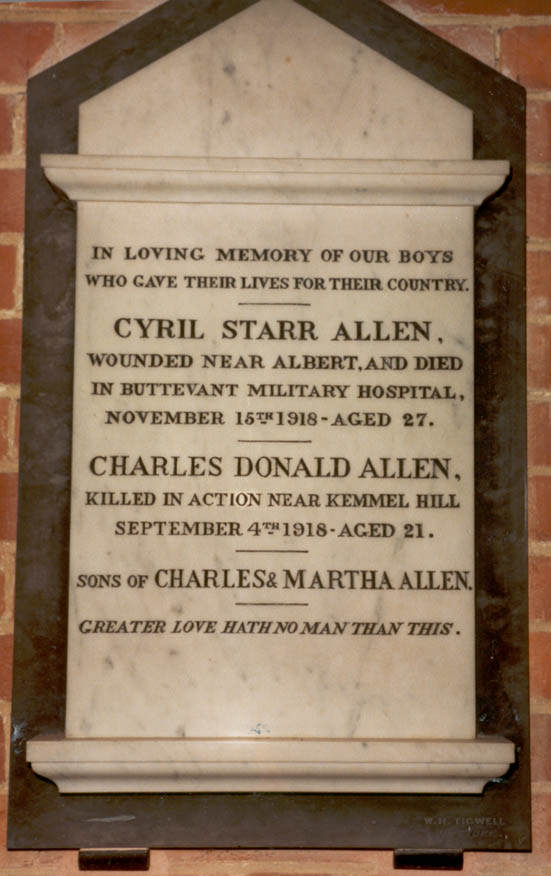
Cyril Starr Allen was born on 15th June 1891 in the village of Baughurst, near Tadley in Hampshire. He was the second youngest of five children to Charles and Martha Allen. Charles was a rate collector, and the family moved around the county during Cyril’s early years.

By the time Cyril left school, Charles had become an assistant bursar in Wootton, near Basingstoke. Cyril, meanwhile, had found similar administrative employment and was working as a clerk for a local land agent.

At the start of 1911, Cyril enlisted in the British Army. He joined the 4th Battalion of the Wiltshire Regiment as a Private and was soon based on Salisbury Plain. His service records confirm that he was 19 years and 7 months old, and stood at 5ft 5ins (1.65m) tall. Private Allen served for his initial term of four years, before being remobilised.

In November 1915, Cyril married Mabel Young. She was a printer’s daughter from Wiltshire, and the couple married in Salisbury, before settling down in Frome, Somerset. They went on to have a child, a daughter they called Kathleen.

Remobilised in the autumn of 1915 Private Allen received a series of promotions – to Lance Corporal, Corporal, Lance Sergeant and Sergeant, and, by June 1917, he found himself at the Front.

On 22nd April 1918, Cyril was injured, sustaining gunshot wounds to his shoulder and left arm. He was invalided back to England for treatment, and was hospitalised in the north of the country. He was then transferred to the Royal Welch Fusiliers with the rank of Corporal and sent to Ireland to continue his recovery and work light duties.

While in Ireland, Corporal Allen contracted influenza and was admitted to the Buttevant Hospital in County Cork. Sadly, in his weakened state, it was something he was to succumb to, and he passed away, with Mabel at his bedside, on 15th November 1918. He was just 27 years of age.

Cyril Starr Allen’s body was brought back to England; he was laid to rest in the graveyard of Christ Church in Frome, Somerset.


Corporal Cyril Allen (from ancestry.co.uk)

After the loss of her husband, Mabel went on to live her life. In 1923, she married James Burr, a draughtsman from Frome; they went on to have a child – a brother for Kathleen – called James.


Cyril’s two brothers, Winthrop and Charles, also fought in the First World War.

(from ancestry.co.uk)

Winthrop had emigrated to North America in 1911, but returned to Europe as part of the Canadian Expeditionary Force when war broke out.

Lance Corporal Charles Allen served with the 15th Battalion of the Hampshire Regiment. He fought on the Western Front and was killed near Kemmel Hill in Belgium on 4th September 1918. He was just 21 years old. Charles is commemorated at the Tyne Cot Memorial in Zonnebeke, Belgium.


Private Harry Maidment

Private Harry Maidment

Henry James Maidment – known as Harry – was born in Penarth, South Wales, in the autumn of 1890. He was one of seven children to Somerset-born Henry and Minnie Maidment. Henry Sr was a general labourer, and, when he died in 1899, Minnie remained in Penarth, earning money to support the family as a hawker of fruit.

By the time of the 1911 census, most of Minnie’s children were still living at home, with all but one of them working. Harry was employed as a van driver for a laundry, while his siblings were working variously as labourers, sailors and a housekeeper.

In the autumn of 1911, Harry married Annie Hillier, a servant who had been born in Yeovil, but who had also moved to South Wales. The couple went on to have a son, Henry, in October 1912, but he tragically passed away when he was just a couple of months old. They were not to have any other children.

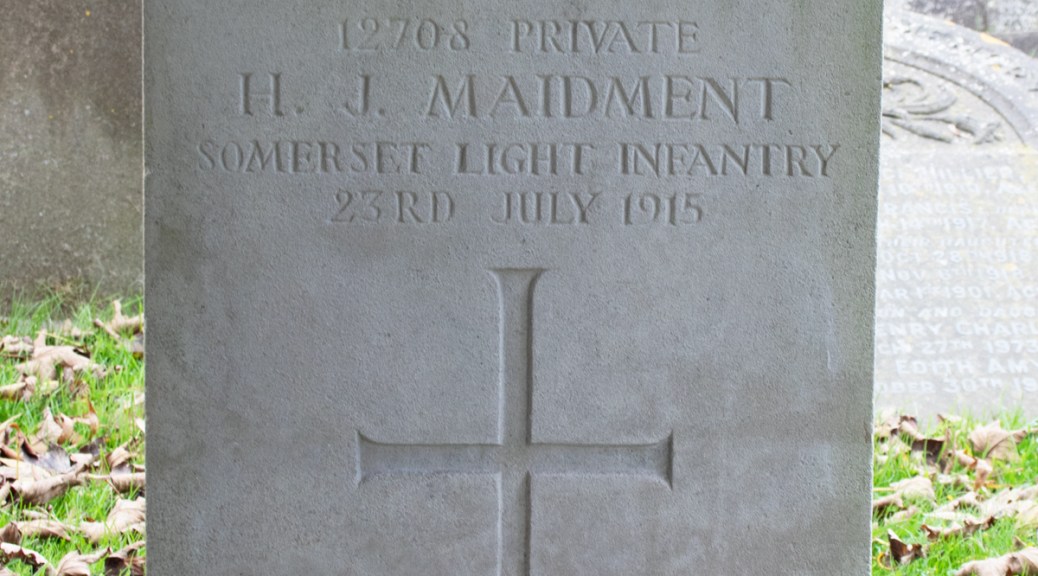
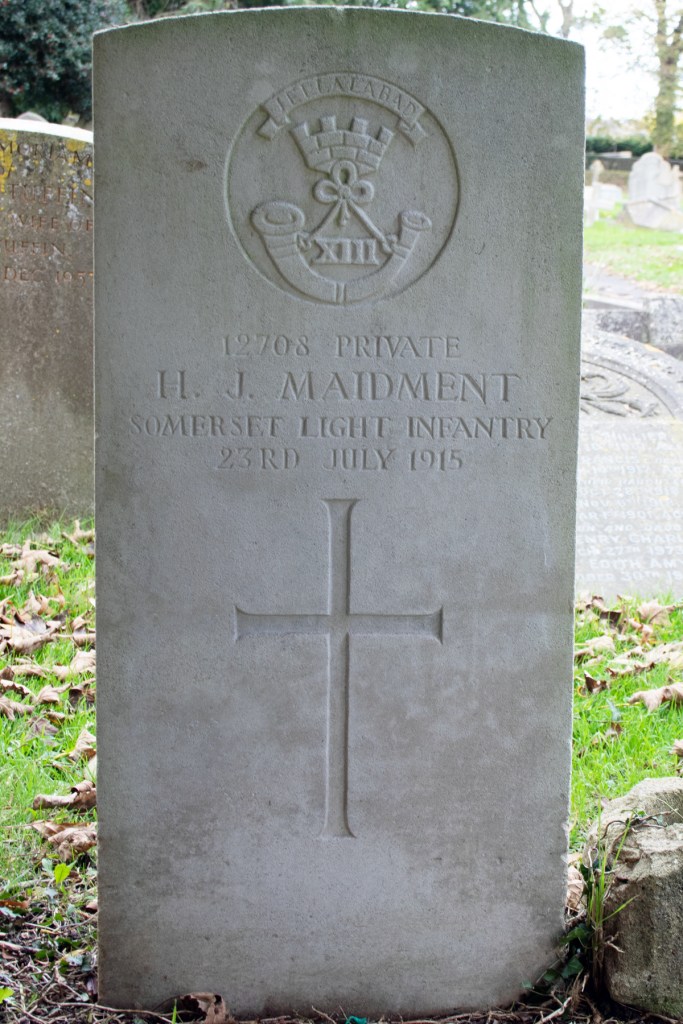
War was coming to Europe by this point, and Harry was keen to play his part. He enlisted towards the end of 1914, joining the 1st Battalion of the Somerset Light Infantry as a Private. He arrived in France at the beginning of May 1915, and would have seen fighting at Ypres that spring.

It seems that Private Maidment was wounded at Ypres; he was medically evacuated home and was admitted to the Graylingwell Hospital in Chichester, West Sussex. Details of his injuries are not available, but they must have been severe; he passed away from them on 23rd July 1915, aged just 25 years old.

Harry James Maidment’s body was brought back to Somerset; he was laid to rest in the graveyard of Christ Church, Frome, his parents’ home town, and where his widow, Annie was living.


Private John Hallett

Private John Hallett

John Hallett – better known as Jack – was born in the spring of 1891 in the Somerset town of Frome. One of twelve children, his parents were carpenter Frederick Hallett and his wife, Elizabeth. When he left school, Jack found work at a printer’s, helping with the typesetting.

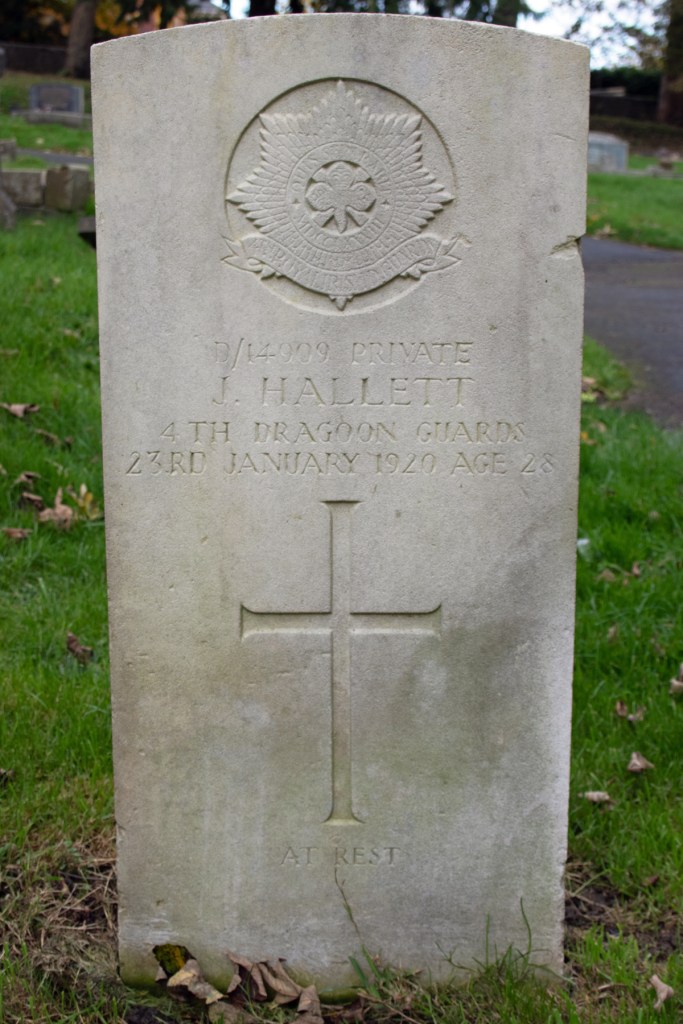
War was approaching, and Jack was keen to do his bit. While full details of his military service are not available, it is clear that he enlisted as a Private in the Royal Irish Dragoon Guards. He served in France with the 4th Battalion, arriving there in October 1915.

A later report suggests that Private Hallett was “seriously wounded several times during the war” [Somerset Standard: Friday 30th January 1920], although no specific details are available about his injuries. He survived the conflict and was awarded the British and Victory Medals and the 1915 Star for his service.

Demobbed and back at home, it seems that John did not fully recover from his wounds. He was admitted to the Victoria Hospital in Frome in January 1920, and died there a matter of days later. He was just 28 years old.

John Hallett was laid to rest in the graveyard of Christ Church in his home town of Frome, Somerset.


The local newspaper gave a more detailed report on John’s funeral:

Ex-Soldier’s Death

The funeral took place yesterday afternoon at Christ Church of Mr John Hallett, aged 29, of The Butts, Frome, who passed away at the Victoria Hospital on Friday last. Deceased had been seriously wounded several times during the war, and a day or two ago was removed to the hospital. The Rev. J Howard Lewis conducted the service, which was attended by local Oddfellows, to which society the deceased belonged, and by a number of other representative mourners.

Somerset Standard: Friday 20th January 1920

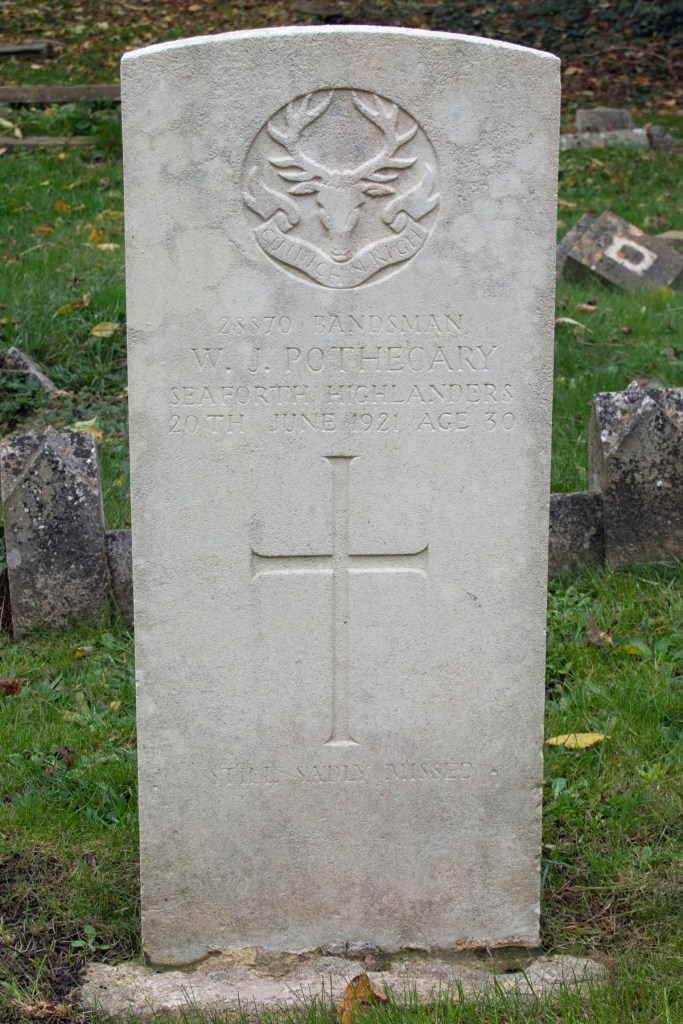
Bandsman William Pothecary

Bandsman William Pothecary

William James Pothecary was born in Frome, Somerset, on 24th April 1891, one of six children – and the only boy – to Francis and Annie Maria Pothecary. Francis was a groom, and the couple raised the family in Pilly Vale (now Willow Vale) which ran alongside the River Frome in the centre of the town.

Little further information on William’s early life is available, although it seems he was a keen musician, and took up the oboe at an early age. He joined the 2nd Seaforth Highlanders in 1909 as a Bandsman, and, from later reports, was a talented player.

When was broke out, William was sent to the front, but in 1915, while caught up in the Second Battle of Ypres, he was buried and seriously wounded by a bomb. He was sent to a convalescent home in Ireland, recovered reasonably well and returned to France, where he served until the end of the war.

Bandsman Pothecary was demobbed in July 1919 and returned to Somerset. The following year, he needed an operation following the recurrence of the issues he encountered following his injury, and all seemed to be going well for a long-term recovery.

William had a relapse in the summer of 1921, and was admitted to Bath Hospital. Sadly, however, he was not to recover this time, and he passed away on 20th June. He had just turned 30 years old.

William James Pothecary was laid to rest in the graveyard of Christ Church in his home town of Frome.


The Somerset Standard gave a glowing obituary for young William:

Death of an “Old Contemptible”

The was, through the fighting is over, still claims victims from the ranks of survivors. On Monday, Mr William James Pothecary, one of the “Old Contemptibles”, died in the Pensions Hospital at Bath from the effects of wounds which he received in 1915. He was the only son of Mr and Mrs FW Pothecary, of Bath Street, and very deep sympathy is felt with the parents and sisters in their great bereavement. Mt WJ Pothecary was an old Regular.

Nearly twelve years ago he joined the 2nd Seaforths. He was a talented player of the oboe, and it was his love of music which prompted him to become a bandsman in the 2nd Seaforths. He had previously been a bugle boy in the old Volunteers, and afterwards a member of the Territorial Band. And at the time of his death he was one of the most valued players in the Frome Town Military Band.

He went to France with his regiment in 1914. In 1915 he was seriously wounded and buried by a bomb. His condition was critical for a long time, but he slowly recovered and was sent to a convalescent camp in Ireland. He remained there for a considerable time, and when he was deemed medically fit he was sent to France a second time. He continued to serve in France until after the Armistice. He was discharged from the Army in July 1919.

Last year it was necessary for him to undergo a very serious operation in hospital. The operation was successful, and it was hoped there would be a permanent recovery. But on Thursday last there was a recurrence of an old trouble, and he was removed to Bath Hospital, where he died on Monday morning.

He was a talented and promising young fellow, and his death is deeply deplored by his many friends, and not least by his fellow members of the Frome Town Military Band.

Somerset Standard: Friday 24th June 1921

Boy Clifford Day

Boy Clifford Day

Clifford Day was born on 27th November 1897 in Weston-super-Mare, Somerset. He was one of eleven children to John and Sophia Day. John initially worked as a general labourer for a stonemason, but by the time of the 1911 census, he had begun working for a gas company. The family, at this point, were living in a five-room house a short distance from the town centre.

Living in a large household, a dream of escape may have fermented in young Clifford’s mind. To see some of the world, he joined the Royal Navy on 3rd September 1913. Given he was only fifteen, he was too young to formally enlist, but he was given the rank of Boy, and set to work.

Clifford’s service papers confirmed that he stood at 4ft 11ins (1.48m) tall, had brown hair, brown eyes and a fresh complexion. It was also noted that he had a scar on his forehead.

Boy Day’s service began on HMS Impregnable, where he spent nine months learning the ropes. He moved on to HMS Gibraltar in May 1914, before transferring to HMS Vivid – the shore-based establishment in Devonport – at the outbreak of the First World War.

On 3rd October 1914, Clifford was assigned to the battlecruiser HMS Tiger. He was on board for only three weeks, when he was taken back to HMS Vivid, and sent to the Naval Hospital there. He was admitted with a fractured skull, sadly passing the next day – the 26th October 1914 – at the age of just 16 years old. I’ve been unable to locate any further information about his injury, other than that an inquest found that it was accidental death.

Clifford Day was brought back to Weston-super-Mare for burial. He was laid to rest in the Milton Road Cemetery in the town.


Private Charlie Badman

Private Charlie Badman

Charles Badman – better known as Charlie – was born in 1895 in the Somerset seaside town of Weston-super-Mare. His parents were stonemason Henry Badman and his wife Caroline.

Unfortunately, there is little documented information about Charlie’s early life. By the time of the 1911 census, the family were living in a terraced house in Clevedon Road, Weston-super-Mare, a short distance from the sea. Charlie’s four oldest brothers had left home by this point, but his other two siblings – his dressmaker sister Martha and his plasterer brother Arthur – were still living with their parents. Charlie, at this point, was still at school.

When war was declared, Charlie was keen to do his bit. He enlisted in the Royal Army Medical Corps, and was assigned to the 65th Field Ambulance as a Private. This section was connected to the 21st Division, which saw action on the Western Front at Loos, the Somme, Arras, Passchendaele and Cambrai, although it is not possible to determine how Private Badman was involved in these battles. He was awarded, however, the Victory and British Medals for his service.

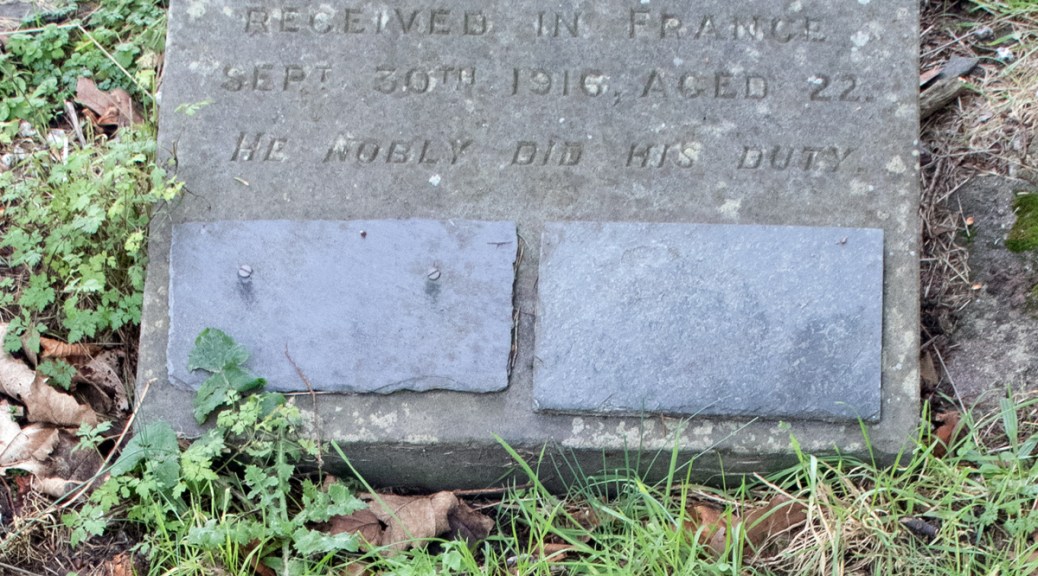
The only other concrete information available for Charlie is the inscription on his gravestone. This confirms that he was wounded in France on 7th September 1918. It seems that he was medically evacuated to England, and was admitted to a military hospital in Bristol, not far from his family in Somerset.

Sadly, it seems that his wounds proved too severe; he died at the hospital five months later, on 4th February 1919, aged just 25 years old.

Charlie Badman was brought back to Weston-super-Mare for burial. He lies at rest in the Milton Road Cemetery in the town.


Private Percy Coward

Private Percy Coward

Percy Herbert Coward was born in the Wiltshire town of Westbury in the autumn of 1896. He was one of seven children – all boys – to Lily Coward and her weaver husband Charles. Not long after Percy was born, the family moved across the county border to Frome, Somerset, presumably for Charles’ work.

By the time of the 1911 census, the Coward family were living in a five-room end-of-terrace cottage on the outskirts of the town. Charles and Percy were both working as warpers – threading looms – in the cloth industry; two of his brothers were working for a printer in the town. Percy was proving himself an integral part of the community.

[Percy] was very highly esteemed by a large circle of acquaintances… He was a worker with the YMCA and Frome Brotherhood, a member of the band and in other directions showed himself a young man of much promise. He was employed successively at Messrs Houston’s [Woollen Mill] and at the Silk Factory.

Somerset Standard: Friday 26th April 1918

An active member of the town’s territorial force, when the Great War broke out he was mobilised. Initially attached to the Royal Army Medical Corps, he subsequently served with the Royal Army Service Corps and the North Staffordshire Regiment, before obtaining his final transfer to the 42nd Company of the Machine Gun Corps.

During his time in the army, Private Coward would have seen action in some of the fiercest battles of the war – at the Somme, Arras and Ypres. In the spring of 1918, his battalion was involved in the Battles of St Quentin and the Avre, and it was during this last skirmish that he was wounded.

Percy’s injuries were severe enough for him to be medically evacuated back to England and, once there, he was admitted to the Royal Woolwich Hospital in South London. His wounds were to prove too much for him, however, and he passed away at the hospital on 12th April 1918. He was just 21 years of age.

Percy Herbert Coward was brought back to Somerset for burial. He was laid to rest in the Dissenters’ Cemetery, Vallis Road, within walking distance of his family home.


Private Frederick White

Private Frederick White

Frederick James White was born in the autumn of 1898, one of four children to Frederick and Emma White. Frederick Sr was a gas fitter from Frome, and the Somerset town was where the family were raised.

As a youngster, Frederick Jr attended the Primitive Methodist Sunday School in the town. He also acted as treasurer for the local YMCA. He was only 15 when war broke out, so was not able to enlist immediately.

However, by 1916 he had joined the 1st Battalion of the Devonshire Regiment as a Private and, at some point, was assigned to the Royal North Devon Hussars.

Either way, in whichever regiment he served, Frederick saw fighting in France, and was wounded in the autumn of 1917. Medically evacuated back to England, he was admitted to the temporary military hospital at Collegiate Hall in Sheffield.

The local newspaper shed a little more light into Frederick’s life:

Deceased, who was in the North Devon Hussars, died on November 22nd, at Sheffield, of wounds he received on November 5th. He was brought back to England three weeks to the day from the time he sailed for France.

Somerset Standard: Friday 30th November 1917

Private White’s wounds were too much; he passed away at the age of just 19 years old.

Frederick James White’s body was brought back to his home town. He was laid to rest in the Dissenters’ Cemetery in Vallis Road, Frome.


Frederick Sr and Emma White would have been understandably saddened by their son’s passing. They had four children; their eldest, Florence, had passed away before reaching her first birthday. Their youngest, Reginald, had died in childbirth. Frederick had died as a result of the First World War.

Sadly, the tragedy wasn’t yet over. Their only surviving child, Frederick’s younger brother William, passed away in August 1919, aged just 17 years old.

Frederick Sr and Emma had outlived all of their children, none of whom had reached or survived their teenage years.


Captain Hugh Brooking

Captain Hugh Brooking

Hugh Cyril Arthur Brooking was born on 15th September 1870 and was one of six children (although he also had three further half-siblings through his father’s first marriage). His father, Arthur Brooking, was the vicar of the Hertfordshire village of Bovingdon, and it was in the vicarage that he and his wife Marian raised their family (with the help of seven servants).

Hugh led a life befitting of a reverend’s son; he was educated at St Mark’s School in Windsor, Lancing College and Down College, both in Sussex. He continued his studies at the Mining College in London (now part of Imperial College London), and went out to South Africa to further that work.

The local newspaper reporting on his funeral takes up the story:

When the Boer War broke out he joined the Imperial Light Horse, and was engaged in the battles of Elandslaagte, Wagon Hill and others, was in Ladysmith during the siege, and the relief of Mafeking. He was several times mentioned in despatches, and obtained the Queen’s medal and six clasps, and the King’s medal with two clasps. He then joined the South African Constabulary, under General Baden Powell.

He had previously held a commission in the North Somerset Yeomanry, and after leaving it for a short time he re-joined a soon as the [First World War] was declared, and was in France with his regiment when it made its famous stand against the Prussian Guards. All his superior officers were killed or wounded, and he was temporarily in command of the regiment.

He received the ribbon of the 1914 Star of Mons, but did not live to get the star. He served with the regiment 20 years. He was latterly attached to the Labour Corps at West Ham.

Captain Brooking came to Frome with his parents as a boy. In his youth he was a thorough sportsman, well known in the hunting field, genial and kindly, ready with a pleasant word, and courteous to all, he won friendly appreciation from all classes of townsfolk.

He had seen a great deal of fighting, though from exposure and other causes his health suffered, and he was employed on home service.

He was in command of the 371st Labour Company, and second in command of his battalion, when he met with the slight accident which led to his death. He grazed his knuckles, causing bleeding, but of so slight a character that no notice was taken of it. A few hours later he again struck his hand, and fresh paint appears to have affected the wound, and blood poisoning supervened.

Somerset Standard: Friday 7th June 1918

In his personal life, Hugh had met and married Florence Day, a farmer’s daughter seventeen years his junior from Somerset. The wedding was in the autumn of 1912, and they would go on to have two children, Granville and Hugh Jr. The boys would both go on to lead distinguished lives, Granville in the armed forces and Hugh as a ‘King’s Messenger’ in South America.

Following Captain Brooking’s injury, he was admitted to the Military Hospital in Purfleet but the treatment he received there was to do no good. Three months after the accident, on 31st May 1918, he passed away; he was 47 years of age.

Hugh Cyril Arthur Brooking’s body was taken back to Frome; he was laid to rest in the graveyard of St John the Baptist Church in the town.


Larger memorial image loading...
Captain Hugh Brooking
(from findagrave.com)

Lance Corporal Henry Preece

Lance Corporal Henry Preece

Henry Thomas Preece was born in the summer of 1884, one of seven children to agricultural labourer Tom Preece and his wife, Sarah. Thomas had been born in the Somerset village of Nunney, and it was here that he raised his family.

When Henry left school, he chose not to follow in his father’s agricultural footsteps. By the time of the 1911 census, he was recorded as a baker and, as such, would have been at the heart of village life in Nunney.

Henry married local woman Ellen Stone in 1909, who was a dressmaker with her own account. The couple would go on to have four children between 1909 and 1916.

With war looming, Henry felt the need to play his part. He joined the King’s Royal Rifle Corps in January 1916 and, after training, was sent to France a couple of months later.

He was wounded on July 25th, when out with a wiring party erecting barbed wire obstacles. He received a gun-shot wound in the abdomen, which also injured the spinal cord and his back. He was first taken to the South African Hospital at the base, and after being there for several days he was removed to England and take to the Netley Hospital where he died…

Somerset Standard: Friday 8th September 1916

Lance Corporal Preece died on 3rd September 1916, at the age of 32 years old. His body was brought back to Nunney, where he was laid to rest in the family grave at All Saints’ Church.


Lance Corporal Henry Preece
(from britishnewspaperarchive.com)