Category Archives: unknown

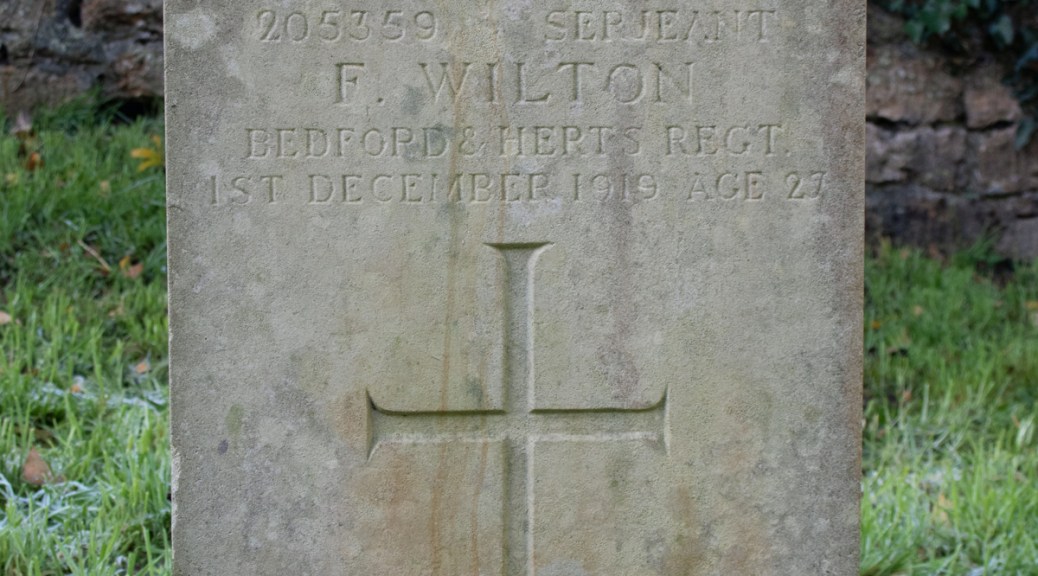
Serjeant Frederick Wilton

Serjeant Frederick Wilton

Frederick Uriah Wilton was born in Yarlington, Somerset, in the spring of 1892. One of thirteen children, his parents were farm labourer Thomas Wilton and his wife Mary.

Frederick and his brothers followed their father into agricultural labouring, and, according to the 1911 census, the family were living and working at Shatwell Farm, on the outskirts of Yarlington itself.

When war broke out, Frederick was keen to play his part. Details of his military service are difficult to piece together, but what is clear is that he enlisted in the Bedfordshire Regiment.

During his time in the army, Frederick rose to the rank of Serjeant. He survived the war and, in 1919, he was placed on furlough while waiting to be demobbed. Sadly, it is likely that he fell ill during this time, and he passed away on 1st December 1919, at the age of 27.

Frederick Uriah Wilton was laid to rest in the graveyard of St Mary’s Church in Yarlington.


Serjeant Wilton’s headstone notes that he served in the Bedfordshire and Hertfordshire Regiment. The two regiments were amalgamated in 1919, and Frederick was recorded as having served in the newly formed regiment.


Private Frederick Neale

Private Frederick Neale

In a quiet corner of St Peter & St Paul’s Churchyard in Aylesford, Kent, is a headstone dedicated to 35013 Private F Neale of the Gloucestershire Regiment. The memorial confirms that he died on 24th November 1918, but little more information remains on his life.

The Army Record of Soldiers’ Effects confirms his first name as Frederick, but that he was not eligible for the War Gratuity payment, which suggests that he had less than six months’ service when he passed.

The document also confirms that he was assigned to the 3rd Battalion of the Gloucesters, and that he had passed away at the Preston Hall Military Hospital in Aylesford. There is no next of kin of beneficiary for his personal effects, and so the trail goes cold.

With no age or date of birth it is impossible to trace any further details for Frederick. No other military records survive, nor is there any note of his passing or funeral in contemporary newspapers. Frederick Neale’s life is destined to remain lost to time.


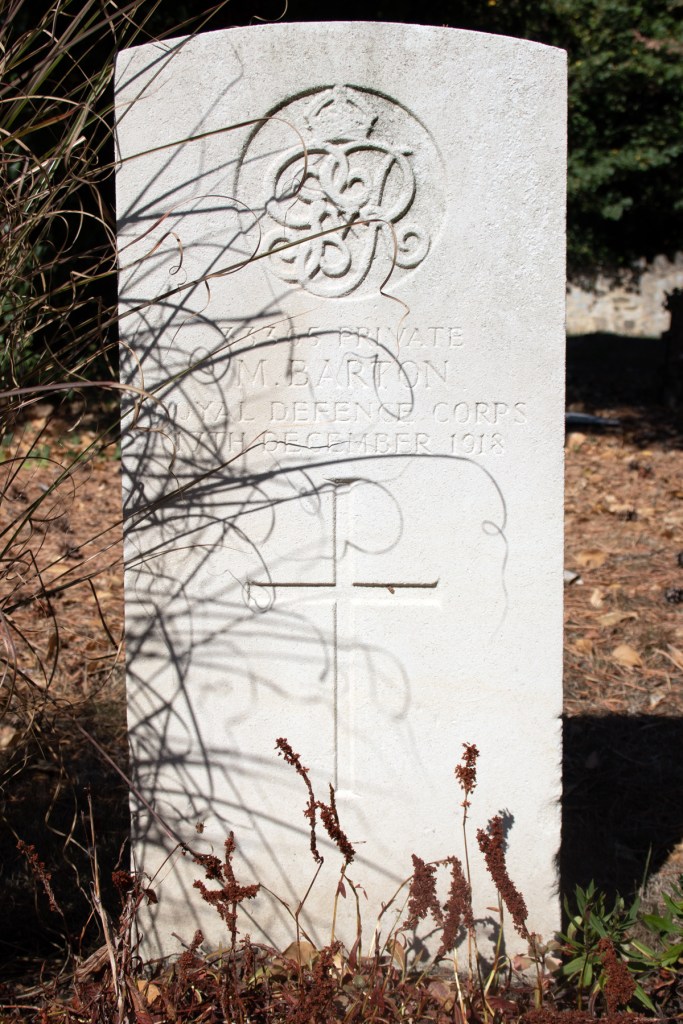
Private Michael Barton

Private Michael Barton

Michael Barton was born in the spring of 1863 in the Kent village of Hadlow. The youngest of three children, his parents were farm labourer William Barton and his wife Annie. Michael became a farm labourer when he left school and, when William died in 1890, he remained at home to support his mother.

Annie passed away in 1905, and this proved a turning point for Michael. By the time of the next census in 1911, he was recorded in the Tonbridge Union Workhouse, one of its 600 inmates.

Michael’s trail is harder to pick up at this point. Despite his age, it seems that he sought a way out of his situation when war broke out and had certainly enlisted in the army by the last year of the conflict. Initially joining the Royal Defence Corps, Private Barton was soon transferred to the Labour Corps, and was assigned to 572nd Agricultural Coy.

The next document relating to Michael is that of his passing. He died on 17th December 1918 at the Preston Hall Military Hospital in Aylesford, Kent, although the cause of his death is not readily available. He was 55 years of age.

Michael Barton was laid to rest in the graveyard of St Peter & St Paul’s Church in Aylesford, not far from the hospital in which he had passed.


The Army Register of Soldiers’ Effects records that Michael’s belongings passed to a Miss Kate Burley when he died. Not one of his immediate relatives, it is likely that she was a friend or other relation.


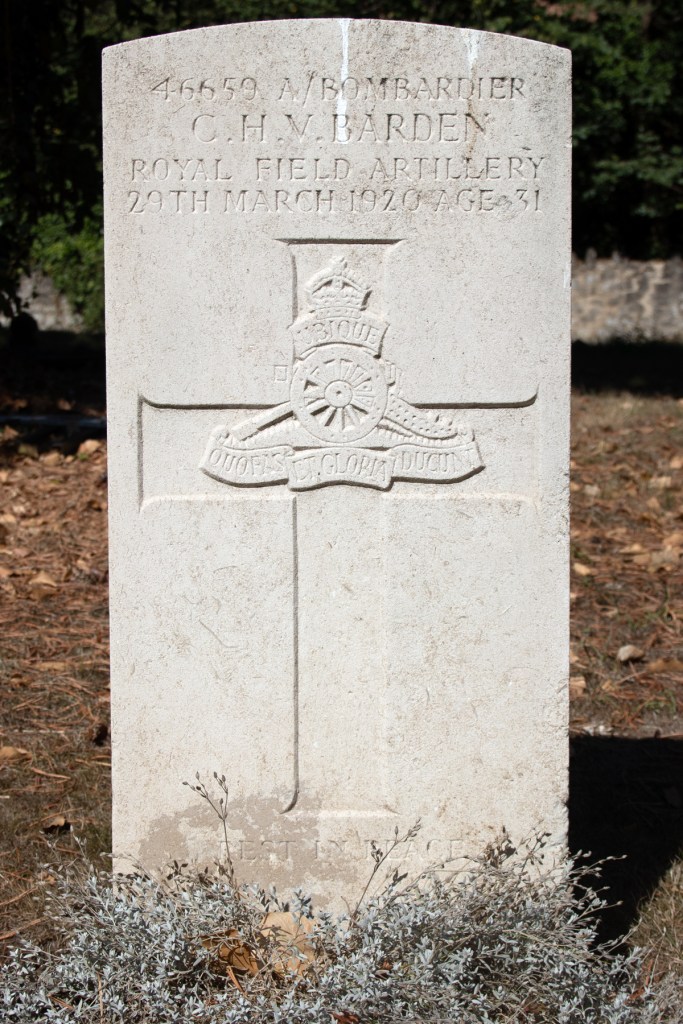
Acting Bombardier Charles Barden

Acting Bombardier Charles Barden

In the First World War section of St Peter and St Paul’s Churchyard, Aylesford, is the grave of Charles Henry Barden. Born in the summer of 1888 he was the sixth of seven children to Isaac and Harriett Barden. Isaac was a stoker at the local cement works, and this was an industry Charles’ brothers went into.

As for Charles, however, his life is more of a mystery, and it is possible to build a picture of him only from the snippets that are left behind. Even his full name is lost to time – his headstone is dedicated to CHV Barden, but what the V stands for is now unclear.

Absent from the 1911 census, what is known is that Charles’ father died in 1914 and that in August that year, Charles enlisted in the Royal Field Artillery. Driver Barden was sent to France within weeks of the declaration of war and, during the conflict he rose to the rank of Acting Bombardier.

In the spring of 1917, Charles married Angelina Pudney, who had been born in Rochford, Essex. The couple had twin daughters – Sarah and Emily – the following year, although tragically Sarah passed away before her first birthday.

It is unclear when or if Charles was demobbed when the Armistice was declared. He passed away at home on 29th March 1920, at the age of just 31 years old.

Charles Henry V Barden was laid to rest in the graveyard of St Peter and St Paul’s in his home village.


Angelina found happiness again after her husband’s death. She married again, to Alfred Hughes, in the spring of 1923.


Charles’ older brother George also fought in the First World War. He enlisted in the 1st Battalion of the Royal West Kent Regiment, and was killed in the fighting at Ypres. He was 36 years old when he died, and is commemorated on the Menin Gate.


Private Harold Wheeler

Private Harold Wheeler

Harold Wheeler was born on 22nd May 1898 in Gloucester. One of nine children, his parents were George and Emma Wheeler. George, who worked as a telegraphist and clerk for the Post Office, was from Rugby, but by the time he and his Swansea-born wife has their second child, they had settled down in Gloucestershire.

There is tragically little information on Harold’s life and it is impossible to know what he did between leaving school and enlisting in the army. War broke out in 1914, and, while too young at the time, he had joined up by early 1917.

Private Wheeler was assigned to the 3rd (Reserve) Battalion of the Gloucestershire Regiment. Based in Kent, he was billeted in Maidstone. The only other record available for him is that of his passing. He had been admitted to the Military Hospital in Aylesford, and died, through causes unknown on 24th June 1917. He had just turned 19 years of age.

Harold Wheeler was laid to rest in the graveyard of the nearby St Peter’s & St Paul’s Church in the Kent village where he had passed.


Driver James Roberts

Driver James Roberts

James Roberts was born in 1885 in Llangollen, Denbighshire. The youngest of three children, he was the son of Elias and Winifred Roberts. Elias was a builder’s labourer and, while James initially went into this line of work when he left school, by the time of the 1911 census, he was listed as being employed as a gamekeeper.

War broke out across Europe, and James was there to play his part for King and Country. Full details of his military service are not available, but he enlisted in the Royal Field Artillery, and was assigned to C Battery of the 161st Brigade. This was a Howitzer unit, and, as a Driver, James would have been involved in leading the horses pulling the cannons to where they needed to be.

There is no actual confirmation that James served overseas. He was, however, awarded the Victory and British Medals for his service. Driver Roberts survived the war, but again, details of what actually happened to him are lost to time.

What can be confirmed is that, by 1919, James had been admitted to the Wharncliffe War Hospital in Sheffield, and this is where, on 27th November that year, he passed away. He was just 34 years of age.

James Roberts was brought back to Llangollen for burial. He was laid to rest in the town’s Fron Cemetery.


Gunner George Curtis

Gunner George Curtis

George Henry Curtis was born in Oldland, near Bristol, in around 1887. His parents were George and Frances (Fanny) Curtis, and he was one of their four children.

There is little direct information about George’s life: his was a common name in the Gloucestershire area, and so it is difficult to identify if some documents are related to him nor not.

The first piece of concrete evidence for him is his marriage certificate. He wed Elizabeth May Henly on 7th November 1914. She was the daughter of an engineer, while George gave his trade as a tobacco operator (possibly making cigars and cigarettes). The wedding took place at St Anne’s Church in Oldland, local to bother bride and groom.

When war broke out, George stepped up to play his part and enlisted in the Royal Garrison Artillery as a Gunner. He did not see action overseas, but was awarded both the Victory and British Medals for his service.

Gunner Curtis’ adult life is hard to piece together. All that can be confirmed is that he passed away on 9th July 1921, at the age of 32 years old.

George Henry Curtis was laid to rest in the graveyard of the church in which he had been christened and married, St Anne’s in his home village, Oldland.


Private Alfred Bishop

Private Alfred Bishop

Alfred John Bishop was born on 25th April 1896 in the Devon village of Kingswear. The older of two children, his parents were John and Susanna Bishop. John was a farm worker, and his expertise with horses was not lost on Alfred, who became a delivery driver for a baker in Marldon, to the north of Paignton, when he left school.

On 3rd September 1917, Alfred married road contractor’s daughter Bessie Webber. Originally from Staverton, her family had settled in Ipplepen, and this is where the newlyweds made their home.

War had come to Europe by this point, and Alfred had enlisted in the Royal Army Service Corps (RASC). His background with horses came in useful, as he was assigned to the Yeomanry Remount Depot. Details of Private Bishop’s military service are lost to time, so it is unclear if he was attached to one of the RASC depots in the UK, or if he served abroad.

Alfred survived the war and, by 1919, was back home. He and Bessie had a son, Leslie, who was born on 23rd October 2020. Time with his son was to be tragically brief, however, as Alfred passed away on 14th April 1921. The cause of his death is not known, but he was just 25 years of age.

Alfred John Bishop was laid to rest in the graveyard of St Andrew’s Church in Ipplepen.


Bessie went on to marry again, to James Joint in the autumn of 1932. She passed away in Newton Abbot in 1980, at the age of 85.


Alfred’s brother James’ life was also cut short. He married Ethel Warren in 1925, and is recorded has having passed away in London in the autumn of 1935, when he was only 35 years old. Ethel was left with two young children to raise, and John and Susanna were to outlive both of their sons.


Lieutenant Thomas Denny

Lieutenant Thomas Denny

Thomas David William Denny was born on 26th December 1890 in Glasgow, Lanarkshire. There is little information on his early life, other than that his parents were Thomas and Annie Denny.

By the time of the 1911 census, Thomas Jr was serving as a Lance Corporal in the 2nd Battalion of the Gloucestershire Regiment, and was based at the Verdola Barracks in Malta.

When war broke out, the battalion was called back to mainland Europe. By 19th December 1914, Thomas found himself in France; two years later, he was in Salonika, Greece.

Thomas’ bravery was not in doubt. While serving in France, he received the Military Medal for conspicuous gallantry. This went hand in hand with a promotion to Sergeant. In 1917, he received a commission as Second Lieutenant and was moved to the regiment’s 3rd Battalion.

In the spring of 1918, Second Lieutenant Denny married Elsie, a woman from Bearsted, near Maidstone in Kent. Sadly, little else is known of her, and even a later newspaper report only referred to her as “a Bearsted lady” [East Kent Gazette: Saturday 15th March 1919].

By early 1919, Thomas was back in Britain. Whether he had been demobbed is unclear, but is seems more likely that he had returned home for medical treatment. On 6th March, he passed away in Maidstone. He was just 28 years of age.

Thomas David William Denny was laid to rest in the graveyard of Holy Cross Church in Bearsted close to where the now-widowed Elsie must have lived.


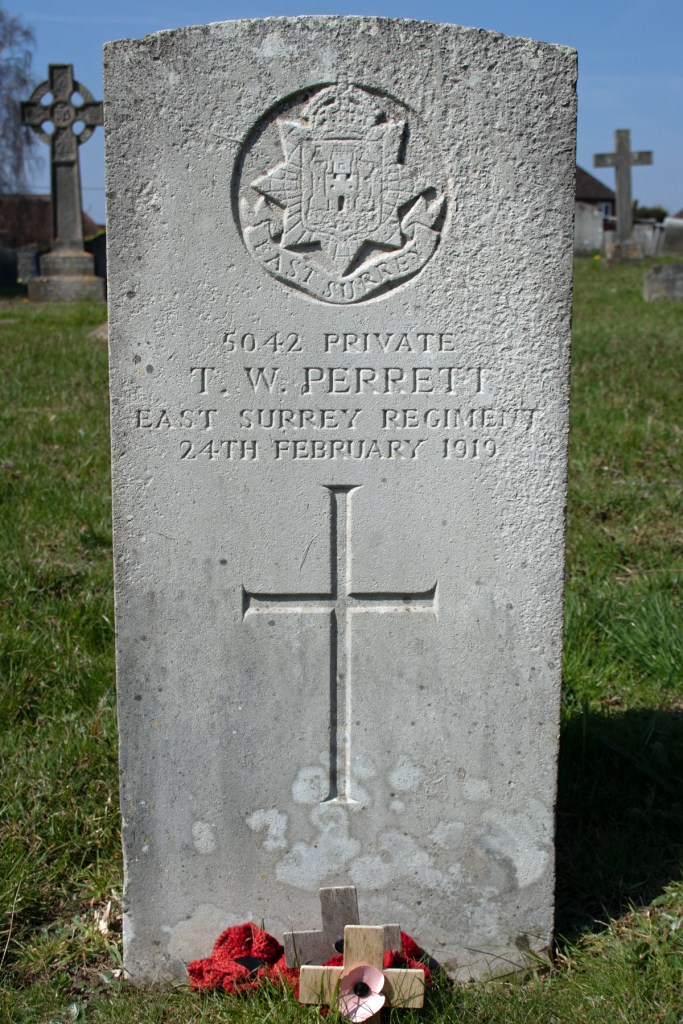
Private Thomas Perrett

Private Thomas Perrett

Thomas William Perrett was born in October 1878, the seventh of eight children to Lewin and Ann Perrett. Lewin was an agricultural labourer from Wiltshire, and it was in Aldbourn, near Marlborough, that the family were raised.

Initially finding work as a farm labourer, Thomas was soon drawn to the bright lights and big city. By the early 1900s he had moved to London, and it was here that he met, and in 1909 married, Mary Sterry, a labourer’s daughter from Middlesex. The couple went on to have three children, Elsie, Rose and Alice.

Thomas, by this point, had found work on the railways: the 1911 census records him as a railway porter, presumably at Paddington Railway Station, which was within a few minutes’ walk of where the Perrett family were living.

War came to Europe, and Thomas was keen to play his part. Full details of his service are not available, but he enlisted in the East Surrey Regiment, where he was assigned to the 2nd/5th Battalion. This was a second line unit, and Private Perrett remained on home soil for the duration of the war.

This territorial role was reinforced when he transferred across to the 696th Agricultural Company of the Labour Corps. Details of his work are not available, but it seems likely that he was assigned to farm work in the mid-Sussex area.

This too is where Private Perrett remained after the war and where, on 24th February 1919, he was to pass away. Details of his death are vague and the cause is unknown, but he was 40 years of age.

Thomas William Perrett was laid to rest in the cemetery in Cuckfield, West Sussex.