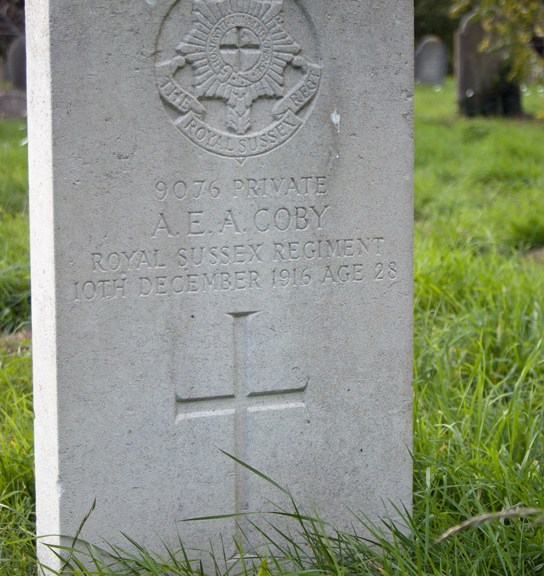
There are some mysteries that are just destined not to be solved, no matter how much digging you do. One gravestone in Worthing’s Broadwater Cemetery, dated 10th December 1916, proved to be one of those.
Research across the standard platforms revealed very little. There was no AEA Coby on Ancestry, the service number 9076 did not reveal anything on the Fold3 website. The name Coby did not feature in any contemporary newspaper article in December 1916 or January 1917.
One lead suggested that Private Coby’s first names are Albert Ernest, but again, this drew a blank. Another gave the surname with the spelling Cobby, and this seemed to fit better.
The birth of an Albert Ernest Cobby was registered in Sussex at the start of 1888, but the parents’ names are missing. The Commonwealth War Graves Commission website gives these as Alfred and Ellen Coby, but there is no concrete documentation to back this up.
The combination of Cobby and the service number did identify a military record on Fold3, but even here the information was limited. The document confirmed that Albert was nearly 29 when he enlisted in the Royal Sussex Regiment on 3rd December 1915, and that he was a motor cleaner in Worthing by trade. It gave his mother as Mrs A Cobby, but this does not fit with the Ellen suggested elsewhere.
Crucially, it confirmed that Private Cobby served on the home front for a matter of weeks – from 29th February 1916 to 4th May 1916. No reason is given for the end of his service.
Sadly, much of Private AEA Cobby’s life is destined to remain a mystery, with no definite links between the various pieces of evidence.
Charles George Leach was born in 25th July 1872 and was the second of eight children. His parent were Gloucestershire-born painter William Leach and his laundress wife Ellen who raised the family in Greenwich, South London. William had married previously, but his first wife, Emma, had died in 1868, leaving him a widow at 40, with five children to raise. He had married Ellen shortly after, and the family grew in size.
There is little information on Charles’ young life. It seems like the family had moved down to Sussex at some point; this is where Charles met his future wife, fisherman’s daughter Ellen. By the time William died in 1909, the family had again relocated, this time moving back to Gloucestershire.
The 1911 census gives Charles and Ellen visiting Charles’ sister Alice and her husband. The couple had two children by this point, as did Alice. Charles’ mother Ellen was also living there; a family of nine living in a house in the town of Cinderford.
Details of Charles’ military life as somewhat sketchy. He did enlist, joining the Royal Army Service Corps on 6th December 1915, and certainly served in France, gaining the Victory and British Medals and the 1915 Star. However the records suggest that Private Leach was discharged from the army on medical grounds in the spring of 1916, and the refusal of a war gratuity – paid once soldiers had attained six months’ service – seems to back this up.
There is little more information available on Charles Leach. He and Ellen went on to have four children in all, and moved back to Sussex, close to her family. He passed away on 4th March 1919, at the age of 46, but no cause of death is available.
Charles George Leach lies at rest in the Broadwater Cemetery, in Worthing, West Sussex.
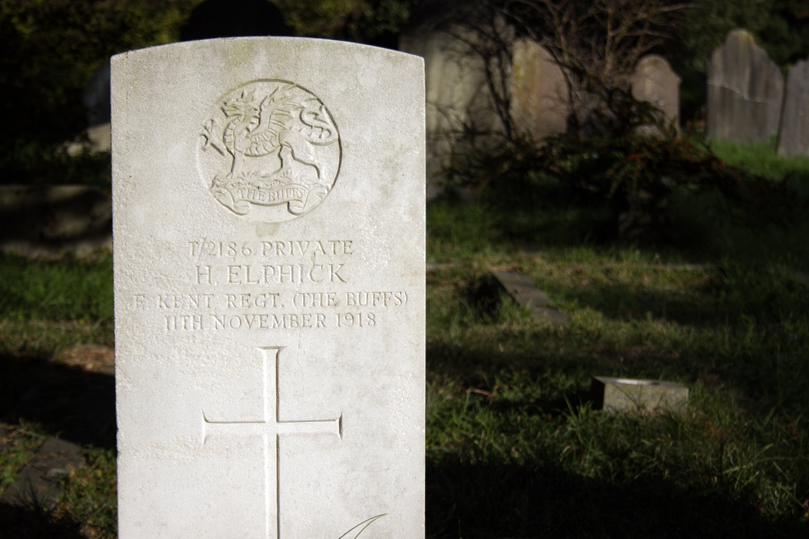
Holdsworth Elphick was born on 7th June 1891, one of five children to Herbert and Mary Elphick. Herbert was a billiard marker and professional player, who had been born in Brighton. Mary was from Ireland, but the couple raised their family in London, presumably as this is where the best opportunities for work were.
When he left school, Holdsworth found work at the George Hotel in Balham, South London, where he was employed as a barman. The 1911 census shows another barman there called Geoffrey Elphick, who, while not one of Holdsworth’s brothers, may well have been a cousin.
When war broke out, Holdsworth was quick to sign up. He enlisted as a Private in the Buffs (the East Kent Regiment) on 9th September 1914 and, after a year on the Home Front, he was sent out to France as part of the British Expeditionary Force in August 1915.
There is little further information available about Private Elphick’s time in the army. He returned to England on 25th February 1916; this appears to have been a medical evacuation as, two months later, he was discharged from the army as he was no longer physically fit to continue.
Life continued for Holdsworth. In September 1917, he married Lydia Ann Armstrong, a dock labourer’s daughter from Southampton, although this is where his trail seems to end.
The next available evidence for Private Elphick is his gravestone. This confirms that he passed away on 11th November 1918 – Armistice Day – but no further information is available. He was just 27 years of age.
Holdsworth Elphick lies at rest in the Broadwater Cemetery in Worthing, West Sussex (presumably this is where he and Lydia moved after their marriage, although there is nothing to confirm this).
Charles Edward Duke was born in early 1880, the oldest of three children to George and Charlotte Duke. George was a market gardener, but for all of Charles’ childhood censuses – 1881, 1891 and 1901 – his father is absent. Instead, Charlotte is listed as the head of the household, married and working as a launderess. Given that the censuses were all taken in the spring, it is possible that her husband was working away each time the document was recorded, although this is supposition. In every census, though, it is interesting to note that she had taken in lodgers to help pay the bills.
The family lived in Worthing, West Sussex, in a small house near the centre of town. When he left school, Charles found work as an errand boy for a local stationer, before finding more gainful employment as a gardener in one of the multitude of nurseries surrounding the coastal town.
In 1901, Charles married Lucy Barnes, a carter’s daughter from the town; the young couple set up home in Broadwater, to the north of Worthing town centre, and went on to have four children; Alice, Henry, Dorothy and Margaret.
When war arrived on European shores, Charles played his part. Sadly his military records are all but non-existent, but from what remains it’s possible to piece together something of his military life.
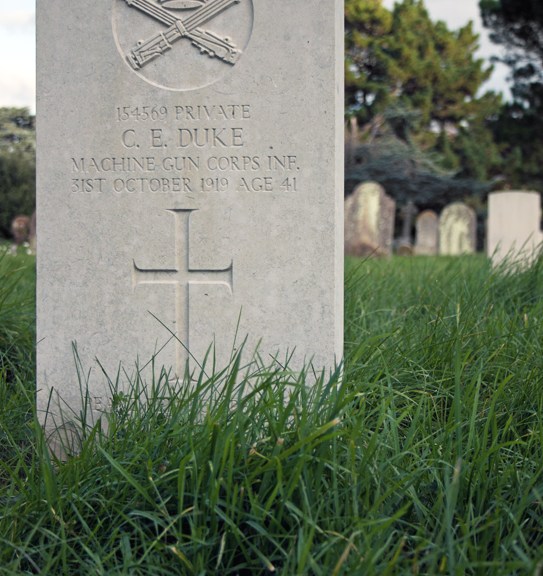
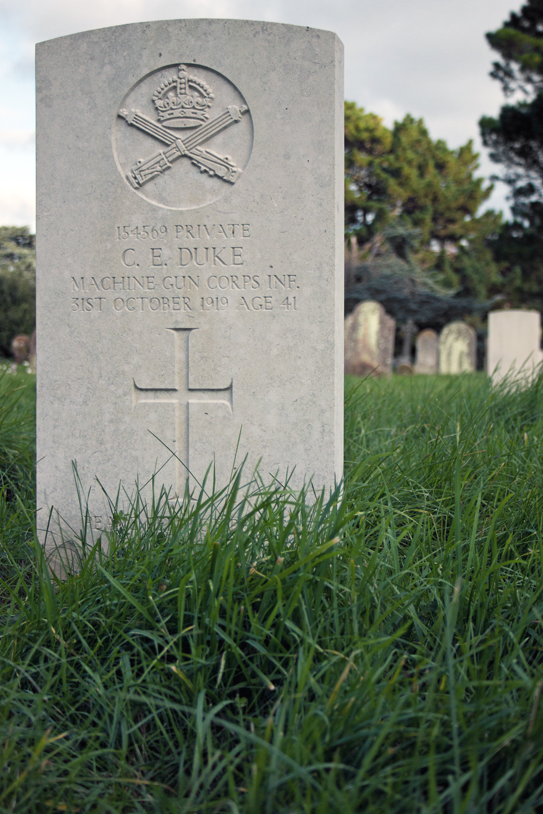
Private Duke enlisted in the Machine Gun Corps, and was assigned to the 16th Company. While it is impossible to place him in any specific location, his company was certainly involved in the Battle of the Somme.
Charles survived the war; the next evidence available for him notes that he died on 31st October 1919 in a hospital in Brighton, although o cause is given for his death. The Commonwealth War Graves Commission give his age as 41, although it seems likely he was a couple of years younger than this, based on when his birth was registered.
Charles Edward Duke was buried in the Broadwater Cemetery, a short walk from where his widow and children were living.
Richard Edward Cadenaci was born in Sutton, Surrey, in around 1886. His father, who was also called Richard Edward Cadenaci, was a house painter and, with his wife Maria, had thirteen or fourteen children, of whom Richard Jr was the middle one.
Documentation on the Cadenaci family is scarce. On 5th April 1896, when Richard Jr was 10, he and three siblings were baptised together.
By the turn of the century, the family were living on Merton High Street, in Wimbledon. Richard Sr and Maria were there with their youngest five children.
Richard Jr seemed keen on a life of adventure – the 1911 census lists him as a Private in the 3rd Battalion of the Royal Fusiliers, and that he was based in Mauritius. His full military service records are not available, but it is likely that his term of service with the army was extended as war loomed.
Private Cadenaci was sent to France in January 1915 and, during his time in the Great War, he received the Victory and British Medals and the 1915 Star. At some point during the conflict he was transferred across to the Labour Corps, though the move came with a promotion to Corporal. Again, there is little further information about his service, but records suggest that he was discharged from the army – possibly through health reasons – on 20th September 1918.
Here, Richard’s trail goes cold. He died on 23rd March 1920, just eighteen months after the end of this military service, at the age of 32. There is no record of the cause of his passing and nothing to connect him to the town in which he was buried, Worthing, West Sussex.
It is possible that Corporal Cadenaci left the army for medical reasons, and his move out of London was for cleaner air, but this is only presumption on my part, and there is nothing to confirm this either way.
Richard Edward Cadenaci lies at rest in the Broadwater Cemetery in Worthing.
Sometimes research into the names of the fallen runs into obstacles. There are graves I have researched that have brought up very little information, either because the soldier concerned is too young to have a lot of documentation about them, or because information on them has subsequently been lost.
On other occasions, it is the sheer wealth of documentation that proves to be the stumbling block. Such is the case with William Frederick Holden, buried in the Broadwater Cemetery in Worthing, West Sussex.
The grave itself gives some information: he was a Private in the Royal Sussex Regiment, with a service number of 8298970, and died on 16th February 1921, at the age of 26. The Commonwealth War Graves Commission archives give some further information: his father was Frederick Charles Holden, and his stepmother was Elena.
The Find A Grave website adds a little further information – he was born in Sidlesham, near Chichester in West Sussex. The site suggests, however, that he was born in 1897, which would suggest he was 23 or 24 when he died.
Researching on Ancestry throws up a wealth of other information, which begins to make it more of a challenge to identify the correct details. Both William and Frederick were common names in the late Victorian era, and Holden was a familiar Sussex name, and had many spelling variations.
Searching for William’s service number on sites like Fold3 does not provide any results, so that does not provide an opportunity to narrow down the information. Nor is there any record of his passing or burial in contemporary newspapers.
To add to the confusion, when I dug a little deeper, it seems that William’s birth name was, in fact, Frederick William Holden, and he was known by his middle name to avoid confusion with his father. His mother was Fanny Warrington (née Walker), and he seems to have had one sister, Annie. Fanny seems to have passed away in 1903, and Frederick Sr went on to marry Louisa.
So, like a patchwork, vague details of William’s life are pieced together. But huge gaps still remain. Private Holden was assigned to the 4th Battalion of the Royal Sussex Regiment, which fought at Gallipoli and served in Egypt and France before the war was done. However, there is no evidence that William fought abroad.
Sadly, William’s passing is lost to time as well. We know when he died, but there is nothing to confirm a cause of death. Given when it was, it seems likely to have been as a result of one of the invasive lung conditions that ravaged Europe after the First World War. But he could just as easily have succumbed to the ongoing effects of wounds received during fighting. Given the lack of supporting documentation, we are unlikely ever to know.
William Frederick Holden lies at rest in Worthing’s Broadwater Cemetery.
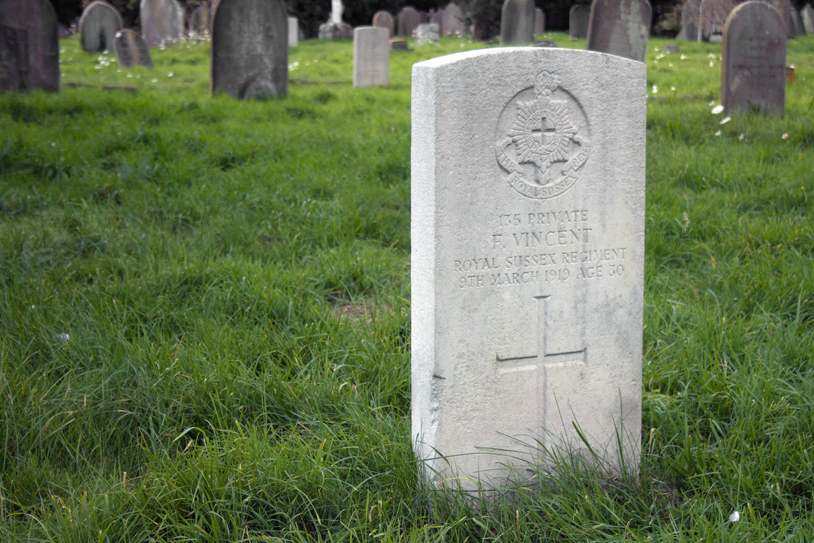
Fred Vincent was born in Crewkerne, Somerset, in 1889, one of seven children to Charles and Elizabeth Vincent. Charles was a dairyman, and, over the years, the whole family helped out in the business. This seemed a transitory business – over the years, the family moved around Dorset and, by the time of the 1911 census, were living in Wiltshire.
Frustratingly, after that document, Fred’s trail goes quiet. He married a woman called Dorothy, and at some point the couple moved to Worthing, West Sussex, although there are no records to confirm dates for either of these.
When war broke out, Fred enlisted in the Royal Sussex Regiment. Documents are again lacking, so it is impossible to tell which battalion he served in, or whether he was based at home or abroad. Private Vincent did subsequently transfer to the Labour Corps, although again, dates and the location of his service are not available.
Sadly, Fred has disappeared into the mists of time. He and Dorothy were living in Worthing when he passed away on 9th March 1919, at the age of 30 years old. There is nothing in contemporary newspapers to suggest that his passing was anything out of the ordinary.
Fred Vincent lies at rest in the Broadwater Cemetery of his adopted home town of Worthing.
Hubert Stephen Buck was born on 18th October 1887, in Stepney, East London. His father, Edgar Buck, started to use his grandmother’s maiden name – Campbell – from the 1880s, and, by 1901, the family had formally changed their name.
At the time of his marriage to Hubert’s mother Alexandra Stephen in 1885, Edgar was working as a ostrich feather manufacturer. The couple went on to have six children, all boys, of which Hubert was the second oldest.
By the time of the 1901 census, Edgar and Alexandra has moved the family south of the river, from Mile End to Lambeth. By now, Hubert’s father was working as a musician, but there is little further information about his trade.
The next census – from 1911 – found the family living in Lewisham. Edgar was now listed as a band leader, while Hubert, who was the oldest child still living at home, gave his profession as musician, presumably in his father’s band.
War was imminent and, while Hubert was definitely involved, there is little specific information about his military service. He enlisted in the Irish Guards, and was assigned the role of Bandsman.
In August 1917, Hubert married Alice Johnson in Sutton, Surrey. He listed his profession as Musician in HM Irish Guards, so must have enlisted before that point. Interestingly, the same document identifies Edgar’s profession as Bandmaster in the 1st City of London Regiment, so it seems he also enlisted.
The marriage certificate shows Alice was two years older then her new husband, and that she was the daughter of warehouseman Alfred Johnson, who had, by that point, passed away.
Bandsman Campbell survived the war, but there is no indication as to whether he served abroad, or was part of a territorial force. He and Alice moved to Worthing in West Sussex, but there is no confirmation on when the move took place. The 1921 census, taken in June of that year, records the couple as living at 151 Lyndhurst Road in Worthing, where he was noted as being a totally disabled pensioner. There is little further information about him, other than the fact that he died on 4th August 1921, at the age of 35.
Hubert Stephen Campbell was laid to rest in the Broadwater Cemetery in Worthing.
While Hubert’s trail went cold, there is further information on Alice. An advert in the Worthing Gazette offers musical training by her:
Musical Training on Modern Methods
Pianoforte (Matthay), Voice Production, Singing, Theory, Harmony, Aural Culture, Musical Appreciation, and Art of Teaching.
Thorough preparation for all Examinations, Elementary to Diploma Grades, Special Courses for Teachers for the study of the Matthay system and the Art of Teaching.
MADAME ALICE CAMPBELL (Member of the Musical Councils of the London and East London Musical Festivals. Registered Teacher: Teachers’ Registration Council.
Worthing Gazette: Wednesday 31st August 1921
Digging a little deeper, and there are similar advertisements in the newspaper from late 1917, through to at least the 1930s, by which time, Alice was running the Worthing School of Music.
The advert suggests a couple of points. It certainly suggests that a love of music is what brought Hubert and Alice together in the first place. There was a definite musical connection in the household, initially driven by Hubert’s father, and continued with his widow.
Given that the advert above is dated a matter of weeks after Hubert’s death, it also seems likely that his passing was not unexpected. There is nothing in the local media relating to his death, and, with regular students to teach, Alice obviously felt is unnecessary to take any significant time away from her work in grief. It is supposition on my part, but it would suggest that Hubert died from a chronic condition, possibly one of the lung diseases that were rife across Europe in the aftermath of the Great War.
The last advert for the Worthing School of Music ran on 12th September 1934. Beyond that date – when Alice would have been 49 – there is no further clear record of her or the school.
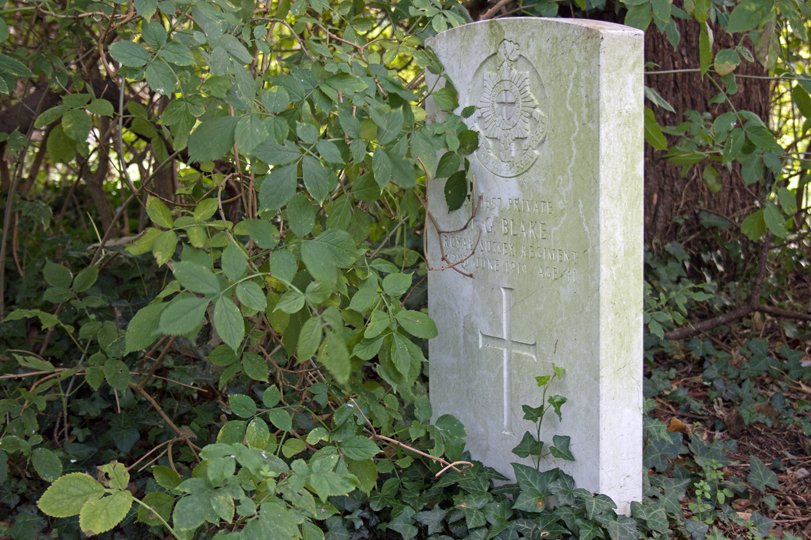
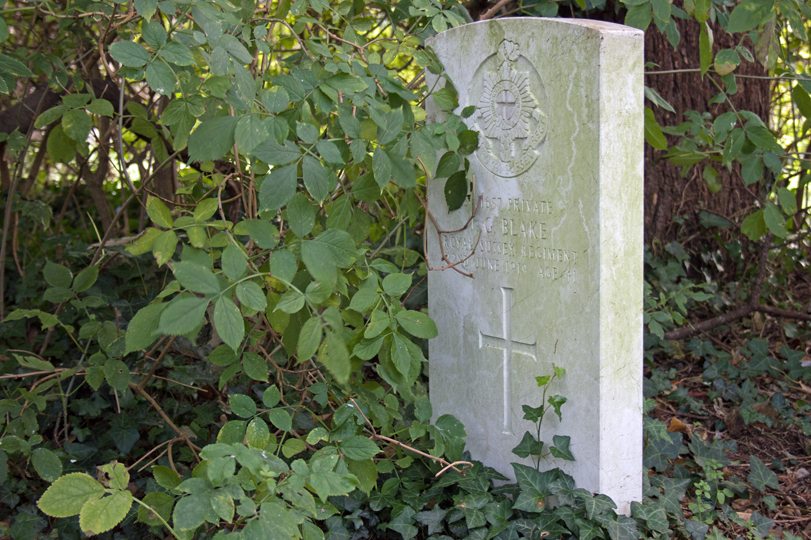
John George Blake was born early in 1878, and was the oldest of seven children. His father, Job, was a general labourer, and, with Eliza, John’s mother, brought the young family up in the West Sussex town of Worthing.
Job died in 1898, ages just 36 years old; Eliza found work as a housekeeper, while John was employed as a carter for the railway. By the 1901 census, the family were living in a terraced house near the centre of town, Eliza living there with her three sons, two daughters, son-in-law and granddaughter.
In October 1904, John married Alice Attwater, a labourer’s daughter from mid-Sussex. The couple moved into a house close to the station and went on to have four children; John Jr, Ernest, Bertha and Dorothy. John was by now working as a porter for the railway, a role he continued through to the outbreak of war.
John enlisted in November 1914; he joined the Royal Sussex Regiment, working as a member of the depot staff. Private Blake was shipped overseas, arriving in France in March 1916.
Almost exactly a year after landing in France, John was injured in the line of duty. The medical report confirmed that a “scald on the left arm and neck [had] occurred while on duty on March 1st 1917, in France. He was preparing hot soup for his company in the front line at midnight. He was not to blame. Injury caused by enemy shelling the company kitchen“.
Private Blake was shipped back to England for treatment, and admitted to Netley Hospital near Southampton. While there, he contracted phthisis (tuberculosis), which left his totally incapacitated. He was medically discharged from military service in August 1917.
Further details of John’s life are scarce. He returned home to his family, although whether he took up his job again is unknown. He passed away on 22nd June 1919 at the age of 41. The cause of his death is unknown, although it seems likely to have been related to the tuberculosis.
John George Blake lies at rest in the Broadwater Cemetery of his home town, Worthing.
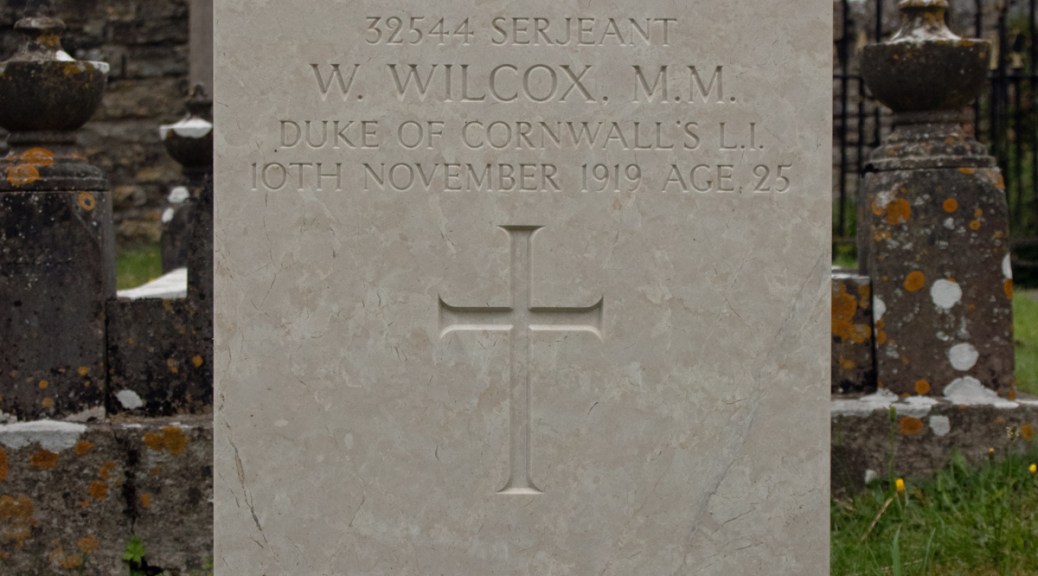
Soloman William Wilcox – known by just his middle name – was born in 1894 and was one of seven children. His father, James, was a carter from Keinton Mandeville in Somerset, and he and William’s mother, Eliza, brought the family up in neighbouring Charlton Mackrell.
By the time of the 1911 census, William had left school, and was working as a farm labourer, with his older brother Sidney. James, meanwhile, had found further employment working in a local bluestone quarry.
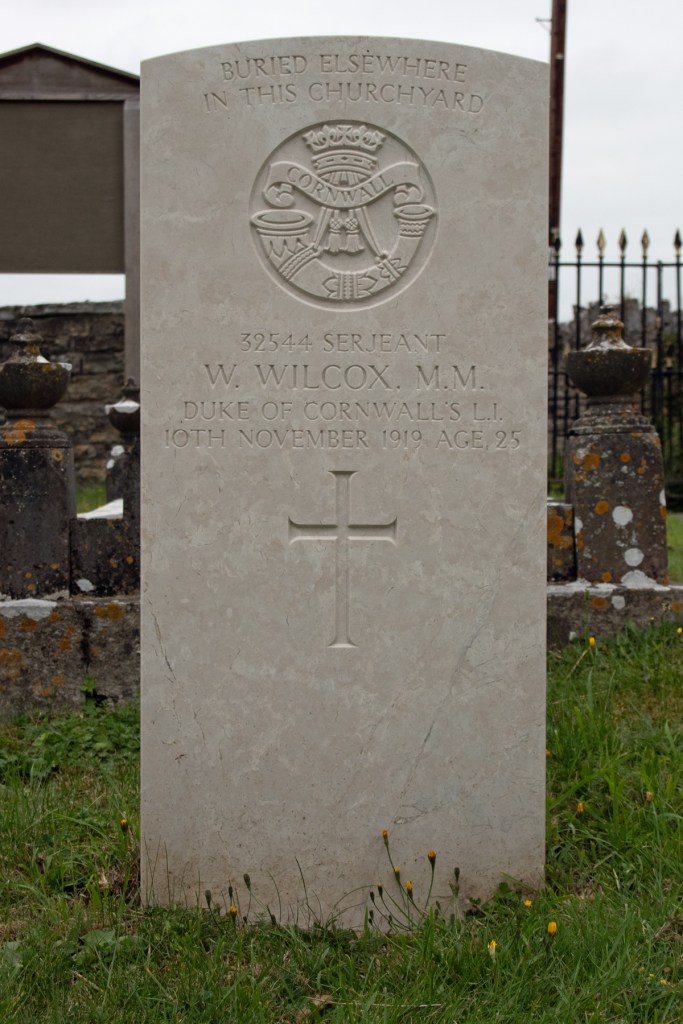
War was on the horizon and, while it is evident that he enlisted in the Duke of Cornwall’s Light Infantry, there is little further documentation to track his service. Both of the regiment’s main battalions fought on the Western Front, though where and when William was involved is lost to time.
He seems to have been an ambitious young man; he rose through the ranks and, at the point he was discharged, he had risen to the role of Serjeant. He was also in receipt of the Military Medal, though there is no further information about the events that led to this.
William may well have been spurred on by family losses he suffered during the conflict. His mother Eliza died in April 1915, his brother Sidney was killed in action on 10th September 1916, and his father James passed away in August 1918.
Serjeant Wilcox survived the war, and was eventually discharged from military service in August 1919. Whether he was simply demobbed, or he was medically discharged is unclear, but, given that he died only a few months later, it seems likely that the latter was the case.
Soloman William Wilcox died in Taunton, Somerset, on 10th November 1919, at the age of 25 years old. His body was brought to St Peter & St Paul’s Church in Charlton Adam, Somerset, potentially close to where some of his remaining family lived.
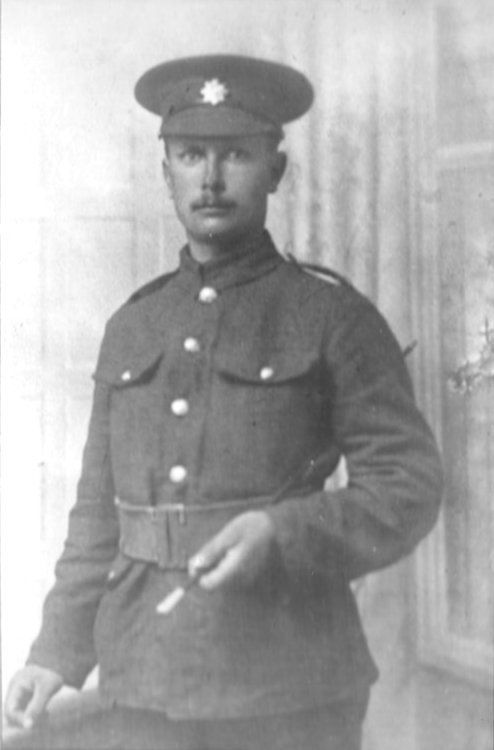
Serjeant William Wilcox (courtesy of findagrave.com)







 Death and Service