Category Archives: unknown

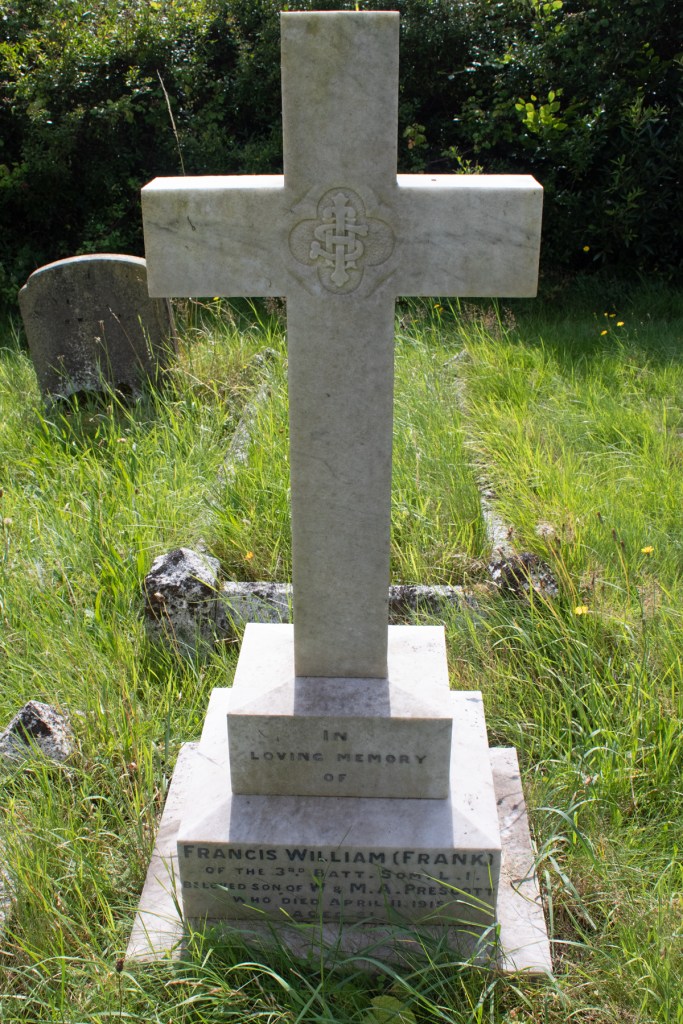
Private Francis Prescott

Private Francis Prescott

Francis William Prescott – better known as Frank – was born on 17th March 1894, and was one of four children to William and Mary. William was an agricultural labourer from Somerset, and, by the time of the 1901 census, the family had settled in the village of Luccombe, in the western outreaches of the county.

Frank went to school in Allerford, before spending a year at Luccombe’s Church of England school – from 13th May 1907 to 29th May 1908. Now aged 14 years old, he was considered old enough to be earning his keep. He found work as a farm boy on a farm on the outskirts of the village, but with storm clouds brewing across the Channel, he was keen to play his part.

Little information is available about Frank’s military service, but it is clear that he enlisted in the first weeks of the war, as imperial fervour gripped the country. He enlisted in the Somerset Light Infantry and, as a Private, was assigned to the 3rd (Reserve) Battalion. Contemporary documents do not confirm either way, but as this particular troop was based at Devonport, Devon, for most of the war, it is unlikely that Private Prescott saw any action overseas.

Indeed, he was in barracks on 11th April 1915, when he passed away. Again, the cause is lost to time, but he was just 21 years of age when he died.

Francis ‘Frank’ William Prescott was taken back to Somerset for burial. He was laid to rest in Luccombe Church Cemetery, not far from where his family still lived.


Frank’s younger brother, Harold, also enlisted in the war. He joined the Royal Engineers as a Private and, unlike his brother, he did go to the Western Front.

Harold was caught up in the fighting, and received a gunshot wound to his arm. He recovered, but the injury dogged him. He was formally discharged on 14th May 1919, and found work as a lorry driver. Harold married Kathleen Peck in December 1929: the couple’s only child, Edward, was born just over a year later.

Harold spent his life in Somerset. He died in Exmoor in the spring of 1968, at the age of 71 years old.


Corporal Herbert Wear

Corporal Herbert Wear

Herbert Francis Wear was born in the summer of 1895, one of twelve children to Charles and Harriet Wear. Charles was a farmer from Congresbury, and when he died in 1907, aged just 51 years old, it fell to Harriet and her children to keep the farm running.

At this point, however, much of Herbert’s trail goes cold, and it is a challenge to piece together anything concrete. When war broke out, he stepped up to play his part, enlisting in January 1917. He was assigned to the Military Police Corps and initially served in the Military Foot Police.

However, at some point during the conflict, Corporal Wear transferred to the Labour Corps, where he was attached to the 449th Agricultural Company. This meant he remained relatively close to home, as he was based in the Taunton area of Somerset.

The next record for Herbert is the British Army Register of Soldiers’ Effects, which confirms that he passed away in Somerset. An entry in the Bristol Times and Mirror (Wednesday 4th December 1918) states that “The funeral of the late Lance-Corporal HF Wear, Stonewell Farm, Congresbury, will take place to-day… 2:30pm.”

Herbert’s death certificate confirmed that he died at home from a combination of influenza and pneumonia. He was 23 years of age when he breathed his last.

Herbert Francis Wear was laid to rest close to his father in the graveyard of St Andrew’s Church in Congresbury.


Private Frank Harvey

Private Frank Harvey

Frank Ernest Harvey was born at the start of 1892, the youngest of seven children to George and Clara Harvey. George was from Bethnal Green, London, and worked as a telegraphist clerk for the Post Office. By the time Frank was born, the family had moved to Leytonstone, while the 1901 census records them as living in Ilford.

On the day of the next census, in 1911, George and Clara were visiting friends in Guildford, Surrey. The four of their children who were still living with them were all at the family home. Ida, their daughter, was not listed as having any employment, while her three brothers were all working a clerks: one for an ironmonger, one for a stockbroker and Frank for an electrical engineer.

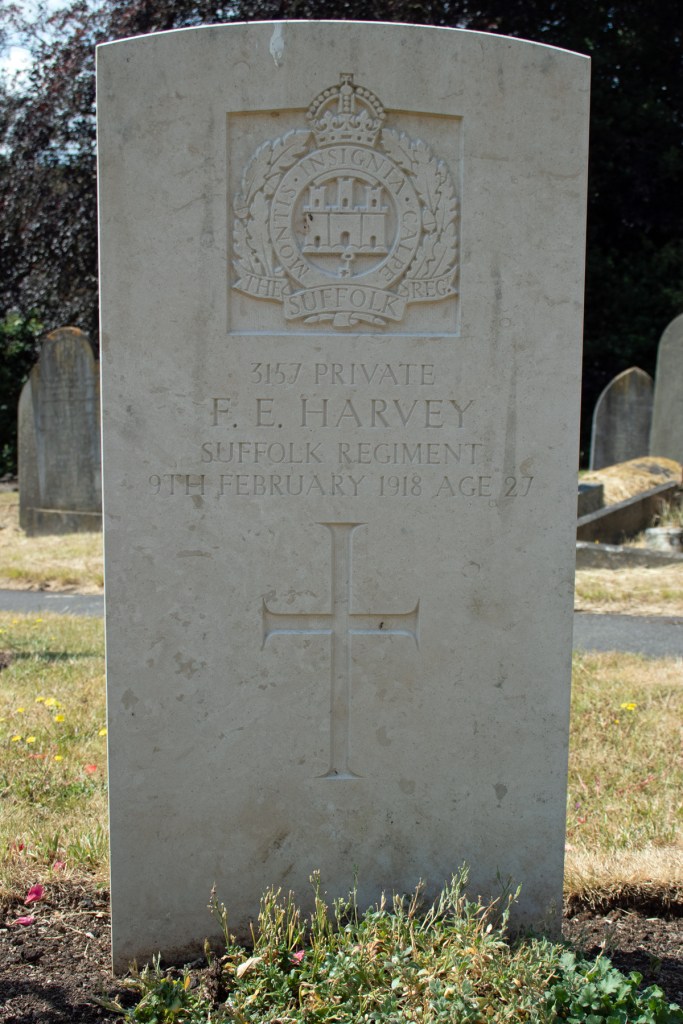
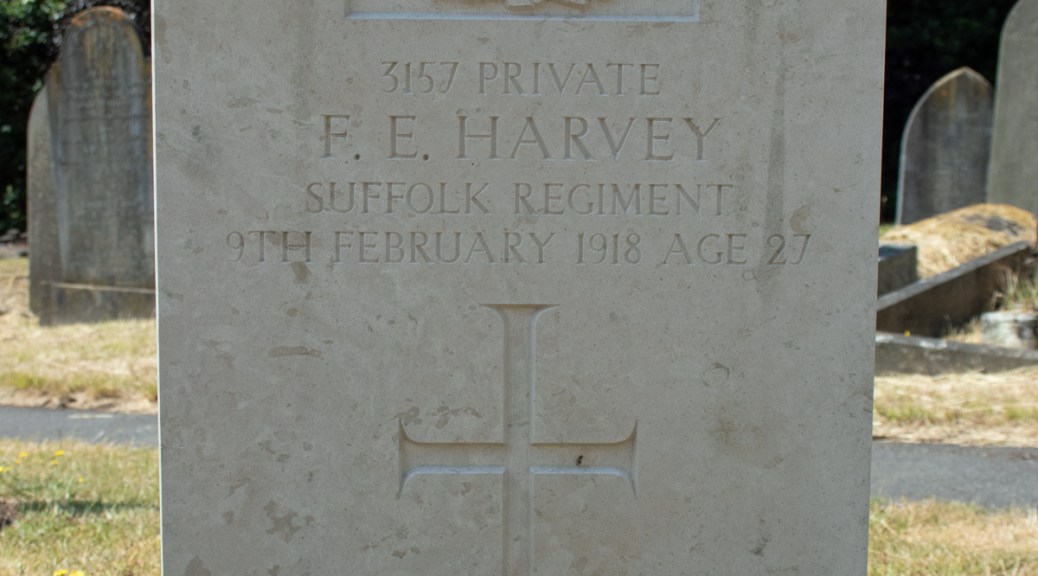
When war broke out, Frank stepped up to serve his king and his country. Little information is available about his military career, and, while his headstone confirms he was in the Suffolk Regiment, other records suggest that he had transferred to the regiment from the Royal Army Service Corps.

There is also little information about Private Harvey’s passing. Based on the fact that he was laid to rest in the Locksbrook Cemetery, Bath, it is likely that he had been admitted to the city’s War Hospital. This did not specialise in any single condition or set of conditions, so it could be that Frank was sent there to recuperate from an injury, or to recover from an illness.

Sadly, neither was to be the case, and Private Frank Ernest Harvey passed away on 9th February 1918. He was 26 years of age.


Private James Savory

Private James Savory

James Henry Savory was born in Gloucester in the spring of 1872. An only child, his parents were Frederick and Sophia Savory. Frederick was innkeeper of the town’s Bell Inn, but things seemed to go wrong for the family as time passed.

Both Frederick and James disappear from the 1891 census return, while Sophia is recorded as being an inmate in the Bristol City Workhouse. She was still there ten years later, although whether she had been there for the full decade is unclear.

James, by this point, had found employment as a travelling labourer. By the autumn of 1891, he had met Edith Morgan, a butcher’s daughter from Bristol. The couple married on 16th May 1892, four days before Edith gave birth to their first child, a daughter they called Eleanor. The couple set up home in Bedminster, James finding work as a foreman at the local marble works. He and Edith went on to have four children in all.

James was drawn to piecemeal work: by the time of the 1911 census, the family had moved to Portishead, Somerset, and he was employed as an ironmonger. His son, James Jr, was apprenticed in the same line of work, and the family had a relative, 71-year-old printer William Badger, boarding with them to bring in a little extra money.

What war came to Europe, James stepped up to play his part. Full records are not available for him, but he certainly enlisted in the army. Based on his age – he was 42 years old when the conflict began – it seems likely that he either volunteered for service, or that he was called up later in the war.

Private Savory was attached to the 19th Battalion of the Hampshire Regiment. Whether he service on home soil or overseas is unclear, but he survived through to the end of the war, and had returned home by the start of 1919.

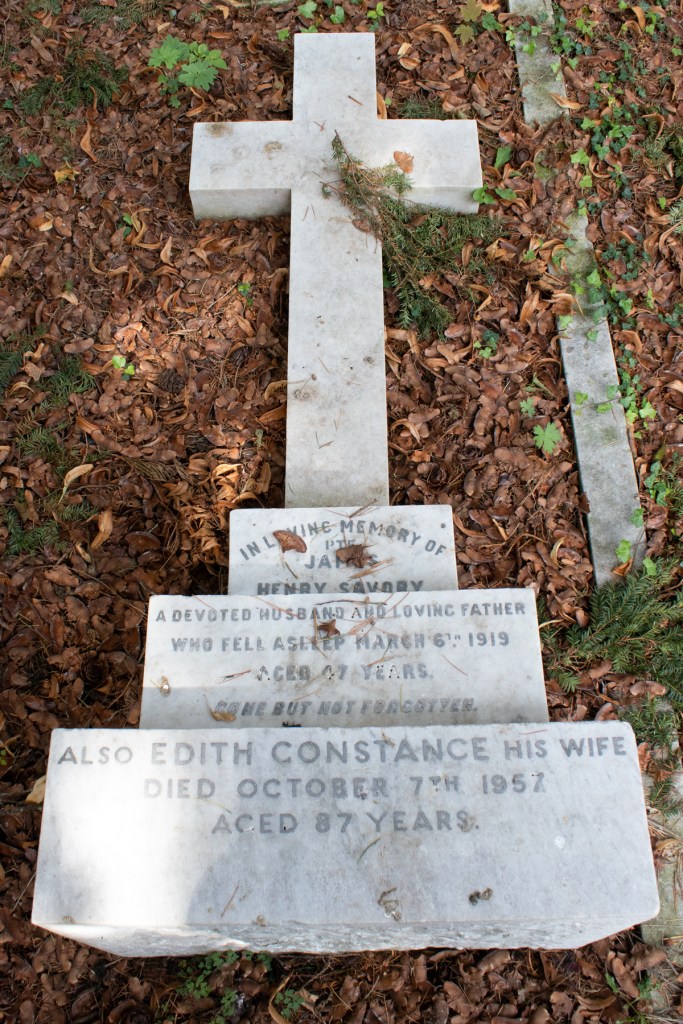
James Henry Savory died on 6th March 1919: he was 46 years of age. He was laid to rest in Portishead Cemetery, not far from where his widow still lived. Edith lived on until October 1957: she was laid to rest with her late husband, reunited after nearly forty years.


Sapper John Renouf

Sapper John Renouf

John Renouf was born in Bedminster, Bristol, on 26th June 1875. Hiss parents, Charles and Emily Renouf, had been born in St Helier, Jersey, and had moved to the mainland with their older children in around 1874. Charles was a blacksmith, initially working on naval vessels in Jersey, he continued his smithing when the family had settled in Bedminster.

John was one of seven children and became apprenticed to his father when he finished his schooling. Charles’ trade offered him an opportunity for a career, however, and, on 23rd September 1893, he enlisted in the Royal Navy as a Blacksmith’s Mate. His service records show that he was 5ft 7.5ins (1.71m) tall, with black hair, grey eyes and a fresh complexion.

John signed up for a 12-year contract, and was primarily based out of HMS Vivid, the Royal Naval Dockyard in Devonport. His records confirm that he was not shore-bound, however, and he spent time on eleven ships up to 1905. At this point, his contract came to an end, and he chose not to re-enlist.

At this point, John’s trail becomes a little hazy. He returned to Bristol, and seems to have continued working as a blacksmith. The 1911 census recorded him as being one of a number of residents at the city’s Salvation Army Hostel on Tower Hill. According to the same census, Charles, now 71 and a widower of three years, was living with his youngest son, Ernest, and family.

When war came to European shores, John’s skills as a blacksmith were to be called upon once again. His service records are no longer available, but it is clear that he chose not to re-join the navy, instead enlisting in the Royal Engineers as a Sapper.

Sapper Renouf’s trail goes cold again: he was assigned to one of the Waterways and Railway Troops, but it is unclear whether he spent his time on home soil or overseas. Either way, he survived the conflict, and was back in Britain soon after the Armistice.

The next record for John Renouf is that of his passing. He died in Bath, Somerset, on 30th December 1919, at the age of 44 years old. John was laid to rest in the sweeping grounds of the city’s Locksbrook Cemetery.


Private Joseph Curtis

Private Joseph Curtis

In the war grave section of Locksbrook Cemetery in Bath, Somerset, is a headstone dedicated to a Private J Curtis, of the King’s Liverpool Regiment, who passed away on 3rd January 1921. The Commonwealth War Graves Commission confirms that Joseph Curtis had transferred to the 430th Company of the Labour Corps at some point.

Little additional information is available for Joseph Curtis. Only one service document remains, his Medal Roll Index Card. This gives the dates of his service – 22nd February 1915 to 17th October 1918 – but no other identifying details.

Without a year or place of birth, it is not possible to track down any census records. As Bath was the location of both a War Hospital and one for army pensioners, his burial in a cemetery nearby is no guarantee that the city was ever his home. There is also no report of Private Curtis’ passing or funeral in any available contemporary newspapers.

The life of James Curtis is destined to remain a mystery, therefore, taken with him when he was laid to rest.


Private William Parsons

Private William Parsons

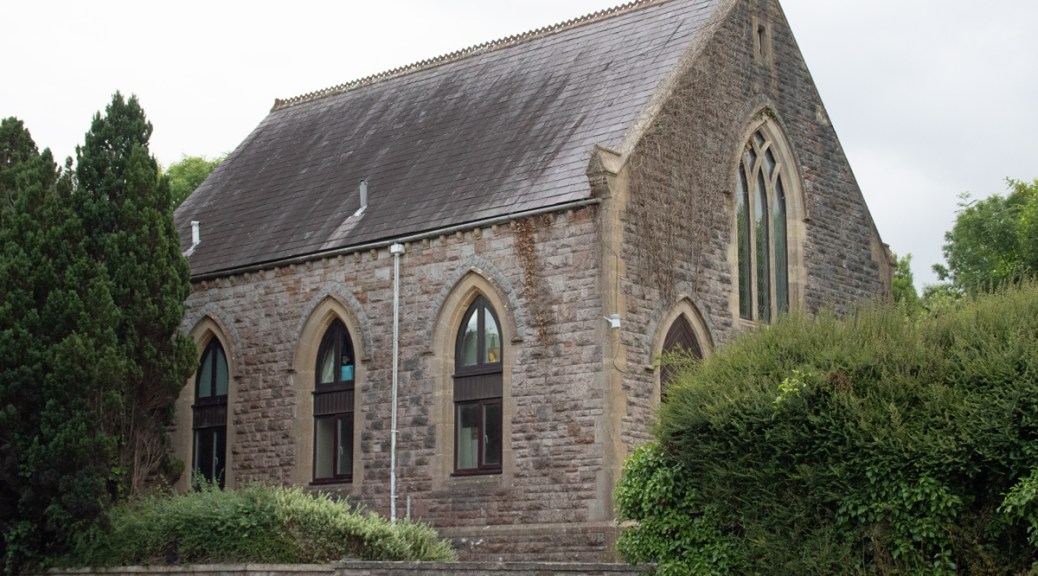
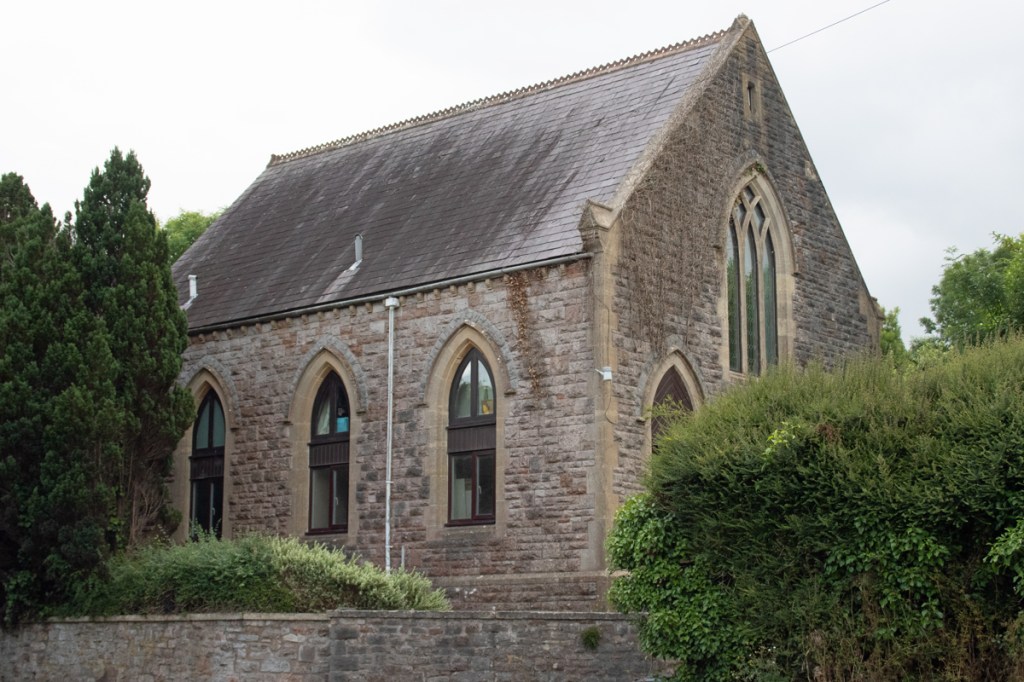
On the main road between Glastonbury and Wells, on the outskirts of the village of Coxley is the old Wesleyan Methodist Chapel. Now converted to a house, its back garden contains the remains of Private WR Parsons, who died in January 1919.

William Reginald Parsons was born on 22nd February 1895 in the hamlet of Chilton Burtle, near Bridgwater. The second of eight children, his parents were Wallace and Harriet Parsons. By the time of the 1901 census, the family had moved to Wells, where William was employed as a platelayer by Great Western Railways.

When he left school, William found employment as a paper maker, and was employed by the St Cuthbert’s Paper Mill to the west of the city. He wanted bigger and better things, however, and, on 11th April 1912, he enlisted in the Royal Marine Light Infantry.

Private Parsons’ service records show that he was 5ft 6.5ins (1.68m) tall, with brown hair, hazel eyes and a fresh complexion. It was also noted that he had a small scar on the right side of his back. Initially sent to the regiment’s depot in Deal, Kent, this is where he was tested for his swimming ability: he passed on 24th June 1912.

William remained in Deal until the end of the year. After seven months in Portsmouth, Hampshire, he embarked on a number of postings that lasted for the next six years. Initially assigned to the battleship HMS Bulwark, Private Parsons’ main posting was on board another battleship, HMS Zealandia.

Primarily based guarding the North Sea Coast, Zealandia also served in the Mediterranean, sailing as far as the Dardanelles towards the end of 1915. In all, Private Parsons spent more than three years on board the battleship.

William’s next posting was on board the cruiser HMS Royalist, on which he served until the end of the First World War. While he was on board, it appears that he became unwell, and he was admitted to the Royal Naval Hospital in Granton, near Edinburgh. Details of his condition are not readily available, but they were serious enough for him to succumb to them: he passed away on 30th January 1919, at the age of just 23 years old.

The body of William Reginald Parsons was brought back to Somerset for burial. He was laid to rest in the quiet churchyard of the Wesleyan Methodist Chapel in Coxley.


(c) Sharky Ward 2025

As the chapel is now a family home, its garden is not readily accessible. The photo of Private Parsons’ grave was taken by Commonwealth War Graves Commission volunteer Sharky Ward, to whom I am indebted for its use.


Private Anthony Gardner

Private Anthony Gardner

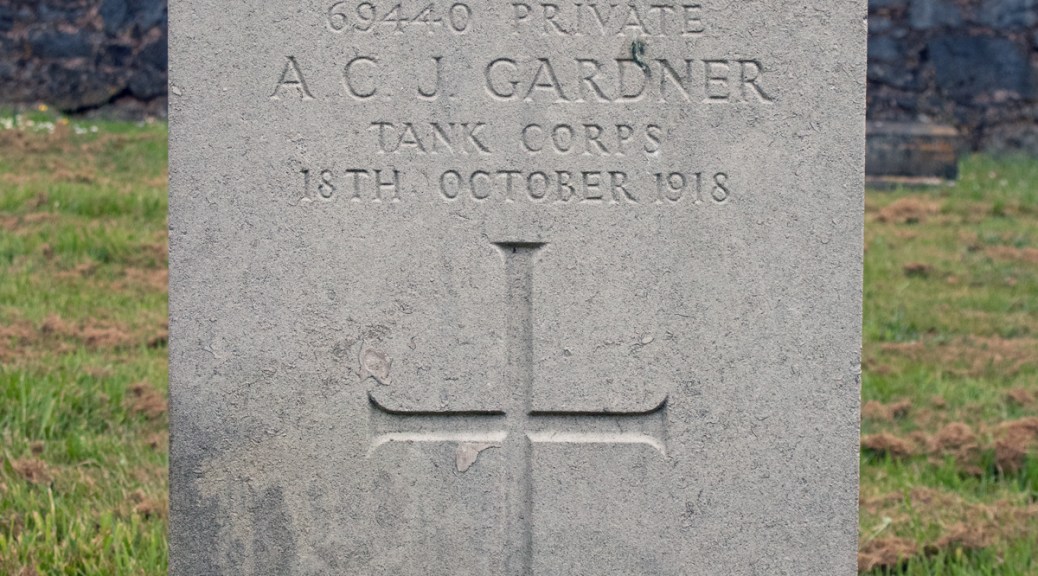
In a quiet spot in Cannington Cemetery, Somerset, is the burial plot for Anthony Charles James Gardner. His headstone confirms that he was a Private in the Tank Corps, and that he died on 18th October 1918.

Private Gardner’s service number provides only one army document: the British Army Register of Soldiers’ Effects. Sadly, this sheds little more light onto his life, confirming only that he died in the Military Hospital in Wool, the village connected to Bovington Camp in Dorset. No next of kin is evident.

Another record suggests that he may have served in the Somerset Light Infantry before transferring to the Tank Corps, but no records remain to confirm this stage of his military career.

There are no census birth or baptism records for an Anthony Gardner. While there are numerous Somerset documents connected to Charles and James Gardners, without any confirmation of his age, or whether he actually came from the county, it is impossible to identify ones relating to the soldier buried in Cannington.

Parish details confirm that Anthony worked at the Blue Anchor Inn in Cannington. The 1911 census recorded him as working there under Charles and Ann West. It confirms that Anthony was 24 years of age, and was born in Gloucester. Tantalising though this fact is, there are no earlier documents to confirm his upbringing in Gloucestershire.

There are no reports in contemporary newspapers about Anthony’s passing or his funeral, so no light can be shed down that route either.

The life of Alfred Charles James Gardner, therefore, is destined to remain lost in the mists of time. His story hidden in the cemetery in Cannington, Somerset.


My thanks to Tina at Cannington Parish Council for her help in uncovering a little of Anthony’s life.


Corporal Francis Rich

Corporal Francis Rich

Francis Frederick Herbert Rich was born in Sherborne, Dorset, in the spring of 1896. The youngest of three children, his parents were Frederick and Alice Rich. Frederick was a grocer’s assistant, who had left Sherborne by the time of the 1901 census for Weston-super-Mare, Somerset, to find work. Alice remained with their children, but, by 1911, the family were back together and living in Bridgwater.

Frederick was now working as a grocer, and his two daughters were employed as pressers in a local blouse factory. Frederick, meanwhile, was apprenticed to an outfitter’s in the town.

War came to Europe, and Francis stepped up to service his King and Country. Full details of his time in the army are lost to time, but it is clear that he joined the Royal Engineers, and was attached to the 20th Territorial Force Depot. This was based in Pier Road, Gillingham, Kent, but it seems likely that he spent at least some time overseas.

A contemporary newspaper suggested that he worked as a dispatch rider for his battalion. The location of his passing – the Royal Victoria Hospital in Netley, near Southampton – would intimate that he had been brought there from the Western Front, having been wounded there.

Corporal Rich had been awarded the Military Medal before he passed, although again, the reason for this award is lost to the ages. He died, through causes unknown, on 16th May 1918, at the age of just 22 years old.

The body of Francis Frederick Herbert Rich was brought back to Somerset for burial. He was laid to rest in North Petherton Cemetery, not far from where his family still lived, on Taunton Road, Bridgwater.


Private William Lye

Private William Lye

William Harry Lye was born in Ilchester, Somerset, in the spring of 1875. The middle of five children, his parents were agricultural labourer Charles Lye and his wife, Sarah. Over the years, Charles found additional work as a groom and, by the time of the 1901 census, this is what William turned his hand to as well.

On 8th April 1901, William married Elsie Drayton, who was from Bishops Lydeard, to the west of Taunton. Elsie was the daughter of a labourer, and the couple married in St Mary’s Church her home village. The couple set up home in nearby Kingston St Mary, and went on to have two children, Herbert, who was born in 1902, and Reginald, who came along six years later.

When war came to Europe, William was called on to play his part. His service records are lost to time, but from what remains it is possible to confirm that he enlisted in the Royal Army Service Corps. His peacetime experience with horses made him an ideal candidate for the Remount division, and he was assigned to the 75th Squadron.

Private Lye survived the war, and by early 1919, was placed on furlough to await being demobbed. His trail goes cold at this point, and the last record for him is that of his passing, through causes unknown, on 24th May 1919. He was 43 years of age.

William Harry Lye was laid to rest in the quiet graveyard of St Mary’s Church, in Kingston St Mary, not far from where Elsie and the children still lived.