Category Archives: Cambridgeshire

Lieutenant Basil Scott-Holmes

Lieutenant Basil Scott-Holmes

Basil Scott-Holmes was born on 2nd February 1884 in the Somerset village of Wookey. The oldest of two children, his father was Liverpool-born Thomas Scott-Holmes and his wife, Katherine. When Basil was born, Thomas was the vicar of St Matthew’s Church, Wookey, but by 1901, he had risen to the role of clergyman – and subsequently Chancellor – at Wells Cathedral.

Basil’s pedigree stood him in good stead. Initially educated in Llandaff, South Wales, he subsequently attended Sherborne School in Dorset. Sent up to Cambridge, he studied history at Sidney Sussex College.

After leaving university, Basil spent time in Europe learning German and French. He was then assigned the role of Assistant Commissioner in North Nigeria but, after a year there he was invalided home taking up a teaching role at the Bristol Grammar School in 1912.

In July 1913, Basil married Barbara Willey, a surgeon’s daughter from Reigate, Surrey. The marriage record shows that Basil was registrar for an architectural association by this point; the couple went on to have two children, daughters Annette and Prudence.

When the war broke out, he was obviously keen to do his bit. In September 1914 he enlisted in the Royal Army Service Corps, before gaining a commission in the King’s Royal Rifle Corps a couple of months later. In the spring of 1916, Lieutenant Scott-Holmes had been seconded to the Machine Gun Corps, although it is unclear whether he served abroad during any of his time in the army.

On the evening of 24th October 1916, Lieutenant Scott-Holmes was riding in a motorcycle sidecar through central London, on the way back to camp. A local newspaper picked up the story:

…they stopped when going through Wandsworth to re-light the near light, and in the dark a motor omnibus ran into them, and Lieutenant [Scott-Holmes], who was strapped in the side-car, was, with the car, flung across the road. He died as he was being taken to Wandsworth Hospital. At the subsequent inquest, a verdict of “accidental death” was returned.

Central Somerset Gazette: Friday 3rd November 1916

Basil Scott-Holmes was just 32 years old. His body was brought back to Somerset; he was laid to rest in the cemetery at Wells Cathedral.


Larger memorial image loading...
Basil Scott-Holmes
(from ancestry.co.uk)

Lieutenant John Scrace

Lieutenant John Scrace

John Scrace was born on 31st July 1892 in Chatham, Kent, the oldest of five children to John and Adelaide Scrace. John Sr was a relieving officer for the Medway Board of Guardians, a role which involved “taking charge of poor or insane persons not otherwise cared for” [census1891.com]. Adelaide worked in a similar role, as an infant protection visitor.

It is fair to say, therefore, that John Jr had a very supportive childhood. He attended King’s School in Rochester, where he obtained a scholarship to Peterhouse College, Cambridge.

When war broke out, John was keen to do his part. Initially joining The Buffs (the East Kent Regiment), he transferred across to the newly-formed Royal Air Force in June 1918. By this point he had risen to the rank of Lieutenant, and, as part of his new RAF role, was based at Driffield in Yorkshire.

On 24th August 1918, the aircraft John was flying at the base, spun into the ground, and John was killed instantly. A subsequent inquest identified that “the cause of the accident was due to the fact that, for reasons unknown, part of the top of the left-hand plane of the machine crumpled up in the air and thereby [caused] the pilot to lose control of his machine.” [rafmuseumstoryvault.org.uk] Lieutenant Scrace was just 26 years of age.

John Scrace was buried in Christ Church Churchyard in Luton, Kent; he is commemorated in Woodlands Cemetery in nearby Gillingham.


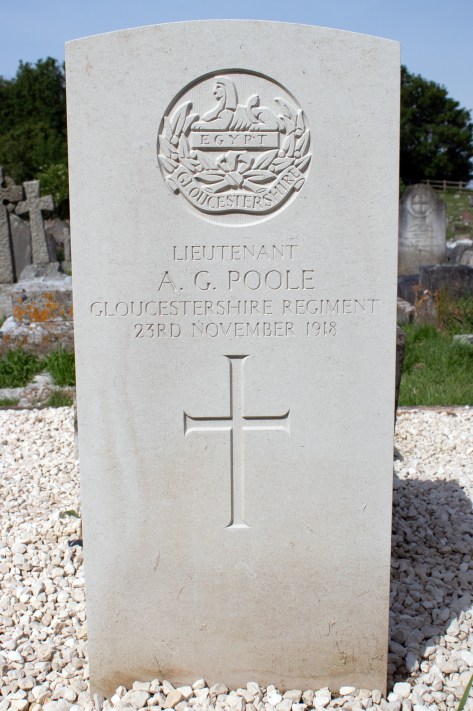
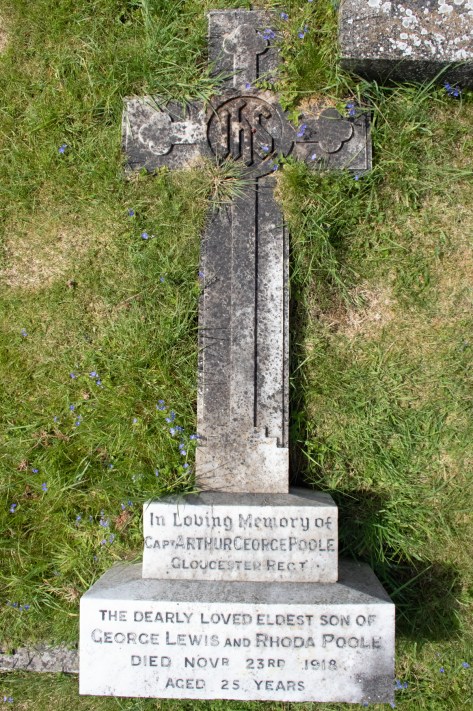
Captain Arthur Poole

Captain Arthur Poole

Arthur George Poole was born in Brislington, Somerset, in April 1893. His father, George, was a master builder, and with his mother, Rhoda, the family raise their five children in the Bristol suburb.

Arthur was obvious a bright lad; he attended the Bristol Grammar School, excelling at football, hockey and cricket. After finishing school, he joined a firm of Bristol solicitors and was also appointed secretary of the Bristol Law Society. He went on to continue his studies, when he was accepted to read law at Emmanuel College, Cambridge.

The war was on the horizon, however, and he was called upon to do his duty.

He joined Bristol’s Own (12th Gloucester Regiment) in 1914, and was musketry officer at Chiseldon for some months before going to France in 1915, where he was attached to the 6th Gloucester Regiment.

Within three months he had a severe attack of trench fever, and was home on sick leave for a few weeks. He was severely wounded in October 1917, and came back to England for good. Some months later he was mentioned in despatches. He spent a year in hospital, and although not discharged, was allowed to resume his law studies.

Gloucestershire Echo: Saturday 14th December 1918

While in hospital, Captain Poole contracted influenza, which then became pneumonia. Although recovering from his injuries, it was these conditions that were to get the better of him, and he passed away on 23rd November 1918, at the age of 25 years old.

Arthur George Poole was laid to rest in the pretty graveyard of St Andrew’s Church in Clevedon, Somerset, where his parents now lived.


Captain Arthur Poole

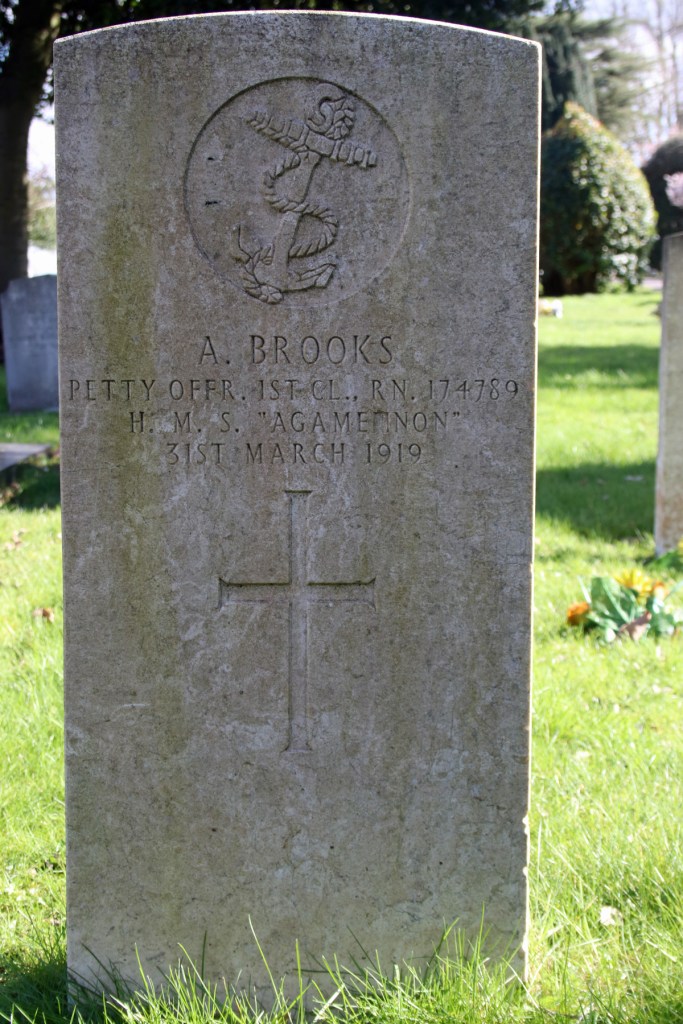
Petty Officer 1st Class Albert Brooks

Petty Officer Albert Brooks

Albert Brooks was born in February 1877 in Cambridge. Sadly, a lot of the documentation for his early life is lost to time, but he enlisted in the Royal Navy in July 1893, at the rank of Boy 2nd Class.

He formally enrolled in naval service in February 1895, initially for a period of twelve years. Beginning as an Ordinary Seaman aboard HMS Thunderer, during his initial time in the navy, he was promoted to Able Seaman and then Petty Officer 2nd Class, while serving on vessels including Hawke, Wildfire, Eclipse and Vernon.

In 1904, Albert married Rosina Wise. A couple of years younger than her new husband, she had been born in Camberwell, South London. The couple had a daughter, Gwendoline, and they set up home in Gillingham, Kent, where Albert was based when not at sea.

War was on the horizon, however, and Petty Officer Brooks’ naval service was extended until the end of the conflict.

Albert was promoted to Petty Officer 1st Class, and continued his service on vessels that included Andromache, London and Hibernia. He transferred to what would be his final ship, HMS Agamemnon, in November 1917.

Petty Officer Brooks served aboard Agamemnon for eighteen months, but it was while stationed at the Naval Dockyard in Chatham that he fell ill. He passed away from aortic disease of the heart – more than likely a heart attack or cardiac arrest – on 31st March 1919. He had just turned 42 years of age.

Albert Brooks lies at rest in the Woodlands Cemetery in Gillingham, Kent.