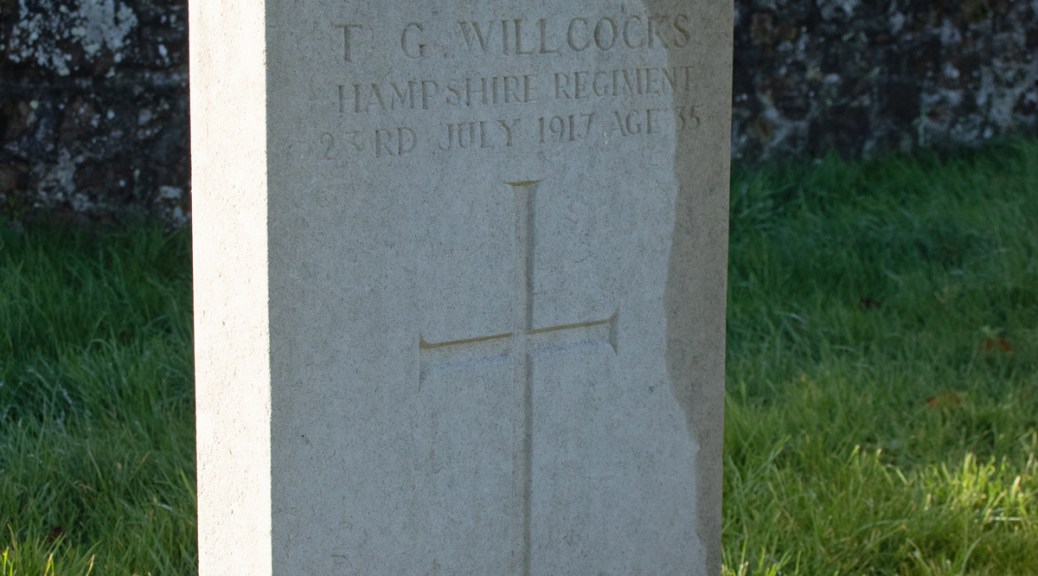
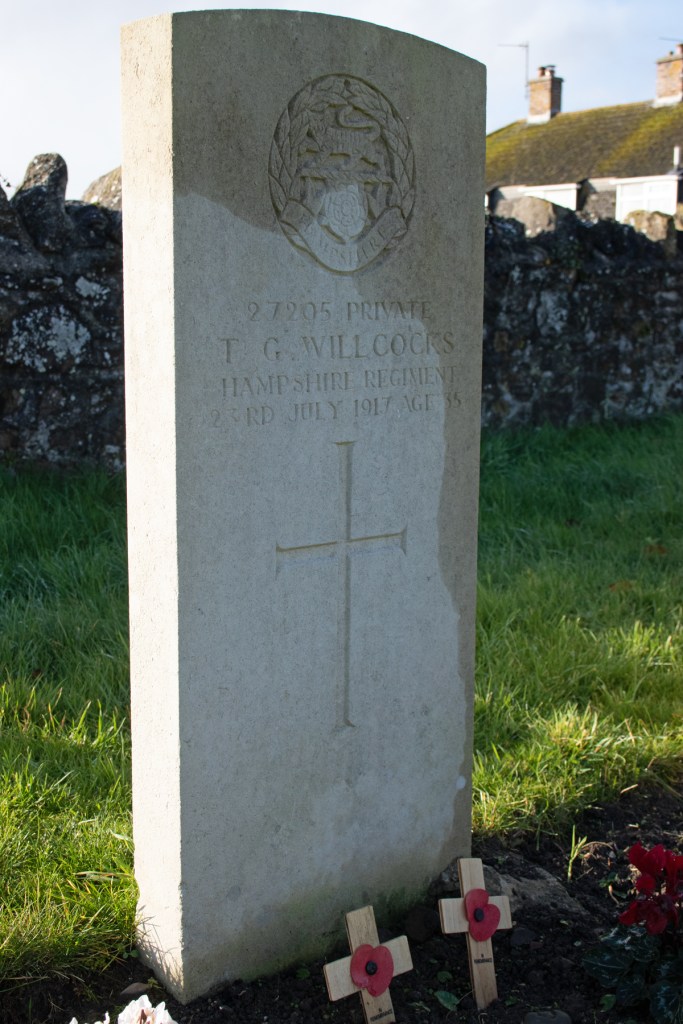
Thomas George Willcocks was born on 18th April 1882, in the Devon village of Chudleigh Knighton. The oldest of five children, his parents were William Willcocks and his wife Emma. William worked as a clay cutter, and this was a trade Thomas followed when he left school.
By 1899, Thomas had met Sophy Gale, a clay cutter’s daughter from nearby Hennock; the couple married and had a daughter, Violet. Thomas was also working as a cutter, and moved into his in-laws house to start raising his young family.
Life can be cruel: the 1911 census shows that Thomas and Sophy had moved to Chudleigh Knighton – where Sophy was originally from. Violet had, by this point, sadly passed away; Thomas’ brother-in-law, Albert, had moved in with the couple to help pay their way.
War was coming to Europe and, although full details of Thomas’ service no longer remain, it is possible to piece together some of his time in the army.
Private Willcocks enlisted in the Duke of Cornwall’s Light Infantry at some point before January 1917, although he soon transferred across to the Hampshire Regiment. His battalion – the 15th – were moved to France in the summer of 1916, and it seems that Thomas was caught up in a gas attack, while in the trenches of the Western Front.
Private Willcocks’ health deteriorated and he was medically evacuated back to the UK for treatment. He was admitted to the Red Cross Hospital in Glasgow, but reports are confused – some identify the impact of the gas on his lungs, while others suggest he was suffering from rheumatism and trench fever. Regardless of the cause, he passed away on 23rd July 1917 at the age of 35 years old.
The body of Thomas George Willcocks was brought back to Devon for burial. He was laid to rest in the graveyard of St Paul’s Church in Chudleigh Knighton.
Thomas’ brother in law, Albert, also died as a result of the First World War; he lies in the grave next to Thomas. His story can be found here.
Thomas’ neighbour was Alfred Moist. He also lies in the same churchyard and his story can be found here.
Edmund Thomas Bevan was born in Weston-super-Mare, Somerset, in November 1867, the son of blacksmith George Bevan and his wife, Mary Ann.
Unfortunately, little documentation remains on Edmund’s early life; after his baptism record, the next evidence for him comes in the form of his military service record, twenty years later.
Looking for a life of adventure, Edmund gave up his labouring job and joined the Somerset Light Infantry. His enlistment papers confirm the date – 12th May 1887 – and showed that he stood at 5ft 4ins (1.62m) tall and weighed in at 120lbs (54.4kg). The papers also note that he had dark brown hair, hazel eyes and a fresh complexion. He also had a scar above his right eye.
Private Bevan joined up for twelve years’ service. He spent his first four years at bases in Essex and Hampshire, before being sent to Gibraltar in November 1891. He returned home after two years, and spent his remaining time in the army in his home county, Somerset. Noted that he had shown a very good character, he was discharged to the reserve brigade on 11th May 1899 in Taunton.
Sadly – tantalisingly – Edmund’s trail goes cold again at this point. When hostilities were declared in August 1914, it seems likely that he was brought out of reserve, but given his age at this point – he was 46 – he was assigned to the territorial force. As a Private in the 125th Coy of the Royal Defence Corps, he would have had civil protection in the London area, although again, specific details are not known.
The next confirmation of Private Bevan’s life is his gravestone. This confirms that he passed away 19th July 1917, at the age of 49. While no cause of death is evident, his pension record sheds a little more light onto his life in the early years of the twentieth century.
Edmund had married a woman called Martha, and the couple had gone on to have a child. Martha passed away in September 1913 and, according to the pension record, Edmund passed guardianship on to his brother Henry.
Edmund Thomas Bevan was laid to rest in the Milton Road Cemetery in his home town of Weston-super-Mare.
Joseph Craven was born in Liverpool on 6th January 1870. There is little information available about his early life, but by the time of the 1891 census, he was boarding with a blacksmith and his family in Bootle, Lancashire. By this point he was working as a fireman – probably a stoker-type role, rather than for the fire service.
The following year, Joseph found an opportunity to broaden his horizons and, on 21st October 1892, he enlisted in the Royal Navy as a Stoker 2nd Class. His papers show that, at the time of joining up, he was 5ft 4ins (1.62m) in height, had dark brown hair, blue eyes and a fresh complexion. No distinguishing marks were noted.
Joseph’s previous employment seemed to have stood him in good stead. After initial assessments at HMS Pembroke – the shore-based establishment at the Royal Naval Dockyard in Chatham, Kent – he was quickly moved on to HMS Wildfire, based in Sheerness. His first sea posting was aboard the battlecruiser HMS Howe, and, within a couple of months, he had been promoted to Stoker 1st Class.
By the time Joseph’s initial twelve-year contract came to an end, he had served on board nine ships and travelled the world. When the time came, he voluntarily renewed his contract and continued his life at sea.
When back in port, he developed a private life. He met a young widow called Sarah Baker in Portsmouth, and the couple married in 1908. The census three years later found Joseph as the head of the household, living in a seven-room house with Sarah, her 13-year-old daughter, 80-year-old widowed mother and two boarders.
Stoker Craven’s naval service was, by this point, continuing apace. By the time hostilities were declared in August 1914, he had served on twelve further ships, and been promoted again, this time to the role of Leading Stoker. In between his voyages, he was based primarily at HMS Victory, Portsmouth Dockyard’s shore-base.
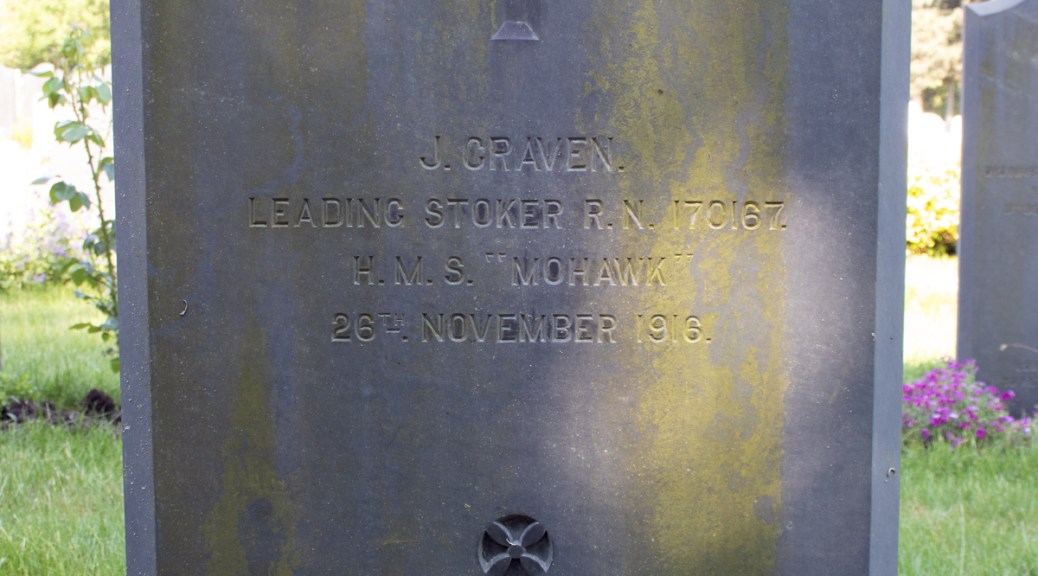
By the end of the following year, Joseph was almost entirely shore-based, moving from HMS Victory in Portsmouth to HMS Pembroke in Chatham and HMS Attentive in Dover. On 26th November 1916, he was serving in Chatham. A local newspaper picks up on what happened to him next:
Joseph Craven… belonging to Portsmouth, met his death under shocking circumstances at Chatham Dockyard on Sunday. When walking by the side of his ship, which was in dry dock, he tripped over some hose and fell headlong into the dock, turning two or three somersaults in his descent, and falling upon his head at the bottom, 80ft [24.3m] below. He was killed instantly.
Kent Messenger and Gravesend Telegraph: 2nd December 1916
An inquest on the 46-year-old’s death was held, and a result of accidental death was returned.
Joseph Craven was laid to rest in the Woodlands Cemetery, Gillingham, walking distance from the dockyard in which he lost his life.
George Henry Hewlett was born on 11th July 1892, the oldest of four children to Henry and Louisa Hewlett. Henry was a painter from Hampshire, who travelled for work. George and his youngest sibling were born in Romsey, while his two brothers were born in Swindon, Wiltshire. By the time of the 1901 census, when George was eight years old, the family had settled in Hammersmith, London.
The next census, in 1911, recorded the family as living in Caterham, Surrey. By this time, George and his father were working as gardeners, while his brothers were working as grocers. Louisa, meanwhile, was employed as a live-in housekeeper for a spinster and her mother just around the corner.
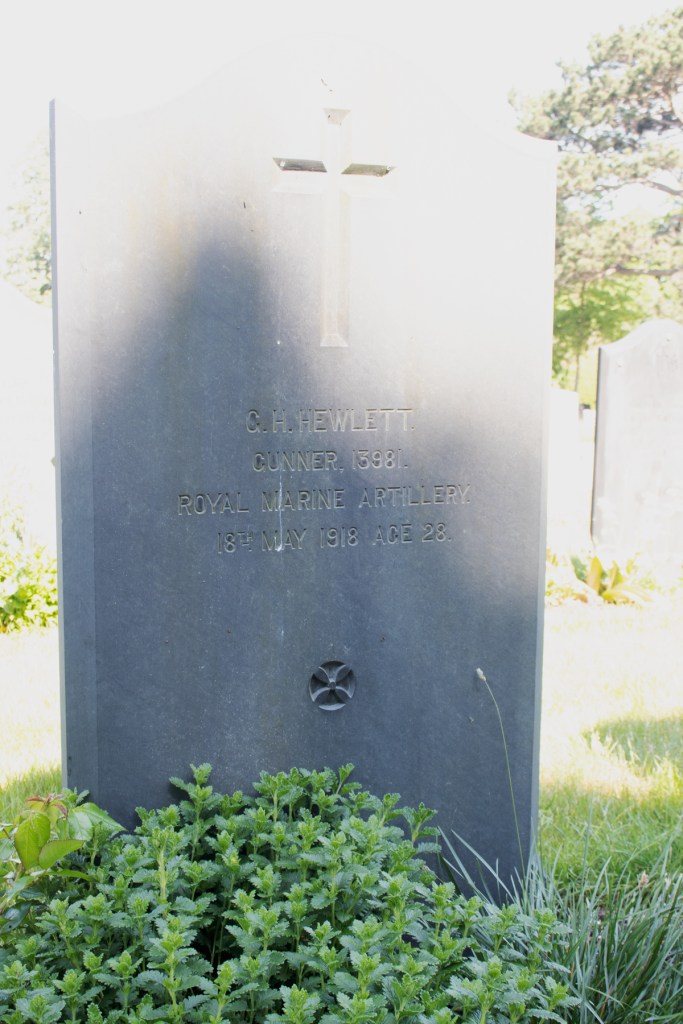
War was coming and George was determined to do his bit. Full details are not available, but he enlisted in the Royal Marine Light Infantry, taking on the role of Gunner. In May 1918 he was on board HMS Iris, a Mersey ferry requisitioned by the Royal Navy for support in the planned raid on Zeebrugge.
On 23 April 1918, HMS Iris was towed across the English Channel to Zeebrugge by HMS Vindictive; she was carrying a couple of platoons of the 4th Battalion of the Royal Marines as a raiding party. When the Vindictive neared the Zeebrugge she cast the ferry aside. Iris tried to pull up to the breakwater under heavy fire in order to off-load the raiding parties which were on board. She sustained heavy fire and a shell burst through the deck into an area where the marines were preparing to land. Forty-nine men were killed, including Gunner Hewlett. George was 28 years of age.
George Henry Hewett’s body was brought back to England. He was laid to rest in the Woodlands Cemetery in Gillingham, Kent, not far from the dockyard at which he was based.
George’s two brothers also fought in the First World War.
John William Hewlett, who was two years younger than George, joined the 1st Royal Marine Battalion of the Royal Naval Division as a Private. He fought on the Western Front, and was killed in fighting on 22nd October 1916. He was 21 years of age. John was laid to rest at the Mesnil-Matinsart Cemetery near the town of Albert in Northern France.
Joseph Herbert Hewlett was born three years after George. When war was declared, he enlisted in the Buffs (East Kent Regiment), joining the 4th Battalion as a Private. Dispatched to India, he was initially based in Bombay, but was injured in fighting. He was sent back to England, and treated at the Military Hospital at Netley, near Southampton. Sadly, his wounds proved too severe – he passed away on 4th April 1915, aged just 20 years old.
In the space of three years, Henry and Louisa Hewlett had lost all three of their sons to the war. After George’s death, a local newspaper reported this was their “sad and proud record”. [Dover Express: Friday 31st May 1918]
Henry Teahen (or Teahan) was born in around 1898 in Castlegregory, County Kerry, Ireland. One of twelve children – eight of whom survived infancy – his parents were John and Catherine Teahan.
John was a wayman (or road surveyor), who was born in Kerry. Catherine was born in Wandsworth and it was in London that the couple met and married. By the time Henry was born, the family had moved back to Ireland, although Catherine had made the journey back to England in the early 1900s, after John passed away.
The 1911 census found the family living in Forest Gate in the east of the capital; Henry’s oldest brother, Joseph, was head of the household and, at 24, was working as a police constable. Schoolboy Henry was there, as was his mother, two more of his brothers, one of his sisters and his niece and nephew.
War was imminent, though, and, within a week of hostilities breaking out, Henry – who had been working as a waiter – enlisted in the Royal Marine Light Infantry. Private Teahen’s service records show that he was 5ft 8ins (1.72m) tall, had a fair complexion, grey eyes and brown hair. They also give his date of birth as 22nd June 1896, although he may have adapted this, as he would have been underage at the point he joined up.
Over the next few years, he served on a number of ships, switching between the Plymouth and Chatham divisions of the regiment. Full details of his duties are not immediately apparent, although is seems that he was injured while on board HMS Valiant in February 1916 – six months before her involvement in the Battle of Jutland – receiving a contusion to his right knee.
By the closing months of the war, Private Teahen had transferred back to the Naval Dockyard in Chatham, Kent. It was while here, early in 1919, that he fell ill. Details of his condition are lost to time, but it is known that he succumbed to them, passing away on 1st March 1919; he was 21 years old when he died.
Henry Teahen was laid to rest in the Woodlands Cemetery in Gillingham, within walking distance of the dockyard at which he was based.
Henry’s older brother James, also fought in the First World War. Full details are not clear, but documents show that he enlisted in the 6th City of London Regiment (also known as the City of London Rifles).
James’ regiment fought in many of the fiercest battles on the Western Front, including Loos, Vimy, High Wood and Messines, but it was at Ypres in the late summer of 1917, that he was injured. He died of his wounds on 30th September, aged just 23 years old.
Private James Teahan was laid to rest at the Mendinghem Military Cemetery in Poperinghe, Belgium.
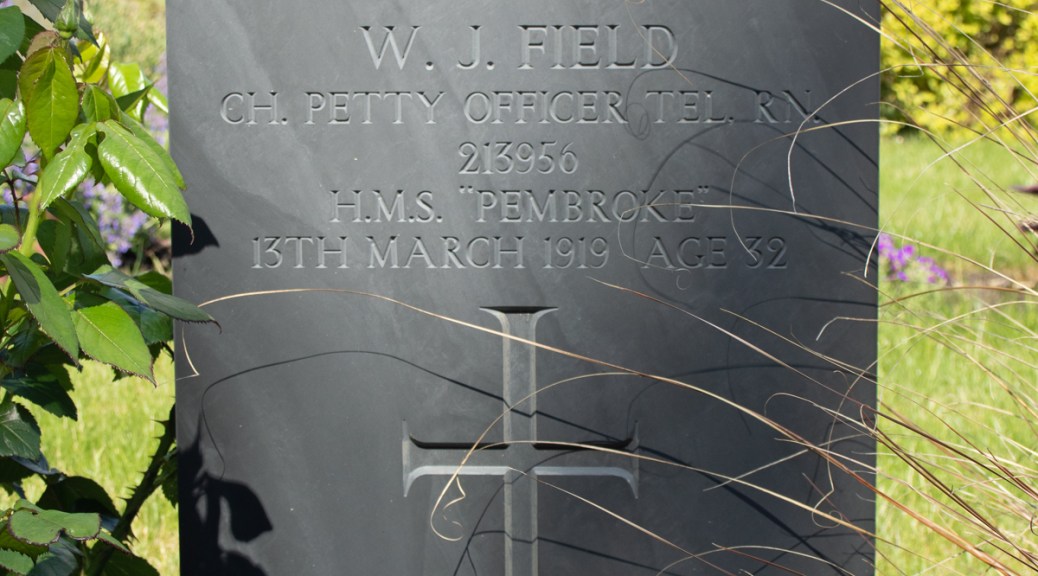
William John Field was born on 8th October 1885 in Boston, Lincolnshire. The eldest of four children, his parents were Charles and Ellen. Charles was a boatman for the coastguard; his job, by the time of the 1891 census, had taken the family to the village of Dawdon on the County Durham coastline.
Given his father’s job, it is not unsurprising that William was destined for a life at sea. As soon as he left school in the spring of 1901, he joined the Royal Navy and was sent to HMS Ganges, the shore-based training establishment in Suffolk. Being underage, he was initially assigned the role of Boy, moving, after a year, to HMS Pembroke, also known as the Naval Dockyard in Chatham, Kent.
By November 1902 Boy Field was moved to HMS Venerable, a ship that was to be his home for the next three years. During this time, William came of age, and was formally enrolled in the Royal Navy as a Signalman. He evidently worked hard on the Venerable, rising through the ranks to Qualified Signalman and Leading Signalman.
In June 1905, William was moved to HMS Leviathan, where he was again promoted, to Second Yeoman of Signals, before again being assigned to Chatham Naval Dockyard six months later.
While based in Kent, William met Nelly Watt, the daughter of a labourer at the dockyard. The couple married in 1906, and went on to have four children.
Over the next few years, the now Petty Officer Telegraphist Field spent an almost equal amount of time at sea and on shore. War was coming and when his initial term of service came to an end in October 1915, he immediately renewed his contract through to the end of the hostilities.
All of William’s time was now spent on land, primarily at HMS Pembroke, but also at HMS Actaeon in Portsmouth, HMS Victory VI at Crystal Palace, London and HMS Bacchante in Aberdeen.
While Chief Petty Officer Telegraphist Field’s naval service records are quite detailed, his passing is anything but. The war over, he moved back to Chatham Dockyard in January 1919. At some point he was admitted to the Royal Naval Hospital in the town, and died from ‘disease’ on 13th March that year. He was just 33 years of age.
William John Field was laid to rest in the Woodlands Cemetery in nearby Gillingham.
A sad aside to the story is that, at the time of he husband’s death, Nellie was pregnant with the couple’s fourth child. John William Field was born on 16th October 1919, destined never to know his father.
Frederick Henry Harvey Finch was born in 1876 in the Sussex village of Ripe. He was one of eleven children, born to James and Eliza Finch. James was an agricultural labourer, a trade into which most of his children, Frederick included, followed.
In the spring of 1900, Frederick married Ellen Maloney. She had been born in Fareham, Hampshire, and, by the time of the 1891 census, ages just nine years old, was recorded in the Union Workhouse in Portsea. The couple wed in Hailsham, and went on to have three children, Frederick Jr, Hilda and Herbert.
By now, Frederick had moved on from farm labouring, and was working as a groom and a gardener. Within ten years, however, he had moved the family to the coast and the village of Angmering; he had found new employment, working as a carter for a coal merchant.
Frederick continued in this line of work as war broke out, but was one of the first to join the village’s contingent of the Voluntary Training Corps. He seemed to be content with this and at the start of 1917, he enlisted in the armed forces, joining the Army Veterinary Corps.
Private Finch was sent to Woolwich for training, but within a matter of weeks fell ill. Admitted to the Royal Herbert Hospital, he passed away on 24th January 1917, at the age of 40. No specific cause of death is recorded, but a local newspaper report of his funeral suggests, rather disingenuously, that “his health, which was never very robust, proved unequal to the strain of Army life”. [Worthing Gazette: Wednesday 7th February 1917]
Frederick Henry Harvey Finch was brought back to Angmering for burial He lies at rest in the graveyard of St Margaret’s Church in the village.
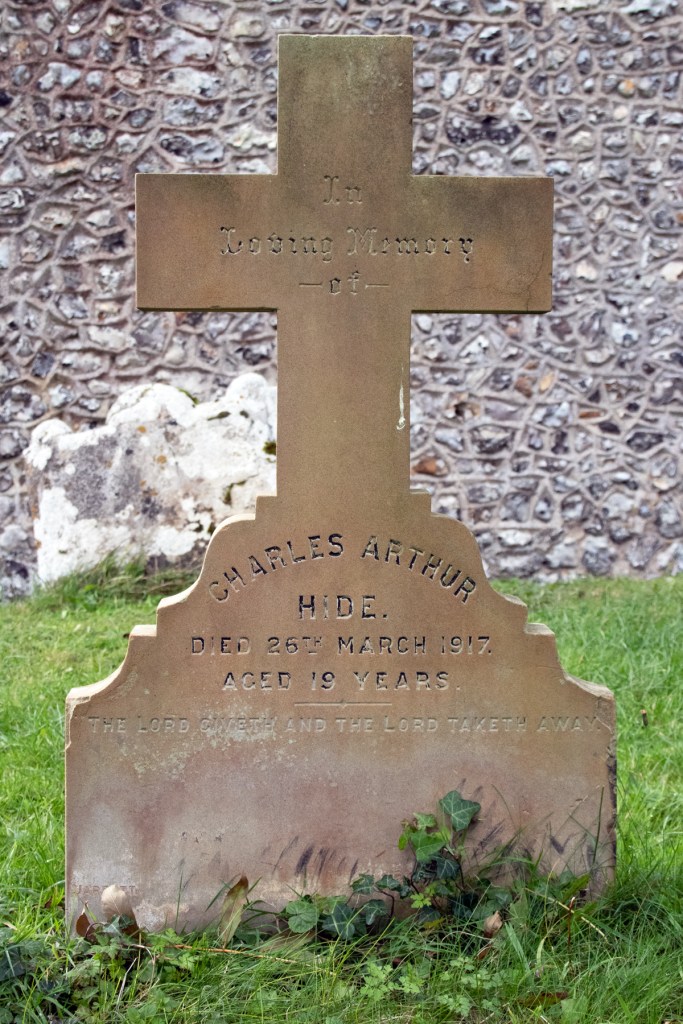
Charles Arthur Hide was born on 14th July 1897 and was the son of Ellen Edith Hide. The 1901 census found Charles living with his mother and her parents in the West Sussex village of Clapham. When Ellen’s father James died in 1909, local hurdle maker Alfred Daniels took her, Charles and her mother in as lodgers. Ellen subsequently married Alfred in 1916.
Charles, by this time, had left school and found employment with the railways. He started work on 22nd April 1913, earning 14s per week (around £55 a week in today’s money) as a porter at the station in Hove.
When war broke out, however, Charles felt the need to do his duty. He resigned from his job on 13th November 1914, and enlisted in the Royal Sussex Regiment as a Private. Charles was not alone in this: the employment records for Hove Station show that a number of other porters also handed in their notice around the same time.
Assigned to the 11th (Service) Battalion (also known as the 1st South Downs), Private Hide was initially based near Bexhill. His troop was then moved on, first to Maidstone in Kent, then to Aldershot, Hampshire. Whilst the battalion as a whole were shipped to France in 1916, there is no evidence that Charles went with them, and it seems that he may have served his time on home soil. Wherever he was based, he was awarded the Victory and British Medals for his time in the army.
At this point, details of Private Hide’s life become sketchy. He is only mentioned in one further document – the Army Register of Soldiers’ Effects – which confirms that he passed away at a military hospital in Epsom, Surrey, on 26th March 1917, although no cause is given. He was just 19 years of age.
Charles Arthur Hide’s body was brought back to Sussex for burial. He lies at rest in the quiet graveyard of St Mary the Virgin Church in his home village of Clapham.
George Trask was born on 22nd December 1875 and was the oldest of nine children. His parents were Absolam and Sarah Jane Trask, although it seems that the couple did not actually marry until after their first three children had been born. Absolam was an agricultural labourer and the family lived in his and Sarah’s home village of East Coker, near Yeovil in Somerset.
George was destined for a life of adventure; in May 1894, aged just 18, he enlisted in the army, joining the Royal Artillery as a Gunner. His medical examination sheds some light on his physique. He stood 5ft 7ins (1.70m) tall and weighed in at 144lbs (65.3kg). He had a fair complexion, hazel eyes and light brown hair.
Oddly, in the section on distinguishing marks – recorded to help identification should the soldier be killed – the medic only highlighted a ‘small mole midway between pubes and umbilicus’: it seems unlikely that this was the only distinguishing mark that could have been highlighted.
Gunner Trask’s initial service was spent in England. He served four-and-a-half years on the home front, before being shipped to Malta. After six months on the island, he was moved to Crete for a few months, before returning to Malta in September 1899.
George completed his initial term of seven years’ service, and elected to remain to complete a full twelve years of enlistment. As part of this, he was transferred to the Caribbean, spending two years stationed in Bermuda, before moving on to St Lucia for a further two years. By December 1905, Gunner Trask was back home in England, and it was on home soil that he remained.
Back in Somerset, George extended his term of service for another four years. Settled in his home village, he married Elizabeth Garrett on 27th December 1908; the couple would go on to have three children: Ethel (born in 1910), Lilian (1911) and George Jr (1916).
Gunner Trask’s military service continued apace. Reassigned to the Royal Garrison Artillery, he was posted in Portsmouth up until the outbreak of the war. He was awarded a third Good Conduct Medal in addition to the ones he had received in 1900 and 1904.
At this point, details of George’s military service become a little hazy. He achieved 21 years’ military service on 29th May 1915 and was awarded a further Good Conduct Medal. At this point, with the war raging, his period of duty was extended again, until the end of the conflict.
At some point during this time, he was assigned to the Royal Artillery’s School of Experimental Gunnery in Shoeburyness Essex. Sadly, there is nothing to confirm his exact role there, although, given that he was in his 40s by this point, it is likely that he acted as more of a mentor.
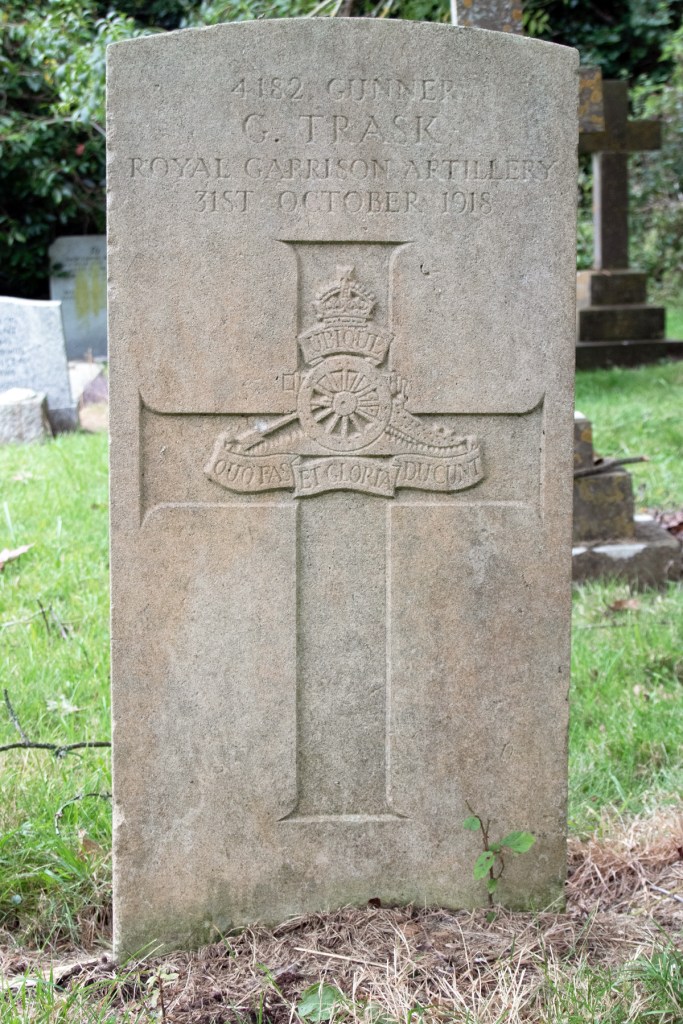
And it is here that the story comes to an end. Gunner Trask is noted as passing away in the Military Hospital in Shoeburyness on 31st October 1918, though there is nothing to confirm the cause of his death. He was 43 years of age.
George Trask’s body was brought back to Somerset for burial. Having travelled the world with the army, he was laid to rest in the graveyard of St Mary’s Church in his home village of East Chinnock.
George’s son George was to follow his father into military service.
Working as a press operator for a plastics company, he married Gwendoline Harper in Southend, Essex in April 1940. There is no record of whether he had enlisted at this point, but is seems likely that he had.
When the Second World War broke out, he joined the 4th Battalion of the Suffolk Regiment. After initially helping in the defence of England following the British Army’s evacuation from Dunkirk, late in 1941, he was sent first to Egypt, then to Singapore to help strengthen the garrison there.
Early the following year, the 4th and 5th Battalions fought in the defence of Singapore, before the island surrendered to the Japanese Army. At this point, Lance Corporal Trask found himself a prisoner of war.
The prisoners were put to work building the Burma railway, and suffered great hardship at the hands of their captors. Many succumbed to illness, and George was amongst them, dying from beriberi on 18th December 1943. He was just 27 years old.
George Reginald Trask was laid to rest in the Chungkai Cemetery in Thailand, 100km west of Bangkok.
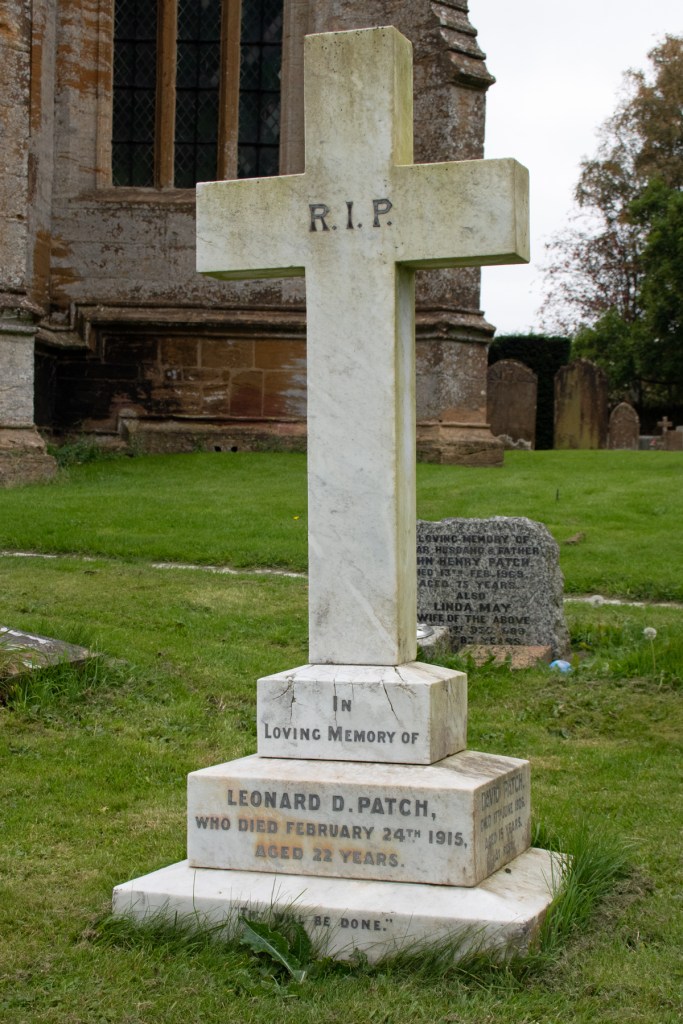
Leonard David Patch was born on 22nd October 1892, the oldest of four children to David and Fanny Patch from Norton-sub-Hamdon in Somerset. David was a stone mason, but when his eldest son left school, he found work as a carpenter.
When war came to Europe, Leonard was one of the first from the village to volunteer. Given the small size of Norton-sub-Hamdon, it seems likely that he would have done so with friends; many of the Pals Battalions were formed like this.
Leonard joined the Somerset Light Infantry as a Private, and was assigned to the 7th Battalion. He was sent to Woking, Surrey, for training and it was while he was billeted there that he contracted measles. Moved to the Military Isolation Hospital in Aldershot, he developed pneumonia, and passed away from the lung condition on 25th February 1915. He was just 22 years of age, and had seen no military action.
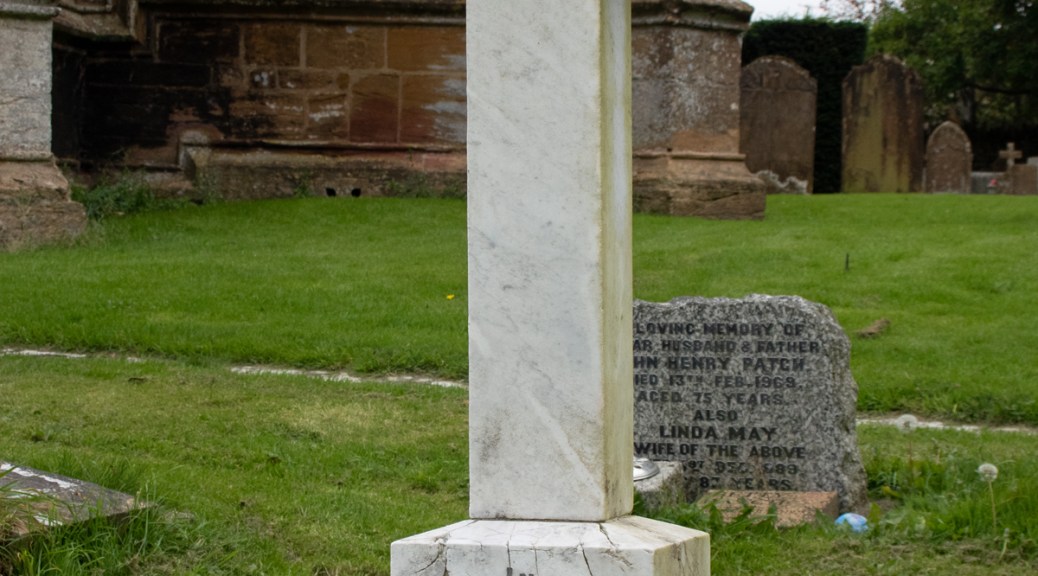
Private Patch’s body was brought back to his home village, where he was laid to rest in the graveyard of St Mary’s Church, where he had been baptised two decades before.
Of Leonard’s brothers, two saw active service.
John Henry Patch, the second oldest of the siblings, served in the Royal Engineers, enlisting just ten months after his brother had died. He survived the war, married Linda Turner in Yeovil and went on to have a son, Norman. John passed away in February 1969, a few days after his 75th birthday.
Edward Lionel Patch – the third brother – served with the Devonshire Regiment. He too survived the war, marrying Honor Brown in 1923; they also had a son, called David. Edward passed away in Yeovil in 1966, aged 70 years old.
The youngest of the four brothers, Clarence William Patch, was born in 1899 and was lucky enough not to have seen military service. He married Emily Brown in 1924 and the couple had a daughter, Emmie. Sadly, she passed away as a babe-in-arms, and Emily was to follow soon after. In 1931, Clarence married again, this time to Emily Dyer; they went on to have a son, Douglas Leonard. Clarence passed away in 1945 at the age of just 46 years old.










 Death and Service