Category Archives: Somerset

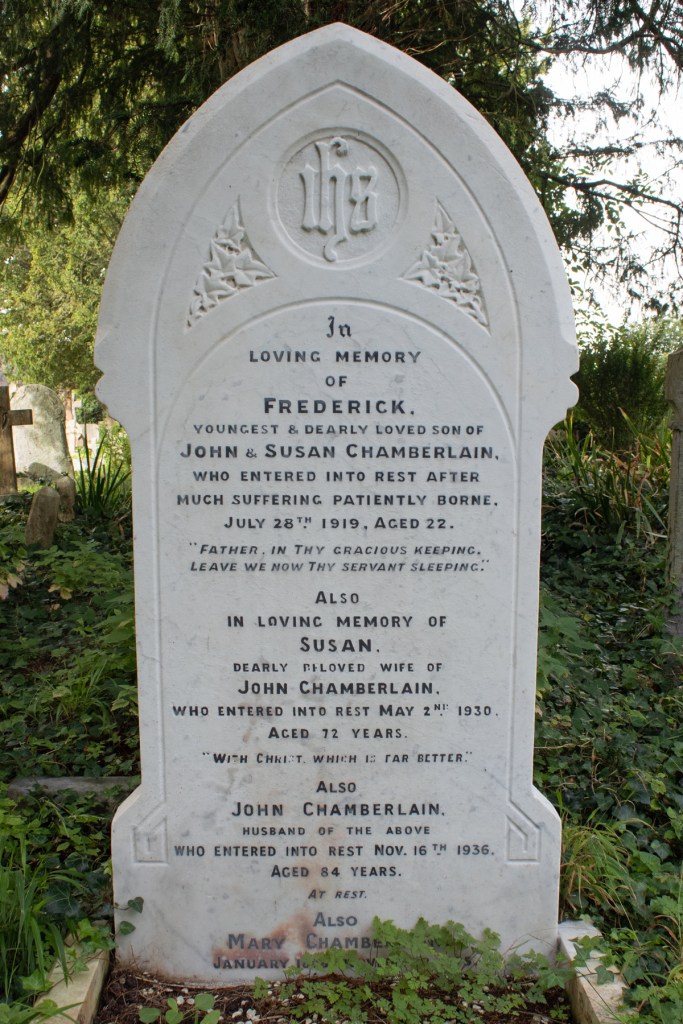
Corporal Frederick Chamberlain

Corporal Frederick Chamberlain

Frederick Chamberlain was born in the summer of 1896, the youngest of six children to John and Susan Chamberlain. John was a gardener from Dulverton in Somerset, but it was in Abbots Leigh, near Bristol, that the family were born and raised.

When he finished his schooling, Frederick found work in service and, by the time war broke out, he was employed as a footman. War presented a new adventure, however, and he was quick to step up and serve his country. He enlisted on 1st September 1914, just a few weeks after hostilities were announced, and was assigned to the 1/4th (City of Bristol) Battalion of the Gloucestershire Regiment.

Private Chamberlain’s service records are pretty sparse, but his unit was sent to France in May 1915, and he was to spend the next thirteen months on the Western Front. He seemed to have performed his duty well, however, and during that time was promoted to Corporal. Frederick returned to Britain in the summer of 1916, for what seemed to be health reasons. He was discharged from the army on medical grounds in November, suffering from phthisis, or tuberculosis.

At this point, the trail goes cold. He returned to Somerset, but his health deteriorated. Frederick passed away at home on 18th July 1919: he was just 22 years of age.

Frederick Chamberlain was laid to rest in the family plot in Holy Trinity Churchyard, Abbots Leigh. His funeral was presided over by Reverend Walter Brinkley, who had performed his baptism two decades earlier.


Major Charles Hall

Major Charles Hall

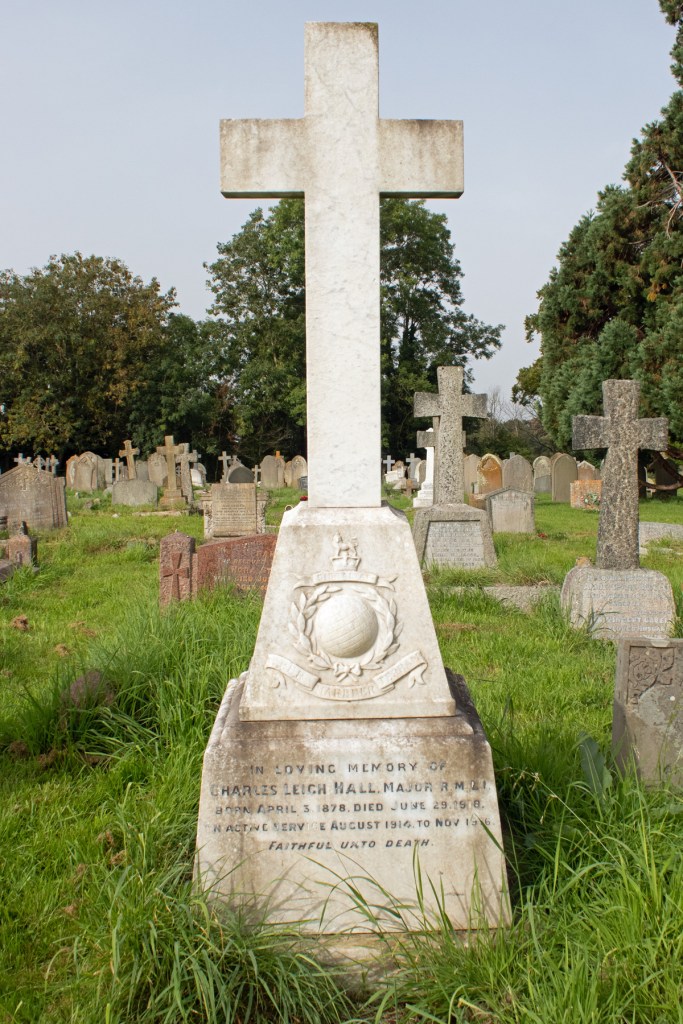
Charles Leigh Hall and his twin Maud, were born on 3rd April 1878 in Clifton, Gloucestershire. Two of eight children, their parents were Pedro and Anne Hall. Pedro, whose full name was Pedro Henrique Sinclair Hall, was better known as Henry, and was a mathematics tutor and Assistant Master at Clifton College, and it goes without saying that the Hall children had a educated upbringing.

Charles was always to be destined for great things. By the time of the 1901 census, when he was 22 years of age, he was a Lieutenant in the Royal Marines Light Infantry. Based on the cruiser HMS Amphion, he travelled the Pacific and, on the night the return was taken, was moored in Vancouver, Canada.

On 15th June 1910, Charles married Sophia Elinor Veale. Born in Caledon, South Africa, the couple wed in the village of Littleham, Devon. They set up home in Gosport, Hampshire – presumably as the now Captain Hall’s work was based from the docks there – and went on to have two children, Anthony and Nicholas.

By September 1915, Charles had been promoted again, this time to the rank of Major. His wartime service included a lot of work in Africa, including in Cameroon in 1914 – for which he was mentioned in Dispatches – German East Africa (Burundi, Rwanda and Tanzania today) in 1915 and Saadani (Tanzania) in 1916.

In October 1916, he was invalided out of the Royal Marine Light Infantry for reasons that are unclear, and returned to Britain from Simonstown, South Africa. While Charles seems not to have gone to sea any more, his experience was still respected, and, on 15th January 1917, he was promoted to Brigade Major.

The family settled back down in Portsmouth, Hampshire, and remained there for the next eighteen months. By the summer of 1918, Charles was in Bristol – either based at the docks there, or hospitalised in the city – and passed away on 29th July 1918. He was 40 years of age.

Sophia and her boys were still in Portsmouth, but Charles Leigh Hall was laid to rest in the graveyard of St George’s Church in Easton-in-Gordano, Somerset. The headstone incorrectly gives the month of death as June. Charles’ will divided his estate – £4467 (£318,000 in today’s money) – between his brother, Arthur, and Charles Garnett, a barrister, possibly as a trust for his sons.


Pioneer Patrick Craven

Pioneer Patrick Craven

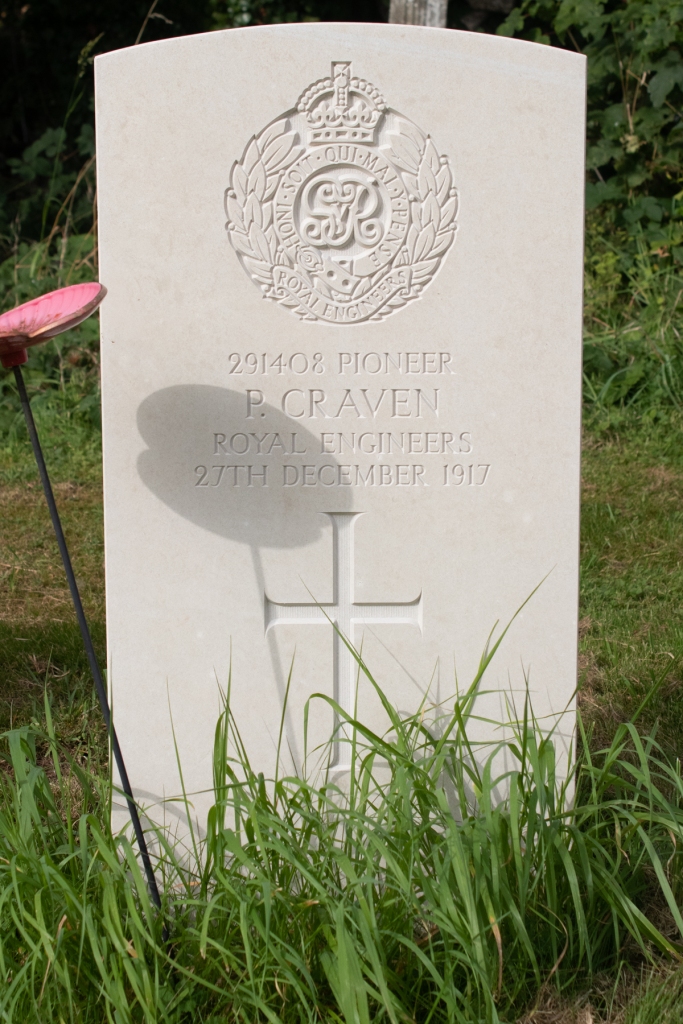
Patrick Craven was born in the summer of 1898 in Drogheda, County Louth. The oldest of three children, his parents were Francis (or Frank) and Mary Craven. Mary died in 1909, and the following year Patrick’s father remarried, to widow Kate Devin. The 1911 census found the extended family living in a cottage on North Road, Frank, Kate and their seven children.

Frank was a farm labourer, and this is work that Patrick also went into when he finished his schooling. War came to Europe in 1914, and he was to be called upon to play his part.

Patrick enlisted in the Royal Engineers on 6th June 1917. His service records confirm that he was 5ft 6ins (1.68m) tall, and weighed 127lbs (57.6kg). Pioneer Craven was assigned to the Inland Waterways Transport Division, and sent to Henbury, on the outskirts of Bristol, Gloucestershire, for training.

There was one blip on Patrick’s otherwise spotless service when, on 1st October 1917, he was confined to barracks for two days for ‘conduct to the prejudice of good order and military discipline, leaving the ranks without permission‘. Shortly after this, Pioneer Craven was assigned to a unit in Portbury, Somerset.

The wet summer of 1917 had given way to a cold, harsh winter, and the conditions were to lead to Pioneer Craven’s tragic demise on 27th December. The detailed report from the Medical Officer explained what had happened:

This man was found dead… in a small harness room at the Lodway Brewery, Pill, a room occupied by the IW&D, Portbury. I was called in to see him and pronounced him dead, the body was quite stiff and cold and death had probably taken place several hours before. When first discovered the body was fully pronated, with the mouth flattened against the floor, the hands were gripping the Army greatcoat which he had pulled over himself.

The harness room was heated by a coke stove the flue of which passed through the room to the ceiling and was cracked, allowing the fumes of the burning coke to emanate into the room. There was no ventilation except through a door communicating with the stables, which was found shut at the time the cadavre [sic] was found. The stove was situate[d] between the position where the body lay and the door, in a cul-de-sac.

One other man slept in the same room the same night, the deceased man having evidently entered the place after the former had fallen asleep. The second man was not affected by the fumes to any degree, but was lying between the stove and the door under which there was a certain amount of draught.

Sheltering himself from the cold winter night, Private Craven had passed away in his sleep from carbon monoxide poisoning. He was just 19 years of age.

Patrick Craven’s family were unable to afford to bring him back to Ireland for burial. Instead, he was laid to rest in the peaceful graveyard of St George’s Church in Easton-in-Gordano, not far from the brewery stables where he had passed.


Lance Corporal Charles Bayliss

Lance Corporal Charles Bayliss

Charles Bayliss was born in Birmingham in 1861. Little concrete information is available about his early life, but later documents confirm his father was called John, and he was one of at least five children.

Charles married Ellen Kimberley on 8th April 1888. The couple wed at St Mary’s Church in Kidderminster, Worcestershire, and went on to have four children – Nellie, Charles, Burt and Eva.

Charles took up manufacturing work, and ended up being a machine belt maker. He also served in the South Staffordshire Regiment, although whether this was on a paid or voluntary basis is not clear.

When was came to Europe, Charles felt the need to serve his country once more. He enlisted on 23rd August 1917, taking five years off his age to ensure he was accepted. He was assigned to the Royal Engineers, and attached to the Inland Waterways and Docks unit.

Private Bayliss was based at Portbury Camp near Bristol, and records suggest that Ellen moved to be near him, finding lodgings on Myrtle Hill in Pill.

Charles was respected for the work that he was doing, and was promoted to Lance Corporal in May 1918. His health was against him, however, and just two months later he collapsed and died from a heart attack while at work. He was 58 years of age.

Charles Bayliss was laid to rest in the graveyard of St George’s Church, Easton-in-Gordano, not far from the docks where he had served, and the riverside home in which his widow still lived.


Lieutenant Hubert Cavell

Lieutenant Hubert Cavell

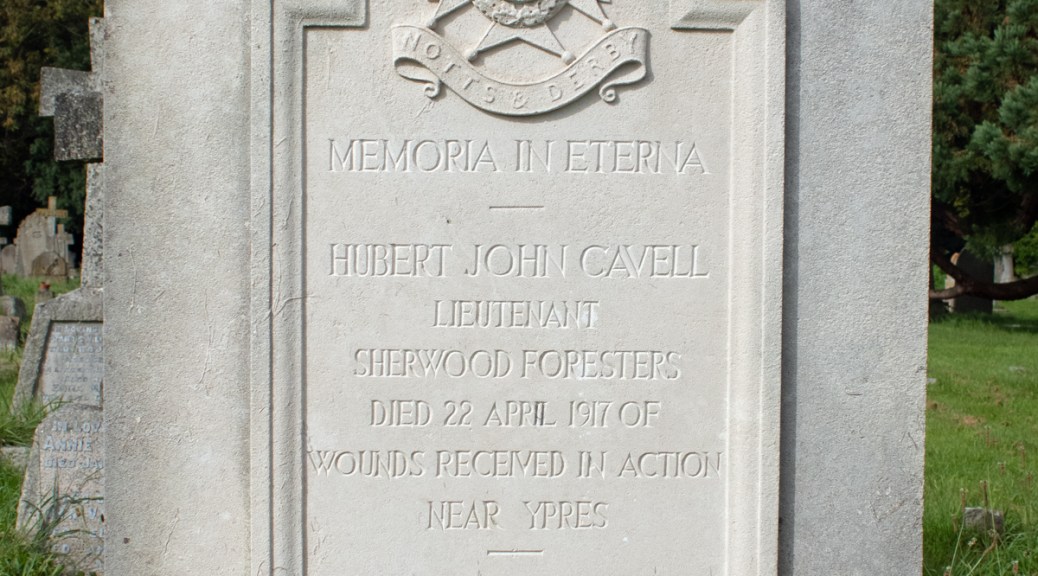
Hubert John Cavell was born on 12th August 1882 in Bristol, Gloucestershire. The middle of three children, his parents were John and Annie Cavell. The 1901 census recorded John as a cycle manufacturer, and both he and Annie were keen to educate their children.

Hubert studied to be an architect, and was employed as such when, on 17th February 1910, he married Florence Shellard. Also born in Bristol, she was the daughter of an insurance agent. Hubert’s father, however, had changed career by the time of his son’s nuptials, and was working as a manufacturer of steel rope.

After their wedding, Hubert and Florence moved out to Easton-in-Gordano, Somerset, and went on to have two daughters: Phyllis, who was born in November 1910; and Dorothy, born in April 1912.

War was brewing across Europe by this point, and, when hostilities were announced, Hubert stepped up to play his part. Full service records for him are lost to time, although is it clear that he joined the Sherwood Foresters (the Nottinghamshire & Derbyshire Regiment). He was assigned to the 11th (Service) Battalion, and, by the spring of 1917, was firmly entrenched on the Western Front.

News has just been received of the death from wounds, received in action, of Lieut. Hubert John Cavell, of Easton-in-Gordano. The deceased officer was educated at the Cathedral School, and had been associated with the firm of Messrs. Paul and James, architects, for the past 16 years. He was for some years a member of the Church Ringers’ Society, being engaged in that capacity at St James’s Church, Bristol. He joined the Sherwood Foresters in January, 1916, received his commission, and had for the past three months held the position of acting-adjutant. He was 34 years of age, and leaves a widow and two little daughters.

Western Daily Press: Tuesday 24th April 1917

Lieutenant Cavell had been caught up in the fighting near Ypres, and was medically evacuated to a military hospital in Dorking, Surrey. It was here that he succumbed to his injuries on 22nd April 1917.

Hubert John Cavell’s body was brought back to Easton-in-Gordano for burial. He was laid to rest in the family plot in St George’s Churchyard. He was reunited with Florence, when he died in 1971, and Dorothy, when she passed away in 1997.


Private Oliver Haskins

Private Oliver Haskins

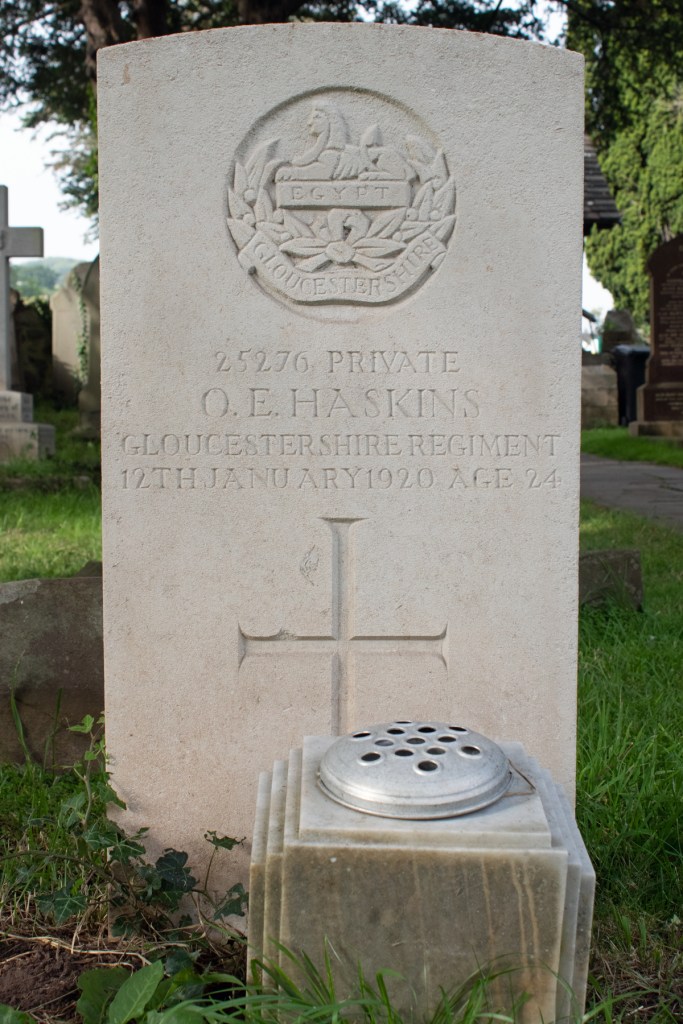
Oliver Edgar Haskins was born in 1896 in Portbury, Somerset. One of ten children, his parents were John and Hester Haskins. John was a gardener, and the 1911 census noted that Oliver was ‘working at home’, although no trade is listed.

When war came to Europe, Oliver stepped up to serve his King and Country, and was one of six Haskins brothers to fight in the conflict. He joined the Gloucestershire Regiment, and was initially assigned to the 15th (Reserve) Battalion. Based on home soil, his unit were barracked at Chiseldon Camp on the fringes of Salisbury Plain, Wiltshire.

At some point Private Haskins transferred to the Labour Corps, and became attached to the 207th Employment Company. It is not possible to identify exactly where he served, but he remained on home soil during the conflict.

The funeral took place at Portbury on Saturday of Mr Oliver Haskins… He was very popular in the village and at business, by virtue of his cheerful disposition and sterling qualities, and was beloved by everybody who came into contact with him. Mr Haskins was taken ill some ten days ago, and confined to his room, but he apparently made a quick recovery until Monday last, when he was suddenly taken worse and died in a few hours, at the age of 24.

Bristol Times and Mirror: Monday 19th January 1920

Oliver Edgar Haskins died on 12th January 1920. He was laid to rest in the once peaceful graveyard of St Mary’s Church in Portbury.


Private Harry Gannett

Private Henry Gannett

Harry Udall Gannett was born in the autumn of 1900, the second of four children to Charles and Clara. Charles was an agricultural labourer from Somerset, and it was here that the family were raised.

The 1901 census found Clara living with her brothers and two children in the village of Fivehead, while Charles was living and working just a few miles away in North Curry.

Charles passed away in 1906, aged just 48, leaving his widow to raise their now four children. The next census, in 1911, found Harry living in North Curry with his aunt and uncle, Francis and Emily Lee. Francis was noted as being a thatcher and hurdle maker. Harry’s mother was living elsewhere in the village with his three siblings. She was working as a farm labourer, while her brother, Russell, was also living there, helping support the family through his work, also as a hurdle maker.

Harry was keen to play his part when war broke out. His age initially prevented him from doing so, but he had enlisted by the late summer of 1918, joining the 53rd (Young Soldier) Battalion of the Devonshire Regiment. His service records are no longer available, but his unit was based at Rollestone Camp in Wiltshire, and this is likely where he was sent to be trained.

Little further information is available for Private Gannett. He contracted influenza while billeted in the cramped army barracks and died on 13th January 1919. He was just 18 years of age.

Harry Udall Gannett was brought back to Somerset for burial. He was laid to rest in the peaceful graveyard of St Peter & St Paul’s Church in North Curry. His headstone reads “our dear nephew”, and it is likely that is was paid for by Francis and Emily Lee, the relatives who had taken him in after his father’s death.


Stoker Petty Officer Charles Lavis

Stoker Petty Officer Charles Lavis

Charles Walter Lavis was born in Iowa, USA, on 2nd April 1888. The second of eleven children, his parents were James and Martha Lavis. The only census record Charles appears from – the return from 1901 – shows that James was an agricultural labourer from Long Sutton in Somerset. The family’s move to America seemed not to have lasted for long – Charles’ immediate siblings – Mabel, who was two years older, and George who was two years younger – were both born in Long Sutton.

Charles was drawn to a life of adventure and, on 11th April 1906, he enlisted in the Royal Navy. His service records confirm that he was 5ft 5ins (1,65m) tall, with brown hair grey eyes and a fresh complexion. As a Stoker 2nd Class, he was initially sent to the training ship HMS Nelson, before moving to what would become his shore base, HMS Victory, the Royal Naval Dockyard in Portsmouth, Hampshire.

Over the next year, Charles serves on HMS Hecla and HMS King Edward VII, where, on 17th May 1907, he was promoted to Stoker 1st Class. He remained on the King Edward VII for more than four years, before returning to Portsmouth in August 1911.

Back on shore, Stoker 1st Class Lavis was promoted to Leading Stoker, and spent the next nine months training for the role at HMS Fisgard, also in Portsmouth. He spent six months on the battleship HMS Revenge, before moving again to another battleship, HMS Britannia.

Charles spent two years on the Britannia, and it was while assigned to her that he got married. He wed Bessie Patten on 31st May 1914 in Martock, Somerset: the couple would go on to have a daughter, Eileen, who was born the following April.

It was while Charles was serving on HMS Britannia that was broke out. In November 1914, he returned to Victory for further training and, in the spring of 1915, he was promoted to Stoker Petty Officer.

Over the next three years, Charles served on three more vessels, before finally returning to Portsmouth in April 1918. The reason for his return was because of his health, and he was soon admitted to the Royal Naval Hospital in Haslar, Gosport, suffering from tuberculosis of the neck. The condition necessitated an operation, but Stoker Petty Office Lavis was not to survive the procedure. He suffered from heart failure, and died on 2nd May 1918. He had not long turned 30 years of age.

Charles Walter Lavis was taken back to Somerset for burial. He was laid to rest in the quiet graveyard of All Saints’ Church in Martock.


Records suggest that the Lavis family could not settle. Passenger lists from March 1912, show James and Martha travelling with nine children to Portland, Maine, before moving on to Huron in Ontario. James was still recorded as being a farm labourer, so it seems that opportunities for the family were better in North America than in Britain.

When war broke out, citizens of the Commonwealth were called upon to play their part and, despite being under age, Charles’ younger brother Arthur, stepped up to serve. Details of his time in the army are scarce, but he was assigned to the 14th Battalion of the Canadian Infantry. His troop set sail for Britain in October 1914: Arthur was just 14 years old at this point, and had lied when he joined up, giving his date of birth as 20th May 1897.

Private Arthur Lavis was in France by August 1916, taking up position on the Front Line at Coucelette. They met heavy troops, even before a full offensive got underway on 16th September. Ninety-two soldiers from the 14th Battalion were killed during the attack, Arthur included. He was just 16 years old, and his remains were never recovered. He is commemorated on the Vimy Memorial in France.


Lance Corporal Frederick Beaven

Lance Corporal Frederick Beaven

Frederick Henry Jacob Beavan was born in Street, Somerset, in the summer of 1891. There is little information available about his early life, although later records suggest that his parents were Mr & Mrs Tom Beaven.

Frederick married a woman called Elsie late in 1910 or early in 1911 and, while there is little information about her, they went on to have three children, Harwood, Hubert and Tom. The 1911 census noted that Frederick was working as a boot and shoe maker in the town’s factory, Clark’s.

The only other documents for Frederick relate to his passing. When war broke out, he enlisted in the Worcestershire Regiment, although it is not possible to determine which battalion he was assigned to. Private Beaven did serve overseas, however, and, by the summer of 1918, had been promoted to the rank of Lance Corporal.

Frederick was injured during a German gas attack that summer, and was medically evacuated to Britain for treatment. His weakened condition was to prove too severe, however, and he passed away on 10th July 1918, from double pneumonia. He was 27 years of age.

Frederick Henry Jacob Beaven was brought back to Street for burial. He was laid to rest in the town’s cemetery.


Lance Corporal Frederick Gilbey

Lance Corporal Frederick Gilbey

Frederick James Gilbey was born on 1st September 1888 in Walthamstow, Essex. The oldest of nine children, his parents were Alfred and Emily. Alfred was a general labourer, and the family initially lived on Chingford Road, before moving to an end-of-terrace house at 41 MacDonald Road.

On 28th August 1910, Frederick married Katherine Heathorn. Little more information is available about her, although the young couple’s marriage seemed to be the start of something bigger: the newlyweds emigrated shortly afterwards, arriving in Fremantle, Australia, in October 1910. Frederick’s immigration records noted that he was employed as a salesman, while Katherine was working as a dressmaker.

The couple settled into their new life well. The 1916 Electoral Records found the family living at 20 Oswald Street in the leafy Victoria Park suburb of Fremantle. Frederick was now working as a tram conductor, while Katherine was busy raising their two children, Leslie and Arthur.

By this point, Europe was two years into a bloody conflict. Frederick’s younger brother William, a Private in the Royal Fusiliers, had been killed at Gallipoli in August 1915, and it would seem that he also felt pulled to serve his King and Empire.

On 12th September 1916, Frederick enlisted in the Australian Imperial Force. His service documents note that he was 5ft 6.5ins (1.69m) tall and weighed 140lbs (63.5kg). Private Gilbey had auburn hair, blue eyes and a fresh complexion.

After initial training, he left Fremantle for the two-month journey back to Britain. Assigned to the 13th Training Battalion, his unit was based in Codford, Wiltshire. In November 1917, Frederick attended the 15th Rifle Course at the School of Musketry in Tidworth, where he qualified as 1st Class, with a fair working knowledge of the Lewis Gun.

The following February, Private Gilbey was transferred to the 51st Battalion of the Australian Infantry, and sent with his unit to France. On 20th April, days before the Battle of Villers Bretonneux, he was promoted to Lance Corporal.

The battle, however, was to prove to be his last. Wounded in the right thigh by gun shot, he was medically evacuated to Britain, and admitted to Bath War Hospital, Somerset, for treatment. His wounds were too severe, however: Private Gilbey passed away on 2nd May 1918, at the age of 29 years old.

With his widow and children on the other side of the globe, Frederick James Gilbey was laid to rest in the military section of Bath’s Locksbrook Cemetery.