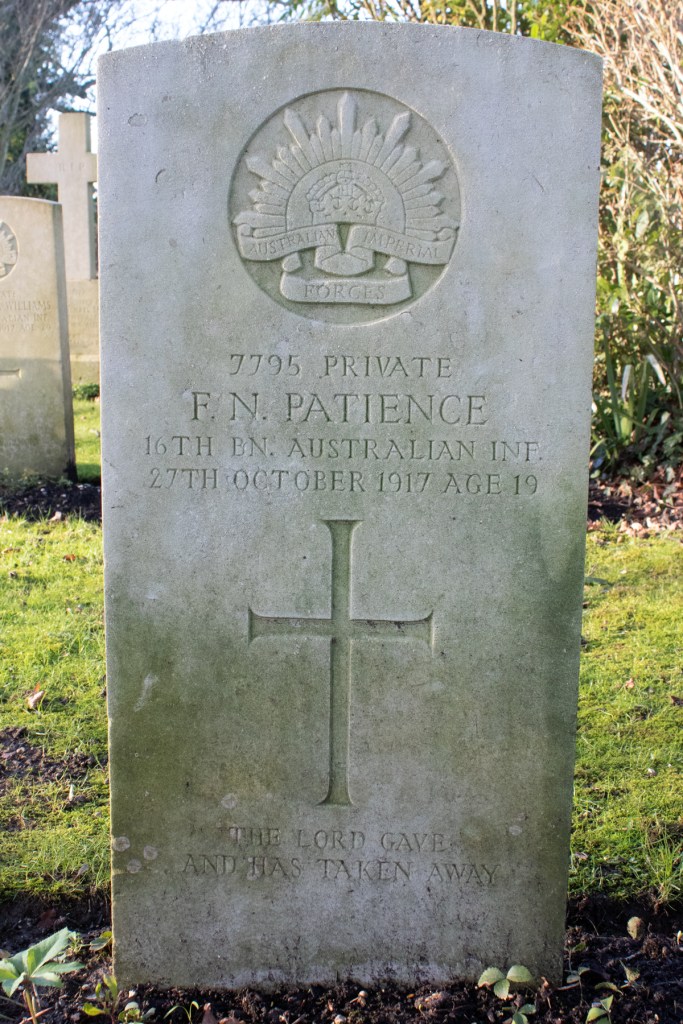
Frank Nicholas Patience was born in Mullewa, Western Australia, on 6th March 1898. The tenth of fifteen children (of which four did not survive childhood), his parents were Joseph and Elizabeth Patience.
There is little concrete information about Frank’s early life. When he finished his schooling, he found employment as a farm hand, and this is what he was working as when he stepped up to serve his country.
Frank enlisted in the Australian Imperial Force on 18th June 1917. Within six weeks he left his homeland for Europe, arriving in Liverpool, Lancashire, on 3rd October. Assigned to the 16th Battalion of the Australian Infantry, he was barracked in Wiltshire, at a camp not far from the village of Codford.
Tragically, Private Patience’s time in the army, and in Britain, was to be brief. Within weeks of arriving in Wiltshire, he contracted pneumonia, and was admitted to the camp hospital. The condition was to prove his undoing, however, and he passed away on 27th October 1917. He was just 19 years of age.
Frank Nicholas Patience was 9,000 miles (14,500km) from home. He was laid to rest in the extended graveyard of St Mary’s Church in Codford, Wiltshire.
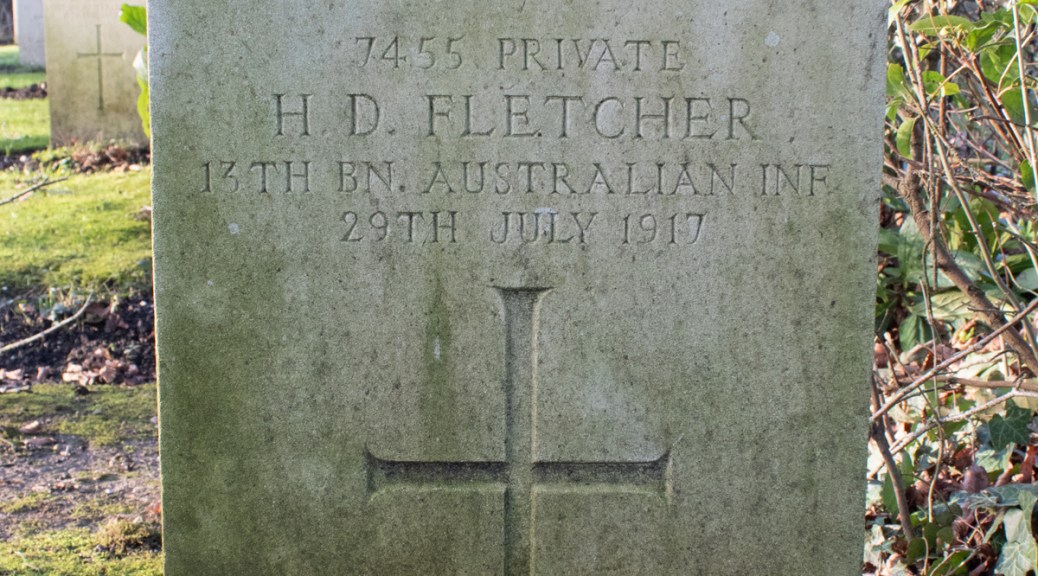
Harry David Fletcher was born in Leichhardt, New South Wales, Australia, on 1st November 1883. The seventh of ten children – and the only surviving son – his parents were Daniel and Charlotte Fletcher.
There is little information about Harry’s early life: he found work as a labourer when he finished school and, on 11th March 1911, he married Lillian Bosworth. The couple went on to have a son, Harold, who was born the following February.
When war came to Europe, the British Empire was called upon to play its part. On 19th February 1917, Harry enlisted in the Australian Infantry, although he did so under the alias of Harry Conway. His service records show that he had dark brown hair, hazel eyes and a medium complexion. He was also 5ft 7.75ins (1.72m) tall and weighed 140lbs (63.5kg). He had two noticeable scars: one on the inside of his right arm, the other on his right shin.
Private Conway/Fletcher set sail for Europe on 10th May 1917, arriving in Britain two months later. His unit – the 13th Battalion – was billeted in Wiltshire, near the village of Codford. Tragically, his time in the army was to be brief: he suffered issues with his gallbladder, and died in the camp hospital from cholecystitis and septicaemia on 29th July 1917. He was 33 years of age.
Harry David Fletcher was laid to rest in the Australian section of the new churchyard of St Mary’s Church in Codford. His burial records note that the service was officiated by Chaplain Captain Collins, with six of his friends from the battalion acting as pallbearers. He was buried in an elm and brass coffin, with a small oak cross being erected over the grave.
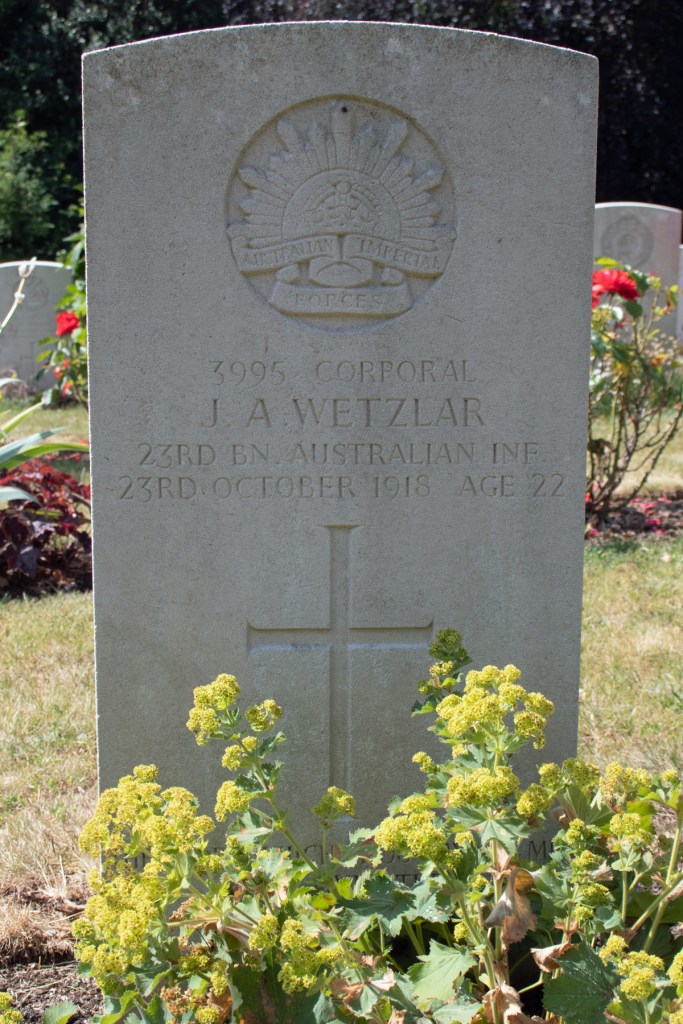
John Albert Wetzlar was born in Bendigo, Victoria, Australia, in the spring of 1895. One of four children, his parents were Ernest and Annie Wetzlar.
Little information about John’s life is available, and most of the detail that can be pieced together comes from his First World War service records. These confirm that he was working as a clerk when he enlisted on 14th July 1915. John’s medical record shows that he was 5ft 4.5ins (1.63m) and weighed 8st 5lbs (53kg). He had brown hair, blue eyes and a fresh complexion.
Private Wetzlar set sail for Europe on 8th February 1916, arriving with his unit in Alexandria, Egypt, six weeks later and landing in Marseille, France, on 31st March. Attached to the 23rd Battalion of the Australian Infantry, by the end of June, he found himself on the front line.
On 22nd August 1916, John’s unit was caught up in fighting, and he was wounded by shrapnel in his right leg. He was admitted to the 4th Australian Field Ambulance unit, before being transferred to the No 1. Canadian General Hospital in Etaples. His injuries required more care, however, and he was medically evacuated to Britain, and was sent to the 2nd General Hospital in Manchester.
Private Wetzlar spent the next six months recuperating, only re-joining his unit back in France on 10th March 1917. Back on the Western Front, he was promoted to Lance Corporal on 9th June, and to full Corporal four months later.
In January 1918, John was transferred back to Britain. Details are sketchy, but it may be that his experience was used to help train new recruits, as he was billeted at Tidworth Camp in Wiltshire. He remained on British soil until May, when he was sent to the Western Front for a third time.
Corporal Wetzlar’s time in France was to be fated. On 1st September 1918, John was wounded a second time, when he received a gun shot injury to his right leg once more. Medically evacuated back to Britain, he was admitted to Bath War Hospital in Somerset. The injury was severe enough to warrant an operation, and the damaged limb was amputated.
During his recovery, Corporal Wetzlar contracted influenza and pneumonia and, tragically, given what he had been through, these were to prove fatal. John died on 23rd October 1918: he was 22 years of age.
Thousands of miles from the home he had left nearly three years before, John Albert Wetzlar was laid to rest in the military section of Bath’s sweeping Locksbrook Cemetery, alongside other from his homeland.
Charles Gregory was born in Buckfastleigh, Devon, early in 1879, the son of John and Mary Gregory. There is next to no information about his early life and, in fact, there is very little documentation for him at all.
Most of the details for Charles come from his First World War service records. These confirm that he was living in Australia, having emigrated there with his parents. His father had died by the time Charles joined up, but Mary was living in Welshpool, to the east of Perth.
Charles was 37 years old when he joined up in March 1916: his records show that he was 5ft 3.5ins (1.61m) tall and weighed 160lbs (72.5kg). He had light brown hair, grey eyes and a dark complexion, possibly from the time he spent outside, working as a groom.
As part of the Australian Imperial Force, Private Gregory sailed from Fremantle on 13th October 1916. He arrived in Plymouth, Devon, exactly two months later, and was assigned to the 4th Battalion of the Australian Infantry. He was sent to France on 8th February 1917 and, over the next few months, transferred between the 14th and 16th Battalions.
On 22nd September, Private Gregory was caught up in a bomb attack and badly injured. After initially receiving treatment to his shattered left ankle and lower ribs, he was medically evacuated to Britain for further medical intervention.
Charles was admitted to the Bath War Hospital in Somerset, but his injuries were to prove too severe. He died from tetanus on 29th October 1917, at the age of 38 years old.
With his family in Australia, the body of Charles Gregory was instead laid to rest in the military section of Bath’s sweeping Locksbrook Cemetery, next to where the war memorial would be constructed.
William James Profitt was born on 20th August 1894 in Collingwood, Victoria, Australia. The oldest of ten children, his parents were Cornish-born Francis Profit and his Australian wife Mary.
Little information is available about William’s early life. When he finished his schooling, he found work as a salesman, and this is the work he was doing when war was declared in Europe.
William felt duty bound to serve his King and Empire, and, on 5th July 1915, he enlisted in the Australian Imperial Force. His service records confirm that he was just 5ft 2.5ins (1.59m) tall, weighing 8st 4lbs (52.6kg). He was noted as having cark brown hair, blue eyes and a fresh complexion: he had a scar on his left cheek.
After initial training, Private Profitt arrived in Alexandria, Egypt. He was assigned to the 23rd Battalion of the Australian Infantry and, by 30th March 1916, he was in France. William’s unit was one of the many to become entrenched at the Somme, having been evacuated from Gallipoli just weeks before he had arrived in Europe.
On 2nd August Private Profitt was admitted to a camp hospital in Boulogne with a sprained ankle. The medical report noted the injury as trivial, having occurred when, on ‘being relieved from trenches [he] slipped and fell into an old German dugout.’ By 21st August he was back with his unit, now based in Etaples.
Just a week later, William was sent to a casualty clearing station in Rouen, having been shot in his right elbow. Less trivial an injury this time round, he was medically evacuated to Britain for treatment, and was admitted to the Cambridge Military Hospital in Aldershot, Hampshire.
Private Profitt’s injury should not have been a life-threatening one, but septicaemia set in. His condition worsened, and he passed away on 25th October 1916. He was just 22 years of age.
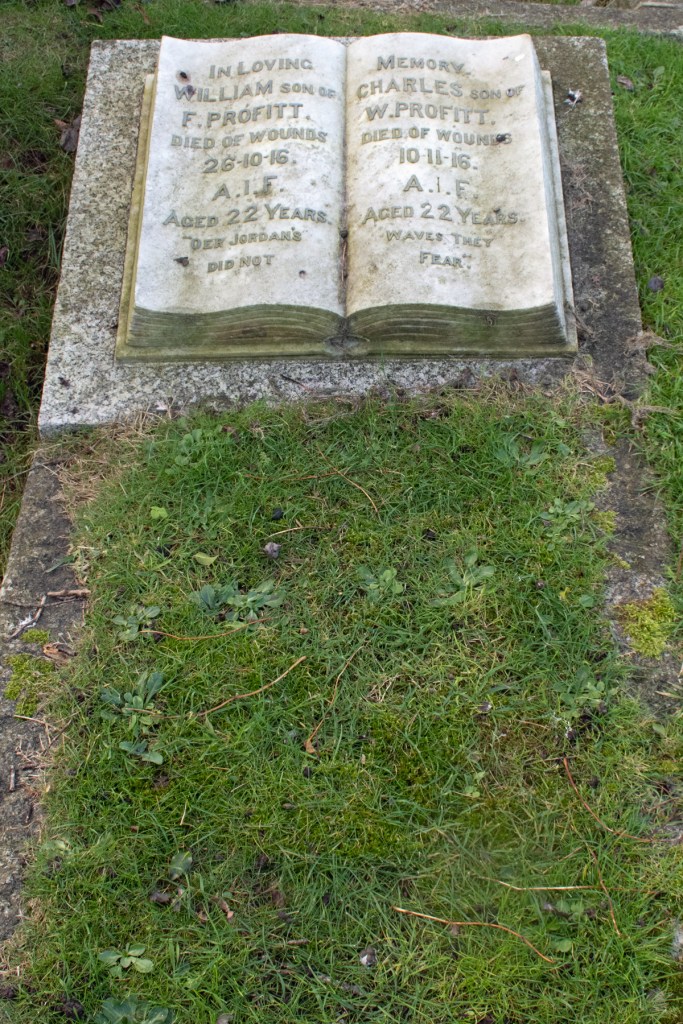
With William James Profitt’s family more than 10,000 miles (17,000km) away, it was not possible to him to be buried at home. Instead, his body was taken to the peaceful and picturesque graveyard of St Michael’s Church in Rock, Cornwall, close to where his father’s family still lived.
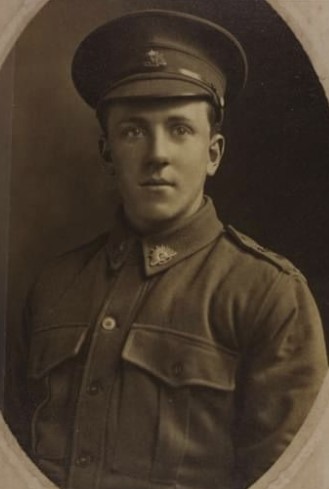
Private William Profitt (from findagrave.com)
William’s grave shares a dedication with Charles Profitt, who died just a fortnight after him.
John Walter Charles Profitt – better known as Charles – was born in the summer of 1894 Geelong, Victoria, Australia. The oldest of three sons to William and Harriet Profitt, it is likely that his father was William’s uncle, and that the two siblings had both travelled to Australia to earn their fortunes.
Working as a teacher at the time, Charles enlisted just days after his cousin, joining the 6th Field Ambulance unit. His service records show that he had dark brown hair, grey eyes and a fresh complexion, no dissimilar to William. Standing 5ft 8ins (1.73m) tall and weighing 10st 6lbs (66.2kg), it is clear that his side of the family had markedly different genes.
Private Profitt arrived in France on 27th March 1916, and his dedication to the role showed when he was promoted to the rank of Lance Corporal in August.
On 9th November he was badly wounded while carrying out his duties, receiving a severe gun shot wound to his abdomen. He was admitted to the 1st Anzac Medical Station, but died of his injuries just two days later. He was just 22 years of age.
Lance Corporal Charles Profitt was laid to rest in Heilly Station Cemetery to the south of Méricourt-l’Abbé. He is commemorated with his cousin, William, in St Michael’s Church, Rock.
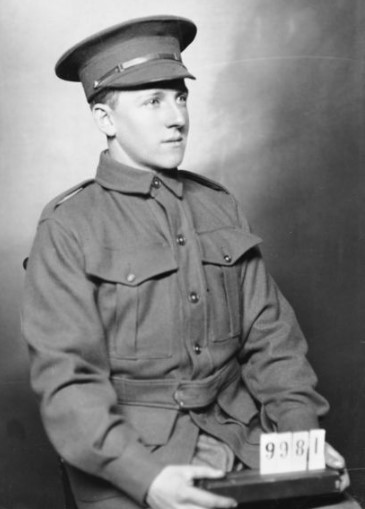
Lance Corporal Charles Profitt (from findagrave.com)
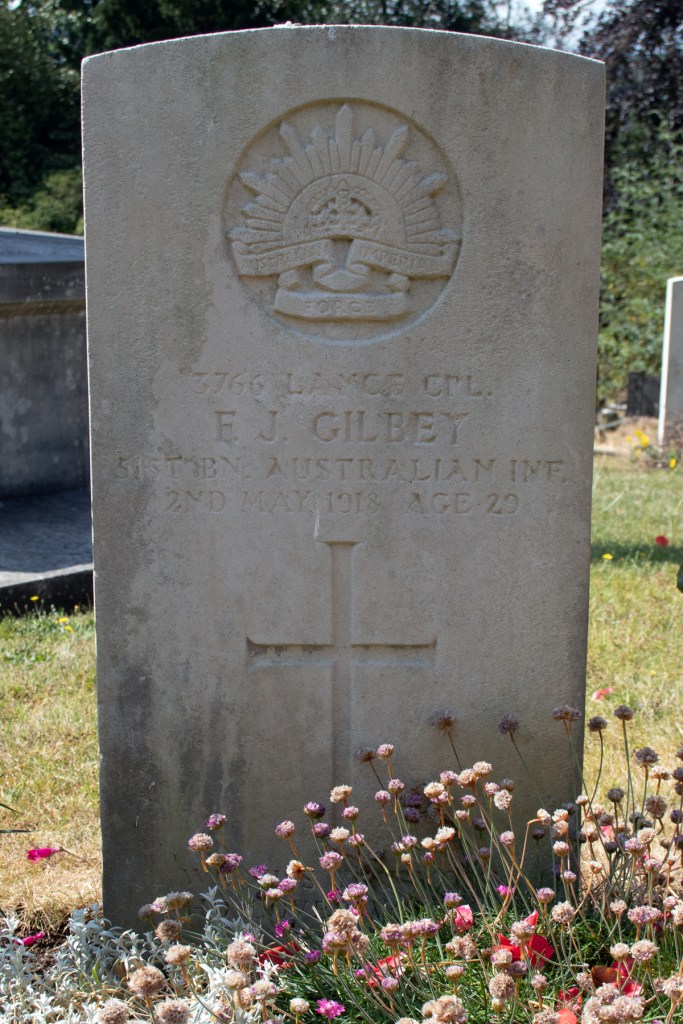
Frederick James Gilbey was born on 1st September 1888 in Walthamstow, Essex. The oldest of nine children, his parents were Alfred and Emily. Alfred was a general labourer, and the family initially lived on Chingford Road, before moving to an end-of-terrace house at 41 MacDonald Road.
On 28th August 1910, Frederick married Katherine Heathorn. Little more information is available about her, although the young couple’s marriage seemed to be the start of something bigger: the newlyweds emigrated shortly afterwards, arriving in Fremantle, Australia, in October 1910. Frederick’s immigration records noted that he was employed as a salesman, while Katherine was working as a dressmaker.
The couple settled into their new life well. The 1916 Electoral Records found the family living at 20 Oswald Street in the leafy Victoria Park suburb of Fremantle. Frederick was now working as a tram conductor, while Katherine was busy raising their two children, Leslie and Arthur.
By this point, Europe was two years into a bloody conflict. Frederick’s younger brother William, a Private in the Royal Fusiliers, had been killed at Gallipoli in August 1915, and it would seem that he also felt pulled to serve his King and Empire.
On 12th September 1916, Frederick enlisted in the Australian Imperial Force. His service documents note that he was 5ft 6.5ins (1.69m) tall and weighed 140lbs (63.5kg). Private Gilbey had auburn hair, blue eyes and a fresh complexion.
After initial training, he left Fremantle for the two-month journey back to Britain. Assigned to the 13th Training Battalion, his unit was based in Codford, Wiltshire. In November 1917, Frederick attended the 15th Rifle Course at the School of Musketry in Tidworth, where he qualified as 1st Class, with a fair working knowledge of the Lewis Gun.
The following February, Private Gilbey was transferred to the 51st Battalion of the Australian Infantry, and sent with his unit to France. On 20th April, days before the Battle of Villers Bretonneux, he was promoted to Lance Corporal.
The battle, however, was to prove to be his last. Wounded in the right thigh by gun shot, he was medically evacuated to Britain, and admitted to Bath War Hospital, Somerset, for treatment. His wounds were too severe, however: Private Gilbey passed away on 2nd May 1918, at the age of 29 years old.
With his widow and children on the other side of the globe, Frederick James Gilbey was laid to rest in the military section of Bath’s Locksbrook Cemetery.
John McClymont was born in Cowra, New South Wales, Australia, in 1865. Full details of his early life are lost to time, but later documents confirm that his mother was called Sophia.
Most of the information relating to John’s life comes from his army service records. These confirm that he enlisted on 13th September 1915, and that he was assigned to the 8th/20th unit of the 5th Australian Infantry Brigade. He was noted as being a labourer when he joined up, with brown hair, blue eyes and a fresh complexion. The record confirms that he stood 5ft 10ins (1.78m) tall, and weighed 169lbs (76.7kg).
Private McClymont arrived in Egypt in February 1916, and transferred to the 2nd Battalion of the Australian Imperial Force. He was initially based at Tel-el-Kebir camp, close to Cairo. From here on in, he seems to have been beset with poor health, and had numerous hospital admissions for heart ailments and haemorrhoids.
By April 1916, John’s unit had arrived in France, and his commitment to the job was not to go unrewarded. On 13th July 1916, he was appointed to the role of Acting Sergeant, and just three months later, he was reassigned to the 1st Australian Infantry Brigade Headquarters, where he was mustered as a Driver.
He was still battling health issues, however, and, in 18th August 1917, he was admitted to a hospital in Boulogne with heart disease. Within a month, Driver McClymont had been medically evacuated to Britain for treatment, and he was taken to Bath War Hospital in Somerset. It was here that he was diagnosed with diabetes, and, having slipped into a diabetic coma, it was here that he passed away, on 9th October 1917. He was 42 years of age.
With all of his family on the other side of the world, John McClymont was laid to rest in the military section of Bath’s Locksbrook Cemetery.
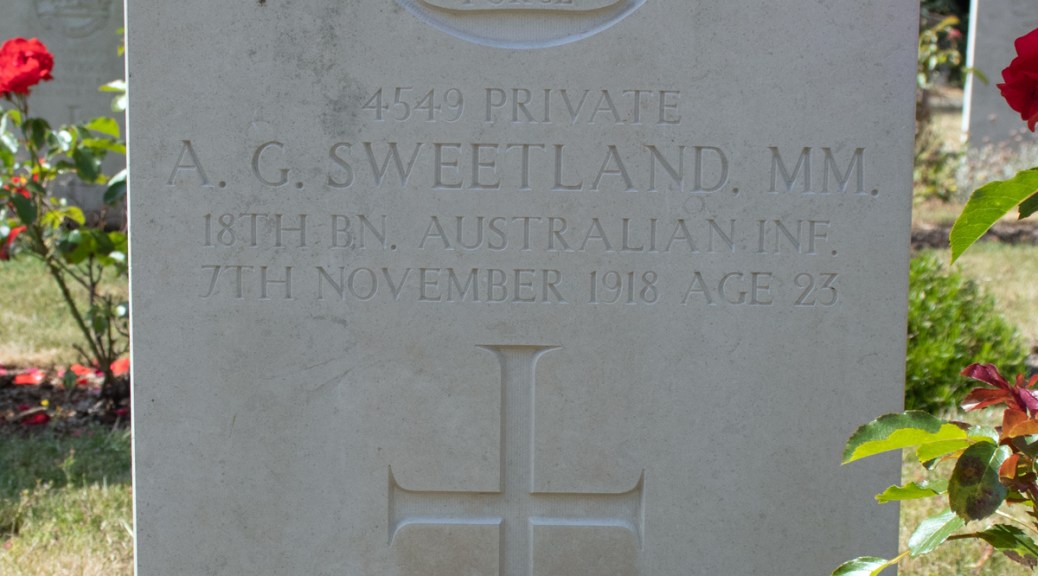
Albert Graham Sweetland was born on 6th January 1895 in Kensington, Middlesex. The oldest of seven children, his parents were mechanical engineer Albert Sweetland and his wife, Edith.
A work ethic was instilled into Albert Jr from an early age. By the time of the 1911 census, he had been sent to Truro, Cornwall, where he worked as a servant to the Faull family, tending to their poultry.
Albert was set on developing a life for himself and, in the next few years, he emigrated to Australia. He settled in the town of Liverpool, now a suburb of Sydney, and found work as a station hand. War was on the horizon, however, and people of the empire were called upon to serve their King.
Albert enlisted on 22nd January 1916, joining the 18th Battalion of the Australian Infantry. His service records tell a little about the man he was becoming. He was 5ft 7ins (1.7m) tall, and weighed 143lbs (64.9kg), with fair hair, blue eyes and a fair complexion. The document also notes that he was a Methodist, and that he had tried to enlist in the British army before emigrating, but that a slight defect in his right eye had prevented him.
Private Sweetland set sail for Europe on 9th April 1916. His unit sailed via Suez, reaching Folkestone, Kent, that November. His time back in Britain was to be brief, however: within a matter of days he was in Etaples, France.
Albert was thrown into the thick of things. On 5th May 1917, he was wounded while fighting at Arras. He was shot in the legs, and medically evacuated to Britain for treatment and recuperation. He was to remain on home soil for the next year, before returning to his unit in June 1918.
On 3rd October 1918, Private Sweetland was injured during the Battle of the Beaurevoir Line. His unit’s push forward was initially successful, but ultimately failed to capture the the village. The German forces attacked with gas, and Albert was caught up in it, receiving a gun shot wound to his back.
By the time Beaurevoir was in Australian hands three days later, more than 430 Allied soldiers had been killed. Albert was awarded the Military Medal for his bravery during the battle.
Private Sweetland was medically evacuated to Britain once more, and was admitted to Bath War Hospital for treatment. This time, however, he was not to be as luck as he had been eighteen months previously. He died on 7th November 1918, from a combination of appendicitis, pneumonia and heart failure. He was just 23 years of age.
Albert Graham Sweetland was laid to rest in the military section of Bath’s Locksbrook Cemetery, not far from the facility where he had passed. His parents and his sister Winifred attended the funeral.
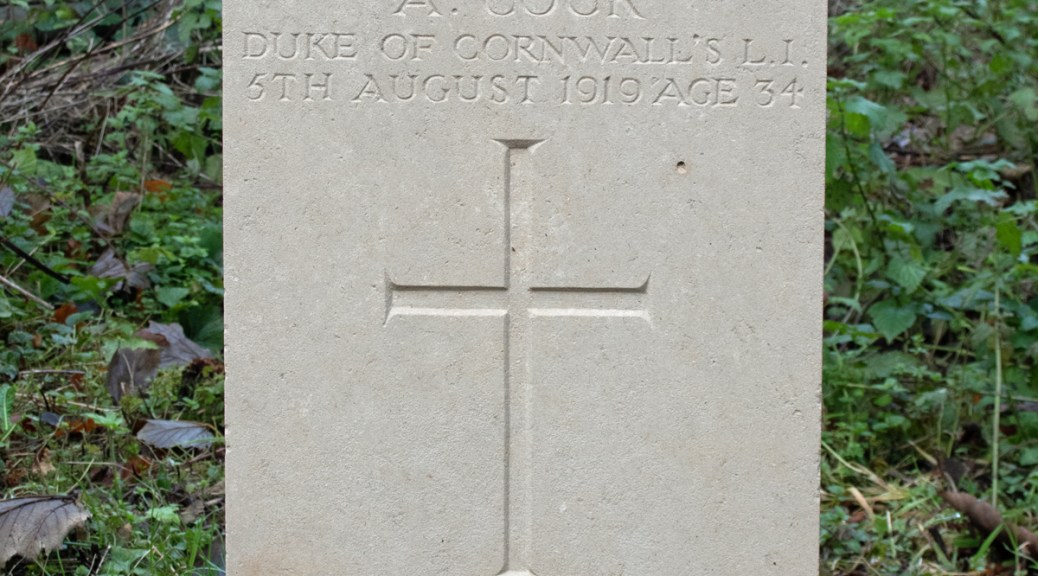
Arthur Cock was born in around 1885 in Wadebridge, Cornwall. One of eleven children, he was the son of mortar mason William Cock, and his wife, Louisa.
When he left school Arthur helper his father out in the business, but when war came to Europe’s shores, he stepped up to play his part. Sadly, his service records are lost to time, and it is a challenge to piece together his time during the conflict from a confusion of other documents.
It is clear that Arthur enlisted in the Duke of Cornwall’s Light Infantry, as this is what is engraved on his headstone. However, his Medal Roll suggests that he also served in the Gloucestershire Regiment and the Labour Corps. He seems not to have fought overseas, and was awarded the Victory and British Medals for doing his duty.
Private Cock’s entry in the Army Register of Soldier’s Effects confirms that he must have enlisted before February 1919, and that he passed away at Whitchurch Hospital.
An entry in the local newspaper, reporting on his death, reads as follows:
In loving memory of Pte. Arthur Cock, son of William, and the late Louisa Cock, of Wadebridge, who died August 5th, at Whitchurch War Hospital, Cardiff.
Cornish Guardian: Friday 8th August 1919
Interestingly, the facility Arthur had been admitted to was a psychiatric hospital, but with no other confirmation as to his passing, it is only possible to assume the cause of his death. He was 34 years old when he passed away.
Arthur Cock’s body was brought back to Cornwall for burial. He was laid to rest in the peaceful, wooded graveyard of St Breoke’s Church, next to the family grave in which Louisa had been buried three years previously.
The family grave, by this time, was tragically quite full. William was able to mourn his son, wife and six of Arthur’s siblings – Mary, William, John, Fred, Charles and Ernest – who had all passed in childhood and were laid to rest there.
Arthur’s younger brother – another William – also fought in the First World War. His service records reveal a lot about his life.
Private Cock enlisted in the Australian Imperial Force on 7th September 1914. At the time he was working as a railway porter in Morphettville, now a suburb of Adelaide, Australia. His records confirm that he was 5ft 8.5ins (1.74m) tall, and weighed 158lbs (72kg). He had brown hair, brown eyes an a fresh complexion.
William left Australia for the battlefield on 20th October 1914, and soon found himself in the Eastern Mediterranean. Sadly, this was to be the end of the line for him: he was killed on the battlefields of Gallipoli on 23rd March 1915, aged just 28 year of age.
William Cock was laid to rest in the Shrapnel Valley Cemetery in Gallipoli. He is commemorated on the headstone of the family grave back in St Breock.
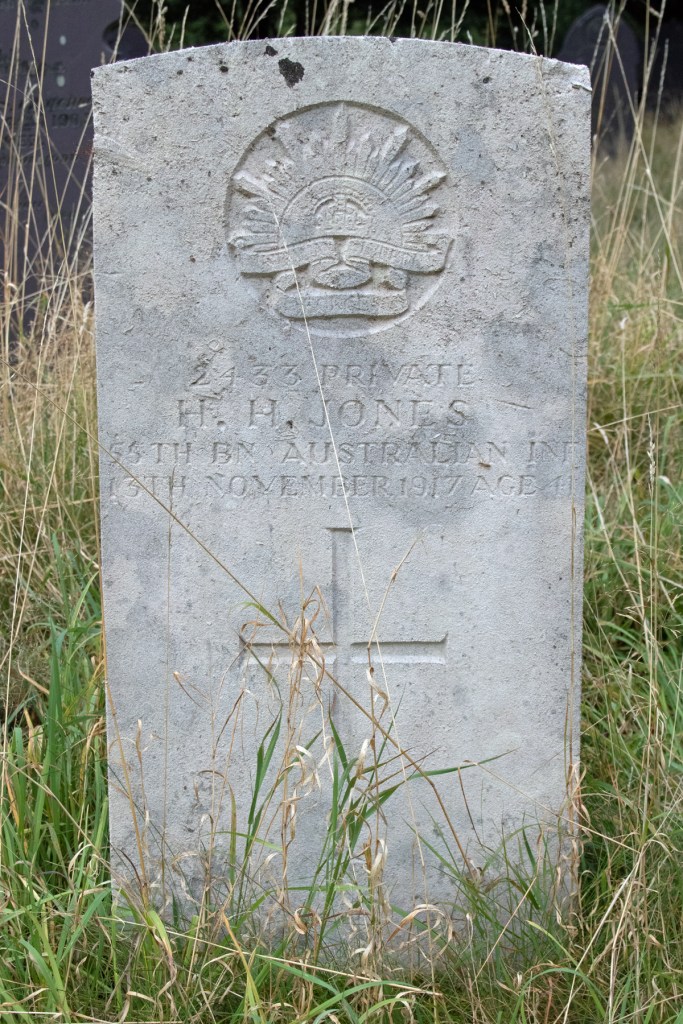
Hugh Henry Jones was born in around 1876 in the Welsh village of Llanberis, Gwynedd. He was one of seven children to quarryman John Jones and his wife Mary.
Slate was the big industry in Snowdonia, and Hugh and his brothers all followed his father into the quarries. Labour was plentiful and wages would not have been high, so when the opportunity arose for employment overseas, he seems to have taken it.
Exact details are sketchy, but Hugh emigrated to Australia at some point in the early 1900s. He settled in the city of Goulburn, New South Wales and the experience he had built up back home stood him good stead, as he continued working as a quarryman.
When war broke out in Europe, those in the British colonies were called upon to play their part, and Hugh was among those to serve King and Country. He enlisted on 29th December 1915, joining the 55th Battalion of the Australian Infantry.
Private Jones’ service records show that he was 40 years and six months old, stood 5ft 4ins (1.63m) tall and weighed 130lbs (59kg). He had a dark complexion, blue eyes and black hair. He also appears to have had a denture in his lower jaw.
After initial training, Private Jones set off for Europe at the end of September 1916, arriving in Plymouth six weeks later. Within a matter of weeks he was on the move again, sailing for France, and arriving at Etaples at the start of 1917.
Private Jones was ensconced on the Western Front for the next few months but, as spring came, he was starting to have some health issues. In April he was admitted to a field hospital suffering from dyspepsia (indigestion), which was subsequently diagnosed as gastritis.
Medically evacuated to Britain for treatment, Hugh spent the next few months being treated in hospitals in Kent, and Dorset, before being admitted to the Royal Infirmary in Liverpool. Sadly, by this point, his condition had been identified as stomach cancer and, while in Liverpool, he passed away. Private Jones breathed his last on 13th November 1917, at the age of 41 years old.
Hugh Henry Jones was brought back to Wales for burial. He was laid to rest in the graveyard of St Peris Church in his home village of Llanberis.













 Death and Service