Category Archives: Bedfordshire Regiment

Private James Payne

Private James Payne

The early life of James Payne is a challenge to piece together. The first document that can be properly attributed to him is his marriage certificate from 27th May 1901.

This confirms that he was 21 years old, and working as a labourer. His father’s details are noticeable by their absence. The document also gives his wife’s name, Kate Bessie Warr, and information about her father – labourer Sydney Warr. James was also working as a labour at this point, and the two of them were living in Pulham, Dorset.

By the time of the 1911 census, the newlyweds had moved to the village of Yetminster. James was working as domestic gardener, and the couple had two children – Cyril and Louis. James’ place of birth is given just as Somerset, further clouding his past.

When war came to Europe, James stepped up to play his part. Full details of his time in the army are lost to time, but documents suggest that he had enlisted by October 1917 at the latest. Private Payne joined the Bedfordshire Regiment, and was attached to the 1st Battalion. His unit service on the Western Front throughout the conflict, although there is no evidence that James spent any times overseas himself.

Piecing the sparse number of documents together suggest that in March 1918, James was admitted to the 3rd Western General Hospital in Cardiff, Glamorganshire. He was suffering from nephritis and pneumonia, but it is unclear whether he was serving in Wales at the time, or was taken there for treatment. Either way, his condition was to prove too severe. Private Payne passed away on 20th March 1918: he was 38 years old.

James Payne’s body was taken back to Dorset for burial. He was laid to rest in the peaceful graveyard of St Andrew’s Church in his adopted home of Yetminster.


Lance Corporal George Fenn

Lance Corporal George Fenn

Much of George Fenn’s life is destined to be lost to time. Born in Bristol, Gloucestershire, in the summer of 1878, details of his parents are unknown. His was a common name in the late Victorian period, and census returns from the time identify at least two men born in the area around the same time.

The first document that can be directly connected to George is the 1911 census. This recorded him living at 13 Tankards Close in Clifton, where he was working as a dock labourer. His is noted as having been married to Minnie since 1902. The couple had one child, a son called William who was six years old.

When war broke out, George was quick to enlist. Full details of his service are lost, but he had certainly joined the Bedfordshire Regiment by the end of 1914. Attached to the 7th (Service) Battalion, by the start of the following year, his unit had moved to Salisbury Plain in anticipation of being sent to the Western Front.

George seems to have made his mark in the army, and he was soon promoted to the rank of Lance Corporal. In the spring of 1915, he contracted pneumonia, however, and was admitted to the military hospital in Codford, Wiltshire, close to where his unit was based.

Sadly, the condition was to prove Lance Corporal Fenn’s undoing: he passed away on 1st June 1915, at the age of 36 years of age.

George Fenn was laid to rest in the peaceful churchyard of St Mary’s, Codford, not far from where he had passed away.


George’s entry on the Army Register of Soldiers’ Effects and his Pension Ledger card shed a little more light on the family he had left behind. The first divides his belongings between his widow, Minnie, and the guardian of his child, Mrs Sarah Clarke. George’s pension ledger gives Sarah’s address as 14 Tankard’s Close, Bristol, and confirms that he was, in fact, separated from Minnie when he passed.


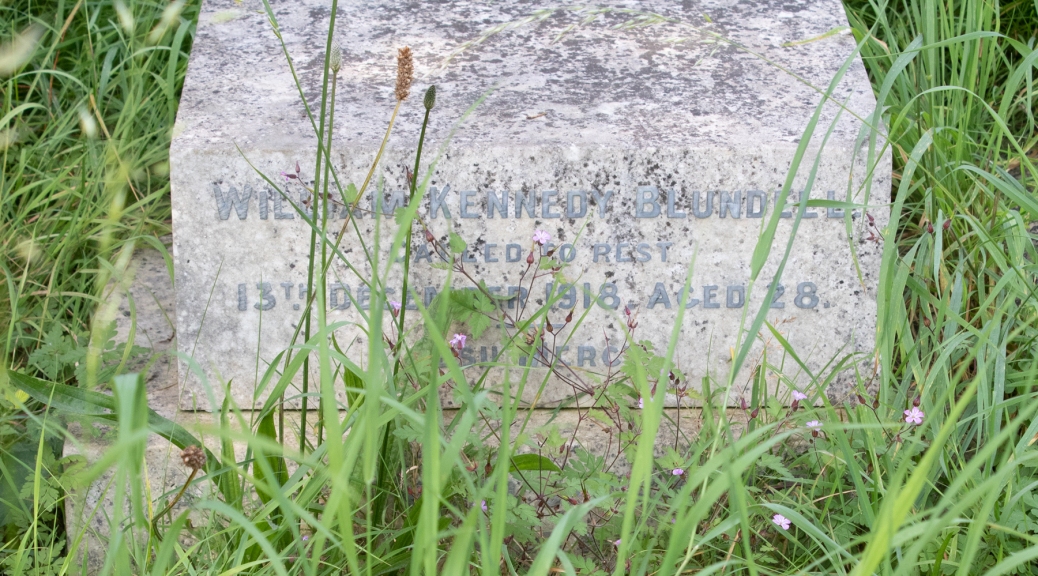
Captain William Blundell

Captain William Blundell

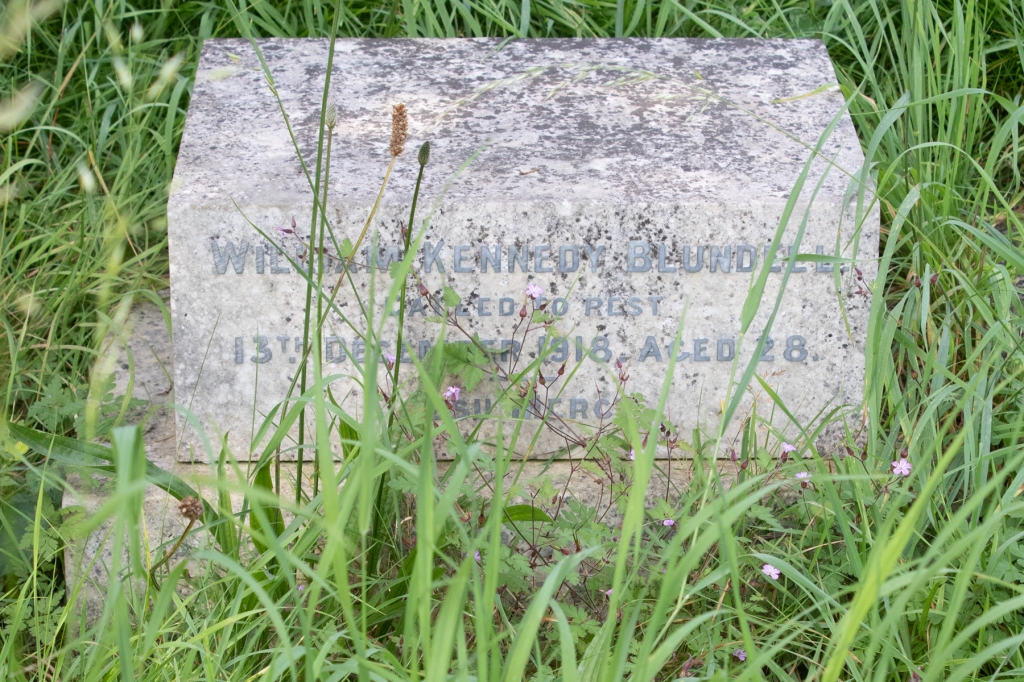
William Kennedy Blundell early life seems anything but ordinary. Born in Cardiff, Glamorgan, in the summer of 1890, he was the only child to bank clerk Edmund Blundell and his wife, Annie. Edmund was born in Staplegrove, Somerset, while Annie had grown up in Lahore, India.

The 1891 census found William living with his maternal grandparents James and Edith Kennedy in the Walcot area of Bath, while his parents were firmly based in Cardiff. Edmund died the following year, so it is possible that he was placed out of the way while Annie tended to her husband (along with her sister-in-law and a domestic servant).

By the time of the next census return, Annie and William were reunited, and were living in Avenue Road, Wimborne Minster, Dorset. Anne was living off her own means, and had a servant, Emily Chaffey, to hep look after the home.

Both Annie and her son disappear from the 1911 census. It is likely that William had embarked on a military career by this point, and may have been serving overseas. Sadly, his trail goes cold, but scraps of later information help identify some of what became of him.

By the outbreak of the First World War, he was serving in the Bedfordshire Regiment. He was based in Egypt from January 1916, and rose to the rank of Captain by the end of the conflict. By 1918, he was attached to the 12th (Transport Workers) Battalion, and was back in Britain.

Captain Blundell was in Sussex by the time of the armistice, and it was here that he fell ill, contracting pneumonia. He was admitted to the General Eastern Hospital in Brighton, but the condition was to prove too severe. He passed away on 13th December 1918, at the age of 28 years old.

William Kennedy Blundell’s body was taken back to Somerset for burial. He was laid to rest in the sweeping grounds of Locksbrook Cemetery in Bath.


Private William Lock

Private William Lock

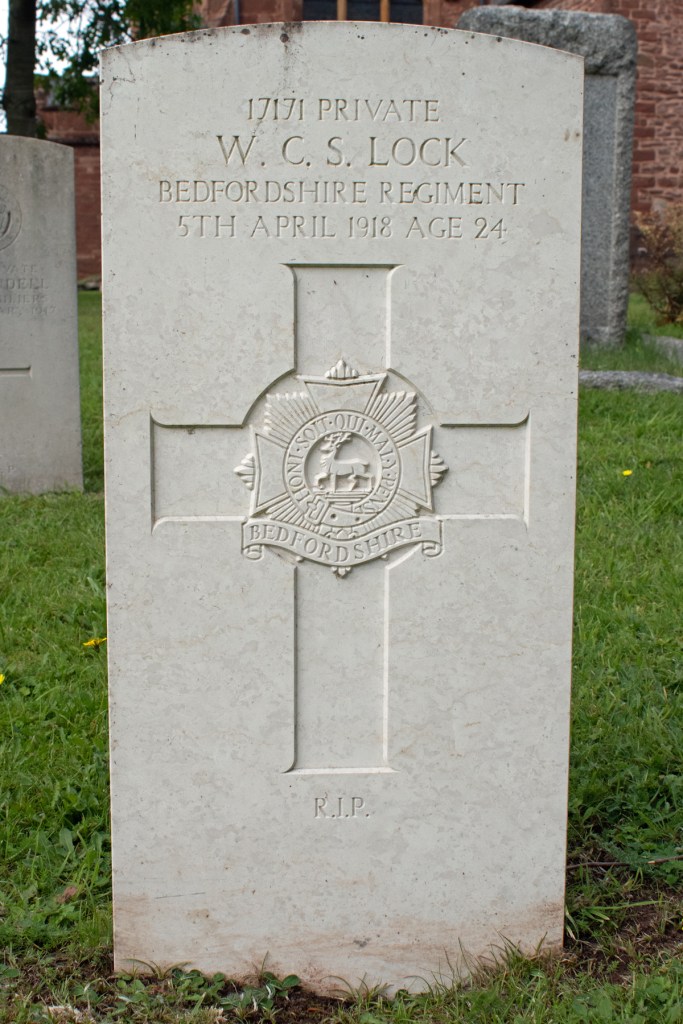
William Charles Shallis Lock was born in the spring of 1894, the eldest child to Harriet Lock. Born out of wedlock, Harriet went on to marry William’s father, Charles Shallis, in 1897. The couple would go on to have two more children – Walter and Lilian – before Harriet’s untimely death in 1900.

The 1901 census recorded William living with his maternal grandparents, Daniel and Ellen Lock, in the family’s home village of Bishops Lydeard, Somerset. Daniel was a farm labourer and, by the time of the 1911 census, William was making his own way in the world, boarding at Rainbow Wood Farm in Claverton, to the east of Bath. The document seems to indicate that William had ditched his first name, and was now using Charles as his preference.

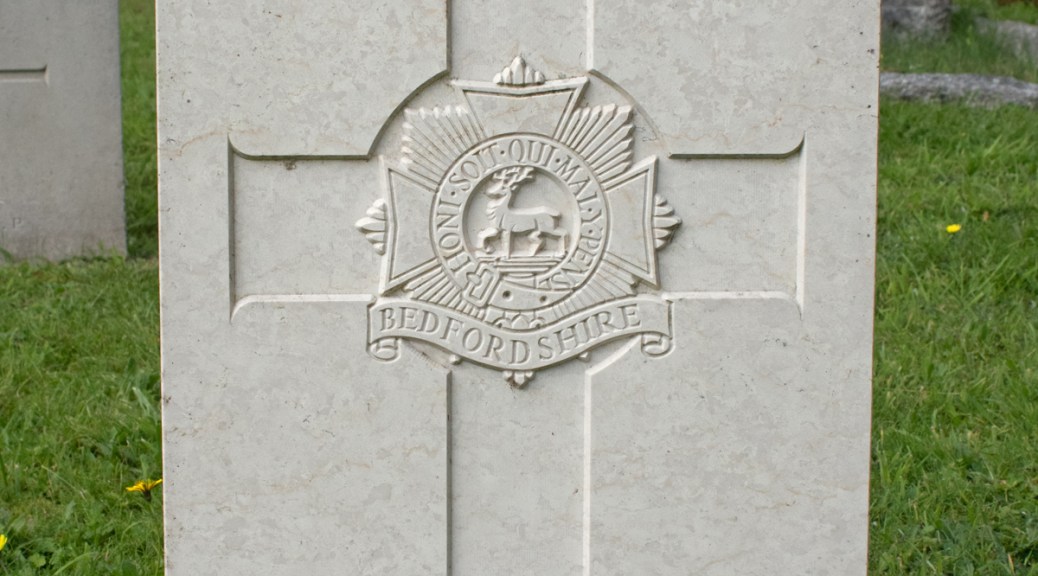
War came to Europe in the summer of 1914, and Charles stepped up to play his part. Sadly, full service records are no longer available for him, but it is clear that he had enlisted in the opening months of the conflict, and that he joined the Bedfordshire Regiment.

Assigned to the 7th (Service) Battalion, Private Lock found himself in France by the end of August 1915. Charles would have found himself in the thick of the fighting, and was entrenched at both the Somme in 1916 and Passchendaele the following year.

It seems likely that Private Lock’s luck ran out at either the Battle of St Quentin in March 1918, or at the Battle of the Avre, just a few weeks later. That he was wounded is certain, as he was medically evacuated back to Britain, and admitted to Liverpool Infirmary. Charles’ injuries were to prove too severe, however, and he died while admitted on 5th April 1918. He was just 24 years of age.

The body of William Charles Shallis Lock was taken back to Somerset for burial. He was laid to rest towards the front of the graveyard of St Mary’s Church, in his home village, Bishops Lydeard.


Private Jeremiah West

Private Jeremiah West

Jeremiah West was born in the spring of 1892, the oldest of eight children to John and Laura West. John was an agricultural labourer from Somerset, and it was in the village of Bleadon that the family were born and raised.

When he finished his schooling, Jeremiah followed in his father’s footsteps. By the time of the 1911 census, he was working as a servant on the nearby Shiplette Farm, where he was employed by Kate Poole.

War came to Europe in 1914, and Jeremiah stepped up to play his part. He enlisted in the Somerset Light Infantry in 1915, and was assigned to the 4th Battalion. Private West set sail for India that August, and seems to have remained overseas for some time.

Records are not clear, but it would appear that Jeremiah returned to Britain at some point, and became attached to the 3rd Battalion of the Bedfordshire Regiment. This was a garrison troop, based in Harwich, Essex, and Jeremiah found himself part of the battalion’s Labour Corps.

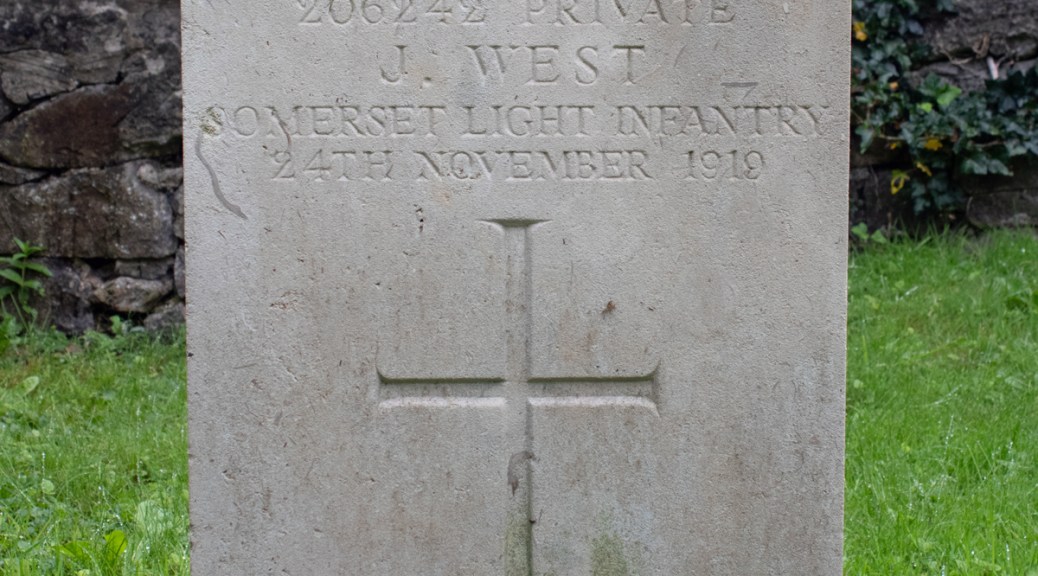
Private West survived the war, but came down with pneumonia in the autumn of 1919. He passed away on 24th November 1919: he was 27 years of age.

Jeremiah West was brought back to Somerset for burial. He was laid to rest in the peaceful graveyard of St Peter and St Paul’s Church in his home village of Bleadon.


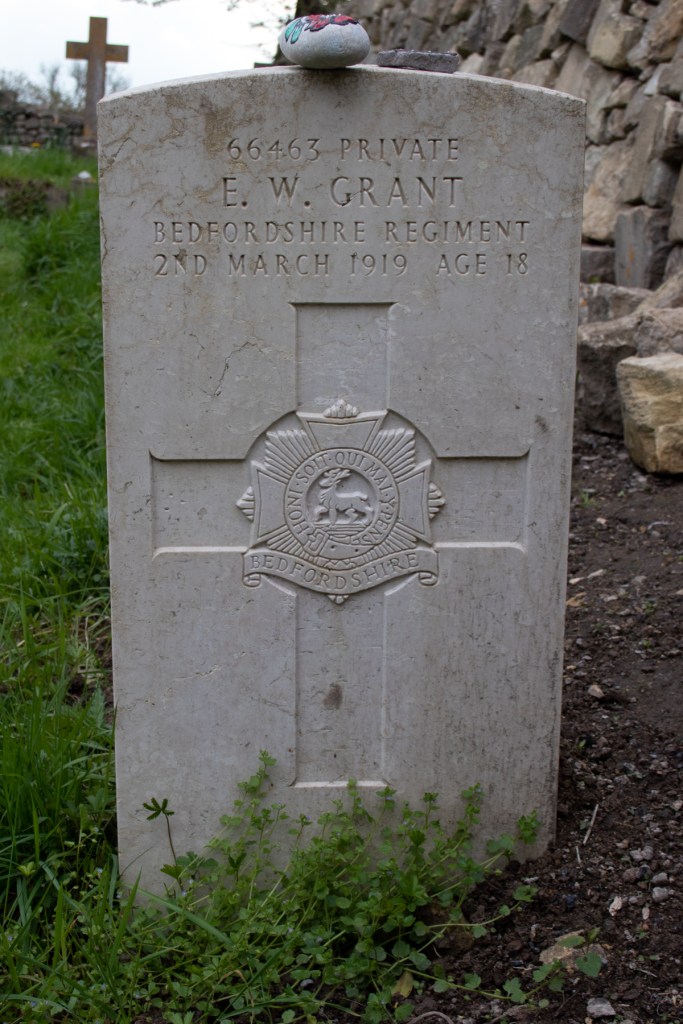
Private Eric Grant

Private Eric Grant

Eric William Grant was born at the start of 1901, the middle of three children to Ernest and Annie Grant. Ernest was a carpenter from Bath, Somerset, and it was here they he and Annie raised their young family.

Little information is available about Eric’s young life. When war came to Europe, his father joined up, enlisting in the Royal Engineers as a Sapper. Keen not to miss out, Eric also signed up, lying about his age to ensure he was accepted.

When he joined in February 1916, Private Grant was assigned to the 52nd (Graduated) Battalion of the Bedfordshire Regiment. Full details of his service are lost to time, but towards the end of the war, Eric was based in East Anglia.

It was here, in early 1919, that Private Grant fell ill. He was admitted to the Norfolk War Hospital, but whatever his condition, it proved fatal. He passed away on 2nd March, aged just 18 years old.

Eric William Grant’s body was brought back to Somerset for burial. He was laid to rest in the peaceful graveyard of St Michael’s Church, Monkton Combe, where the family now living.


Despite her understandable concern at seeing her husband and son go off to war, and for Eric to die because of it, Annie was to be reunited with Ernest. Again, full details of his service are lost, but the 1939 Register found him and Annie living with their daughter and Ernest’s brother in Bathavon, Somerset.

Annie passed away in 1947, at the age of 73. Ernest lived on until 1952, having lived to 76 years old. Both were buried in St Michael’s Churchyard, reunited with their son at last.


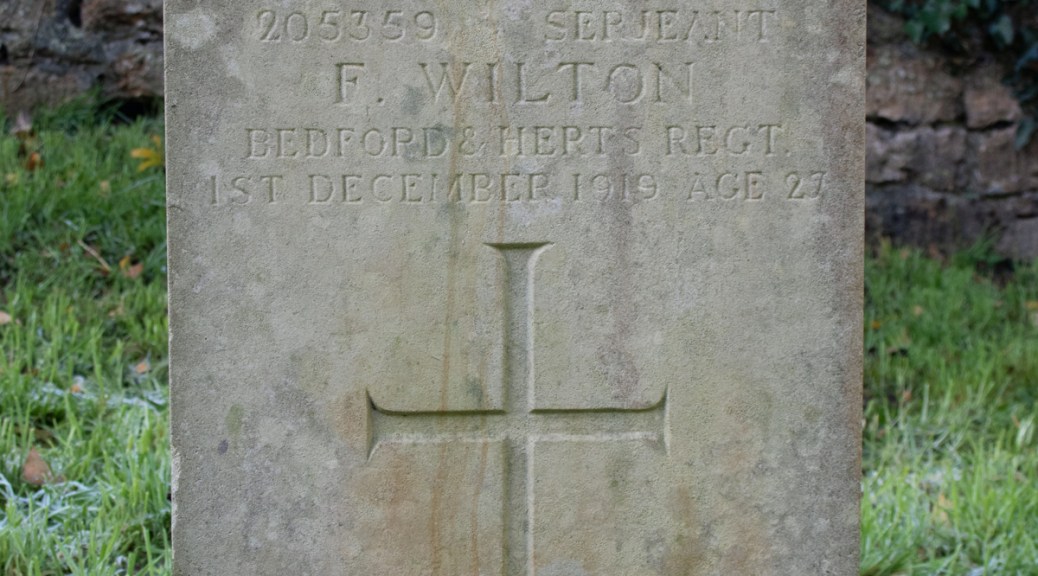
Serjeant Frederick Wilton

Serjeant Frederick Wilton

Frederick Uriah Wilton was born in Yarlington, Somerset, in the spring of 1892. One of thirteen children, his parents were farm labourer Thomas Wilton and his wife Mary.

Frederick and his brothers followed their father into agricultural labouring, and, according to the 1911 census, the family were living and working at Shatwell Farm, on the outskirts of Yarlington itself.

When war broke out, Frederick was keen to play his part. Details of his military service are difficult to piece together, but what is clear is that he enlisted in the Bedfordshire Regiment.

During his time in the army, Frederick rose to the rank of Serjeant. He survived the war and, in 1919, he was placed on furlough while waiting to be demobbed. Sadly, it is likely that he fell ill during this time, and he passed away on 1st December 1919, at the age of 27.

Frederick Uriah Wilton was laid to rest in the graveyard of St Mary’s Church in Yarlington.


Serjeant Wilton’s headstone notes that he served in the Bedfordshire and Hertfordshire Regiment. The two regiments were amalgamated in 1919, and Frederick was recorded as having served in the newly formed regiment.


Private William King

Private William King

William Samuel King was born in the summer of 1880, and was one of four children to Richard and Elizabeth King. Richard was a railway worker from Totnes, Devon, and this is where the family were born and raised.

When he left school, William found work as a house painter, and this is a job he continued to do through to the outbreak of the Great War. On 8th June 1908 he married Minnie Edmunds: the couple went on to have a son, Leslie, who was born in 1912. William and Minnie had, by this point, moved to Swansea, West Glamorgan, presumably as work was more plentiful here than in their Devon home. His work as a decorator seems to have been recognised, and he was admitted to the National Association Partnership, Swansea South.

On 1st December 1915, William enlisted and his service records show that he was 5ft 2ins (1.57m) tall. While it is clear that he spent his time on home soil, his service seems a bit disjointed.

Private King wasn’t formally mobilised until September 1916, when he was assigned to the 2nd/2nd Battalion of the Monmouthshire Regiment. In December he was transferred to the Royal West Kent Regiment before returned to his original battalion in February 1917. A month later, he moved to the Bedfordshire Regiment, before moving to the Middlesex Regiment a few weeks later. This also seems to have been a temporary move as, three weeks later, he was assigned to the 337th Works Company of the Labour Corps (although this was still part of the Middlesex Regiment).

The potential reason behind Private King’s haphazard service seemed to become a little clearer when, in September 1917, he was referred to Fort Pitt Hospital in Rochester, Kent. He was noted as being “very talkative, noisy [and] in a state of mental disease… he has… exalted and grandiose ideas and is difficult to restrain.” His mental health was obviously suffering, and he was discharged from military service in December 1917.

William returned home, although it was not to be for long. He passed away on 13th April 1918, at the age of 37 years old. While no cause of death is evident, it seems likely to have been connected to his ‘mania’, which had been exacerbated by his army service.

William Samuel King was laid to rest in Totnes Cemetery, not far from his parental home.


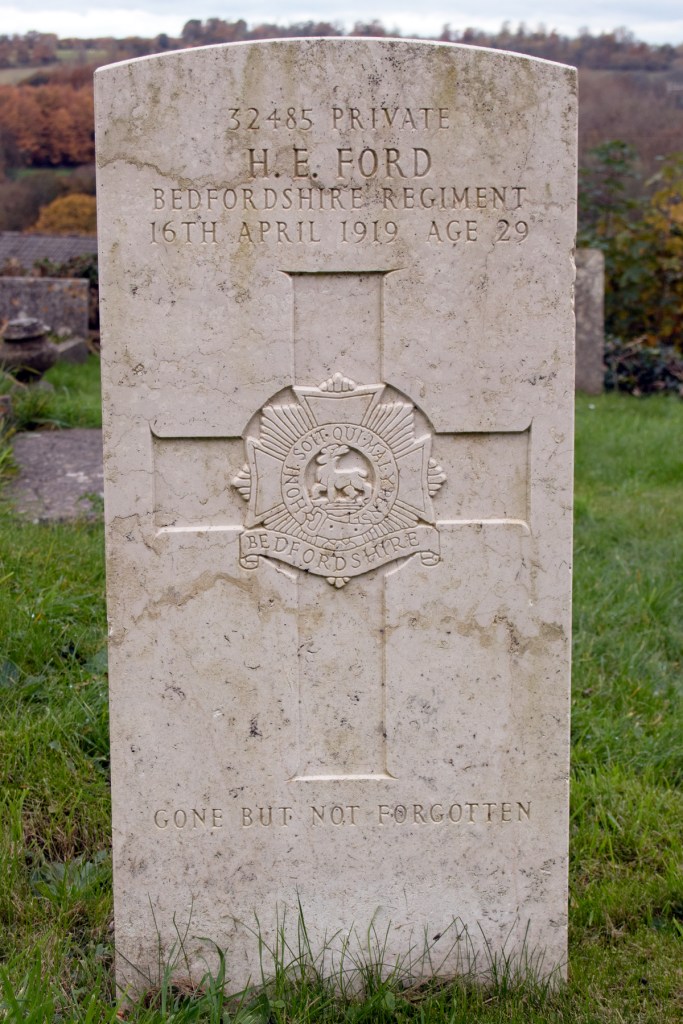
Private Herbert Ford

Private Herbert Ford

Herbert Edgar Ford is one of those people whose early life is destined to remain lost to time. His first names appear interchangeably on documents, with Herbert also being shortened to Bertie, but this means there is no definite trail to his early years.

He was born in Frome, Somerset, around the beginning of 1890, though nothing remains to suggest who his parents would have been. He married at the start of 1914, to local woman Ethel Mary Butler, and they went on to have a daughter, Doreen, at the end of the year.

By that point, war had been declared, and Herbert wanted to play his part. Full details of his military service are not available, but it is evident that he had enlisted in the Bedfordshire regiment by 1918. His troop – the 1st Garrison Battalion – were dispatched to India and were based in Delhi for the majority of the war, but it is unclear when or if Private Ford joined them.

Sadly, the next record for Private Ford is the notice of his death in the local newspaper. This confirms that he died on 16th April 1919 at Birmingham Hospital, “after a long and painful illness” [Somerset Standard: Friday 25th April 1919]. He was just 29 years of age.

Herbert Edgar Ford’s body was brought back to Somerset: he was laid to rest in the graveyard of Holy Trinity Church in his home town of Frome.


Private Henry Cowles

Private Henry Cowles

In a quiet corner of a cemetery in Somerset stands a gravestone to Private HJ Cowles. It confirms that he passed away on 26th April 1920, and that he was in the Bedfordshire Regiment during the First World War.

Little additional information on HJ Cowles is available. One document, the Medal Roll Index Card, confirms his first name as Henry, and that he had initially joined the Somerset Light Infantry. He was awarded the British Medal for his war service.

Cowles is a fairly common name in the Somerset area, and, without any additional information – date of birth, familial connections – it is impossible to narrow down the name on the gravestone to a specific Henry Cowles from the area or beyond.

There is also nothing in any contemporary newspapers to suggest that Private Cowles’ passing was anything out of the ordinary.

Sadly, therefore, he remains a name lost to history. Henry J Cowles, whoever he was, and however he died, lies at rest in the Milton Cemetery in Weston-super-Mare, Somerset.