Category Archives: Royal Engineers

Sapper William Dove

Sapper William Dove

William Henry Dove was born in the autumn of 1871 in Stafford, Staffordshire and was one of seven children to William and Louisa Dove. William Sr was a gardener by trade, but his son wanted bigger and better things.

On leaving school, he initially took up a post as a junior teacher, but military service was calling him and, on 21st February 1891 he enlisted in the Royal Lancaster Regiment. Private Dove’s service records show that he was 5ft 7ins (1.70cm) tall and 136lbs (61.8kg) in weight. He had sandy hair, grey eyes and a fair complexion. He also gave his age as 18 years and 3 months, although he was actually a year older.

Private Dove signed up for seven years’ service and completed this on home soil. In October 1891 he was promoted to Lance Corporal, and a year later he was promoted again, this time to Corporal.

In November 1894, William was found guilty of ‘conduct to the prejudice of good order and drunkenness‘ and was sentenced to be reduced in rank, so became a Private again. He learnt the error of his ways, though, and was reinstated to Lance Corporal in March 1897.

William’s service was completed in February 1898, and he was transferred across to the Army Reserve. This was intended to be for a further five years, but on 15th February 1900, he was discharged from future active service, having been found to be medically unfit. During his time in the army, William had been treated for a two bouts of gonorrhoea, as well as four further infections. The cause of his final medical discharge, however, is unclear.

While on reserve, William had found employment as a railway porter. His work took him to Llangollen, Denbighshire and, this is where he set up home. On 18th April 1899, he married Ellenor Roberts, a labourer’s daughter from the town: the young couple set up home in Ashfield House, Regent Street – now the busy A5.

The 1911 census records William as a porter: the couple had no children of their own, but had adopted a girl, Cissie, who was then eight years old. A live-in domestic servant – Esther Williams – was also recorded on the census.

War was coming to Europe by this point and, while details of his service are unclear, William stepped up to play his part once more. He enlisted in the Royal Engineers as a Sapper, at some point during the conflict, although exact details are lost to time.

Sapper Dove survived the war and returned to Llangollen. The 1921 census records him Ellenor and Cissie living at Bronhaul, and that William was working as a parcel’s porter for Great Western Railways. On 18th August 1921, he collapsed and died with a brain aneurysm. He was 39 years of age.

William Henry Dove was buried in the graveyard of St John’s Church in Llangollen, a short distance from the station at which he portered for so long.


Ellenor lived on until her late 70s. When she passed away, she was laid to rest in the family plot, reunited with her husband after 35 years.

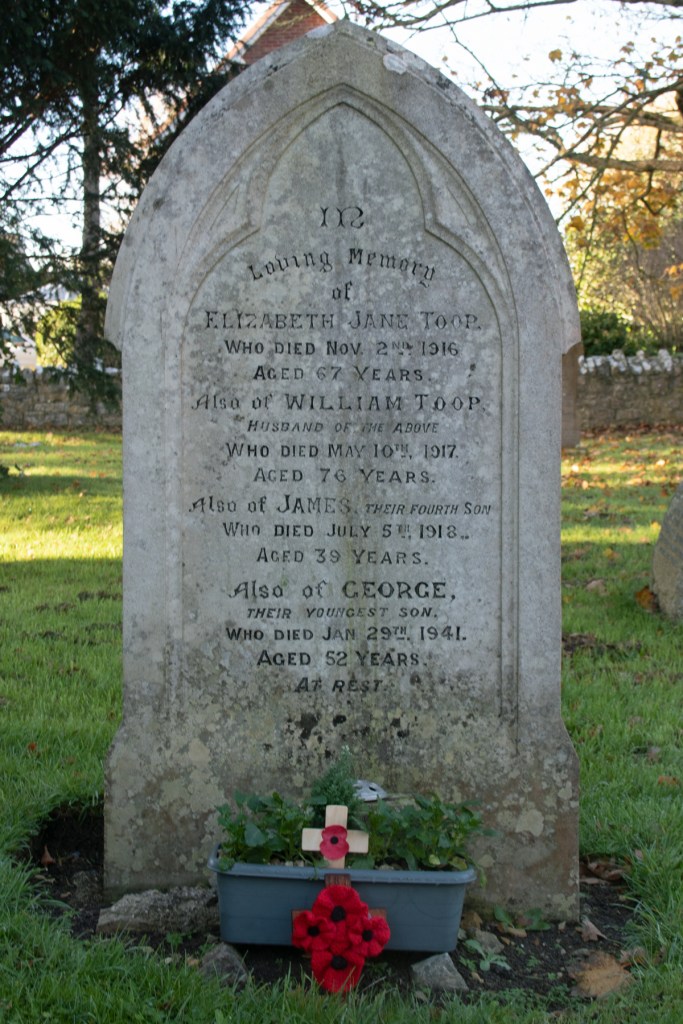
Lance Corporal James Toop

Lance Corporal James Toop

James Toop was born in the Somerset village of Galhampton on 13th January 1879. He was the fifth of eleven children to William and Elizabeth Toop. William was a farm labourer, and James followed his father’s line of work when he left school.

James disappears from documents for a while, only surfacing again in October 1914, when he enlisted for army service. At this point, he was working as a bricklayer, and notes that he had previously served in the Somerset Light Infantry. He is recorded as being 5ft 8ins (1.73m) tall, weighing 136lbs (61.7kg). He had brown hair, grey eyes, and gave his religion as Congregationalist. James also lied about his age, saying that he was 29 years and 9 months when, in fact, he would have been closer to 36 years old when he joined up.

Sapper Toop was assigned to the Royal Engineers, and spent nine months on home soil, during which time he was promoted to Lance Corporal. On 18th July 1915 he went to France, but returned just five days later.

Admitted to the Royal Victoria War Hospital in Netley, Hampshire, James was recorded as suffering the stress of campaign. He was moved to Napsbury War Hospital, near St Albans in Hertfordshire, after a couple of weeks. This institution – formerly the Middlesex County Asylum – was where servicemen suffering from shell shock were sent for rehabilitation, and Lance Corporal Toop joined the near 2,000 other residents.

James’ diagnosis was recorded as being neurasthenia with depression and, in October 1916, he was medically discharged from the army. The medical report noted that he had “had nervous breakdown, complained of vomiting of his food. Had defective memory. Had religious mania 5 years before enlistment.” While his condition was not the result of his war service, the medical board recorded that his mental debility has been aggravated by the strain.

James falls off the radar again at this point. When he recovered, he returned to bricklaying for work. In 1916 his mother died, followed a year later by his father. Both were laid to rest in the family grave in St Mary Magdalene’s Church, Sparkford, Somerset.

James Toop died on 5th July 1918 at the age of 39 years old. He was also buried in the family plot, reunited with his parents far too soon.


Second Lieutenant Francis Willis

Second Lieutenant Francis Willis

Francis John Henry Willis – who was known as Frank – was born in the summer of 1893 in Totnes, Devon. The youngest of three children, his parents were William Willis – a solicitor’s clerk turned accountant – and Susannah, who was the headmistress of a boarding school.

Education played a strong role in Frank’s upbringing, and, by the time of the 1911 census, he was recorded as being an student of architecture and surveying. (Interestingly, in the same census his older brother, William, was noted as having an infirmity, that of his being “delicate from birth.”)

When he completed his studies, Frank found employment in Newton Abbot, where he worked as an architect for Rowell, Son and Locke. War was coming to Europe, however, and in November 1915, he enlisted in the Royal Engineers.

Frank rose through the ranks, and was given a commission in the Royal Air Force when it was formed in April 1918. Based on Salisbury Plain, the now Second Lieutenant Willis became known as an expert shot, making numerous flights without incident.

On the 20th September 1918, however, that was to change. Taking off on a routine flight, the Avro 504K that he was flying stalled and spun into ground, catching fire. Second Lieutenant Willis was killed instantly. He was just 25 years of age.

Brought back to Devon for burial, Frank John Henry Willis was laid to rest in the cemetery of his home town, Totnes.


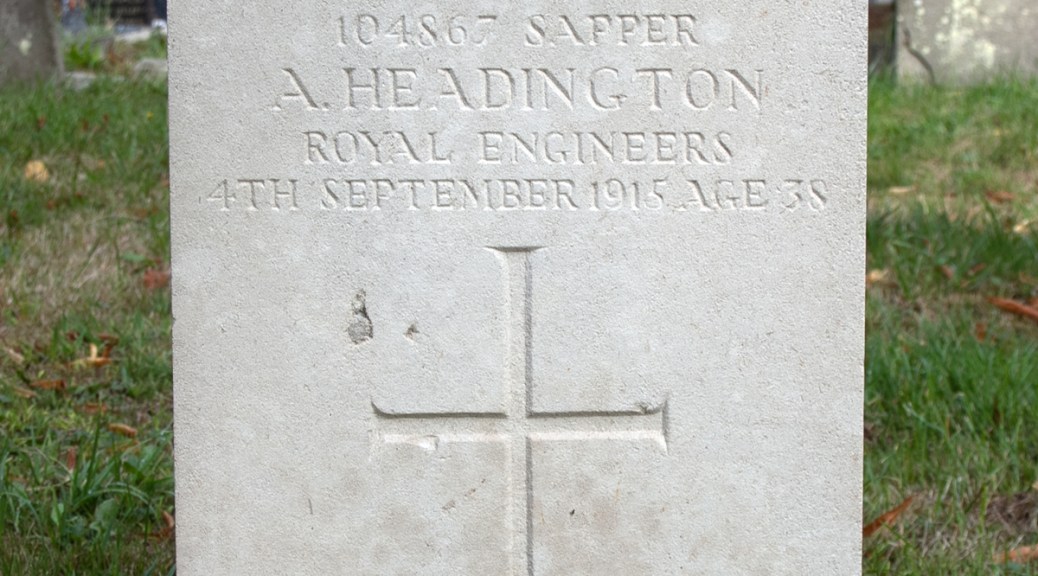
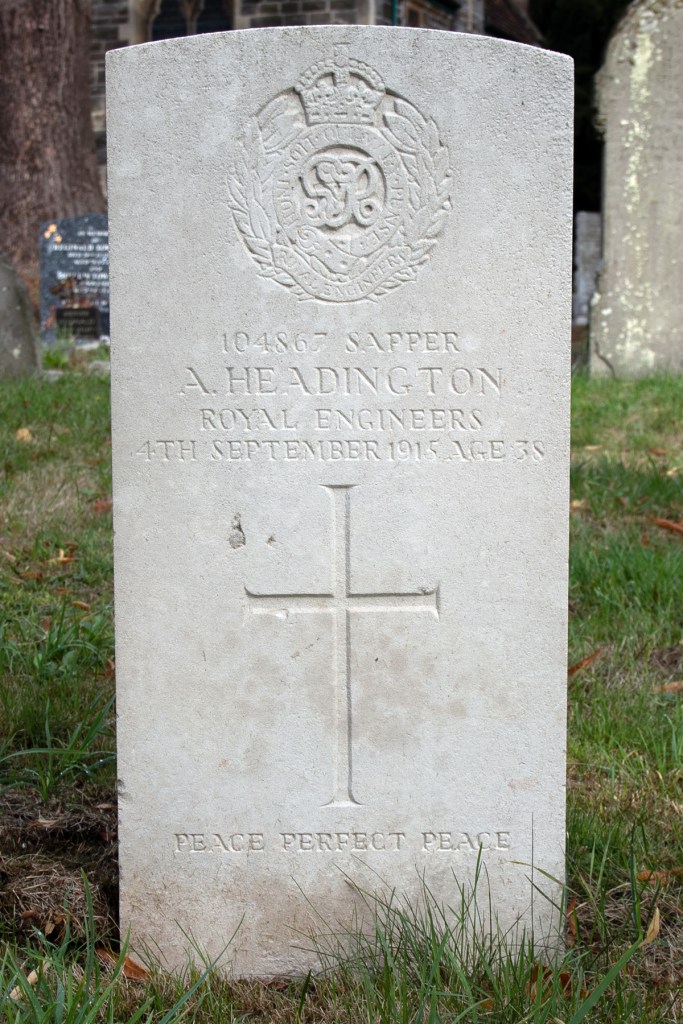
Sapper Albert Headington

Sapper Albert Headington

Albert Edward Headington was born on 5th December 1876 in Keynsham, near Bristol, in Somerset. The ninth of eleven children, his parents were Joseph and Jemima Headington. Joseph was a stonemason and, while he seems not to have had his father’s talents, Albert worked with the same material, becoming a bricklayer’s labourer when he left school.

On 29th May 1899, Albert married Ellen Gray. She was a mason’s daughter from Semley in Wiltshire, and it seems that he was either working there or had some connection with the family through his father’s work. The couple settled down in Keynsham, and went on to have two children, Harold, who was born in 1900, and Edith, who was born in 1912.

By the time of the 1911 census, the family had settled in a small house in the middle of Keynsham. Albert had, by this point, found other employment, and was working for Great Western Railways as a packer.

When war broke out, Albert stepped up to play his part. He enlisted on 22nd June 1915, joining the Royal Engineers as a Sapper. Sent for initial training in Chatham, Kent, he returned home on leave at the end of August. Tragically, he had fallen ill by this point, and died at home on 4th September 1915, having contracted cerebrospinal meningitis. He was 38 years of age.

Albert Edward Headington was laid to rest in the quiet cemetery of his home town of Keynsham.


Ellen went on to live a full life. She and Edith emigrated to Canada in 1921, following Harold, who had made the same move a year earlier. They all settled in the town of Welland, Ontario, not far from Niagara Falls.

Both of Albert and Ellen’s children married and had children of their own. Ellen never remarried, and passed away on 4th November 1956, at the age of 80 years old. She was laid to rest in the Holy Trinity Anglican Cemetery in Welland.


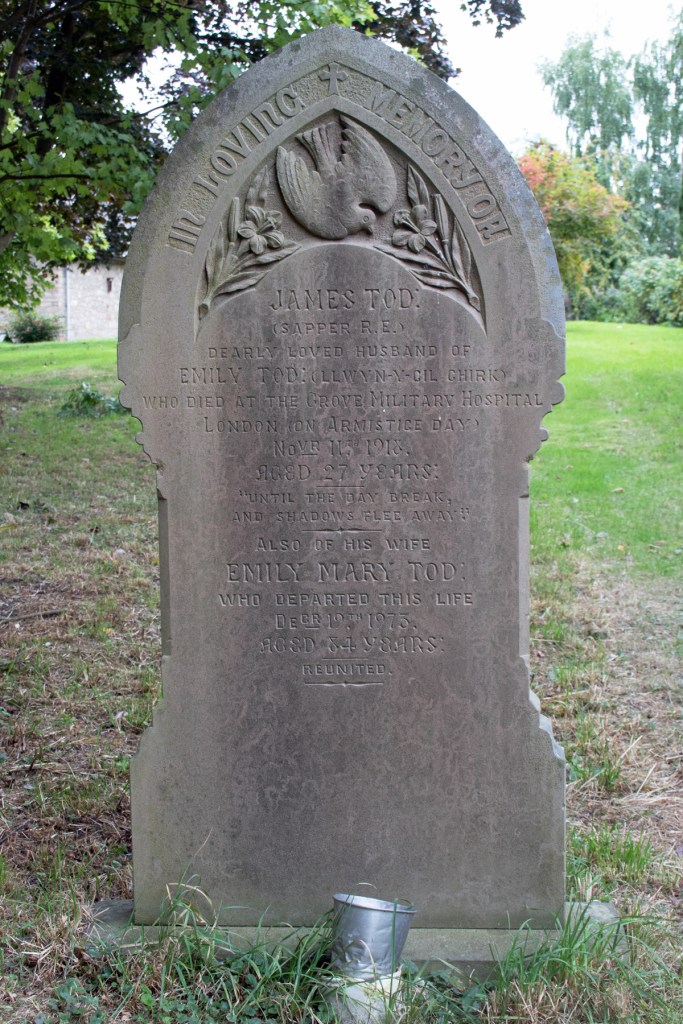
Sapper James Tod

Sapper James Tod

James Tod was born in the spring of 1891 in Chirk, Denbighshire, and was one of nine children. His parents were builder John Tod, who was from Scotland, and Margaret Tod, who had been born in Llangollen.

John passed away when James was in his teens and, when he left school, James found work as a joiner to help support his mother financially.

When war came to Europe, James was called upon to play his part. Full details of his military service are not available, but he had enlisted by the beginning of 1917. James joined the Royal Engineers as a Sapper, and was assigned to the London Electrical Engineers.

It is unclear whether Sapper Tod served overseas, but he certainly would have been based in the London area, carrying out repair works as needed. The London Electrical Engineers were also pioneers in the use of searchlights to spot enemy aircraft and Zeppelins raiding the capital. A detachment was also sent to France to position and man searchlights on the Western Front, although, again, it is not clear whether James was one of those involved.

It is clear that James was back in Wales at the start of 1917, however, as, on 18th January, he married his sweetheart, Emily Mary Edwards, at the parish church in his home town. Emily was the daughter of a gamekeeper from nearby Pontfadog, but it was in Chirk that the coupler were to make their home.

Sapper Tod was soon back on duty, however, and the next evidence available for him is that of his admission to the Grove Military Hospital in Tooting, South London. He had contracted a combination of influenza and pneumonia, and these lung conditions were sadly to get the better of him: he passed away on Armistice Day, the 11th November 1918. He was just 27 years of age.

James Tod was brought back to Wales for burial. He was laid to rest in the family plot in the graveyard of St Mary’s Church in the town.


It seems that James had been in some debt when he passed, as some of his war pension was held over to cover those costs.

Tragically, Emily was five months pregnant when James died. She gave birth to a son, who she named after his father, on 9th March 1919.

Emily never remarried, and, by the time of the 1939 Register for England and Wales, was recorded as the Lodgekeeper for Deer Park Lodge, which was attached to Chirk Castle. She passed away on 19th December 1973, at the age of 84 years old. She was laid to rest with her late husband, a couple reunited at last after more than five decades.

James Jr lived a long life, passing away in the spring of 1999, in his eightieth year.


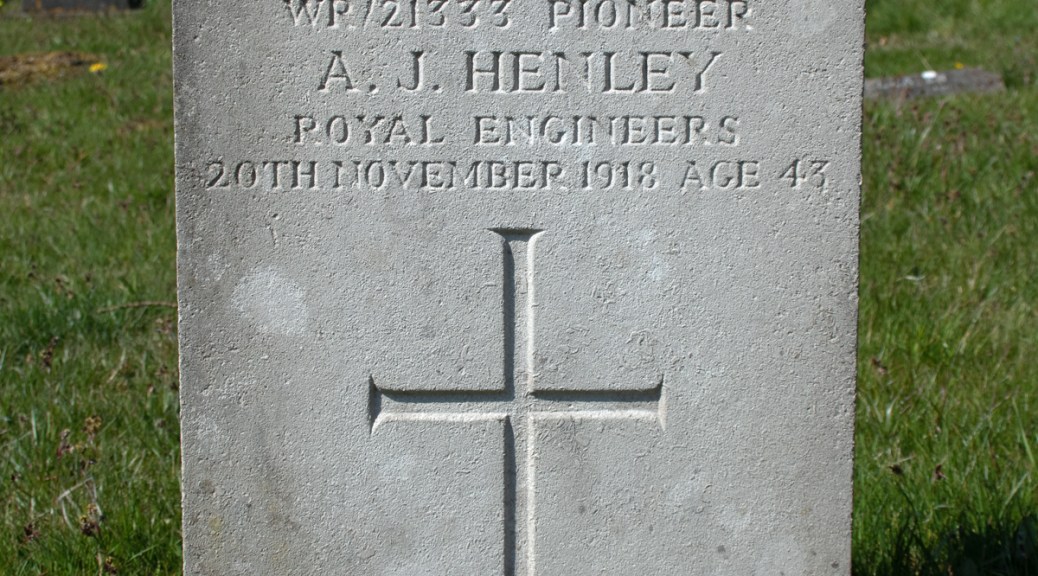
Pioneer Albert Henley

Pioneer Albert Henley

Albert James Henley was born in the spring of 1875, the youngest of nine children to Caleb and Ann Henley. Caleb was an agricultural labourer from Cuckfield, and it was in this West Sussex village that the Henley siblings were born and raised.

Albert found work on a farm when he left school, but soon found other employment as a bricklayer. On 15th August 1896 he married Sophia Leney: the couple went on to have four children – Kate, Minnie, Albert and William.

War came to Europe, but Albert was not initially called on to serve king and country because of his age. He did enlist, however, joining the Royal Engineers in January 1917. His service records suggest that he was a month short of his 45th birthday (which does not tie up with his baptism records) and stood 5ft 10.5ins (1.79m) tall. He is noted to have been of good physical development, weighing in at 159lbs (72.1kg).

Pioneer Henley was assigned to the 307th Road Construction Company and, after a month’s training was dispatched to France. He spent more than eighteen months overseas, before being medically evacuated to England in the autumn of 1918, having contracted bronchitis. Albert was admitted to hospital in Dover as soon as he had crossed the Channel, but died there the following day. He passed away on 20th November 1918 and was 43 years of age.

Albert James Henley was brought back to West Sussex for burial: he was laid to rest in the cemetery of his home village, Cuckfield.


A sad epilogue to Albert’s story is that his widow, Sophia, had to wait for his belongings to be returned to her. In a letter to the regiment on 14th December 1918, she wrote:

…it is nearly a month since he passed away, and I have not heard anything. When I came there on the 20th [November] they said his personal belongings would be sent on in a few days.

The Royal Engineers office responded that they were unable to forward his personal effects on until authority had been received from the War Office. It was to be another six months before Sophia finally got her late husband’s items – a purse, knife, notebook, letters, photo, gloves, watch (with case and chain), handkerchief, muffler and four coins – back.


Second Lieutenant Francis Wakeford

Second Lieutenant Francis Wakeford

Francis Reginald Steele Wakeford was born in the summer of 1893 in Penarth, Glamorgan. The middle of five children, his parents were Herbert – who was a master printer – and Mary Wakeford. When he left school, Francis became a stockbroking clerk, but when war broke out, he was quick to ensure he played his part.

Initially enlisting in the Royal Engineers, he was attached to the Glamorgan Yeomanry. By the time he was sent to France, however, he had been assigned to the Lancashire Fusiliers.

After eighteen months of fighting, in the spring of 1918, Second Lieutenant Wakeford transferred to the Royal Air Force and gained his wings. “During six months’ flying he had many encounters with enemy airmen, many of whom he brought down, and was also in several bombing raids over Germany.” [Western Mail: Monday 30th December 1918]

When the Armistice was declared, Francis returned to Wales. He has been suffering from an ongoing illness, and this was to be to what he was to succumb. Second Lieutenant Wakeford passed away in Cardiff on Christmas Day, 25th December 1918. He was just 25 years of age.

Francis Reginald Steele Wakeford was laid to rest in the graveyard of St Augustine’s Church in his home town of Penarth.


Second Lieutenant Wakeford (from findagrave.com)

Francis’ grave also commemorates the passing of his only brother, Charles Herbert Stanley Wakeford.

Four years Francis’ senior, Charles had enlisted in the 24th (Pembroke and Glamorgan Yeomanry) Battalion of the Welch Regiment. As the war moved through its final year, Lieutenant Wakeford found himself caught up in the fierce fighting of the Second Battles of the Somme.

Charles was killed on 7th September 1918, aged 28 years old. He was laid to rest in Tincourt British Cemetery, in Picardie, France. He is also commemorated on the family grave in St Augustine’s Church, Penarth.


Sapper Walter Wigginton

Sapper Walter Wigginton

Walter Wigginton was born in the Leicestershire village of Illston-on-the-Hill in the summer of 1880. The second of seven children, his father John was a grazier, managing cows over a six-acre pasture. His mother, Rebecca, who was also born in Leicestershire, raised the family and managed the home.

Walter turned his hand to carpentry, and, by the time of the 1901 census, he was boarding with a widow in Frimley, Surrey, employed for his woodworking skills. By 1905, his journeyman life had taken him to the Somerset village of Trull. It was here that he met and married Annie Oaten, and here that the couple settled down to raise their family. They had two children, Dorothy, born in 1906, and Winifred, who was born two years later.

War was closing in on Europe and, by the summer of 1916, Walter had joined up to play his part. Initially assigned to the 65th Training Reserve Battalion, he had not long transferred across to the Royal Engineers as a Sapper when he fell ill.

Sapper Wigginton was admitted to the Kinmel Park Military Hospital near Abergele on the North Wales coast, suffering from bronchial pneumonia. Sadly, this lung condition was to get the better of him, and he passed away at the hospital on 29th December 1916, at the age of 36 years old.

Walter Wigginton’s body was brought back to Somerset for burial. He was laid to rest in the graveyard of All Saints’ Church in Trull, where his widow and children still lived.


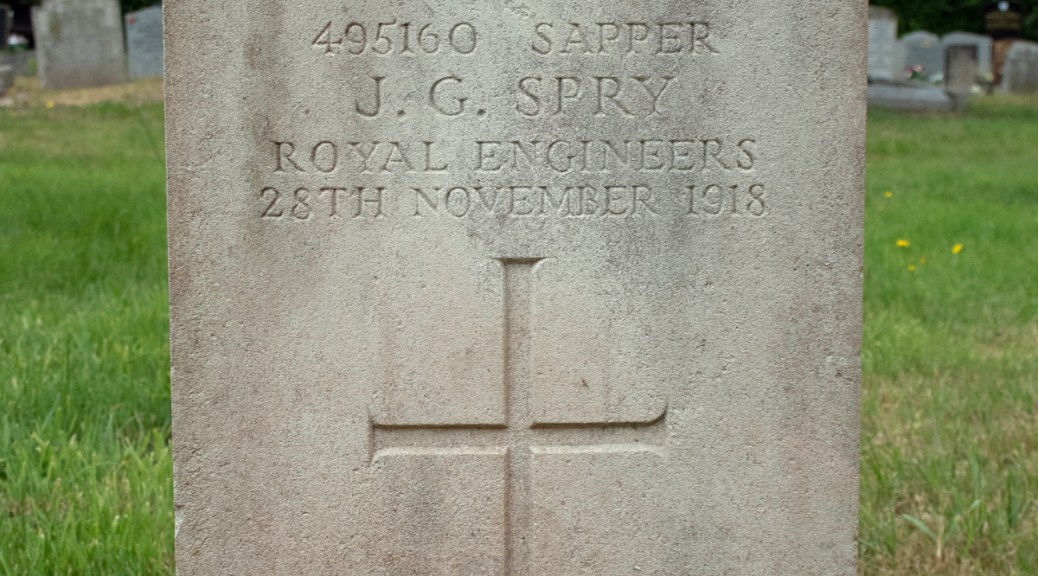
Sapper John Spry

Sapper John Spry

Details of John George Spry’s life remain tantalisingly out of reach. He was born in around 1874 in the Devon village of Woolfardisworthy, and was one of eight children to John and Ann Spry. John Sr was a general labourer who died in 1891. By this point the family were living at 14 Honestone Lane, Bideford, and John Jr was working as a stone mason.

John married Emily Langford. She was a blacksmith’s daughter from Taunton, Somerset, but the couple set up home in nearby Wellington, before moving to Twerton, Bath. The went on to have three children: Ivy, Ruby and Frederick. Interestingly, Ivy seems to have been taken in by Emily’s mother, Emma, while Ruby and Frederick remained with their parents.

The 1911 census found Emily, Ruby and Frederick living with John’s mother in Bideford. Ivy was in Wellington with Emma, but John is missing from the records.

When war broke out, John joined up. He enlisted in the Royal Engineers, and was assigned the rank of Sapper. Dates for his service – and where that service was carried out – are lost to time, but by the autumn of 1918, John was based in barracks in Fovant, Wiltshire.

By this time, Sapper Spry had fallen ill. Suffering from influenza and bronchial pneumonia, he was to succumb to the lung diseases, as so many other returning servicemen did. John passed away on 28th November 1918, aged 45 years of age.

John George Spry was brought back to Somerset for burial. He was laid to rest in Wellington Cemetery, not far from where his widow had relocated.


What became of the Spry family after John’s death is unclear. Emily cannot be tracked down in the 1921 census, nor can her middle child, Ruby.

Ivy was boarding at 55 Harrow Road, Paddington, Middlesex, where she was working as a Lieutenant in the Salvation Army. Frederick, meanwhile, had found work as a steersman on a steamroller, and, according to the census, was living with his maternal uncle, Charles, in Bideford.

The 1939 Register picks up Emily once more, living in a small end-of-terrace cottage on the outskirts of Wellington. Now 70 years of age, she was noted as being incapacitated, no doubt being tended to by Ruby, who was also living there, employed as a puttee machinist.


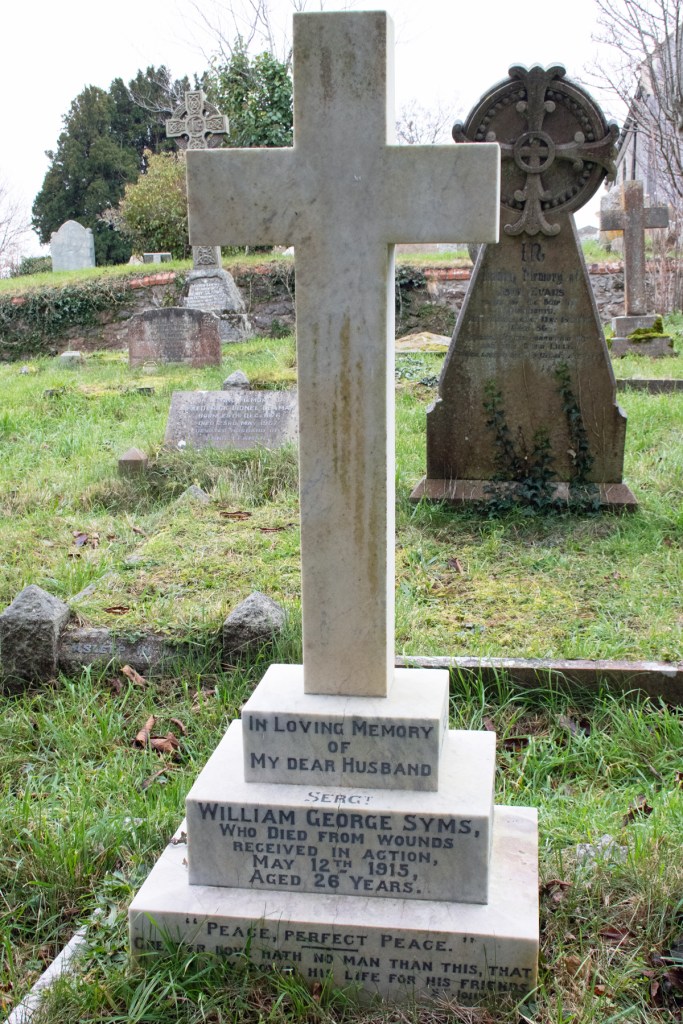
Serjeant William Syms

Serjeant William Syms

William George Syms was born in in the spring of 1889, the oldest of two children to George and Rose Symes (both spellings are recorded). George was a postman from Devon, and the family were born and raised in Highweek, Newton Abbot.

When William left school, he followed in his father’s footsteps becoming a postman in his home town. Life was not without its ups and downs, however, and the 1911 census record him as an inpatient, convalescing from an unknown illness in Exmouth.

In the summer of 1913, William married Amelia Oliver, a gardener’s daughter, who also from Highweek.

When war broke out William was eager to play his part, and enlisted in the early months of the conflict, alongside a number of his colleagues. He joined the Royal Engineers, and was assigned to the 1st (Wessex) Division Signal Company. He was sent to France on 22nd December 1914 and was involved on the Front Line from early on.

By the spring of 1915, he was fighting at Ypres, and was badly injured, fracturing both legs and suffering from the effects of being gassed. Serjeant Syms – as he was by then ranked – was medically evacuated to England for treatment. He was admitted to the Auxiliary Military Hospital in Manchester, but died of his injuries on 12th May 1915. He was just 26 years old.

William George Syms’ body was brought back to Devon for burial. He was laid to rest in the graveyard of All Saints Church in his home town of Highweek. Tragically, he was never to see his son, also called William, who had been born just two months before.