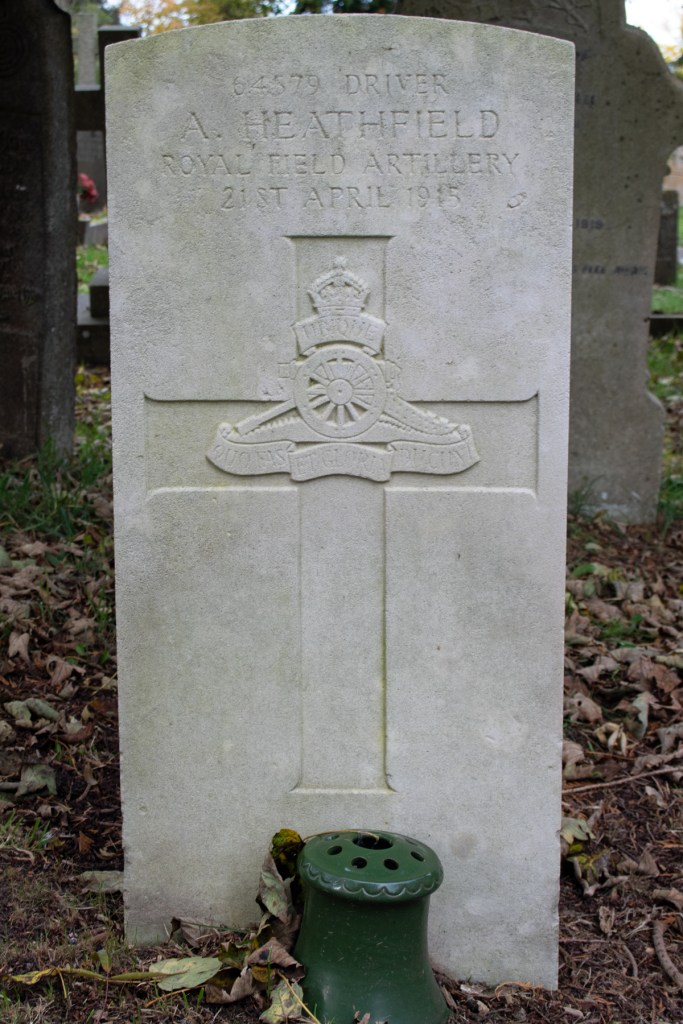
Arthur Heathfield was born in Shefford, Bedfordshire, early in 1897, the oldest child to Ellen Grace Heathfield. Ellen married William Lewis in 1903, and went on to have four children in total.
When he left school, Arthur found work as a farm labourer, but by this time, war was coming to Europe. Full details of his military career are not available, but he enlisted in the Royal Field Artillery at some point towards the end of 1914.
Driver Heathfield was assigned to the 14th Brigade, which saw fighting on the Western Front, although it is not possible to determine whether Arthur himself went overseas. What is certain is that, by the spring of 1915, he was admitted to hospital in Frome, Somerset, suffering from meningitis. Sadly, he was to succumb to the disease on 21st April. He had not long turned 18 years old.
Arthur Heathfield was laid to rest in the graveyard of Christ Church, in the town in which he died.
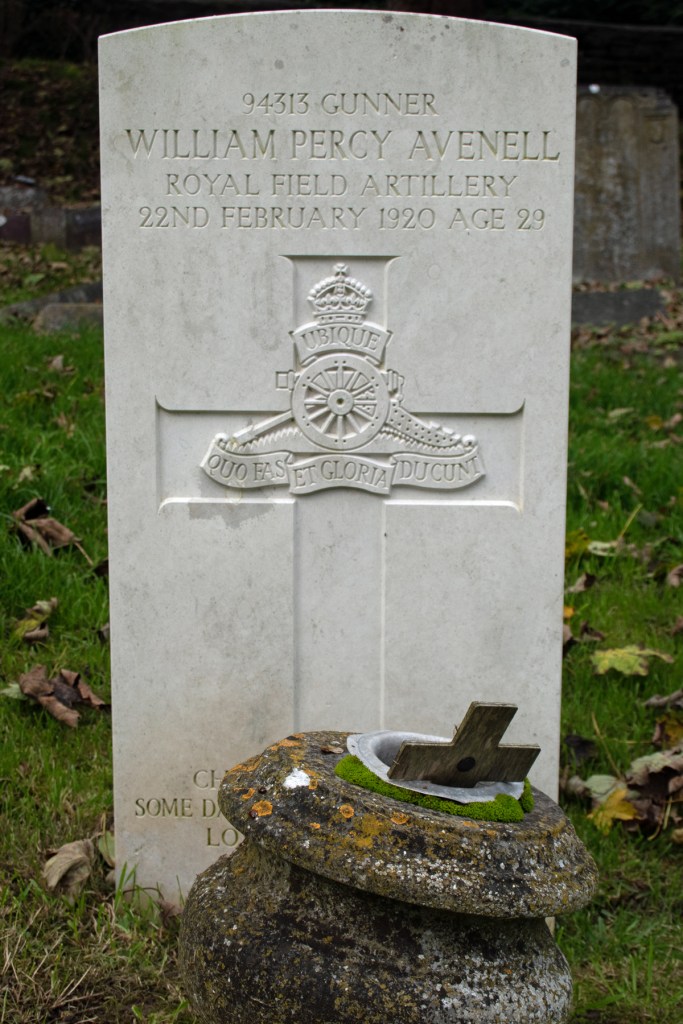
William Percy Avenell seems destined to remain lost to time, and there is little documentation about his life.
He was born in around 1891, and enlisted in the Royal Field Artillery as a Gunner in the summer of 1915, serving in France and earning the Victory and British Medals and the 1915 Star in the process. Gunner Avenell subsequently transferred to the 861st Employment Company of the Labour Corps.
William survived the war and returned to England. He had settled in the Somerset town of Frome (he may have been from the town, but there is nothing to evidence this) with his wife, Lily Beatrice.
Gunner Avenell’s passing is as lost in time as the rest of his life. He died on 22nd February 1920, at the age of just 29 years old.
William Percy Avenell lies at rest in the graveyard of Christ Church in Frome.
Daniel Mcauley was born in Belfast in around 1883, one of six children to John and Margaret Mcauley. John was a farmer, and when Daniel – who was named after his uncle – left school, he found labouring work to help the family bring in an income.
In January 1909, Daniel married Annie Fittis, the daughter of a linen tenter (stretching cloth on a loom while it was drying and maintaining the machines). The couple had had a son, John, eighteen months before, and would have another child, Sarah, later that year.
The 1911 census for Northern Ireland found the young family living with Annie’s mother and two sisters in Dayton Street, near the middle of Belfast. Annie and her sisters were working as flax spinners, while Daniel was a labourer. Tellingly, the document lists inhabitants’ religion – Daniel is the sole Roman Catholic amongst a family of Presbyterians.
War was coming to Europe, and Daniel was called on to do his bit. Sadly, full details of his military service are not available, but what is clear is that he enlisted as a Bombardier in the Royal Field Artillery towards the end of 1914. He was shipped to England, and barracked in Somerset, near Frome.
Sadly, the next evidence of Daniel’s life comes in a wealth of newspaper articles that report on the accident that led to his death.
One soldier was killed and another seriously injured as the result of a horse attached to a Royal Field Artillery wagon bolting at Frome Saturday morning. The wagon was on its way to the stables when the horse got out of control and ran along Christ Church Street West.
One man, who was riding in the wagon, in jumping clear was seriously cut about the head and body, and was taken to the hospital. The other, Bombardier Daniel MacAulay, belonging to Glasgow [sic], remained in the wagon trying to pull up the horses, but the vehicle swerved across the road and he was thrown out, his head coming into contact with a street lamp.
He was taken to the hospital on the police ambulance, but died before admission. He was a married man, about 34 years of age, and was to have gone on leave Saturday in order to visit his sick child. In the morning he received a letter from his wife saying that the child had been seriously ill and had gone blind.
Mr Douglas Mackay, deputy coroner, held an inquest at Frome on Tuesday on the body of the deceased. The verdict was “Accidental death.”
Shepton Mallet Journal: Friday 19th March 1915
Other newspapers reported similarly, a couple stating that Daniel was father to three children. There is no evidence that this was the case and, given that all of the reports state that he came from Scotland, when he was Irish, it is likely that this too was an error. Each newspaper give variations of the spelling of his surname too, evidence that spelling was often at the mercy of the person documenting it, even in the media.
Daniel was buried in Somerset and Annie travelled to England to attend the funeral. Again, newspaper reports suggest that Daniel’s brothers also attended, although he had only one male sibling.
Bombardier Daniel Mcauley died on 13th March 1915, aged around 33 years old. He was laid to rest in the Vallis Road Burial Ground in Frome, also known as the Dissenters’ Cemetery (for those who did not follow the English Protestant faiths.
William Hann was born towards the end of 1871, the son of Harry Hann, who was a stonemason, and his wife Susan. Born in Stoke-under-Ham (now Stoke-sub-Hamdon), he was one of nine children, although sadly five of his siblings passed away at a young age.
Sadly, little of William’s early life remains documented. A newspaper article that reported on his passing, however, confirms that he served in the Royal Field Artillery, and was based in India for four years, before being shipped to South Africa to fight in the Boer War.
Back in Somerset in the early 1900s, he married a woman called Ellen, and the couple went on to have four children – Hilda, Herbert, Kate and Louisa.
At the outbreak of the [First World War], though under no obligation, [Gunner Hann] responded to the call of duty and was among the first to volunteer from Stoke. He was attached to the Indian Expeditionary Force and sent to France, and it is interesting to know that he saw some of the native soldiers whom he had bet while serving in India many years ago.
After serving in France for some time, he was transferred to Mesopotamia, and it was there that his health became impaired, which made him an easy victim of the disease which caused his death.
Western Chronicle: Friday 1st June 1917
Gunner Hann had contracted cellulitis in his right arm, which turned septic. He returned home on sick leave on 22nd May 1917, but died at home from blood poisoning just two days later. He was 48 years of age.
William Hann was laid to rest in the graveyard of St Mary’s Church, in his home village of Stoke-sub-Hamdon.
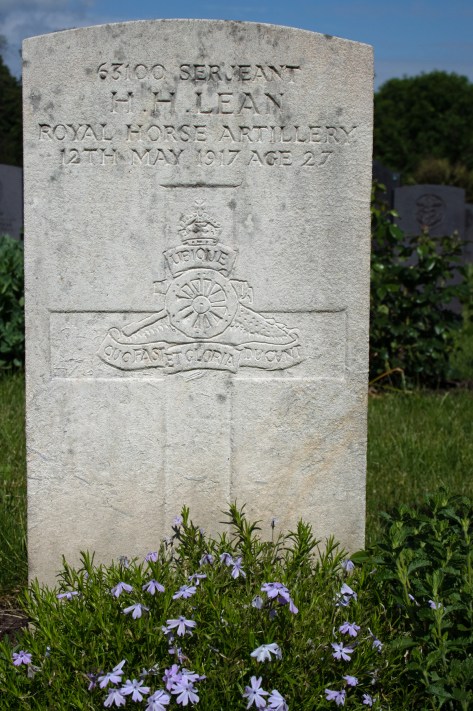
Harold Henry Lean was born in Gillingham, Kent, in the summer of 1890. The youngest of eight children, his parents were tailor Robert Lean and his wife Sarah. His siblings followed a variety of trades – coachman, painter, shoemaker – but Harold was keen to follow a more long-term career.
When he left school (and after his father’s death in 1901), he enlisted in the army, becoming a Gunner in the Royal Horse Artillery. Little remains of his service documents, but at the time of the 1911 census, he was firmly ensconced in the Artillery Barracks in Leeds.
The next record for Harold comes, sadly, in the form of a news report, detailing the inquest surrounding his death:
SUICIDE OF A SERGEANT AT TOPSHAM BARRACKS
Mr Hamilton Brown, Deputy Coroner for Exeter, held an inquest at Topsham Barracks last evening touching the death of Acting-Sergt. Harold Henry Lean, 26, of the [Royal Field Artillery], who died on Saturday as a result of a self-inflicted wound in the throat.
The evidence given by Bombardier JE Driscoll, of the [Royal Military Police], Trumpeter Sydney Russell, deceased’s batman, Bombardier Biddlescombe and Corporal J Williams signalling instructor was that Sergeant Lean, who had some time ago been ill, on Saturday morning was in his room with Russell, but did not speak all the morning.
Shortly after eleven o’clock he took his razor from a shelf in the corner of the room where he kept his shaving materials. Going to his bed he lay across it with his knees nearly touching the floor and drew the razor across his throat. Russell ran to him and caught him by the shoulders, but deceased pushed him away. Russell then called the assistance of Driscoll and Biddlescombe from an adjoining room.
Williams, who was a personal friend and worked with deceased as a signaller, said that deceased worried about the illness from which he had suffered, and two days previously said he thought he was going insane. He had never threatened to take his life.
Captain RW Statham, [Royal Army Medical Corps], said deceased joined that unit in October 1916, and a month later he reported sick. He was sent away to a military hospital, but was returned this year cured and reported for full duty. The illness had a tendency to create mental depression.
On Saturday morning had entered his name on the sick list, but did not attend the sick parade at 9am. At 11:10 when witness was called to him he found him dead. Witness described the wound, which was a very severe one.
The jury returned a verdict of “Suicide during temporary insanity”.
Wester Times: Tuesday 15th May 1917
Serjeant Harold Henry Lean’s body was brought back to Kent from Devon. He was laid to rest in the Woodlands Cemetery in Gillingham.
Fred Ford was born in the Wiltshire town of Mere in 1877. One of eight children to John and Charlotte, his father was an agricultural labourer from the village.
When he left school, Fred initially found work as an errand boy; he soon moved into labouring and, by the time of the 1901 census, was employed as a bricklayer.
In 1904, Fred married Florence Phillips; she was the daughter of an agricultural labour from Somerset. Fred, by this time, had found work as a coal miner in the county, and the young couple set up home in the village of Babington, near Frome. They went on to have four children.
Conflict was on the horizon and, while full details of his military service are not available, it’s clear that he enlisted as soon as he was able to, almost as was was declared. Gunner Ford joined the Royal Field Artillery, and was assigned to the 108th Brigade of the regiment’s Ammunition Corps.
Initially based in Taunton, Fred was soon moved to Portsmouth and then Worthing, and it was here, in the first winter of the war, that he contracted influenza and pneumonia. Admitted to St Cecil’s Red Cross Military Hospital in the Sussex town, sadly the condition proved too much for him. He passed away on 8th February 1915, tragically hours before Florence arrived from Somerset. Gunner Ford was just 37 years old.
Finances not enabling her to transport his remains back home, Florence Ford laid Fred’s body to rest in Broadwater Cemetery in Worthing, the town where he died.
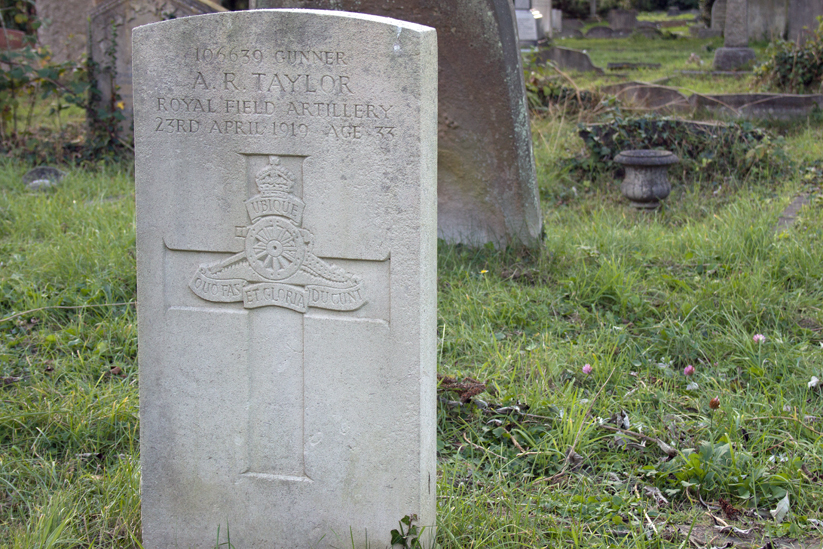
Alfred R Taylor was born in Portsmouth, Hampshire, in 1886, and was one of six children to James and Agnes Taylor. James was a jobbing gardener, who had been born near Chichester in West Sussex.
Agnes had been born in Tarring, near Worthing, and strong connections to her home town seemed to remain. In the 1891 census, Alfred was boarding with his aunt – Agnes’ sister – in Worthing and, ten years later, both of his parents and all of his siblings were also living there.
By 1911, Alfred was working as a nursery gardener – given his father’s work, this is not surprising, and, at the time, the coastal slopes of the South Downs were filled with orchards, farms and nursery greenhouses.
Tantalisingly, there is not a lot more documentation relating to Alfred’s life. When war broke out, he enlisted in the Royal Field Artillery as a Gunner. He joined up in October 1915 and was sent to the Balkans and, as a result of his service, was awarded the Victory and British Medals and the 1915 Star.
Back home on leave, Gunner Taylor married Ellen Mary Sayers at the start of 1918. She was a plumber’s daughter from Worthing, and this was where she and Alfred married.
When the Armistice was declared, Alfred was transferred to the Labour Corps, as part of the Army Reserve force. He passed away on 23rd April 1919, and, while there are no details of his death, it is likely that he fell victim to one of the lung conditions impacting the returning troops at the time. He was just 33 years of age when he died.
Alfred R Taylor was laid to rest in the Broadwater Cemetery in Worthing, not far from where his widow lived.
There are some further details about Ellen Taylor. She and Alfred did not have any children, and she never married again. She passed away in the spring of 1968 in her home town, at the age of 88 years old.
Alfred Fear was born towards the end of 1898, the youngest of nine children to Charles and Eliza Fear. Charles was a mason from Weston-super-Mare in Somerset, who raised his family in the town of his birth.
Sadly, given his youth, there is little documented about Alfred’s early life. He was still at school at the time of the 1911 census and, while he would have found some sort of employment after leaving, there is no record of what that would have been.
Alfred’s military service records are also sparse. He enlisted in the Royal Field Artillery and was assigned the role of Driver in the 321st Brigade. While dates cannot be confirmed, he would have enlisted before the spring of 1918.
The next two documents relating to Driver Fear are his Pension Ledger record and the Army Register of Personal Effects. These confirms that he passed away on 22nd October 1918 at the Norfolk War Hospital. The cause of death given was infirmation of the brain, (or possibly inflammation of the brain). He was just 20 years old.
Alfred Fear’s body was brought back to Weston-super-Mare for burial. He lies at rest in the town’s Milton Cemetery.
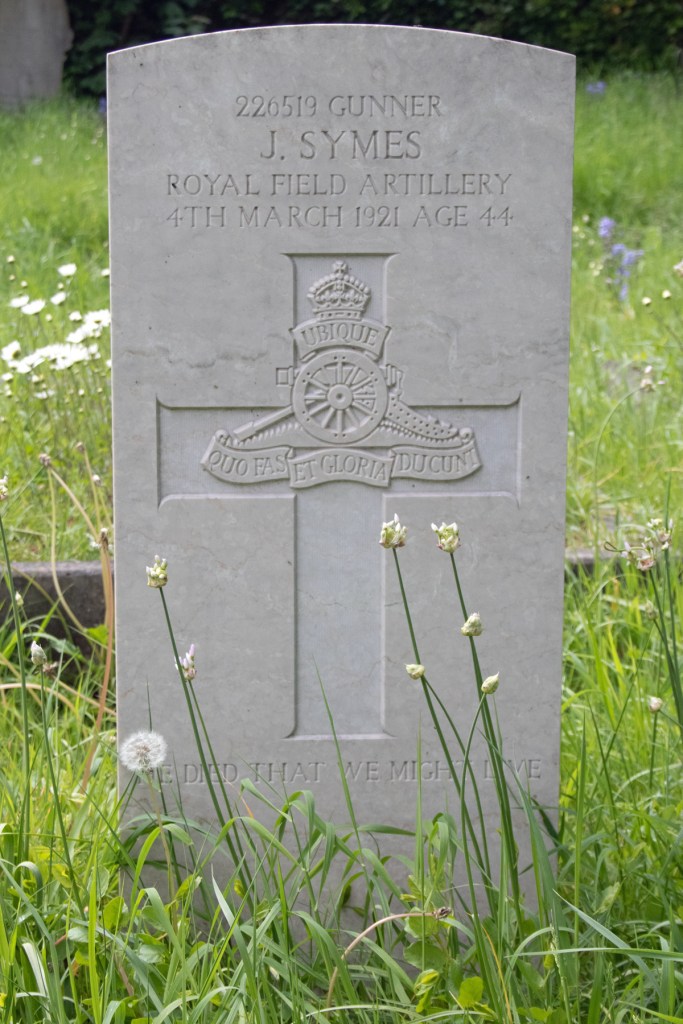
Joseph Symes was born in May 1876, and was the youngest of ten children to Joseph and Caroline Symes. Joseph Sr was a shoemaker who had been born in Shepton Mallet, Somerset, but who had moved to Bristol for work in the late 1860s.
As with some of his older siblings, Joseph Jr followed in his father’s shoemaking footsteps. He worked as a boot clicker, punching the eye holes in footwear, and cutter, taking the shaped pieces out of large leather hides.
In June 1905, he married Emily Delling, who was also from Bristol, and the couple went on to have a son, Douglas, a year later. The couple moved into a two-up-two-down terraced house in a cul-de-sac to the north east of the city centre.
War was coming to the British Isles. Full details of Joseph’s military service no longer exist; however, his gravestone confirms that he enlisted in the Royal Field Artillery.
There is no documentation to confirm whether Gunner Symes saw active service abroad; he certainly survived the war, but in February 1919 was discharged on medical grounds, suffering from myalgia. He was granted a pension, and the family soon replaced the busy city life for a quieter one down the coast in Weston-super-Mare.
Joseph’s trail goes cold for a couple of years, and he passed away on 4th March 1921, at the age of 44 years old. Sadly, there is nothing to confirm the cause of his death; it seems likely that his ongoing medical condition got the better of him.
Joseph Symes was laid to rest in the Milton Cemetery in Weston-super-Mare.
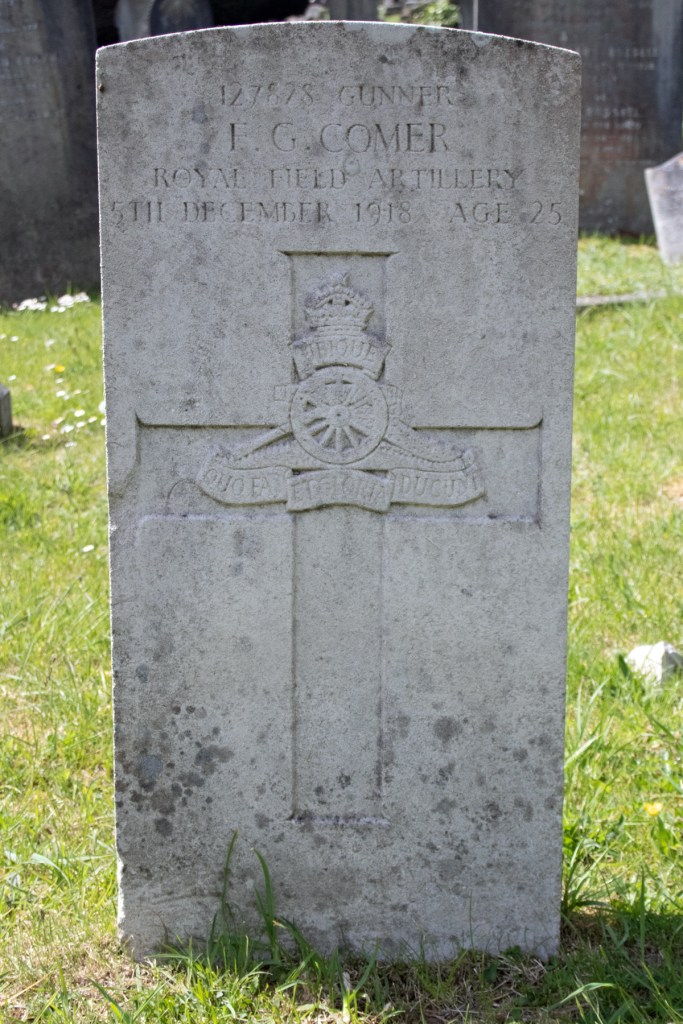
Frederick George Comer was born on 8th July 1893, the older of two children to Fred Comer and his wife Fanny. Fred Sr was a decorator, and raised his family in his town of his birth, Weston-super-Mare.
While his younger brother Clifford followed in his father’s footsteps and became a decorator, Frederick Jr had set his sights elsewhere. The Western-super-Mare Gazette and General Advertiser reported on 31st December 1910, that he had gained a certificate by Pitman’s Shorthand with a speed of 60 words per minute. Within a year, he was working as a news reporter in the local area.
War was on the horizon, but sadly this is where Frederick’s trail goes a bit cold. He enlisted in the Royal Field Artillery, although existing documents do not confirm a date for this. Gunner Comer definitely served overseas, however, and was wounded in action.
Sadly, the other information available confirms that Gunner Comer died from his wounds on 5th December 1918. He was just 25 years old.
Frederick George Comer’s body was brought back to Weston-super-Mare; he lies at rest in the Milton Cemetery in his home town.










 Death and Service