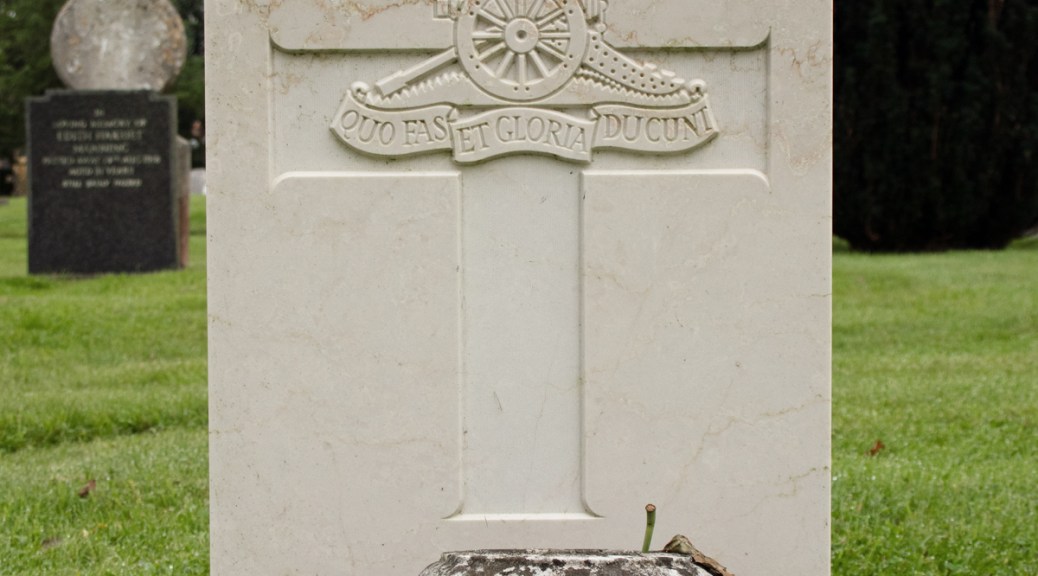
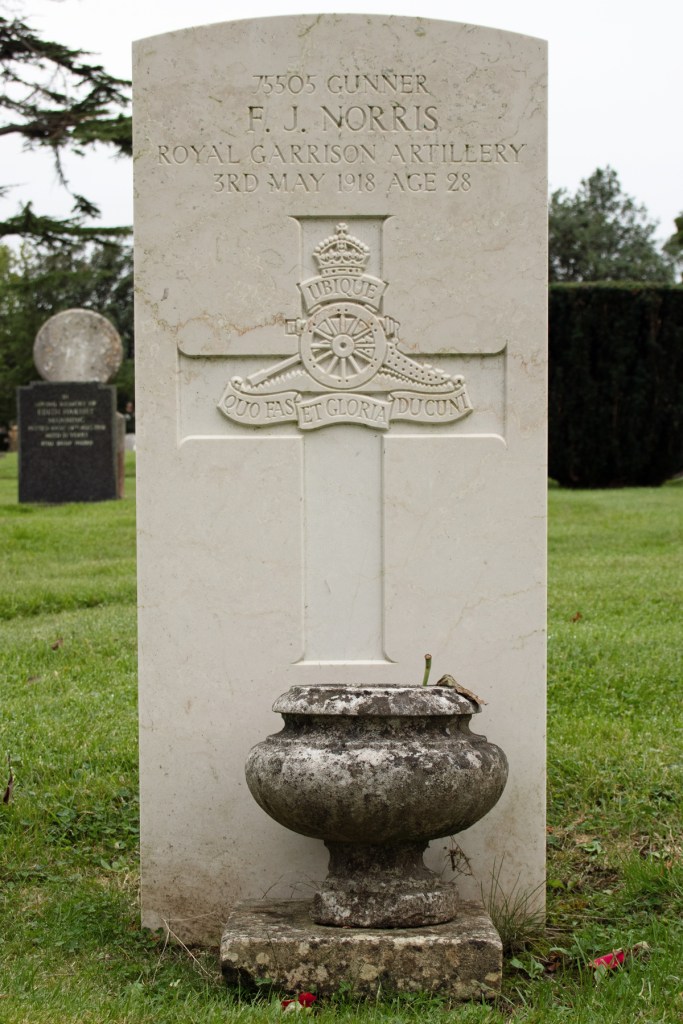
Frederick James Norris was born in the spring of 1890, one of eight children to Henry and Sarah Norris. Henry was a brewer’s drayman and groom, Sarah a milliner, and together they raised their family in the Somerset town of Yeovil.
When he left school, Frederick found work as a carman and carter, following in his father’s footsteps. Henry had died in 1907, followed by his two older brothers, Alfred in 1911 and Frank in 1912. Frederick, by this time, had met Emily Katherine White, and the couple married in Yeovil Parish Church on 23rd May 1909. They went on to have a daughter, Gwendoline, the following year.
War was fast approaching and, in December 1915, Frederick enlisted, joining the Royal Garrison Artillery as a Gunner. After a few months’ training, he was sent to Columbo, Ceylon (now Sri Lanka), where he served for just over a year. During his time there, he had contracted tuberculosis, a condition that ultimately resulted in his return to the UK.
Gunner Norris arrived back in England in August 1917, where he was again admitted to hospital with the respiratory condition. He was ultimately discharged from the army on medical grounds in August of that year.
After leaving the army, Frederick was admitted to a sanitorium, but at this point his trail goes cold. He died on 3rd May 1918, at the age of 28. While the cause of death is not stated, it seems likely to have been as a result of his already debilitated health.
Frederick James Norris was laid to rest in the cemetery in his home town of Yeovil.
William Francis Morgan was born on 22nd January 1884 in Bengal, India. The youngest of three children, he was the son of James Morgan and his wife Mary. Both came from Ireland, marrying in 1876. They moved to London, before James was posted to India as part of his role in the Royal Horse Artillery.
Sadly James died when William was just a toddler; this prompted Mary to move the family back to England. She married again in 1887, to Edward Curling, who was a carpenter in the Royal Artillery, and the family settled on the Isle of Grain in Kent, living in the fort where Edward worked.
Surrounded by those in military service and with an army heritage himself, is it no surprise that William felt drawn to the life. In September 1898 he enlisted in the Royal Garrison Artillery. Though not yet fifteen years old, he stood 5ft 11ins (1.69m) tall and weighed in at 101lbs (46kg). He had a fresh complexion, grey eyes and light brown hair and four distinctive marks were noted – three scars on his head and one on his right knee.
Trumpeter Morgan certainly got to see a lot of the world during his time in the army. After a period on home soil, he was sent to Egypt on Christmas Eve 1901, staying there for just over a year. He moved on to India, returning to England five years later, by which time he had achieved the rank of Gunner.
War was imminent, and in September 1914 he was sent to France as part of the British Expeditionary Force. Barring a short period at home, Gunner Morgan remained on the Western Front for the remainder of the war, finally returning to the UK in January 1919.
William’s time in the army was one of two halves. He had several bouts of illness during his service, coming down with phimosis in 1901, scarlet fever and gonorrhoea in 1902, a fractured clavicle in 1903, pneumonia in 1904, rheumatism in 1906, ague in 1908, pleurisy in 1909, and had to return from France to England for an operation to remove a carbuncle between his shoulder blades in the summer of 1915.
Gunner Morgan was also pulled up for his conduct a few times too. He was punished for neglect of duty in August 1908, disobeyed orders in May 1909, was pulled up for being improperly dressed while in Portsmouth’s Highbury Arms Pub in November 1909 and went AWOL for ten hours on 31st July 1913.
There were positives to William’s service too, however. He was awarded the British and Victory Medals as well as the 1914 Star during the First World War. He was mentioned in dispatches and received the Military Medal in 1917 an the Long Service and Good Conduct Medal two years later.
Sadly, though, after Gunner Morgan’s positive and lengthy military service, his time out of the army was to be brief. Returning to England on 13th January 1919, he contracted influenza and pneumonia and succumbed to the lung conditions within weeks. He passed away on 27th February 1919, at the age of just 35 years of age.
William Francis Morgan was laid to rest in the Woodlands Cemetery, Gillingham, Kent, just minutes’ walk from where his mother now lived.
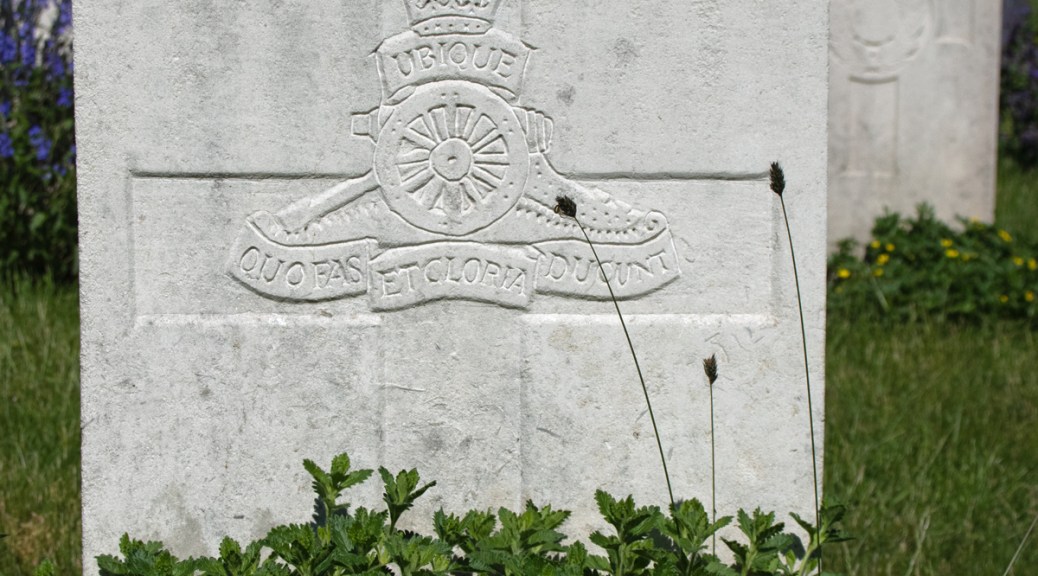
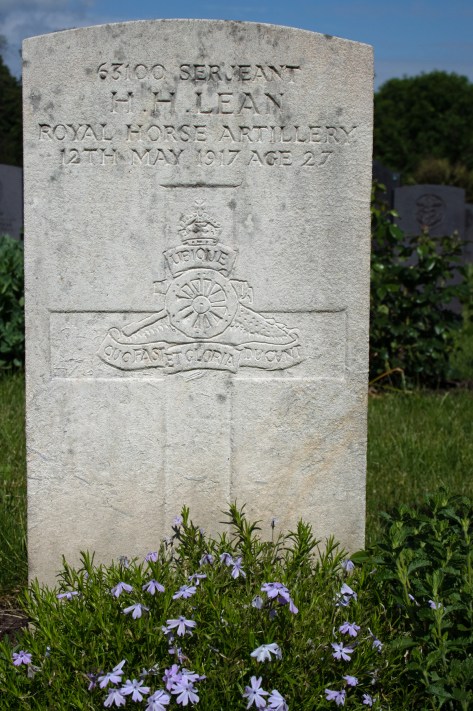
Harold Henry Lean was born in Gillingham, Kent, in the summer of 1890. The youngest of eight children, his parents were tailor Robert Lean and his wife Sarah. His siblings followed a variety of trades – coachman, painter, shoemaker – but Harold was keen to follow a more long-term career.
When he left school (and after his father’s death in 1901), he enlisted in the army, becoming a Gunner in the Royal Horse Artillery. Little remains of his service documents, but at the time of the 1911 census, he was firmly ensconced in the Artillery Barracks in Leeds.
The next record for Harold comes, sadly, in the form of a news report, detailing the inquest surrounding his death:
SUICIDE OF A SERGEANT AT TOPSHAM BARRACKS
Mr Hamilton Brown, Deputy Coroner for Exeter, held an inquest at Topsham Barracks last evening touching the death of Acting-Sergt. Harold Henry Lean, 26, of the [Royal Field Artillery], who died on Saturday as a result of a self-inflicted wound in the throat.
The evidence given by Bombardier JE Driscoll, of the [Royal Military Police], Trumpeter Sydney Russell, deceased’s batman, Bombardier Biddlescombe and Corporal J Williams signalling instructor was that Sergeant Lean, who had some time ago been ill, on Saturday morning was in his room with Russell, but did not speak all the morning.
Shortly after eleven o’clock he took his razor from a shelf in the corner of the room where he kept his shaving materials. Going to his bed he lay across it with his knees nearly touching the floor and drew the razor across his throat. Russell ran to him and caught him by the shoulders, but deceased pushed him away. Russell then called the assistance of Driscoll and Biddlescombe from an adjoining room.
Williams, who was a personal friend and worked with deceased as a signaller, said that deceased worried about the illness from which he had suffered, and two days previously said he thought he was going insane. He had never threatened to take his life.
Captain RW Statham, [Royal Army Medical Corps], said deceased joined that unit in October 1916, and a month later he reported sick. He was sent away to a military hospital, but was returned this year cured and reported for full duty. The illness had a tendency to create mental depression.
On Saturday morning had entered his name on the sick list, but did not attend the sick parade at 9am. At 11:10 when witness was called to him he found him dead. Witness described the wound, which was a very severe one.
The jury returned a verdict of “Suicide during temporary insanity”.
Wester Times: Tuesday 15th May 1917
Serjeant Harold Henry Lean’s body was brought back to Kent from Devon. He was laid to rest in the Woodlands Cemetery in Gillingham.
Fred Ford was born in the Wiltshire town of Mere in 1877. One of eight children to John and Charlotte, his father was an agricultural labourer from the village.
When he left school, Fred initially found work as an errand boy; he soon moved into labouring and, by the time of the 1901 census, was employed as a bricklayer.
In 1904, Fred married Florence Phillips; she was the daughter of an agricultural labour from Somerset. Fred, by this time, had found work as a coal miner in the county, and the young couple set up home in the village of Babington, near Frome. They went on to have four children.
Conflict was on the horizon and, while full details of his military service are not available, it’s clear that he enlisted as soon as he was able to, almost as was was declared. Gunner Ford joined the Royal Field Artillery, and was assigned to the 108th Brigade of the regiment’s Ammunition Corps.
Initially based in Taunton, Fred was soon moved to Portsmouth and then Worthing, and it was here, in the first winter of the war, that he contracted influenza and pneumonia. Admitted to St Cecil’s Red Cross Military Hospital in the Sussex town, sadly the condition proved too much for him. He passed away on 8th February 1915, tragically hours before Florence arrived from Somerset. Gunner Ford was just 37 years old.
Finances not enabling her to transport his remains back home, Florence Ford laid Fred’s body to rest in Broadwater Cemetery in Worthing, the town where he died.
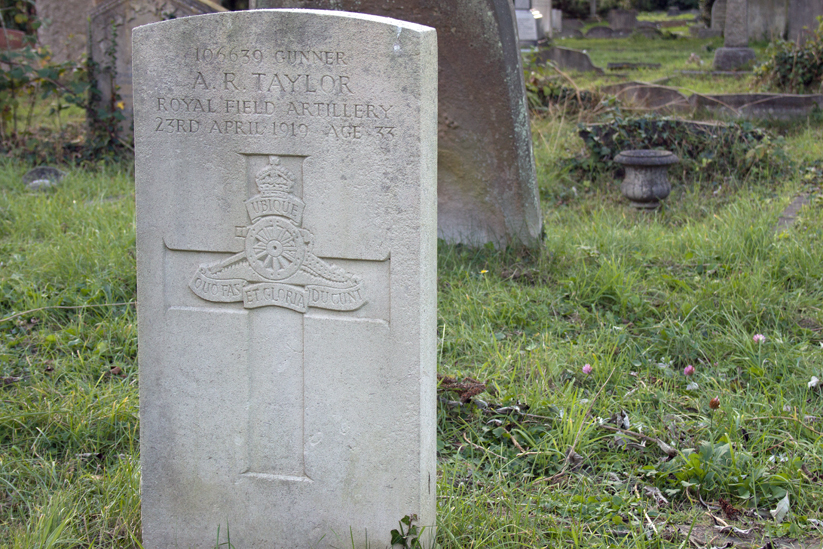
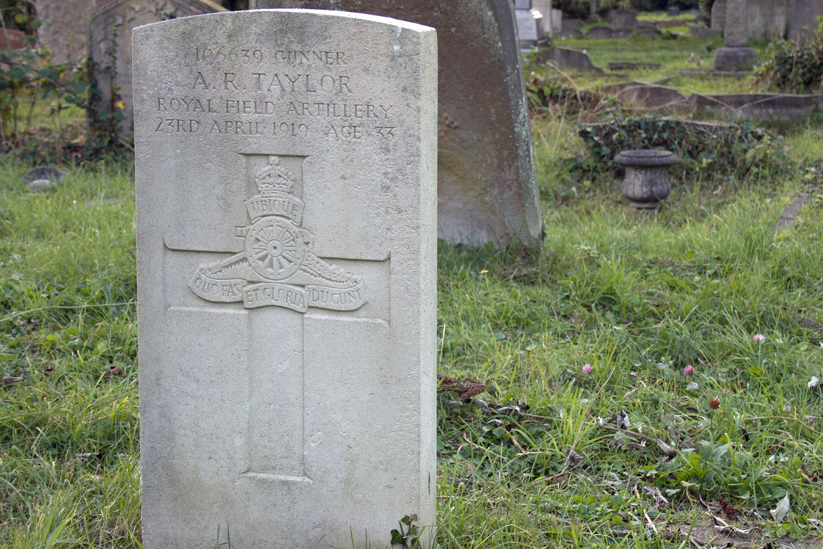
Alfred R Taylor was born in Portsmouth, Hampshire, in 1886, and was one of six children to James and Agnes Taylor. James was a jobbing gardener, who had been born near Chichester in West Sussex.
Agnes had been born in Tarring, near Worthing, and strong connections to her home town seemed to remain. In the 1891 census, Alfred was boarding with his aunt – Agnes’ sister – in Worthing and, ten years later, both of his parents and all of his siblings were also living there.
By 1911, Alfred was working as a nursery gardener – given his father’s work, this is not surprising, and, at the time, the coastal slopes of the South Downs were filled with orchards, farms and nursery greenhouses.
Tantalisingly, there is not a lot more documentation relating to Alfred’s life. When war broke out, he enlisted in the Royal Field Artillery as a Gunner. He joined up in October 1915 and was sent to the Balkans and, as a result of his service, was awarded the Victory and British Medals and the 1915 Star.
Back home on leave, Gunner Taylor married Ellen Mary Sayers at the start of 1918. She was a plumber’s daughter from Worthing, and this was where she and Alfred married.
When the Armistice was declared, Alfred was transferred to the Labour Corps, as part of the Army Reserve force. He passed away on 23rd April 1919, and, while there are no details of his death, it is likely that he fell victim to one of the lung conditions impacting the returning troops at the time. He was just 33 years of age when he died.
Alfred R Taylor was laid to rest in the Broadwater Cemetery in Worthing, not far from where his widow lived.
There are some further details about Ellen Taylor. She and Alfred did not have any children, and she never married again. She passed away in the spring of 1968 in her home town, at the age of 88 years old.
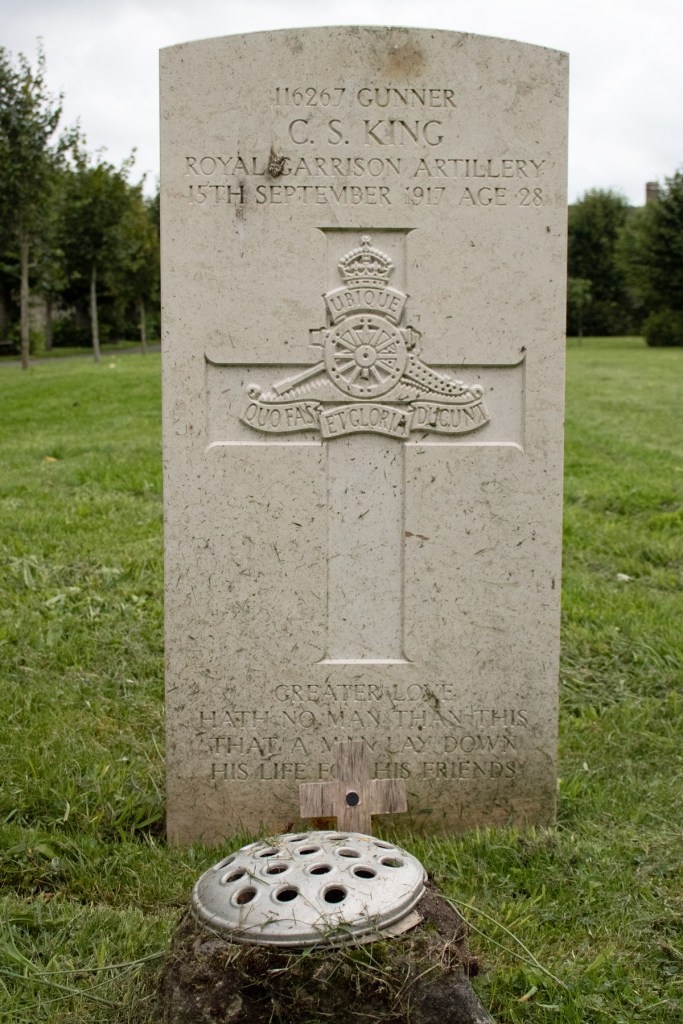
Charlie Stephen King was born in Dorset on 18th October 1888, one of six children to Stephen and Virtue King. Stephen was a painter, glazier and paperhanger from Gillingham, and this is where he and Virtue raised their children.
When Charlie left school, he also went on to become a painter, but specifically for the railways, but whether this was on the rolling stock or stations, is not certain.
In October 1909, Charlie married Bessie Imber, a postman’s daughter from Shaftesbury. The couple set up home in Gillingham, before moving back to Bessie’s home town; they went on to have three children.
War was coming, though, and Charlie enlisted in December 1915. He was not formally called up until August 1916, and was assigned a Gunner in the Royal Garrison Artillery. After initial training, he was sent to the Western Front in March 1917.
Exact details of Gunner King’s service are not available. He was certainly involved in fighting during the summer of that year, and, in September, was wounded. Evacuated back to England with a gunshot wound to his left ankle and shell shock, he was admitted to the War Hospital in Sunderland. Sadly, septicaemia set in, and he passed away on 15th September 1917, at the age of just 28 years old.
Charlie Stephen King’s body was brought back to Dorset, where he was laid to rest in the Holy Trinity Churchyard in Shaftesbury.
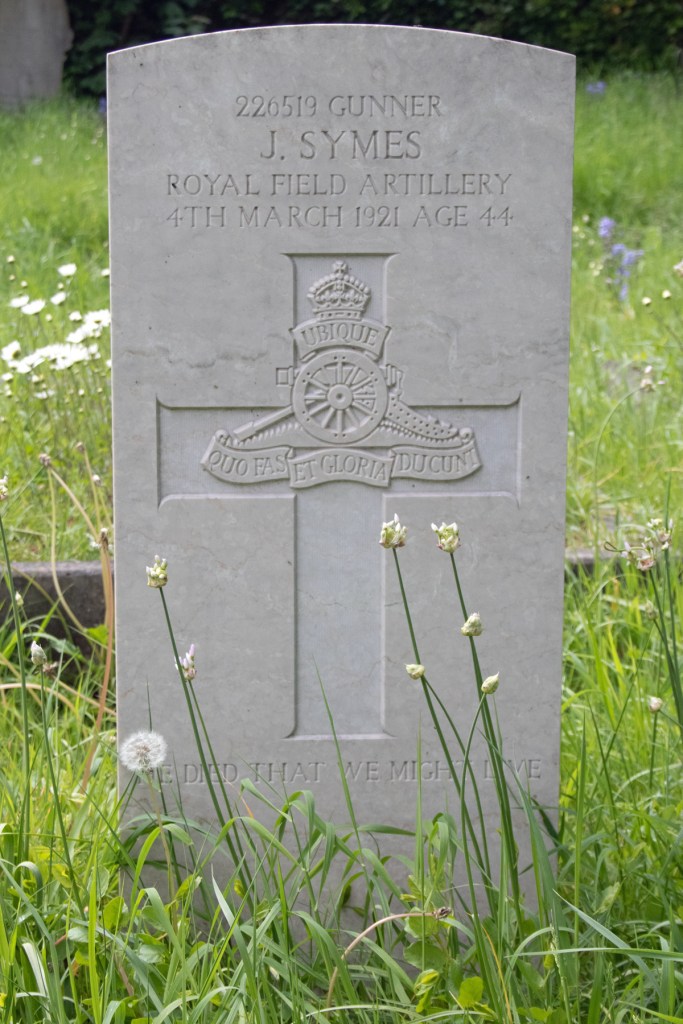
Joseph Symes was born in May 1876, and was the youngest of ten children to Joseph and Caroline Symes. Joseph Sr was a shoemaker who had been born in Shepton Mallet, Somerset, but who had moved to Bristol for work in the late 1860s.
As with some of his older siblings, Joseph Jr followed in his father’s shoemaking footsteps. He worked as a boot clicker, punching the eye holes in footwear, and cutter, taking the shaped pieces out of large leather hides.
In June 1905, he married Emily Delling, who was also from Bristol, and the couple went on to have a son, Douglas, a year later. The couple moved into a two-up-two-down terraced house in a cul-de-sac to the north east of the city centre.
War was coming to the British Isles. Full details of Joseph’s military service no longer exist; however, his gravestone confirms that he enlisted in the Royal Field Artillery.
There is no documentation to confirm whether Gunner Symes saw active service abroad; he certainly survived the war, but in February 1919 was discharged on medical grounds, suffering from myalgia. He was granted a pension, and the family soon replaced the busy city life for a quieter one down the coast in Weston-super-Mare.
Joseph’s trail goes cold for a couple of years, and he passed away on 4th March 1921, at the age of 44 years old. Sadly, there is nothing to confirm the cause of his death; it seems likely that his ongoing medical condition got the better of him.
Joseph Symes was laid to rest in the Milton Cemetery in Weston-super-Mare.
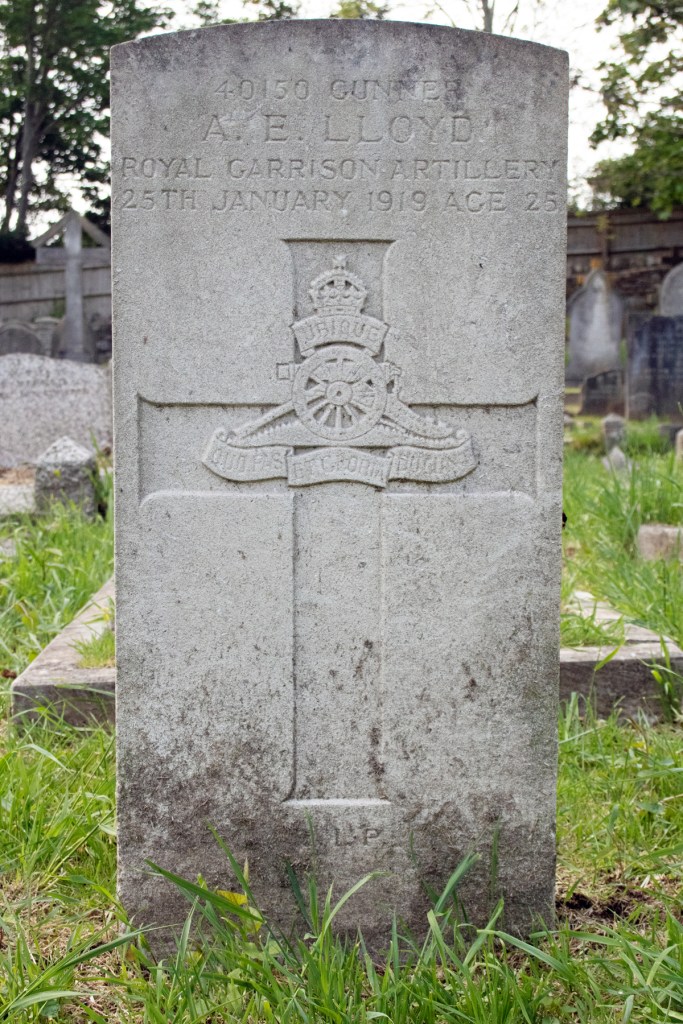
Albert Edward Prankard Lloyd was born in Somerset on 25th September 1893, in the Somerset village of Kewstoke (now a suburb of Weston-super-Mare). He was one of eight children to Jabez and Charity Lloyd. Jabez was initially a mason, but later went on to find work as a miner in South Wales. Charity worked as a laundress to help bring in extra money.
When Albert left school, he found employment as a labourer, remaining at home with Charity, with Jabez working away, and three of his sisters working as housemaids or laundresses. By 1911, however, he had moved to Wales with his father to work as a miner; steady employment that brought in a little more money because of the risks involved.
War, however, was on the horizon, and Albert enlisted before hostilities broke out. Joining up on 12th January 1914, his military records show him as standing 5ft 7ins (1.7m) tall and weighing in at 166lbs (75.3kg). He joined the Royal Garrison Artillery and, over the next five years, served three tours of duty in France, totalling just over three years on the Western Front.
Gunner Lloyd’s military service was not without incident, however. In November 1914 he was admitted to hospital for a week, suffering from shock. In April 1917, a shell exploded close to him and he was again found to be suffering from shock. His records note that, following the injury, he had had suicidal thoughts, and wished he was dead.
Just a month later, back on the battlefield, Albert received a gunshot wound to his right thigh. Nine months later, he was admitted to the Hermitage General Hospital in Higham, Kent for three weeks. (The ailment is a mystery, with just the term SCT Toe to identify it.)
When the Armistice came, Gunner Lloyd remained in France, finally returning home on 13th January 1919 ready to be demobbed. While not clear in his records, it seems that the initial ‘shock’ he had suffered from in 1914 had continued throughout the war.
One of the last comments on Albert’s service records is stark. “Found dead on Great Western Railway near Weston-super-Mare. 25.01.19“. Frustratingly, there is no other documentary evidence to expand on this curt phrase, no contemporary newspapers seem to have reported on the event, and nothing more than a scribbled police report was provided for the inquest (again, of which nothing remains).
It seems that the effects of five years of conflict proved too much for Gunner Lloyd; he committed suicide at the age of just 25 years old.
Albert Edward Prankard Lloyd lies at peace at last in the Milton Cemetery in his home town of Weston-super-Mare.
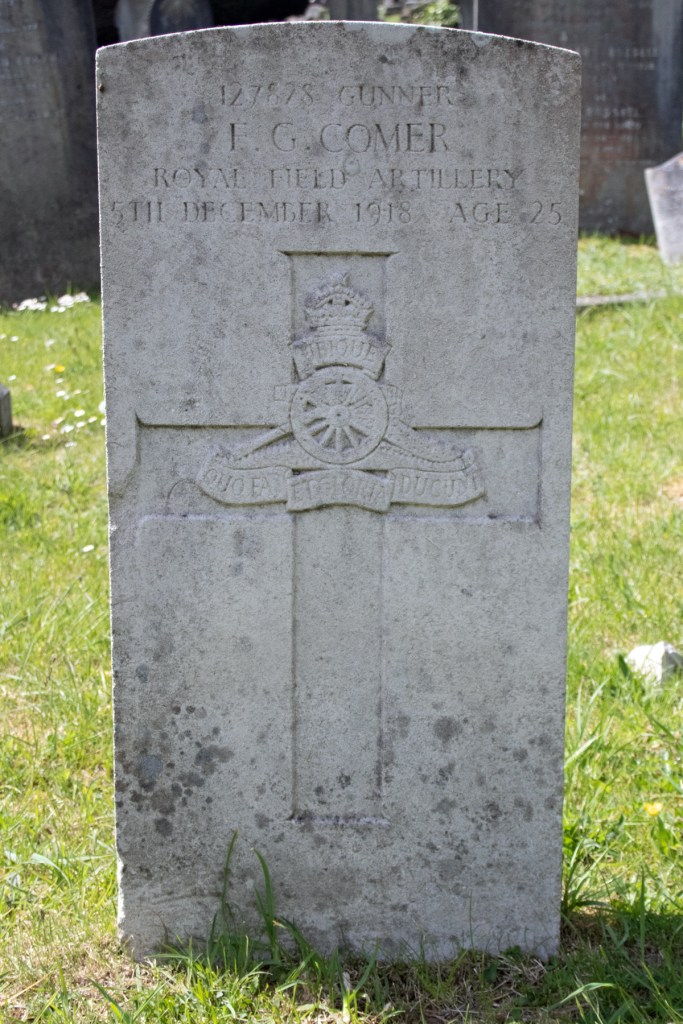
Frederick George Comer was born on 8th July 1893, the older of two children to Fred Comer and his wife Fanny. Fred Sr was a decorator, and raised his family in his town of his birth, Weston-super-Mare.
While his younger brother Clifford followed in his father’s footsteps and became a decorator, Frederick Jr had set his sights elsewhere. The Western-super-Mare Gazette and General Advertiser reported on 31st December 1910, that he had gained a certificate by Pitman’s Shorthand with a speed of 60 words per minute. Within a year, he was working as a news reporter in the local area.
War was on the horizon, but sadly this is where Frederick’s trail goes a bit cold. He enlisted in the Royal Field Artillery, although existing documents do not confirm a date for this. Gunner Comer definitely served overseas, however, and was wounded in action.
Sadly, the other information available confirms that Gunner Comer died from his wounds on 5th December 1918. He was just 25 years old.
Frederick George Comer’s body was brought back to Weston-super-Mare; he lies at rest in the Milton Cemetery in his home town.
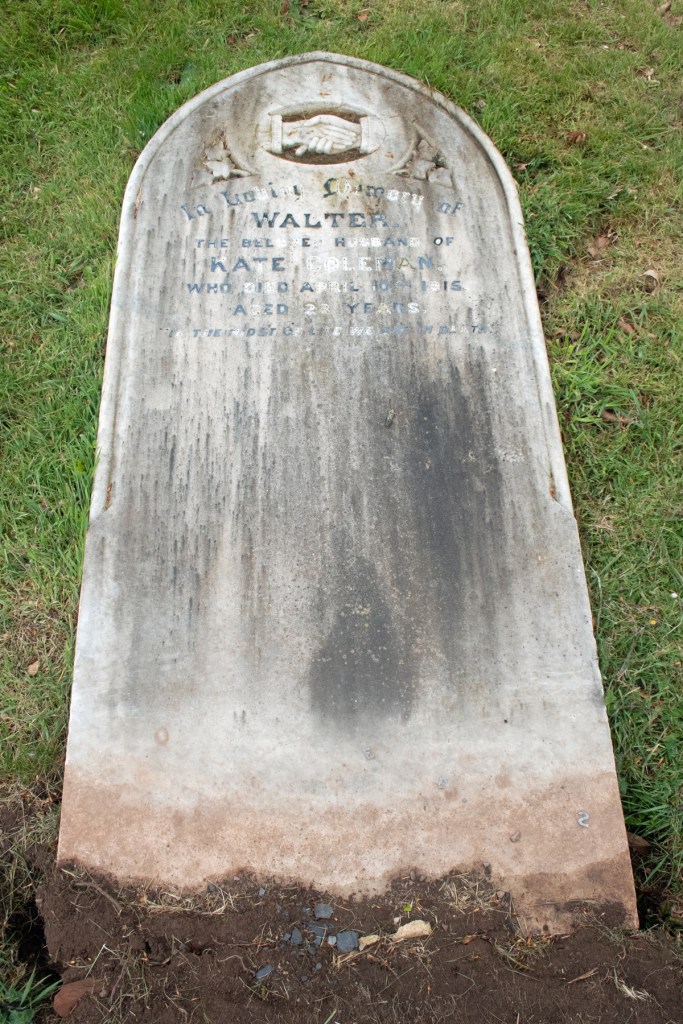
Walter Coleman was born in the spring of 1887, one of seven children to James and Emily Coleman. James was a hairdresser and the family lives in the Somerset town of Taunton.
Walter didn’t follow his father’s trade; instead, after a spell working at a collar factory when he left school, he was soon employed as a groom.
On Christmas Day 1910, he married Kate Norris, and the couple set up in a two-up, two-down in the middle of the town.
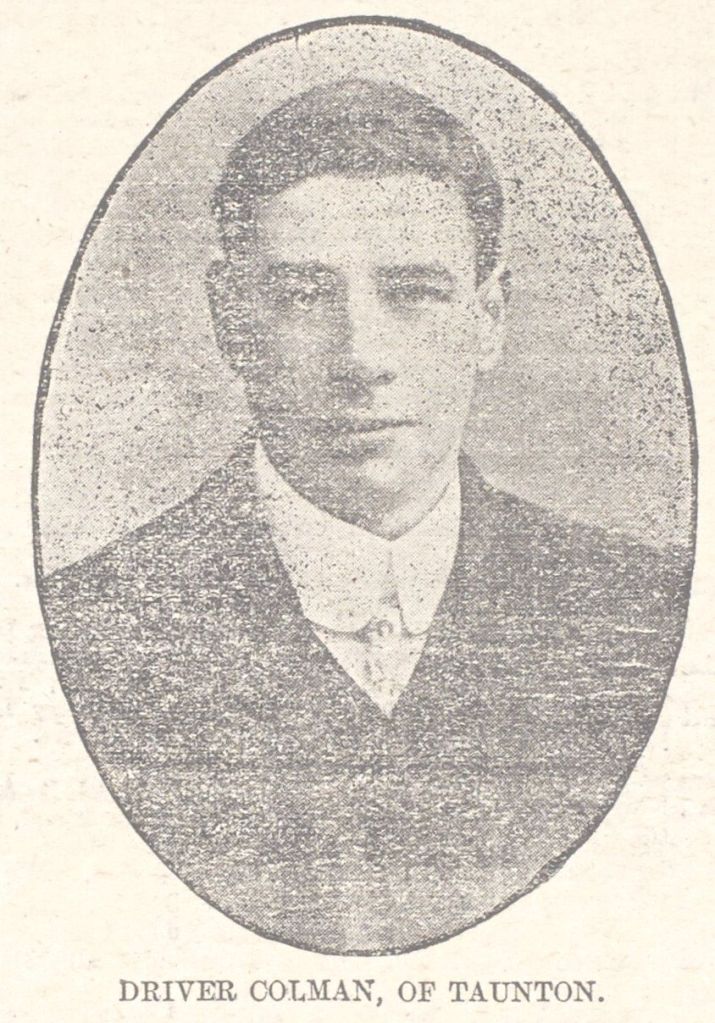
War was on the horizon, however, and when it broke out, Walter signed up straight away. He joined the 72nd Brigade of the Royal Field Artillery as a Driver and trained at the Bulford Camp on Salisbury Plain. It was while he was here on 10th April 1915 that he had an accident and fell off his horse. Sadly, Driver Coleman fractured his skull and died of his injuries that day. He was just 28 years old.
Walter Coleman lies at rest in the St James’ Cemetery in his home town of Taunton.
Walter Coleman (from findagrave.com)
Walter’s older brother Henry James Coleman also served in the Great War. Posted to France as part of the Labour Corps, he died of wounds on 12th April 1918. He was 33 years old, and left behind a widow and four children. He is buried at the Longuenesse Souvenir Cemetery in France.








 Death and Service