Category Archives: Lance Corporal

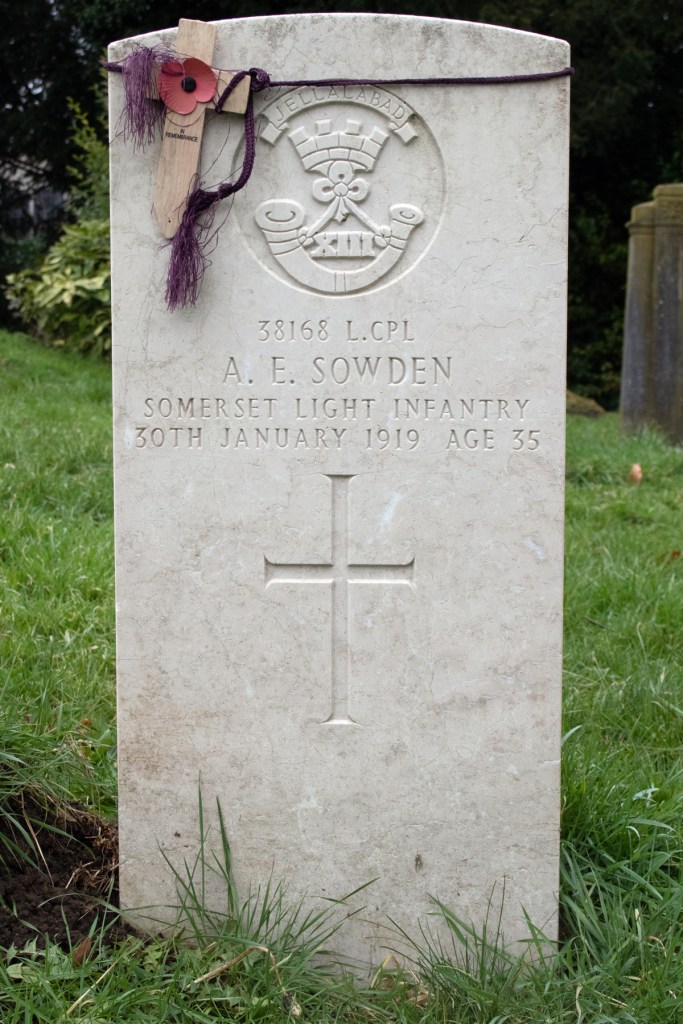
Lance Corporal Alfred Sowden

Lance Corporal Alfred Sowden

Alfred Edward Sowden was born in the autumn of 1883, in Bath, Somerset. He was the youngest of seven children to Robert and Mary Sowden. Robert had died by the time of the 1891 census, and Mary turned to charring to bring in money for the family.

In the summer of 1904, Alfred married Harriet Sumsion, a baker’s daughter also from Bath. The couple set up home in a small cottage on the main road to Bristol, and had a son, William, who was born the following year. Alfred was working as a house painter by this point, and the young family had a lodger, William Gabb, who was a local chef.

When war came to Britain’s shores, Alfred stepped up to play his part. He may have had some previous military experience, because he joined the Somerset Light Infantry as a Lance Corporal. Assigned to the 2nd/4th Battalion, by August 1915, he was on his way to India. His troop remained there for two years, before moving to Egypt in the autumn of 1917, then on to France the following June.

With the end of the conflict, the Empire’s forces were slowly demobbed. While he was waiting to be stood down, Lance Corporal Sowden fell ill. He developed influenza and septic pneumonia, and the combination was to prove fatal. He passed away on 30th January 1919, at the age of 35 years old.

Alfred Edward Sowden’s body was brought back to Bath for burial, where he was laid to rest in the city’s St James’ Cemetery.


Alfred’s widow had had a tragic few years. Her father, Walter, had passed away in February 1916, and her mother died just three months after Alfred.

Harriet never remarried after her husband’s passing. She remained in the family home for the rest of her life and, by the time of the 1939 Register, had a boarder, billiard marker James Jones. She was close to family, however, as her brother William lived just three doors away.

Harriet died in September 1941 at the age of just 56. She was laid to rest near her husband, reunited after 22 years.


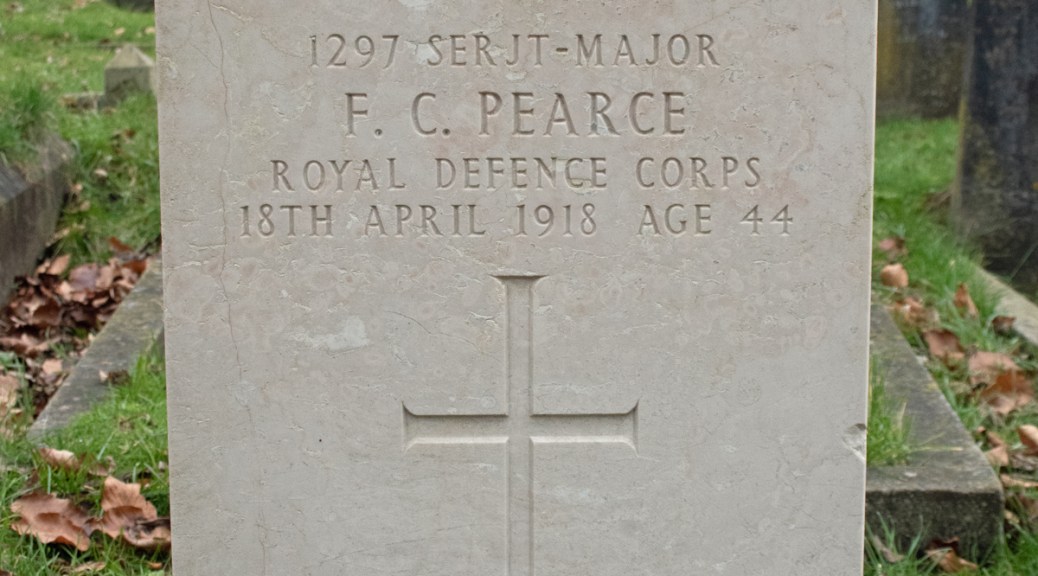
Serjeant Major Frederick Pearce

Serjeant Major Frederick Pearce

Frederick Charles Pearce was born in the spring of 1873 in the Gloucestershire town of Thornbury. The youngest of six children, his parents were Thomas and Elizabeth Pearce. Thomas was an agricultural labourer and, when he finished school, Frederick found work as a ‘rural messenger’.

This was only a step towards the career that Frederick sought, however, and on 12th July 1892, he enlisted in the Gloucestershire Regiment a a Private. His service records show that he was 5ft 5ins (1.65m) tall and weighed 128lbs (58kg). He was noted as having a fresh complexion, blue eyes and brown hair.

Private Pearce spent twelve years in the army, serving in Malta, Egypt, India and Ceylon (Sri Lanka). He had two stints in South Africa, including the 1899-1900 campaign, during which he was wounded in his chest in the battle at Farquhar’s Farm.

By the time he was discharged on 11th July 1904, he had risen through the ranks to Sergeant, his service records noting that his conduct had been “very good” (in capitals and underlined).

Thomas had died in 1896, and Frederick’s widowed brother William moved back in with his mother to help support her. Frederick also returned to Gloucestershire and, on 30th March 1905, he married Mary Rugman in the parish church in Olveston. The couple may have been childhood sweethearts, as the Pearces and Rugmans were Thornbury neighbours.

The marriage certificate noted Frederick as a groom, and it is likely that he was able to turn his hand to any role after his army career. The couple had a son Leslie, who was born in 1909, and, with the new responsibility of fatherhood, Frederick sought a more permanent career.

The 1911 census found the family living in Somerset, where Frederick was employed as a gardener at the Kingswood Reformatory School. This was a boarding school on an estate to the north of Bath, set in 57 acres of grounds, and again it seems likely that his military career stood him in good stead for such a prestigious role.

When war came to Europe, Frederick felt the pull of his military career once more. While his age did not compel it, on 20th November 1914, he re-enlisted in the Gloucester Regiment. He was enlisted with his previous rank, but within a year has been promoted to Acting Colour Sergeant.

In the spring of 1916, the Royal Defence Corps was formed, and, given his experience and age, Frederick was transferred across to the new regiment. Colour Sergeant Pearce was based in London and, over the next eighteen months served in four troops: 109, 149 and 150 Protection Companies and the 10th City of London Volunteers’ Regiment.

Frederick’s age and the demands of his role were beginning to take their toll by this point, and by the end of 1917, he had developed nephritis, or inflamed kidneys. The condition was severe enough to warrant his discharge from service, and the now Sergeant Major Pearce’s military career came to an end on 17th January 1918.

Frederick returned home to Bath, to the bosom of his family. He and Mary three children by this point, Violet and Freddie being two younger siblings to Leslie. Tragically for the Pearces, however, the family life was not to to last for long: Frederick’s condition was to get the better of him just three months later. He passed away on 18th April 1918, at the age of 44 years old.

Frederick Charles Pearce was laid to rest in St James’ Cemetery in Bath; a man of duty resting at last.


Tragedy was to strike again for poor Mary, when just six months later her youngest child, Freddie, also passed away. Details of his death are vague, but he was buried with his father, the two Fredericks reunited too soon.


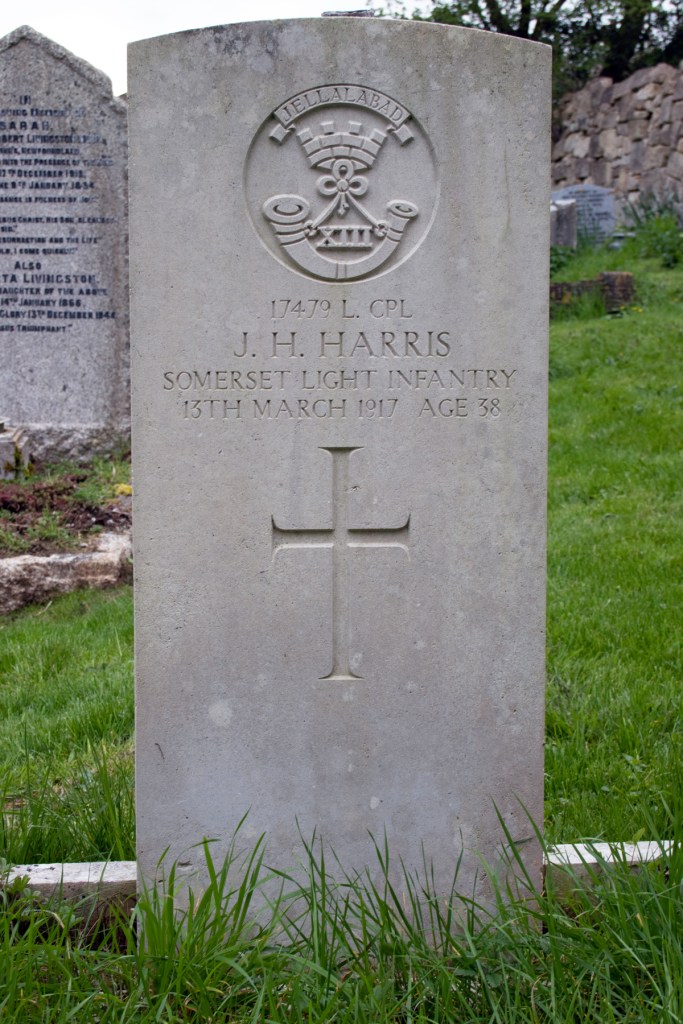
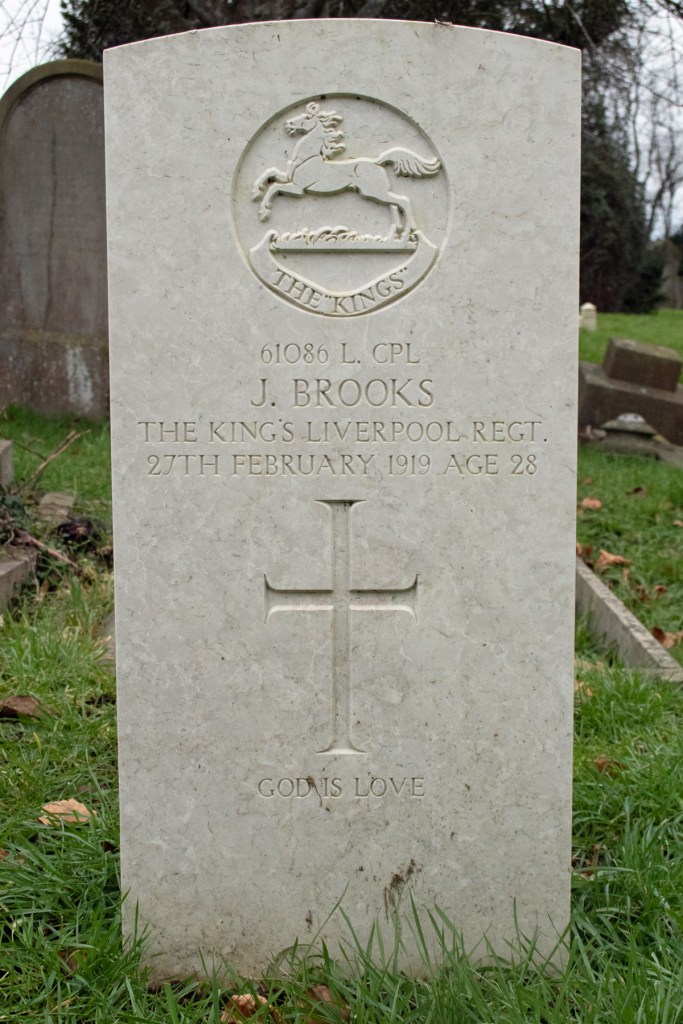
Lance Corporal Jack Brooks

Lance Corporal Jack Brooks

Jack Brooks was born in the autumn of 1890 and was the second of nine children. His parents, John and Kate Brooks, both came from Bath, where they ran a bakery on Queen Street, in the centre of the city. When he left school, it was natural for Jack to follow in his parents’ trade.

When war arrived on Europe’s shores, Jack stepped up to play his part and, on 7th December 1915, he enlisted in the Wiltshire Regiment as a Private. His service records show that he was 25 years and 2 months old, was 5ft 8.5ins (1.74m) tall, and weighed 156lbs (70.8kg). He was also noted to have a scrotal hernia, had flat feet and an upper set of dentures. These were enough for him to be passed for home service only, and he was formally mobilised on 10th February 1916.

Private Brooks seems to have taken a while to settle into army life. He was soon transferred across to the East Lancashire Regiment and, in May 1916, was attached to the 8th Works Coy as a Lance Corporal. In February 1917 he was transferred again, this time to the King’s Liverpool Regiment. On 6th June 1917 he was demoted to Private for ‘neglect of duty’, for not taking proper care of the stores that he was in charge of.

He married a woman called Rosina Elizabeth in 1917: the couple went on to have a son, William, who was born on 22nd November that year.

Jack continued serving after the end of the war and, by the beginning of 1919, was based in Aldershot. It was while here that he fell ill, and was admitted to the town’s Connaught Hospital on 11th February, suffering from influenza and pneumonia. Sadly the combination of illnesses was to prove to much: he succumbed to them, breathing his last on 27th February 1919. He was just 28 years of age, a boy with his mother, Kate, with him when he passed.

The body of Jack Brooks was brought back to Somerset for burial. He was laid to rest in the city’s St James’ Cemetery.


Private Francis Millard

Private Francis Millard

The early life of Francis Albert Millard is lost to time. He was born in 1894 in Bath, Somerset. His gravestone notes that he was the adopted son of AE and H Evans, though there are no census records confirming the three as a family. His military records specifically note that he has “no relations alive only one brother who is younger than myself nor have I any guardians”.

Interestingly, when Private Millard passed, Mrs Harriet Evans, who was noted as a foster mother, applied for his personal effects. Two days later, and Albert Francis Millard, who was claiming to be Francis’ father, also put in an application.

Francis was working as a seaman when he formally enlisted. He had previously been a volunteer in the Durham Light Infantry, and was readily accepted in the regiment’s 2nd Battalion. He joined up in November 1911, his service records noting that he was 5ft 3ins (1.6m) tall, 104lbs (47.2kg) in weight, with a fresh complexion, blue eyes and light brown hair. He was also noted as having a tattoo of the figure of a woman on his right forearm and a scar on his left buttock.

Over the next couple of years Private Millard was reprimanded a couple of times for small misdemeanours – being absent from bread rations on 15th September 1912, and being absent from the company officer’s lecture on 22nd February 1913. During this time he had been promoted to Lance Corporal, but the reprimand he received demoted him to Private once more. Overall, however, his service appears to have been a positive one and, when war was declared, he soon found himself on the Western Front.

[Priavte Millard] was present at the retreat from Mons. He took part in the advance over the Marne and the Aisne, and [had] been engaged in the battles around Ypres. In the early part of August [1915] a charge was ordered, and in this he took part. The late Captain RH Legard… to whom Millard was servant, fell. Millard ran to his assistance, and was wounded in two places…

Bath Chronicle and Weekly Gazette: Saturday 21st August 1915

Francis received gun shot wounds to his thigh and across his spinal column. He was medically evacuated to Britain for urgent treatment. Admitted to the King George Hospital in South London, his admission notes make for stark reading:

Patient very collapsed. Sunken eyes, some delirium. Small circular wound on right shoulder behind level 1st Dorsal spine 2″ from middle line; wound on inner side of left thigh, with suppuration and cellulitis. Can move both arms but very poor power. Patient continued to go downhill rapidly after admission despite stimulation (brandy, [strychnine], saline).

A telegram was sent to Harriet and she took the first train to London. She arrived on the evening of Tuesday 17th August, and remained by Francis’ bedside until he passed away the following morning. He was just 21 years of age.

The shattered body of Francis Albert Millard was brought back to Somerset for burial. He was laid to rest in the city’s St James Cemetery.


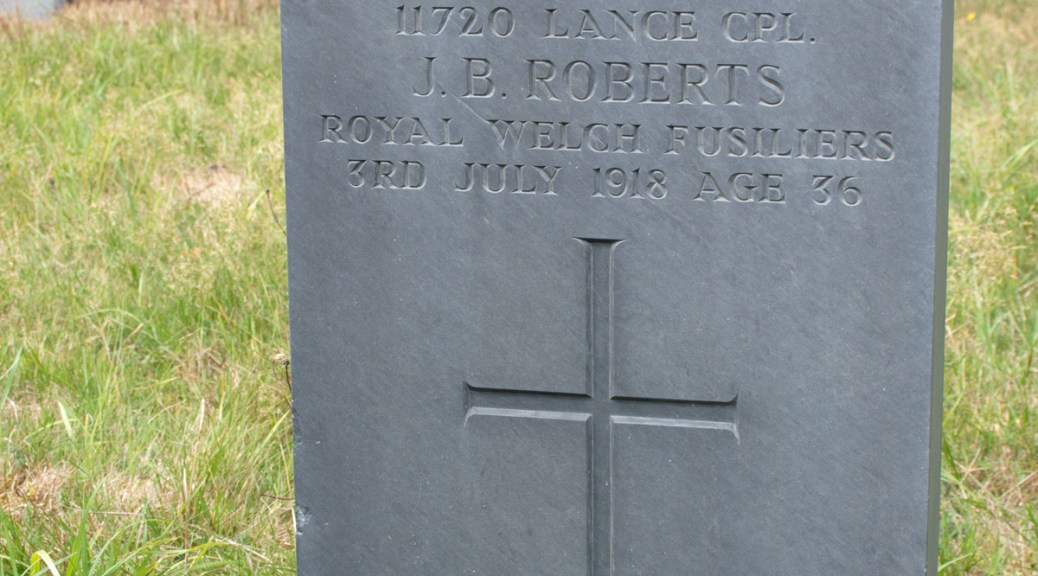
Lance Corporal John Roberts

Lance Corporal John Roberts

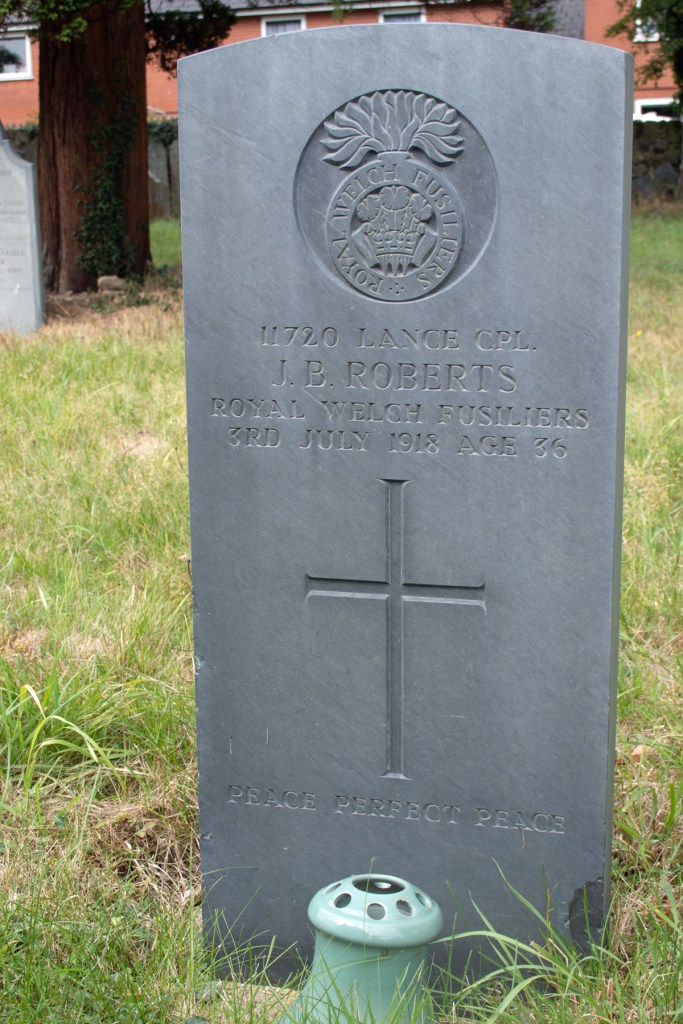
John Briscoe Roberts was born in 1882 in the Welsh village of Llanaelhaiarn. He was the oldest of ten children to the village’s sub-postmaster Samuel Roberts and his wife Elizabeth.

When he left school, John found employment with a local estate agent and, by the time of war was declared, he was working as a clerk for a timber mill in Llangollen, Denbighshire.

John was quick to enlist – he joined up on 15th August 1914 and, as a Private, was assigned to the Royal Welch Fusiliers. His service records show he was 5ft 7ins (1.70m) tall, and weighed 142lbs (64.4kg). They also note that he had black hair, brown eyes and a dark complexion.

Private Roberts’ initial service was carried out on home soil. He worked diligently and was rewarded for it, being promoted to Lance Corporal in December 1914. By the following June, his troop, the 8th Battalion, was sent overseas, first to Mudros in Greece, and then on to Gallipoli. In September 1915, Lance Corporal Roberts contracted dysentery and tuberculosis. He was medically evacuated back to Britain and admitted to the 1st Scottish General Hospital in Aberdeen to recover.

On 26th January 1917, John married Gladys Emily Edwards in Wrexham Parish Church. The couple settled down in Llangollen, where Gladys was from, and where John had been working before the war. His lung condition continued to dog him, however and, after another couple of months, he was deemed no longer fit for active service, and medically discharged from the army.

John took up his role in the timber yard again, remaining there for the next year or so. Tuberculosis was ultimately to get the better of him, however, and he passed away on 3rd July 1918, at the age of 36 years old.

John Briscoe Roberts was laid to rest in the graveyard of St John’s Church in Llangollen, Denbighshire.


Sapper William Dove

Sapper William Dove

William Henry Dove was born in the autumn of 1871 in Stafford, Staffordshire and was one of seven children to William and Louisa Dove. William Sr was a gardener by trade, but his son wanted bigger and better things.

On leaving school, he initially took up a post as a junior teacher, but military service was calling him and, on 21st February 1891 he enlisted in the Royal Lancaster Regiment. Private Dove’s service records show that he was 5ft 7ins (1.70cm) tall and 136lbs (61.8kg) in weight. He had sandy hair, grey eyes and a fair complexion. He also gave his age as 18 years and 3 months, although he was actually a year older.

Private Dove signed up for seven years’ service and completed this on home soil. In October 1891 he was promoted to Lance Corporal, and a year later he was promoted again, this time to Corporal.

In November 1894, William was found guilty of ‘conduct to the prejudice of good order and drunkenness‘ and was sentenced to be reduced in rank, so became a Private again. He learnt the error of his ways, though, and was reinstated to Lance Corporal in March 1897.

William’s service was completed in February 1898, and he was transferred across to the Army Reserve. This was intended to be for a further five years, but on 15th February 1900, he was discharged from future active service, having been found to be medically unfit. During his time in the army, William had been treated for a two bouts of gonorrhoea, as well as four further infections. The cause of his final medical discharge, however, is unclear.

While on reserve, William had found employment as a railway porter. His work took him to Llangollen, Denbighshire and, this is where he set up home. On 18th April 1899, he married Ellenor Roberts, a labourer’s daughter from the town: the young couple set up home in Ashfield House, Regent Street – now the busy A5.

The 1911 census records William as a porter: the couple had no children of their own, but had adopted a girl, Cissie, who was then eight years old. A live-in domestic servant – Esther Williams – was also recorded on the census.

War was coming to Europe by this point and, while details of his service are unclear, William stepped up to play his part once more. He enlisted in the Royal Engineers as a Sapper, at some point during the conflict, although exact details are lost to time.

Sapper Dove survived the war and returned to Llangollen. The 1921 census records him Ellenor and Cissie living at Bronhaul, and that William was working as a parcel’s porter for Great Western Railways. On 18th August 1921, he collapsed and died with a brain aneurysm. He was 39 years of age.

William Henry Dove was buried in the graveyard of St John’s Church in Llangollen, a short distance from the station at which he portered for so long.


Ellenor lived on until her late 70s. When she passed away, she was laid to rest in the family plot, reunited with her husband after 35 years.


Lance Corporal James Toop

Lance Corporal James Toop

James Toop was born in the Somerset village of Galhampton on 13th January 1879. He was the fifth of eleven children to William and Elizabeth Toop. William was a farm labourer, and James followed his father’s line of work when he left school.

James disappears from documents for a while, only surfacing again in October 1914, when he enlisted for army service. At this point, he was working as a bricklayer, and notes that he had previously served in the Somerset Light Infantry. He is recorded as being 5ft 8ins (1.73m) tall, weighing 136lbs (61.7kg). He had brown hair, grey eyes, and gave his religion as Congregationalist. James also lied about his age, saying that he was 29 years and 9 months when, in fact, he would have been closer to 36 years old when he joined up.

Sapper Toop was assigned to the Royal Engineers, and spent nine months on home soil, during which time he was promoted to Lance Corporal. On 18th July 1915 he went to France, but returned just five days later.

Admitted to the Royal Victoria War Hospital in Netley, Hampshire, James was recorded as suffering the stress of campaign. He was moved to Napsbury War Hospital, near St Albans in Hertfordshire, after a couple of weeks. This institution – formerly the Middlesex County Asylum – was where servicemen suffering from shell shock were sent for rehabilitation, and Lance Corporal Toop joined the near 2,000 other residents.

James’ diagnosis was recorded as being neurasthenia with depression and, in October 1916, he was medically discharged from the army. The medical report noted that he had “had nervous breakdown, complained of vomiting of his food. Had defective memory. Had religious mania 5 years before enlistment.” While his condition was not the result of his war service, the medical board recorded that his mental debility has been aggravated by the strain.

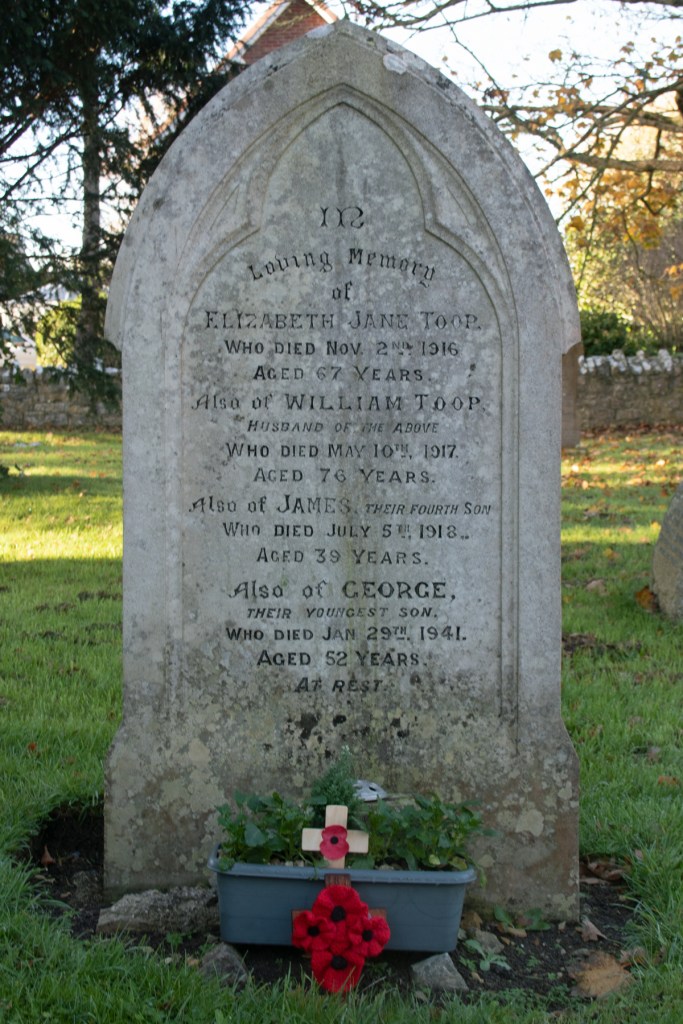
James falls off the radar again at this point. When he recovered, he returned to bricklaying for work. In 1916 his mother died, followed a year later by his father. Both were laid to rest in the family grave in St Mary Magdalene’s Church, Sparkford, Somerset.

James Toop died on 5th July 1918 at the age of 39 years old. He was also buried in the family plot, reunited with his parents far too soon.


Second Lieutenant Cyril Croft

Second Lieutenant Cyril Croft

Cyril Talbot Burney Croft was born on 28th January 1891 in Streetsville, Ontario, Canada. He was the only child of Dorset clergyman Otho Croft and his Canadian-born wife, Lucy.

Otho brought his young family back to England when Cyril was a boy. The 1901 census found him and Lucy living in South Cadbury, Somerset, where he had taken the role of the local rector. Their young son, meanwhile, was boarding at a school in St Leonard’s in East Sussex.

Education was key to Cyril’s development. He was sent to King’s College in Taunton and St Boniface College in Warminster, and enlisted in the Officer’s Training Corps for three years.

During this time, he and Lucy had travelled back to Canada, and there was an obvious draw for the young man as, in 1913, he made a move to Quebec, becoming the Assistant to the Commissioner of Harbour Works in the city.

When war broke out, Cyril was quick to step up and play his part. Joining the Canadian Expeditionary Force on 23rd September 1914, his service records show that he was 6ft 1in (1.85m) tall, with black hair, grey eyes and a dark complexion.

Cyril was initially assigned to the 12th Battalion of the Canadian Infantry, where he held the rank of Lance Corporal. On arriving in England, however, he took his leave of the Canadian force, and accepted a role in the King’s Royal Rifles. Within a few months, he transferred again, gaining the rank of Second Lieutenant in the 8th (Service) Battalion of the Somerset Light Infantry.

Details of Cyril’s actual service are vague, however, as his British Army service records are no longer available. It appears that he did not serve any time overseas, as his battalion was raised in Taunton, Somerset, and did not move to France until the end of 1915.

Second Lieutenant Croft had made a further transfer by this point, joining the Royal Flying Corps in the summer. He gained his wings on 27th October 1915 at a Military School in Birmingham.

On 8th December 1915, he was a passenger in an aircraft being piloted by a Lieutenant McDonald at Castle Bromwich.

The weather was “bumpy” but not bad… They went towards Birmingham, and then made a turn to the left. [McDonald] noticed that the engine was missing fire when he was at a height of 1,500ft [460m], and decided to land. He turned off the petrol, but did not switch off the electric ignition. He made a right-hand turn, so as to reduce the height, the machine then being at a normal angle, when, owing to the wind, the aeroplane banked. To put the machine back again he put the control lever over to the left, but finding that the machine did not answer to the control, he put on the right rudder, and Lieutenant C Black, of the Royal Flying Corps, who had instructions to watch the aeroplane, stated that shortly after eleven o’clock in the morning it ascended to a height of 1,500ft. Shortly afterwards he saw the machine coming down: it made a short spiral, then a complete circle, and while turning to make another at a height of 500ft [150m], fell straight to the ground, nose downwards. The aeroplane was in proper working order, and the witness was of the opinion that the accident was due to wind disturbances.

De Ruvigny’s Roll of Honour

Croft and McDonald were both killed. Cyril was just 24 years of age. His Colonel wrote to Otho and Lucy, noting that Cyril “did so well that it makes one feel the loss all the more of such a promising young officer. He is, indeed, a great loss to our country, especially in these times.” Cyril’s Major noted “he had a most charming, lovable character, and was thoroughly popular with all his brother officers. He was exceedingly keen at his work, and in him the service has lost a most promising and capable officer.”

Cyril Talbot Burney Croft was brought back to Somerset for burial. He was laid to rest in the graveyard of his father’s church: St Thomas a Becket’s in South Cadbury.


Second Lieutenant Cyril Croft
(from ancestry.co.uk)

Lance Corporal Thomas Roberts

Lance Corporal Thomas Roberts

Thomas Roberts was born in Llangollen, Denbighshire, in 1895. One of seven children, his parents were William and Ellen Roberts. William was a butter merchant, and his wife helped in the business.

When Thomas left school, he found work as a greengrocer’s assistant, but when war was declared he saw an opportunity for glory. While full details of his military service are no longer available, it’s clear that he enlisted in the Royal Welch Fusiliers.

Private Roberts was assigned to the 13th (Service) Battalion (1st North Wales) and on 1st December 1915, found himself in France. For the next eighteen months, he was firmly ensconced on the Western Front, and rose to the rank of Lance Corporal for his service.

In April 1917, Thomas was injured in fighting and was medically evacuated to Britain for treatment to his bullet wounds. Admitted to the Edmonton Military Hospital in North London, his injuries were to prove too severe. Lance Corporal Roberts passed away on 22nd April 1917. He was just 21 years of age.

Brought back to Wales for burial, Thomas Roberts was laid to rest in the family plot in Llangollen’s Fron Cemetery.


Thomas was buried along with his brother David, who had passed away in 1912. They were joined by their father William, who died in 1919, and their sister Elizabeth, who passed away in 1945. The family were finally reunited with Ellen, when she died in 1947, at the age of 86.


Lieutenant Thomas Denny

Lieutenant Thomas Denny

Thomas David William Denny was born on 26th December 1890 in Glasgow, Lanarkshire. There is little information on his early life, other than that his parents were Thomas and Annie Denny.

By the time of the 1911 census, Thomas Jr was serving as a Lance Corporal in the 2nd Battalion of the Gloucestershire Regiment, and was based at the Verdola Barracks in Malta.

When war broke out, the battalion was called back to mainland Europe. By 19th December 1914, Thomas found himself in France; two years later, he was in Salonika, Greece.

Thomas’ bravery was not in doubt. While serving in France, he received the Military Medal for conspicuous gallantry. This went hand in hand with a promotion to Sergeant. In 1917, he received a commission as Second Lieutenant and was moved to the regiment’s 3rd Battalion.

In the spring of 1918, Second Lieutenant Denny married Elsie, a woman from Bearsted, near Maidstone in Kent. Sadly, little else is known of her, and even a later newspaper report only referred to her as “a Bearsted lady” [East Kent Gazette: Saturday 15th March 1919].

By early 1919, Thomas was back in Britain. Whether he had been demobbed is unclear, but is seems more likely that he had returned home for medical treatment. On 6th March, he passed away in Maidstone. He was just 28 years of age.

Thomas David William Denny was laid to rest in the graveyard of Holy Cross Church in Bearsted close to where the now-widowed Elsie must have lived.