Arthur Henry Bloomfield was born on 19th December 1888, the youngest of six children. His parents, agricultural labourer and carter William and his wife Mary, raised the family in the small Norfolk village of East Harling, which was about halfway between the larger towns of Thetford and Diss.
Arthur married Rose Howlett in November 1911; the couple had two children – Margaret and Frederick – who became siblings for Rose’s daughter, Violet.
While Arthur’s military records are scarce, it is evident that he enlisted in the 9th Battalion of the Royal Irish Rifles. Private Bloomfield’s troop fought at a number of the key skirmishes on the Western Front, including the devastating (for the battalion) Battle of Albert in 1916.
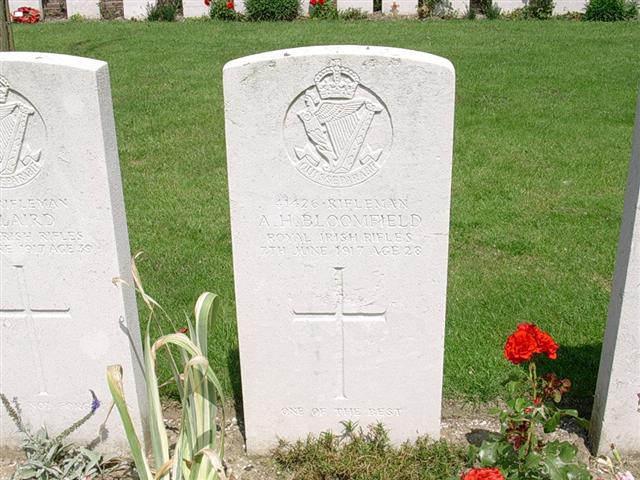
A year later, the 8th and 9th Battalions were caught up in the Battle of Messines and it was here that Private Bloomfield met his fate. His pension records show that he was killed in action on 7th June 1917. He was 28 years old.
Arthur Henry Bloomfield lies at rest in the Lone Tree Military Cemetery in Mesen, West Flanders, Belgium.
Interestingly, Arthur’s pension records only cite his beneficiaries as Rose, Margaret and Frederick. This may go further in confirming that Violet was not his daughter.
Arthur Henry Bloomfield was my great great uncle.
Photo courtesy of Commonwealth War Graves Commission.
James Adams was born in June 1883, son of Robert and Eliza Adams from Bridgwater in Somerset. Robert was an agricultural labourer; James was one of seven children.
James was keen to get out and see the world. In November 1905 – aged just 12 years old – he enlisted in the Royal Navy as a stoker. After training in Devonport, Plymouth, Stoker Adams served on a number of different vessels, including HMS Victorious, Ramillies, Amphitrite, Monmouth, Andromeda and Halcyon.
By the time war broke out, James has been promoted to Leading Stoker, and was assigned to HMS Cornwall. This was an armoured cruiser that was involved in the Battle of the Falklands in December 1914.
Promoted to Stoker Petty Officer in October 1915, James continued to serve on HMS Cornwall until he was transferred to the brand new ship, HMS Valkyrie. The vessel was involved in offensive sweeps and convoy escorts based out of Harwich.
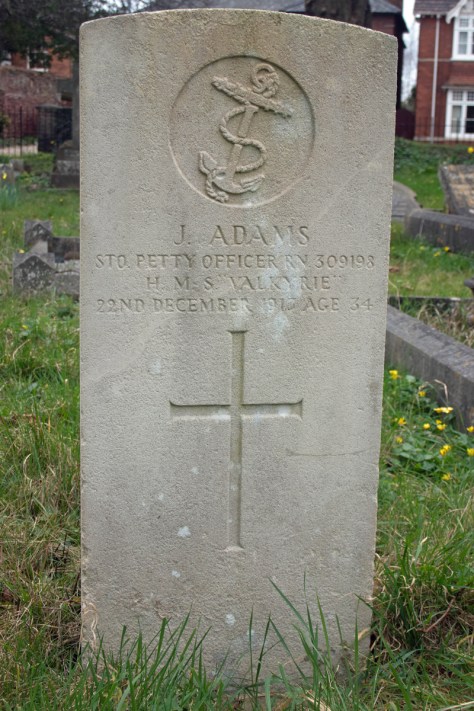
On 22nd December 1917, the Valkyrie was part of the escort for a convoy travelling to the Netherlands, when she struck a mine. In total, nineteen men were killed, twelve instantly; this included Stoker Petty Officer Adams. He was 34 years old.
James Adams lies at rest in the Wembdon Road Cemetery in his home town of Bridgwater.
Bernard Dyke was born in 1897, the oldest of three children to Albert and Edith Dyke from Bridgwater, Somerset. Albert worked for a brewery, and the young family lived in a house on the main road west out of the town.
Bernard received a scholarship to attend Dr Morgan’s School, a grammar school in the town, and he was a pupil there from autumn 1910 to spring 1913. He left at the age of 16, and became a merchant’s clerk.
War was on the horizon, however, and Bernard joined up. Full details of his military service are not available, but he enlisted in the Devonshire Regiment. Private Dyke spent some time at the Tregantle Fort, near Plymouth, and it was here that he was caught up in an accident.
It has transpired than a rather remarkable shooting fatality occurred at Tregantle rifle ranges, near Plymouth, on Friday, when Private Bernard Dyke, aged about 24, of the Devon Regiment, received a gunshot would in the left side, and almost immediately expired.
The soldier was acting as an observer for a Lewis gun section when he received the fatal injury, the section being at the time out of action awaiting the appearance of a moving target. On the deceased’s left hand side was a musketry party of nine carrying out an exercise, and when he received his injury only one or two rounds had been discharged by this party.
When the first shot or so had been fired deceased suddenly shouted “Oh! Oh!” and dropped. An officer and NCOs ran to assist him, but found that life was extinct. A military doctor was soon on the spot, and found the bullet had entered the deceased’s left side below the ribs and made its exit at the top of his right arm.
As the musketry party was 80 degrees to the right of the firing party it is strange that a shot could have been fired so wide, but the explanation may be found to be in a ricochet or a soldier’s erratic action.
Western Morning News: Monday 21st January 1918.
Private Bernard Dyke died on 18th January 1918, aged just 20 years old. He lies at rest in the Wembdon Road Cemetery in his home town of Bridgwater, minutes’ walk from his family home.
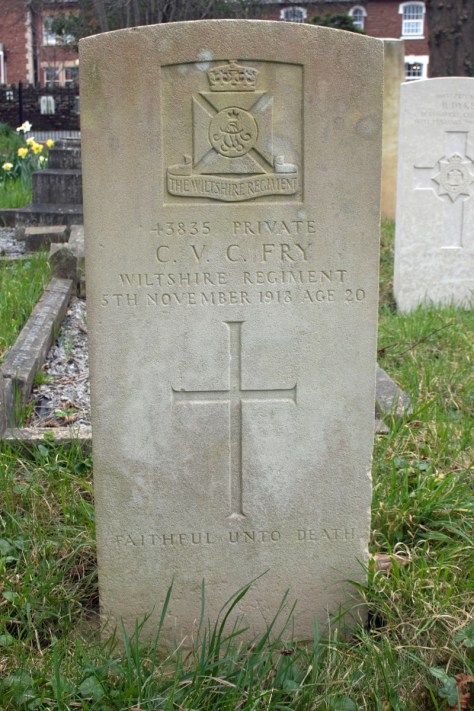
Clarence Vivian Clements Fry was born in November 1898 to William and Rosa Fry. William was a ‘provisions merchant clerk’, who went on to become a ‘cheese and provision dealer’, or grocer. Sadly, Rosa passed away in 1904, at the tender age of 31, leaving Clarence without a mother at just six years old.
William remarried in 1908, and he and new wife Amy had a daughter, also called Amy, a year later. By the 1911 census, the family of four were living in a three storey Victorian Terraced house to the south of Bridgwater town centre.
Sadly, little of Clarence’s military career remains documented. Initially joining the Royal Army Service Corps, Private Fry soon transferred over to the Duke of Edinburgh’s Wiltshire Regiment.
The 1st Battalion found in some of the key battles on the Western Front, including Mons, Ypres, Messines and Vimy Ridge. As his enlistment date isn’t known, it’s impossible to say whether Private Fry was involved in these conflicts or not.
What is likely is that Private Fry was involved in the Battle of the Selle, which took place near the towns of Cambrai and Valenciennes in northern France in October 1918. Clarence was certainly injured at this point, and was evacuated to England for treatment.
Admitted to the Cambridge Military Hospital in Aldershot, it seems that his injuries were too severe and he succumbed to them on 5th November 1918, just a week before the Armistice was signed. Private Fry was just 19 years old.
Clarence Vivian Clements Fry lies at rest in the Wembdon Road Cemetery in his home town of Bridgwater in Somerset.
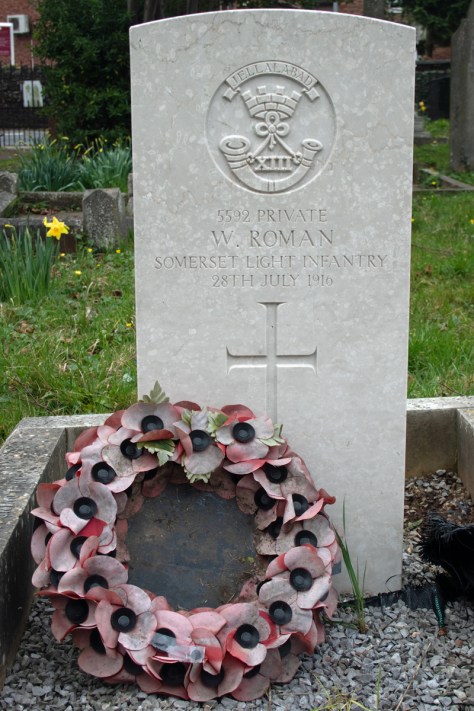
Walter James ‘Rattler’ Roman was born in July 1880, one of six children to George and Betsy Roman. George was a labourer in a brickyard, and the family lived in Bridgwater in Somerset.
Walter’s passion was rugby football, and he made the Bridgwater & Albion first team at the age of 15. Two years later had reached county level, and was playing for Somerset.
Walter enlisted in the army in around 1897, joining the Somerset Light Infantry. He spent several years abroad, serving as a Private in India and South Africa and fighting at Cawnpore and in the Second Boer War.
When Walter’s service ended, he returned to England, and continued his rugby career. He was a regular for the Bridgwater and Somerset teams, gaining the nickname ‘Rattler’, before being signed up by Rochdale Hornets in 1910.
Walter married Henriette Washer in Bridgwater in April 1911, and the couple had two children, Edna – born in 1912 – and Leonard – who was born a year later.
Continuing with rugby union, Walter was called to county level, where he joined Lancashire for a number of games. Walter also played for England, receiving a cap in the international match against Wales in February 1914, and he toured Australia and New Zealand the same year.
War broke out, and Private Roman was re-enlisted, one of twenty-five Hornets players to enlist. He served on the Western Front with the 1st Battalion of the Somerset Light Infantry and was caught up in the engagements at Ypres and Armentieres. Fighting at in the Battle of the Somme, he went over the top at Beaumont-Hamel at the start or fighting, on 1st July 1916 – his 36th birthday.
In that initial charge, he was shot several times, in both arms, a leg and the torso. Initially treated at a local field hospital, he was evacuated to England and admitted to the Voluntary Aid Hospital in Cheltenham. His condition initially improved, and he wrote letters to Henrietta, who was living back in Rochdale.
Sadly, Walter’s contracted sepsis and his health deteriorated; Henrietta was called to the hospital in Cheltenham on 27th July 1916. It is likely that she didn’t make it in time, as Walter passed away at 1pm the following day. He was just 36 years old.
Walter James Roman lies at rest in the Wembdon Road Cemetery in his home town of Bridgwater, Somerset, one of may sporting heroes to perish in the First World War.
Walter Roman (courtesy of findagrave.com)
Walter was one of 25 Rochdale Hornets players to enlist when war broke out. Of those men, five did not return: Private Walter Roman; Sergeant John Twigg; Private Archie Field; Private Tom West and Private CJ Burton.
William James Bradbeer was born in the spring of 1888, the youngest of eight children to Alfred and Jane Bradbeer from Bridgwater in Somerset. Alfred was a carriage trimmer, fitting out the train coaches for the local railways.
Sadly, William lost both of his parents in 1910; by this point he was 22, and was working as a schoolmaster along with his older brother Alfred. Five of the Bradbeer siblings were living together by this point, along with Sidney Palfrey, a photographer, who was boarding with them.
On 27th December 1911, William married Selina Nurse, who was also from Bridgwater, and whose father was a master mariner. The couple did not have any children together.
There is little evidence of William’s life after his marriage. He was enlisted in the Royal Garrison Artillery during the war, although no details of his military service are available. The battalions provided support in key forts primarily along the south coast of England, but also in places like the Channel Isles, Malta and Sierra Leone. Without Second Lieutenant Bradbeer’s records, it is impossible to know specifically where he served, but it would seem likely that he remained in England during the war.
The last years of William’s are also shrouded in mystery; he passed away on 8th August 1920, at the age of 32. I have been unable to uncover a cause of death, but it seems likely to have been an illness, as there is nothing in the contemporary media to suggest anything unusual or untoward.
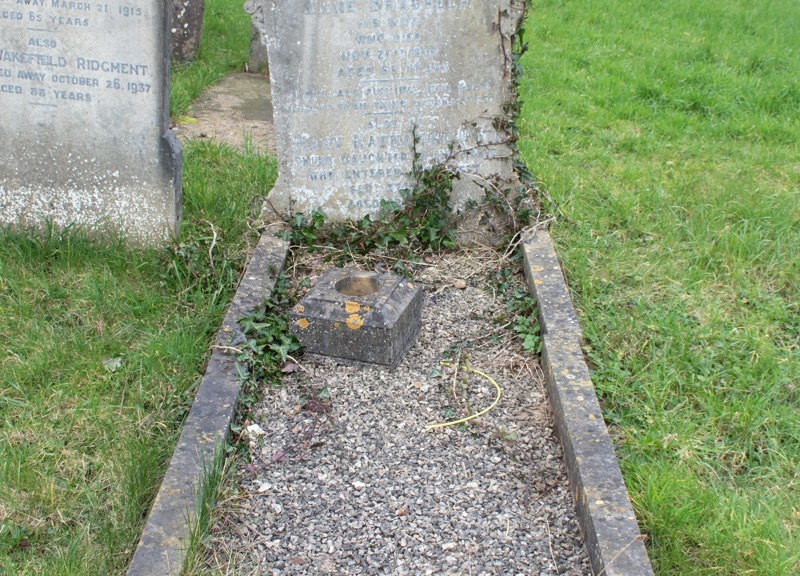
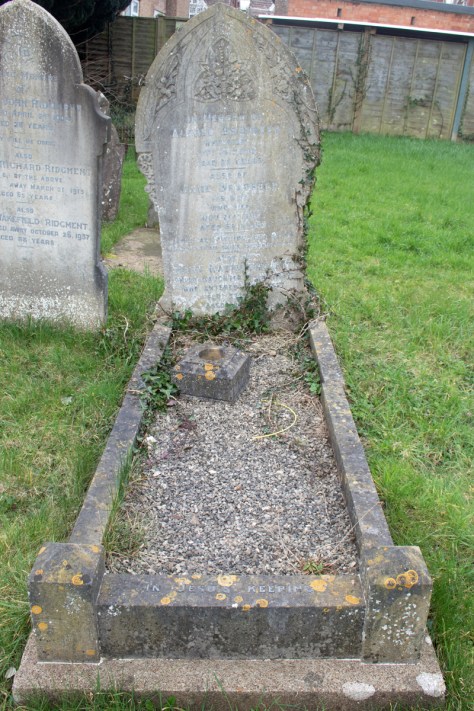
William James Bradbeer lies at rest in the Wembdon Road Cemetery in his home town of Bridgwater. Sadly, though, his grave is also lost to time, and I was unable to pinpoint its location. In death, as in his later years, William remains a mystery.
Note: The grave at the top of this page, however, is of a couple of his Bradbeer relatives, buried in the same cemetery.
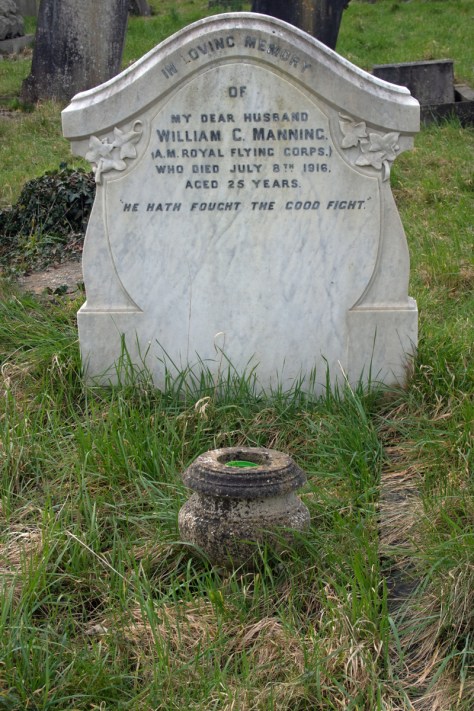
William Charles Manning – known as Willie – was born in Bridgwater in 1890, one of ten children to Samuel and Emily Manning. Samuel was a cabinet maker, and at least of three of his sons, Willie included, went into the family business.
There is little information available on Willie’s life, but he married Nellie Dodden, also from Bridgwater, in November 1915. Sadly, this was around the time that Nellie’s father passed away; tragedy for Nellie was still close by.
Willie’s military records are minimal, although details of his passing can be determined from the subsequent newspaper report.
He had enlisted in the Royal Flying Corps around October 1915, certainly around the time he and Nellie married. He was an air mechanic, something his woodworking skills probably drew him to and was based at Manston Airfield in Kent.
On 8th July 1916, Willie was a passenger in a flight piloted by Lieutenant Bidie. It seems that Bidie was turning the plane while at low altitude, while attempting to land. The plane crashed, and both Bidie and Willie were killed. Air Mechanic Manning was just 25 years old.
William Charles Manning lies at rest in the Wembdon Road Cemetery in his home town of Bridgwater, Somerset.
Walter Ricks Treliving was born in Bridgwater, Somerset, in 1876, the middle of three children to James and Elizabeth Treliving. James was a commercial traveller in the drapery trade, and this is something his son followed him into.
According to the 1891 census, Walter was a pupil at the Commercial Traveller’s School in Pinner, Middlesex, which was, in effect, a boarding school-cum-children’s home for the children of commercial travellers and orphans.
Commerce was obviously engrained into Walter by this point and, after leaving school, he followed his father into the trade of trading. He travelled with his work, frequently boarding with others; in 1901, the census recorded him as living lodging with his maternal aunt Annie Ricks.
Love beckoned, however, and in 1904, Walter married Mabel Broadrick, the daughter of a Unitarian Minister from Worcestershire. The couple set up home in Weston-super-Mare and had a daughter, Beryl, two years later.
Things were not to go smoothly, however, as an article in the Western Daily Press were to show:
In the Divorce Court yesterday, a case was heard in which Mr Walter Treliving, a commercial traveller of Weston-super-Mare, petitioned for a divorce from Mabel Annie Treliving, on the ground of her misconduct with Mr Charles E Rust, an engineer. The case was undefended.
Mr Treliving said he was married on the 13th August 1904 at Bridgwater, and afterwards lived at Weston-super-Mare. There was one child of the marriage. The married life was happy until May 1913, when his wife told him that she cared for someone else.
In July 1913, his wife went away to Manchester on a visit, and when she came back she told him she had stayed with Mr Rust at the Grand Hotel… He forgave her for that, and took her away for a holiday to Lynton. He then discovered that she was still corresponding with the co-respondent, and afterwards that she was meeting him again.
On the 13th September his wife left him, and he heard that she had gone to Khartoum with the co-respondent. He received a letter from her, in which she said:
“Dear Walter. The divorce papers have come. Of course I cannot defend the case, nor he. So you have it all in your power. I hope you will be happy now you are free. If eve I came back to England, may I see Betty [sic]? I cannot marry Mr R. She will not divorce him. I do not know what I shall do now. I hope you will be happy if you marry again, as I hear you will. Oh! if you had only held out one hand to save me, how different it might have been. I am a broken woman. Yesterday, when the petition came, I realised it. You are fully paid back for all your sufferings. Enjoy your victory. Your wife.”
Petitioner said it was not his intention to marry again, as his wife suggested. He had done everything in his power to induce her to remain with him.
Western Daily Press: Thursday 1st April 1915
A decree nisi was granted to Walter and he was awarded costs.
Sadly, it has not been possible to track Walter’s military history. That he enlisted is evident; he joined the Royal Army Service Corps, and rose through the ranks to become Second Lieutenant Treliving. The divorce proceedings did not identify him as serving in the army, so it seems likely that he joined up at some point after April 1915 – his age and his status as a single father seem further proof of this assumption.
Walter returned to Bridgwater in October 1918 to attend his mother’s funeral. Elizabeth had contracted influenza and, sadly, after returning home Walter also caught and succumbed to it. He died on 11th October 1918, at the age of 42.
His probate confirms two beneficiaries; his sister Hilda Treliving, and another woman, Kate Symons, presumably as guardians and trustees for Beryl.
Walter Ricks Treliving lies at rest in the Wembdon Road Cemetery in his home town of Bridgwater, Somerset. He had been buried on the same day as Elizabeth, the mother whose funeral he had returned to attend.
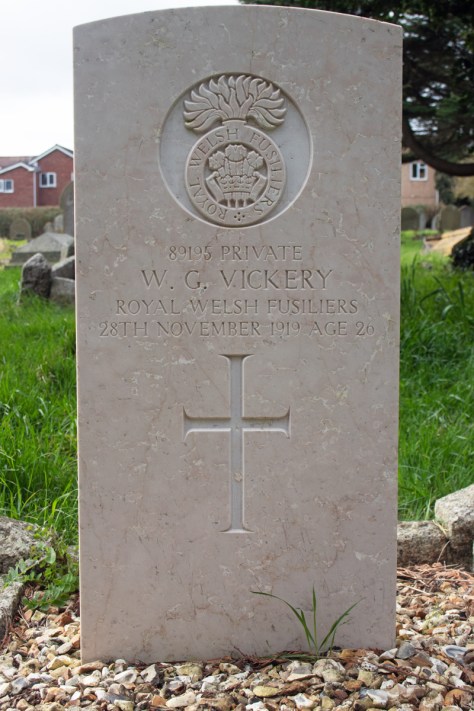
William George Vickery was born in the summer of 1894, the youngest of three children to George and Mary Vickery. George was a labourer in a brickyard, and this is work that his son followed him into once he left school.
William seems to have progressed with work as, by the time he enlisted for military service, he was recorded as a miner, working in the collieries of South Wales. Initially joining up in February 1916, is seems like his job gave him a level of protection for a couple of years at least; he was not formally mobilised by the Royal Welch Fusiliers until May 1918.
Initially serving on the home front, Private Vickery was shipped to France in September 1918, serving two months there, before returning home. William was eventually discharged from the army on medical grounds; having contracted tuberculosis while on active duty.
There is little information about William after his discharge. It seems likely that his health deteriorated, however, as he died just a year later, on 28th November 1919. He was just 26 years of age.
William George Vickery lies at rest in the Wembdon Road Cemetery in his home town of Bridgwater, Somerset.
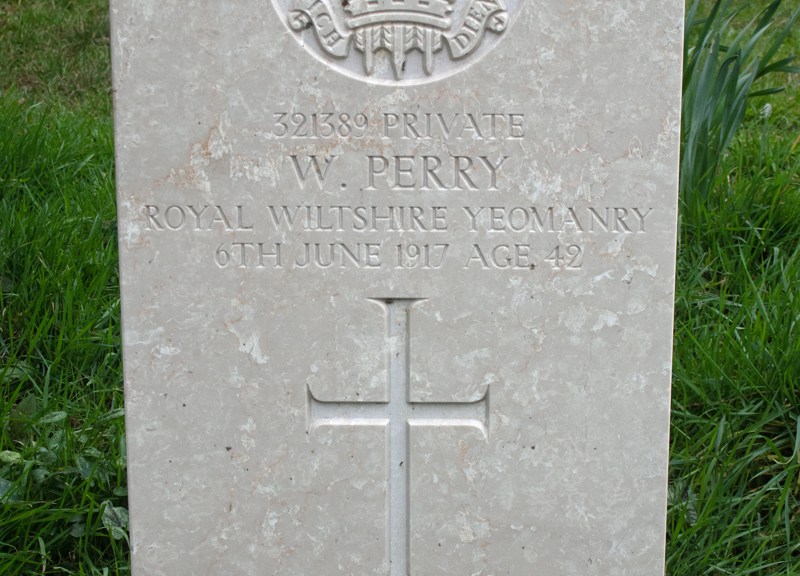
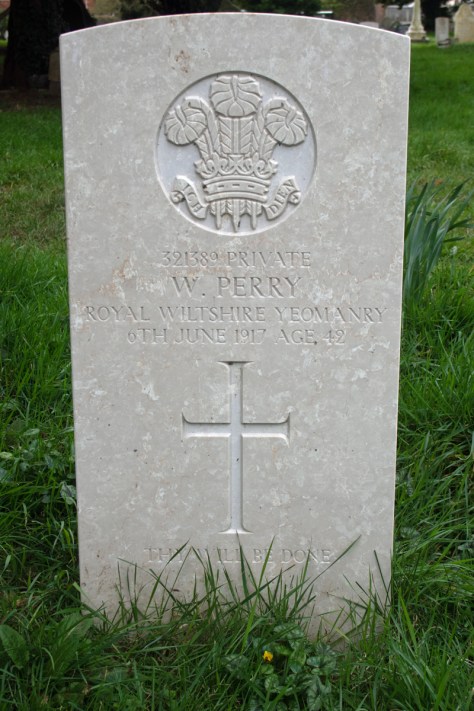
Walter Perry was born in Bridgwater, Somerset, in 1874. He was one of ten children to James Perry, a general dealer, and his wife Hannah. After he had left school, Walter became a labourer; his older siblings had all become labourers or factory workers in the area.
In November 1899, Walter married Rebecca Cavill; their first child, Hilda, was born at the end of March the following year. By this time, Walter was working for a brewery, while his new wife was working at a shirt collar factory. The young couple went on to have two further children – Walter and Beatrice – before Rebecca tragically passed away in June 1906.
Walter married again in November 1908, this time to a Mary Ann Reed also from Somerset. The couple went on to have two children, Joseph and Edna, and the family lived together in the centre of Bridgwater.
The Great War was on the horizon. While details of Walter’s military service are not readily available, it is unlikely that he was called up as soon as hostilities broke out – he turned 40 in 1914, and so was too old to qualify immediately.
Walter enlisted in the 2/1st Royal Wiltshire Yeomanry; he was based primarily in England, where his battalion acted as a training/reserve for the 1st Battalion, who were serving on the Western Front. It was while Private Perry was based in Essex, that he contracted appendicitis; he was admitted to the General Military Hospital in Colchester, but passed away on 6th June 1917. He was 43 years old.
Walter Perry lies at peace in the Wembdon Road Cemetery in his home town of Bridgwater.









 Death and Service