Category Archives: Private

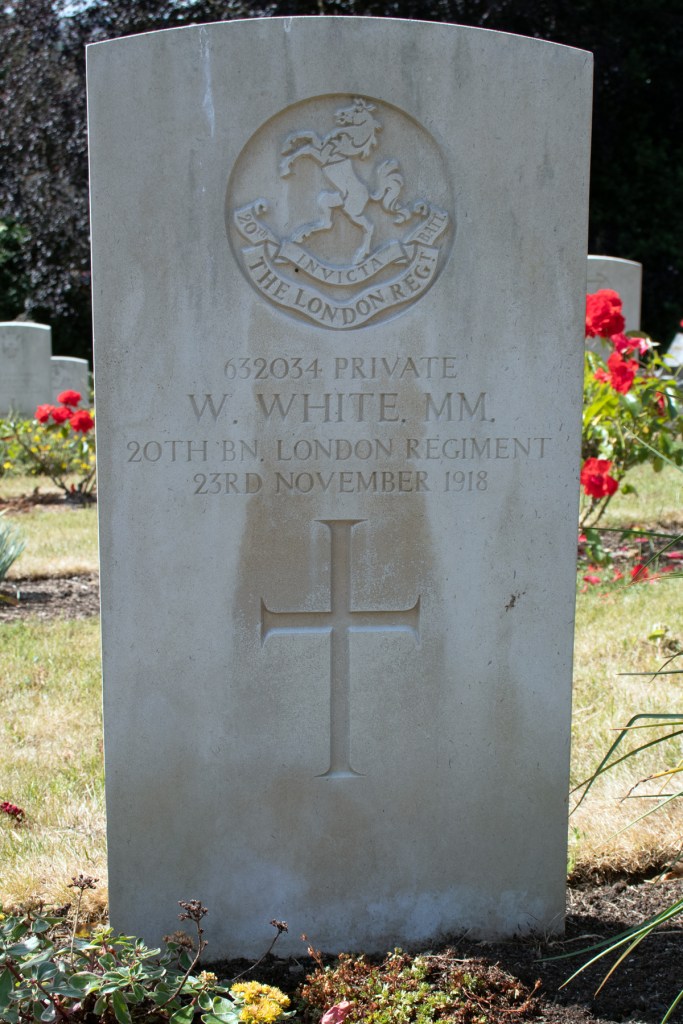
Private William White

Private William White

William White was born in the autumn of 1892 in Gravesend, Kent. He was the second of eleven children to Joseph and Eleanor – or Ellen – White. Joseph was a general labourer who, by the time of the 1911 census, was employed in the local docks.

The same census recorded the family of eleven people living in four rooms at 2 Robert Street, Gravesend. In addition to Joseph, both William and his older brother, Joseph Jr, were employed as assistants for a local butcher, while the next youngest of the siblings, Edward, was working as a bootmaker’s errand boy.

When war was declared, William stepped up to play his part. Full service details have been lost to time, but it seems that he had enlisted by the spring of 1918 at the latest. He joined the London Regiment, and was assigned to the 20th (City of London) Battalion. Private White’s unit spent the duration of the conflict on the Western Front, fighting at Loos, the Somme and Messines amongst other areas.

By the end of the war, William had been awarded the Military Medal for his bravery, although it is unclear when and for what he receive it.

The next confirmed record for Private White was his admission to hospital in Somerset, as he was suffering from pneumonia. He was sent to the Bath War Hospital, but it is unclear whether he had been on home soil when he fell ill, or if he had been medically transferred there from across the English Channel.

William White’s condition was to prove fatal. He passed away in hospital on 23rd November 1918, at the age of 26 years old. His body was laid to rest in the military section of Locksbrook Cemetery in Bath, not far from the hospital where he had breathed his last.


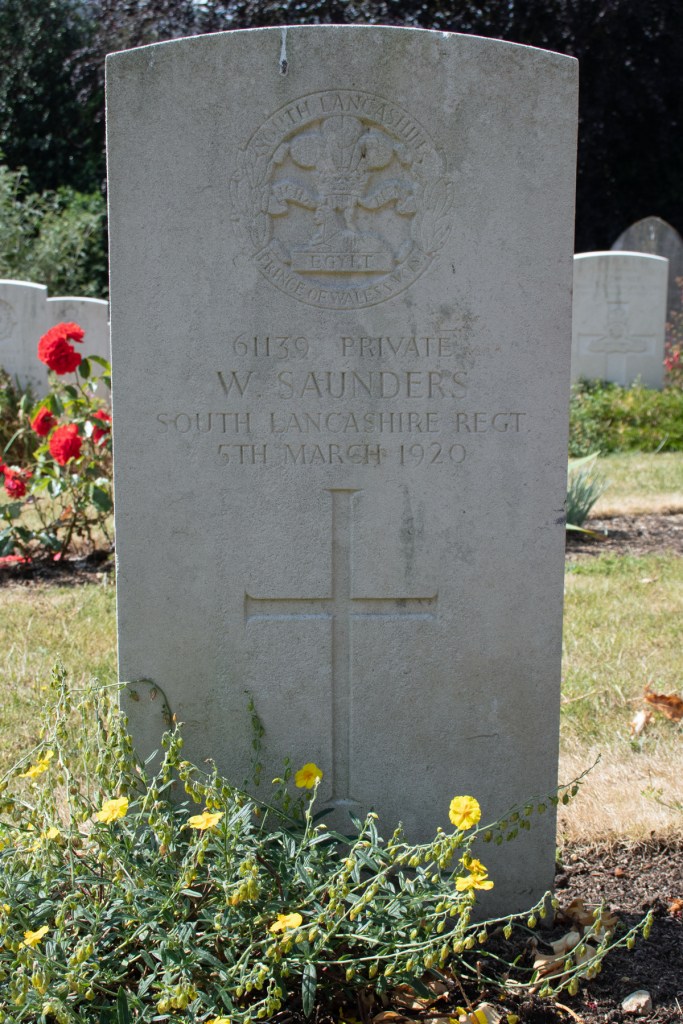
Private Walter Saunders

Private Walter Saunders

There is little concrete information about the life of Walter Saunders, and what details are available come from his limited military documents. These confirm that he was born in December 1862 in Widcombe, near Bath, Somerset.

Walter was unemployed labourer when enlisted in the army in January 1882. He joined the Somerset Light Infantry, and was attached to the 4th Battalion. His service records show that he was just under 5ft 5ins (1.64m) tall, with brown hair, hazel eyes and a fresh complexion. He was also notes as having a scar on his abdomen.

Private Saunders seems to have served in southern Asia, receiving the India medal and Burma 1885-1887 clasp. He then moved to South Africa, and was caught up in the Second Boer War. There is no further information about his initial time in the army.

When his contract came to an end, it would seem that Walter returned to the UK, finding work as a dock labourer in South Wales. When war came to Europe, though, he stepped up once more so serve his country, this time joining the South Lancashire Regiment. He was assigned to the 15th (Transport Workers’) Battalion, which served in the Mersey dockyards.

The next record for Private Saunders comes from June 1917, when he was sent to a medical board. He had been unwell for a while, it seems, and was suffering from arteriosclerosis, or hardened arteries. The medical report confirmed this was a permanent condition, and that he was no longer fit for military service.

At this point, Walter’s trail goes cold. It seems likely that he returned to Somerset, possibly still having family connections there. He passed away on 5th March 1920. He was 57 years of age.

Walter Saunders was was laid to rest in the military section of Bath’s sweeping Locksbrook Cemetery.


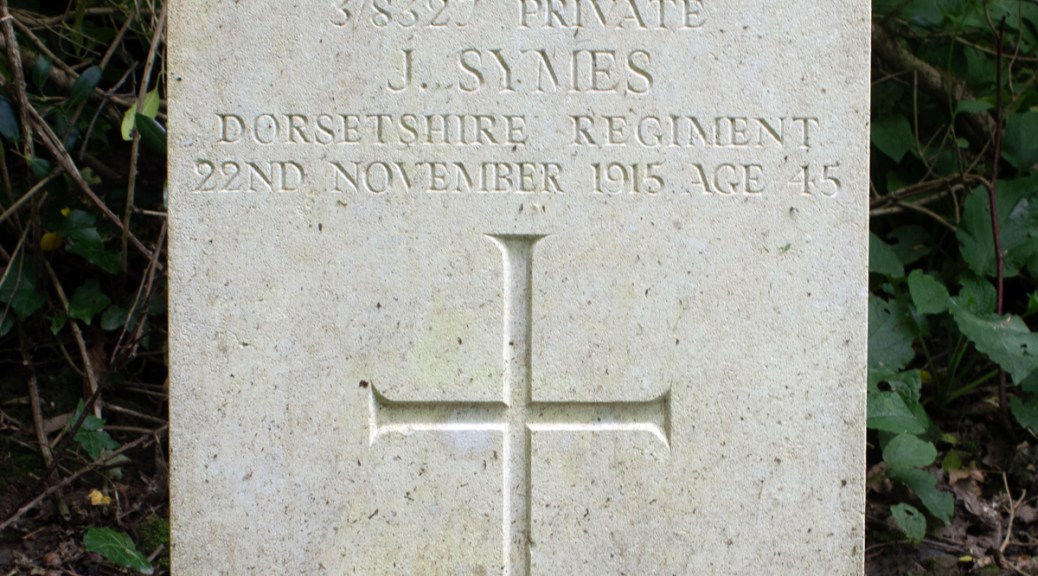
Private Joseph Symes

Private Joseph Symes

Joseph Symes was born in the spring of 1871, and was the oldest of four children to William and Sarah. William was a farm labourer from Stoke Abbot in Dorset, and it was here that the family were born and raised. They set up home with Sarah’s parents, and were recorded as living with them in the 1871 census, and with Sarah’s widowed mother in the 1881 record.

William had died by the time the 1891 census return was taken, and Sarah took up work as a mill hand. The document found her living in the village of Netherbury, a few miles to the south east of Stoke Abbott, with her three younger children, William, Alice and Mary Ann. Joseph was noticeable by his absence, but later documents confirm that he had enlisted in the Dorsetshire Regiment by this point, and was likely serving overseas.

Joseph had returned to England by the turn of the century, setting up home back in Netherbury. On 24th September 1910, he married Sarah Jane Dunsbury in Beaminster parish church. The daughter of a blacksmith, she was 13 years Joseph’s senior – 52 years old to his 39. The couple lived in Netherbury, where he was working as a mason’s labourer.

When war broke out, Joseph stepped up to play his part once more. He re-enlisted in the Dorsetshire Regiment on 1st September 1914, and was attached to the 6th Battalion. His service records confirm that he was 5ft 5.5ins (1.66m) tall and weighed 182lbs (82.6kg).

Private Symes remained on home soil during his time in the army. He switched to the 3rd (Reserve) Battalion in March 1915, which was based in and around Weymouth. In the autumn of 1915, he was admitted to the Sidney Hall Military Hospital in the town, suffering from bronchial pneumonia. The lung condition was to prove his undoing, and he passed away on 22nd November 1915, while still admitted. He was 44 years of age.

Joseph Symes was taken back to Netherbury for burial. He was laid to rest in the graveyard of St Mary’s Church in the village.


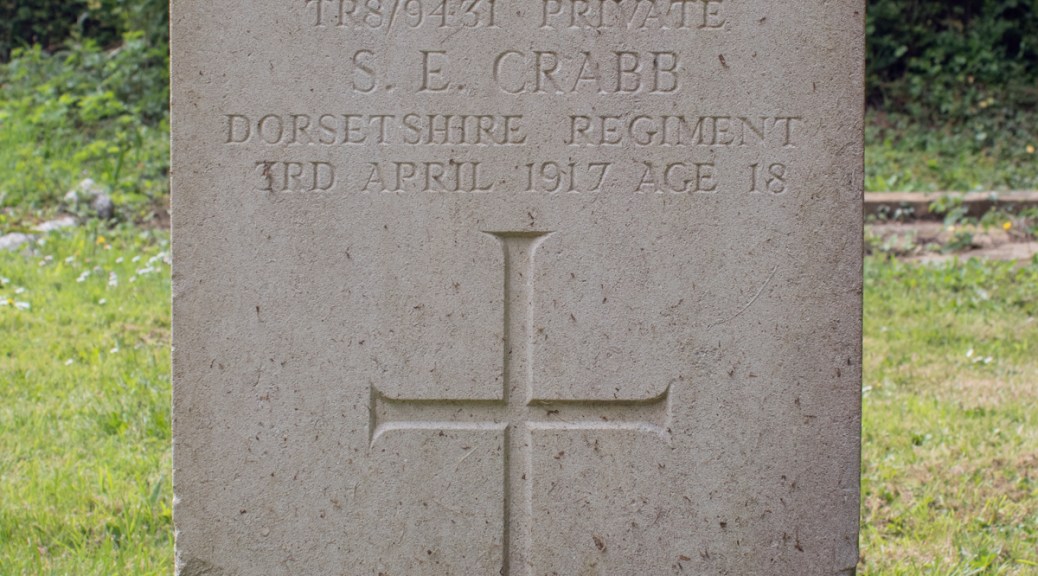
Private Sidney Crabb

Private Sidney Crabb

Sidney Edgar Crabb was born in the autumn of 1898 in the Dorset village of Chedington. One of ten children, his parents were shepherd-turned-farm labourer John Crabb and his wife, Mary.

Little information is available about young Sidney’s life. He was still at school when the 1911 census was taken, and was too young to enlist when war was declared in the summer of 1914. He enlisted in the Dorsetshire Regiment no earlier than October 1916, and was sent to Warminster for training.

The only other record for Private Crabb confirms his passing. He died from bronchial pneumonia while in hospital near his army camp in Warminster, Wiltshire, on 3rd April 1917. He was just 18 years of age.

Sidney Edgar Crabb’s body was taken back to Dorset for burial. He was laid to rest in the graveyard of St Mary’s Church, in his home village of Halstock. While only five of his siblings survived childhood, Sidney was the only one to pass away as a result of the conflict.


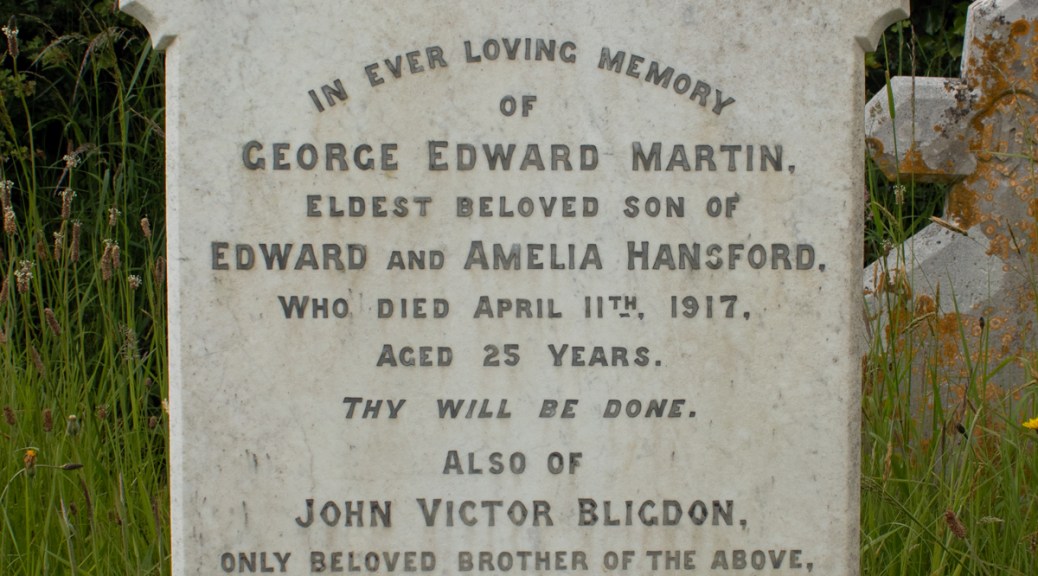
Private George Hansford

Private George Hansford

George Edward Martin Hansford was born on 25th March 1892, the second of five children – and the eldest son – to Edward and Amelia Hansford. Edward was a farmer from Netherbury in Dorset, and this is where the family were born and raised.

By the time of the 1911 census, Lower Ford Farm had become a family affair, with George and his older sister, Susannah both supporting their father in running things. War was on the horizon, however, and things were to change.

George was called upon to serve his country on 15th February 1916. He joined the Dorsetshire Regiment, and was assigned to the 2nd Battalion. He wasn’t formally mobilised until 19th January 1917, but his medical identified an underlying health condition.

Private Hansford had suffered a bout tuberculosis in 1914, and this left to his medical report confirming that his health was impacted to the point that he was medically unfit to serve in the army. Unfortunately, while awaiting the results of the report, George, who was back at home had a recurrence of the condition, and succumbed to it. He passed away on 11th April 1917, at the age of just 25 years old.

George Edward Martin Hansford was laid to rest in the graveyard of Holy Trinity Church in Salwayash, a few miles from the family home in Netherbury.


Private John Gaunt

Private John Gaunt

John Alfred Gaunt was born on 15th October 1893, the fourth of five children to John and Jane Gaunt. John Sr was a cattle dealer from St Ives in Huntingdonshire, and it was in the nearby village of Needingworth that the family were born and raised.

John Sr sought out opportunities to support his wife and children and, in 1902 he moved the family to Canada, settling in Pincher Creek, Alberta. There isn’t a great deal of detail available about the Gaunts’ time in North America, but it is likely that farming became their way of life.

Tragedy struck the family in October 1912, when John Sr died, at the age of 61. By this point it seems that they had moved on to British Colombia. Just six months later, Jane also died, John Jr was left an orphan while still a teenager.

Most of the family seemed to remain on the west coast – a later document shows John’s older sister Julia living in Cranbrook, British Colombia – but John was working as a farmer by this point and had either returned to Pincher Creek after his parents’ deaths, or had remained there when they went west.

When war broke out in Europe in the summer of 1914, the Empire were called upon to serve, and John was to return to the country he had left more than a decade earlier. He enlisted on 20th January 1916, joining the Canadian Expeditionary Force.

Private Gaunt’s service records show that he was 5ft 8ins (1.72m) tall, 130lbs (59kg) in weight and had light brown hair, blue eyes and a fresh complexion. It was also noted that he had a fine scar, some 3.5ins (9cm) long, on his upper left arm and had a slight defect in his speech (although this is not elaborated on).

John departed for Europe on 21st August 1916, boarding the HMS Olympic for Liverpool, Lancashire. His unit was initially based in Witley Camps near Aldershot, Hampshire, and he would remain on base until the end of the year. This included eight weeks admitted to the Connaught Hospital, when he was suffering from a bout of syphilis.

By January 1917, John was transferred to the 21st Reserve Battalion, which meant a move to Seaford, East Sussex. He transferred again to the 50th Battalion on 19th March, a move which included being shipped off to France.

Over the next couple of months, things were to change dramatically for Private Gaunt. His service records note that he was wounded on 10th May, but that he remained on duty. On 21st July, he wad admitted to the No. 11 Ambulance Station in Rouen, suffering from jaundice.

He was medically evacuated to Britain for treatment, initially to the Auxiliary Hospital in Exeter, Devon, then to Uplyme Hospital, just to the north of Lyme Regis. By this point, John was severely ill. He passed away on 13th August 1917, at the age of 23 years of age.

With the majority of his family living on the other side of the Atlantic, John Alfred Gaunt was, instead, laid to rest in the churchyard of Ss. Peter & Paul Church in Uplyme, not fat from where he had breathed his last. He is also among those servicemen to be commemorated on the Pincher Creek War Memorial.


Private Percy Coplestone

Private Percy Coplestone

Percy Reginald Coplestone was born in Torquay, Devon, on 17th August 1890. The oldest of four children, his parents were bakers William and Louisa Coplestone. The family moved to Kinkerswell in 1895, and, by the time of the 1911 census, they had moved to Paignton.

The Copplestones had set up business in Church Street and Louisa’s widowed mother, Louisa Smallbone, had moved in with them. Percy, now 20 years of age, was helping in the business, while his younger sister, Gladys, was employed as a draper’s assistant.

When war came to Europe, Percy was called upon to play his part. Details of his service are tantalisingly scarce, but they suggest that he had enlisted no earlier than April 1915. He joined the Royal Devon Yeomanry, and was assigned to the 3rd/1st Battalion, although his time in the military was to be brief.

The funeral took place Friday of Pte. Percy Coplestone, eldest sone of Mr and Mrs Coplestone, Church-street, Paignton, who joined 1st Devon Yeomanry, sustained an injury while undergoing gymnastic training, was operated upon on Monday, and died in the evening.

[Western Times: Tuesday 23rd November 1915]

Percy Reginald Copplestone died on 15th November 1915: he was 25 years of age. He was laid to rest in Paignton Cemetery, a short walk from where his family still lived.


While researching Percy’s life, I came across a couple of articles relating to a legal action taken against his father, William, by Edward Elkington, for damaged caused in a car accident. Edward was suing for £15 damaged, while William counter-sued for £65.

The case was initially heard in November 1915 – sadly, a week after Percy’s passing – before being adjourned until the following January. In amongst a number of witness statements, a local newspaper reported William’s evidence:

William Joseph Coplestone… baker and confectioner, said he left the Gerston [Hotel] between 11.5 and 11.10 in his single motor, with Mr Tolcher and Mr Hicks. It was a rather heavy car for his size, very reliable and very slow. They went on second speed, about six or seven miles an hour, and at the corner of Hyde-road witness [William] sounded the hooter, nothing then being visible. Taking a wide turn following the Torquay lines leading to Torquay, witness got on the left side, the proper side. He saw the lights of a car approaching, also a tram-car, the car being 140 yards away and 50 yards ahead of the tram. The car was approaching on the wrong side, and there was practically an end-on collision. Witness expected every moment the other car would have gone over to its proper side. Witness had driven about 100 feet when the collision took place and his car was stationery at the time. Witness and his friends were thrown out. The car cost him about £80 and the estimate of repairs was £63 5s. Mr Elkington said, “It is a bad job.” Witness replies, “It is your fault absolutely; you are on the wrong side of the road.” Plaintiff said, “You were crossing the road fast,” and witness replied that he was bound to cross the road. Elkington remarked, £I did my best to avoid the accident. Immediately I saw you I applied my brakes, but the roads were greasy, and the wheels would not grip.” PC Clarke was not there when the collision took place. Later he suggested to the constable that measurements should be taken, and went back to look after Mr Hicks. Before he got back they had moved his car. Coplestone said he had often driven two people in the car. When his son left for the Dardanelles, witness drove his wife and son to Southampton in comfort.

[Western Times: Tuesday 25th January 1916]

The case was adjourned once again, to 11th February. Frustratingly, there seems not to have been any follow-up newspaper report, so there is no confirmation of the outcome of William’s case.

Private Frederick Bundy

Private Frederick Bundy

Private Frederick Arthur Bundy, of the 1st Somerset Light Infantry is to be buried in Locksbrook Cemetery tomorrow (Saturday) afternoon with full military honours. He met with a fatal accident in Belfast on Sunday last. In the afternoon when in quarters he was passing from one room to another when a rifle which was bring cleaned by a comrade in the room which he was entering went off. The bullet passed through Private Bundy’s wrist and entered the stomach. He was at once removed to the military hospital, but passed away at midnight, from internal haemorrhage. Deceased, was the son of Mr FA Bundy, of 93 High Street, Upper Weston, and enlisted at the Drill Hall, Bath, in August 1919, when only 15 years of age, being accepted as he was a youth of exceptionally fine stature. At the time of his death he was 16 years and 10 months of age. After a short period of training at Taunton he went with a draft of Somersets to Ireland and was stationed for some time at Carrickfergus Castle, being moved into Belfast when the riots occurred there.

[Bath Chronicle and Weekly Gazette: Saturday 4th December 1920]

Frederick Arthur Bundy was born early in 1904, and was the middle of three children to Frederick and Mary Ann Bundy. Frederick Sr was a labourer from Bath, Somerset, and it was in the Weston area of the city that the family were born and raised.

The 1911 census – the only one Frederick Jr would be recorded on – noted the family as living at 45 High Street, Weston. The household consisted of Frederick Sr, Mary Ann, Frederick Jr, his older sister Sarah, younger brother William and Mary Ann’s daughter from a previous marriage, Annie.

Sadly, due to his young age, there is little additional documentation to build a picture of Frederick Jr’s life. He passed away on 28th November 1920, and was laid to rest in Bath’s Locksbrook Cemetery, not far from the family home.

Frederick Arthur Bundy’s funeral was shown in a photo-spread in the Bath Chronicle of 11th December 1920.


Editor’s Note: While Frederick enlisted nine months after the end of the First World War, his acceptance for a Commonwealth War Grave is because his passing being between the qualifying dates and the cause being as a result of his military service.


Private Ernest Richards

Private Ernest Richards

Ernest Richards was born in Bath, Somerset, 1886, and was the youngest of four children to Emma Richards. Emma was widowed when Ernest was an infant, and no baptism records remain to confirm who he was.

The fate of the Richards family is outlined through the consecutive census records. The 1891 document shows Emma and her children living at 4 Camden Row, to the north of the city centre. Emma was employed as a needlewoman, while Ernest’s oldest brother, Herbert, was working as an errand boy. The family shared their home with widowed laundress Emily Clarke, helping with the bills.

By the time of the 1901 census, the family had moved to 1 Claremont Row. A bit further out of the centre of the city, this offered more space for the growing children. Emma was still working as a needlewoman, but three of the children were gainfully employed: Ernest as a printer’s errand boy, Herbert as a grocer’s carter, and their brother William as a book shop porter.

The 1911 census found Emma still living at 1 Claremont Row. She was 53 by this point, and no longer working, but three of her children were still living there, and bringing in an income. William was a milkman, Ernest a porter, and her youngest child, daughter Gladys, was a machinist.

War was closing in on Europe by this point, but from here on in, Ernest’s trail gets a bit sketchy. Later records confirm that he had enlisted by the summer of 1916, and they he had joined the Coldstream Guards. Attached to the 5th (Reserve) Battalion, Private Richards appears to have been based on home soil.

Ernest seems to have been hospitalised in February 1917. Sadly, there is little additional information about his condition. While his regiment was based in Windsor, Berkshire, there is no evidence to confirm whether his barracks where also there, so it isn’t clear to which hospital he was admitted.

Private Richard would succumb to his ailment. He passed away, while in hospital, on 10th February 1917: he was 30 years of age.

Ernest Richards’ body was taken back to Somerset for burial. He was laid to rest in Bath’s majestic Locksbrook Cemetery, not far from his family home.


Gunner Arthur Green

Gunner Arthur Green

Arthur William Green was born on 27th August 1896, the middle of five children to William and Mary Green. William was a shoemaker, who was employed at the Clark’s factory in Street, Somerset, and this is where the family were born and raised.

Clark’s was the key employer in Street and, by the time of the 1911 census, five of the Green family were working for them. This included the 15 year old Arthur, whose job was a shoe cutter.

When war came to Europe, Arthur had already stepped up to play his part. He enlisted in the Royal Marine Artillery in March 1914. His service records confirm that he was 5ft 8ins (1.72m) tall, with brown hair, blue eyes and a fresh complexion. He was also noted as having a scar on the back of his neck.

Private Green was initially under age for service in the regiment, only coming of age at the end of August 1914. He initially completed his training either in Chatham, Kent, or Plymouth, Devon, becoming a Gunner on 5th February 1915. That spring he was assigned to the battleship HMS Warspite, and would remain on board for the next four years.

In February 1918, Gunner Green was assigned to the 4th Battalion of the Royal Marines. Still serving on Warspite, on 23rd April he was involved in the Raid on Zeebrugge. A combined action by the Royal Navy and Royal Marines, the aim was to block the entrance to the port of Bruges-Zeebrugge by sinking obsolete ships. A total of 1700 men were involved, and, in the ensuing battle, some 200 were killed and 400 wounded.

Gunner Green was one of those who was injured in the battle. When the Warspite returned home, he was admitted to the Royal Naval Hospital in Chatham, Kent, but his injuries were to prove too severe for him to overcome. He passed away on 17th May 1918, at the age of just 21 years old.

Arthur William Green was laid to rest in Woodlands Cemetery, Gillingham, not far from the Chatham base he had briefly known as home.