George Henry Babb was born on 6th October 1900 in the village of Halberton, Devon. One of ten children, his parents were stonemason Clem Babb and his wife, Emily.
There is little documented about George’s life. The 1911 census records that he was still at school, and there is nothing to confirm the work he found when he completed his education.
George was not yet 14 years old when was was declared, and the Army Register of Soldiers’ Effects suggests that he didn’t enlist until the late spring of 1918. He was assigned to the Royal Warwickshire Regiment and was attached to the 5th Battalion.
Private Babb was sent to the north east for training, and it seems that he became unwell while there. He was admitted to the 1st Northern General Hospital in Newcastle-upon-Tyne, suffering from a combination of influenza and pneumonia. The conditions were to prove fatal: Private Babb passed away on 8th November 1918, a month after his eighteenth birthday.
George Henry Babb was taken back to Devon for burial. He was laid to rest in the peaceful graveyard of St Andrew’s Church in his home village of Halberton.
Reginald Payne was born on 27th January 1898 in Milverton, Somerset. He was the third of five children – and the oldest son – to Thomas and Mary Payne. Thomas was a dairyman, and both he and Mary were from Devon: the family moved back to the county after Reginald was born, and, by the time of the 1911 census, they had settled in the village of Halberton.
Reginald, at this point, was still in school, and there is little information about his life. When war broke out, he volunteered to serve his country, but, with no military records remaining, the only point of reference for him is a newspaper report of his funeral.
Quite a gloom was cast over Halberton when it became known that Pte. Reginald Payne, eldest son of Mr & Mrs T Payne, of Brimery Dairy, had passed away at the Military Hospital, Devonport. Deceased, who enlisted in 1916 in the Hussars, and was attached to the 1st City of London Yeomanry, proceeded to Egypt, and whilst there he underwent two operations for appendicitis. He returned to England after recovering, and was sent to Ireland, where he had a return of the old trouble, and was again operated on four times, and then sent to Devonport, where he passed away.
[Western Times: Friday 6th February 1920]
Reginald Payne was a day over 22 years of age when he passed away. He was taken back to Halberton for burial, and was laid to rest in the peaceful St Andrew’s Churchyard.
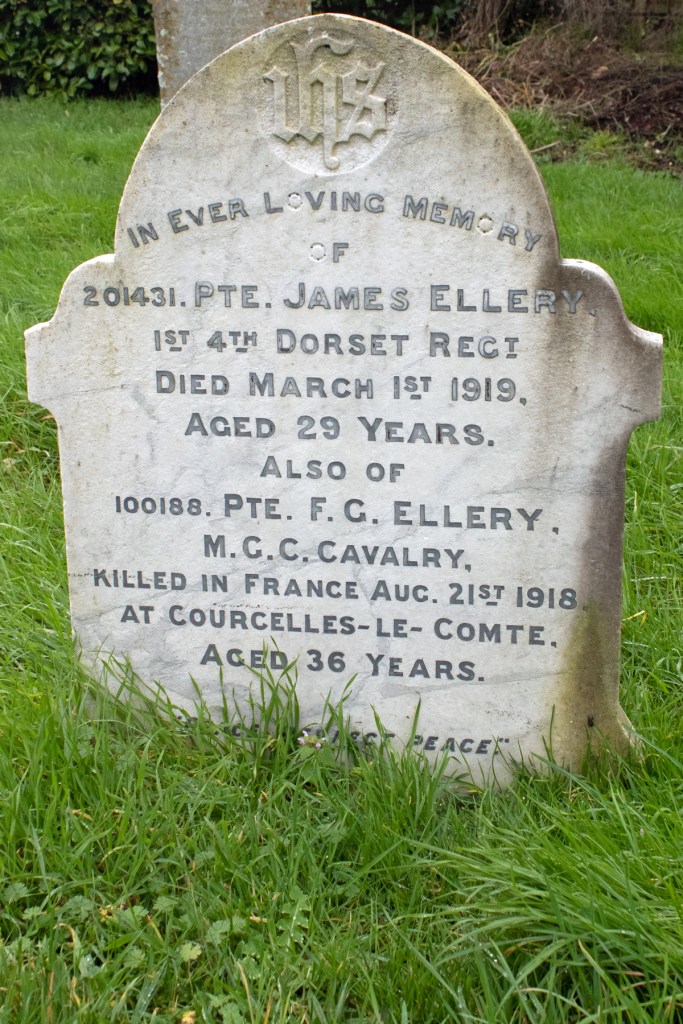
James Ellery was born in the autumn of 1889, and was the middle of seven children. His parents – Frederick and Mary – were born in Dorset, and the family were raised in the hamlet of Lillington. Frederick was a farm labourer, but James found his way into building work when he finished his schooling.
When war came to Europe, James stepped up to play his part. Full details of his military service have been lost to time, but it is clear that he had enlisted in the Dorsetshire Regiment and was attached to the 1st/4th Battalion.
Private Ellery’s unit served in India and Mesopotamia during the conflict, but it is unclear whether James saw any action overseas. Certainly by early 1919 he was back in Britain, as he was hospitalised in Sherborne following a bout of influenza. This developed into pneumonia, and he was admitted to the town’s Yeatman Hospital.
James’ immune system had become weakened during the conflict, and the pneumonia turned septic. It proved to be fatal, and James passed away on 1st March 1919. He was 29 years of age.
James Ellery’s body was taken back to Lillington for burial. He was laid to rest in the peaceful graveyard of St Martin’s Church.
James was not the first of the Ellery siblings to die during the Great War. His eldest brother, Frederick, had enlisted in the 2nd Battalion of the Machine Gun Corps Cavalry. He was killed in action on 21st August 1918, leaving behind a widow and three children. He was 36 years of age and is commemorated on the Vis-en-Artois British Memorial in Haucourt. France.
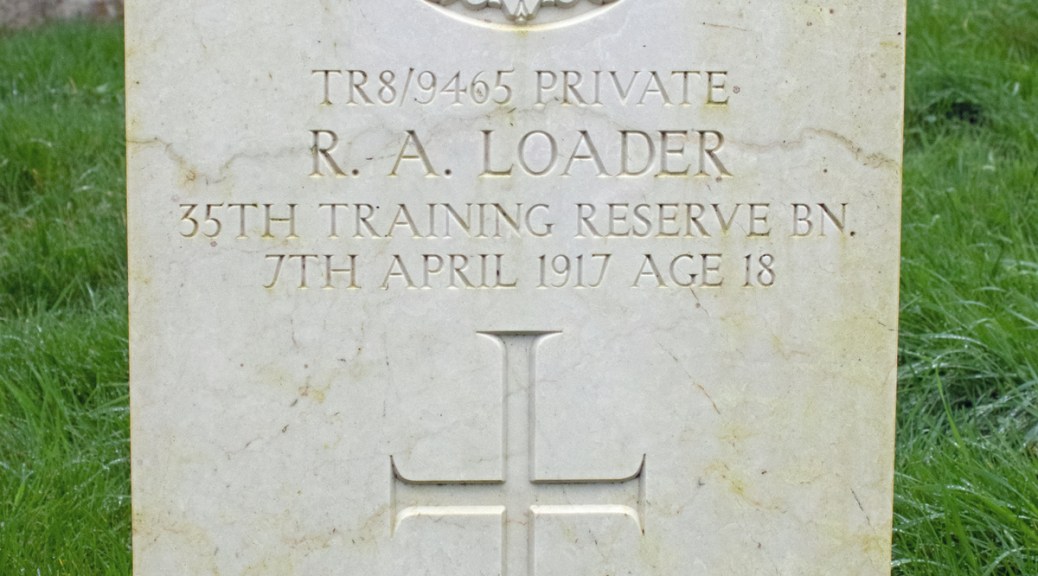
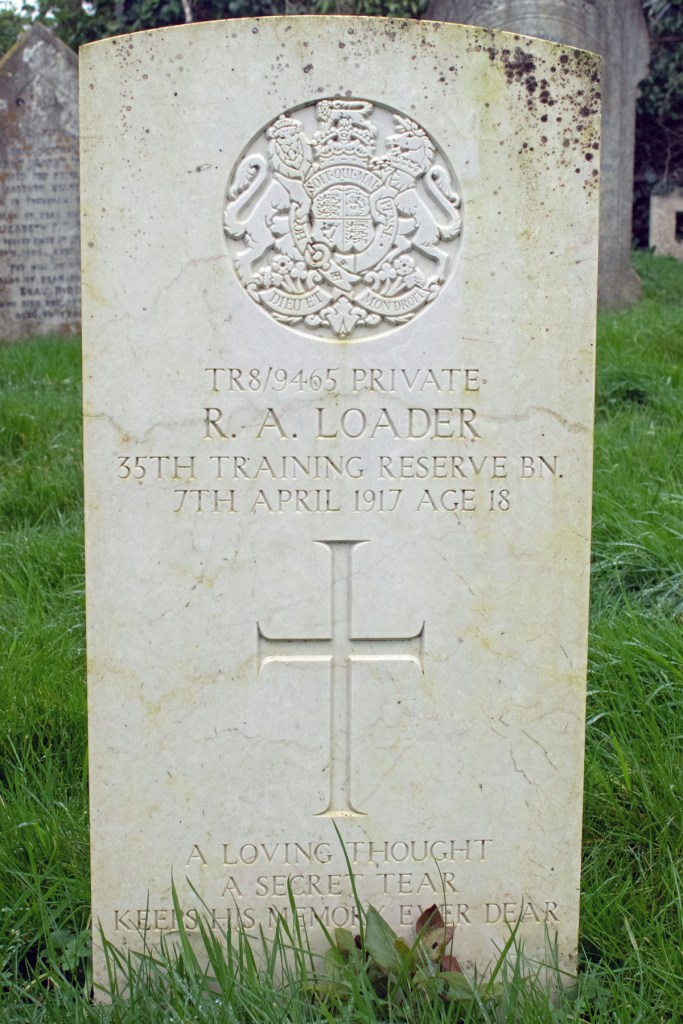
Reginald Alfred Loader was born in the autumn of 1898, and was the eighth of nine children. His parents – Robert and Amelia – both came from the Dorset village of Lillington, and this is where they raised their family.
Sadly, there is little specific information on Reginald’s life. When war broke out, he stepped up to play his part, and enlisted in the Training Reserve Battalion at some point after October 1916. His unit, the 35th Battalion, was based in Wool, Dorset, but there is no further information about his time there.
The only other concrete information about Private Loader confirms his passing. He died in hospital – through causes unknown – on 7th April 1913. He was just 18 years of age.
Reginald Alfred Loader’s body was taken back to Lillington for burial. He was laid to rest in the graveyard of St Martin’s Church in the village.
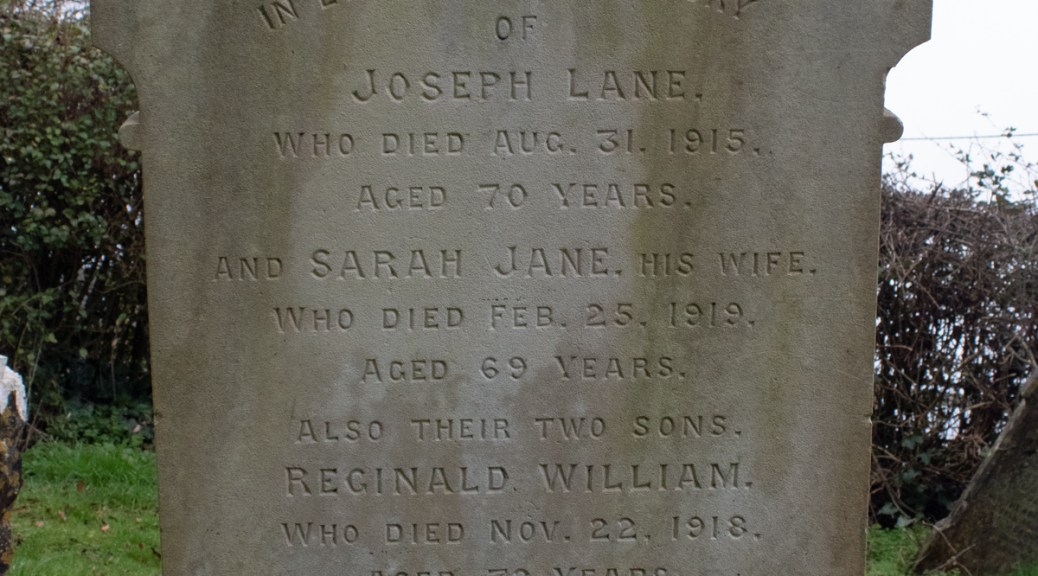
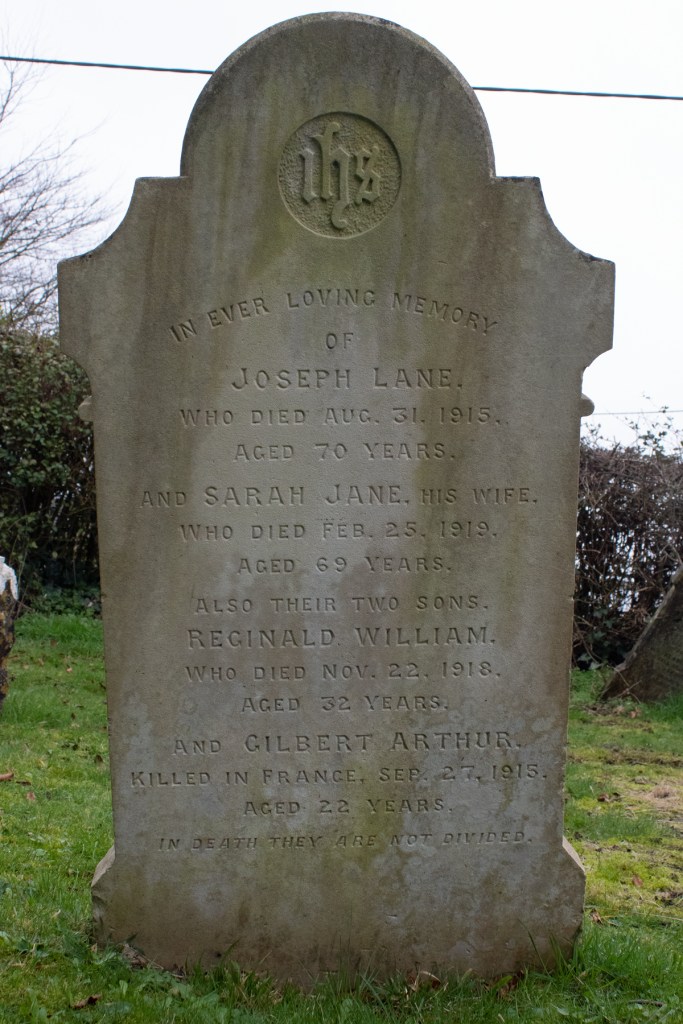
Reginald William Lane was born in the autumn of 1886, the eighth of ten children to Joseph and Sarah. Joseph was an agricultural labourer and he and his wife raised their family in their home village of Thornford in Dorset.
When he finished his schooling, he found work as a gardener’s boy. He went on to make a career out of this and was employed as a gardener when he married Evelyn Sharp on 15th April 1914. The couple exchanged vows in St Swithun’s Church, Hinton Parva, Dorset, the marriage certificate noting that the groom’s father was now employed as a woodsman.
War came to Europe later that year, and Reginald enlisted to serve the King and Empire. Little information is available about his military career: he joined the Dorsetshire Regiment, but there is no confirmation that he spent any time overseas. Private Lane transferred over to the 3rd (Reserve) Battalion of the Wiltshire Regiment, his new unit serving on home soil. Based in Kent, Reginald was part of the Thames & Medway Garrison.
Joseph died at the end of August 1915, and was laid to rest in the St Mary Magdalene Churchyard. Just weeks later, Reginald’s younger brother, Gilbert, a Private in the 3rd Battalion of the Middlesex Regiment, was killed during the Battle of Loos. He was commemorated on the Loos Memorial in Dud Corner Cemetery in France.
Private Reginald William Lane survived the war, but only by eleven days. While based in Kent, he contracted influenza and pneumonia. He died on 22nd November 1918, aged 32 years. His body was brought back to Dorset, and was laid to rest alongside his father.
There is no further information available for Evelyn.
Reginald’s mother, Sarah, however, only lived for another couple of months. She passed away on 25th February 1919, at the age of 69 years old. She was reunited with her husband and son in St Mary Magdalene Churchyard, the family headstone commemorating Private Gilbert Lane as well.
The early life of Ernest Brister is a challenge to piece together. His baptism record – at St Mary Magdalene Church in Thornford, Dorset – suggests that he was born in the summer of 1891, but gives only the name of his mother, Rosina Brister.
The 1901 census identifies the 9-year-old Ernest as a visitor to the house of Eliza Brister, a 65-year-old widow working as a laundress. There are several other Bristers in the village – including Eliza’s own to children – but Rosina is nowhere to be seen.
The next census, taken in 1911, sheds a little more light on the situation. Ernest is still living with Eliza, but he is now recorded as being her grandson. Aged 75, she was still taking in laundry, but Ernest was employed as a mason.
In the autumn of 1913, Ernest married Beatrice Chalker. She was a shepherd’s daughter from Dewlish in Dorset. The couple wed in Dorchester and went on to have two children, Doris and Edwin.
When war broke out, Ernest stepped up to play his part. He enlisted in the Dorsetshire Regiment, and found himself in France by the summer of 1915.
There is little information about Ernest’s time in the army, but later in the war, he seems to have transferred over to the Wiltshire Regiment. Attached to the 3rd (Reserve) Battalion, his new unit served on home soil and, based in Kent, was part of the Thames & Medway Garrison.
Private Brister was based in Maidstone in the autumn of 1918, when he contracted influenza and pneumonia. He was admitted to the military hospital in Aylesford, but the conditions were to prove to severe. He passed away on 24th November 1918, aged 27 years old.
Ernest Brister’s body was taken back to Dorset for burial. He was laid to rest in the graveyard of St Mary Magdalene Church. His grandmother, Eliza, passed away just a month later, at the age of 82. She was laid to rest close to her beloved grandson.
The 1910s were harsh for Ernest’s widow, Beatrice. Her youngest son was born in March 1915, her mother dying a couple of months later. She lost her brother, Edwin, to the war – he was serving with the 1st Battalion of the Gloucestershire Regiment, when he was killed on 28th August 1916. He was just 19 years of age. Two years later, she was widowed when Ernest passed away.
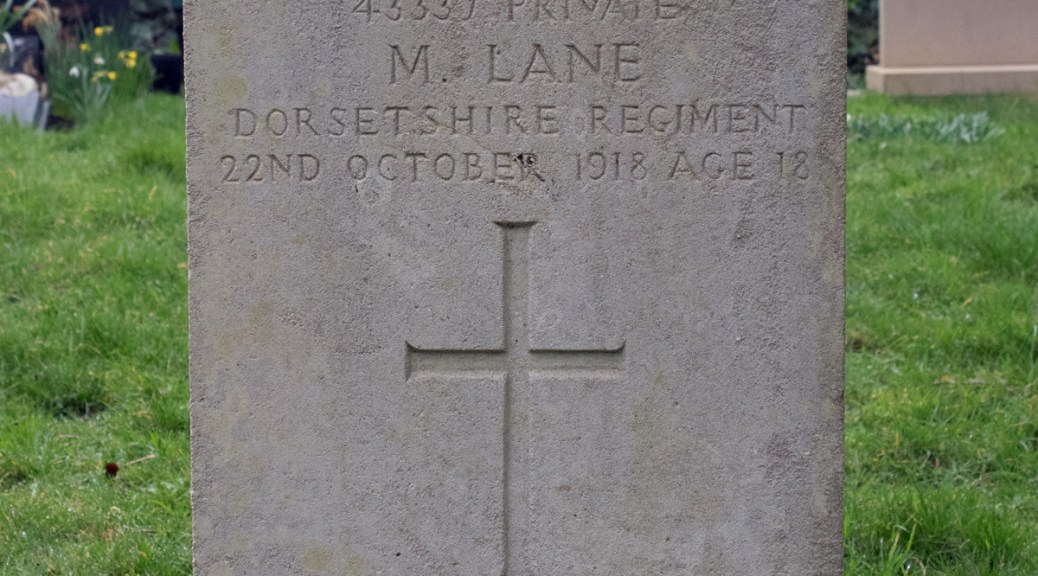
Mark Lane was born in the summer of 1900 in Thornford, Dorset. One of ten children, his parents were estate drainer Albert Lane and his wife, Sarah. Sadly. there is little concrete information about Mark’s life.
When war broke out, his eldest brother, Gilbert, served in the 5th Battalion of the Dorsetshire Regiment, rising to the rank of Serjeant. Having fought at, and survived, Gallipoli. his unit moved to France in July 1916. Involved in the Battle of the Somme, Gilbert was killed and was laid to rest at Bulls Road Cemetery in France.
His oldest brother dead, Mark seems to have wanted to serve his country and do Gilbert’s memory proud. He did not turn 18 until the summer of 1918, and he seems to have used this as an opportunity to enlist. He also enlisted in the Dorsetshire Regiment and, as part of the 4th (Reserve) Battalion was sent off to do his training.
Unfortunately, details of what happened to Private Lane are lost in the mists of time. He was admitted to a military hospital in the autumn of 1918, and died there on 22nd Octover. He was just 18 years of age.
The body of Mark Lane was laid to rest in the graveyard of St Mary Magdalene Church in his home village of Thornford.
Henry Ridler was born in Henbury, Gloucestershire, in the summer of 1862. He was the middle of three children to Abraham and Harriet Ridler. Abraham was a farm labourer who moved the family for work to the Weston area of Bath, Somerset, not long after Henry’s younger brother, John, was born.
The oldest Ridler sibling, Joseph, worked as a cabinet maker, and by the time of the 1881 census, both Henry and John were apprenticed to him. Henry married Emma Stone on Christmas Eve 1882, and the couple would go on to have seven children.
The 1891 census found Henry and the family living at 5 Comfortable Place in Bath, one of a row of terraced cottages then, but now sandwiched between the River Avon and the busy A4. Henry and Emma had four children by this point – all daughters – and the house was split between them and mother-and-daughter dressmakers Lucy and Lucy Batt.
By the time of the 1901 census, the family were growing up, and had moved literally just around the corner, to 2 Onega Terrace. Set slightly back from the main road, this terraced house had six rooms, and was better suited to the growing family. Henry was still working as a cabinet maker at this point, while his three oldest daughters – Mabel, Lilian and Maude – were all employed, as a corset fanner, a kitchen maid and a nurse girl respectively.
The next census return, taken in 1911, recorded the Ridler family still living in the same house. Henry and Emma had been married for 28 years by this point, and, while 2 Onega Terrace may have had six rooms, they would have become very cramped by this point. Six of the children – aged between 14 and 27 – were still living at home, with everyone in the household but Emma bringing in a wage of sorts.
War was closing in by this point, and, despite his advancing years, Henry was drawn to serve his King and Country. He enlisted in the Royal Army Service Corps on 20th October 1915, a date that confirms he volunteered for duty, as conscription wasn’t introduced until the following year. Henry’s service records show that he was 5ft 6ins (1.68m) tall, with greying hair and blue eyes.
Private Ridler spent two periods of time overseas. In November 1915, his unit was sent to the Eastern Mediterranean, and he served in Salonika, Greece, for seven months. While there, he was hospitalised following an injury to his right knee. He was medically evacuated to Malta, before being posted back home in Britain to convalesce in Woodcote Park Hospital, Epsom, Surrey.
By the summer of 1916, Henry was deemed fit once more, and was sent abroad again, this time to the Western Front. Details of his time there are sketchy, although he seems to have been transferred tot he Labour Corps at some point. It appears that his previous injury flared up again, and he was eventually discharged from the army on medical grounds on 30th July 1918.
At this point, Henry’s trail goes cold. He returned to Bath, but it is unclear whether or not he was able to resume working. The next confirmed documentation for Henry’s life is that of his passing. While the cause is unclear, he breathed his last on 3rd June 1921: he was 58 years of age.
Henry Ridler was laid to rest in Bath’s sweeping Locksbrook Cemetery, a short walk from the family home in Onega Terrace.
Emma remained in the family home for the next 17 years. When she passed away in 1938, she was also laid to rest in Locksbrook Cemetery, not far from her late husband.
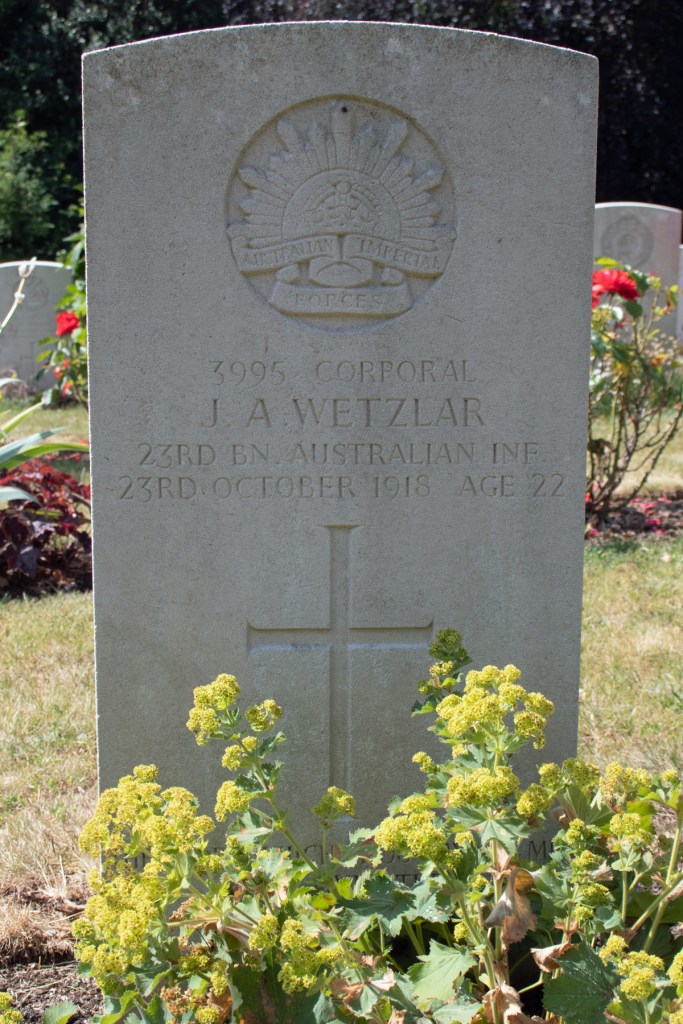
John Albert Wetzlar was born in Bendigo, Victoria, Australia, in the spring of 1895. One of four children, his parents were Ernest and Annie Wetzlar.
Little information about John’s life is available, and most of the detail that can be pieced together comes from his First World War service records. These confirm that he was working as a clerk when he enlisted on 14th July 1915. John’s medical record shows that he was 5ft 4.5ins (1.63m) and weighed 8st 5lbs (53kg). He had brown hair, blue eyes and a fresh complexion.
Private Wetzlar set sail for Europe on 8th February 1916, arriving with his unit in Alexandria, Egypt, six weeks later and landing in Marseille, France, on 31st March. Attached to the 23rd Battalion of the Australian Infantry, by the end of June, he found himself on the front line.
On 22nd August 1916, John’s unit was caught up in fighting, and he was wounded by shrapnel in his right leg. He was admitted to the 4th Australian Field Ambulance unit, before being transferred to the No 1. Canadian General Hospital in Etaples. His injuries required more care, however, and he was medically evacuated to Britain, and was sent to the 2nd General Hospital in Manchester.
Private Wetzlar spent the next six months recuperating, only re-joining his unit back in France on 10th March 1917. Back on the Western Front, he was promoted to Lance Corporal on 9th June, and to full Corporal four months later.
In January 1918, John was transferred back to Britain. Details are sketchy, but it may be that his experience was used to help train new recruits, as he was billeted at Tidworth Camp in Wiltshire. He remained on British soil until May, when he was sent to the Western Front for a third time.
Corporal Wetzlar’s time in France was to be fated. On 1st September 1918, John was wounded a second time, when he received a gun shot injury to his right leg once more. Medically evacuated back to Britain, he was admitted to Bath War Hospital in Somerset. The injury was severe enough to warrant an operation, and the damaged limb was amputated.
During his recovery, Corporal Wetzlar contracted influenza and pneumonia and, tragically, given what he had been through, these were to prove fatal. John died on 23rd October 1918: he was 22 years of age.
Thousands of miles from the home he had left nearly three years before, John Albert Wetzlar was laid to rest in the military section of Bath’s sweeping Locksbrook Cemetery, alongside other from his homeland.
Charles Gregory was born in Buckfastleigh, Devon, early in 1879, the son of John and Mary Gregory. There is next to no information about his early life and, in fact, there is very little documentation for him at all.
Most of the details for Charles come from his First World War service records. These confirm that he was living in Australia, having emigrated there with his parents. His father had died by the time Charles joined up, but Mary was living in Welshpool, to the east of Perth.
Charles was 37 years old when he joined up in March 1916: his records show that he was 5ft 3.5ins (1.61m) tall and weighed 160lbs (72.5kg). He had light brown hair, grey eyes and a dark complexion, possibly from the time he spent outside, working as a groom.
As part of the Australian Imperial Force, Private Gregory sailed from Fremantle on 13th October 1916. He arrived in Plymouth, Devon, exactly two months later, and was assigned to the 4th Battalion of the Australian Infantry. He was sent to France on 8th February 1917 and, over the next few months, transferred between the 14th and 16th Battalions.
On 22nd September, Private Gregory was caught up in a bomb attack and badly injured. After initially receiving treatment to his shattered left ankle and lower ribs, he was medically evacuated to Britain for further medical intervention.
Charles was admitted to the Bath War Hospital in Somerset, but his injuries were to prove too severe. He died from tetanus on 29th October 1917, at the age of 38 years old.
With his family in Australia, the body of Charles Gregory was instead laid to rest in the military section of Bath’s sweeping Locksbrook Cemetery, next to where the war memorial would be constructed.









 Death and Service