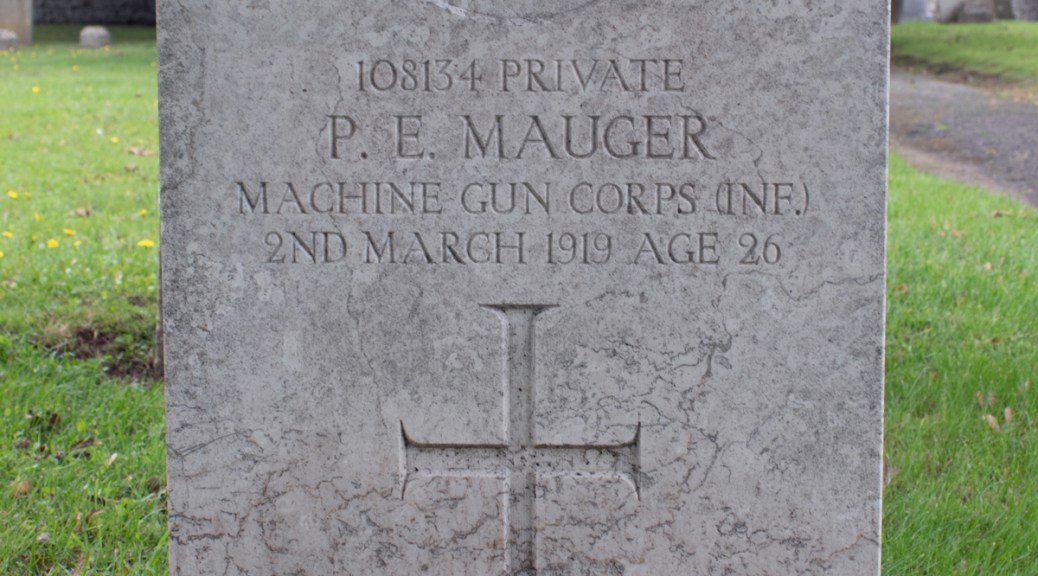
Philip Mauger was born in 1893 in the St Peter’s area of Jersey, Channel Islands. He was the oldest of six children to Albert and Jane Mauger. Albert was a labourer, alternating between road-building and farm work, depending on the time of year. When he finished his schooling, however, Philip fund work as a wheelwright’s assistant.
On 10th February 1917, Philip married Florence Dimmick, a shoemaker’s daughter from St Ouen. Their marriage certificate confirms Philip was a farmer by this point, and it seems likely that the young couple tied the knot ahead of his conscription the army.
Full details of his military service are lost to time, but it is clear that Philip enlisted in the Machine Gun Corps. Private Mauger survived the conflict, but here his trail fades. All that can be confirmed is that he passed away on 2nd March 1919, at the age of 26 years old. He was laid to rest in St Ouen’s Churchyard.
After her husband’s passing, Florence did not remarry. The couple had not had children, and it appears that she reverted to her maiden name. Husband and wife were reunited, however, when Florence passed away in 1937, and she was buried alongside Philip.
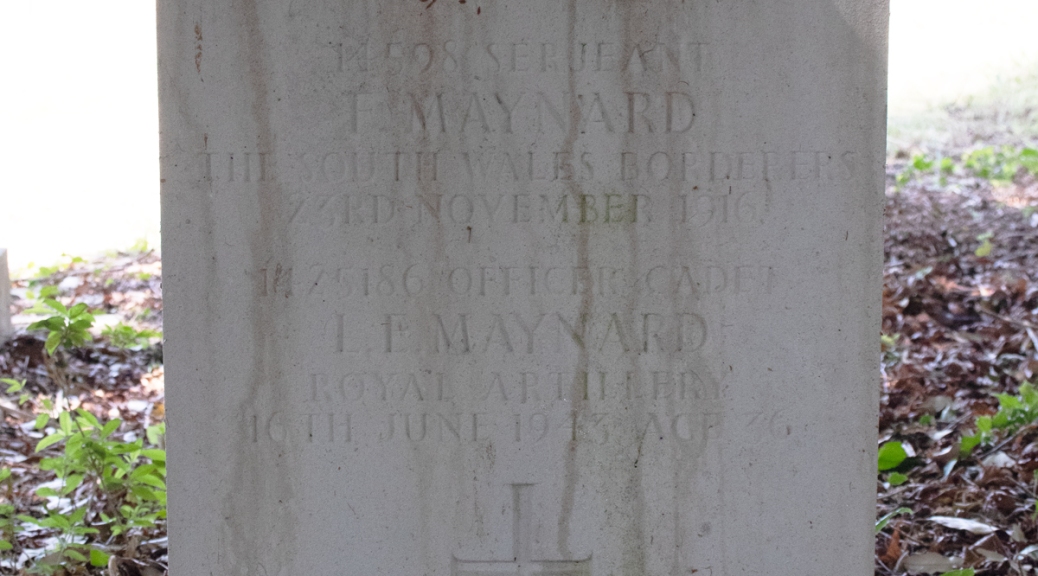
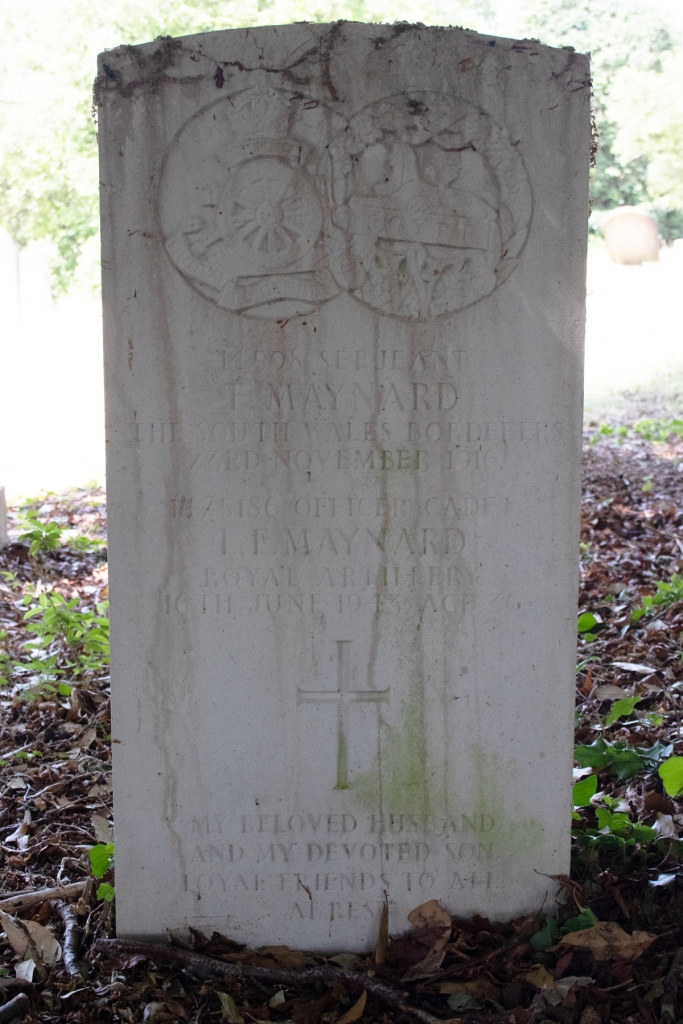
Details of Fred Maynard’s early life are a challenge to piece together. His First World War service records give his age as 44 years old when he enlisted in September 1914, and confirm his place of birth as Melksham, Wiltshire.
A newspaper report of his funeral gives the name of three brothers – Charles, Frank and Arthur – while only one census return, from 1881, provides a potential match for the family. This suggests Fred’s parents were iron fitter Alfred Maynard and his wife, Deborah, and gives the family’s address as Waterworks Road in Trowbridge.
Fred joined the army in the autumn of 1888. Initially assigned to the Gloucestershire Regiment, he had transferred to the Wiltshire Regiment by the following spring. Private Maynard showed a commitment to duty: in December 1890 he was promoted to Lance Corporal, rising to Corporal in the summer of 1893.
Fred was stood down to reserve status after his seven years’ active duty, but was recalled to the army in December 1899, when war broke out in South Africa. Promoted to Serjeant, he was sent to fight in the Boer War, and was mentioned in dispatches on 2nd April 1901 for special and meritorious service in South Africa. He was stood back down to reserve status in October 1901.
On 21st November 1895, Fred had married Louisa Card. The couple set up home in Trowbridge, but soon moved to London. They went on to have six children: Ernest, Nora and Leslie, who were all born in the London; and Arthur, Martha and Stuart, who were born in Cardiff, the family having moved to Wales by 1910.
The army was not finished with Fred, however, and, within weeks of war breaking out in the summer of 1914, he was called back into service. Given the rank of Serjeant again, he was attached to the South Wales Borderers. Fred was 44 years of age by this point, his service records confirming that he stood 5ft 8ins (1.73m) tall, weighed 164lbs (74.4kg) and had brown hair and hazel eyes.
Attached to one of the regiment’s depots, it seems unlikely that Fred saw service overseas this time around. He was discharged from the army on 1st September 1916 and this seems to have been on medical grounds. Later documents suggest that Serjeant Maynard had been diagnosed with carcinoma of the pylorus, or stomach cancer.
Fred returned to Cardiff, but his time back home was to be short. He was admitted to the Lansdown Road Military Hospital, and passed away on 23rd November 1916. He was 46 years of age.
It seems that Fred’s brother’s had some sway in his funeral. Instead of being laid to rest in Cardiff, where Louisa and the children were living, he was, instead, buried in the Locksbrook Cemetery, Bath, Somerset. His sibling Charles, who was a sergeant in Bath City Police, lived in the city, as did another brother, Frank.
Fred’s headstone also commemorates his and Louisa’s son, Leslie. He had joined the army in the 1920s and, in the summer of 1943, was in Yorkshire, undergoing officer training.
The death of an officer cadet through the accidental discharge of a rifle whose bolt had jammed was described at an inquest…
Captain WH Price said he was in charge of an exercise on the moors which involved the used of small arms and the firing of live ammunition. A squad of cadets lay on the ground in front of a trench firing over a range. All finished firing except Cadet Frank Holroyd, who said his bolt had hammed while firing a second round. [Price] told him to release the bolt by knocking the cocking piece up and back.
This attempt failed, and he told Holroyd to get back into the trench, turn the rifle magazine upwards, place the butt on the side of the trench, and kick the bolt down with his foot. While Holroyd was doing this he noticed Maynard standing in the trench about 4ft away from Holroyd and on his right-hand side.
Captain Price said he saw the rifle was pointing down the range when Holroyd kicked the butt. The cartridge suddenly exploded and Maynard dropped into the trench, shot in the head, and was dead when they reached him.
[Bradford Observer: Saturday 19th June 1943]
Officer Cadet Leslie Maynard was 36 years of age when he was killed. His body was taken back to Somerset for burial: he was laid to rest in the same grave as Fred, father and son reunited after 27 years.
Louisa remained somewhat elusive as time wore on. Fred’s military records confirm that she had moved from Cardiff to the Isle of Wight by 1922. By the time of her son’s death, she was living in Sidcup, Kent.
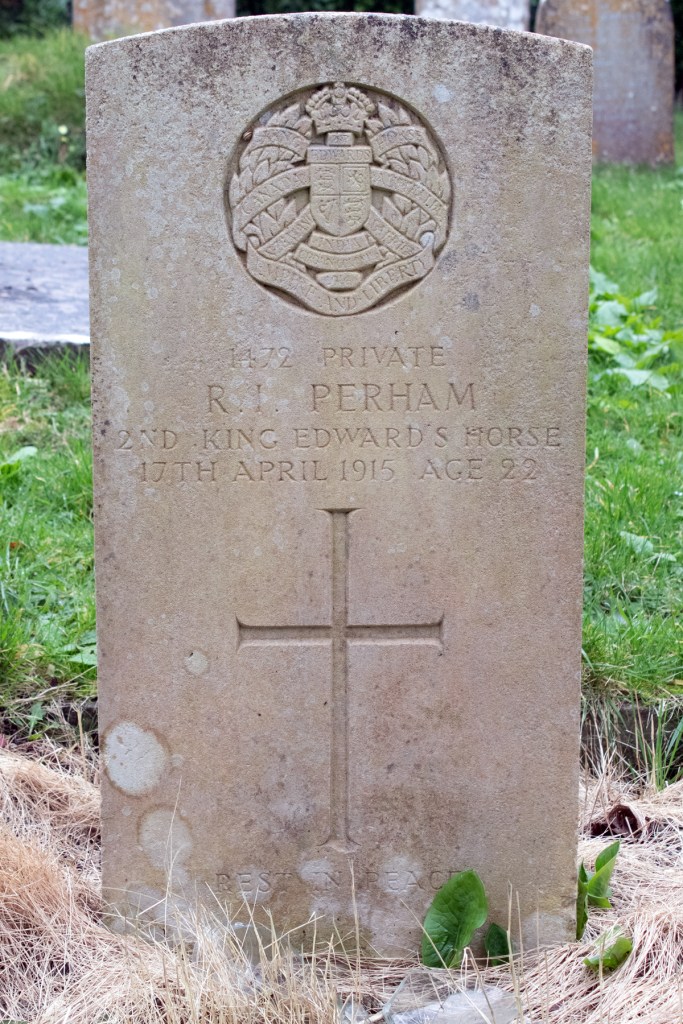
Robert Ivor Perham was born in the Dorset village of Purse Caundle in the autumn of 1892. The oldest of eight children – and thirteen years older than his youngest sibling – his parents were farmers Thomas and Annie Perham.
Thomas took the family where the work was: the 1901 census found them living at Manor Farm in West Chelborough, Dorset. Ten years later, they had moved north in the county, to Ryme Intrinseca. Robert was helping his father on the farm by now, his seven siblings all still being at school.
Robert saw an opportunity for farming to give him an adventure and, on 27th March 1913, he set off for Australia to work as a ranch hand. His time in the Antipodes was to be cut short, however, when, in the summer of 1914, war broke out in Europe. He made the lengthy journey back to Britain to serve his King, and was assigned to the 2nd King Edward’s Horse regiment.
Private Perham’s time in the army seemed not to have been a lengthy one. Full details of his service are lost to time, but it is likely that he arrived back in Blighty in the early weeks of 1915. He quickly fell ill – from ‘spotted fever’, or meningitis – and was admitted to the 2nd Eastern General Hospital in Brighton, Sussex. Sadly, it was a condition to which he would succumb: Robert passed away on 17th April 1915, at the age of 22 years old.
The body of Robert Ivor Perham was taken back to Dorset for burial. He was laid to rest in the peaceful graveyard of St Hippolyte’s Church in Ryme Intrinseca.
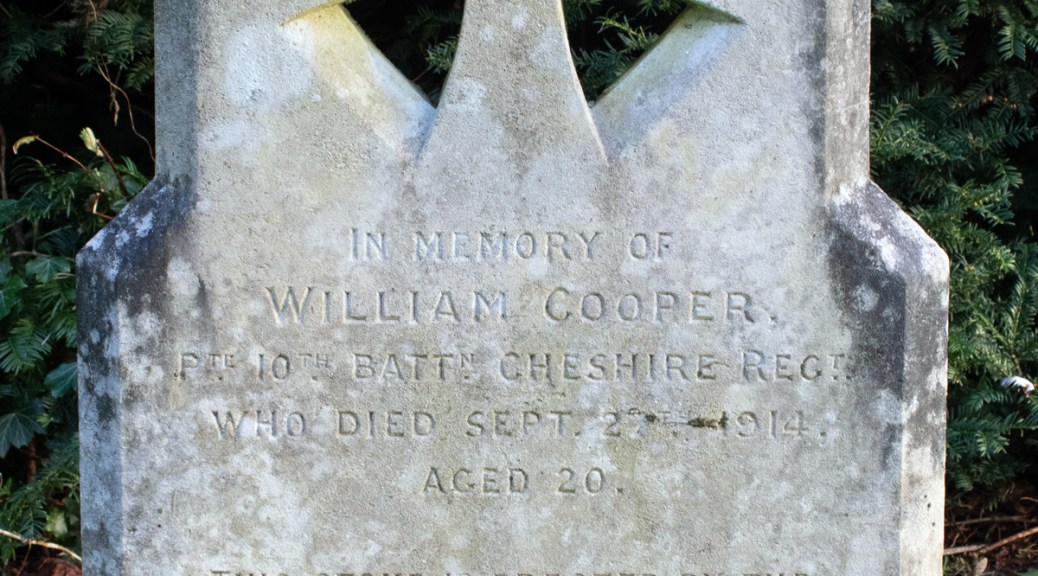
William Cooper was born in Mobberley, Cheshire, in 1894. Little information is available about his family life, but records suggest that his father was called John.
The first document that can be attributed to William is the 1911 census. This recorded him as living in Newton Hall Lane in Mobberley, with his widowed aunt and two cousins.
William’s trail goes cold again at this point, and can be picked up again when war broke out in the summer of 1914. He enlisted early on, joining the Cheshire Regiment. Attached to the 10th (Service) Battalion, his unit moved to Codford on the edge of Salisbury Plain, Wiltshire, by September.
William Cooper… was taken suddenly ill while on parade on Sunday morning at 8.30, and dropping out of the lines, was carried to the Army Medical Corps tent in the Chitterne Road, but on arrival there death had already taken place.
Lieutenant Spraight, of the Army Medical Corps, stated having examined the body of deceased, want he came to the conclusion that death was due to asphyxia and an epileptic fit.
[Devizes and Wilts Advertiser: Thursday 1st October 1914]
Private William Cooper died on 27th September 1914: he was just 20 years old when he died. It seems that his family were unable to cover the cost of the funeral: he was laid to rest in the peaceful graveyard of St Mary’s Church, Codford, his headstone being erected by his comrades in the battalion.
Much of George Fenn’s life is destined to be lost to time. Born in Bristol, Gloucestershire, in the summer of 1878, details of his parents are unknown. His was a common name in the late Victorian period, and census returns from the time identify at least two men born in the area around the same time.
The first document that can be directly connected to George is the 1911 census. This recorded him living at 13 Tankards Close in Clifton, where he was working as a dock labourer. His is noted as having been married to Minnie since 1902. The couple had one child, a son called William who was six years old.
When war broke out, George was quick to enlist. Full details of his service are lost, but he had certainly joined the Bedfordshire Regiment by the end of 1914. Attached to the 7th (Service) Battalion, by the start of the following year, his unit had moved to Salisbury Plain in anticipation of being sent to the Western Front.
George seems to have made his mark in the army, and he was soon promoted to the rank of Lance Corporal. In the spring of 1915, he contracted pneumonia, however, and was admitted to the military hospital in Codford, Wiltshire, close to where his unit was based.
Sadly, the condition was to prove Lance Corporal Fenn’s undoing: he passed away on 1st June 1915, at the age of 36 years of age.
George Fenn was laid to rest in the peaceful churchyard of St Mary’s, Codford, not far from where he had passed away.
George’s entry on the Army Register of Soldiers’ Effects and his Pension Ledger card shed a little more light on the family he had left behind. The first divides his belongings between his widow, Minnie, and the guardian of his child, Mrs Sarah Clarke. George’s pension ledger gives Sarah’s address as 14 Tankard’s Close, Bristol, and confirms that he was, in fact, separated from Minnie when he passed.
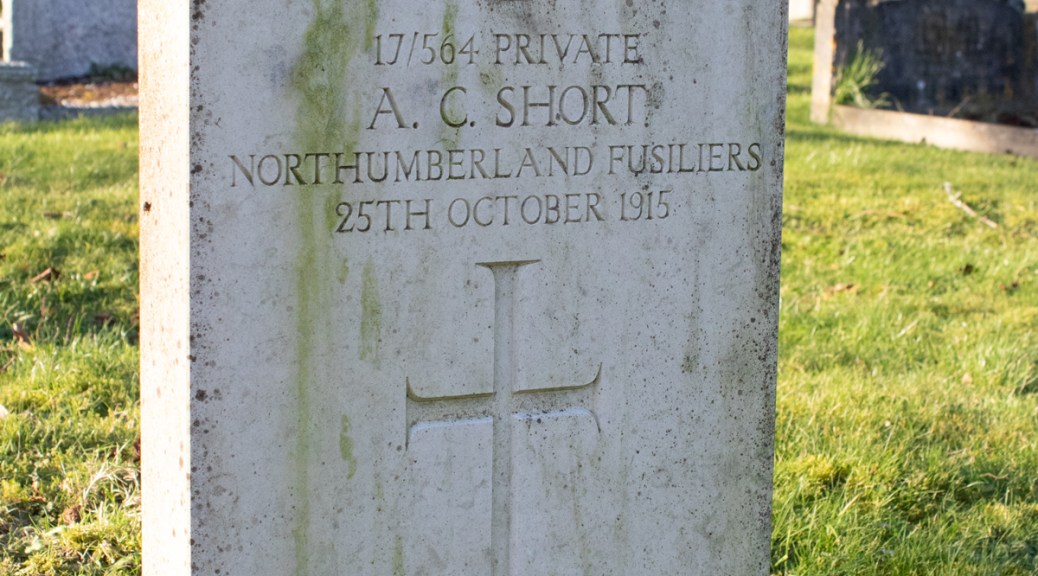
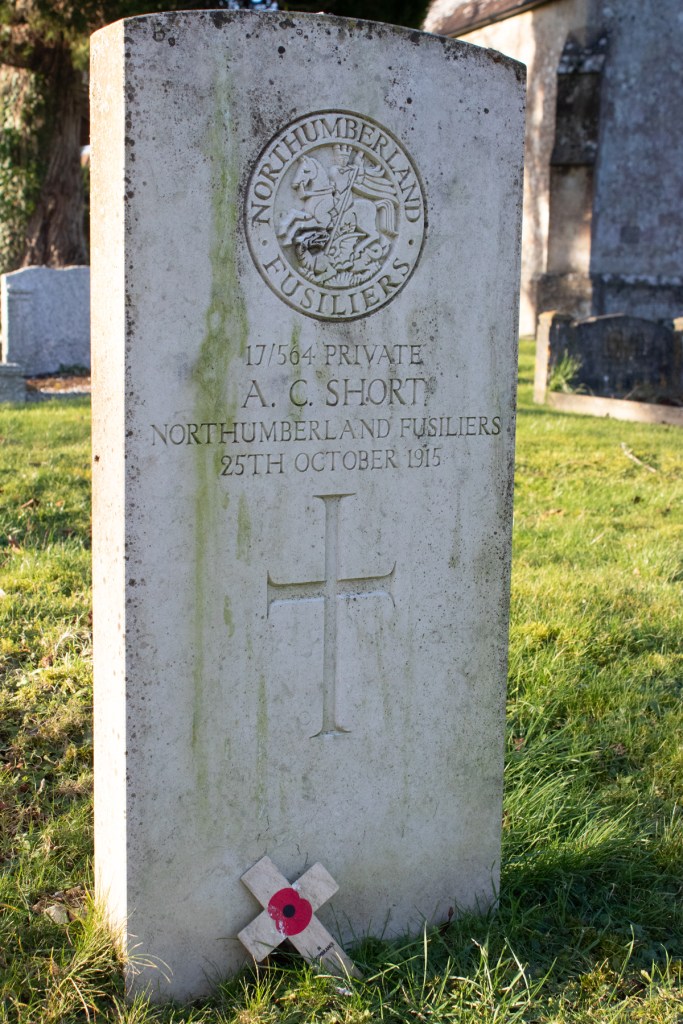
Alexander Coverdale Short was born in the Yorkshire village of Nafferton in the autumn of 1890. One of twelve children, his parents were labourer Benjamin Short and his wife, Emily.
Benjamin died in 1908, and the following year Emily remarried, to widow William Jefferson. He was a clerk for the council in neighbouring Driffield but, by the time of the 1911 census, the family had moved to Sculcoates, near Kingston-upon-Hull, where he had taken up employment at an auctioneer’s.
The 1911 census found the extended family living at 44 Hopwood Street in Hull, a seven-room property. William and Emily headed the household, sharing the house with William’s son Alfred, Alexander and four of his sisters, Alexander’s nephew, two boarders and two visitors – another of Alexander’s sisters and her son.
Alexander was employed as a bricklayer’s apprentice by this point, but at some point found alternative employment working for the North Eastern Railway Company. War was on the horizon, however, and he had enlisted in the Northumberland Fusiliers by the spring of 1915.
Private Short was attached to the 17th (Service) Battalion (North Eastern Railway Pioneers) and, by August 1915, his unit had moved to Codford, Wiltshire, on the edge of Salisbury Plain.
Knowing a trip across the English Channel was likely imminent, before he left Yorkshire, Alexander married Dora Harrison. The daughter of a butcher, she had been born and raised in Sculcoates.
Alexander’s time in the army was not to be a long one. Within a matter of months, his health began to deteriorate, and on 25th October 1915, he died of heart failure at Codford Military Hospital. He was just 24 years of age.
Finances appear to have prevented Private Short’s family from bringing their son and husband home. Instead, Alexander Coverdale Short was laid to rest in the peaceful St Mary’s Churchyard in Codford.
James McEwan was born towards the end of 1879 in Bury Lancashire. He was the older of two children to James and Mary McEwan. James Sr was a foundry worker, who died in the 1890s, leaving his widow to raise their two sons.
By the time of the 1901 census, all three members of the household were earning money: Mary was employed as a cotton card room hand in a mill; James was a wringing machine fitter, while his younger brother, Peter, was a printer’s apprentice.
The next census, in 1911, found James still living at home with his mother. He was now employed as a labourer in the local railway goods yard, and his maternal aunt, Annie, was living with them, working as a rover in the local mill.
When war broke out, James stepped up to serve his country. Full details are lost to time, but it is clear that he enlisted in the Lancashire Fusiliers, and was attached to the 4th/5th Battalion. This was a service and training unit, and Private McEwan did not spend any time overseas.
In the winter of 1915, James was based on Salisbury Plain, Wiltshire. While billeted there, he contracted bronchial pneumonia, and was admitted to a camp hospital. Sadly the condition was to prove too much for his body to bear, and he succumbed to it on 26th December 1915. He was 36 years of age.
It seems that Mary was unable to afford to bring her sone back to Lancashire. He was laid to rest in the peaceful St Mary’s Churchyard, in Codford, Wiltshire, not far from where he had breathed his last.
Philip John Langlois was born 21st September 1886 in St Lawrence, Jersey. One of fourteen children, he was the eldest son to carpenter Philip Langlois and his wife, Mary.
When he finished his schooling, Philip Jr was apprenticed to his father, but, by the time of the 1911 census, the Langlois family had taken on Mayfield Farm. Most of the family we included in running it.
When war came to Europe, Philip left his father’s farm and stepped up to play his part. Sadly, full details of his service are lost to time, but it is clear that he enlisted in the Royal Jersey Militia. Attached to the 1st, or West, Battalion, he served his time on the island.
The funeral took place yesterday afternoon with full military honours of Pte. Philip Langlois, of D (St Lawrence) Co… The deceased, who was 28 years of age, was very popular with his comrades, and was on duty a fortnight ago. Though suffering with a slight cold, he then seemed otherwise to be in good health. A few days ago, however, he was engaged ploughing, when he was taken ill, and returning to his father’s residence… was obliged to take to his bed. Unfortunately he never rallied, but passed away on Tuesday last.
It is very many years since a military funeral took place at St Lawrence, and this coupled with the sad circumstances surrounding the death was responsible for the large number of sympathetic spectators who lined the roads and assembled at St Lawrence Churchyard, where the internment took place.
[Jersey Evening Post: Saturday 6th February 1915]
Philip John Langlois had passed away on 2nd February 1915. His family headstone notes the other members of his family who are buried with him.
Philip’s younger brother, George, enlisted in the Hampshire Regiment, and was attached to the 1st Battalion as a Private. He was caught up in the Third Battle of Ypres and killed on 4th October 1917. George was 21 years of age, and is commemorated on the Tyne Cot Memorial.
Sadness was to strike again on 21st December 1917, when Philip’s sister, Elsie, passed away: she was 28 years old. Another sister, Florence, passed away on 3rd March 1918, aged 29. Both were laid to rest with their brother.
Philip’s parents were also interred in the family grave: Philip Sr when he died in 1936 at the age of 76; and Mary when she passed away in 1955 aged 92.
Percy Light was born on 19th September 1898, and was one of seven children. His parents were groom-turned-motor bus driver Harry Light and his wife, Mary. Harry had been born in Hartlepool, County Durham, while Mary hailed from Penzance, Cornwall. However, the couple raised their family in Paignton, Devon.
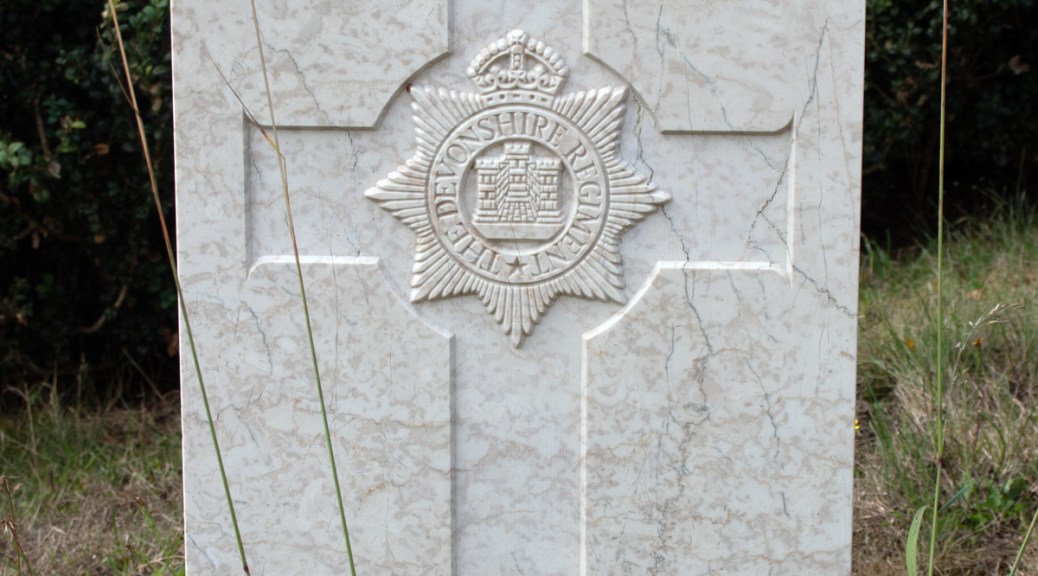
Percy’s trail is a challenge to follow. He enlisted in the army around the time of his mother’s death, early in 1914. He was assigned to the Devonshire Regiment and, as a Private, was attached to the 3rd (Reserve) Battalion. His unit was stationed in Britain throughout the First World War, and there is no evidence that he spent any time overseas.
In the spring of 1917, Private Light fell ill, contracting tuberculosis. The condition was serious enough for him to be medically discharged from the army and he was officially stood down on 22nd February.
Percy’s trail goes cold at this point: he returned to Paignton, and it seems that his poor health got the better of him. He passed away at home on 18th November 1917: he was just 19 years of age.
Percy Light was laid to rest in the sweeping ground of Paignton Cemetery, not far from where his father still lived.
Ernest James Triggs Carder was born early in 1880, the third of ten children to Samuel and Julia. Samuel was a shipwright from Devon and it was in Dartmouth that the family were born and raised.
Ernest – who went by his second name, James – found employment as a groom when he finished his schooling. In the spring of 1907, he married Elizabeth Seward. The couple wed in St Saviour’s Church, Dartmouth, setting up home in Gospel Lane.
James and Elizabeth went on to have three children – Samuel, Edward and Betty. The 1911 census found James working as a grocer’s waggoner, with his youngest brother, Frederick, living with them.
The times were trying for James and Elizabeth: both Samuel and Julia died in 1909; and Edward, their middle child, passed away in September 1911 at the age of just seven months. In the summer of 1915, Betty wad born, and the following April. James was called up to serve his King and Country.
On 14th June 1916, Private Carder was assigned to the Devonshire Regiment, and attached to the 3rd (Reserve) Battalion. The unit would remain on home soil throughout the conflict, but James was not to be part of it for long.
On 29th July 1916, Private Carder was found dead in a lavatory at the Granby Barracks in Devonport, with a razor near him. He had been complaining of eczema on his legs for a while, which made it difficult for him to sleep and had the knock-on effect of causing him headaches. His commanding officer, Corporal Stonelake, said that James “was not too quick, but was a man of good character and tried to do his best… each time he complained of his head he declined to see the doctor.” [Western Morning News: Tuesday 1st August 1916]
Private Carder had willingly enlisted, and appeared not to have any qualms about serving in the army. At the inquest following his death, the jury returned a verdict of taking his life while of unsound mind. He was 36 years of age.
Ernest James Triggs Carder was taken back to Paignton, where Elizabeth and the children were living. He was laid to rest in the town’s cemetery, having found peace at last.
Less than a year later, James’ youngest brother, Frederick, also died. Read more of his life here.








 Death and Service