Category Archives: Sapper

Sapper William John

Sapper William John

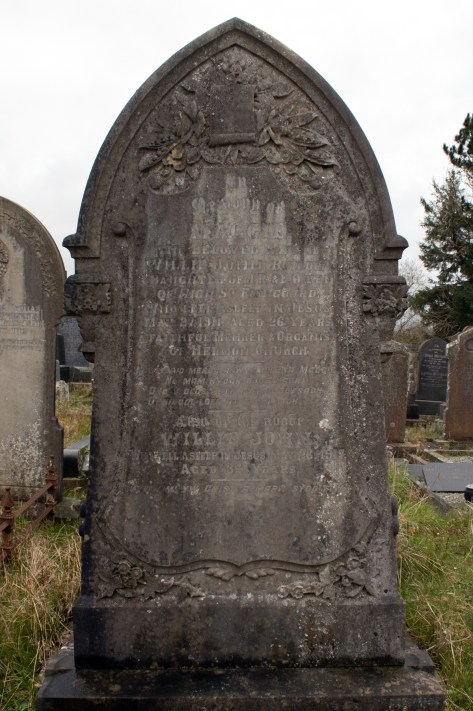
In the Hermon Baptist Burial Ground in Fishguard, Pembrokeshire is a headstone dedicated to Maggie and Willie John. The inscription reads: “In memory of Maggie, the beloved wife of Willie John, builder. Daughter of JR & E Owen of High Street Fishguard, who fell asleep in Jesus May 27, 1911, aged 26 years. A faithful member & organist of Hermon Church… Also of the above Willie John, who fell asleep in Jesus May 26, 1917, age 34 years.”

The early life of Willie – or William – John is a challenge to piece together. He and Maggie – Margaret – married in Hermon Chapel on 30th March 1907, and went on to have a son, Owen, who was born in May 1908.

Willie was employed as a builder and mason, and, after Maggie’s death, sought work wherever he could find it. When war broke out, he was living at 16 Bryn Bedw, Blaengarw, Glamorganshire, although it is unclear whether Owen was with him as well.

Willie’s trade made him an ideal candidate for the Royal Engineers, and he was assigned to the 38th Signal Company when he enlisted on 6th March 1915. Sapper John’s service records show that , he was 5ft 6ins (1.68m) tall, with black hair, dark eyes and a sallow complexion.

Sapper John was sent to Biggleswade, Bedfordshire, for his training, and it was while there that things took a downturn. On 17th September he had a standard inoculation against typhoid, and from there on in felt unwell. Over the following days and weeks he became anaemic and had bouts of giddiness and pains in the back. His medical report notes that he was breathless on waking, and when he walked more than a few hundred yards.

Over the next few months Willie’s condition was monitored, but his condition did not improve. Ultimately he was medically discharged from the army on 10th May 1916, as he was no longer fit enough to serve.

At this point, Willie John’s trail goes cold. He seems to have returned to Pembrokeshire, and it was here, on 26th May 1917, that he passed away. He was reunited with Maggie in the Fishguard burial ground.


Sapper Harold Chandler

Sapper Harold Chandler

Harold Frederic Chandler was born on 8th April 1886, and was the only child to Frederic and Rhoda. Frederic was a newspaper publisher, and the family lived in North London. The 1891 census found the Chandlers living at 1 Parolles Road, Islington; ten years later they were at 14 West View on Highgate Hill.

Those census returns included family members as part of the household. By the time of the 1911 census, however, when the were living in a substantial house at 22 Hillside Gardens, Highgate, there were no other family members with them, although they did have a boarder – banker’s clerk Alfred Schleicher – and domestic servant Esther Tebbutt living with them.

By this point, Harold was 24 years of age, and was employed as an architect’s assistant. War was coming, however, and he was called upon to play his part.

Full details of Harold’s service have been lost to time, but it is clear that he enlisted in the Royal Engineers as a Sapper, likely using the skills he had learnt in his civilian life.

The only documentation confirms Harold’s passing. Discharged from the army on 29th October 1919, he died just over a year later. He breathed his last on 17th December 1920, at the age of 34 years old. His death was registered in Edmonton, Essex, so it seems likely that he was there in some sort of convalescent capacity.

The body of Harold Frederic Chandler was taken back to Middlesex for burial, and he was laid to rest in Highgate Cemetery.


Corporal Gwyn Thomas

Corporal Gwyn Thomas

Gwyn Lewis Thomas was born in Llanrhian, Pembrokeshire, in 1894, and was the youngest of five children to George and Jane Thomas. George was a farmer, and by the time of the 1911 census, his son had been sent to work with another farmer, William Miles, in Mathry, four miles to the east.

When war broke out, Gwyn stepped up to serve his country. He enlisted in the Royal Engineers as a Sapper and, while little information about his service, it is clear that he was sent to France on 23rd August 1915. By the end of the conflict, he had achieved the rank of Corporal, and when the Armistice was declared, he returned home to Wales.

The only other documents connected to Corporal Thomas are those relating to his passing. He died from disease on 2nd March 1920, at the age of 25 years old. His death was registered in Haverfordwest, Pembrokeshire, which would suggest that he either passed there, or that that was the registry office to his home.

Gwyn Lewis Thomas was laid to rest in Mathry Congregational Chapelyard in Rehoboth, midway between his parents’ farm and that of his former employer. His headstone is inscribed with the words Bu farw o effaith y Rhyfel Mawrth (He died from the effects of the Great War).


Sapper Charles Salisbury

Sapper Charles Salisbury

Charles Salisbury was born in Helensville, New Zealand, on 23rd June 1885. The fifth of six children, his parents were James and Sarah Salisbury.

Little information is available about Charles’ early life, but by his 20s he had found work as a linesman, working his way up to foreman. In April 1914 he married Nora Fiori: the couple settled in Onehunga, and had two children: Pauline had been born in 1907, and sister Catherine followed in 1911.

When war broke out in Europe, the British Empire called upon its own to step up and serve. Charles enlisted on 9th April 1916, joining the 15th Division of New Zealand Signallers, itself part of the New Zealand Engineers. His service records show that he was 31 years of age, 5ft 9ins (1.65m) tall and weighed 154lbs (69.9kg). He was noted as having dark hair, blue eyes and a dark complexion.

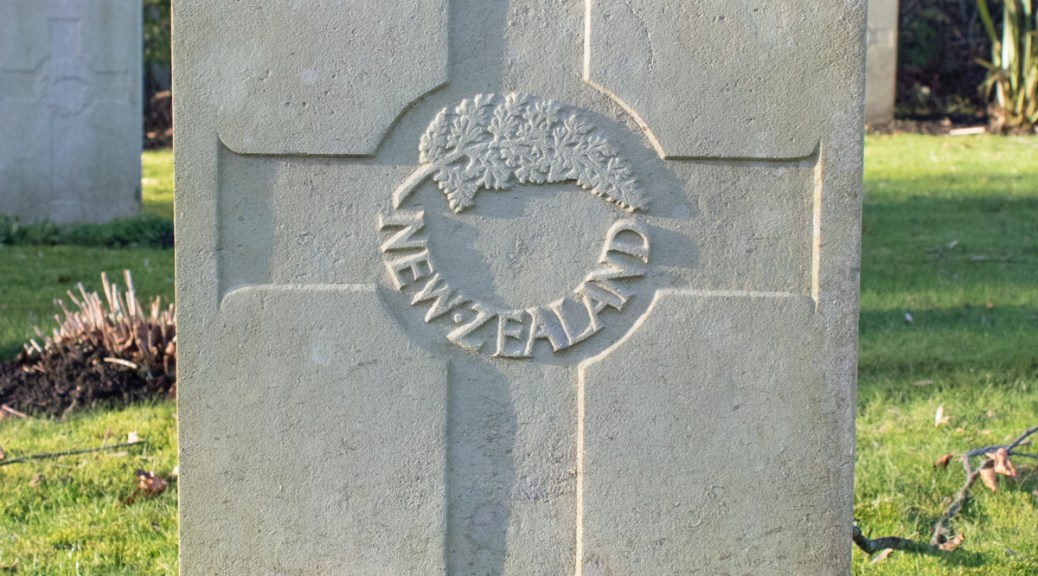
Sapper Salisbury’s unit left Wellington for Britain on 28th July 1916. The voyage on board the ship Waitemata took ten weeks, Charles setting foot on solid ground again in Devonport, Devon, in October. From there the battalion moved to its base near Codford, in Wiltshire.

Charles would spend the next six months in camp, presumably in preparation for a move to the continent. Sadly for Charles, however, he was not to see any action away from Britain. On 27th May 1917 he was admitted to the camp hospital, suffering from a cerebral haemorrhage: he died the following day. Sapper Salisbury was 31 years of age.

Charles Salisbury was laid to rest in the newly consecrated ANZAC extension to St Mary’s Churchyard in Codford, not far from the troops encampment.


Sapper Charles Salisbury
(from findagrave.com)

Sapper Joseph Yeoman

Sapper Joseph Yeoman

Joseph Frederick Yeoman was born on 28th December 1880, the sixth of eight children to John and Eliza. John was a brewer’s drayman from Harbertonford in Devon, but it was on the coast in Paignton that the Yeoman family were born and raised.

When he finished school, Joseph found work as a mason’s apprentice. The 1901 census found the family of seven living in a small terrace cottage on Hill Park Terrace, to the south of Paignton town centre, with all but Eliza bringing in a wage.

In 1906, Joseph married Lydia Gill. She was the daughter of a general labourer from Chudleigh, Devon, who was working as a domestic servant for an architectural surveyor and his wife. The couple went on to have two children – Joseph Jr, who was born the following year, and Lilian, who was born in 1910, but who died when just a babe-in-arms.

The 1911 census found Joseph and Lydia living at 20 Nuneham Terrace, Joseph Jr is missing from the document, and it seems likely that, with his sister’s death, he had been taken in by another relative to allow his grieving parents some space.

When war broke out, Joseph stepped up to play his part. Full details of his military service have been lost to time, and a clear chronology is a challenge to piece together. Lydia passed away in January 1915, but it is not clear whether Joseph had enlisted by this point. His entry in the Army Register of Soldiers’ Effects confirms that he had joined up by September 1915 at the latest, and that he was in the Royal Engineers.

Sapper Yeoman was assigned to the 1st/3rd (Wessex) Field Company. It is unclear from his records whether he served overseas, but by the spring of 1916, he was in Kent.

The news will be received with deep regret of the death of Sapper JF Yeoman… which took place on Sunday from enteric fever at Nackington Hospital, Canterbury. Deseased was in the employ of Mr WF Pearce before joining up, and frequently assisted the old Rugby Football Club.

South Devon Weekly Express: Friday 10th March 1916

Joseph Frederick Yeoman was 35 years of age when he died on 5th March. His body was brought back to Devon for burial, and he was laid to rest in Paignton Cemetery.


Joseph Yeoman Jr was just nine years old when his father, and had lost both of his parents within a space of just over a year. Emma Augusta Gill, possibly Lydia’s sister-in-law, was given guardianship of him, and he moved to East Brent, Somerset, for a new life.


Sapper Walter Woodward

Sapper Walter Woodward

Walter Sargeant Abbott Woodward was born in Bath, Somerset, in the summer of 1896. The oldest of four children, his parents were Henry and Louisa. Henry Woodward was a painter and decorator, but when Walter completed his schooling, he found work as a telegraph messenger for the Genera Post Office.

The 1911 census recorded the family – Walter, his parents and his three siblings – living in a 3-roomed apartment at 5 Beauford Square, close to the city centre. Within a year, Walter had been promoted within the GPO, and was given the role of Assistant Postman.

War came to Europe and Walter was called upon to play his part. On 10th December 1915 he enlisted in the army, and was assigned to the Royal Engineers as a Sapper. His records show that he was still employed by the GPO at this point, and was working as a Lineman, so it seems that his skills were appropriate for the regiment to which he was assigned.

Sapper Woodward’s service documents confirm that he was 5ft 10ins (1.78m) in height, and that he was not formally mobilised until April 1916. After a couple of months’ training, he was sent to France and he remained on the Western Front for just over a year.

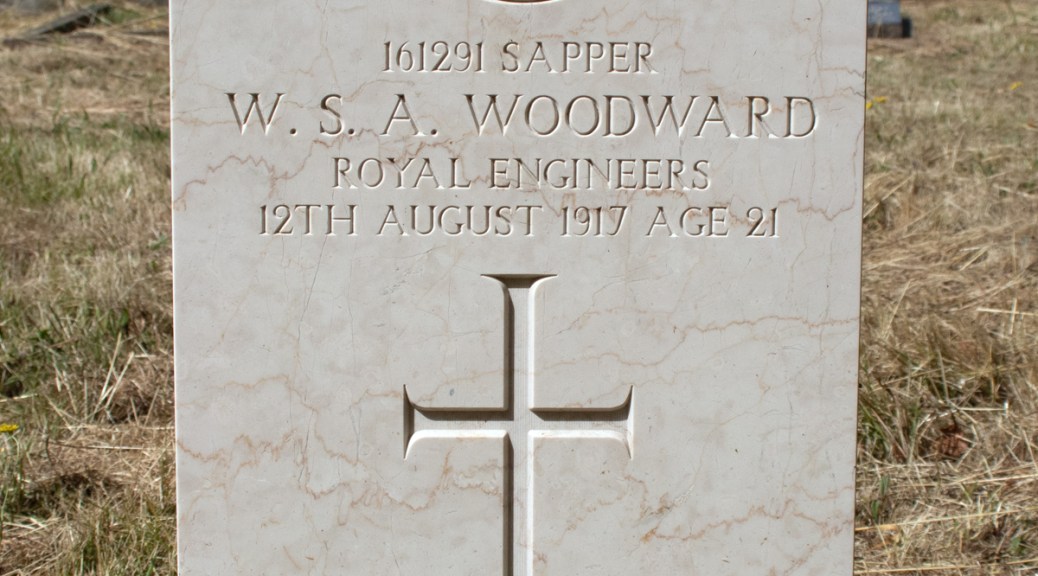
On 3rd July 1917, Sapper Woodward was posted back to England. It seems that he was en route for the Signal Depot in Fenny Stratford, Buckinghamshire, when he became ill. Admitted to the Queen’s Canadian Hospital in Shornecliffe, Kent, he was suffering from gastritis. This would ultimately take his young life: he passed away on 12th August, aged just 21 years old.

The body of Walter Sargeant Abbott Woodward was taken back to Somerset for burial. He was laid to rest in the city’s Locksbrook Cemetery.


Sapper William Harris

Sapper William Harris

William Arthur Edward Harris was born in the spring of 1896 in Uffculme, Devon. The second of four children, his parents were William and Louisa. William Sr was a ganger on the railways, and by the time of the 1911 census, the family has moved to Halberton, near Tiverton, as that was where the work had moved to.

The same census return confirmed the work that William Jr had taken up, noting that he was an apprentice to an agricultural implement maker. This was not to last for long, however, as storm clouds were brewing over Europe.

When war broke out in the summer of 1914, William Jr was keen to play his part. He enlisted the following year, and his apprenticeship seems to have stood him in good stead. He joined the Royal Engineers as a Sapper, and was attached to the 77th Field Coy. His unit arrived in France on 15th July 1915.

Details of William’s time in the army is lost to time, but a newspaper report of his funeral sheds a little light on his time overseas: “Sapper Harris was among the first from Halberton to join up, and had seen much active service in France, being wounded at Arras on Sept. 16, 1917.” [Tiverton Gazette: Tuesday 25th June 1918]

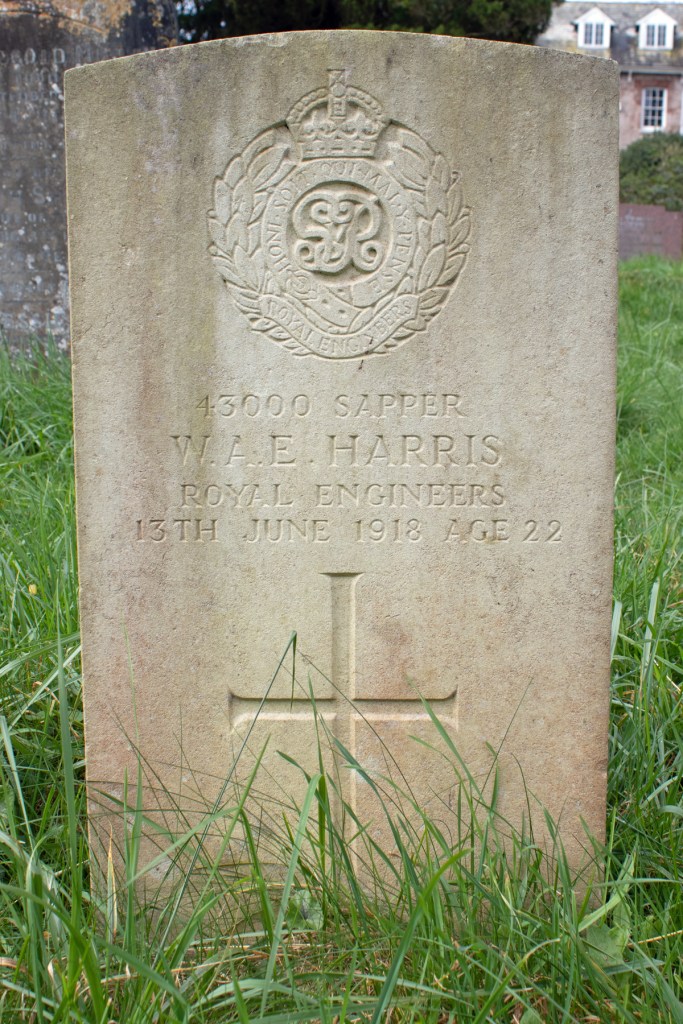
Sapper Harris seems to have returned to Britain by the summer of 1918, although it is unclear whether he was on leave, based back in the UK or was being medically treated here. “At the early age of 22, [William] passed away in Kempston Military Hospital after a brief illness” [Tiverton Gazette: Tuesday 25th June 1918]

William Arthur Edward Harris had died in hospital in Bedfordshire on 13th June 1918. His body was taken back to Devon for burial, and he was laid to rest in the graveyard of St Andrew’s Church, Halberton.


Sapper Rupert Whicker

Sapper Rupert Whicker

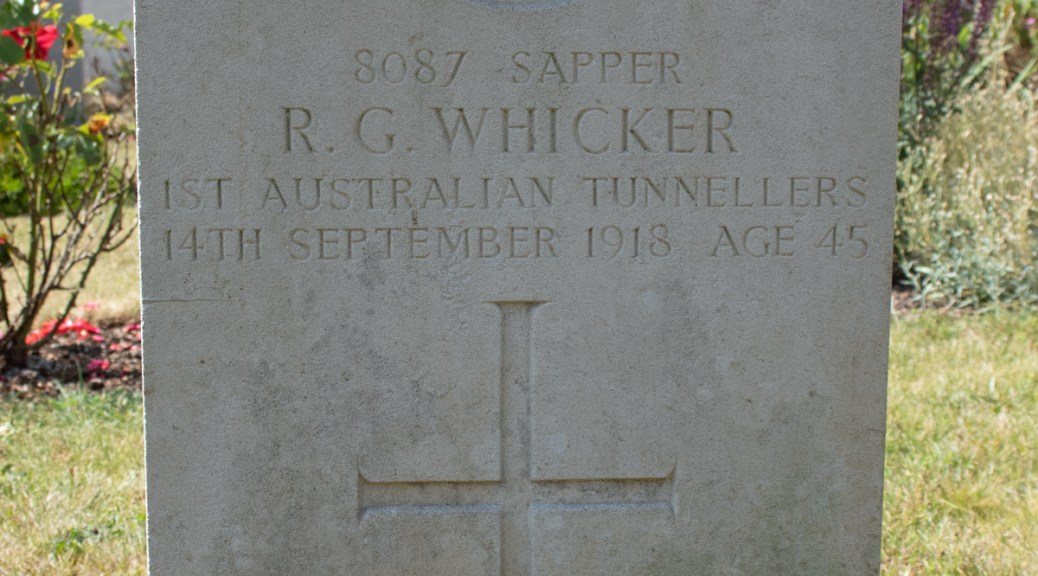
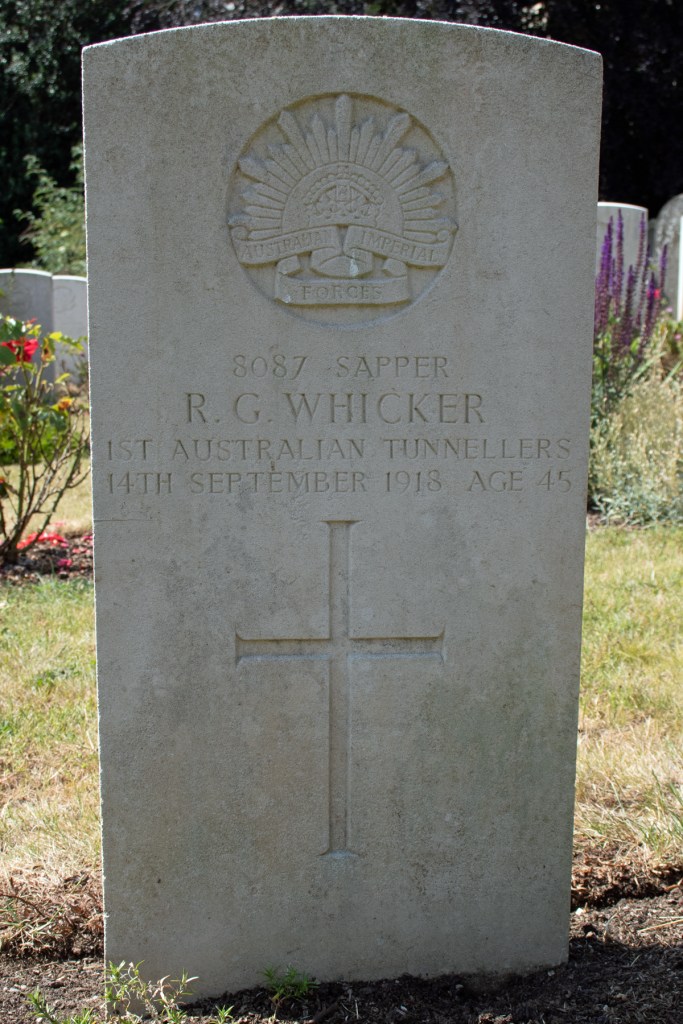
Rupert Gilchrist Whicker was born in Derby, Derbyshire, on 6th February 1873, one of eight children to Walter and Susannah Whicker. There is little information about the family’s early life, and it appears than one of both of Rupert’s parents had died by the time he was 14 years of age.

The Whicker siblings seemed to have gone their own ways at this point, emigrating to the United States and Australia, and it was to Ballarat in Victoria, Australia, that Rupert sailed in 1896. His trail goes cold for then nine years, at which point he married the Australian-born Ellen Ward. The couple would go on to have six children, eventually setting up home in Melbourne.

It is only Rupert’s military records – from when he enlisted on 21st September 1917 – that we discover more about what he had been doing. He gave his trade as miner, and the document suggests that he had tried to join up earlier in the war, but had been rejected as being under height: he was just 5ft 1.5in (1.56m) tall. Rupert’s medical also confirmed that he was 107lbs (48.5kg) in weight, and had auburn hair, hazel eyes and a fair complexion. He was noted as having a birth mark on the side of his left foot and two scars on his left cheek, between the eye and the bone.

Sapper Whicker was assigned to the 1st Battalion of the Australian Tunnellers. He left Australia on board the SS Indarra on 26th November 1917, bound for Europe. After leaving Port Said, Egypt, on 9th January 1918, Rupert’s unit landed in the south of France eleven days later. They travelled to Cherbourg by train, and finally landed in Southampton, Hampshire, on 2nd February 1918.

Rupert would remain on British soil until the beginning of April. His unit arrived in Caëstre in the middle of the month, and he then found himself on the Western Front. Sapper Whicker would serve there for the next four months, and it was only because of illness – a bout of gastritis – that he was brought back from the Front Line.

The stomach condition was severe enough to warrant Rupert’s medical evacuation to Britain for treatment, and he was admitted to Bath War Hospital in Somerset. What was initially thought to be an infection turned out to be far more serious. Sapper Whicker was diagnosed as having stomach cancer, and it has quickly taken hold. Sadly, it would prove fatal, and Rupert passed away on 14th September 1918: he was 45 years of age.

Rupert Gilchrist Whicker had died thousands of miles from his home. He was laid to rest in the military section of Bath’s Locksbrook Cemetery, not far from the hospital in which he had breathed his last.


Sapper Nuriel Evans

Sapper Nuriel Evans

Nuriel Ivor Evans was born on 22nd October 1892 in Lefroy, Tasmania, Australia. The older of two children, his parents were Powel and Mary Evans. There is little definitive information about Nuriel’s early life. The first concrete details come from his First World War service records.

Nuriel enlisted in the Australian Imperial Force on 31st August 1915. He was working as a tailor at the time, bring in money for his wife, Ida, who he had married in May 1913, and their daughter, Mollie, who was born that December.

Sapper Evans’ records confirm he was 5ft 3.5ins (1.61m) tall and weighed in at 131lbs (59.4kg). He was noted as having brown hair, grey eyes and a fair complexion, with a scar on his right shin.

Nuriel sailed for Europe on 23rd November, having been attached to the Australian Engineers. His unit left the Egyptian port of Alexandria in March 1916, and arrived in Marseille, France, ten days later. Leave aside, he was to serve on the Western Front for the next two years.

Barring one offence of being absent from parade (on 23rd March 1916, for which he was confined to barracks for a day), Sapper Evans had an unblemished record. On 23rd June that yeah, he was admitted to a field hospital because of a scald to his left foot. The injury was severe enough for him to be medically evacuated to Britain for treatment, and he only eventually returned to his unit on 24th February 1917.

Sapper Evans was badly wounded again on 27th April 1918, having received shrapnel wounds to his back, left buttock and right hand. Initially treated on site, he was moved to a hospital in Rouen, before being evacuated to Britain once more. By 1st May, he was in Bath War Hospital, Somerset, for treatment.

Sadly, any medical support was to prove too little. Sapper Evans passed away on 15th May 1918, from an “aneurysm shock following [a] secondary haemorrhage.” He was 25 years of age.

Thousands of miles from home, Nuriel Ivor Evans was laid to rest in the military section of Bath’s Locksbrook Cemetery.


Sapper Nuriel Evans
(from findagrave,com)

Serjeant Herbert Fleming

Serjeant Herbert Fleming

Herbert Gordon Maurice Fleming was born in Stockton, Wiltshire, on 24th March 1888. An only child, his parents were carpenter and wheelwright George Fleming and his wife, Annie.

Little further information is available about Herbert’s early life. On 25th June 1910 he married Ethel Young, a shepherd’s daughter from Wiltshire: they would go on to have four children, Herbert Jr, Ivy, George and Harold.

Herbert’s marriage certificate noted that he was employed as an engine driver. In his spare time, he also volunteered for the Wiltshire Regiment. When war broke out in the summer of 1914, he was called upon to play his part, and was formally mobilised in July 1916.

Sapper Fleming joined the Royal Engineers. His service records show that, at 28 years of age, he stood 5ft 7.5ins (1.71m) tall, and weighed 159lbs (72kg). He was of good physical development, although his medical report noted that some dental attention was required, and he had a pendulous mole on his back.

After his initial training, Herbert was sent to France. He was to remain part of the British Expeditionary Force for the next three years. While details of his service are scarce, his commitment to the army was clear: he was promoted to Lance Corporal in December 1918; full Corporal in June 1919; and Serjeant just three months later.

In October 1919, Herbert arrived back in Britain and the following month he was formally demobbed. He returned to his family, who were now living in Bath, Somerset. Back on civvy street, Herbert took up work as a motor waggon driver in the city, but his post-army life was to be short-lived.

The enquiry into the death on Saturday of Herbert John Maurice Fleming… was held at Bath Guildhall… Medical evidence proved that the cause of death was heart failure, due to an unexpected attack of pneumonia.

The widow said her husband did not complain of illness until Friday evening, when he returned from a journey to Reading. He then said he ached all over, and would go to bed at once. On Saturday evening he said he felt better, and sent her to the chemist for a tonic. He told her not to send for a doctor, as he expected to be quite well on Monday. On Sunday he still appeared fairly well, and was quite cheerful: but in the afternoon he complained of sickness, and the end came very suddenly.

[Bath Chronicle and Weekly Gazette: Saturday 27th March 1920]

Herbert John Morris Fleming was just three days short of his 32nd birthday when he died. He was laid to rest in Bath’s sweeping Locksbrook Cemetery.


The spelling of Herbert’s second middle name is variously noted as Maurice and Morris. For consistency, I have used the spelling noted on his birth certificate.