Category Archives: Sergeant

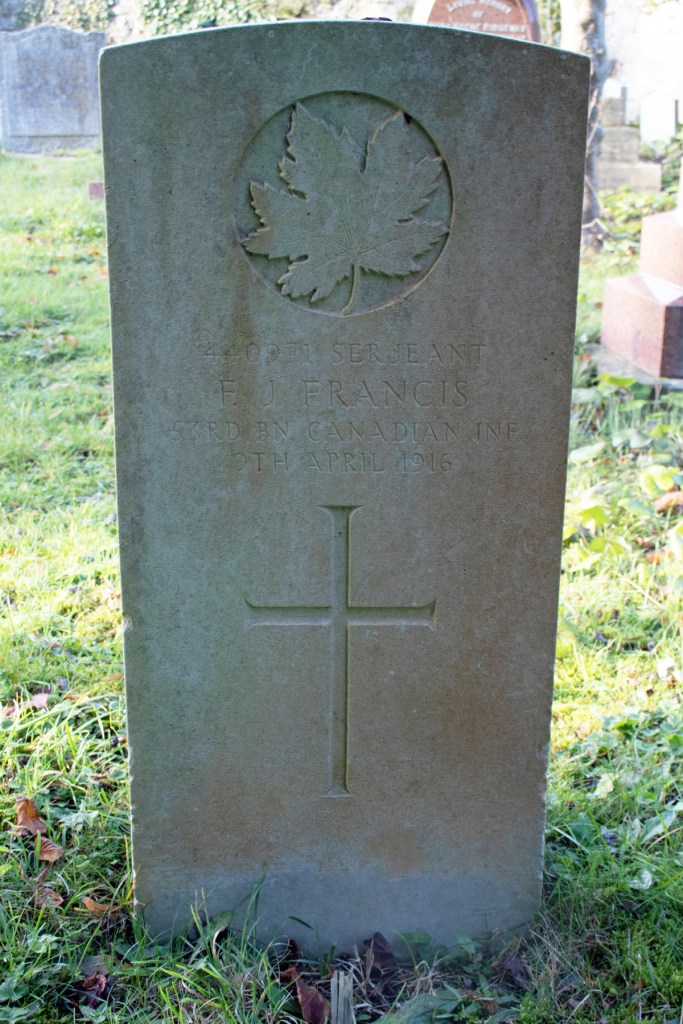
Serjeant Frederick Francis

Serjeant Frederick Francis

Frederick John Francis was born on 15th February 1893, to Henry and Mary Francis. One of nine children, the family lived in the Somerset village of Curry Rivel.

Henry was a labourer, but Frederick had his sights set on a new life and, at some point in his teens, he emigrated to Canada to work as a farmer. Details of his life in North America are scarce, but it is clear that he was in Manitoba when war broke out back in Europe.

Frederick stepped up to serve his King and Country, enlisting at Camp Sewell on 5th April 1915. His service records confirm that he was 5ft 5ins (1.65m) tall, and weighed 145lbs (65.8kg). He was assigned to the 53rd Battalion of the Canadian Infantry. His service papers also note that he was promoted to the rank of Sergeant on 30th April 1915, although whether the date is correct, or whether Frederick had previous military experience is unclear.

Sergeant Francis boarded the SS Empress of Britain to make the journey back to Europe, little knowing that he was not going to see his home again. On 9th April 1916, just one day from docking in Hampshire, he passed away from quinsy, or throat abscess. He was just 23 years of age.

The body of Frederick John Francis was brought back to Somerset for burial. He was laid to rest in the graveyard of St Andrew’s Church in the village of his birth, Curry Rivel.


Frederick’s younger brother, Charles, had also made a life in Canada. He enlisted at Camp Sewell just two months after his brother, joining the same battalion.

Charles, who had the rank of Private, arrived in Europe before Frederick and, and was sent to the front line in February 1916. In June, he was involved in the fighting at Mount Sorrel, on the Ypres Salient, and it was here, on 6th June 1916, that he lost his life. He was just 21 years of age.

Charles Arthur Francis is commemorated on the Menin Gate in Ypres. His parents had to mourn the loss of two sons within two months.


Sergeant Herbert Rendall

Sergeant Herbert Rendall

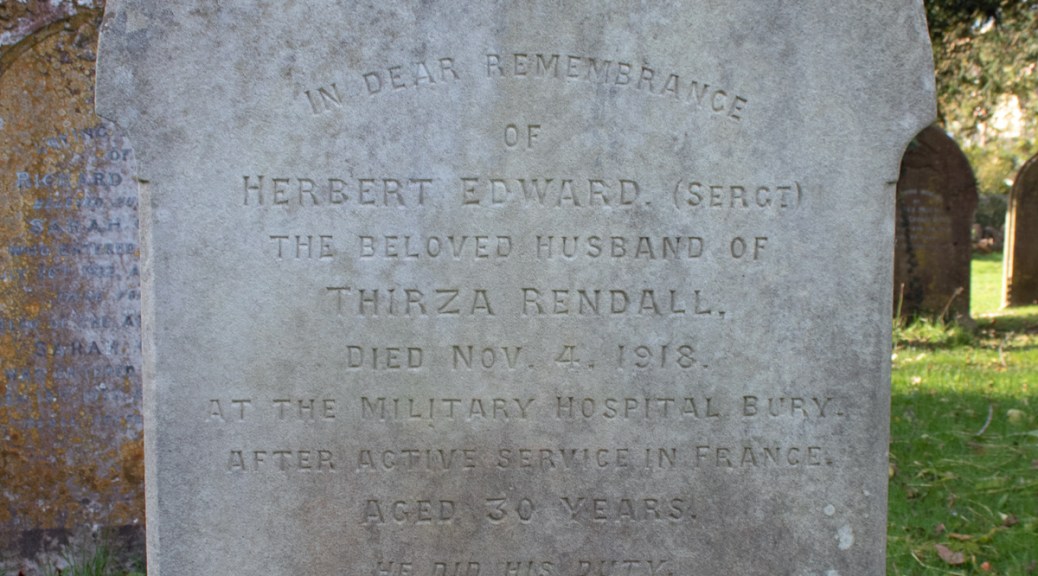
Herbert Edward Rendall was born in West Coker, Somerset, in the autumn of 1889. He was one of eight children to William and Mary Rendall. William was a foreman at a local twine factory, although by the time of the 1911 census, he had also taken on ownership of a local grocer’s shop. Herbert and his younger brother, Clifford, managed the shop for their father.

In the spring of 1913, Herbert married Thirza Shire. She was the daughter of an agricultural labourer from Yeovil and, by the time of their marriage, she had taken on work as a servant for the vicar of St Leonard’s Church in Misterton, near Crewkerne.

When war was declared, Herbert joined the Somerset Light Infantry. Sadly, little detail of his military service remains. It is clear that he was hard working and well thought of, as he progressed through the ranks to Sergeant, and transferred to the 1st Battalion of the Wiltshire Regiment.

Herbert served on the Western Front, and, as the war entered its final months, he would certainly have been involved in the Battles of the Lys, on the Hindenburg Line and in the closing Battles of the Somme.

By the autumn of 1918, Sergeant Rendall was back on home soil, either for home support, or for medical reasons. He was based in Bury, Manchester, and had fallen ill. While the full details are unclear, whatever condition he had contracted got the better of him, and he passed away on 4th November 1918. He was 29 years of age.

Herbert Edward Rendall was brought back to Somerset for burial. He was laid to rest in the quiet graveyard of St Martin’s Church in West Coker.


Records vary over the date of Herbert’s passing. While his headstone confirms 4th November, military records – and the Commonwealth War Graves Commission website – suggest the following day. Similarly, some documents suggest he was 30 when he died, while his birth and death records confirm he was in his thirtieth year.


Thirza went on to have a full life. She married again in 1923, to a Henry Tregale, and the couple went on to have a daughter. She lived to a ripe age, passing away in the autumn of 1981, at the age of 93.


Serjeant Frederick Wilton

Serjeant Frederick Wilton

Frederick Uriah Wilton was born in Yarlington, Somerset, in the spring of 1892. One of thirteen children, his parents were farm labourer Thomas Wilton and his wife Mary.

Frederick and his brothers followed their father into agricultural labouring, and, according to the 1911 census, the family were living and working at Shatwell Farm, on the outskirts of Yarlington itself.

When war broke out, Frederick was keen to play his part. Details of his military service are difficult to piece together, but what is clear is that he enlisted in the Bedfordshire Regiment.

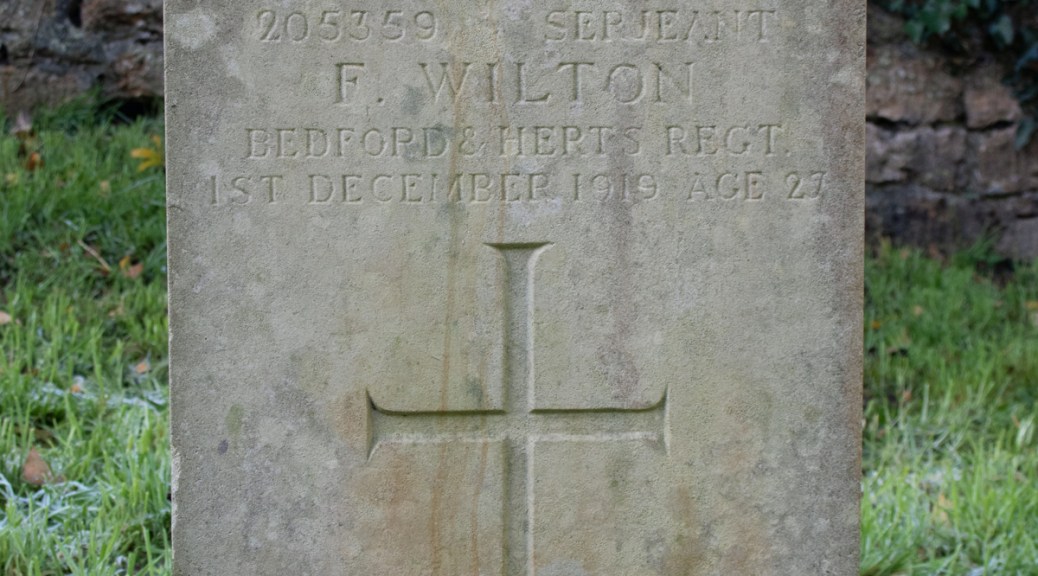
During his time in the army, Frederick rose to the rank of Serjeant. He survived the war and, in 1919, he was placed on furlough while waiting to be demobbed. Sadly, it is likely that he fell ill during this time, and he passed away on 1st December 1919, at the age of 27.

Frederick Uriah Wilton was laid to rest in the graveyard of St Mary’s Church in Yarlington.


Serjeant Wilton’s headstone notes that he served in the Bedfordshire and Hertfordshire Regiment. The two regiments were amalgamated in 1919, and Frederick was recorded as having served in the newly formed regiment.


Lance Serjeant John Whiddett

Lance Serjeant John Whiddett

John Whiddett was born in Hammersmith, Middlesex, in 1892, and was one of thirteen children to Alfred and Mary Ann Whiddett. Alfred was a house painter while Mary Ann worked as a charwoman to bring in some additional money for the growing family.

John worked as a porter when he left school, but when war came to Europe, he stepped up to play his part. He enlisted in the Wiltshire Regiment in the summer of 1915, and was assigned to the 3rd (Reserve) Battalion.

While Private Whiddett served in France, he returned to Britain, and promoted to Corporal and then Lance Serjeant. His battalion eventually formed part of the Thames & Medway Garrison. Frederick found himself in Kent by the autumn of 1917 and served out the remainder of the war there.

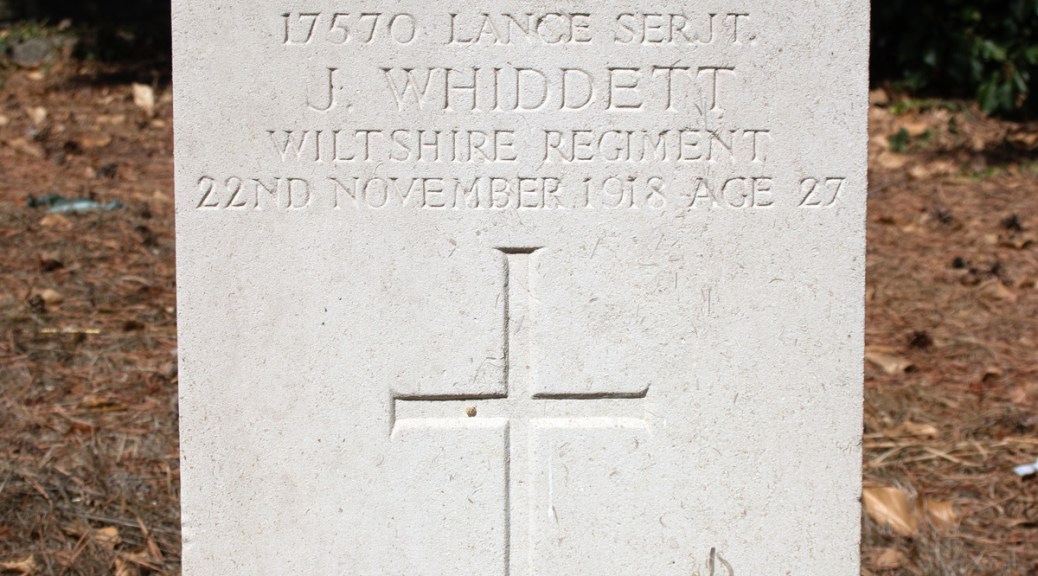
At some point during the autumn of 1918, Lance Serjeant Whiddett fell ill. He was admitted to the Preston Hall Military Hospital in Aylesford, suffering from a combination of influenza and pneumonia. Sadly he was not to survive these lung conditions, and he succumbed to them on 22nd November 1918. He was just 26 years of age.

Finances may have restricted John’s family’s ability to bring his body back to Middlesex. Instead, he was laid to rest in the graveyard of St Peter and St Paul’s Church in Aylesford, Kent.


Serjeant Albert Rumbelow

Serjeant Albert Rumbelow

Albert Edward Rumbelow was born in 1879 in Wycombe Marsh, Buckinghamshire. One of eleven children, his parents were Suffolk-born paper maker Philip Rumbelow and his wife, Jane.

Little information is available about Albert’s early life, although by the time of the 1901 census, he is recorded as being a Private in the Rifle Brigade. The family had moved to the village of Little Chart in Kent by this point, where his father was still continuing in the manufacture of paper.

Private Rumbelow’s military service is evidenced in later documents. He served with the 1st Battalion from 1895 to 1907, was awarded the South Africa medals for 1901 and 1902: he was also granted the clasp for his involvement in the defence of Ladysmith. He appears to have been wounded at this point, and was invalided out of full military service and placed on reserve.

In 1904, Albert was back in England, and living in London. That year he married Ellen Sillis, a cordwainer’s daughter from Norfolk. The couple set up home in Fulham, and went on to have five children: Abert Jr, Iris, Florence, Doris and Hilda.

By the time of the 1911 census, Albert was working at the local Public Hall, as a labourer, hall attendant and cleaner. The family were living at 9 Crabtree Lane in Fulham, sharing the property with the Fitzgerald family.

War was closing in on Europe by this point, and, once again, Albert stepped up to plat his part. He enlisted within days of conflict being declared, and within weeks had been given the rank of Corporal. His service records note that he was 5ft 10ins (1.78m) tall, weighed 156lbs (70.8kg), had brown hair and blue eyes. He was also recorded as having a tattoo of crossed rifles and a crown on his right forearm, and scared on his left calf, knee and eyebrow.

By the spring of 1915, Albert had been promoted again, to the rank of Serjeant. He was sent to France on 19th May, having been assigned to the 7th (Service) Battalion. Serjeant Rumbelow was involved at the Somme and was awarded the Distinguished Conduct Medal “for conspicuous gallantry” on 3rd June 1916. “He exposed himself to machine-gun and rifle fire when going across the open to rescue a wounded man. Later he went under fire to fetch a stretcher.”

Serjeant Rumbelow appears to have been injured in the skirmish, and was invalided to the UK later that month. When he recovered he was posted again, this time to the 18th (London) Battalion of the Rifle Brigade.

The following February he made the transfer across to the Labour Corps, and by March 1917, Serjeant Rumbelow was back in France. In August he was promoted to Company Sergeant Major, but was invalided back to England with bronchitis in February 1918.

When he recovered Albert was assigned to the 364th Area Employment Coy. in Kent, and seems to have voluntarily taken a drop in rank – back to Serjeant – in doing so. His health was dogging him by this point and in the late summer of 1918, he was admitted to Preston Hall Military Hospital in Aylesford, suffering from VDH, or heart disease.

Sadly, the strain of his military service was to be his undoing. He passed away from the heart condition on 21st September 1918, at the age of 39 years of age.

Albert Edward Rumbelow was laid to rest in the graveyard of St Peter & St Paul’s Church in Aylesford, not far from the hospital where he had breathed his last.


Now widowed, Ellen was left with the unenviable task of raising five young children on her own. She married again, to Private William Lake, on 8th June 1919, and the family moved to Essex. She lived until the age of 79, and was laid to rest in Sutton Road Cemetery in Southend.


Lieutenant Thomas Denny

Lieutenant Thomas Denny

Thomas David William Denny was born on 26th December 1890 in Glasgow, Lanarkshire. There is little information on his early life, other than that his parents were Thomas and Annie Denny.

By the time of the 1911 census, Thomas Jr was serving as a Lance Corporal in the 2nd Battalion of the Gloucestershire Regiment, and was based at the Verdola Barracks in Malta.

When war broke out, the battalion was called back to mainland Europe. By 19th December 1914, Thomas found himself in France; two years later, he was in Salonika, Greece.

Thomas’ bravery was not in doubt. While serving in France, he received the Military Medal for conspicuous gallantry. This went hand in hand with a promotion to Sergeant. In 1917, he received a commission as Second Lieutenant and was moved to the regiment’s 3rd Battalion.

In the spring of 1918, Second Lieutenant Denny married Elsie, a woman from Bearsted, near Maidstone in Kent. Sadly, little else is known of her, and even a later newspaper report only referred to her as “a Bearsted lady” [East Kent Gazette: Saturday 15th March 1919].

By early 1919, Thomas was back in Britain. Whether he had been demobbed is unclear, but is seems more likely that he had returned home for medical treatment. On 6th March, he passed away in Maidstone. He was just 28 years of age.

Thomas David William Denny was laid to rest in the graveyard of Holy Cross Church in Bearsted close to where the now-widowed Elsie must have lived.


Serjeant Frank Carter

Serjeant Frank Carter

In the graveyard of St Augustine of Hippo Church in Penarth, Glamorgan, lies the Commonwealth War Grave for Serjeant Frank Carter. The headstone confirms that he had died on 31st August 1915 and that he was in the Loyal North Lancashire Regiment.

Little further information is available about him, apart from a few scattered details from a number of documents.

Frank’s burial record shows that he had been residing in The Fort, Penarth, a garrison constructed on the cliffs near the entrance to the harbour and Cardiff Bay. The record, written by George Turner, confirms that his burial was on 2nd September 1915, and that he was 51 years old when he passed.

Serjeant Carter’s record in the Army Register of Soldiers’ Effects confirm that he was in the 2nd/4th Battalion of his regiment, and that he must have enlisted at some point before February 1915. The document states that he died in the Western Hospital in Cardiff, and that his beneficiary was Miss M Smithson.

These few documents add up to very little, and do not provide enough information to concretely uncover anything else of Frank Carter’s life. His is a story that is destined to remain lost to time.


Frank shares his grave with another member of the Loyal North Lancashire Regiment, Private Edward Savage. Read his story here.


Serjeant-Trumpeter Alexander de Vere

Serjeant-Trumpeter Alexander de Vere

Alexander Johnstone de Vere was born on 10th August 1889 in Murree, India (now Pakistan). He was one of five children to Norfolk-born Alexander Johnstone (also known as John Ralph de Vere), and his wife Dorothea who had been born in Sangor, India. Alexander Sr was a Sergeant Major in the 12th Lancers, and the family returned to England not long after his son was born, settling first in Aldershot, then in Sandhurst.

Alexander’s youngest sibling, George, was born in Cairo, Egypt, so the family was on the move again. Sadly, Alexander Sr died in a nursing home in the city just two years later and, after returning to England, Dorothea passed away in a Holborn infirmary just two years later.

Documents for the de Vere children – Ellen, Alexander, Dorothea, William and George – are few and far between. The 1911 census places Dorothea boarding with a family in Kingston-upon-Thames, where she was employed as a dress maker. The same document records William as a Bandsman in the 1st Battalion of the Seaforth Highlanders, based at Chanpatia, in Northern India. George, meanwhile, was a schoolboy at the Duke of York’s Royal Military School on the outskirts of Dover. Of the two eldest siblings, however, there is no record.

In the autumn of 1912, Alexander married Emily Louise Collins. Born in Norfolk in 1884, she was working as a servant in a house in Surrey when she and Alexander met. The couple married in Faversham, Kent, and settle down there, their daughter, Dora, being born in the town in January 1915.

Given his family’s military background, it is not unsurprising that Alexander enlisted in the army almost as soon as war was declared. He may have already seen military service, as he enlisted in the 11th Hussars as a Lance Corporal. By 15th August 1914, Alexander was in France.

Lance Corporal de Vere was quickly caught up in the fighting. He saw action at Mons and Nery in 1914, and at Ypres the following year. By this point, he had been promoted to the rank of Sergeant Trumpeter, reflecting the musical connection he shared with his younger brother, William.

Alexander remained in France until January 1916, when he was invalided home. He was admitted to Dorchester County Hospital in Dorset, suffering from a cerebral abscess. Despite treatment, he succumbed to the condition, passing away on 17th March 1916, at the age of just 26 years old.

Alexander Johnstone de Vere was brought back to Kent for burial. He was laid to rest in Faversham Borough Cemetery.


Quartermaster Serjeant George Bunting

Quartermaster Serjeant George Bunting

George William Willis Bunting was born in Faversham, Kent, in the spring of 1889. The middle of eleven children to George and Mary Ann Bunting, he was also the oldest boy. George Sr was a labourer in the town’s munitions works, and his son followed suit, and was recorded as a cordite labourer there in the 1911 census.

When war came to Europe, George Jr was keen to play his part. He enlisted in the Royal Garrison Artillery, and was assigned to the 343rd Siege Battery. While full details of his service are not available, George’s life was laid out in a newspaper report following his death:

The death has occurred in quite pathetic circumstances of Battery Quartermaster Sergeant George William Bunting, 1st Kent Heavy Battery, Royal Garrison Artillery… who, after serving throughout the war, and coming unscathed through more than three years service in France, though he had several narrow escapes, had died of pneumonia at his home, just as he was anticipating return to civil life.

BQMS Bunting joined the Faversham Volunteer Corps (in which his father also formerly served) some seven years before the war, and when was broke out he was at the annual training with the Battery. War service immediately followed and in 1915 he went to France and, except for leave, had been out there ever since until a few weeks back when he returned for demobilisation. He was not feeling at all well when he arrived home, indeed he seems to have been so unwell that when he got indoors he remarked “I’m done.”

His words, unhappily, were only too prophetic, for he never left the house again, pneumonia developing and culminating in his death on February 27th, only nice days after his arrival.

Prior to the war the deceased, who was in his 30th year and unmarried, had been employed at the Cotton Powder Works ever since he left school. At the commencement of his war service, he was a Corporal, but his keenness at his work steadily gained him promotion and eventually he reached the rank of Battery Quarter Master Sergeant. Keen and conscientious himself, he expected the same in others, and it says much for his example and influence that he was held in the very highest regard by the men of his Battery, while to his officers he was a greatly valued NCO.

Faversham News: Saturday 15th March 1919

Quartermaster Serjeant George William Willis Bunting died at his Faversham home on 27th February 1919. He was just 29 years of age. He was laid to rest in the town’s Borough Cemetery.


Serjeant Frank Ely

Serjeant Frank Ely

Frank Harold Ely was born in November 1889, and was the oldest of four children. His parents were coal porter Frank Ely and his wife, Florence. They were both born in Kent, and raised their family in their home town of Faversham.

When Frank Jr left school, he found work as a bottler, but he had his eyes set on bigger adventures. In January 1908, at the age of 18, he enlisted in the 1st Battalion of the Rifle Brigade. His service records show that he was 5ft 5.5ins (1.66m) tall and weighed 109lbs (49.5kg). Rifleman Ely had brown hair, grey eyes and a fair complexion. He was also noted as having a scat on his right knee.

Rifleman Ely’s early service was wholly territorial, but not without incident: in 1909 he was treated for tonsillitis, two years later, he received treatment for syphilis.

He was also not one to toe the line. In August 1911, he was reprimanded for not appearing at the 6:30am parade. On 9th March 1912, he was severely reprimanded for ‘improper conduct in town, at about 11:35pm’. On 25th September 1913, he was reprimanded once again, this time for irregular conduct – using the officers’ latrines.

When war came to Europe, the Rifle Brigade were soon in the thick of it. On 26th August 1914, Frank was wounded in the hand during fighting at Ligny, France, and was then captured and held as a prisoner of war in Hamelin until the spring of 1918.

Moved to the Netherlands, Rifleman Ely was finally released after the Armistice was signed, and returned to England on 19th November 1918. He was demobbed the following March, but re-enlisted within weeks, was given the rank of Serjeant and was due to be shipped to India to continue his service.

However, while at an army camp in Aldershot, Frank contracted pneumonia. The struggles the previous few years had had on his health proved too much for him, and, on 26th August 1919 – five years to the day that he had been shot and captured – Serjeant Ely passed away. He was 40 years of age.

Frank Harold Ely was brought back to his home town for burial. He was laid to rest in Faversham Borough Cemetery.