James Hurley was born in Timoleague, County Cork, Ireland, on 1st August 1894. His was not an uncommon name so full details of his early life are a challenge to unpick. However, later records confirm that his father was also called James Hurley, and when he finished his schooling, he found work as a farm labourer.
When war broke out in Europe, James Jr was quick to step up and play his part. He enlisted in the Royal Navy on 12th January 1915, and took the role of Stoker 2nd Class. His service records show that he was 5ft 5.5ins (1.66m) tall, with dark brown hair, grey eyes and a fresh complexion.
Stoker 2nd Class Hurley was sent to HMS Pembroke, the Royal Naval Dockyard in Chatham, Kent, for his training. However, his time there was to be tragically brief. He was admitted to the Welcome Hospital when he contracted pneumonia and empyema, but the condition was to prove too severe. He passed away on 6th February 1915, at the age of just 20 years old. He had been in the Royal Navy for just 25 days.
James Hurley’s parents were unable to bring him back to Ireland for burial. Instead, he was laid to rest in the Roman Catholic section of the Woodlands Cemetery in Gillingham, not far from the dockyard in which he had so briefly served.
Thomas McCall was born in Bootle, Lancashire, in 1892 and was one of two children to Francis and Elizabeth. Frank was a stoker on the steamers leaving Liverpool docks and, after working at the docks himself, Thomas soon followed his father onto the ships. By the summer of 1911, he had worked as a trimmer on at least two liners, the RMS Carmania and the RMS Empress of Britain.
When war came to Europe, Thomas stepped up, joining the Mercantile Marine Reserve – now better known as the Merchant Navy. By the summer of 1915, he was assigned to the seaplane carrier HMS Vindex, which spent most of the war in the North Sea.
Stoker McCall’s time there was to be brief. Details are sparse, but he passed away on 14th October 1915, with records suggesting this was due to disease. He was just 23 years of age.
Finances may have limited Frank and Elizabeth from bringing their son back to Lancashire: Thomas McCall was instead laid to rest in the Roman Catholic section of Woodlands Cemetery in Gillingham, Kent, not far from the dockyard in which he had been based.
Thomas’ headstone gives MaCall as his surname. This is an error: his name was spelt McCall.
Peter Bennoit was born in 1897 in St George’s, Newfoundland. The son of fisherman and sporting guide Peter Bennoit and his wife, Selina, little more is known about his early life.
When war was declared in Europe, he was quick to take up the call to arms. He made the journey to St John’s, and enlisted in the Newfoundland Royal Naval Reserve on 14th October 1914. He set sail for Britain on board the training ship HMS Calypso and, having arrived in November, he was transferred to HMS Pembroke, the Royal Naval Dockyard in Chatham, Kent.
Seaman Bennoit remained in Chatham for the next couple of month, presumably to await a formal posting. This was not to happen, however: he was admitted to the Royal Naval Hospital in Chatham with mastoiditis, a bacterial infection of the inner ear. The condition was so serious that Peter succumbed to it: he passed away on 20th January 1915, at the age of just 18 years old.
Peter Bennoit was 2500 miles (4000km) from home, so it was not possible for him to be interred in Newfoundland. Instead, he was laid to rest in the Roman Catholic section of Woodlands Cemetery in Gillingham, Kent, not far from where he had passed.
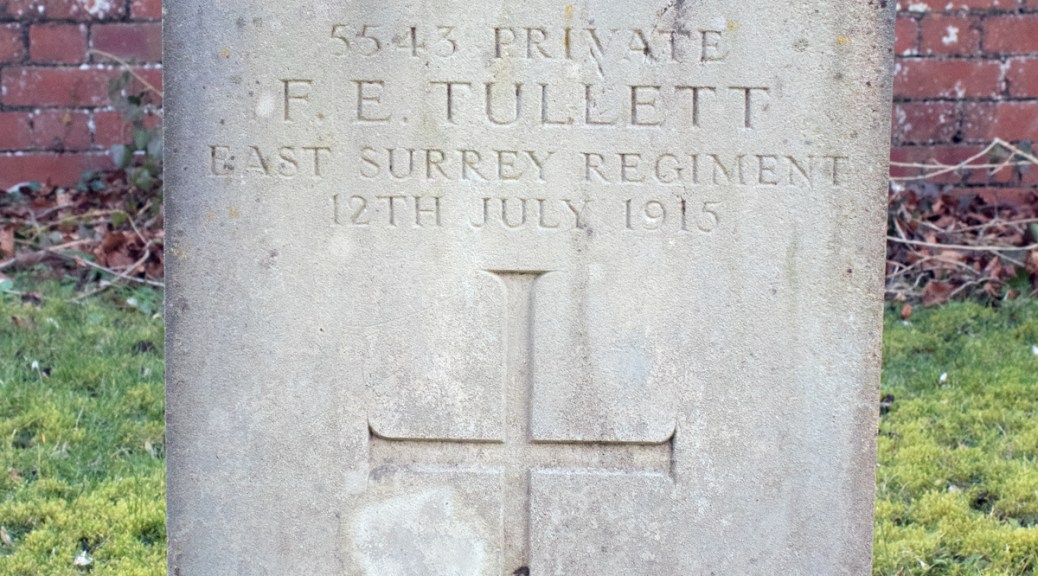
Frederick Edward Tullett was born in 1885 in Islington, Middlesex. The seventh of nine children, he was the fourth son of house painter John Tullett and his wife, Sarah.
When he completed his schooling, Frederick found work as an errand boy for a greengrocer. This appears to have been a trade he enjoyed: by the time of the 1911 census, he was employed as a greengrocer’s porter; while his marriage certificate records him as a fully-fledged grocer.
Frederick’s betrothed was Eliza Gundry, the daughter of a bricklayer from Wimbledon, Surrey. The ceremony was held on 18th April 1915 in the town’s All Saints’ Church. The couple were already living at 15 Dryden Road at this point.
It would appear that Frederick had already stepped up to serve his King and Country by the time of his marriage and, while his profession was listed as greengrocer, it may be that this was the job he continued while waiting to be formally mobilised.
Frederick had enlisted in the army by the start of 1915, and was assigned to the 8th (Service) Battalion of the East Surrey Regiment. The unit was based on Salisbury Plain, Wiltshire, and this is where Private Tullett would end up by that summer.
Crowded barracks were notorious as breeding grounds for infections diseases, and Frederick, sadly, was not to be immune. He contracted pneumonia, and was admitted to a military hospital in Codford. The condition was to prove his undoing: he passed away on 12th July 1915, at the age of 30 years old.
Finances may have prevented Eliza, who had been widowed after just 12 weeks of marriage, from bring her husband back home. Instead, Frederick Edward Tullett was laid to rest in the graveyard of St Peter’s Church in Codford, Wiltshire.
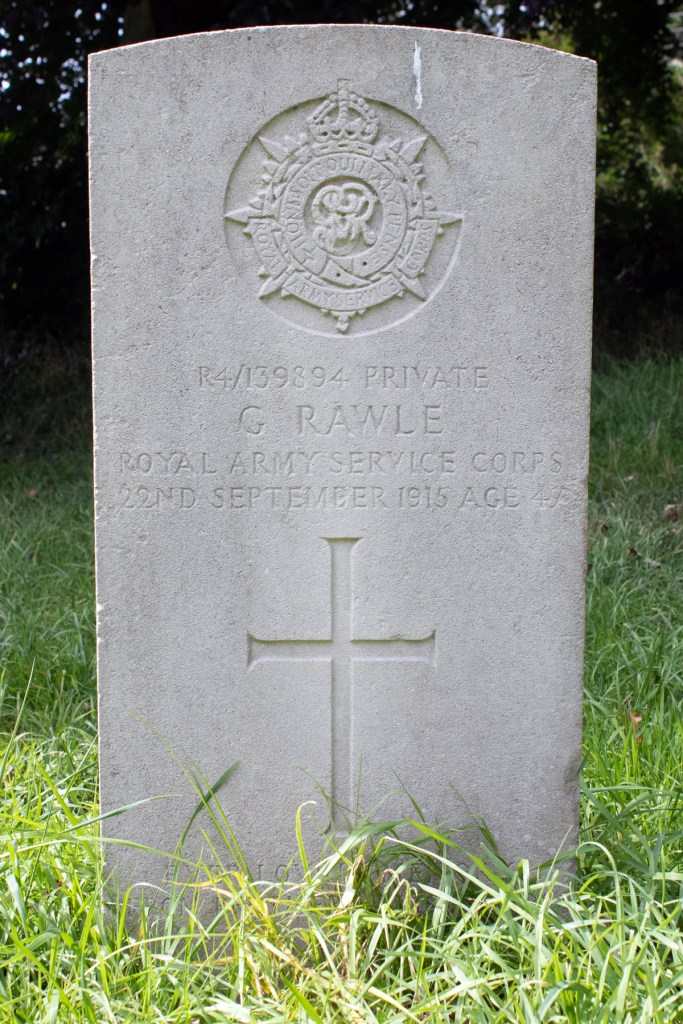
George Rawle was born on 26th April 1867 in the Somerset village of Milverton. One of nine children, his parents were William and Ann. William was a shepherd turned general labourer and, when he first finished his schooling, George was sent north to Nether Stowey, where he worked as a stable boy at Castle Hill House.
The 1891 census found George back living with his parents, who had moved to Milverton, presumably following William’s work. George, by this time, was employed as a domestic groom, although the next census found both him and William – now 74 years of age – working as general labourers.
William died in 1902, and Ann passed away seven years later. By 1911, George had moved just up the road to Wiveliscombe. He was living in a four-roomed cottage and employed as a jobbing gardener. He shared his home with two of his sisters: Jane was 46 years old and working as a housemaid; Alice, 33 years of age, was a housekeeper.
When war came to European shores, George felt the need to step up and play his part. He joined up at an enlistment drive at the brewery in Wiveliscombe, and was assigned to the Royal Army Service Corps as a Private. While waiting for his medical he returned to the home he shared with his sisters. It was here, just five days later, that he ended his life.
A painful sensation was caused in Wiveliscombe on Wednesday morning, through the action of Priv. George Rawle, of the E Squadron, Somerset Mule Depot, who took his own life under distressing circumstances at his residence at Higher Nunnington.
Deceased… had been restless through the night, and about five o’clock in the morning he told his sister he was going to get up to write a letter. The sister begged him to put his clothes on, but he would not do so, and went downstairs. She followed him in her nightdress. He picked up a gun in the hall, and she tried to take it away from him, but failed. Rawle went out to the path in front of the door of the house. His sister took hold of his arm, but he wrenched himself away, put the muzzle of the gun in his mouth, pulled the trigger, and fell down beside her, having blown out his brains.
Dr WH Randolph was in attendance shortly after, but could only pronounce life extinct.
The inquest took place on Friday, before Mr Foster Barham, coroner for West Somerset.
Jane Rawle, deceased’s sister, said her brother had suffered from nervous depression for many years, and seventeen years ago was a patient at Cotford Asylum. Lately he had been worried about the house in which he lived.
Taunton Courier and Western Advertiser: Wednesday 29th September 1915
The jury at the inquest returned a verdict of suicide while of unsound mind. George was 48 years of age.
George Rawle was laid to rest in the quiet graveyard of St Andrew’s Church, Wiveliscombe. His estate was shared between two of his sisters, Jane and Hannah.
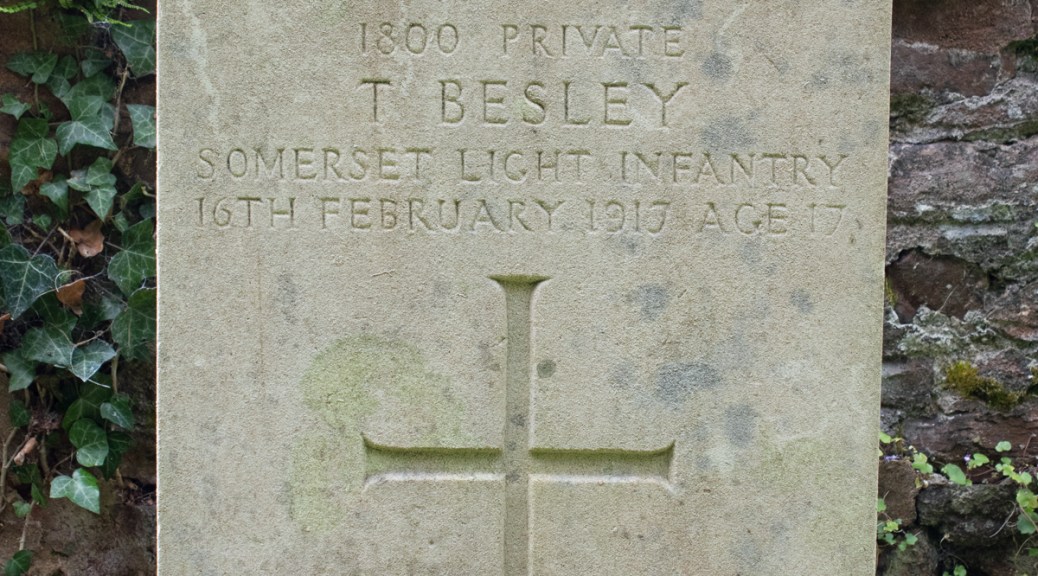
The short life of Thomas Besley is a challenge to unpick. He was born in Bampton, Devon, early in 1896, one of ten children to farm labourer Steven Besley and his wife, Fanny.
Steven’s work took the family around the region, and the 1901 census found the Besleys living on Cordings Farm in Wiveliscombe, Somerset. The document records Thomas as being 5 years of age, sharing the accommodation with his parents and six of his siblings.
The 1911 census records Thomas working as a live-in labourer at Manor Farm in Huish Champflower, a village just three miles outside of Wiveliscombe.
Meanwhile, his family are still recorded as living in Wiveliscombe itself, Steven and Fanny residing with four of their children. Now, however, another Thomas is listed with them: seven years old, he is the only child of their oldest son, William and his late wife, Elizabeth. She had died in 1904, around the same time as young Thomas’ birth, and it would appear that Steven and Fanny adopted their grandson (he is listed on the census as their ‘son’). William went on to marry again, but his new wife, a widow called Hannah, had seven children from her first marriage. The couple would go on to have a son of their own, but it was a crowded house, and so Thomas lived permanently with his grandparents.
The older Thomas Besley signed up almost as soon as war was declared in 1914. While his service records are sparse, he joined the 3rd/5th Battalion of the Somerset Light Infantry.
What can be determined from the records is that Private Besley drowned. His death certificate – which mistakenly records his surname as Beasley – confirms that Thomas’ body was found in the River Tone in Taunton on 16th February 1915, and the cause of death noted as ‘found drowned’.
While research for Besley draws a number of blanks about the circumstances of his death, the misspelled surname featured in a contemporary newspaper report:
On Tuesday afternoon, around four o’clock, MJ Chapman… while passing the Locks at Firepool, Priory, Taunton, observed what appeared to be the body of a man floating in the swirl caused by the overflow of the Locks into the pool. The police were immediately informed… and proceeded to the spot with the ambulance and recovered the body of a man, dressed in khaki uniform. The body had evidently been in the water for a considerable time and was much decomposed. The deceased was subsequently identified as Thomas Beasley, son of Mr Stephen Beasley, of Langley Marsh, Wiveliscombe. He was a private in the 5th Battalion of the Somerset Light Infantry, and was 40 years of age. He had been in ill-health for a considerable period, and latterly had been depressed. He disappeared on January 16th, and despite all enquiries his whereabouts remained a mystery until Tuesday…
[At the inquest] Stephen Beasley, a farm labourer… gave evidence of [Thomas’] identification. He said that his son had lately been ill. Three months ago he was taken from Salisbury Plain to Bristol Hospital, where he remained for about a month. After his discharge from Hospital he went home, where he remained about a fortnight, and for the last two months he had been quartered at Taunton. In this time witness had seen his son twice, but he could not say that he had been well since he came out of Hospital. He was low-spirited, but never told witness that anything troubled him.
Florence Beasley… sister of deceased, said she last saw her brother about a month ago in Taunton. He seemed very strange and low and would not speak unless spoken to first. He seemed to be troubled, and would not shake hands with her when she left him. He seemed to be always ‘studying.’ There was no suicidal tendency in the family…
Captain Burridge stated that deceased was sent to hospital from the Plain about September. About the middle of October he had a wire from Bristol Infirmary informing him that he was dangerously ill and dying. However, he got over that, and he was discharged on October 28th. He was sent for 22 days’ furlough to his home and returned to duty on November 22nd. Ever since that time he had not been in the best of health, but nothing had been noticed of his mental condition. He believed at one time there was a talk of his being discharged as medically unfit. He disappeared on January 16th.
The Coroner asked [how] long deceased had been in the service, and witness answered that he joined on June 1st, 1913. His complaint when removed to Bristol Hospital was double pneumonia.
On the suggestion of the Coroner, the jury returned an open verdict.
Taunton Courier and Western Advertiser: Wednesday 24th February 1915
In addition to the Besley/Beasley surname, the report features a couple more discrepancies. Thomas’ father’s name is given as Stephen, when it was Steven. The deceased is also recorded as being 40 years old when he died, when he was actually half that age.
Thomas Besley was laid to rest in the peaceful graveyard of St Andrew’s Church in Wiveliscombe. It gives his age as 17 years old and the date of his death as 16th February 1917.
Official intimation has been received of the death of Capt. Lord Kesteven, of the Lincolnshire Yeomanry, who sailed for the Balkans last week. Sir Thomas Carew Trollope… third Baron Kesteven, who was born in May 1891, was the only son of the late Hon. Robert Cranmer Trollope and the Hon. Mrs Trollope, of Crowcombe Court, Taunton, and was educated at Eton. He succeeded to the barony on the death of his uncle, the second Baron, in July last. He joined the Lincolnshire Yeomanry about six years ago, when his uncle was Colonel of the regiment, and was gazetted Captain in October 1914. He had seen service in France during the present war, being attached to Jacob’s Horse, Indian Cavalry, until he succeeded to the title. Lord Kesteven was unmarried, and the title becomes extinct, but the baronetcy goes to Mr William Henry Trollope.
Bath Chronicle and Weekly Gazette: Saturday 13th November 1915
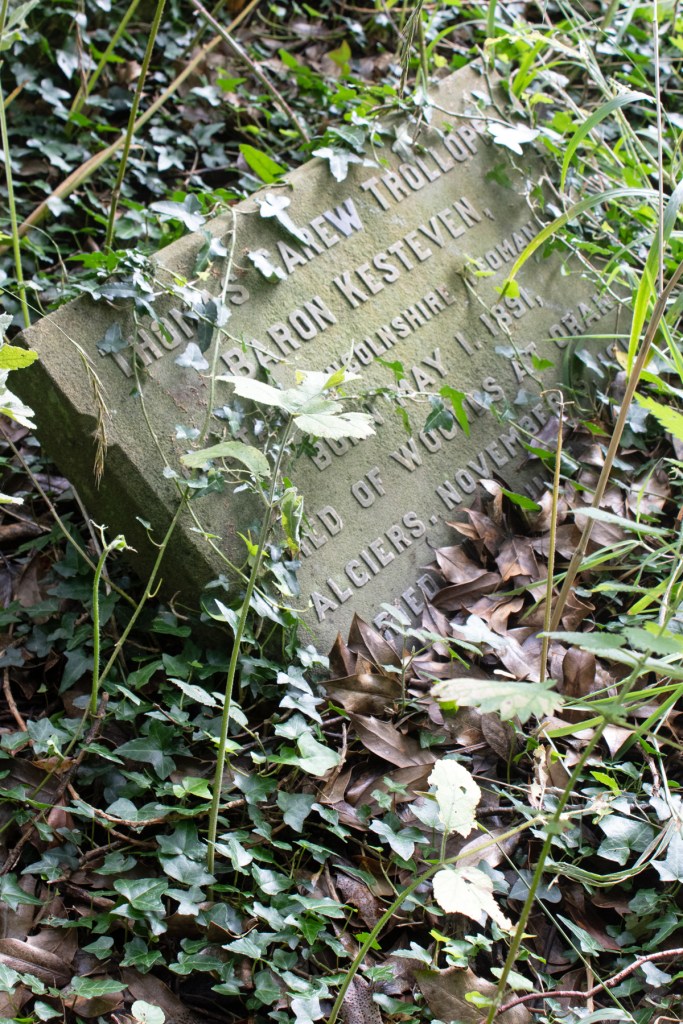
Thomas Carew Trollope was born in Middlesex, London on 1st May 1891. He was the younger of two children to Robert and Ethel Trollope, whose main residence was Crowcombe Court in Somerset.
Thomas was destined for great things. The 1901 census recorded him as being a boarder at Naish House Preparatory School in Wraxall, Somerset, while his older sister, Dorothy, remained at home with their parents and ten live-in servants.
Ten years later, and on his way to being prepared for the barony, Thomas was living with his uncle, John Trollope, the Baron Kesteven, at his estate, Casewick, in Uffington, Lincolnshire.
On the 5th November 1915, on Thomas’ journey to the Balkans, the ship he was on, the SS Mercian, was shelled by U-Boat SM U-38. After more than an hour being bombarded, the Mercian escaped. By that time, however, 78 men were wounded, 23 were killed, and 22 troops and eight crew members were missing. The Mercian managed to dock at Oran, Algeria, and those killed were either buried at sea or in the city’s cemetery.
Captain Sir Thomas Carew Trollope was also killed: he was just 24 years of age. It is unclear whether Thomas’ body was brought back to Britain or was buried in Oran, but the family plot includes a memorial to him.
A memorial service was held in the Church of the Holy Ghost, Crowcombe, on Monday 15th November 1915, the villagers commemorating the untimely passing of their favourite “Mr Tom Trollope”.
Captain Sir Thomas Trollope, Baron Kesteven (from findagrave.com)
Herbert Perry was born in Sampford Brett, Somerset, on 2nd July 1887. One of fifteen children, his parents were Henry and Mary Perry. Henry was a groom and gardener, and the family were raised in a small cottage in the centre of the village.
Herbert and his siblings attended the local Church of England school, but once he finished his education his own trail goes cold. The next records relate to his military service, although they are also a bit scarce.
What is clear is that Herbert enlisted early in the war. He joined the 1st Battalion of the Devonshire Regiment, and was in France as soon as January 1915. Private Perry found himself at Ypres, and it was here, in July, that he was badly injured.
Private Perry was medically evacuated to Britain for treatment, and he was admitted to the 5th Northern General Hospital in Leicester. Sadly, this was to be where he would breathe his last: his wounds were to prove too severe, and he succumbed to them on 1st August 1915. He had not long turned 28 years of age.
Herbert Perry’s body was taken back to Somerset for burial. He was laid to rest in the family plot in the peaceful graveyard of St George’s Church. There he was reunited with his mother, Mary, who had died three years before.
Herbert’s older brother, William, joined the Duke of Cornwall’s Light Infantry when war broke out. Assigned to the 1st Battalion, he rose to the rank of Lance Corporal. William fought at the Somme, and was killed there. He is commemorated at the Thiepval Memorial, and remembered on the family headstone in Sampford Brett.
Arthur Samuel Dudley was born in the spring of 1895, and was the second of six children to Arthur and Alberta Dudley. Arthur Sr was an fitter for an engineering works in Birmingham, and it was in the Kings Norton area of the West Midlands where he and Alberta raised their family.
When he finished his schooling, Arthur found work as a grocer’s assistant, but factory work offered better financial prospects, and by the time war was declared in 1914, he was working as a tube drawer for the company that employed his father.
The conflict brought further opportunity for a career and an adventure, and this was not something Arthur was able to let pass by. He enlisted on 3rd September 1914, but intriguingly did so in Bodmin, Cornwall, some 200 miles to the south of his home, and there seems to be no direct connection between the Dudleys and this part of the country.
Arthur joined the Duke of Cornwall’s Light Infantry and was assigned to the 6th (Service) Battalion. His medical report – which was completed back in Birmingham towards the end of September – showed that he was 5ft 6.75ins (1.69m) tall and weighed 120lbs (54.4kg). He had brown hair, green eyes and a fair complexion.
On 18th January 1915, Private Dudley transferred to the Army Cyclist Corps, and was attached to the 19th Divisional Cyclist Company. Based in Somerset, he soon found himself barracked near Burnham-on-Sea. It was here, just two weeks later, that Arthur became ill. On 30th January 1915 he was sent to the Volunteer Aid Detachment Hospital in the town, in a diabetic coma, and passed away same evening. He was just 19 years of age.
Unable to afford the cost of bringing their son’s body back to the West Midlands, Arthur Sr and Alberta instead made their way to Somerset for the funeral. Arthur Samuel Dudley was laid to rest in the peaceful Burnham Cemetery, not far from where he had breathed his last.
About 700 of his comrades followed the coffin… Mrs Duncan Tucker and Mrs T Holt, representing the staff of the Red Cross Hospital, were also present.
John Henry Wimble was born in the autumn of 1870, in Bathampton, Somerset. One of seven children, his parents were William and Charlotte Wimble. Charlotte had been married before, but her husband, John Eastment, had died in 1862, leaving her with three children to raise. She remarried in 1864, and William helped support the growing household.
John sought an escape to adventure and, when he finished his schooling, he enlisted in the army. Full service records are not available, but by the time of the 1891 census, he was noted as being a Private in the Somerset Light Infantry, and was living in barracks in Farnborough, Hampshire.
In the autumn of 1891, John married Eliza Hammond. She had been born in Calne, Wiltshire, and, at the time of their wedding, which took place in Bath, she was working as a parlour maid. The couple would go on to have two children, Percy and Victor.
John completed his army service and, according to the 1911 census, the family had settled in Cheddon Fitzpaine, to the north of Taunton. He was noted as being an army pensioner and that he was working as a warehouseman in the government stores. By the time war broke out, the family had moved to Burnham-on-Sea, where John had taken up the role of caretaker at the local Institute.
The war has cost another gallant local soldier, in the person of Sergt.-Major Wimble, of the Somersets, his life. This brave man re-joined the Army when war broke out on condition he could go to the Front. He was wounded, and died in a hospital at Edinburgh. The War Office had the remains sent to Burnham on Tuesday, where they were placed in St Andrew’s Church, and a large attendance of the public and the [Volunteer Training Corps] attended the funeral on Wednesday.
Taunton Courier and Western Advertiser: Wednesday 17th November 1915
John had been assigned to the 6th (Service) Battalion on re-enlisting, and was quickly sent to the front. Caught up in the Action of Hooge and the Second Attack on Bellewaarde, he was medically evacuated to Britain in the autumn of 1915, and passed away on 4th November, at the age of 45.
Here, though, accounts differ slightly. While the newspaper report suggests that he died of his wounds, the Army Register of Soldiers’ Effects gives the cause of death as gastritis.
After the funeral at St Andrew’s Church, John Henry Wimble’s body was laid to rest in Burnham Cemetery.
Regimental Serjeant Major John Wimble (from findgrave.com)









 Death and Service