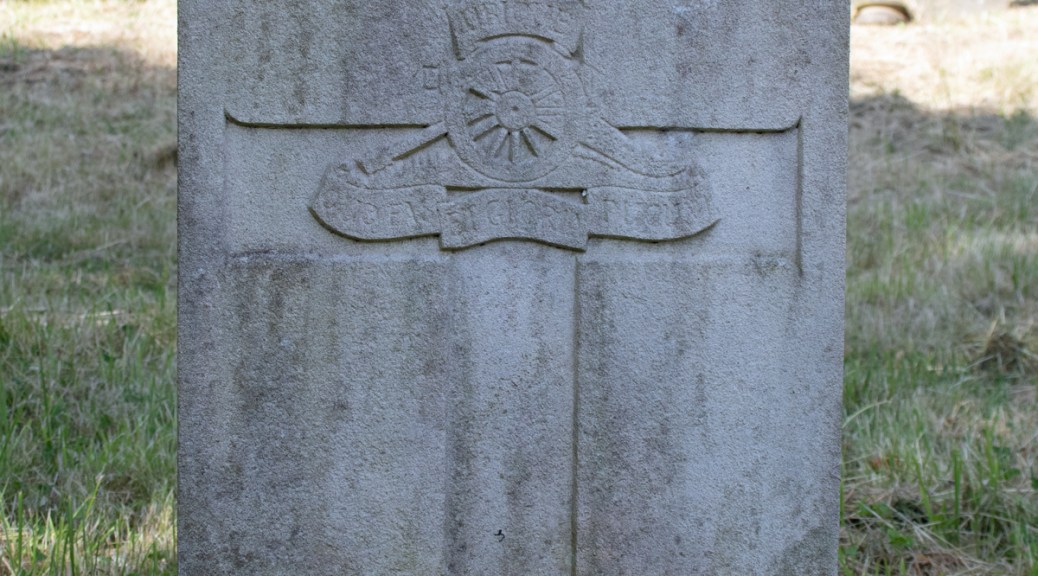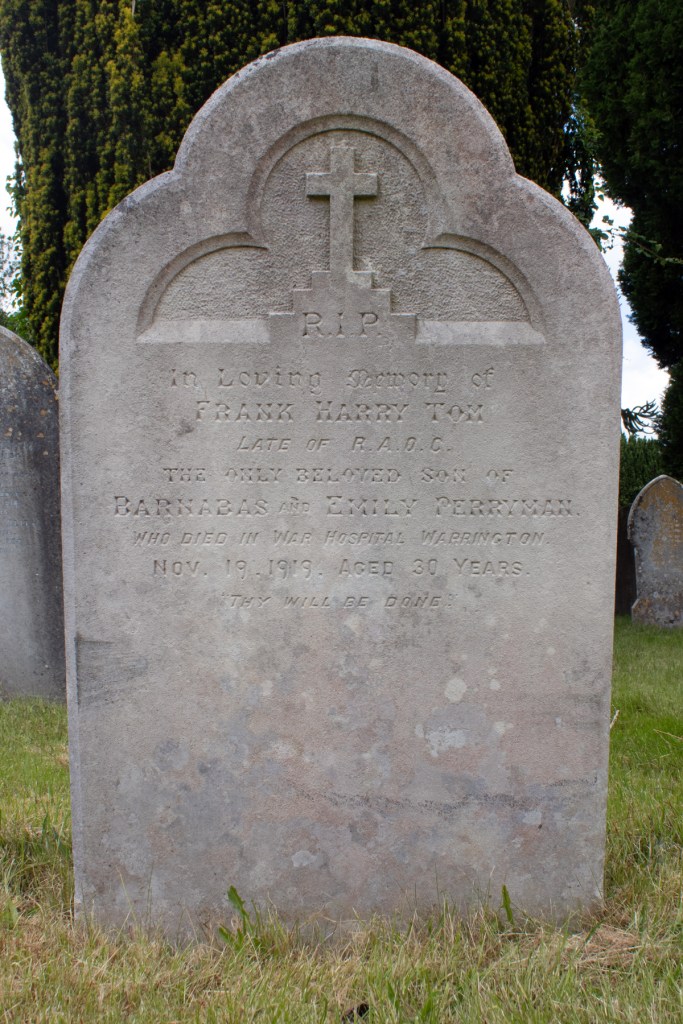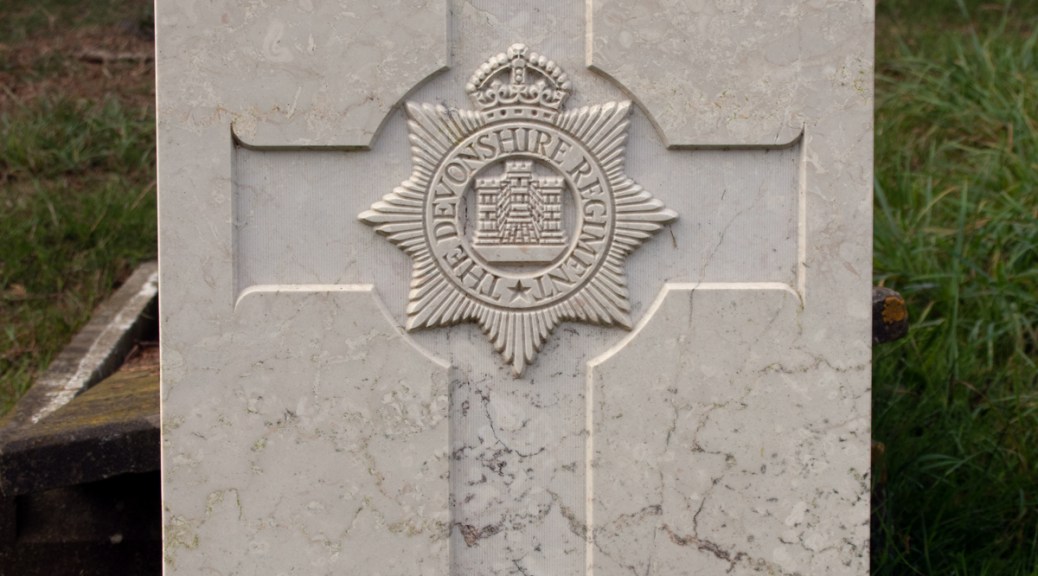
Colin Thomas Frazer Rough was born in the autumn of 1896, and was the oldest of seven children to Thomas and Zelia. Thomas was a dairyman from Devon, and the family were initially raised in Charmouth. Thomas took up work as a farmer in 1911, and this meant a move to to Axminster: having finished his schooling, Colin helped his father on the farm.
Colin was still working with his father when war broke out across Europe. He stepped up to play his part, and enlisted in the Royal Garrison Artillery 11th December 1915. His service records show that he was 19 years and three months old, and stood 5ft 8ins (1.72m) tall.
Gunner Rough was not formally mobilised until May 1916. He would spend the next two-and-a-half years on home soil, and was based in Catterick, Yorkshire.
On 31st July 1918, Colin was sent to France with his unit. Full details of his service overseas have been lost to time but it would seem that he was back on home soil by the beginning of 1919.
Gunner Rough had contracted influenza and pneumonia, and returned home to recuperate. The conditions were to prove too severe, however, and he passed away on 8th February 1919, at the age of 22 years old.
Colin Thomas Frazer Rough was laid to rest in the family plot in Axminster Cemetery. Tragically, his younger brother Alan had passed just three weeks earlier: the two were buried alongside each other.
William Charles Mence was born in Blackheath, Kent in the spring of 1877. He was the oldest of five children to William Cookes Mence and his wife, Susanna.
William Sr was a chemist-turned-dentist, and by the time of the 1881 census, the family had moved to prestigious lodgings on the corner of Claremont and Victoria Roads in Kingston-upon-Thames, Surrey. William had set up practice in the building, and employed two servants to assist him with the practice, and two more to help Susanna with the family.
Dentistry would keep William Sr occupied for at least the next thirty years, a move to nearby Surbiton in the late 1890s being the only change tot he business.
William Jr, meanwhile, was making his own way in the medical world. The 1901 census recorded the 24-year-old Mr Mence visiting a possible mentor, physician and surgeon Charles Gallie, in Camberwell. William was also noted as being a physician and surgeon, and this was to become the career in which he forged his way.
On 9th August 1906, William married Dorothy Mytton in the Saint Aelhaiarn’s Church in Guilsfield, Powys, Wales. Dorothy was the daughter of a retired army captain, Devereaux Mytton. She had been born in Guilsfield and, at the time of the 1901 census, was living with her family and ten servants at Garth Hall, close to the village.
The young couple’s marriage certificate also sheds some light on William’s career. It confirms that he was working as a medical practitioner, and was living in the village of Perranzabuloe in Cornwall.
William and Dorothy went on to have five children, and named them to reflect their combined family histories. Daughter Evaline Dorothy Cookes Mytton Mence was born first, in 1907, followed by sons John Herbert Myttone Cookes Mence, Devereaux Mervyn Mytton Cookes Mence and Godfrey Powis Mytton Cookes Mence. Their fifth child, daughter Myfanwy Susan Mence, was born in 1914.
When war broke out in Europe, William was drawn to play his part. While full details about his service are not available, his public standing meant that he took a commission as Captain in the Royal Army Medical Corps. His Medal Roll Index Card confirms that he was awarded the 1914-1915 star, so he joined early in the conflict. It also outlines that he served in Mesopotamia from 4th February 1916, in France in 1917 and in Salonika from 1917 to 1919.
Ill health seemed to have dogged him in later years, and by the summer of 1919, Captain Mence had returned to British shores, and to Devon, where his practice had moved to shortly before the conflict.
Dr William Charles Mence, of Axminster, who died in Axminster Cottage Hospital on Friday night, recently returned from active service… He was a medical officer under Axminster Board of Guardians…
Western Morning News: Monday 28th July 1919
William Charles Mence died on 25th July 1919 as a result of an ongoing illness: he was 42 years of age. He was laid to rest in Axminster Cemetery, not far from the family home.
Robert Jenkins Kelway was born in the autumn of 1897 in the Devon town of Torquay. The oldest of four children, his parents were Robert and Rosina Kelway. Robert Sr had been born in Paignton and, when a job working as a carter for Hollicombe Gas Works came up in around 1900, he moved the family back down the coast.
By the time of the 1911 census, the Kelways were living at 3 Hollicombe Terrace, on Torquay Road: their home was one of a row of terraced houses build specifically for the gas works employees, and all of their neighbours were employed there in one form or another.
Robert Jr was 13 years old at this point, and seemed to have completed his schooling: his entry on the census confirms he was employed as a telegraph messenger for the Post Office.
Everything was to change when war was declared and, on 22nd April 1915, Robert Jr voluntarily stepped up to play his part. Lying about his age – he said he was 19, when he was, in fact, two years younger – he was nonetheless taken on his word. His service records show that he was 5ft 5ins (1.65m) tall and weighed 141lbs (64kg). He was noted as having brown hair, blue eyes and a fresh complexion.
Assigned to the Devonshire Regiment, Private Kelway was initially attached to the 3rd Battalion. At the end of October 1915, however, he was transferred to the 8th (Service) Battalion, and dispatched to France. His unit was caught up in the Battle of Loos, but it was at the Somme the following year that Robert would really have cut his teeth in fighting.
Private Kelway saw out the Somme relatively unscathed, but, on 27th December 1916 his luck was to run out. He was shot in the back, damaging one of his lower vertebra, and was medically evacuated to Britain for treatment.
Robert was admitted to King George’s Hospital in South London, and it was quickly ascertained that the damage to his spine was permanent. Paralysed from the waist down, he was, not surprisingly, no longer able to continue in the army in any capacity. His discharge papers noted that he was a ‘steady, sober and honest’ person.
From this point, details of Robert’s life are sketchy. It is unclear whether he was able to return home, although he was definitely back in Devon by the spring of 1919, as this is where he died. Admitted to the Royal Devon & Exeter Hospital, he passed away from pneumonia on 18th April, aged just 21 years old.
Robert Jenkins Kelway was laid to rest in Paignton Cemetery, a short distance from where his family lived, in the Preston area of the town.
Melbourne Linas Mumford was born on 13th June 1898, and was one of seven children to William and Fanny. William was a Gunner in the Royal Artillery, and while Melbourne and his siblings were born in the Kent village of Cliffe, the family soon moved to rented rooms in Stafford Street, not far from his new barracks in Gillingham, Kent.
It seems that William’s term of service came to an end, and he moved the family to Devon, where he had been born. Fanny died in 1909, at the age of just 33, and he was suddenly left to raise the family alone. The1911 census found William and his three sons – including Melbourne – living in a cottage in Paignton. William was by now working as a nurseryman, while Melbourne’s older brother, also called William, was bringing in some money as a paperboy for Smith & Sons.
When war came to European shores, Melbourne stepped up to play his part. Full service details have been lost to time, but later documents confirm that he had enlisted in the Devonshire Regiment on 9th August 1915. Attached to the 9th (Service) Battalion, papers confirm that he was 5ft 3.5ins (1.61m) tall, and weighed 99lbs (44.9kg).
Private Mumford’s unit fought as Loos in 1915, and at the Somme in 1916, but it was at Ypres, on 7th October 1917, that he was badly injured. Melbourne was shot in the left thigh, which caused a compound fracture in his femur. Medically evacuated to Britain for treatment, he spent time hospitalised in Manchester.
Recuperation was ongoing, but was not to prove successful, and Private Mumford was eventually discharged from the army on 22nd January 1919.
Melbourne’s treatment would continue, however, and he had a further operation on his leg that summer. Tragically, however, his body had been weakened, and he passed away following the procedure, on 27th August 1919. He was just 21 years of age.
The body of Melbourne Linus Mumford was laid to rest in Paignton Cemetery, not far from the family home in Corsham Road.
Private Mumford’s Dependant’s Pension was assigned to Mrs Kate Mumford, who was recorded as his mother. This would suggest that William had remarried after the 1911 census, although there are no records to confirm this.
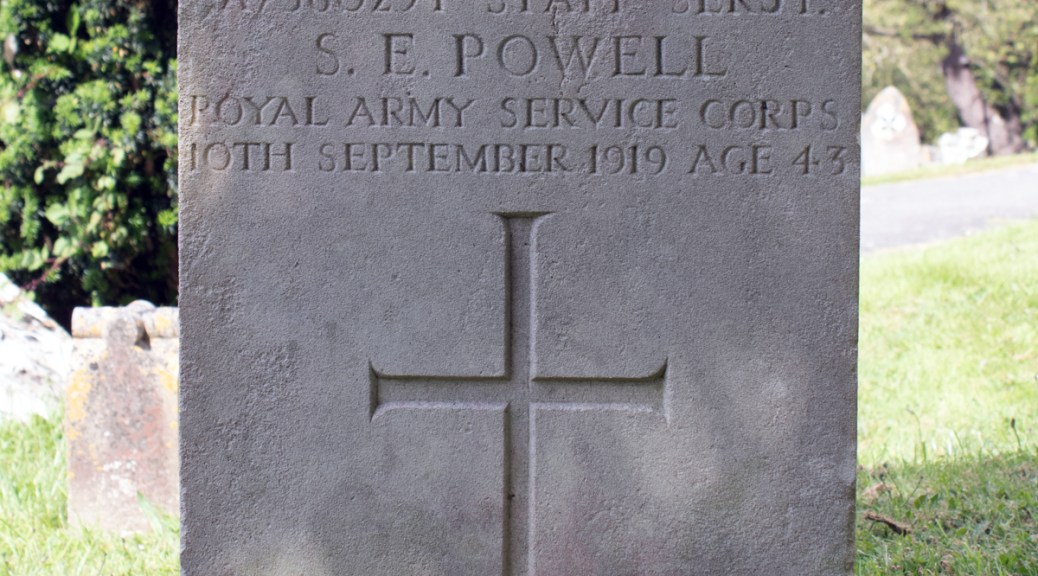
Samuel Edwin Powell was born at the start of 1876, the third of eight children to Samuel and Catherine Powell. Samuel Sr was a baker from Gloucestershire, and it was in the village of Leonard Stanley that the family were born and raised.
Much of Samuel Jr’s earlier life is undocumented, and he does not appear on either the 1891 or 1901 census returns. By the time of the next census, taken in 1911, he is recorded as living in Lewisham, Surrey.
The census noted that Samuel was employed as a commercial traveller in the chocolate industry. He was married to Stroud-born Ellen Hobbs, and had been since 1906. The couple had a son, Denis, who was a year old, and were living at 20 Hazelbank Road in Catford, with a domestic servant, Edith Price, helping Ellen while her husband was away working.
When war broke out, Samuel was called upon to play his part. He was enlisted in the Royal Army Service Corps, with the rank of Staff Serjeant, which would suggest that his absence from earlier documents was because of earlier military service.
There is little information about Samuel’s time in the army, other than that he was attached to the Clearing Office when the Armistice was declared.
The cause of Staff Serjeant Powell’s passing is not known, but the Army Register of Soldier’s Effects confirm that he died in Dorset on 10th September 1919. The connection to Dorset is unclear: he may have been serving in the area, or recuperating from an illness. He was 43 years of age.
Samuel Edwin Powell was laid to rest in Lyme Regis Cemetery, overlooking the seaside town.
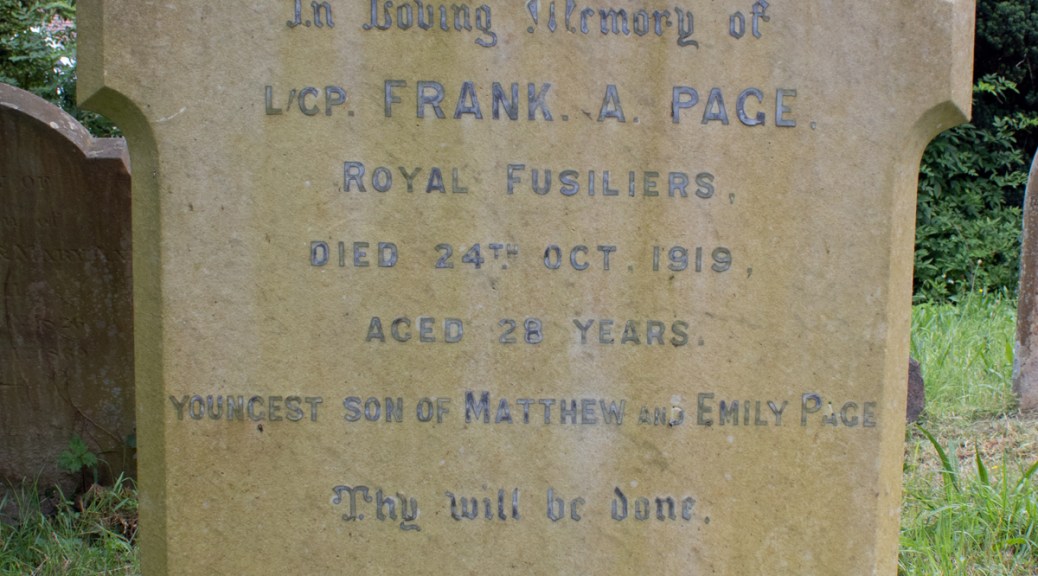
Frank Arthur Page was born early in 1891, and was one of seven children – and the youngest son – to Matthew and Emily Page. Matthew was a bricklayer’s labourer from Lancing in Sussex, while Emily had been born in Norfolk. It was in the village of Steyning, however, that the couple raised their family.
By the time of the 1901 census, Matthew had been invalided out of work. The family had moved to a small cottage in Lancing by this point, and Frank’s older brothers were working to bring in some money for the family.
The next census return, taken in 1911, found Matthew and Emily living Frank and his older brother Sydney at 2 Ivy Cottages in Lancing. Both of the Page siblings were working as market gardeners by this point, bringing in some money to help support the family.
War came to Europe in the summer of 1914, and Frank stepped up to serve his King and Country. Full details of his military service are lost in the mists of time, but it is clear that he enlisted in the Royal Fusiliers, and was attached to the 26th (Service) Battalion (Bankers).
Frank’s unit served in both France and Italy, although, without his documents, it isn’t possible to determine where, and for how long, he served. During his time in the army, however, he was promoted to the rank of Lance Corporal, underlining a level of dedication on his part.
Matthew passed away in the spring of 1917, and it appears that Frank was demobbed at some point after the Armistice. By the autumn of 1919, he was back in Sussex, living with his now widowed mother. His time in the army seems to have impacted on Frank’s health by this point, and he died ‘from disease’ on 24th October 1919. He was 28 years of age.
Frank Arthur Page was laid to rest in the graveyard of St James the Lesser Church in Lancing, not far from where his father had been buried.
Francis George Marchant was born in the autumn of 1894, the fourth of five children to William and Emma Marchant. William – who went by his middle name, Walter – was a gamekeeper from the village of Uplyme in Devon, and this is where the family were born and raised.
Sadly, there is little specific information about Francis’ life. When war was declared, he stepped up to play his part, joining the Coldstream Guards as a Guardsman. Attached to the Machine Gun Corps, he would have spent time overseas, but details about his time in the military are long since lost.
By the end of the conflict, Guardsman Marchant was based in Hampshire, billeted in Witley Camp. While here, for reasons unknown, he was admitted to the Connaught Military Hospital. It was here, on 4th April 1919, that he passed away: he was 24 years of age.
Francis George Marchant was taken back to Devon for burial. He was laid to rest in Uplyme’s Ss. Peter & Paul’s Church.
Denys Ernest Puttock was born on 14th September 1895 in the Devon village of Halwill. The middle of three children, his parents were Edward and Alice Puttock. Edward was a vicar of the village’s St Peter & St James’ Church, but died tragically early:
The Red. E Puttock, Rector of Hallwill died on Wednesday, after a brief illness… Mr Puttock had been in charge… for six and a half years. He was much beloved by those among whom he labourer and universally respected. His devotion to the due performance of all his sacred duties was unceasing and his visitations among the poor and afflicted were much appreciated by the whole parish. He was fond of all manly sports, and under his captaincy the Cricket Club at Halwill attained considerable success. Up to the day of his death he could hardly believe that he was ill, and up to the last it was hoped that his wonderful constitution might have carried him through the illness. About a fortnight since he contracted a chill. He would not be deterred from carrying out his duties, and against the advice of his friends, he persisted in taking every service at the church long after he was fit for it. On Sunday, the 24th January, although then in a high fever, he took both the morning and evening services at Halwill Church unassisted, and also the Sunday School in the afternoon. Pneumonia set in at the end of last week, and on Tuesday evening, the 2nd February, the action of the heart failed. He leaves a widow and three young children to mourn their loss.
[Exeter and Plymouth Gazette: Friday 5th February 1897]
After Edward’s death, Alice moved the children to Okehampton. The 1901 census found the family living at 4 Brondage Park, Alice by this time living off her own means. She felt that learning was important, and Denys was sent to Twyford School and St Edmund’s School in Canterbury, Kent. From here he took up a career in the Royal Navy, enlisting in September 1913.
He served in the Highflyer as a Cadet, and was Midshipman in HMS Conqueror, and later Sub-Lieutenant in the destroyers Patriot and Valorous. Long exposure to the rough weather in the North Sea during the winters of 1916 and 1917 brought on tuberculosis, which incapacitated him for further war service. He was invalided our of the Navy and spent many months in a Sanitorium.
[Exeter and Plymouth Gazette: Friday 4th April 1919]
Denys Ernest Puttock’s health was failing him, and he passed away on 20th March 1919, while still admitted. He was 23 years of age. The report of his funeral included comments from those who knew him:
His Headmaster writes: “He has not lived in vain, for he has exercised the power of unconscious influence on all those around him. He knew the secret of happiness – purity of soul and unselfishness of heart.” His Commanding Officer has written: “He was a zealous and capable young officer. Possessed of great charm of manner, he was popular with both officers and men.”
[Exeter and Plymouth Gazette: Friday 4th April 1919]
Alice, having moved to Paignton by this point, laid her son to rest in the town’s cemetery. When she passed away in 1932, she was buried alongside him.
James Ellery was born in the autumn of 1889, and was the middle of seven children. His parents – Frederick and Mary – were born in Dorset, and the family were raised in the hamlet of Lillington. Frederick was a farm labourer, but James found his way into building work when he finished his schooling.
When war came to Europe, James stepped up to play his part. Full details of his military service have been lost to time, but it is clear that he had enlisted in the Dorsetshire Regiment and was attached to the 1st/4th Battalion.
Private Ellery’s unit served in India and Mesopotamia during the conflict, but it is unclear whether James saw any action overseas. Certainly by early 1919 he was back in Britain, as he was hospitalised in Sherborne following a bout of influenza. This developed into pneumonia, and he was admitted to the town’s Yeatman Hospital.
James’ immune system had become weakened during the conflict, and the pneumonia turned septic. It proved to be fatal, and James passed away on 1st March 1919. He was 29 years of age.
James Ellery’s body was taken back to Lillington for burial. He was laid to rest in the peaceful graveyard of St Martin’s Church.
James was not the first of the Ellery siblings to die during the Great War. His eldest brother, Frederick, had enlisted in the 2nd Battalion of the Machine Gun Corps Cavalry. He was killed in action on 21st August 1918, leaving behind a widow and three children. He was 36 years of age and is commemorated on the Vis-en-Artois British Memorial in Haucourt. France.
Alexander Bertram Cain was born on 31st July 1885 in Ormskirk, Lancashire. He was the ninth of eleven children to concert promoter Robert Cain and his wife, Sarah.
By 1901, Robert and Sarah had moved the family to Jersey, setting up home in St Saviour’s. Robert was noted as living off his own means, but Alexander, who would have been 15 by this point, is noticeable by his absence and, in fact, does not appear on that year’s census return.
Robert died in 1909, and on 26th January 1911, Alexander married a woman called Hilda Bedford. They settled down in St Helier, and went on to have two children, daughters Yvonne and Elizabeth. The census taken three months after the couple’s wedding recorded Alexander as living on his own means, so money appeared not to be an issue for the young family.
When war came to Europe, Alexander was called upon to play his part. On 12th March 1917, he enlisted in the Royal Jersey Militia, and was attached to the regiment’s Garrison Battalion, stationed on the island. His service records confirm that he was 5ft 7ins (1.7m) tall, and that he had a scar on his left cheek. The document also suggests that he had spent time in the Gloucestershire Regiment, but no further information about this is available.
Private Cain spent the next two years in the army. Towards the end of this time, however, his health appears to have been impacted, to the point that, on 6th May 1919, he was medically discharged from the Royal Jersey Militia.
Whatever his condition, it was to prove fatal. Alexander passed away at home on 31st May 1919: he was 33 years of age.
Alexander Bertram Cain was laid to rest in the family plot in La Croix Cemetery in Grouville, Jersey, Hilda left widowed and with two children – Elizabeth just four months old – to raise.