Tag Archives: Able Seaman

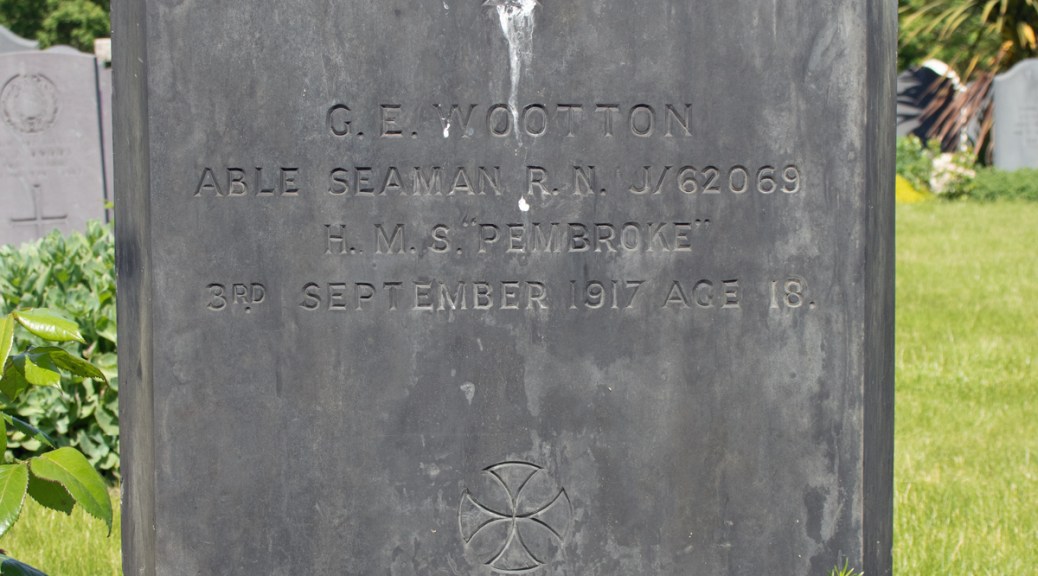
Able Seaman Gregory Wootton

Able Seaman Gregory Wootton

Gregory Ernest Wootton was born on 28th October 1898, the only child of Henry and Isabella Wootton. The family lived in East London, and the year of Gregory’s birth was a challenging one. His parents married that year, and Henry also passed away, leaving Isabella to raise her son on her own.

She was made of stern stuff, however, and moved back in with her father, Joseph, while finding employment as a florist, working with artificial flowers. By 1909, Isabella had remarried, wedding policeman Harry Mee, and moving to South London, where the couple had a child of their own, Gregory’s half-brother, Leonard.

War was edging close to Europe, although Gregory was underage when hostilities broke out. By late 1916, however, this was no longer the case, and he was drawn to the Royal Navy. On 6th November, he gave up his job as a case maker, and enlisted as an Ordinary Seaman. His sign-up papers show that he stood 5ft 4ins (1.62m) tall, had brown hair, brown eyes and a fresh complexion.

Ordinary Seaman Wootton’s first posting was at HMS Pembroke, the shore-based establishment at the Naval Dockyard in Chatham, Kent. After a couple of months, he was moved north, to HMS Ganges, which was a similar training base in Suffolk. While here, he was promoted to Able Seaman.

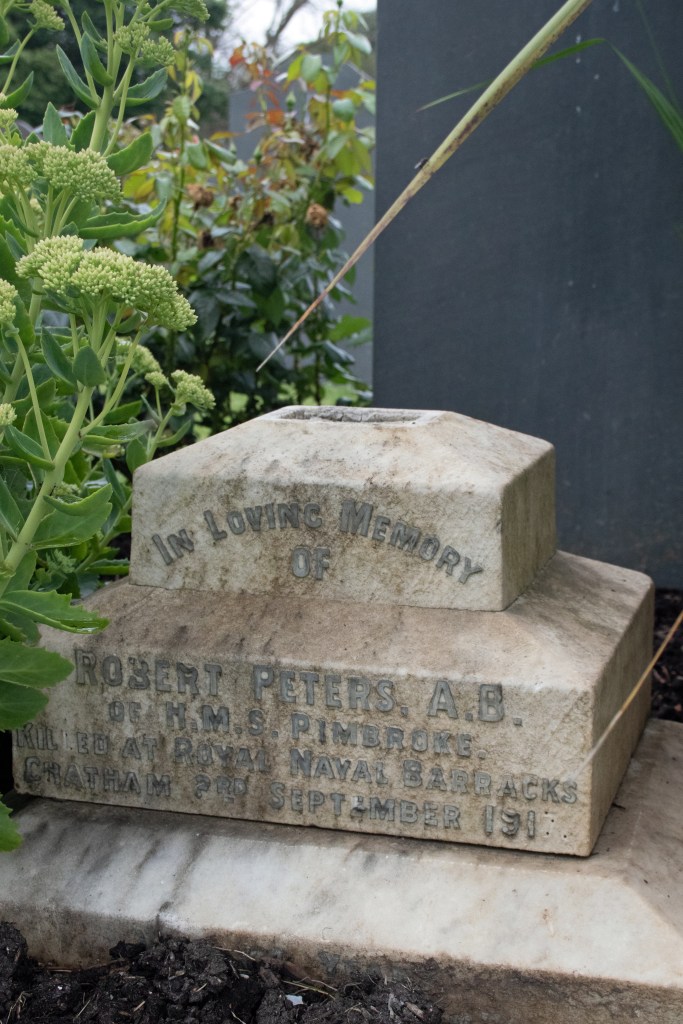
In June 1917, Gregory was on the move again, returning to Chatham. While here, at a particularly crowded time for the dockyard, he was billeted at the nearby Drill Hall. On the night of the 3rd September, while resting, the first German night raid dropped bombs on Chatham, directly hitting the Drill Hall. Able Seaman Wootton was killed instantly. He was just 18 years of age.

Gregory Ernest Wootton was laid to rest in the Woodlands Cemetery in nearby Gillingham. He was buried with the other 97 victims of the Chatham Air Raid.


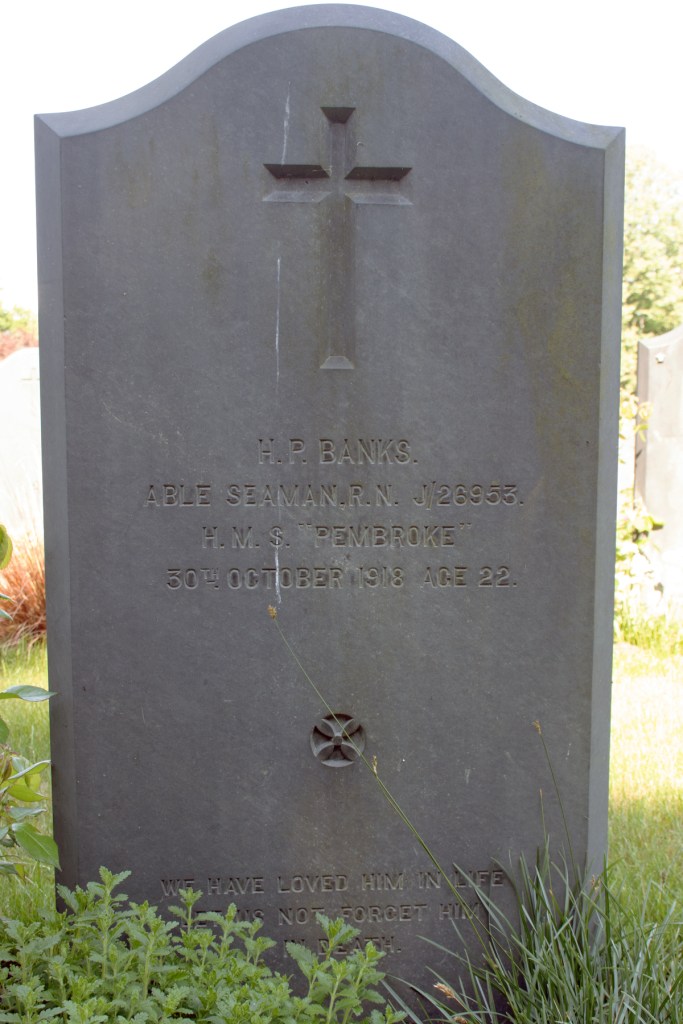
Able Seaman Hubert Banks

Able Seaman Hubert Banks

Hubert Philip Banks was born on 13th September 1896 in Tottenham, London and was one of eight children to Wilfrid and Mary Banks. Wilfrid was a gas engineer, but when he left school, Hubert found work as a clerk. By the time of the 1911 census, the family had moved to Edmonton.

Hubert had a sense of adventure, and wanted a career that reflected that. On 23rd September 1913, he enlisted in the Royal Navy; as he was underage at this point, he was given the role of Boy. Within a year he turned 18 and was formally given the rank of Ordinary Seaman.

After initial training at HMS Pembroke – the shore-based establishment at the Royal Naval Dockyard in Chatham, Kent – he was assigned to HMS Cornwallis, a dreadnought class vessel that served in the Mediterranean. Hubert spent two years on Cornwallis, during which time he was promoted to Able Seaman.

Over the next few years, Hubert served on three more vessels – HMS Quernmore, HMS Agamemnon and HMS Europa. In between times, he was based back in Chatham before moving back to HMS Pembroke on a more permanent basis in July 1918.

It was while he was back in Kent that Hubert fell ill. He was admitted to the Naval Hospital in Chatham with pneumonia, and was to succumb to the lung condition on 30th October 1918. He was just 22 years of age.

Hubert Philip Banks was laid to rest in the Woodlands Cemetery in Gillingham, Kent, not far from the naval base he called home.


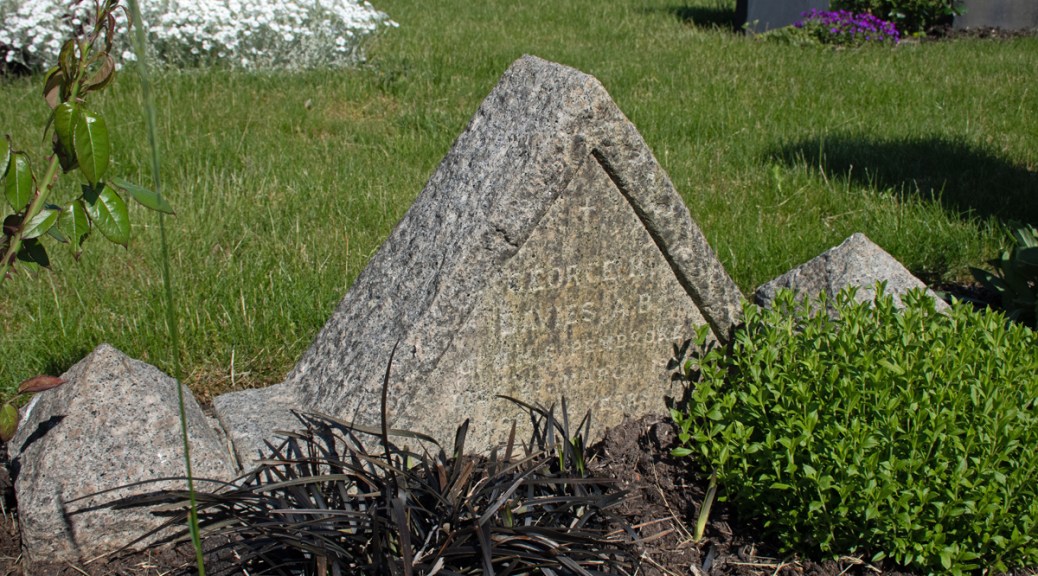
Petty Officer 1st Class George Fawcett

Petty Officer 1st Class George Fawcett

George Fawcett was born on 3rd February 1873, one of ten children to John and Maria (or Mary). John was a stonemason who raised his family in Essex, and it was in Stratford that George and most of his siblings were born.

When George left school, he was drawn to a life of adventure. He joined the Royal Navy on 5th May 1888, and was first assigned the role of Boy, as he was under age. He was formally enlisted on 3rd February 1891 – his 18th birthday. He had, by this point, been serving on HMS Hotspur for nine months, and was given the rank of Ordinary Seaman. His hard work must have held him in good stead, because he was promoted to Able Seamen just two months later.

Over the course of his initial twelve years’ service, Able Seaman Fawcett served on eight different ships, and continued to rise through the ranks. He mad made Leading Seaman by 1894 and Petty Officer 2nd Class five years later. By the time his first term of service had ended, he had been promoted again, this time to Petty Officer 1st Class.

George voluntarily renewed his service in 1903, and over the next few years, he served on a number of other vessels. His shore base was always HMS Pembroke, though, and his time at sea was interspersed with periods at the Naval Dockyard in Chatham.

Petty Officer Fawcett had been in the Royal Navy for 23 years by the time war was declared. He was still at sea in August 1914, but was transferred to a permanent shore role at the beginning of the following year. He spent three years fulfilling his duties at HMS Pembroke, but fell ill in the spring of 1918.

He was admitted to the Naval Hospital in Chatham with liver disease, and this was a condition he was not to recover from. Petty Officer Fawcett passed away on 12th April 1918, at the age of 45.

George Fawcett’s body was laid to rest in the Woodlands Cemetery, Gillingham, not far from the naval base at which he was based.


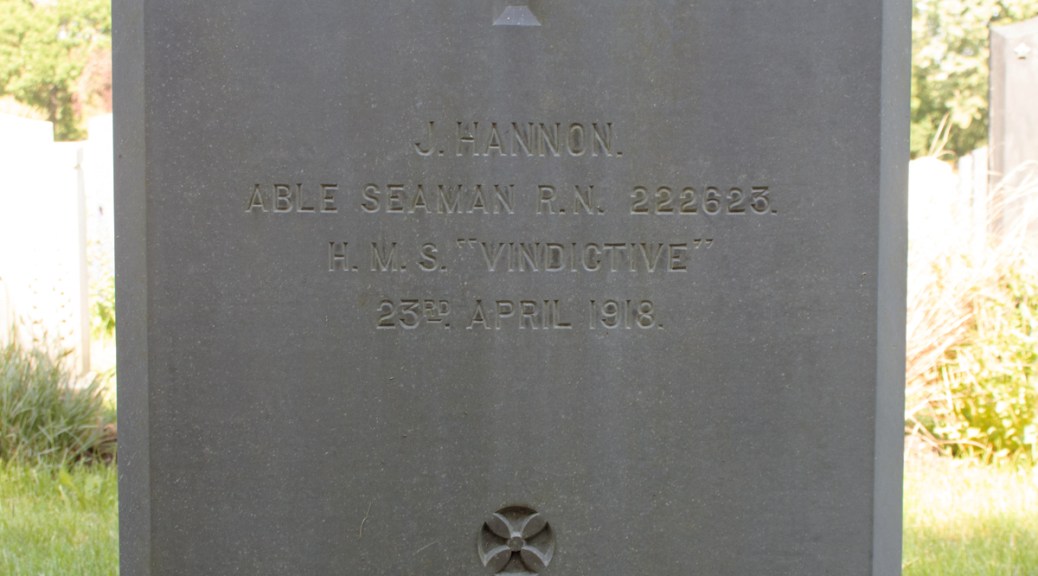
Able Seaman John Hannon

Able Seaman John Hannon

John Hannon (or Hannan) was born on 9th November 1885, in the Cork village of Ladysbridge. He was one of ten children to labourer Michael Hannon and his wife, Kate.

Given his proximity to the coastal port of Cork, it is no surprise that John sought adventure on the high seas. In May 1903, he joined the Royal Navy as a Boy, and served on HMS Black Prince. His enlistment papers gave his height as 5ft 4ins (1.62m), and recorded that he light brown hair, blue eyes and a sallow complexion. He also had a tattoo on each wrist.

As soon as he turned eighteen, on 9th November 1903, he was formally signed up, and given the rank of Ordinary Seaman. Over the next eighteen months, he served on two more ships – HMS Minotaur and the training ship HMS Boscawen – and was promoted to Able Seaman in August 1905.

John’s naval career continued apace up until the Great War. When hostilities broke out, he was assigned to HMS Tiger, and served on the ship at the Battles of Dogger Bank (1915) and Jutland (1916).

At the start of 1918, Able Seaman Hannon was transferred to HMS Hindustan; this was one of the many ships that supported the Zeebrugge Raid on the 23rd April. The plan was to scuttle a number of ships in the entrance to the Zeebrugge Canal in Belgium, thus preventing the German Navy from launching into the North Sea.

Over 1700 men were involved in the raid and heavy fighting left close to 300 sailors dead, with a similar number wounded. Sadly Able Seaman Hannon was one of those to lose their lives in the battle. He was just 32 years old.

John Hannon’s body was brought back to England; he was laid to rest in the Woodlands Cemetery in Gillingham, Kent, close to the Naval Dockyard in Chatham that he had occasionally called home.


Petty Officer William Coughlan

Petty Officer William Coughlan

William Henry Coughlan was born on 16th November 1891, one of thirteen children to William and Catherine Coughlan. William Sr was a labourer, born and bred in the East End of London, who raised his family in Hackney.

William Jr seemed keen for a way to improve himself and in May 1909, enlisted in the Royal Navy. Initially given the rank of Boy, this was due to his age; on his eighteenth birthday a few months later, he was formally enrolled in the navy as an Ordinary Seaman.

To begin with, he was billeted at HMS Ganges II, the shore-based training ship in Harwich, Suffolk, but within a matter of weeks he was on board a sea-going destroyer, HMS Antrim.

Ordinary Seaman Coughlan was obviously a keen young man; by the time the Great War broke out, he had served on four further ships, as well as another shore base, HMS Pembroke I. He rose through the ranks to Able Seaman and, by 1915, had reached the role of Leading Seaman.

Most of his service was spent upon HMS Agamemnon, initially in the Channel, but was then moved to the Mediterranean. On the night of the 5th May 1916, the ship was moored in the harbour at Thessaloniki (Salonika). A Zeppelin, the LZ55, made a bombing raid, but when the searchlights caught it, the Agamemnon fired on it and hit the aircraft, breaking it in two. It crashed in the swamps around the Vardar river and its crew were captured.

Leading Seaman Coughlan remained on the Agamemnon, before returning to England in November 1917, where he received further training at the Naval Dockyard in Chatham. He was promoted to Petty Officer a couple of months later, and began three years of shore- and ship-based service.

In the summer of 1921, while again based in Chatham, he contracted pneumonia, succumbing to the lung condition in a matter of weeks. Petty Officer Coughlan died on 26th July 1921, aged just 29 years old.

William Henry Coughlan was laid to rest in the Woodlands Cemetery in Gillingham; within walking distance of the naval base that had become his home.


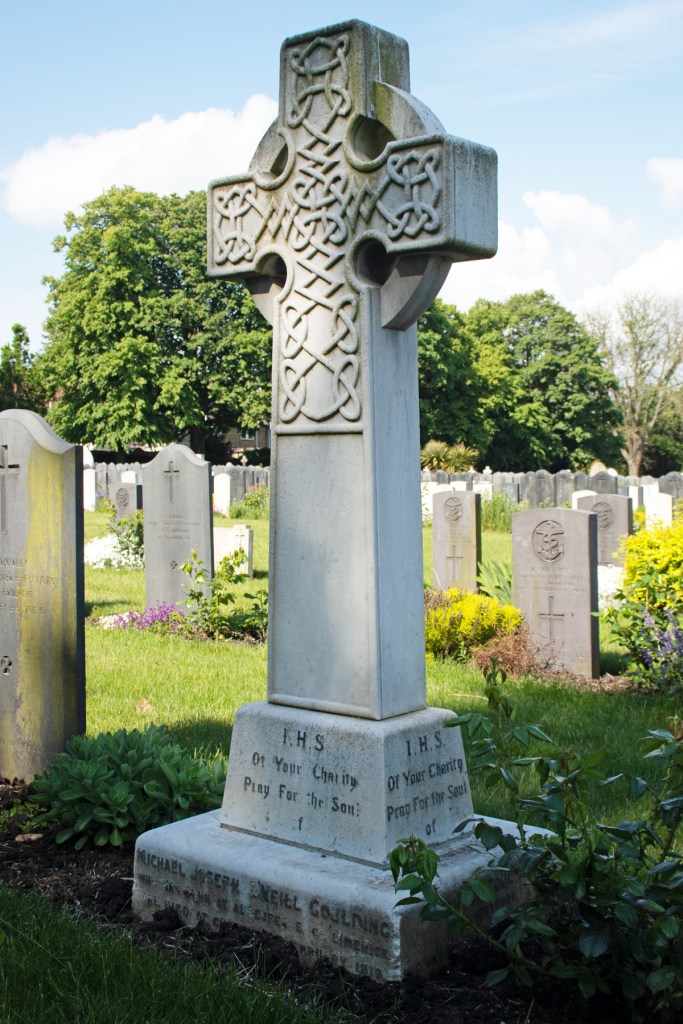
Able Seaman Michael Goulding

Able Seaman Michael Goulding

Michael Joseph O’Neill Goulding was born on 5th May 1884, the oldest of six children to Michael and Ellen Goulding (née O’Neill). Michael Sr worked for the inland revenue and his job took him around most parts of the British Isles.

Michael Jr had been born in Limerick – both of his parents came from Ireland – but his subsequent three siblings (Patrick, Margaret and William) had all been born in Scotland. His second youngest sibling, Lily, was born in County Durham, the youngest back in Scotland, while, by the time of the 1901 census, the whole family were living in Forest Gate, East London.

The census also shows that Michael Jr, having left school, was working at Customs House (presumably where his father was employed), as a boy copyist on tea accounts. The inland revenue at that time was a career for life; by the next census in 1911, the family had moved to Hertford, where Michael Sr was a customs and excise supervisor, and Michael Jr was an assistant clerk at the same place of employment.

War was on its way, but Michael seems not to have enlisted immediately. While specific dates for his joining up are not available, it appears that he was still working for the Inland Revenue when he got married in Shoreditch, in April 1917. His wife was called Bridget Mary Gough (known as Bryde), and she had also been born in Ireland. The couple went on to have a daughter, Ellen (or Eileen), the following year.

By this time, Michael had definitely enlisted. He joined the Royal Naval Volunteer Reserve, and was based at HMS Pembroke, the shore-based establishment in Chatham, Kent. This was the location for the Navy’s main accounting base, so it is likely that he was employed for financial, rather than his military, skills.

Able Seaman Goulding served through to the end of the war and beyond, and it was while he was based in Kent that he became unwell. Admitted to the Royal Naval Hospital in Chatham, he succumbed to a combination of bronchitis and pneumonia on 22nd February 1919. He was 34 years of age.

Michael Joseph O’Neill Goulding was laid to rest in the Woodlands Cemetery in nearby Gillingham. His family were still in Hertford, while his widow and daughter moved back to Ireland.


Michael Joseph O’Neill Goulding
(courtesy of ancestry.co.uk)

Able Seaman George Davies

Able Seaman George Davies

George Herbert Davies was born in Rosses Point, County Sligo, Ireland on 28th September 1872. One of eight children, his parents were naval man Robert Davies and his wife Catharine.

George was obviously drawn to the sea, and enlisted in the Royal Navy in February 1888. Too young to be an active member of the crew, he was initially given the rank of Boy, before rising to Ordinary Seaman when he came of age in September 1890.

Over the duration of his initial twelve years’ service, George was assigned to a total of eight ships, with time between each spent at the shore-based establishment HMS Pembroke in Chatham, Kent. He rose to the rank of Able Seaman and, in February 1903, volunteered to continue his time in the Royal Navy.

At the start of 1914, having served for a further ten years, Able Seaman Davies was stood down to the Royal Fleet Reserve. He did not remain on reserve status for long, however, as, in August 1914, he was called again into active service as war was declared.

While primarily based on HMS Pembroke this time, George did service two tours on sea-going vessels: he spent two years on board HMS President from October 1914, and then six months on the General Greenford. By January 1917, however, he was back at HMS Pembroke.

Within a couple of months, Able Seaman Davies had been admitted to the Royal Naval Hospital in Chatham, suffering from pancreatitis. Sadly, this haemorrhaged, and he passed away on 27th March 1917; he was 44 years old.

George Herbert Davies was laid to rest in the Woodlands Cemetery in Gillingham; walking distance from the Naval Dockyard that had been his base for so long.


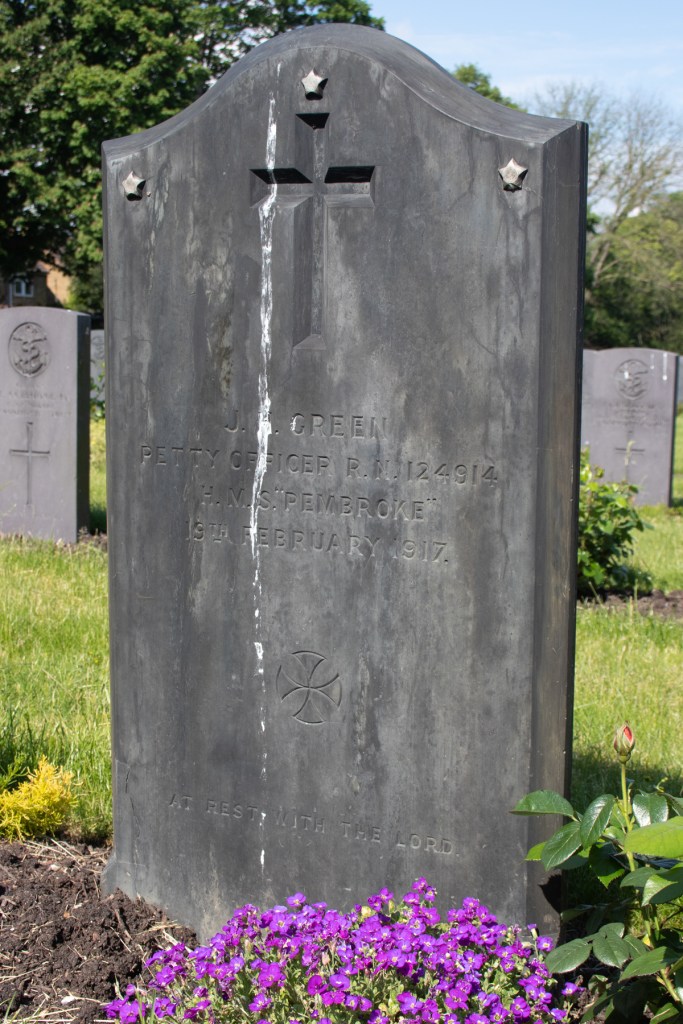
Petty Officer James Green

Petty Officer James Green

James Henry Green was born in Brixham, Devon, on 13th April 1868, the only child to Isaac and Sarah Green. Isaac was the son of a miller from Essex, who found work as a miner in the south west; he sadly died in 1871, when James was just a toddler.

Sarah had been married before she met Isaac; she had had two children, both daughters, with her first husband, William Tozer, so James had two half-sisters. William had died in 1865, and Sarah had gone on to marry James’ father later that year.

The 1881 census found Sarah and the children living in a cottage in the middle of Brixham; she was listed (somewhat uncharitably by current standards) as a mangle woman. She had taken in a couple of lodgers and James – then aged 13 – was listed as a scholar.

James was evidently keen to make a place for himself in the world. In 1885 he enlisted in the Royal Navy, working as a Boy on a number of ships until, on his 18th birthday, he was given the rank of Ordinary Seaman. His naval records show that he had a dark complexion, brown eyes and brown hair and stood as just 5ft 1in (1.55m) tall.

During his initial ten years’ service, James served on nine ships as well as shore-based establishments, working his way up to the rank of Able Seaman. One the initial period of enlistment was up, he extended his time in the navy voluntarily, eventually serving on a further five vessels and reaching the rank of Able Seaman before transferring to the Coastguard in South Shields. James was stood down form active naval duties in January 1908 and transferred to the Royal Naval Reserve, based in Chatham, Kent.

It was while he was in County Durham that he met Edith Hansford (or Handforth), a horse keeper’s daughter from Whitburn. The couple married in the spring of 1901, and settled down in Sculcoates, to the north of Hull.

When war was declared, those in the Royal Naval Reserve were called into immediate action, and James was no exception. Given the rank of Petty Officer, he was initially assigned to HMS Pembroke, the shore establishment in Chatham, before a brief tour on HMS Columbine, and a longer term on the gunboat HMS Britomart.

In July 1916, Petty Officer Green returned to HMS Pembroke; he remained based there for six months, before being admitted to hospital, suffering from phlebitis (an inflammation of the veins in the legs). Sadly, the condition got the better of him; he passed away in the Royal Naval Hospital in Chatham on 19th February 1917, at the age of 48.

James Henry Green was laid to rest in the Woodlands Cemetery in his adopted home town of Gillingham, Kent.


Petty Officer Tom Jones

Petty Office Tom Jones

Thomas Jones (known as Tom) was born in Wednesbury on 7th September 1882 and was the middle of seven children. His father, also called Thomas, was a grocer and, with his mother Mary, they raised their family first in the Staffordshire town and then in Blackpool, Lancashire.

When he left school Tom helped his dad in the shop, primarily dealing with meat. His mind was on greater adventures, however, and in November 1898, he enlisted in the Royal Navy. Due to his age, he was initially given the rank of Boy, but was officially signed up as an Ordinary Seaman on the day after his 18th birthday.

Over the time of his initial twelve years’ service, Tom rose through the ranks, from Able Seaman to Leading Seaman and Petty Officer. In May 1912, however, he was ‘disrated’ back to Able Seaman, but there is no evidence to confirm why this was done. By this time, he had served on nine ships, as well as having time in shore-based establishments, and had completed his twelve years as a mariner.

Meanwhile, in the autumn of 1904, Tom had married Hannah Kennedy, a dockyard labourer’s daughter from Gillingham, Kent. The couple went on to have four children and set up home in the centre of the town, not far from the Naval Dockyard where Tom was sometimes based.

With war in Europe on the horizon, Tom immediately volunteered to continue his duty when he term of service came to an end. Working hard, he soon regained the rank of Leading Seaman and, by April 1915, was back up to Petty Officer once more.

During the remainder of his time in the Royal Navy, Petty Officer Jones served on a further seven vessels. In October 1920, after more than two decades’ service, he was invalided out, having contracted tuberculosis, rendering him unfit to continue.

At this point Tom’s trail goes cold. It seems likely that his lung condition got the better of him; he passed away on 20th June 1921, at the age of 38 years old.

Petty Officer Tom Jones was laid to rest in the Woodlands Cemetery in Gillingham, Kent.


Tom Jones II
Petty Officer Tom Jones
(courtesy of ancestry.co.uk)

Petty Officer William Dale

Petty Officer William Dale

William Edmund Dale was born in Worthing, West Sussex on 25th November 1886 and was the older of six children. His father, also called William, was a carman, and he and William’s mother, Eliza, brought the family up in the Sussex town.

William Jr seems to have had a number of jobs, working as a draper’s errand boy, a milkman’s assistant and a gardener. He found his true calling at the age of 12, however, when he enlisted in the Royal Navy.

Initially acting as a Boy 2nd Class, over his initial twelve years’ employ he served on eleven vessels, and rose through the ranks to Boy, Ordinary Seaman and Able Seaman.

It was while serving on HMS Blake in 1910, that he married Mary Williams. The couple went on to have two children, William, born in 1910, and Harry, born the following year. The family set up home in Portsmouth, where the sailor was based.

With his initial service complete in 1916, William’s term of duty was extended until the end of hostilities. A promotion to Leading Seaman followed, and he was assigned to HMS Attentive, part of the Dover Patrol guard.

In 1917, William was promoted again, this time to the role of Petty Officer, and was assigned to HMS Royal Sovereign, the Navy’s new battleship. He served on the vessel for the remainder of the way, and through into the summer of 1919.

It was in the last month of his service, that Petty Officer Dale fell ill. He was taken ashore, and sent to the Royal Naval Hospital in Chatham, Kent. He had contracted meningitis, and sadly succumbed to it within days of being admitted. He died on 4th August 1919, at the age of just 32 years old.

William Edmund Dale was brought back to the town of his birth; he lies at rest in a quiet corner of the Broadwater Cemetery in Worthing, West Sussex.