John Arthur William Claxton was born at the start of 1883 in Mile End, Middlesex. He was the only child to John and Louisa Claxton. John Sr was a brewer’s drayman, and, when Louisa died in the 1890s, He was left to raise his son.
When he completed his schooling, John Jr found work as a joiner’s apprentice. On 4th February 1907, he married Maud Wilson, a labourer’s daughter from Stepney. The couple went on to have two children: Louisa was born in 1907, and John the following year.
At this point, John’s trail goes cold. His marriage certificate confirms he was employed as a carpenter, and he definitely enlisted in the Royal Navy at some point, but whether this was as a direct result of the outbreak of war is unclear.
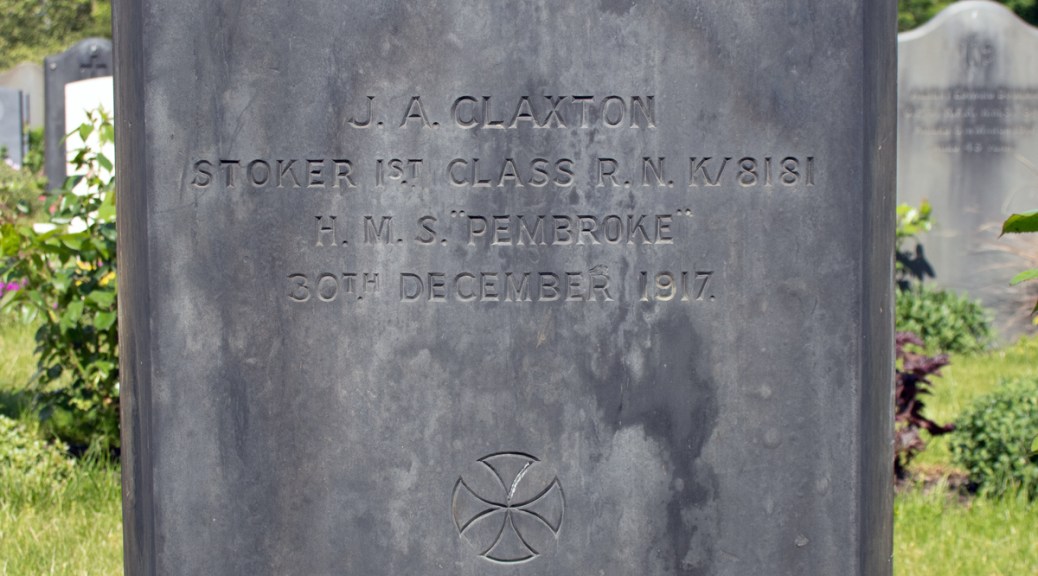
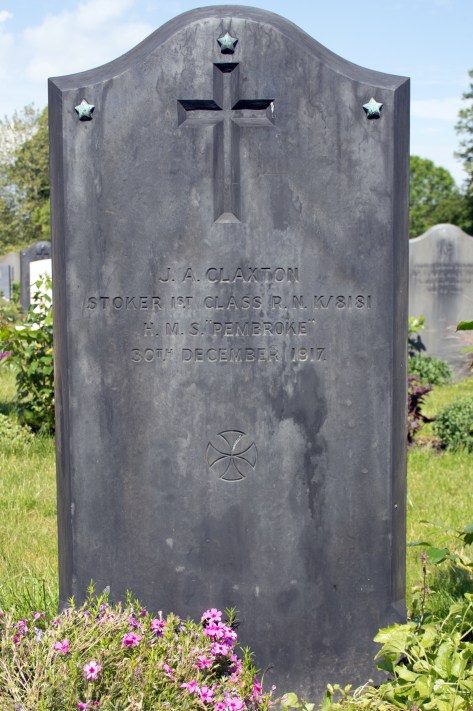
Stoker 1st Class Claxton’s service records have been lost to time. The only other document relating to him is his Pension Ledger Index Card. This confirms that he died from asthma and pneumonia on 30th December 1917: he was 34 years of age.
John Arthur William Claxton is likely to have died at either the Royal Naval Dockyard in Chatham – otherwise known as HMS Pembroke – or the Royal Naval Hospital in the town, as his body was buried in Woodlands Cemetery, Gillingham, not far from the base.
Joseph Walls was born in Tortington, near Arundel, in West Sussex, on 13th November 1880. The youngest of four children, his parents were gamekeeper James Walls and his wife Annie. James moved the family to where his work took him and, by the time of the 1891 census, they had settled in the New Forest village of Sway, Hampshire.
When Joseph finished his schooling, he found work as a horseman and groom. The 1901 census found him living with his parents and older sister in a house in Brockenhurst. He seems to have taken his work seriously, and soon found himself a position as a chauffeur. The next census, taken in 1911, recorded him as working for Ann Libbey and her family in the village of Boldre.
On 18th February 1914, Joseph married Edith Perry. A carpenter’s daughter, she was working as a domestic servant when the couple exchanged vows. Their wedding certificate confirms that Joseph was ten years his new wife’s senior, and that they ceremony was witnessed by his older brother Frederick and her younger sister, Esther.
Joseph and Edith would go on to have two children: Vera was born in 1915, while Daphne came along three years later. During this time, however, war was raging across Europe, and Joseph had stepped up to play his part.
Private Walls enlisted within weeks of war being declared, on 10th December 1914. His service papers show that he was living at Hospital Cottage in Lyndhurst when he joined up. He was 5ft 8ins (1.72m) tall, with black hair, grey eyes and a dark complexion. He was also noted as being asthmatic since he was a child.
Assigned to the 1st/4th Battalion of the Hampshire Regiment, over the next few years, Private Wallis would see the world. Within days of enlisting, he was shipped out to India, where he would spend nearly three years (apart from the in the summer of 1917, when he served as part of the Mediterranean Expeditionary Force). During this time, Joseph was promoted to Lance Corporal, although by the time he left the army, he had returned to the tank of Private.
By the beginning of September 1917, Joseph was back on home soil. A spell of malaria that spring had impacted his asthma, and at the end of November, he was deemed no longer fit for war service. Private Walls was medically discharged from the army on 29th November 1917.
At this point, Joseph’s trail goes cold. He definitely returned home – Daphne was born just a few days after the Armistice – but it is unclear whether he was it enough to work.
Joseph Walls died on 14th February 1919: he was 38 years of age. He was laid to rest in Lyndhurst Cemetery, not far from where Edith and their children lived.
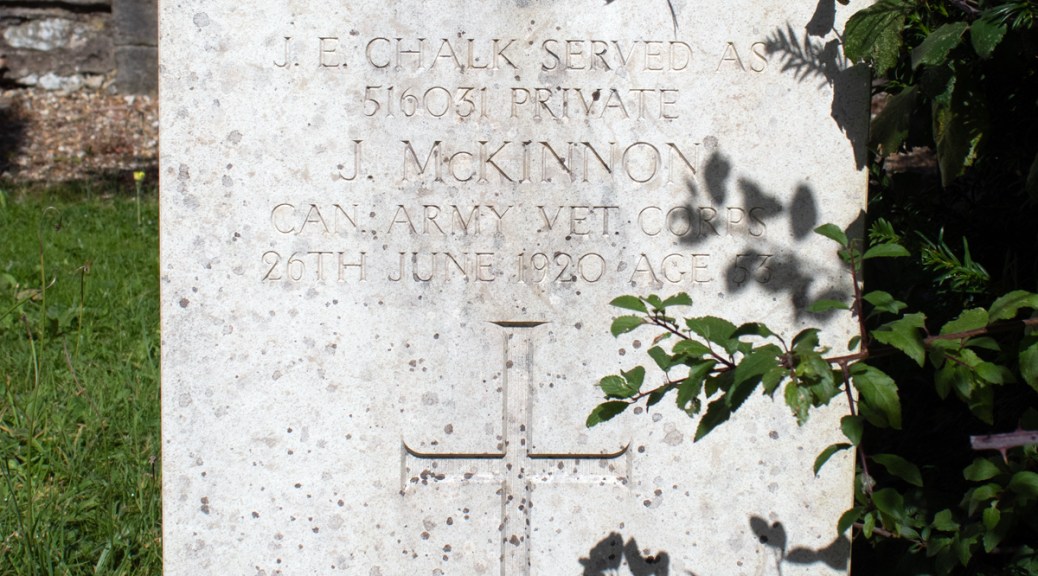
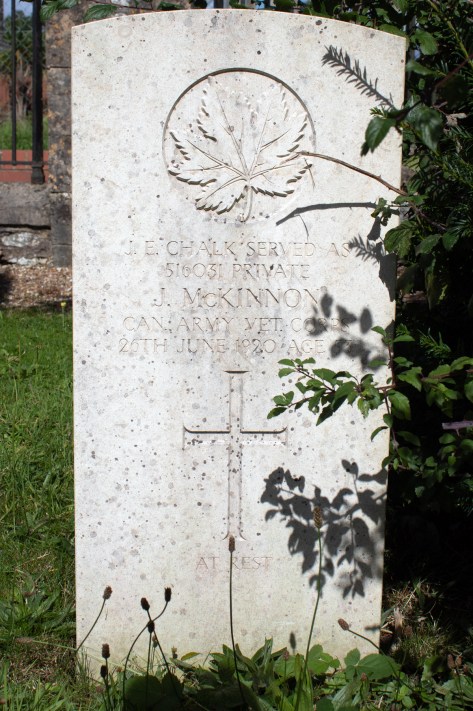
In Mere Cemetery, Wiltshire, is a headstone dedicated to JE Chalk, who served as Private J McKinnon in the Canadian Army Veterinary Corps. He died on 25th June 1920, and gives his age as 53 years old.
Private McKinnon’s service records suggest, however, that he was born on 14th October 1874 in Inverness, Scotland, and give his army name as John. The Commonwealth War Graves Commission give his other name as James Edward Chalk. James seems to have been keen to disguise his background, and it is only with some digging that the real story comes out.
James was the youngest of five children to Edward and Mary Chalk. Edward was a carpenter from Mere, and this is where the family were born and raised.
When he finished his schooling, James found work as a booking clerk. Edward died in the 1880s, and the 1891 census found James living at home with his mother, who had taken on laundry work to help with their finances.
By 1901, Mary and James were living on Water Street, to the south of the town centre. There’s was now an extended household, and included James’ sister Olive. James is noted as being married, and while no marriage records exist, it would seem that his wife, Mary, and their daughter, Ivy, were also living there.
The next census, taken in 1911, suggests James’ life had taken a different turn. Employed as a railway foreman, he was now living with his older sister, Olive, in her home. He is noted as being married with a child, but neither Mary nor Ivy appear in the same census.
At some point in the next five years, James took the decision to move overseas, and create himself a new identity.
John McKinnon was living in Montreal when the call came to join up. He enlisted on 29th April 1916, by which point he was 41 years of age. Assigned to the Canadian Army Veterinary Corps, his service records confirm that he was 5ft 9ins (1.75m) tall, with greying brown hair, grey eyes and a sallow complexion. He was noted as having scars on both legs, and another on the second toe of his right foot.
Private McKinnon’s unit were quick to be dispatched to Britain, and he arrived in Shornecliffe, Kent, on 29th June. He spent the next five months at the army base, and had two spells of a month each in hospital during that time: the first for asthma, the second for bronchitis.
In November 1916, John moved along the coast to Shoreham, West Sussex. His health was badly impacted, though, the medical report stating that ‘his chest is of the emphysematous type but at present free from bronchitis. He will not do well in England.’ John was formally discharged from the army on 15th November 1916.
At this point, John’s already sparse trail goes cold once more. It is possible that he moved to Wiltshire to be nearer to family, although nothing can be confirmed.
James Edward Chalk, who serves as Private John McKinnon, died on 26th June 1920: His service records suggest that he was 45, but he was, in fact, 53 years of age. He was laid to rest in Mere Cemetery, on the outskirts of the town he had called home for so long.
Frederick Henry Browning was born on 19th March 1884, and was the third of five children to John and Elizabeth Browning. Born in Dunedin, New Zealand, there is little information about his early life, but as he grew up, he found work as a blacksmith.
When war broke out in Europe, Frederick was working for JS Collins at the Mountain Hotel in Queenstown. By this point he had also spent three years in military service, working for the Ambulance Brigade in Nelson, at the northern tip of South Island.
Frederick stepped up to play his part, enlisting on 22nd August 1916. His service documents show that he was 5ft 7ins (1.7m) tall, and weighed 153lbs (69.4kg). A Methodist, he had black hair, brown eyes and a dark complexion.
Attached to the New Zealand Otago Regiment, Private Browning was sent to Trentham, on the North Island, for training. An asthmatic, he spent two weeks in hospital with the condition in October 1916. On 30th December 1916 his unit departed for Europe on board the SS Athenic, a White Star Line ship conscripted for troop use at the start of the war.
Frederick’s asthma returned on the journey, and he spent a further week of the journey in his sick bed. The Athenic docked in Devonport, Devon, on 3rd March 1917, and Private Browning was sent straight to the town’s military hospital, his lung condition once again affecting him.
It would not be until 14th March that Frederick eventually re-joined his unit, who were based in a camp just outside the Wiltshire village of Codford. His health was really struggling, however, and he came down with a bout of pneumonia. On 24th March he was admitted to the No. 3 New Zealand General Hospital near the camp, but the condition was to get the better of his weakened body. Private Browning passed away on 31st March 1917, at the age of 33 years old.
The body of Frederick Henry Browning was laid to rest in the ANZAC graveyard extension of St Mary’s Church, Codford, not far from the base he had so briefly called home.
Ephraim Alex Jacobs was born in the summer of 1883 in Birmingham, West Midlands and was the youngest child to Morris and Mary Jacobs. Morris was a tailor, but when he finished his schooling, Ephraim followed in his older brother’s trade, becoming a hairdresser.
This was not to prove a long-term career, however and, by the time of the 1911 census, things had changed. Ephraim, who now went by his middle name, had moved to Seend, near Melksham, Wiltshire. The document confirms that he had been married for four years by this point, although full details of his wife, the London-born Ethel, remain elusive. Alex was employed as a rubber worker in a factory in Melksham.
When war broke out, Alex stepped up to play his part. His service records no longer exist, but it seems that he enlisted in the Royal Army Service Corps, and was attached to one of the Mechanical Transport units. He seems not to have served overseas, and was demobbed on 14th September 1919. At this point Private Jacobs was suffering from neuritis, or nerve damage.
Alex’s trail goes cold at this point. He seems to have spent some time at the Pensioner’s Hospital in Bath, Somerset, and this is where, on 22nd December 1920, he passed away. The cause of his death was noted as being a cerebral tumour and asthma. He was 37 years of age.
With finances seemingly leaving Ethel unable to bring her late husband back to Wiltshire, Alex Ephraim Jacobs was instead laid to rest in the sweeping Locksbrook Cemetery, Bath.
Herbert Griffith was born in the summer of 1883 in the Somerset village of Crowcombe. One of eight children, his parents were coachman James Griffith and his wife, Selina.
Herbert’s early life is a challenge to piece together. The 1901 census recorded him as living at Weacombe House, West Quantoxhead, where he was employed as a footman.
On 16th December 1909, Herbert married Selina May Davies. Also born in Crowcombe, she was the daughter of a tailor. The couple’s marriage certificate confirms the wedding was conducted at the village church. The couple went on to have two children, Dorothy in 1912, and Geoffrey four years later.
Herbert, at this point, was living in Farnborough, Warwickshire, where he was employed as a valet. (While no document remains to confirm this, it seems possible that this was actually Farnborough Hall, home to generations of the Holbech family.)
When war broke out, Herbert seemed keen to serve his country. He enlisted in the Royal Army Medical Corps, although his full service records no longer remain, so it is not possible to confirm whether he served on home soil or overseas.
The next record relating to Private Griffith is that of his passing. He died in Southampton, Hampshire, on 22nd February 1916, as a result of a combination of bronchitis, asthma and cardiac failure. He was 32 years of age, and would never get to meet his son, who was born two weeks later.
The body of Herbert Griffith was taken back to Somerset for burial. He was laid to rest in the peaceful surroundings of the Church of the Holy Ghost in his home village, Crowcombe.
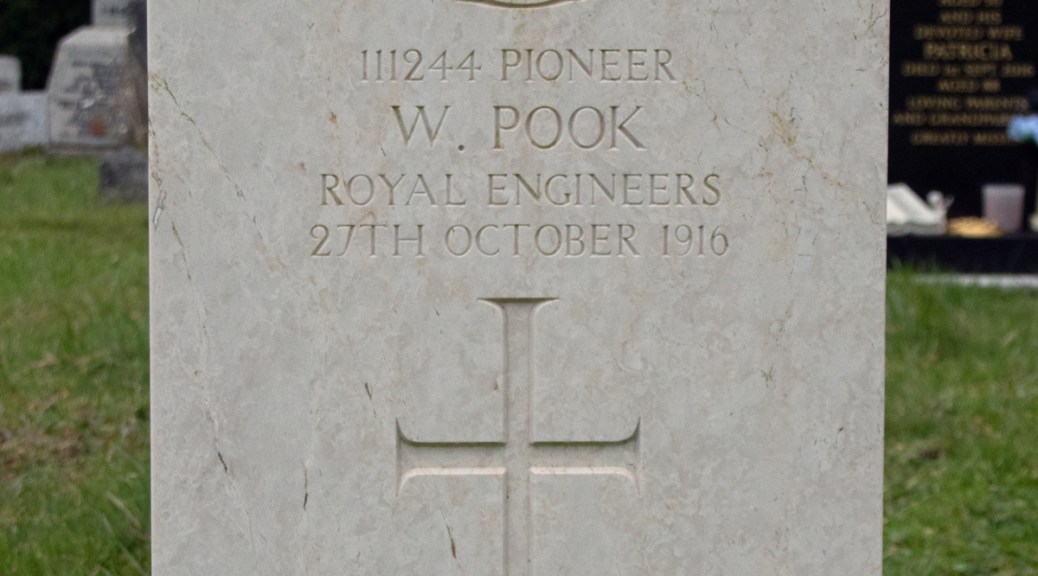
William Pook was born in 1869. There is little specific evidence available about his early life, but his service records confirm that he married Jessie Elizabeth Moxey on 25th January 1890: they went on to have four children.
The 1891 census records the young family living in the village of Highweek, near Newton Abbot in Devon, where William was working as a fellmonger, dealing in hides and sheepskins. This was a trade he continued through the years, and is confirmed as his line of work by the time of the 1911 census. At that point, the expanding family had moved from Highweek to nearby Wolborough.
War was coming to Europe and, in August 1915, at the age of 46, William joined up. His age suggests that this was something he did voluntarily – compulsory enlistment was only introduced the following year – and he joined the Royal Engineers as a Pioneer. The role was designed to relieve the infantry from some of the duties that kept them from the front line, effectively acting as a labour force to free up those who were fighting.
Pioneer Pook was sent to France in August 1915, remaining there for nine months. Health issues started to intervene, and, in June 1916, he was dismissed from military service as being medically unfit because of his asthma.
At this point, William’s trail goes cold. The next record confirms that he died on 27th October 1916, in Newton Abbot. No cause of death is evident, but it seems likely to have been related to his lung condition. He was about 47 years old.
William Pook was laid to rest in Newton Abbot Cemetery.





 Death and Service