Tag Archives: Australia

Serjeant Richard Ford

Serjeant Richard Ford

Richard Oscar Ford was born in Williamstown, Australia, in July 1891. The oldest of four children – and the only son – his parents were Anthony and Mary Ford. Anthony was a soldier, but Richard chose a different route and took work as a labourer when he completed his schooling.

There is little information available about Richard’s early life, but when war broke out, he stepped up to play his part. He enlisted in the Australian Imperial Force on 9th November 1914.

By this point he was working as a bushman, and his service papers reveal something of the man he had become. Standing 5ft 7ins (1.7m) tall, he weighed 140lbs (63.5kg), Private Ford had auburn hair, blue eyes and a fair complexion.

Assigned to the Light Horse Regiment, Richard left Australia for Europe on in March 1915. His unit arrived on the Gallipoli Peninsula on 15th July, and he would remain there for the next five months.

In December 1915, Richard came down with a bout of influenza, and was medically evacuated to the island of Mudros, then on to Alexandria, Egypt. In January 1916, he was admitted to hospital again, this time suffering from gonorrhoea and, after treatment, he re-joined his unit on 2nd February.

Private Ford’s unit spent that spring training in Egypt, but on 29th May, they set sail for the Western Front. Within a week they had disembarked in the French port of Marseilles and headed north to Etaples.

The next couple of years would prove a little disjointed. Richard switched units in August 1916, and given the rank of Gunner, but within two months his role had changed to Driver. His service records suggest that he managed to avoid injury during the fighting he was involved in, but that did not mean that he avoided hospital completely.

In January 1917 Driver Ford was admitted to the 51st General Hospital with a heart murmur, returning to his unit on 16th March. He had a second spell in hospital in February 1918, having come down with laryngitis.

In July 1918, having spent some time at the 4th Army Corporal School, Richard was reassigned to the 3rd Australian Field Artillery. This move seemed to have been the focus he needed. Initially promoted to Bombardier, within a month he rose to Lance Corporal, and by December 1918 he was a full Sergeant.

After the Armistice was signed, Richard was given three weeks’ leave, which he spent in Britain. By January 1919, however, his health was becoming an issue again, and he was admitted to the military hospital in Fovant, Wiltshire, suffering from influenza. The condition worsened, and Sergeant Ford passed away from bronchopneumonia on 4th February 1919. He was 27 years of age.

Richard Oscar Ford was laid to rest in Highgate Cemetery, Middlesex. While there seems to be no direct connection between the location and the man, his father, Anthony, had been born in Hackney, so it can be assumed that there was a family link to the area.
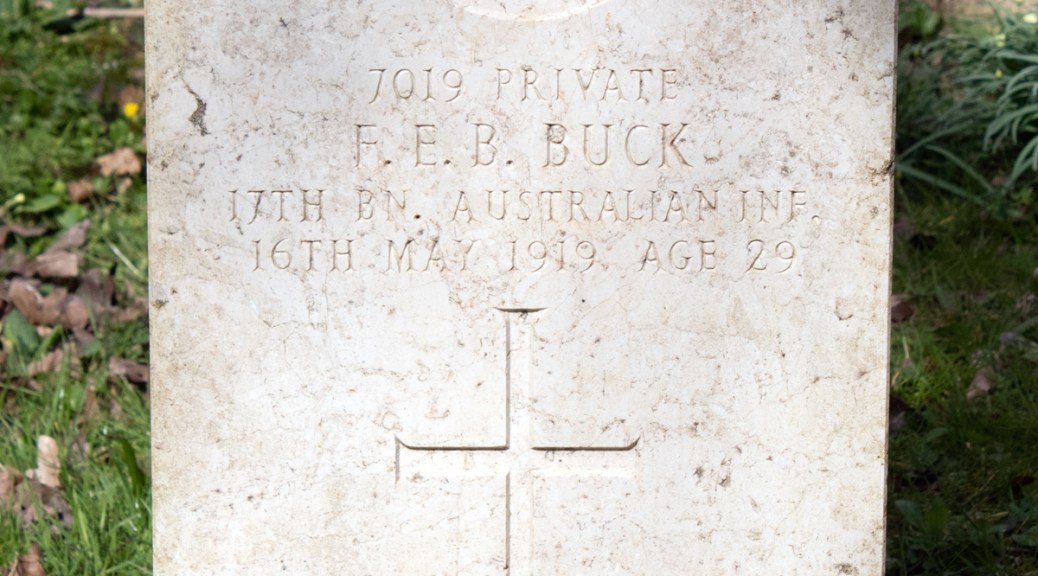
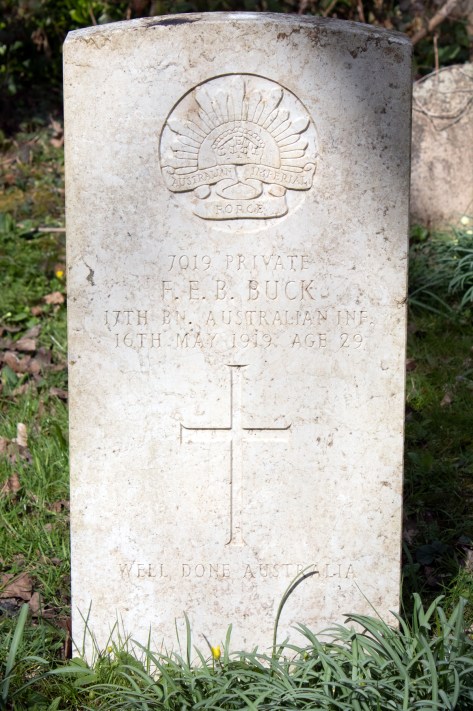
Private Frank Buck

Private Frank Buck

Frank Ernest Brydgnes Buck was born in Islington, Middlesex, early in 1889, his mother’s name was Rosina, but his father’s details have been lost to time, the 1901 census confirming that she was a widow. The document notes that Frank was the youngest of four children, and the family had taken rooms in a three-storey house on Yerbury Road.

By the summer of 1917, Frank had emigrated to Australia. Settling in the town of Inverell, New South Wales, he took employment as a clerk. However, when war came to Europe, he was called on to play his part, and enlisted in the Australian Imperial Force on 16th July 1917.

Private Buck’s service records confirm that he was 5ft 11.5ins (1.82m) tall and weighed 11st 4lbs (71.7kg). He was recorded as having dark hair, blue eyes and a dark complexion. He had a burn scar on his right forearm, and a third nipple on the right side of his chest.

Frank’s unit departed from Sydney on 31st October 1917, and he spent the next two months on board the SS Euripides. During that time he was promoted to Acting Corporal and, when he disembarked in Devonport, Devon, on 26th December, he marched to the ANZAC camp in Fovant, Wiltshire.

Assigned to the 5th Training Battalion, Frank seems to have taken this unexpected return to Britain as a free ticket home: on 6th February 1918 he went AWOL, and only surrendered back to his unit on 9th April. Help in detention for a day, he forfeited 63 days’ pay, and was demoted to the rank of Private for his actions.

On 13th May, Private Buck was dispatched to France. He was assigned to the 17th Battalion of the Australian Infantry, but his time overseas was not to be a lengthy one. In July he was admitted to the 5th Australian Field Ambulance with gastritis: he was then transferred to the 5th Casualty Clearing Station, then the 3rd General Hospital in Le Treport. Medically evacuated to Britain for treatment, he ended up in Reading War Hospital for ongoing treatment.

Placed on furlough on 16th September, Private Buck went AWOL again on just two weeks later. Arrested on 26th November 1918, he was hauled before a judge at Highgate Police Court: his crimes amounted to being absent without leave, but also stealing three blank cheques and forgery. Pleading guilty, he was sent to Wormwood Scrubs for nine months.

Frank would not end up serving his time, however. He was admitted to the infirmary with a perforated duodenal ulcer, and died from exhaustion on 16th May 1919. He was 29 years of age.

Frank Ernest Brydgnes Buck was laid to rest in Highgate Cemetery.


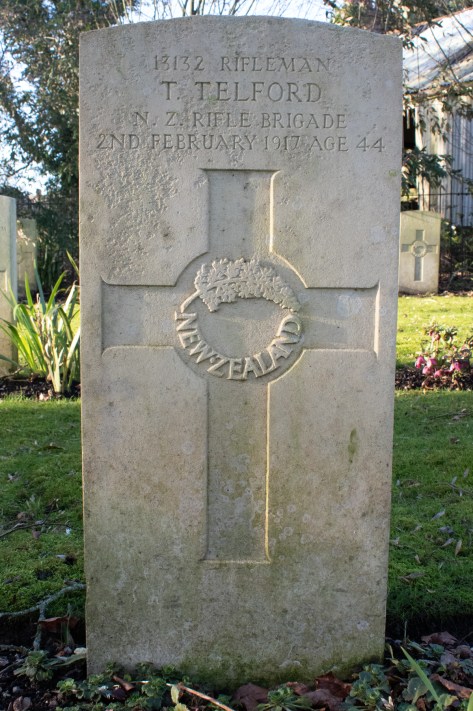
Rifleman Thomas Telford

Rifleman Thomas Telford

Thomas Telford was born in Bacchus Marsh, Victoria, Australia, on 31st July 1873. The fifth of eleven children, his parents were James and Mary Telford.

There is little additional information about Thomas’ early life. By the time war broke out, he had moved to New Zealand, and was working as a bushman, based out of Whanganui on the south coast of North Island.

Thomas enlisted on 18th January 1916, and would be assigned to the New Zealand Rifle Brigade. His service records show that, at 42 years of age, he was 5ft 5ins (1.65m) tall, and weighed 149lbs (67.6kg). A Roman Catholic, he had iron grey hair, blue eyes and fair hair.

Rifleman Telford’s unit left New Zealand in the spring of 1916. After five weeks in Egypt, he arrived on British soil on 7th August, marching from Southampton, Hampshire, to the Sling Camp in Wiltshire.

By 20th August, Thomas was in France, fighting on the front line. He was injured less than three weeks later and, after initial treatment in France, he was medically evacuated to Britain at the end of September.

Rifleman Telford spent time convalescing in a military home in Hornchurch, Essex, before being transferred to the ANZAC base in Codford, Wiltshire. That winter he contracted pneumonia, and he was admitted to the No. 3 New Zealand General Hospital on the outskirts of the village.

Sadly, the lung condition was to prove the better of Thomas. He passed away on 2nd February 1917, at the age of 43 years old.

Thousands of miles from home, Thomas Telford was laid to rest in the graveyard extension to St Mary’s Church in Codford, not far from where he had breathed his last.


Rifleman Alexander Shaw

Rifleman Alexander Shaw

Alexander Richardson Shaw was born in Sandhurst, Victoria, Australia, on 10th February 1884. The second of seven children – although two of his younger siblings died when just babes-in-arms – his parents were Thomas and Elizabeth Shaw.

Little is known about Alexander’s early life. Thomas passed away in 1890, and Elizabeth was left to raise the family alone.

The next document for Alexander is his army service record, confirming that he enlisted on 27th June 1916. By this point he had moved to New Zealand and settled in Wellington. He was employed as a labourer and working for a GG Holmes.

It seems that Alexander had tried to enlist before: his records show that he had previously been turned down because of poor eyesight. At this point, however, with the war raging in Europe, and thousands of New Zealanders being called upon, he was taken on. His service records show that he was 5ft 8ins (1.72m) tall, and weighed 12st 6lbs (78.9kg). Alexander was also noted as having fair (reddish) hair, blue eyes and a fresh complexion.

Rifleman Shaw was sent to Trentham, outside Wellington, for his basic training. His time there was not without incident, however, and on 21st July he was confined to barracks for three days for failing to comply with an order.

On 16th October 1916, Rifleman Shaw’s unit – the New Zealand Rifle Brigade – set sail from Wellington on the SS Willochra for their ten-week voyage to Europe. Discipline remained tight on board and, as the ship was nearing the end of its journey, Alexander was again pulled up. His records simply state that his offence was ‘for clothing issued’, and he was stopped the sum of 3d 6d from his pay.

The Willochra arrived in Devonport, Devon, on 29th December 1916 and, while the rest of his unit was sent to their base at Sling Camp near Bulford, Wiltshire, Rifleman Shaw was admitted to the port’s military hospital. His condition is unclear, but by 10th January he was well enough to be moved to the No. 3 New Zealand General Hospital in Codford, Wiltshire.

Private Shaw was suffering from influenza, and this quickly developed into pneumonia. He passed away on 15th January 1917, just five days after being admitted. He was 32 years of age.

Thousands of miles from home, the body of Alexander Richardson Shaw was laid to rest in the peaceful graveyard extension to St Mary’s Church in Codford, not far from where he had died.


Rifleman John Delaney

Rifleman John Delaney

Little information is available on the early life of Rifleman John Delaney. Born in Launceston, Ausrtalia, on 31st January 1888, by the summer of 1916 he was working as a shepherd in the New Zealand settlement of Whatatutu.

It was here that he enlisted in the country’s Expeditionary Force, and was assigned to the Rifle Brigade. His service records note that, at 28 years of age, he was 5ft 9ins (1.75m) tall and weighed 143lbs (64.9kg). The record confirms that he had fair hair, grey eyes and a fair complexion. He had tattoos on both forearms, and a scar on his left foot. The service docmentation also gives his next-of-kin as his friend, Mr G Garrett of Springbank, near Canterbury, on New Zealand’s South Island.

John’s unit boarded the TSS Maunganui in Wellington on 15th November 1916, embarking on the ten week voyage to Britain. Arriving in Devonport on 29th January 1917, Rifleman Delaney arrived at the ANZAC camp in Codford, Wiltshire, a few days later.

The journey had taken its toll on a lot of the newly arrived troops. John was admitted to the No. 3 New Zealand General Hospital on the outskirts of the camp with pneumonia on 10th February. His condition was to prove too severe, however, and he passed away just seven days later. He was 29 years of age.

John Delaney was laid to rest in the specially extended graveyard of St Mary’s Church in Codford.


Across the available documentation, John’s rank is given as both Private and Rifleman. I have used the latter rank, as this is what is provided by the Commonwealth War Graves Commission.


Rifleman John Delaney
(from findagrave.com)

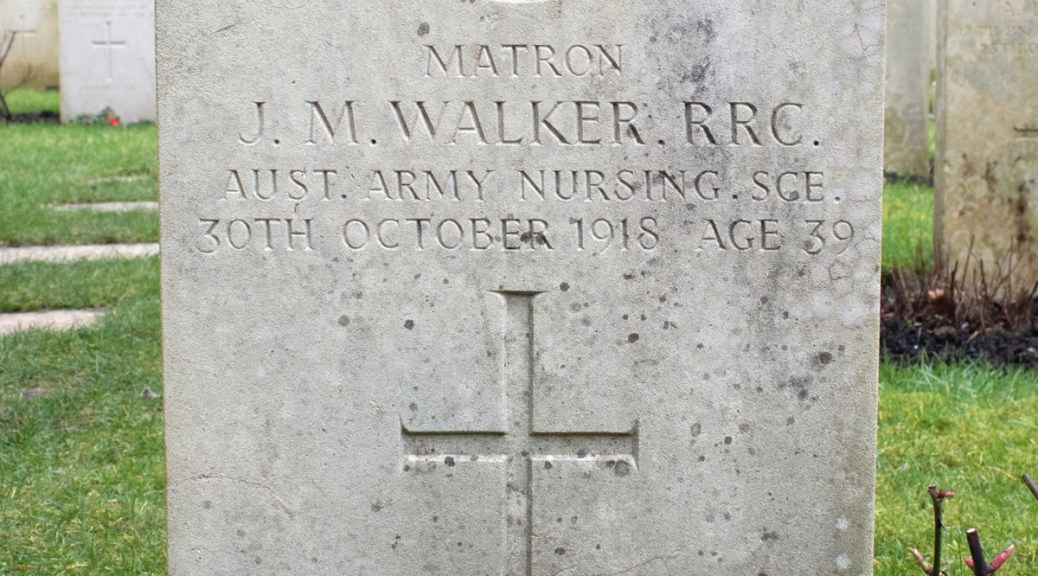
Matron Jean Walker

Matron Jean Miles-Walker

Jean Nellie Miles Walker was born in Hamilton, Tasmania, on 16th November 1878. Her parents were Arthur and Louisa Walker, and her surname moves from Walker to Miles-Walker, depending on the document. There is little information about Jean’s early life, but by 1906 she had taken up nursing.

When war broke out, Jean was quick to step up and help those who were fighting. Initially enlisting on 27th September 1914, she was assigned to a hospital ship a year later, arriving in Ismailia, Egypt, in January 1916.

Now a Sister in the Australian Army Nursing Service, Jean’s records shot the woman she had become. At 36 years of age, she was 5ft 10ins (1.78m) tall, and weighed 128lbs (58kg). She had dark brown hair, brown eyes and a dark complexion.

Over the next couple of years, Sister Walker moved to where she was needed. By September 1916 she was attached to the No. 15 General Hospital in Alexandria, by the end of the year saw her in the 3rd Australian Auxiliary Hospital in London. Jean’s service records note that she was mentioned in despatches on 1st October 1916, but there is no clarification about why she was recognised.

Jean was promoted to Matron in the summer of 1917, and over the next year, she spent time at hospitals in both Britain and France. By the autumn of 1918, she had moved to the No. 1 Australian General Hospital in Sutton Veny, Wiltshire. It was while based here that she fell ill, contracting a fatal combination of influenza and pneumonia.

Sister Walker passed away in the Sisters’ Quarters on 30th October 1918. She was just a couple of weeks short of her 40th birthday.

Jean Nellie Miles Walker was laid to rest in the grounds of St John’s Church, Sutton Veny, close to the hospital in which she had served.


Matron Jean Walker
(from findagrave.com)

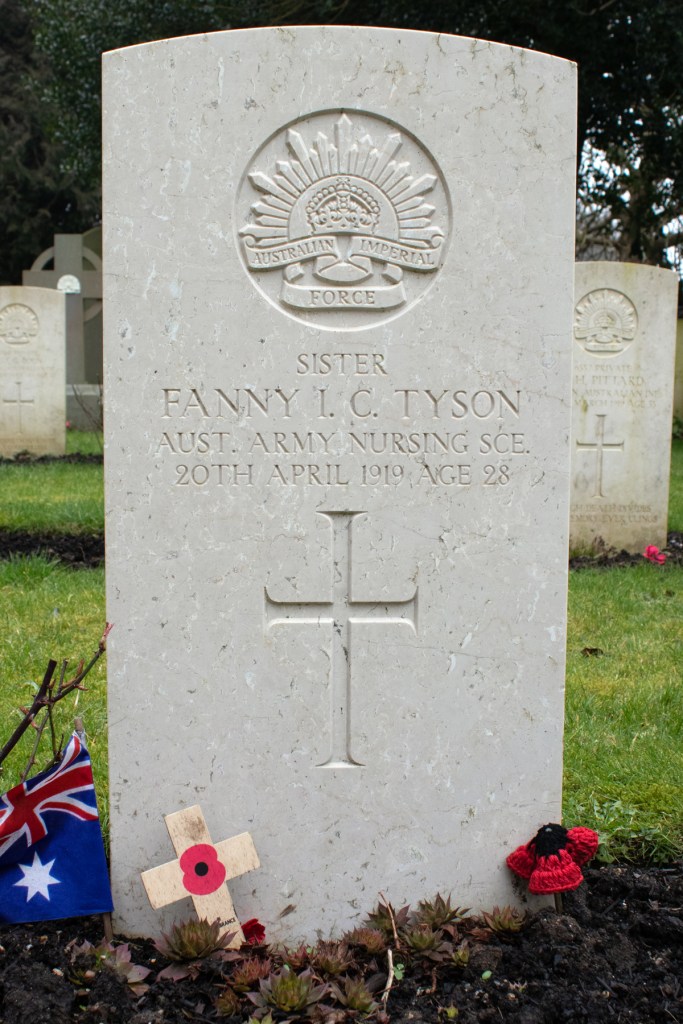
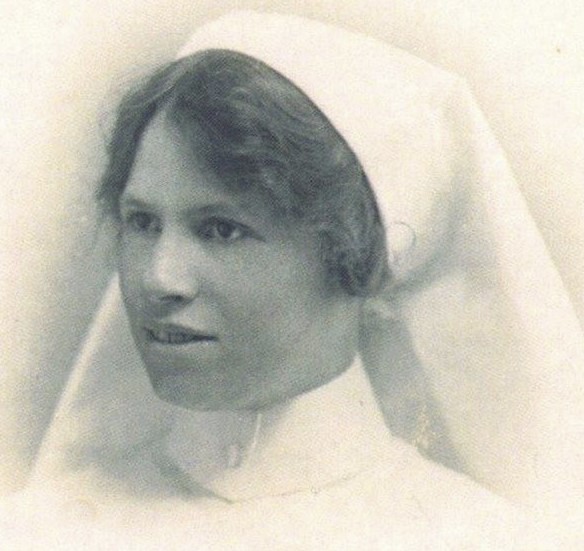
Sister Fanny Tyson

Sister Fanny Tyson

Fanny Isobel Catherine Tyson was born in Balranald, New South Wales, Australia, in 1890, and was the fourth of ten children to John and Teresa Tyson.

There is little information about Fanny’s early life, but when she finished her schooling, she went into the medical profession, and, by October 1911 she was working as a nurse at Bendijo Public Hospital. She became a staff sister and, when war broke out, she stepped up to support the troops being sent to Europe.

On 20th May 1915, Fanny enrolled in the Australian Army Nursing Service and by the following spring, she was on her way across the world. Arriving in France on 6th April 1916, she soon made her way to Rouen. For the next fourteen months Staff Nurse Tyson was attached to the No. 1 Australian General Hospital, but in the summer of 1917, she transferred to the No. 10 Stationary Hospital in Saint-Omer.

Fanny was committed to her job, which would have been traumatic at the best of times. She moved to Dieppe in February 1918, and in the closing weeks of the war, she transferred to Britain, working at the 2nd Australian General Hospital in Southall, Middlesex. On 1st October 1918 she was promoted to the rank of Sister.

Fanny would remain in Britain through the Armistice and beyond. On 20th April 1919, she was admitted to the No. 1 Australian General Hospital in Sutton Veny. Her service records do not confirm what had taken her to Wiltshire, but it seems likely that she was either accompanying wounded soldiers being transferred to Southall, or was training or supporting nurses there.

Sister Tyson had suffered a cerebral haemorrhage. She passed away that evening, as the age of 28 years old.

Fanny Isobel Catherine Tyson was laid to rest in the grounds of St John’s Church, Sutton Veny. She was buried alongside the soldiers her unit had made comfortable in their last days.


Sister Fanny Tyson
(from findagrave.com)

Private Francis Holland

Private Francis Holland

Francis Arthur Holland was born in Maryborough, Victoria, Australia, the fifth of seven children to Matthew and Elizabeth. Details of his early life are lost to time, although a later document confirms his date of birth as 19th July 1887.

Matthew died in 1901, and the New South Wales Police Gazette of 16th February 1910 included a request seeking a missing person:

Francis Arthur Holland, 22 years of age, 6feet high, about 13 stone weight, dark complexion; a sleeper-getter or labourer. Inquiry at the instance of his brother, James Holland, Bradshaw’s College, 250 Flinders-street, Melbourne, Victoria.

The 2nd March edition of the same publication noted that Francis had been found.

By 1916, Francis had moved to New Zealand, and was working as a bushman at the Grosvenor Hotel, New Plymouth. It was while here that he was called upon to serve in the war, and he enlisted on 29th June 1916 in Trentham, North Island. His service records confirm his height, and give his weight as 174lbs (78.9kg). It also noted that he had brown hair, hazel eyes and a fair complexion. He had a scar across the based of his right foot, and another on the left side of his throat.

Private Holland was assigned to the New Zealand Auckland Regiment, and his unit spend the next few months training. On 22nd September 1916, Francis was promoted to the rank of Lance Corporal, but reverted to his previous rank just a matter of weeks later. On 11th October, his unit boarded a ship and set sail for Europe.

Francis arrived in Plymouth, Devon, on 29th December, and set off for France just over a month later. His unit would serve on the Western Front, and, within a matter of months, Private Holland was admitted to field ambulance hospitals twice, for an undisclosed illness in May 1917, and a sprained ankle in June.

This second injury led to a transfer to Britain, and from here on in Francis’ health become more and more impacted. Admitted to hospital in London, he developed tonsillitis and, as he was recovering from this, he was moved again, this time to the ANZAC military camp near Codford, Wiltshire.

While in the camp hospital, it was determined that Private Holland was suffering from a heart infection, endocarditis. Sadly, his health had been tested to the limits by this point, and this was the condition to which he would succumb. Francis passed away on 6th September 1917, at the age of 30 years old.

Having been born in Australia, emigrated to New Zealand and fought on the Western Front, Francis Arthur Holland was now thousands of miles from wherever he might call home. He was laid to rest in the extension to St Mary’s Churchyard in Codford, not far from the camp in which he had spent his last days.


Private Francis Holland
(from findagrave.com)

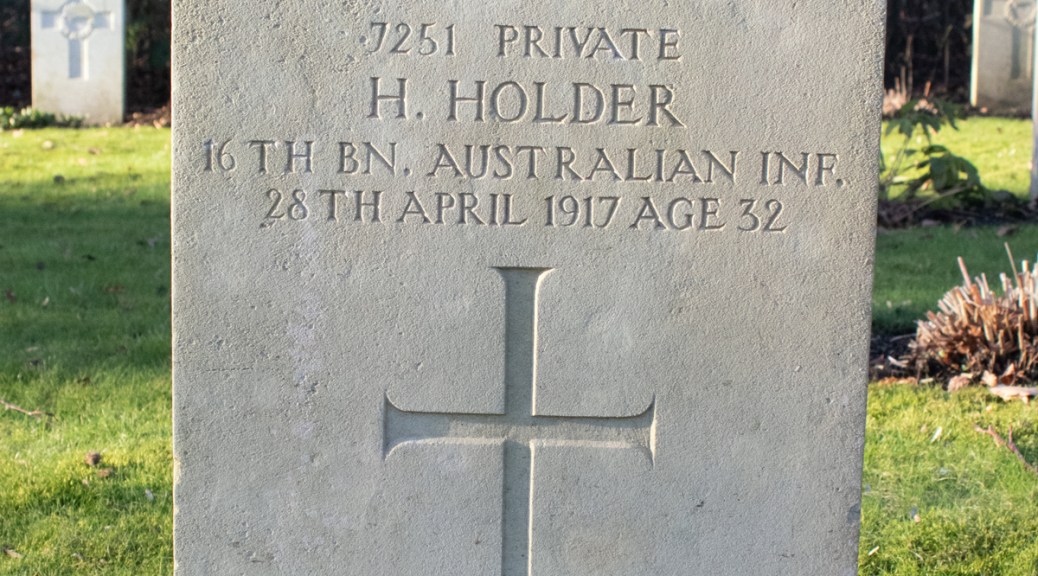
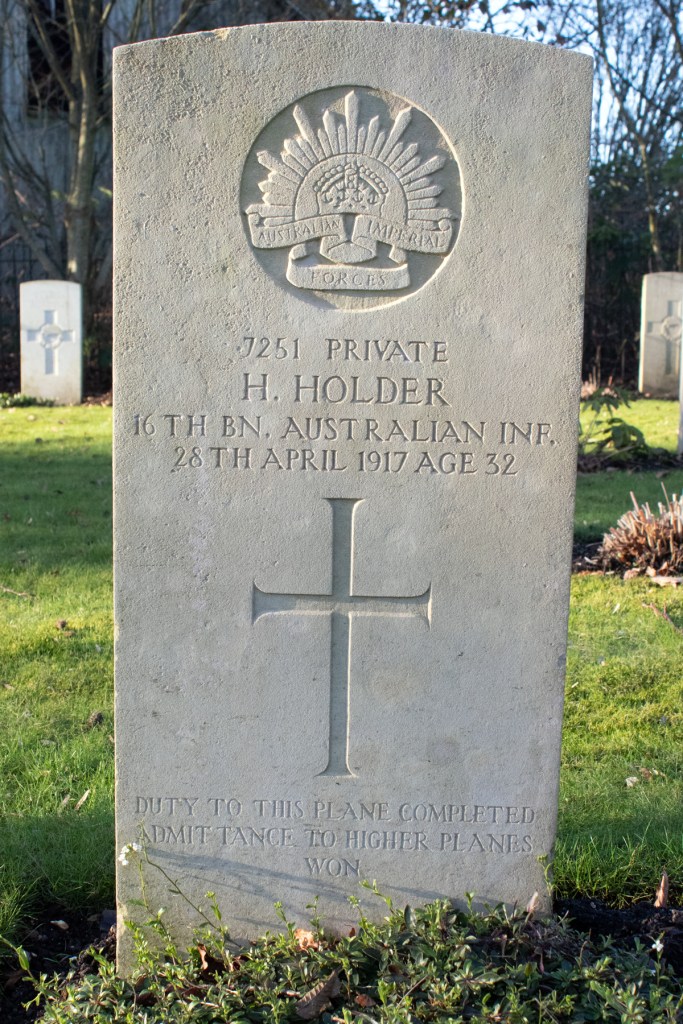
Private Harry Holder

Private Harry Holder

Harry Holder was born in the village of Ludgvan, Cornwall, in the summer of 1885. The oldest of fourteen children, his parents were Harry and Grace Holder. Harry Sr was a market gardener, and his oldest son was to follow in his footsteps.

By the time of the 1911 census, the Holders had moved to Cheltenham, Gloucestershire. Settling in a seven-room house in Leckhampton Road, the household of eleven people had six wages coming in, split between market gardening for the men and floristry for the women.

The following year, Harry Sr took his family on the long journey to Australia for a new life. They found work on a farm near Perth, and Harry Jr was employed as an agricultural labourer when war broke out. When the call came, he stepped up to play his part and his service records suggest that he had spent four years in the territorial army back in Britain. Harry had been turned down for service because of the state of his teeth just a month before trying to enlist again. The second time, however, he was successful, and he joined the Australian Imperial Force on 13th September 1916.

Private Holder’s medical report confirmed the man he had become. At 31 years of age, he was 5ft 10.5ins (1.79m) tall, and weighed 140lbs (63.5kg). A Roman Catholic, he had brown hair, blue eyes and a fresh complexion.

Assigned to the 16th Battalion of the Australian Infantry, Private Holder’s unit departed from Fremantle on 21st January 1917, travelling no board the ship Miltiades. Just under two months later, on 27th March, Harry arrived back in Britain, docking at Devonport, Devon, before moving with his battalion to a camp on the outskirts of Codford, Wiltshire.

A significant proportion of the ANZAC troops became unwell within weeks of arriving at the camp, and Harry was not to avoid illness. On 27th April he was admitted to the barracks’ hospital with cerebrospinal meningitis, but the treatment was to prove too little, too late. Private Holder died on 28th April 1917: he was 31 years of age.

Harry Holder was laid to rest in a new extension to St Mary’s Churchyard in Codford, close to the base where he had breathed his last.


Private Harry Holder
(from findagrave.com)

Private Thomas Bickley

Private Thomas Bickley

Thomas George Bickley was born in Fremantle, Australia, in 1881, and was the second of six children to Absolom and Mary Bickley. May had been married and widowed twice before wedding Thomas’ father, and so he had eight half-siblings as well.

Thomas’ early life is a challenge to piece together, but his service records from the First World War fill in some of the detail. He confirms that he had served in the 1st Imperial Light Horse for eleven months, and that he fought in South Africa – presumably as part of the Boer War of 1899-1902.

At the time of enlisting on 13th September 1916, he was working as a carpenter, and had completed a five-year apprenticeship. He married Rose Buck in 1907, but they did not have any children.

Private Bickley was assigned to the 16th Battalion of the Australian Infantry, and his medical report confirms the man he had become. He was 5ft 10ins (1.77m) tall and weighed 170lbs (77.1kg). At 34 years of age, he had light brown hair, blue eyes and a fresh complexion.

Thomas’ unit left Fremantle on the Argyllshire. The troop ship arrived in Devonport, Devon, two months later, and his battalion was sent to their base near Codford in Wiltshire. The journey impacted a lot of soldiers, and Thomas was not to be immune from this.

On 12th February Private Bickley was sent to the camp hospital as he was suffering from bronchitis. The severity of his condition meant he was immediately transferred to an army hospital in nearby Sutton Veny, but it was to prove too late. Thomas died from the lung condition on 23rd February 1917: he was 35 years of age.

Thomas George Bickley was laid to rest in the ANZAC extension to St Mary’s Churchyard, Codford, not far from the based that had so briefly been his home.