Tag Archives: Canadian Expeditionary Force

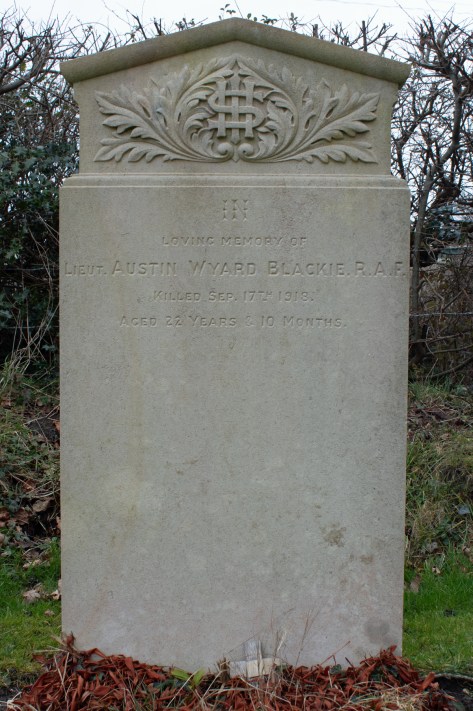
Lieutenant Austin Blackie

Lieutenant Austin Blackie

Austin Wyard Blackie was born in Spring Bay on Ontario’s Manitoulin Island on 17th November 1895. The seventh of eight children, his parents were farmers John and Mary Blackie. John took the family to where the work was: by the time of the 1901 census they had relocated to Algoma, 190km (120 miles) to the north west.

Little further information is available about Austin’s early life. When war broke out, he stepped up to play his part. His military records take a bit of unpicking, but he joined the Canadian Expeditionary Force on 10th April 1916, and was assigned to the 227th Battalion as a Sergeant. He was dismissed from service on 15th December 1916, as he was deemed medically unfit.

Undeterred, Austin’s service papers confirm that he re-enlisted on 7th March 1917, and that he was a student at the University of Toronto Officers’ Training Corps at the time. This document also gives his year of birth incorrectly as 1894.

Austin’s medical in 1917 confirmed that, at 22 years of age (based on the incorrect year of birth), he was 5ft 7.5ins (1.71m) tall and weighed 143lbs (64.9kg). He had fair hair, grey eyes and a fair complexion, good hearing and 20/20 vision. He was also recorded as having a number of scars: two either side of his stomach from an operation, and a third on the right side of his left ankle.

Sergeant Blackie’s time in the army was not destined to be a lengthy one, and there is a sense of his determination to better himself. On 5th May 1917, he was discharged from service again, but this time because he mad the transfer to Canadian Royal Flying Corps.

At this point, Austin’s trail goes frustratingly cold. He was shipped out to Britain, and was based at the 29th Training Depot Station in East Boldre, Hampshire. When the Royal Air Force was formed, he transferred across, and, at some point during this time, he was promoted to the rank of Lieutenant.

Mr A C Hallett, Deputy County Coroner, held inquests on Tuesday, of Lieut. Austin Wyard Blackie, RAF, of California, and Second-Lieut. Arthur Fred Belyea, RAF, of Calgary, Canada, who met thwir deaths while flying. The evidence showed that their machines collided at a great height, and that death in each case must have been instantaneous. Verdicts of “Accidental death” were returned.

[Hampshire Advertiser: Saturday 21st September 1918]

The report’s suggestion that Austin was from California is incorrect, although his parents had, by this point, moved there from Canada.

The RAF’s own report gave a little more detail on what happened:

The court considered the evidence, found that the cause of the accident was entirely due to misadventure in that the [Lieutenant Blackie’s] foot became entangled behind the rudder bar, the machine thus being our of control.

It appears that Austin had been offered a different aircraft to the Sopwith Camel in which he he had been killed. “He apparently took his machine up without asking his Flight Commander’s permission or his Instructor’s, contrary to standing orders.”

Second Lieutenant Belyea’s report card adds a stark twist to the crash: “The cause of the accident was in our opinion an error of judgement on one pilot (unknown) in flying his machine into the other machine from the rear, causing the left hand frame of Camel C8322 and the right hand frames of Camel C96 to collapse, thus causing each machine to spin to the ground. The one pilot was probably attempting to obtain good photographs of the other machine.”

Austin Wyard Blackie was just 22 years of age when he died on 17th September 1918. He was laid to rest alongside Second Lieutenant Belyea in the graveyard of St Paul’s Church, East Boldre, not far from the base in which he had served.


You can read about Second Lieutenant Belyea’s life here.


Lieutenant Austin Blackie
(from findagrave.com)

Private Philip le Cornu

Private Philip le Cornu

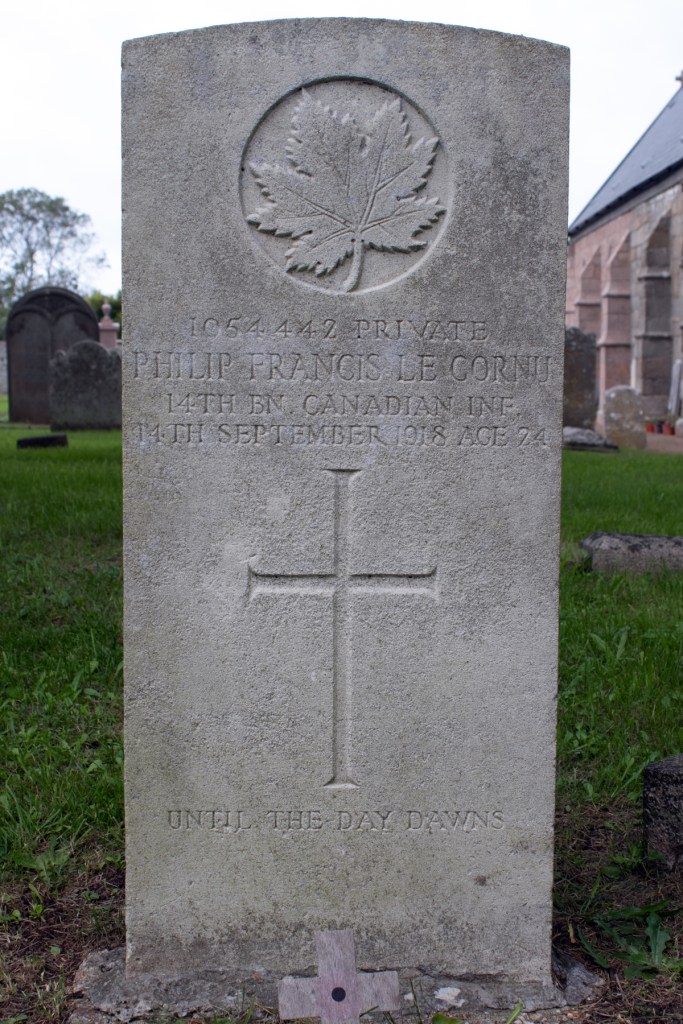
Philip Francis le Cornu was born on 29th July 1894 in St Peter’s, Jersey. The youngest of five children, his parents were Philip and Mary le Cornu. Philip Sr was a farmer, but it seems that both he and Mary passed away not long after his youngest son’s birth. By the time of the 1901 census the children had been split between family members, and Philip Jr was living with his maternal grandparents.

Philip finished his schooling, and seems to have sought a purpose in life. He emigrated to Canada and, by the time war broke out, was living in Grande-Mère, Quebec. He found employment as a clerk, but with conflict raging on the other side of the Atlantic, he responded to the call to arms.

Philip enlisted in the Canadian Expeditionary Force on 12th September 1916. His service records show that he was 22 years and 2 months old and stood 5ft 6ins (1.68m) tall. He had black hair, blue eyes and a dark complexion. Private le Cornu sailed to Britain, and arrived there on 7th April 1917.

Billeted in Shoreham, West Sussex, Philip was attached to the 14th Battalion of the Canadian Infantry. Within weeks he was sent to France, and, on 15th August 1917, was caught up in the Battle of Hill 70 near Lens.

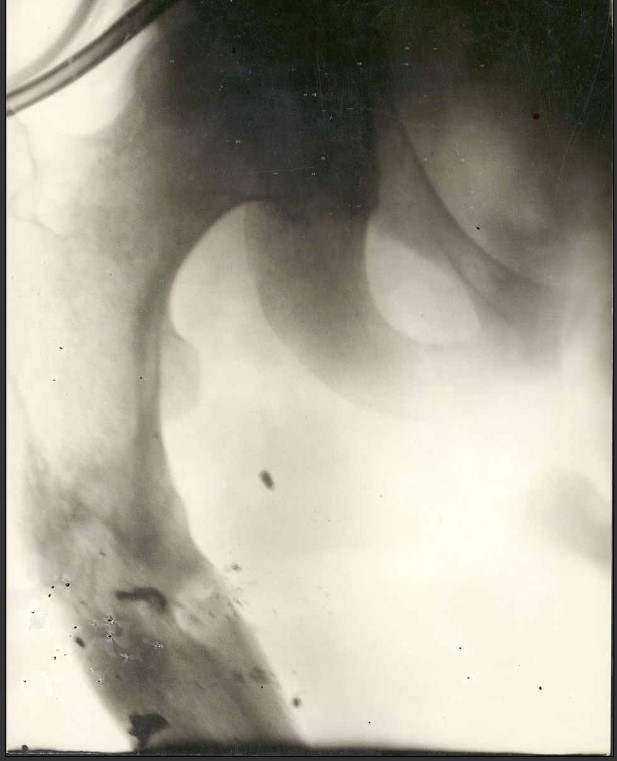
During the skirmish, Private le Cornu was badly wounded in the thigh and sent to the 58th Casualty Clearing Station. Within days he was moved to the 4th General Hospital in Camiens, but his condition necessitated medical evacuation to Britain.

Over the next year, Philip had three operations on his leg, and spent time at the 3rd Southern General Hospital in Oxford, the Manor War Hospital in Epsom, Surrey, and the 16th Canadian General Hospital in Orpington, Kent. Tragically, all of the medical treatment was to prove to no avail. Private le Cornu passed away from his injuries on 14th September 1918, more than a year after Hill 70. He was 24 years of age.

Philip Francis le Cornu’s body was taken back to the Channel Islands for burial. He was laid to rest in the quiet graveyard of St Mary’s Church on Jersey.


X-ray of Private Philip le Cornu’s left femur
(from uk.forceswarrecords.com)

Private Gilbert Patch

Private Gilbert Patch

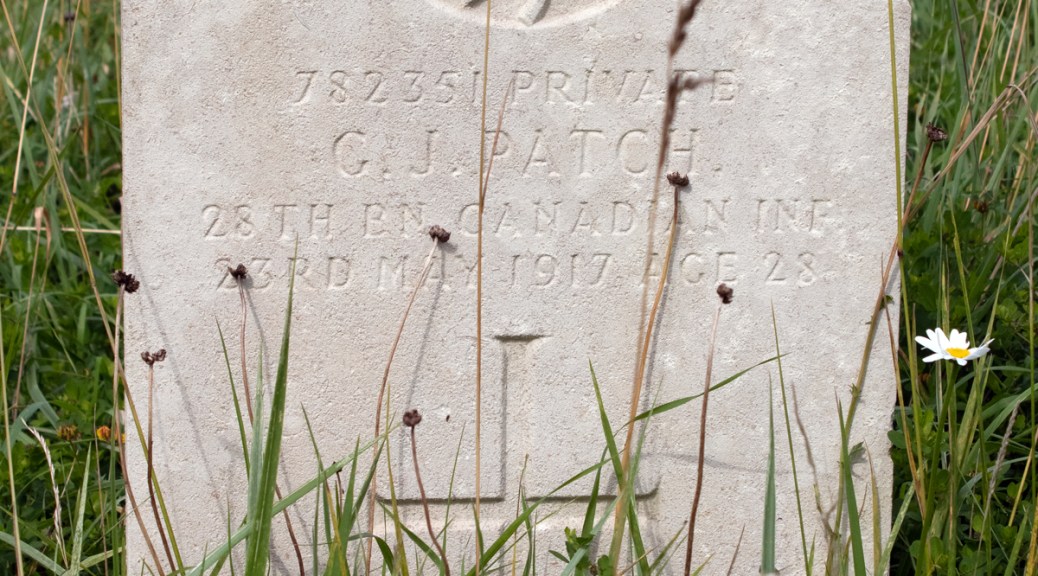
Gilbert John Patch was born in Winford, Somerset, on 3rd July 1888. The third of seven children, his parents were haulier Robert Patch and his wife Ann.

Gilbert followed his father into carting work, but the opportunity of a bigger and better life presented itself. In the spring of 1913, he emigrated to Canada, to find land and work as a farmer. He settled in the hamlet of Caron, Saskatchewan with a friend from home, Percy Worle.

Gilbert’s time overseas was not to be a length one, however. When Europe went to war, the empire was called upon and, on 1st April 1916, Gilbert enlisted in the Canadian Expeditionary Force. His service records show that he was 5ft 8ins (1.72m) tall, with blue eyes, fair hair and a medium complexion.

After his training, Private Patch arrived in France on 28th December 1916, and was assigned to the 28th Battalion of the Canadian Infantry – the same troop as his friend, Percy. During the Capture of Hill 70 in May 1917, Percy was killed and Gilbert himself was badly injured, receiving shrapnel wounds to his head, left arm and right leg.

Private Patch was medically evacuated to Britain for treatment. He was admitted to the Clopton House War Hospital in Stratford-upon-Avon, and while his wounds were treated, within a couple of weeks, he was dangerously ill with a kidney infection. The combination proved too much for his body to take, and Gilbert died on 23rd May 1917. He was 28 years of age.

Gilbert John Patch’s body was brought back to Somerset for burial. He was laid to rest in the graveyard of the local parish church, St Mary & St Peter’s, in his home village of Winford.


Bombardier William Johnson

Bombardier William Johnson

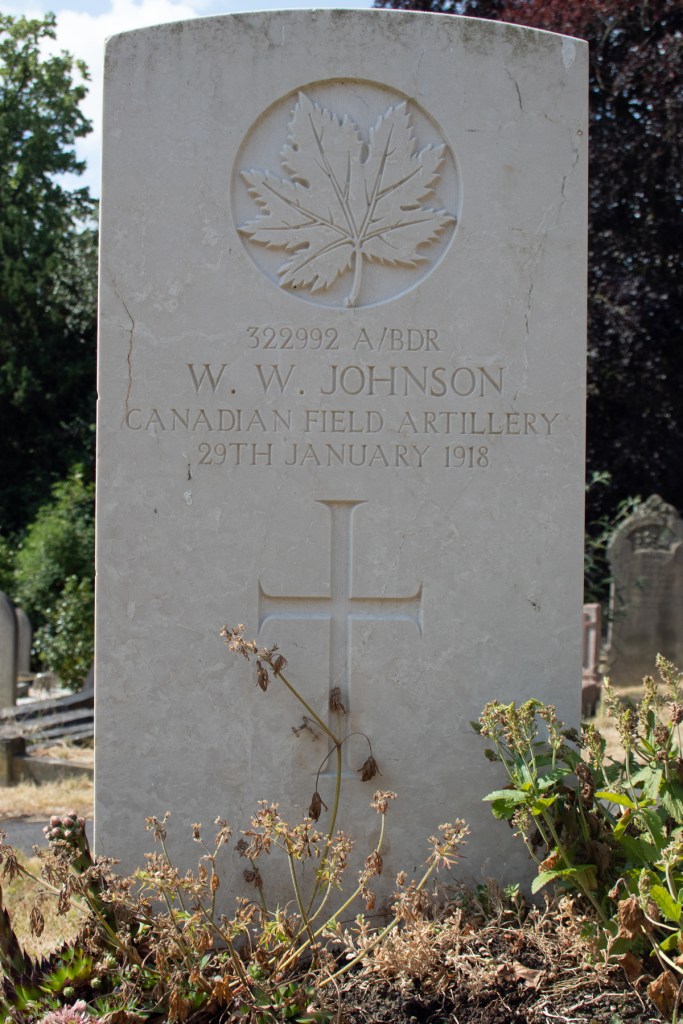
William Wilbur Johnson was born in Wingham, Ontario, Canada, on 25th August 1889, and was the son of John and Barbara Johnson. Little information is available about his early life, but he found work as a saddler when he finished his schooling.

In his free time, William volunteered in the 20th Border Horse Regiment. When war broke out in Europe, he was called upon to play his part, and joined the Canadian Expeditionary Force. His service records confirm he was 5ft 8ins (1.73m) tall, with brown hair, blue eyes and a dark complexion. He was also noted as having two scars both on his inner left forearm.

Private Johnson arrived in England in May 1916, and was initially billeted in Shorncliffe, Kent. He did not remain in Britain for long, however, and, assigned to the 2nd Brigade of the Canadian Field Artillery, he arrived in France on 1st June 1916. William would have been in the thick of things, caught up in the bloody stalemate of the Somme for most of the rest of the year.

In November 1916, William was promoted to Acting Bombardier. After a miserable winter on the Front Line, he became ill, and was admitted to a field hospital for a week with bronchitis and influenza. He recovered and remained on the Western Front during 1917, fighting at both Vimy Ridge and Passchendaele.

By the end of November 1917, Acting Bombardier Johnson’s health was suffering once more. He became jaundiced and, after some time spent in a field hospital, he was medically evacuated to Britain for further treatment. He was admitted to the Bath War Hospital in Somerset, with what turned out to be cirrhosis of the liver. This was something his body was unable to overcome: William passed away on 29th January 1918, at the age of 28 years old.

With all of his family overseas, it was not practical for the body of William Wilbur Johnson to be returned to Canada. Instead, he was laid to rest in the sweeping grounds of the Locksbrook Cemetery, not far from the hospital in which he had breathed his last.


Bombardier William Johnson
(from findagrave.com)

Private William MacPherson

Private William MacPherson

William George MacPherson was born in the township of Greenway, Huron County, Ontario, on 24th September 1893. The eighth of nine children, his parents were farmer Edmund Macpherson and his wife, Sarah, who was better known by her middle name, Keren (short for Kerenhappuch).

Edmund was the fourth generation of the family to be born in Canada, his maternal great grandfather having emigrated from Scotland to Nova Scotia in the late 1770s. Sarah was the first generation of her family to be born in North America, her parents having moved there in the 1850s.

After he finished his schooling, William followed his father into farming. When war broke out in Europe, the Empire was called upon to serve their King. On 7th January 1916, William enlisted in the Canadian Expeditionary Force. His service records show that he was 5ft 6.5ins (1.69m) tall and weighed 150lbs (68kg). He was noted a having dark hair, brown eyes and a dark complexion.

Private MacPherson set sail from Halifax on 22nd August 1916, and arrived in Liverpool eight days later. His troop was based in Witley, Surrey, and it was here, while attached to the 125 Battalion of the Canadian Infantry, that William spent the winter.

On 23rd May 1917, Private MacPherson was transferred to the 4th Battalion, and set sail for France. He was to spend the summer at Ypres, where he encountered some of the bloodiest fighting of the conflict. William was not to be unscathed, and was wounded in his shoulder and neck on 6th November 1917.

William was initially treated at the No. 2 State Hospital at Abbeville. Dangerously ill, though, he was medically evacuated to Britain, on board the Hospital Ship Essequibo, from Le Havre to Shornescliffe. Private MacPherson was quickly moved to Somerset, and was admitted to the Bath War Hospital. Tetanus set in, and he died of his wounds on 21st December 1917. He was 24 years of age.

With his family thousands of miles away, William George MacPherson was laid to rest in the Locksbrook Cemetery in Bath, not far from the hospital in which he had breathed his last.


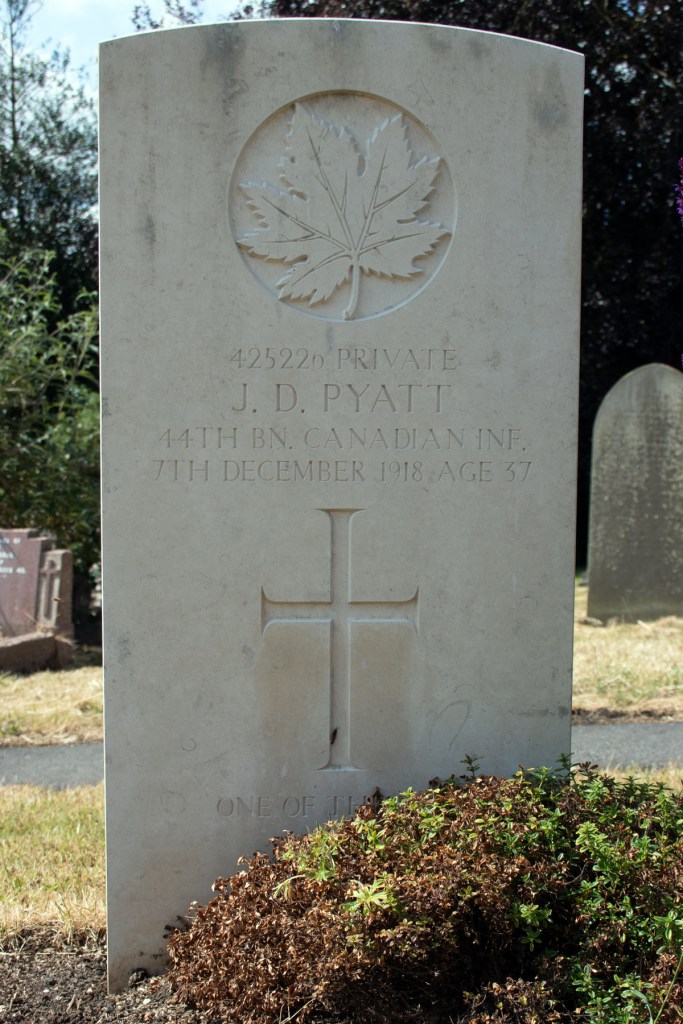
Private James Pyatt

Private James Pyatt

James Douglas John Pyatt was born in the spring of 1881 in Tranmere, Cheshire. The older of two children, his parents were Somerset-born John and Clara Pyatt. John was a coal merchant, and, by the time of the 1901 census, the family had moved back south, settling in the Clifton area of Bristol.

According to that census record, the family were living at 33 Pembroke Road, which Clara ran as a boarding house. James, by this point, was employed as a butcher, while his younger brother, Hubert, was a grocer. At the time the census was taken, the family had two boarders: Emmeline Blake, who was a music teacher, and Archibald Archer, a dentist.

Happiness is Bristol was destined to be short-lived. John died in 1902, aged just 49 years old. The same year, Hubert emigrated to Canada, settling in Brandon, Manitoba. Clara and James both followed the following year, setting up home in the same town.

Clara died in December 1908, but not before seeing both of her sons marry, James to Edith Gillam in June 1907, and Hubert to Lilian Pearce twelve months later.

James was working as a shipping clerk for a brewery by this point, and he and Edith were living on Park Street, to the east of the city. This was an ideal spot for their young family – John, born in 1908, Sidney, born in 1912, and Dennis, born in 1914 – as it overlooked a park and had space around it. Hubert lived down the road with his own family, so the brothers still had each other close by.

When war came to Europe, James felt compelled to play his part for King and Empire. He enlisted in the Canadian Expeditionary Force on 7th July 1915. Private Pyatt’s service records confirm that he was 33 years of age, and stood 5ft 10ins tall. He was noted as having brown hair, brown eyes and an average complexion.

James arrived back in England on 25th March 1916. Once there, he was attached to the 44th Battalion of the Canadian Infantry and by August that year, he was stationed on the Western Front. That autumn, however, he was dogged by illness and was admitted to field hospitals four times, suffering from diarrhoea, myalgia twice, and laryngitis.

By the start of 1917, however, Private Pyatt was back to full fitness. Details of his service over the next couple of years are unclear, although he remained on the Front Line. In December 1918, James was back in England on leave, and had returned to Somerset, possibly to see friends or relatives.

While here, James contracted influenza, and was admitted to the Bath War Hospital. The condition was to get the better of him, however, and he died on 7th December 1918, days after going in. He was 37 years of age.

With his surviving immediate family all in Canada, James Douglas John Pyatt was laid to rest in Locksbrook Cemetery, Bath, not far from the hospital in which he had passed away.


Private John Cotterell

Private John Cotterell

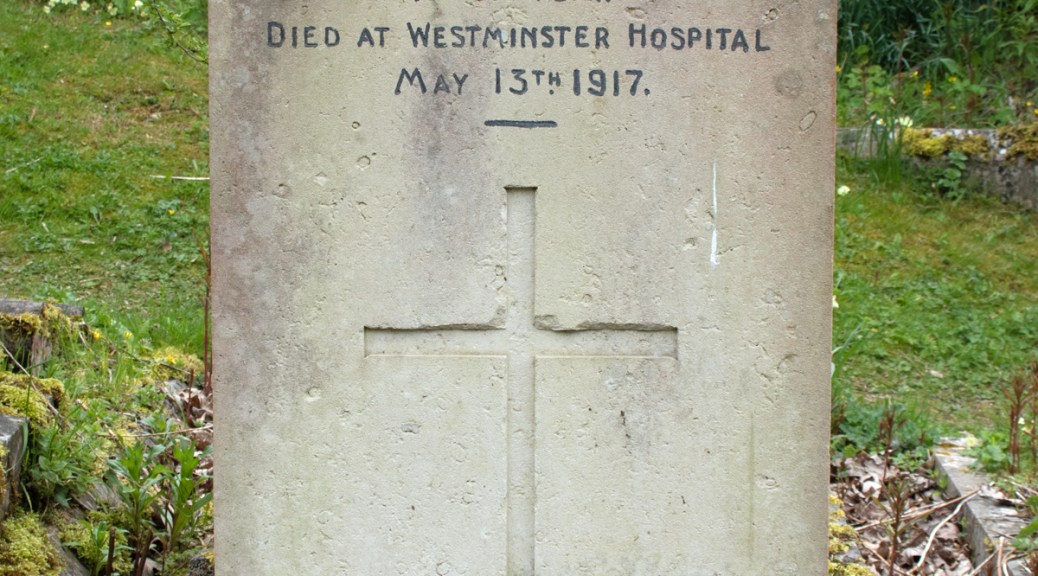
Much public interest was manifested in the funeral, on Thursday, of Private John St Clair Cotterell eldest son of Mr T Sturge Cotterell, JP, of Bath. Deceased, who was 26 years of age, was educated at Bath College, and left England to take up the life of a rancher in Canada. Here he joined the Alberta Rifles and saw service on the Western Front, where he was dangerously wounded in an attack on the Arras front on April 28th. He was, however, brought back to this country, only to succumb to his severe wounds in Westminster Hospital on Saturday. He leaves a widow and one child.

Bath Chronicle and Weekly Gazette: Saturday 19th May 1917

John St John Cotterell was born in Bristol, Gloucestershire, on 17th September 1891. One of six children, his parents were wallpaper manufacturer turned quarry manager Thomas Sturge Cotterell, and his wife, Edith. John remains noticeably absent from both the 1901 and 1911 censuses in which his parents and sibling – and servants – are recorded, so his early life is hard to piece together.

By 1908 John had emigrated to Canada to become a farmer. It was here that he met and married Gladys Nettleton. The couple settled in Alberta and had a daughter, Nellie, who was born in 1915.

When war came to Europe, John stepped up to play his part for King and Empire. He enlisted in the Canadian Expeditionary Force on 8th March 1916, and was assigned to the 192nd Overseas Battalion. Private Cotterell’s service records confirm that he was 5ft 5ins (1.65m) tall, weighed 117lbs (53kg) and had fair hair, grey eyes and a fair complexion.

Private Cotterell left Canada for Britain on 1st November 1916, arriving in Liverpool ten days later. He was transferred to the 9th (Service) Battalion of the Canadian Infantry, and barracked at St Martin’s Plain, near Folkestone in Kent. Early in 1917, he was moved to the 10th Battalion and, on 4th March was shipped off across the English Channel.

John’s arrival in France was not an auspicious one. Tightly packed barracks were a breeding ground for disease, and, by the time he had arrived in Le Havre, John had contracted mumps. He was laid up in a camp hospital for just over a month before returned to his battalion and heading to Arras.

Private Cotterell’s was severely injured in the fighting, and he received a gunshot wound to his spine. Medically evacuated to Britain, he was admitted to the Westminster Hospital in London. His medical report noted that his ‘1st lumbar vertebra [was] shattered and [spinal] cord [was] cut through‘. He had complete paralysis below the groin and that he was in a ‘hopeless condition‘. His injuries proved too severe, and he passed away on 13th May 1917, three days after being admitted. John was just 25 years of age.

John St Clair Cotterell’s body was brought back to Somerset for burial. He was laid to rest in Bath’s Abbey Cemetery.


Serjeant Frederick Francis

Serjeant Frederick Francis

Frederick John Francis was born on 15th February 1893, to Henry and Mary Francis. One of nine children, the family lived in the Somerset village of Curry Rivel.

Henry was a labourer, but Frederick had his sights set on a new life and, at some point in his teens, he emigrated to Canada to work as a farmer. Details of his life in North America are scarce, but it is clear that he was in Manitoba when war broke out back in Europe.

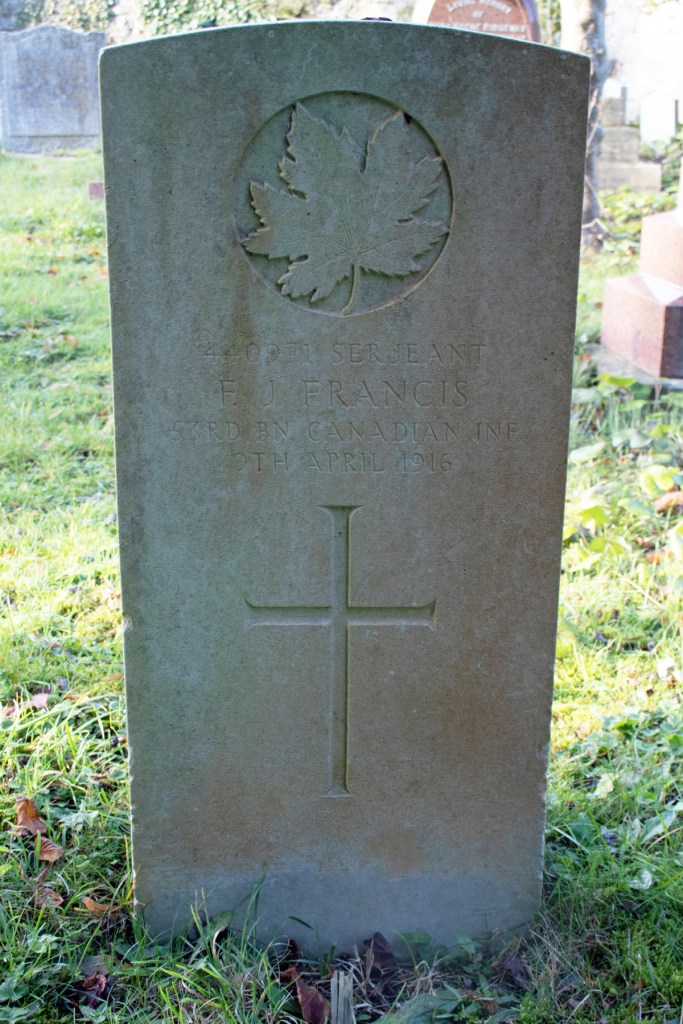
Frederick stepped up to serve his King and Country, enlisting at Camp Sewell on 5th April 1915. His service records confirm that he was 5ft 5ins (1.65m) tall, and weighed 145lbs (65.8kg). He was assigned to the 53rd Battalion of the Canadian Infantry. His service papers also note that he was promoted to the rank of Sergeant on 30th April 1915, although whether the date is correct, or whether Frederick had previous military experience is unclear.

Sergeant Francis boarded the SS Empress of Britain to make the journey back to Europe, little knowing that he was not going to see his home again. On 9th April 1916, just one day from docking in Hampshire, he passed away from quinsy, or throat abscess. He was just 23 years of age.

The body of Frederick John Francis was brought back to Somerset for burial. He was laid to rest in the graveyard of St Andrew’s Church in the village of his birth, Curry Rivel.


Frederick’s younger brother, Charles, had also made a life in Canada. He enlisted at Camp Sewell just two months after his brother, joining the same battalion.

Charles, who had the rank of Private, arrived in Europe before Frederick and, and was sent to the front line in February 1916. In June, he was involved in the fighting at Mount Sorrel, on the Ypres Salient, and it was here, on 6th June 1916, that he lost his life. He was just 21 years of age.

Charles Arthur Francis is commemorated on the Menin Gate in Ypres. His parents had to mourn the loss of two sons within two months.


Second Lieutenant Cyril Croft

Second Lieutenant Cyril Croft

Cyril Talbot Burney Croft was born on 28th January 1891 in Streetsville, Ontario, Canada. He was the only child of Dorset clergyman Otho Croft and his Canadian-born wife, Lucy.

Otho brought his young family back to England when Cyril was a boy. The 1901 census found him and Lucy living in South Cadbury, Somerset, where he had taken the role of the local rector. Their young son, meanwhile, was boarding at a school in St Leonard’s in East Sussex.

Education was key to Cyril’s development. He was sent to King’s College in Taunton and St Boniface College in Warminster, and enlisted in the Officer’s Training Corps for three years.

During this time, he and Lucy had travelled back to Canada, and there was an obvious draw for the young man as, in 1913, he made a move to Quebec, becoming the Assistant to the Commissioner of Harbour Works in the city.

When war broke out, Cyril was quick to step up and play his part. Joining the Canadian Expeditionary Force on 23rd September 1914, his service records show that he was 6ft 1in (1.85m) tall, with black hair, grey eyes and a dark complexion.

Cyril was initially assigned to the 12th Battalion of the Canadian Infantry, where he held the rank of Lance Corporal. On arriving in England, however, he took his leave of the Canadian force, and accepted a role in the King’s Royal Rifles. Within a few months, he transferred again, gaining the rank of Second Lieutenant in the 8th (Service) Battalion of the Somerset Light Infantry.

Details of Cyril’s actual service are vague, however, as his British Army service records are no longer available. It appears that he did not serve any time overseas, as his battalion was raised in Taunton, Somerset, and did not move to France until the end of 1915.

Second Lieutenant Croft had made a further transfer by this point, joining the Royal Flying Corps in the summer. He gained his wings on 27th October 1915 at a Military School in Birmingham.

On 8th December 1915, he was a passenger in an aircraft being piloted by a Lieutenant McDonald at Castle Bromwich.

The weather was “bumpy” but not bad… They went towards Birmingham, and then made a turn to the left. [McDonald] noticed that the engine was missing fire when he was at a height of 1,500ft [460m], and decided to land. He turned off the petrol, but did not switch off the electric ignition. He made a right-hand turn, so as to reduce the height, the machine then being at a normal angle, when, owing to the wind, the aeroplane banked. To put the machine back again he put the control lever over to the left, but finding that the machine did not answer to the control, he put on the right rudder, and Lieutenant C Black, of the Royal Flying Corps, who had instructions to watch the aeroplane, stated that shortly after eleven o’clock in the morning it ascended to a height of 1,500ft. Shortly afterwards he saw the machine coming down: it made a short spiral, then a complete circle, and while turning to make another at a height of 500ft [150m], fell straight to the ground, nose downwards. The aeroplane was in proper working order, and the witness was of the opinion that the accident was due to wind disturbances.

De Ruvigny’s Roll of Honour

Croft and McDonald were both killed. Cyril was just 24 years of age. His Colonel wrote to Otho and Lucy, noting that Cyril “did so well that it makes one feel the loss all the more of such a promising young officer. He is, indeed, a great loss to our country, especially in these times.” Cyril’s Major noted “he had a most charming, lovable character, and was thoroughly popular with all his brother officers. He was exceedingly keen at his work, and in him the service has lost a most promising and capable officer.”

Cyril Talbot Burney Croft was brought back to Somerset for burial. He was laid to rest in the graveyard of his father’s church: St Thomas a Becket’s in South Cadbury.


Second Lieutenant Cyril Croft
(from ancestry.co.uk)

Private Joseph O’Hara

Private Joseph O’Hara

Joseph O’Hara was born in Manchester on 30th May 1882, the son of John and Kate O’Hara. There is little information available about his early life, although it is clear that at some point the family emigrated to Canada, settling in Toronto.

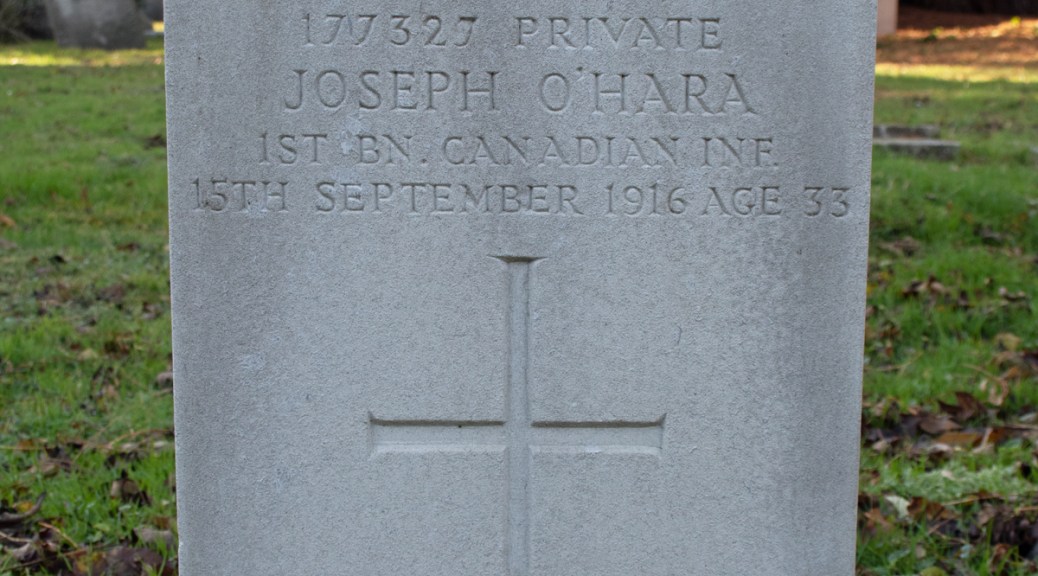
When war broke out, Joseph enlisted, joining the 1st Battalion of the Canadian Infantry. By 1916 Private O’Hara was not only back in Europe, but fighting on the Western Front. Details are scarce, but a contemporary newspaper sheds a little light on what happened to him next.

A contingent of 132 wounded men was detrained at Faversham last Friday morning. Forty-four of the number were taken to The Mount, seventy-one to Lees Court, and seventeen to Glovers (Sittingbourne).

With one exception the cases were all “sitting up” cases and were in a separate train by themselves. This train, however, was preceded by a train of “cot” cases which was going through to Chatham, but owing to the serious condition of one of the men – Joseph O’Hara, of the Canadian Expeditionary Force – the train was stopped at Faversham for his removal to the Mount Hospital. O’Hara had been badly wounded in both legs and he died at the Mount a few hours after his arrival there.

Faversham News: Saturday 23rd September 1916

Private Joseph O’Hara was 34 years of age when he passed away. He was laid to rest in the Faversham Borough Cemetery.


Private Joseph O’Hara
(from findagrave.com)