Henry Gibbs was born in Wiveliscombe, Somerset at the start of 1871. The youngest of five children, he was the second son to John and Emma Gibbs. John was a farm labourer, but when he finished his schooling, Henry went in a different direction.
By the time of the 1891 census, Henry was boarding with his sister Lucy and her husband and young son. The extended family were living in Taunton, Somerset, where Henry was employed as a boot and shoemaker. This appears not to have satisfied him, however, and he soon found other work, enlisting in the Royal Field Artillery. While his army records are lost to time, he seems to have spent twelve years in service.
By the early 1900s Henry living back in Somerset, settling in Bishops Lydeard, to the west of Taunton. On 2nd May 1906, he married a young woman called Florence Gange. Fifteen years his junior – she was 20 years old to her husband’s 35, even though the marriage certificate gave his age as 30 – she a labourer’s daughter from the village, who was working at the Lethbridge Arms public house at the time of their marriage. The couple set up home in a small cottage, and went on to have four children: Ernest, Florence, Mabel and Arthur.
Henry’s work seems to have been transient. On his marriage certificate, he was noted as being a groom, but the next census return, taken in 1911, gave his employment as a labourer for a corn miller.
When war came to European shores, despite his growing family, Henry felt the pull to serve once more. He enlisted in the Royal Army Service Corps in the summer of 1915, with the rank of Driver. As with his previous time in the army, details are scarce, but Henry seems to have been based in Aldershot, Hampshire, or at least this is where he was based towards the end of the conflict.
Driver Gibbs had become unwell by this point, and he was suffering from oesophageal cancer. He was admitted to the military hospital in Farnham Hill, but was to succumb to the condition. He passed away on 1st September 1918, at the age of 47 years of age.
Henry Gibbs was brought back to Somerset for burial. He was laid to rest in the quiet graveyard of St Mary’s Church in his adopted home village, Bishops Lydeard.
Oliver Banwell was born in Burnham-on-Sea, Somerset, in 1882. One of nine children, his parents were mason William Banwell and his wife Jane. When he completed his schooling, Oliver followed his father into manual work and, by the time of the 1901 census, he was employed as a bricklayer.
In 1910, Oliver married Mary Ann Burrows, a carter’s daughter from Axbridge: the couple settled down in lodgings on Oxford Street, near the centre of Burnham-on-Sea, and went on to have three children: Stanley, Primrose and Violet.
When war came to Europe, Oliver stepped up to serve his King and Country. He gave up his new employment as a groom and enlisted on 13th September 1915, joining the Royal Engineers as a Sapper. His service records give some idea of the man he had become. He was 5ft 8.5ins (1.74m) tall, weighing 141lbs (64kg), and was noted to be of good physical development, although he had slight varicose veins in both legs.
Sapper Banwell found himself in France by the end of April 1916. He spent six months overseas, before being posted back to Britain. Initially attached to the 82nd Training Reserve Battalion at the Royal Engineers Barracks in Chatham, Kent, by July 1917, he had moved again, to the 39th Fortress Company, in Sheerness.
In July 1918, Oliver was back in France again, where he was to remain until after the Armistice. By this point his health was beginning to fail and, on his return to Britain in December 1918, a medical examination deemed him no longer fit for army service. He was formally discharged from the Royal Engineers on 30th January 1919, suffering from cancer of the rectum.
Oliver returned to Burnham-on-Sea, and spent the next ten months with his family. His battle with cancer finally proved too much: he passed away on 4th December 1919, at the age of 37 years old.
Oliver Banwell was laid to rest in the family plot in Burnham Cemetery. Mary Ann was buried alongside him when she passed away in 1965, husband and wife reunited after 46 years.
John Edmonds was born on 12th November 1871 in Bath, Somerset. The oldest of five children, his parents were market gardener Albert Edmonds and his wife, Ellen.
When he finished his schooling, John found work as a miner. He sought a more adventurous career, however, and, on 8th November 1894 he enlisted in the army. Assigned to the Royal Artillery, Gunner Edmonds’ service records noted that he was 5ft 8ins (1.73m) tall and weighed 149lbs (67.6kg). He had brown hair, grey eyes and a sallow complexion, with a couple of marks above and below his left eye.
Gunner Edmonds was assigned to the 4th Mountain Battery and spent most of the next year training on home soil. On 17th September 1895, however, he was transferred to the 5th Mountain Battery, and shipped off to India, where he was to spend the next nearly nineteen years. During his time on the Asian sub continent, John was awarded the India Medal, with clasps for the Punjab Frontier and Tirah (both 1897-98). He was also awarded the Delhi Durbar Medal in 1911.
When war came to Europe in August 1914, John was recalled to British shores. He was not to remain on home soil for long, however as, on 9th December he was sent to France as part of the Royal Garrison Artillery. He spent just over a year on the Western Front before his troop was dispatched to Salonika, Greece, in December 1915.
Gunner Edmonds was to remain in the Eastern Mediterranean for a little over three years. During this time he had a short period in hospital, having contracted malaria, but saw the war out in Greece, returning home in March 1919. John was formally stood down from military service on 25th April 1919, having completed 24 years 169 days in the army.
Returning to Bath, John’s health had started to suffer. He had developed cancer, and passed away from the condition on 4th October 1919. He was 47 years of age.
John Edmonds’ body was laid to rest in the military section of Bath’s Locksbrook Cemetery.
Frederick Reginald Channing was born in the autumn of 1869, in Bath, Somerset. He was one of five children to carpenter Allen Channing and his dressmaker wife, Sarah. When Frederick was just a toddler, Allen moved the family south to Chard, and this is where his younger siblings were born.
When Frederick left school, he found work as a lace machine operator and, in fact, all of Allen’s children found work with their hands: Frederick worked alongside one of his brothers, while his two other brothers built on their father’s woodworking skills, one as a coachbuilder, another as a cabinet maker.
By the autumn of 1905, Frederick had moved back to Bath. This is where he met Elizabeth Scammell, a farm labourer’s daughter from Wiltshire. The 1901 census appears to record her as being a servant to a surgeon’s family in Wincanton, and this may have prompted a further move to the larger city where the couple met.
The couple married in Bath towards the end of 1905, and had a son, Frederick Jr, who was born in November the following year. Frederick Sr was doing general labouring work by this point, and the family had moved to Wedmore by the time a second boy, William, was born in 1910. Frederick and Elizabeth had a daughter, Eva, in 1911, and another, Gwendoline, in 1913, tragically, the same year that Eva died.
When war came to Europe, Frederick stepped up to play his part. He enlisted in September 1914, joining the Somerset Light Infantry as a Private. His service records confirm that he was 5ft 6ins (1.67m) tall, and weighed 154lbs (69.9kg). The document also gives his age as 35, although he was actually ten years older than that by this point.
Private Channing spent a year on home soil, during which time Elizabeth gave birth to their fifth child, Percival, who was born in May 1915. Based at a camp in Aylesbury, Buckinghamshire, he was hospitalised twice in this time, suffering from a contusion of his left shoulder.
By September 1915, Frederick was in France, and he remained on the Western Front, apart from when on leave, for the next three-and-a-half years. At some point during this time, he was promoted to the rank of Lance Corporal, and transferred across to the Royal Engineers.
Back at home, Elizabeth was doing her best to raise the family. She didn’t always do the right thing, though, and this resulted in her being taken to court.
Elizabeth Mary Rose Channing, 30… was indicted for having been delivered of a certain female child, did unlawfully by a secret disposition of the deceased child, endeavour to conceal the birth thereof at Wedmore the same day in the month of September 1916.
Mr Wethered prosecuted, and said that the prisoner was a married woman. Her husband was a soldier now on active service. He was last home on leave in April or May, 1917. Previously to that he had not been home for 18 months or two years, so the child could not have been his. Some boys found a parcel in the well, and they discovered the body of the child. The boys communicated with the police, who searched the well and found some pieces of carpet which agreed with a similar carpet in the possession of the prisoner. When arrested she confessed to the crime.
Frederick Channing, husband of the prisoner, said he was home on leave five months ago – May 27th. He went back on June 4th. Previously he had not been home for twenty months. He pleaded for the prisoner in the interests of their four children. He was very sorry for her to think she had thrown herself away like that.
His Lordship, addressing the prisoner, said that while her husband was away doing his duty for her any everybody, she was not faithful to him, and the result was the birth of the child which had been concealed and not revealed till a year afterwards. His Lordship understood that prisoner was already legitimately in a certain condition, and he did not wish her child to be born in prison. She would be sent to prison therefore for three months.
Wells Journal: Friday 26th October 1917
Elizabeth was released in February 1918, and the couple’s last child, Kathleen, was born the following month.
Frederick, meanwhile, returned to the Western Front. He remained in France through to the end of the conflict and beyond, only returning to Britain in February 1919, having fallen ill. Admitted to the North Evington War Hospital in Leicester with influenza, he remained there for two months.
In April 1919, Lance Corporal Channing was transferred to the Bath War Hospital, back in Somerset. This was presumably so that he could be closer to his family, although there is no evidence of whether he was fully reconciled with Elizabeth. His condition did not improve, however, and by this point he was also suffering from myalgia.
Frederick remained in hospital for eighteen months. As time passed, carcinoma of the liver was identified, and this, eventually, was the condition that would take his life. Lance Corporal Canning passed away on 5th September 1920. He was 49 years of age.
Sarah and the children were still living in Wedmore, by this point. Frederick Reginald Channing’s last journey was not to be that far, however. He was moved only a short distance from the hospital, and was laid to rest in the sweeping grounds of the Locksbrook Cemetery in Bath.
Montgomerie Boyle was born on 20th March 1859 in Hendon, London. The youngest of three children, his parents were John and Jane Boyle. John was a barrister, and the family lived in some comfort – the 1861 census found them living in a house in Harrow, Middlesex, with four live-in servants and a groom.
[Montgomerie] joined the South Notts Yeomanry 22 years ago. Subsequently he obtained an appointment at Weston-super-Mare, under the Somerset Territorial Force Association, and did much useful work in co-ordinating the Army Service Corps in the county.
Taunton Courier and Western Advertiser: Wednesday 2nd April 1919
In the spring of 1891, Montgomerie married Constance Smith. She was a banker’s daughter from Nottingham, and the couple tied the knot in Basford, now a suburb of the larger city. They went on to have a daughter, Marion, who was born the following year.
By the 1901 census, the young family had moved to Timsbury, Somerset. Montgomerie was recorded as living on his own means, and the family had a retinue of servants to support them. A decade later, they had moved into the manor house in Staple Fitzpaine, Somerset. Montgomerie was now listed as a Captain in the Army Service Corps.
Storm clouds were gathering over the continent and, when war broke out, Captain Boyle was called back into active service.
…he was stationed with his Regiment on the East Coast for twelve months, and then went to France, where he remained for six months. He was re-called for service with the Mechanical Transport Section of the Army Service Corps in German East Africa, contracted malaria at the end of fifteen months and was invalided home. On his recovery he was despatched to the Egyptian front, and was with the British troops in Jerusalem. He became ill while there, and, on going down to the base at Cairo, was for a month in the Citadel Hospital, where he was treated for a malignant disease. By slow stages, first in a hospital ship, then in a Red Cross train through France, he was conveyed to [Le] Havre. Here, curiously enough, the doctor in charge of the hospital ship upon which he was placed happened to be… an old friend and medical attendant. Major Boyle landed at Southampton, and went immediately to the 3rd London General Hospital at Wandsworth [Surrey], where he was examined by an eminent specialist. His condition was serious but on Monday week last he arrived at his old home, where, despite the devoted care of his wife and daughter, he passed away quietly.
Taunton Courier and Western Advertiser: Wednesday 2nd April 1919
Major Montgomerie Boyle passed away on 27th March 1919, a week after his sixtieth birthday. He was laid to rest in the quiet graveyard of St Peter’s Church, on the outskirts of the grounds of the manor house the Boyles had made their home ten years before.
When Constance died ten years later, at the age of 70 years old, she was laid to rest in the family plot, reunited with her late husband once more.
Charlie Tucker was born early in 1877 in the village of Mark, Somerset. The fifth of six children, his parents were Thomas and Caroline. Charlie’s mother died when he was only a toddler, probably during, or shortly after, the birth of his younger sister, Elizabeth. This left farm labourer Thomas to raise his family alone.
The 1881 census found the Tuckers living in Wedmore, five miles to the east of Mark, where Thomas was supported by his parents, George and Elizabeth. Both died in 1890, but by this point, Thomas had married again, to a widow, Ann Harding. She had a daughter, Mary Ann, who was welcomed into the family, but then Thomas and Ann had their own child, a son called Walter.
The next census, returned in 1891, recorded the family – Thomas, Ann, Charles, Mary Ann and Walter – living in Wedmore. Charles had finished his schooling by this point, and was employed as a general labourer and the family also had a boarder, Ralph Godney, who was just 9 years of age.
The family setup continued, and the 1901 census document found Thomas and Ann living with Charlie and Walter, all of whom were doing farm work. They still seemed to be open to supporting others, however, and had another boarder, a schoolgirl called Elizabeth Grant.
In the spring of 1904, Charlie married Lily Brown. Born in Wedmore, she was the daughter, and only child, of a labourer who was employed as a servant to an Axbridge famer at the time the couple wed. Charlie and Lily set up home in Blackford, near Wedmore, and went on to have four children: Thomas, Walter, William and Kathleen.
When war broke out in 1914, Charlie stepped up to play his part. Full details of his military career are lost to time, but it is clear from what remains that he had enlisted in the Devonshire Regiment by the autumn of 1916. Private Tucker joined the 13th (Works) Battalion, and remained stationed on home soil for the duration of his service.
Little further information about Charlie’s life is evident. Over the next couple of years his health began to fail, and in the spring of 1917 he had been admitted to Bath War Hospital with carcinoma of the stomach. This was to take his life: he passed away on 11th March 1917. He was 40 years of age.
Charlie Tucker’s body was brought back to Blackford for burial. He was laid to rest in the graveyard of Holy Trinity Church.
Lily, now widowed, was left with four young children to raise on her own. Whether for a new life and new opportunities, or to escape the painful memories that Somerset brought, she made the decision to emigrate. In April 1924, she and the children arrived in Canada, and settled in Ontario.
Further information for Lily is not readily available, but her two oldest children, Thomas and Walter, made lives for themselves, and died in 1975 and 1979, respectively.
Frederick Murray Walker was born on 29th July 1862 in the village of Terregles, Kircudbrightshire, Scotland. The fifth of eleven children, his parents were Colonel Sir George Gustavus Walker, Member of Parliament for Dumfries & Galloway, and his wife, Anne. Sir George owned the Crawfordton Estate, and this is where Frederick was raised, with a retinue of fourteen staff to help the family.
Following his father’s military career, Frederick felt a draw to serve. On 15th July 1875, he entered the Royal Navy as a Midshipman. He set out to build a dedicated career, visiting most parts of the world in the process.
While Frederick’s initial service took him to the Mediterranean – where he received the Egyptian Medal and Alexandria Clasp – by 1883 he was out in China, but he also spent time in India and South Africa. In 1882 he was promoted to Sub Lieutenant, three years later he rose to the rank of Lieutenant. By 1899, Frederick had become a Commander.
By his own request, Frederick retired from the Royal Navy on 1st August 1909. He was now 47 years old, and had spent 34 years in service and was given the rank of Captain as a mark of his career.
On 19th June 1891, Frederick had married Lucy Scriven in St Saviour’s Church, Paddington, London. They would go on to have seven children, and to begin with, the life of a Naval Captain took Lucy around the coastal ports of Southern England. When Frederick retired, however, the family settled in a large house in Milford-on-Sea, Hampshire, where they were supported by a governess, cook, parlour maid and housemaid.
When war broke out in 1914, Captain Walker stepped up once more to serve his King and Country. He remained in territorial waters and was given successive command of the yachts James, Zaria and Albion III. By 1917, Frederick’s health was beginning to suffer, and he was placed on HMS Victory’s reserve books, ready should Portsmouth’s Royal Naval Dockyard need his service.
Frederick was not to be called to action again. By the time the Armistice was declared Frederick’s condition was worsening. He had developed cancer of the tongue, and it was having a real impact. He was admitted to the Haslar Hospital in Portsmouth, and passed away there on 7th February 1919, at the age of 46 years old.
By this point the family had relocated to Bath, Somerset, and this is where Frederick Murray Walker’s body was brought for burial. He was laid to rest in the prestigious Lansdown Cemetery, overlooking the city.
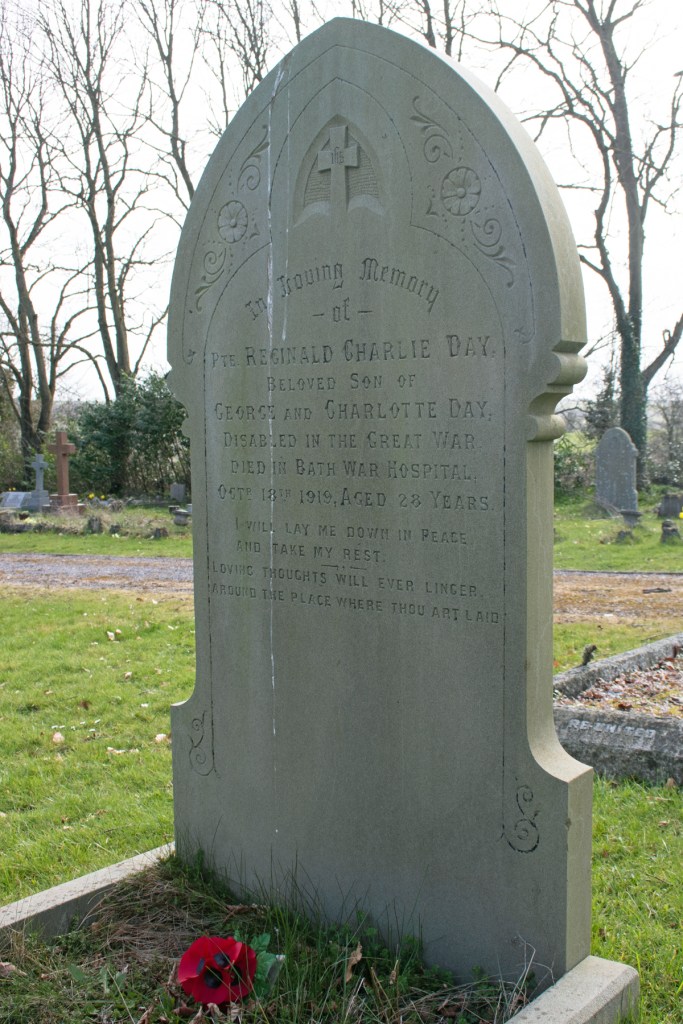
Reginald Charlie Day was born in the spring of 1891, the sixth of thirteen children. His parents – George and Charlotte Day – were born and raised in Gloucestershire, but had moved to Wellow in Somerset by the time Reginald was born.
George was originally a shepherd, but Wellow had two key industries – mining and the railways – and it was into the former that he went, presumably to bring in a regular wage for the expanding Day family.
When he left school, Reginald initially followed his father to the pit, but in April 1913, he opted for a more prestigious career, and enlisted in the army. He joined the Somerset Light Infantry as a Private but, because of his profession, he was not formally mobilised until 1916. His service records give away little about his stature, only that he was 5ft 7ins (1.7m) tall, with good vision and good physical development.
In January 1916, Private Day was moved to the North Somerset Yeomanry and, within a matter of weeks was bound for France. By that October, however, he was moved again, and became attached to the 5th (Service) Battalion of the Dorsetshire Regiment. He was assigned to one of the regiment’s depots, and remained close to the Western Front until the end of July 1917.
At this point, Reginald’s health was beginning to suffer, and he was moved back to the UK for treatment. He was admitted to hospital suffering from a pelvic abscess, and this was later diagnosed as carcinoma of the rectum. No longer fit for military service, he was dismissed from the army on 17th February 1918, his medical records noting that he had been fitted with a colostomy belt.
At this point, Reginald’s trail goes cold. It is likely that he returned home, but whether he was able to take up his previous employment – or work at all – is unclear. His headstone records that he died in Bath War Hospital, although again it is uncertain whether he was admitted from the point of leaving the army, or only in later months as his condition deteriorated. He passed away on 18th October 1919, at the age of 28 years old.
Reginald Charlie Day was laid to rest in the family plot in the peaceful Wellow Cemetery.
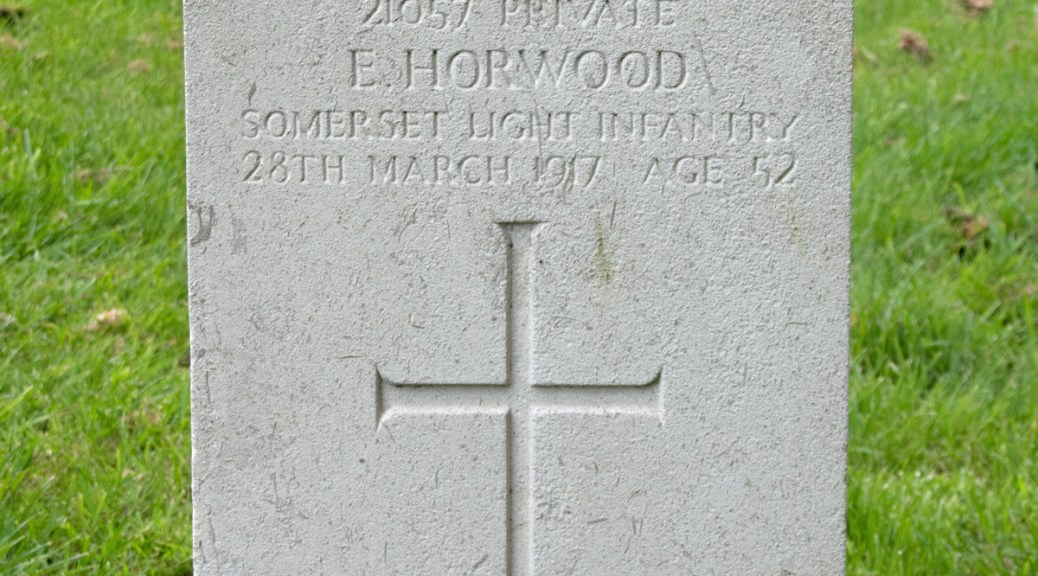
Albert Edward Horwood was born in Bath, Somerset, in the spring of 1864. The middle of five children, his parents were Joseph and Agnes Horwood. Joseph was a stone mason and, when Agnes passed away in 1872 he married again, this time to a woman called Elizabeth.
When he left school Albert – who became better known as Edward – found work in a local foundry. Joseph died in 1888, and just two years later, Edward married Emily Wheeler. She was the daughter of labourer from North Bradley, Wiltshire, and it was in the parish church that the couple exchanged vows.
The couple set up home in the Lyncombe area of Bath, and went on to have nine children, all but one of them girls. Edward continued with labouring work for the next twenty years, as his children grew in the family home in Cheltenham Street.
Despite his age, when was broke out in Europe, Edward stepped up to play his part. He enlisted in the Somerset Light Infantry on 6th November 1914, and was assigned to the 4th Battalion. His service records show that he was 44 year of age and 5ft 11ins (1.8m) tall.
Attached to one of the regiment’s supply companies, Private Horwood remained on the Home Front. He remained on active duty for more than eighteen months until, in June 1916, he was medically discharged because of a large ulcer and epithelioma (lesion) on his tongue. Edward’s medical notes suggest that he was offered an operation to remove the potentially malignant growth, but that he had declined.
At this point Edward’s trail goes cold. He returned home, and passed away on 28th March 1917 and, while the cause is not publicly documented, it seems likely to have been related to the growth in his mouth. He was 52 years of age.
Albert Edward Horwood was laid to rest in the St James Cemetery in his home town of Bath.
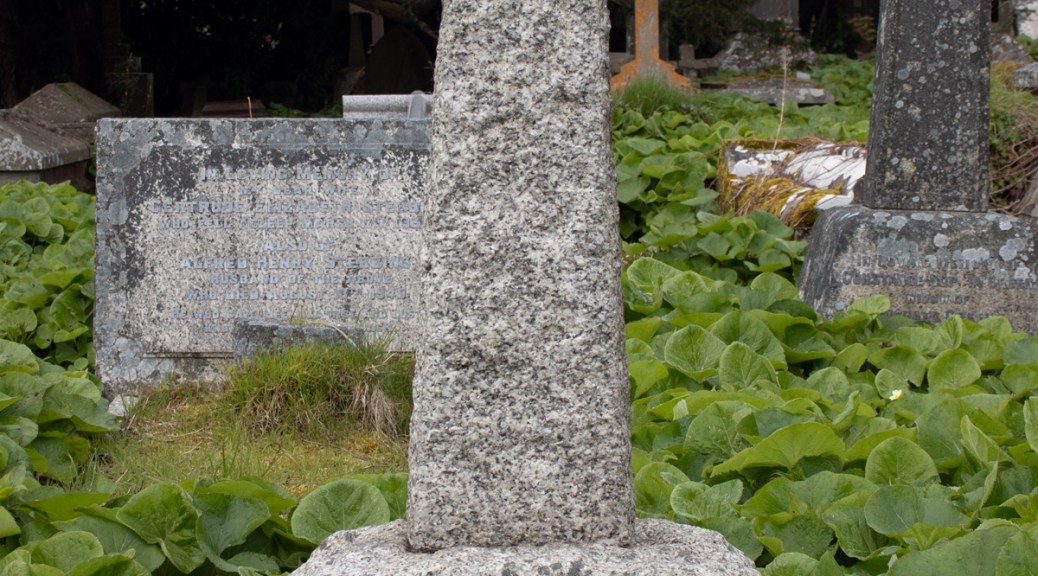
Louis Blake Stevens was born in the spring of 1870 in Pilton, now a suburb of Barnstaple, Devon. One of nine children, his parents were Devon-born sawyer John Stevens and his wife Mary, who was from Swansea.
When he left school, Louis found work in the leather industry, working as a parer and grinder. In the autumn of 1890, he married an Edith Turner, the couple went on to have two children – Edith and Albert – although they seem to have parted company soon after.
On 4th April 1896, Louis married again, this time to a Mary Webber. The couple set up home in Stoke-under-Hamdon (now Stoke-sub-Hamdon), Somerset, and went on to have seven children of their own. By the time of the 1911 census, the family had moved to South Petherton, Somerset, where Louis and Albert were working as a glovers.
Storm clouds were brewing over Europe and, despite his age, Louis was keen to step up and play his part and, on 7th August 1915, he enlisted in the Army Veterinary Corps. His service records confirm he was 42 years old, 5ft 4ins (1.63m) tall, with a dark complexion, dark brown hair and brown eyes.
After some initial training at the Army Veterinary Corps depot, Private Stevens was sent to France. Arriving there on 25th October 1915, he spent the next nine months overseas. During this time, he had issues with his teeth, breaking several on the hard biscuits the army were provided with.
Private Stevens was sent to a camp hospital in Boulogne, where his teeth were extracted, and he was then sent back to Britain to recover. The operation identified epithelioma (a malignant tumour) on his tongue and face, caused by the state of his teeth. He was initially sent to a hospital in Epsom, before being transferred to the Horton City of London War Hospital in Woolwich.
Treatment was ongoing, and, in the end, Private Stevens was finally discharged from the army on medical grounds on 2nd July 1917. The report noted permanent total incapacity, and that treatment was required.
At this point, Louis’ trail goes cold. He returned home to Somerset, and, died there on 23rd January 1918, aged 47 years old. Louis Blake Stevens was laid to rest in South Petherton Cemetery, within walking distance of his widow and family’s home.







 Death and Service