Tag Archives: Devon

Private Henry Weakley

Private Harry Weakley

Henry Weakley was born in 1885 in Bath, Somerset. The second of six children, he was the eldest son to James and Fanny. James was a cab driver, and Henry – who was better known as Harry – followed suit, becoming a coachman by the time of the 1901 census.

In 1910, Harry married a woman called Jennie. There is little information available about her, but the following year’s census return found the couple living with his family at 1 Cork Street, Bath, not far from the city’s Royal Crescent. The census had two records for that address, which confirmed the family’s living arrangements. Harry and Jennie had one room, while the rest of the Weakleys – James, Fanny, four of their children and a grandson – took up four rooms.

Harry was still employed as a coachman as this point, but, with war on the horizon, things were to change. Full details of his military service are lost in the mists of time, but it is clear that he enlisted in the Somerset Light Infantry, and that he was assigned to the 3rd (Reserve) Battalion.

Private Weakley’s unit was a territorial battalion and it remained on UK soil throughout the war. Initially based in Devonport, Devon, the 3rd moved to Londonderry, Northern Ireland, in November 1917, and Belfast the following April. Sadly, the little that remain of Harry’s records do not confirm where he served.

Harry was demobbed on 13th May 1919: his pension ledger notes that he had received gun shot wounds to his neck and back, although no further records identify when or how these injuries occurred. He returned home – 5 St George’s Buildings, Upper Bristol Road, Bath – and seems to have settled back into his pre-war life, although his health was still impacted.

Harry passed away at home on 27th March 1921. He was 36 years of age, and had died of heart failure. Despite his wartime injuries, the war office determined that his condition had been contracted after his army service: Jennie was denied a war pension.

Henry “Harry” Weakley was laid to rest in Bath’s sweeping Locksbrook Cemetery, not far from where his widow still lived.


Able Seaman Walter Brett

Able Seaman Walter Brett

Walter Brett was born in Batheaston, Somerset, on 12th July 1896. The fourth of seven children, he was the second son of George and Louisa Brett. George was a groom and coachman from Norfolk, and his work took the family around the country. Louisa had been born in Staffordshire, their oldest child, daughter Florence, had been born in South Wales. By 1893, the family had settled in Somerset, but the next census, taken in 1901, found them in Branksome, Dorset.

When Walter finished his schooling, he found work as an errand boy for a hairdresser. By now the Bretts had moved back to Somerset, where George – and his widowed father, John – were working as coachmen for a Mr Page. There were seven in the household – George, Louisa, Walter and three of his siblings, and George Sr – and the family were living at 1 Nelson Terrace, on Walcot Street, Bath, in a six-roomed cottage.

Walter sought bigger and better things for himself. His older brother, Frederick, had left home, and was working as a grocer’s assistant in Brislington – now a suburb of Bristol – and he too wanted a career. On 23rd January 1912, he enlisted in the Royal Navy. As he was only 15 year of age, he was given the rank of Boy 2nd Class, and was sent to HMS Impregnable, a training ship based in Devonport, Devon, for his induction.

Obviously showing signs of ability and commitment to the role, Walter was promoted to Boy 1st Class just seven months later. His first assignment was on board the battleship HMS Cornwallis, and he spent the remainder of 1912 serving with her.

After a brief period back in Devonport – this time at HMS Vivid – and six weeks aboard HMS Lancaster, Boy 1st Class Brett was assigned to the ship that would become his home for the next three years. HMS Lion was a battlecruiser, and she was to serve as the flagship of her class of ships during the First World War.

Walter came of age while serving on Lion, and was given the rank of Ordinary Seaman on his eighteenth birthday. His service records show that he was 5ft 6ins (1.68m) tall, with brown hair, blue eyes and a fresh complexion. He was also noted as having a mole on his stomach.

Walter was promoted to Able Seaman in the summer of 1915, and remained on board HMS Lion until the end of April the following year. His ship had been involved in a number of skirmishes by this point, including the Battle of Heligoland Bight, the defence of the raid on Scarborough and the Battle of Dogger Bank. In June 1916, she would be caught up in the Battle of Jutland, but Able Seaman Brett was back on terra firma by this point, and was billeted in Devonport.

On 1st August 1916, Walter was given a new posting, when he was assigned to the dreadnought battleship HMS Ajax. Acting as support to the Norwegian convoys in the North Sea, he was to remain on board until the closing weeks of the war.

Walter’s brother Frederick, meanwhile, was also caught up in the conflict. He had enlisted in the Gloucestershire Regiment, and was assigned to the 12th Battalion. By the spring of 1917, his unit was based in Arras, and was Private Brett was heavily involved. Following an attack on 8th May, he was declared missing, presumed dead. He was 24 years of age, and is commemorated on the Arras memorial.

Back at sea, in October 1918, Able Seaman Walter Brett became unwell, contracting a combination of influenza and pneumonia. He was transferred to the Hospital Ship Garth Castle, but the conditions were to get the better of him. He passed away on 27th October, at the age of 22 years old.

Walter Brett was brought back to Somerset for burial. His parents had lost both of their sons, but were able to lay their youngest to rest in Locksbrook Cemetery, Bath.


Private Edward Vale

Private Edward Vale

Edward Charles Vale was born in the spring of 1890, one of ten children to William and Ellen. Born in Cambridgeshire, William was employed by the local railways, becoming a signalman by the time of the 1901 census. The family were raised in Great Shelford, before moving to the Ely area in the early 1900s.

By the time of the 1911 census, Edward was the oldest of three of his siblings to still be living at home. The Vales were living at 12 Granta Terrace, Stapleford, and Edward was employed as a domestic gardener.

When war broke out, Edward volunteered to serve his country. Full service details are lost to time, but he had enlisted in the Royal Fusiliers by the spring of 1915. By June of that year, Private Vale was fighting in the Balkans.

At some point during the conflict, Edward transferred to the Oxfordshire & Buckinghamshire Light Infantry. He remained in the Easter Mediterranean, but was badly wounded in the summer of 1917.

Medically evacuated to Britain, Private Vale was admitted to the Voluntary Aid Detachment hospital that had been set up at Knightshayes Court, Devon. While details are unclear, Edward’s injuries were to prove too severe. He passed away on 9th October 1917, at the age of 27 years old.

Edward Charles Vale was laid to rest in the peaceful graveyard of St Thomas’ Church in Chevithorne, not far from the hospital in which he had passed.


Pioneer Richard Crook

Pioneer Richard Crook

Richard Crook was born in the spring of 1883 in the Devon village of Locksbeare. The youngest of three children, his parents were Richard and Ann Crook. Richard Sr was a general labourer, and his son followed suit when he completed his schooling.

On 5th November 1904, Richard married farmer’s daughter Elizabeth May. The couple went on to have four children, and moved around Devon to wherever his farm work took them. Ann died in 1910, and by the time of the following year’s census, they had settled in Burlescombe, near Sampford Peverell.

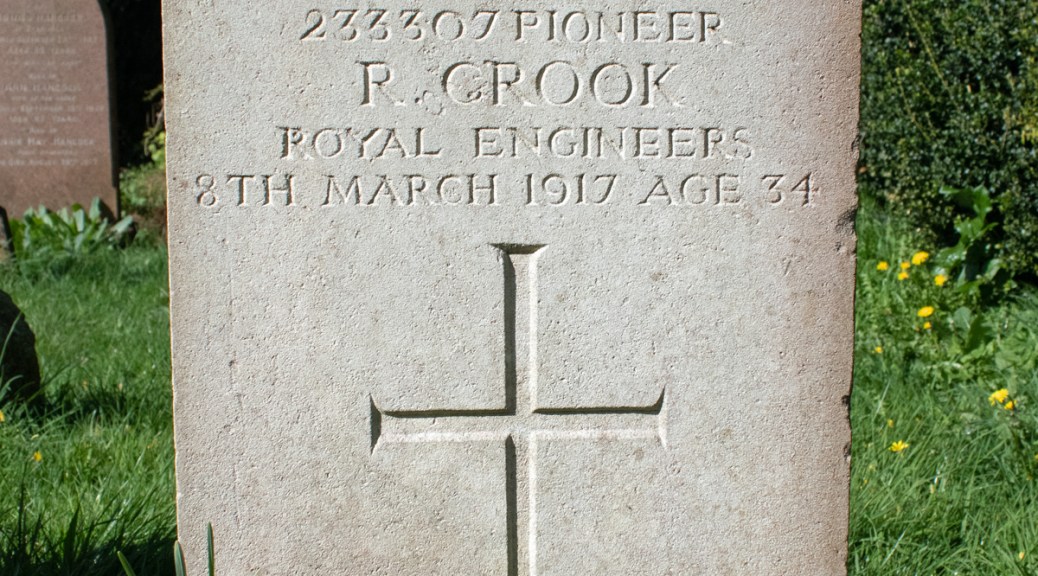
By the start of 1917, Richard was called upon to serve his King and Country. He enlisted on 30th January and joined the Royal Engineers. His service records show that he was attached to the Inland Water Transport Corps, and given the rank of Pioneer.

Richard was sent to Kent for training, but within a matter of weeks he was admitted to a military hospital in Canterbury. He had contracted German measles, and it was so severe that he quickly succumbed to it. He passed away on 8th March 1917, at the age of 34 years old. He had been in the army for less than five weeks.

Richard Crook’s body was brought back to Somerset for burial. He was laid to rest in the graveyard of St Peter’s Church, Uplowman, Devon, not far from where his widow and children were living.


Boy 1st Class Ernest Hewett

Boy 1st Class Ernest Hewett

Ernest Roye Hewett was born on 18th April 1898 and was the third of twelve children to Alfred and Ada. Alfred was a coachman and groom and, while both he and Ada were born in Cornwall, it was in Budleigh Salterton, Devon, that the family were born and raised.

When he finished his schooling, Ernest found work as a butcher’s boy, but when sought bigger and better things. His oldest brother, Ralph, had enlisted in the army by the time of the 1911 census and, by that October, his next oldest brother, Leslie, had enlisted in the Royal Navy. Ernest felt a career in the military was his destiny and, on 12th September 1913, he also joined the navy.

As he was under age at this point, he was given the rank of Boy 2nd Class, and sent to HMS Impregnable, the training establishment in Devonport, for his induction. His service records show that he was 5ft 2.5ins (1.59m) tall, with brown hair, hazel eyes and a fresh complexion.

Ernest spent nine months training, moving from Impregnable to HMS Powerful, and gaining a promotion to Boy 1st Class in the process. In June 1914, he was assigned to the cruiser HMS Edgar, remaining on board for six months, by which point war had broken out.

On 18th December 1914, Lance Corporal Ralph Hewett was killed in action, aged just 20 years old. Attached to the 2nd Battalion of the Devonshire Regiment, he was caught in fighting in Northern France, and is commemorated on the Le Touret Memorial.

Ernest, by this point, had been assigned to another ship, the armed merchant cruiser HMS Viknor. Patrolling the seas off Scotland, towards the end of the month, she was tasked with locating and detaining the Norwegian ship Bergensfjord, on board which was a suspected German spy.

The vessel was located and escorted to Kirkwall in the Orkneys, and the suspect and a number of other prisoners, were taken on board the Viknor to be transported to Liverpool. The ship and crew were never to reach their destination. On 13th January 1915, she sank in heavy seas off the Irish Coast: no distress signal was made and all hands were lost.

BODY WASHED ASHORE – Another body has been washed ashore at Pallntoy Port, about six miles from Ballycastle. The body was that of a man of about 5ft 10in. in height. He was dressed in a blue jacket, and wore a service blue webbed belt, on which was the name E. F. Hewett. In the pocket of the trousers was a boatswain’s whistle.

Freeman’s Journal: 24th February 1915

Already in mourning for Ralph, Alfred and Ada were unable to bring 16-year-old Ernest Roye Hewett back home. Instead, he was laid to rest in Ballintoy parish church, County Antrim.


The heartbreak was to continue for the Hewett family. Leslie’s career had gone from strength to strength and, by the time of his older brother’s death, he had been promoted to Able Seaman. In the summer of 1915, he was assigned to the cruiser HMS Europa, remaining aboard for the next year as it patrolled the Mediterranean. In July 1916 he fell ill, having contracted malaria. This was to prove his undoing: he passed away from the condition on 21st July, at 20 years old.

Able Seaman Leslie Hewett was laid to rest in the Mikra British Cemetery in Greece. His parents had now lost their three oldest sons, and had no way to reach their final resting places.


Stoker 1st Class John Stone

Stoker 1st Class John Stone

John Edward Stone was born on 10th April 1894 in Torquay, Devon. The oldest of seven siblings – of whom three survived childhood, his parents were John and Hannah Stone.

John Sr was a masons labourer, but when his son finished his schooling, he found work initially as a grocer’s errand boy, then as an outdoor porter. John Jr sought bigger and better things, however, and, in February 1913, he enlisted in the Royal Navy.

Stoker 2nd Class Stone’s service records show that he was 5ft 5ins (1.65m) tall when he joined up, and that he had brown hair, grey eyes and a fresh complexion. He was based at HMS Vivid, the Royal Naval Dockyard in Devonport, and this is where he spent the first six months training.

John’s first sea-going posting was on board the armoured cruiser HMS Defence and she was to be his home from 2nd September 1913 to May 1916, when she was sunk during the Battle of Jutland. During his month aboard, he was placed in the brig for 14 days due to ‘absence’. This imprisonment seemed to have refocused John’s priorities, however, and he was promoted to Stoker 1st Class on 26th February 1914.

Rescued from the lost Defence, John was taken back to Devonport, and he remained there until the end of August 1916. From here he transferred to the depot ship, HMS Blake, which was to be his home until the end of the war.

In the spring of 1917, John married Sarah Juliff in St Columb, Cornwall. The couple went on to have a daughter, Christiana, a few months later.

Stoker 1st Class Stone fell ill towards the close of the war, contracting pneumonia. He passed away while still on board HMS Blake, on 15th November 1918. He was 24 years of age.

Sarah was living in Middle Street, Padstow when her husband passed. He was brought back to the county, and was laid to rest in the town’s cemetery.


The official documents go on to say that Sarah moved to the Caerwilliam Hotel in Cabres Bay. However, there are no records for the hotel or location, although it could refer to Carbis Bay in St Ives, Cornwall.


Able Seaman William Masters

Able Seaman William Masters

William George Masters was born in Padstow, Cornwall, on 15th April 1877. The older of two children, his parents were Samuel and Catherine (or Kate) Masters. Samuel was an agricultural labourer, but his son sought a life at sea.

On 7th November 1894, William enlisted in the Royal Navy. Sent to HMS Northampton, an armoured cruiser repurposed as a training ship, he took on the role of Boy 2nd Class. His service records show that he was 5ft 6.5ins (1.69m) tall, with brown eyes, auburn hair and a freckled complexion. He was noted as having a scar on the third finger of his right hand.

Over the next six months, William showed a remarkable dedication to the job. On 7th February 1895 he was promoted to Boy 1st Class, and, just three months later, he came of age and assumed the rank of Ordinary Seaman.

William’s shore base was to be HMS Vivid, the Royal Naval Dockyard in Devonport, Devon, and he returned here regularly over the twelve years of his service. Ordinary Seaman Masters served on ten ships during this time and, on 1st May 1902, was promoted to Able Seaman.

His time in the navy wasn’t to be without incident, however, and he had two spells in the brig – for three days in July 1897, and ten days in December 1905. His misdemeanours are lost to time, but they did blemish an otherwise clear term of service for William.

William married Laura Oldham in 1905: they would go on to have three children – William Jr, Emily and Katharine. He was stood down to reserve status in April 1907 and, by the time of the next census in 1911, the family were living in Church Street, Padstow. No longer working for the Royal Navy, he was, instead, self-employed as a general labourer.

When war was declared in August 1914, William was called back into action. Assigned to HMS Argonaut, he once again too the rank of Able Seaman. He spent a year on board, patrolling the Atlantic, before the protected cruiser was converted to a hospital ship.

In September 1915, Able Seaman Masters transferred to another cruiser – HMS King Alfred – which served in the Mediterranean. He remained on board until the following summer, by which point his health was beginning to become affected.

William returned to Devonport in August 1916, remaining there for a couple of months. On 4th October, he as medically discharged, suffering from myocarditis, a heart condition.

At this point William’s trail goes cold. He returned to Cornwall, passing away at home on 13th September 1917: he was 40 years of age.

William George Masters was laid to rest in Padstow Cemetery, on the outskirts of the town he called home.


Lance Corporal George Carey

Lance Corporal George Carey

George Edward Carey was born at the start of 1877 and was the oldest of eight children to Samuel and Hester Carey. Samuel was a solicitor’s clerk from Clevedon in Somerset, and this is where the family were born and raised. Samuel was not one to sit on his laurels, however, and the 1891 census recorded his occupations as law clerk, innkeeper and insurance agent.

George followed a different path to his father, and found work as a printer’s apprentice when he finished his schooling. He worked up to being a full compositor quite quickly, and was employed as such when, on 30th January 1899, he married Lizzie Taylor. A civil engineer’s daughter, she was working as a teacher when the couple wed: they set up home in Clevedon, and went on to have four children.

By 1911, the Carey family were living in a seven-room house on Strode Road, Clevedon. George was still working as a compositor, but was employed by the local sanitary works. His widowed brother, Albert, who was lodging with his brother and sister-in-law also did the same job.

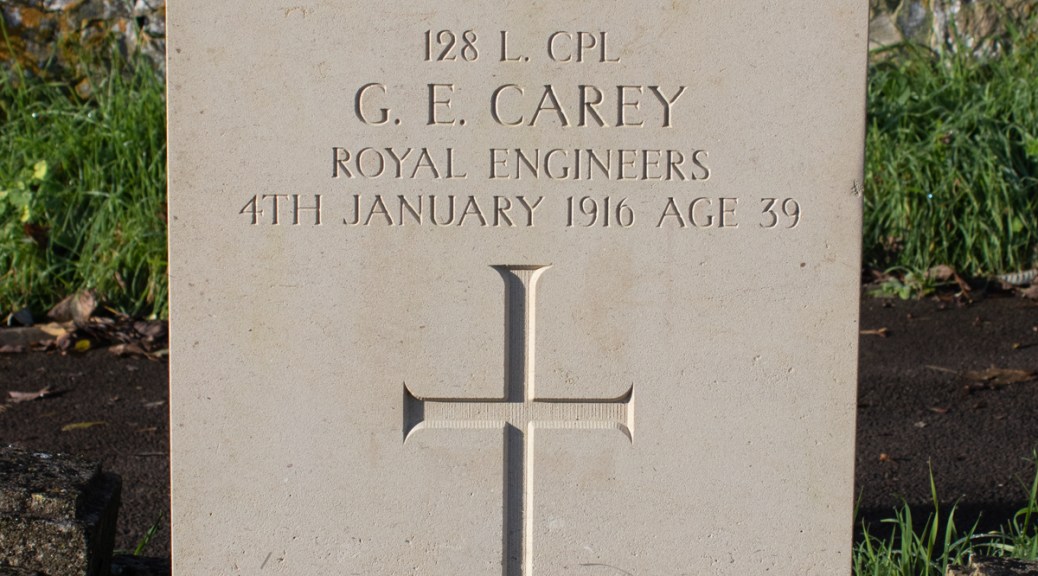
With storm clouds brewing over Europe, George stepped up to play his part. He enlisted in the Royal Engineers in the autumn of 1914 and was attached to the 503rd Field Company in Exeter. Little information is available about his time in the army, and he only comes to light again a year or so later.

Lance-Corporal Carey, 2nd Wessex RE, who has been employed at the office in Colleton-crescent, Exeter, was found dead, with his neck broken, at the bottom of a flight of stairs at the Grapes Inn, South-street, on Thursday morning. The discovery was made by Mrs Dorothy, wife of the licensee of the inn. Information was given to the police, and Dr Pereira visited the scene, and subsequently the body was removed to the mortuary by PCs Wise and Barrett. Carey was fully dressed. He was about 48 years of age, and leaves a widow and four children. For about fourteen months he had been engaged on the Wessex RE staff, and was billeted at a house in the Friars. His home is at Clevedon, Somerset, where he was engaged as a compositor before mobilisation with the Territorials. He was under orders for transfer to another station.

Taunton Courier and Western Advertiser: Wednesday 12th January 1916

George Edward Carey died on 4th January 1916: he was, in fact, not quite 39 years of age. His body was brought back to Somerset for burial and was laid to rest in the stunning graveyard of St Andrew’s Church in his home town of Clevedon.


Private George Buse

Private George Buse

George Henry Buse was born in the Cornish village of St Minver in 1880. One of four children, his parents were Richard and Angelina. Richard was an agricultural labourer, but his son followed a different trade, finding employment as a stonemason.

In the summer of 1904, George married a woman called Mary. They went on to have a daughter, Olive, who was born in 1906, and set up home in Splatt, on the outskirts of the village.

When war came to Europe in the summer of 1914, George stepped up to play his part. He enlisted by the summer of 1916, and joined the 2nd Battalion of the Devonshire Regiment. Private Buse’s unit served on the Western Front, but it is unclear whether he fought overseas.

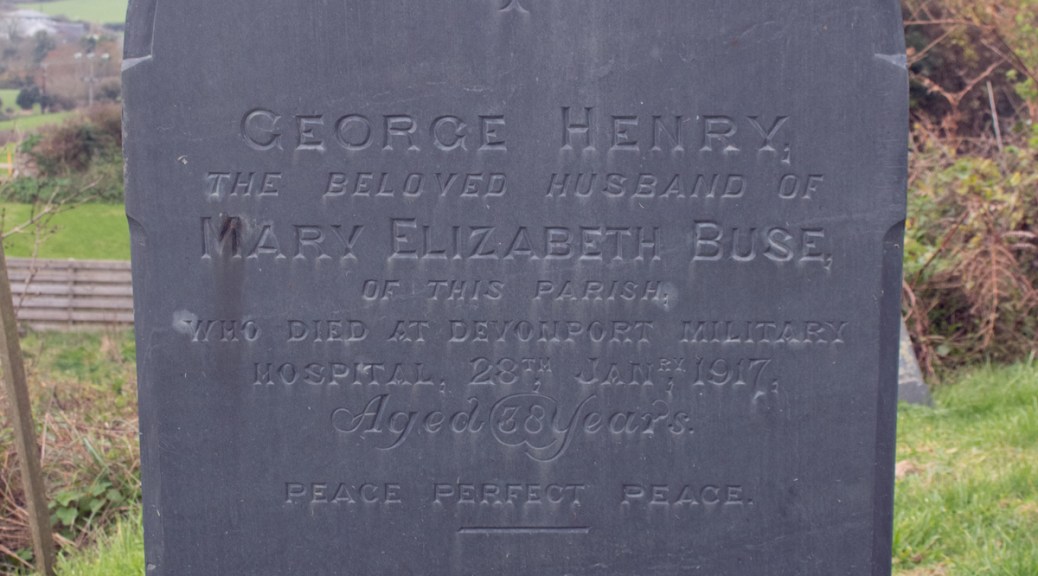
By the winter of 1916, George had fallen ill. He contracted pneumonia, and was admitted to the military hospital in Devonport, Devon. The condition was to prove too severe, however, and he passed away on 28th January 1917: he was 36 years of age.

George Henry Buse was brought back to Cornwall for burial. He was laid to rest in the peaceful graveyard of St Menefreda’s Church in St Minver.


Private William Whaites

Private William Whaites

William Whaites was born on 12th April 1879 in Milverton, Somerset. One of nine children, his parents were George and Anne Whaites. George was an agricultural labourer, and that is work that all of his sons went into at some point.

By the time of the 1911 census, George and Anne were living at Court Bottom in the village, with three of their adult sons – William included – living with them – and doing farm work.

When war was declared, William was called upon to play his part. He enlisted at some point after October 1915, joining the Somerset Light Infantry. Assigned to the 3rd (Reserve) Battalion, Private Whaites was sent to the unit’s base in Devonport, Devon, for training.

Army barracks were cramped places, and often breeding grounds for illness and disease. William was not to be immune to this, and, in the spring of 1916, he contracted pneumonia. He was admitted to the military hospital in Devonport, but quickly succumbed to the condition. He died on 21st April 1916, having just turned 37 years of age.

William Whaites’ body was taken back to Somerset for burial. He was laid to rest in the graveyard of St Michael’s Church in his home town, Milverton.