Tag Archives: Devon

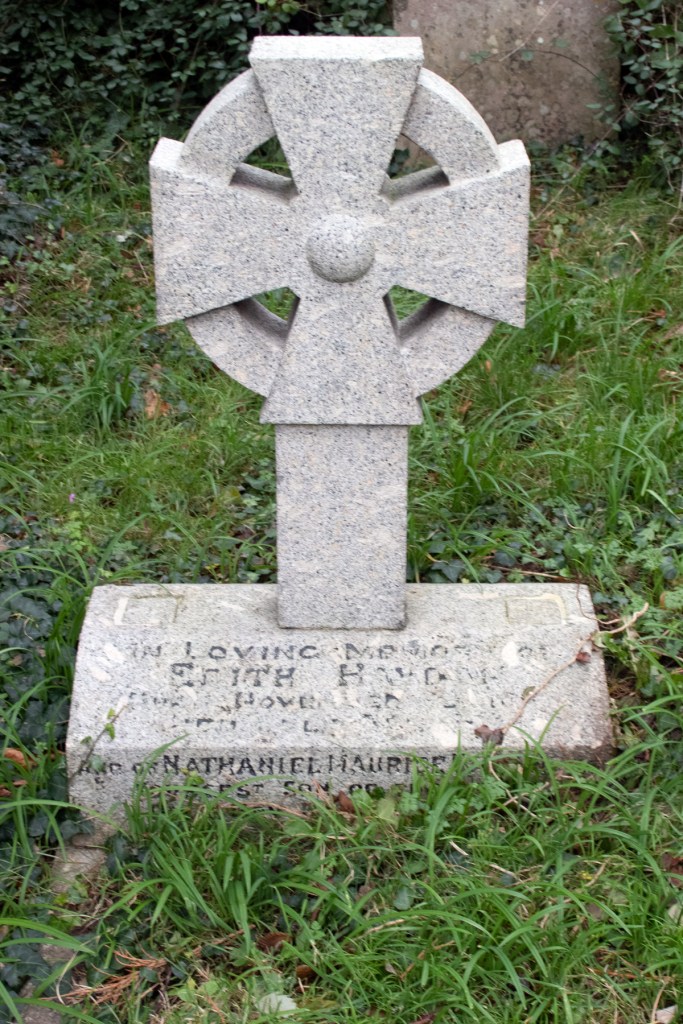
Private Nathaniel Haydon

Private Nathaniel Haydon

Nathaniel Maurice Haydon was born on 26th May 1900, and was the youngest of four children to Edgar and Edith Haydon. Edgar was a surgeon from Bovey Tracey, Devon, but the family were born and raised in Newton Abbot.

Edgar’s work gave them a comfortable lifestyle: the 1901 census shows the family had four live-in servants. Edith passed away from cancer in July 1903, when her youngest was only a toddler. Edgar married again – to a Gertrude Godwin, fourteen years his junior – four years later; given his role in the community, this is likely to have provided the family with a level of stability.

By the time of the 1911 census, Nathaniel and his older brother Frank were recorded as boarders in a private school in the town, while Edgar and Gertrude were listed at the family home with two domestics.

War was coming to Europe, but Nathaniel was initially young to become involved. Spurred on when his oldest brother, Edgar, was killed at the Somme in July 1916, he applied to join the Inns of Court Officer Training Corps in the summer of 1918. He was accepted, and sent off to Hemel Hempstead, Hertfordshire, for training that September.

Sadly, it was Private Haydon’s eagerness to emulate his brother that led to his undoing. While at the camp, he contracted pneumonia, and passed away on 1st November 1918, aged just 18 years old.

Nathaniel Maurice Haydon’s body was brought back to Devon for burial. He was laid to rest in the family plot in the graveyard of St Mary’s Church, Wolborough, Newton Abbot.


Private William Fuller

Private William Fuller

William Charles Fuller was born on 31st January 1876 in Newton Abbot, Devon. He was the older of two children to Francis and Mary Fuller. Francis was a nurseryman, and gardening was a trade that both William and his brother followed him in.

Mary died in 1895 and Francis married a second time the following year, to a Mary Rogers. In July 1905, William married Ellen Bland, the daughter of the landlord of the Swan Inn in nearby Highweek. The couple went on to have a son, William, who was born the following year. William Sr continued his nursery trade through until the outbreak of war, while volunteering for the local defence corps.

When war came to Europe, William stood up to play his part. Full details of his service are not readily available, but it is clear that he had enlisted in the 13th (Works) Battalion of the Devonshire Regiment by the summer of 1916.

Private Fuller was based on home soil, serving in both Devon and Cornwall. However, he was billeted on Salisbury Plain by the start of 1917, and it was here that he fell ill. Having contracted influenza, William was admitted to the Fargo Hospital in Larkhill, Wiltshire; this was where he passed away on 25th January 1917. He was days short of his 42nd birthday.

William Charles Fuller’s body was brought back to Devon for burial. He was laid to rest in the family plot in the graveyard of St Mary’s Church in Wolborough, near Newton Abbot.


Rifleman Bert Burridge

Rifleman Bert Burridge

Bert Burridge was born in the spring of 1893, one of nine children to Charles and Elizabeth. Charles was a journeyman shoemaker from Crediton in Devon, and this is where Bert was born. By the time of the 1901 census, however, the family had moved south to Newton Abbot.

When Bert left school, he found work as a carriage cleaner for the railways; he soon moved out, and boarded with a family in Kingsbridge, in the south of the county.

War was coming to England’s shores, however, and Bert was keen to play his part. He enlisted in the 4th Battalion of the King’s Royal Rifle Corps as a Rifleman on 16th January 1912. His service records show that he stood 5ft 4ins (1.63m) tall, and weighed 121lbs (55kg). He had a fresh complexion, grey eyes, dark brown hair, and a tattoo on right wrist of two crossed hands.

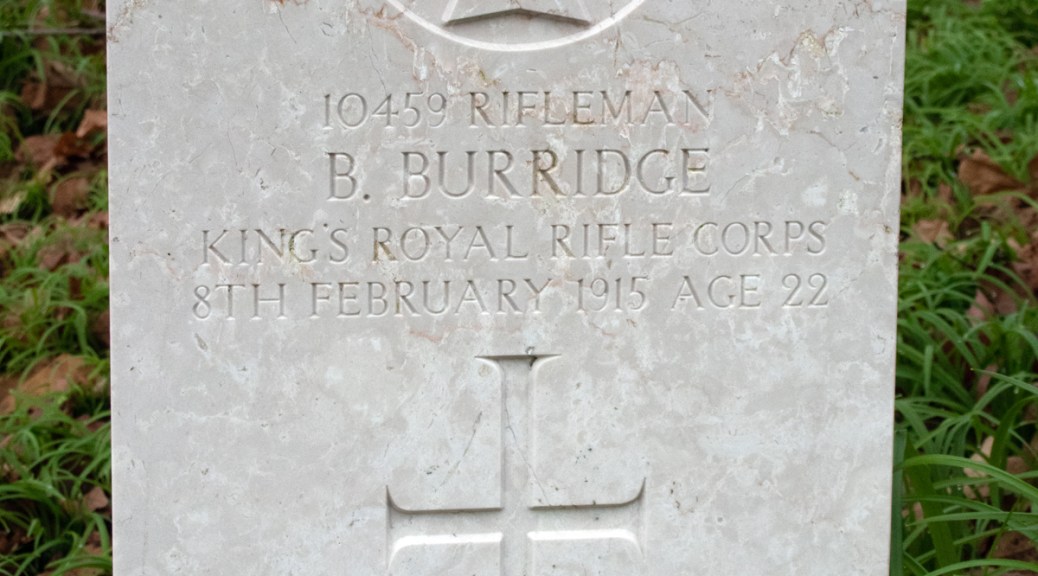
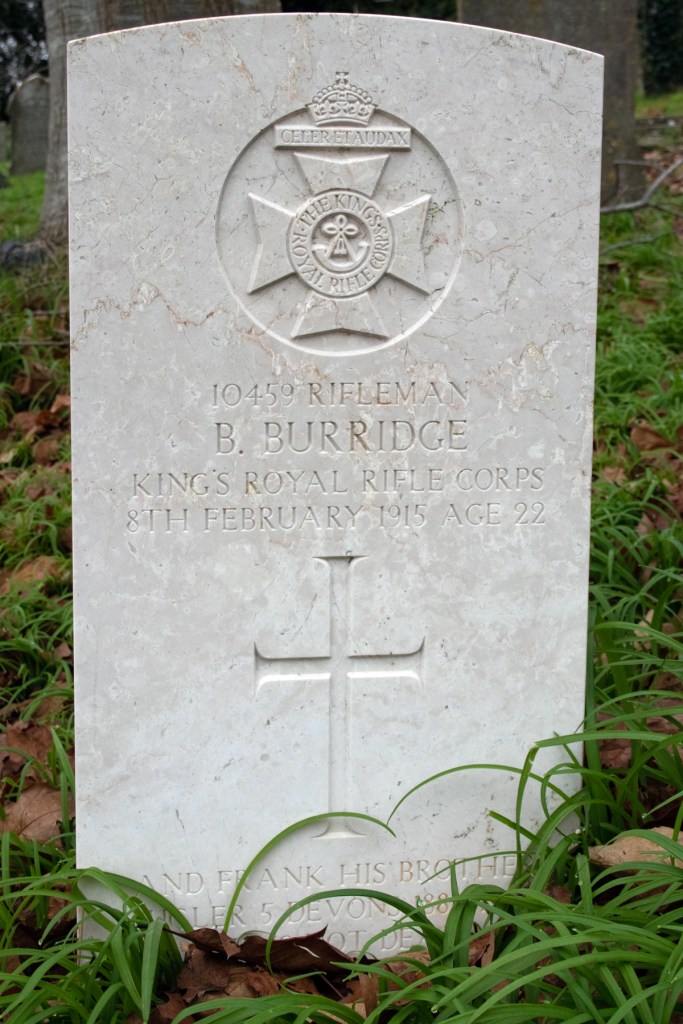
When war broke out, Rifleman Burridge was sent to France and was caught up in the fighting early on. After three months at the front, during the winter of 1914, he contracted frostbite, and was medically evacuated back to England. He was admitted to the 2nd Eastern General Hospital in Brighton, but died of injuries on 9th February 1915. He was just 22 years of age.

Bert Burridge’s body was brought back to Devon for burial. He was laid to rest in the graveyard of St Mary’s Church in Wolborough, on the outskirts of Newton Abbot.


Bert’s headstone also includes a commemoration to his older brother, Frank. Seven years older than Bert, he had enlisted in the Devonshire Regiment as a Bugler when quite young. He passed away in the autumn of 1906, aged just 20, but further details are unclear.


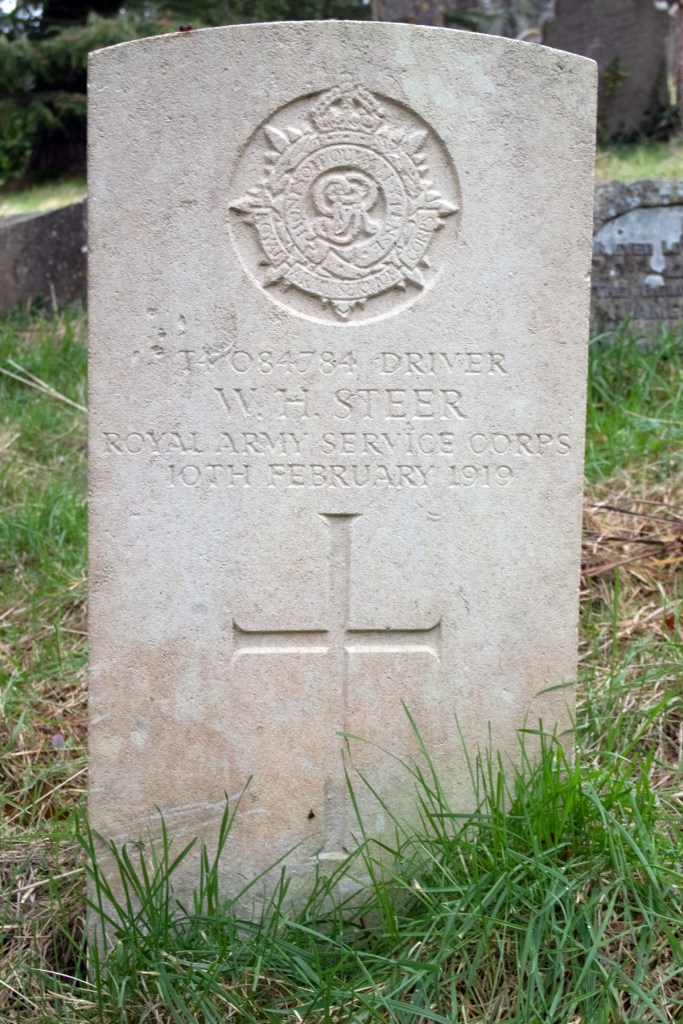
Driver W Steer

Driver W Steer

The life of WH Steer is destined to remain lost to time. Details of his first names and date of birth are not obtainable and, other than the fact that his father was called Thomas, there is no other information about his family.

He had enlisted as a Driver in the Army Service Corps by August 1918, but there is no record as to where he served or for how long he did so. All that can be confirmed is that he was based in Warwick after the conflict ended, and this is where died, of causes unknown, on 10th February 1919.

WH Steer was brought to Devon for burial – presumably this is where Thomas and the rest of his family lived – and he was laid to rest in the graveyard of St Mary’s Church in Wolborough, near Newton Abbot.


Private William Hicks

Private William Hicks

William John Hicks was born in the village of Northlew, Devon, in the spring of 1886 and one of seven children to John and Sophia Hicks. Both of his parents were born in the village, and that was where John found employment as a farm labourer.

By the time of the 1901 census the family had moved to the southern side of Dartmoor, and were living in Wolborough, near Newton Abbot. William had left school, and was also employed, working as a grocer’s porter in the town.

In December 1908, William married Maud Alice Wotton, and the couple set up home near the town’s station. They went on to have a son, also called William, who was born the following year. By this point, William had found more secure employment, and was working as a wagoner for a flour mill.

War was approaching Europe, and when the time came, William joined up to play his part. He enlisted in the Army Veterinary Corps, and there is no doubt that his pre-war employment stood him in good stead for the role. There is little information about Private Hicks’ military service, but it is clear that he had joined up by March 1916, and, for some part at least, was based in Hampshire.

Sadly, the other other available information relating to Private Hicks is that confirming his passing. He died, of causes unknown, on 19th September 1916, in Aldershot, where he was billeted. He was 30 years old.

William John Hicks’ body was brought back to Devon for burial. He was laid to rest in the graveyard of St Mary’s Church in Woborough.


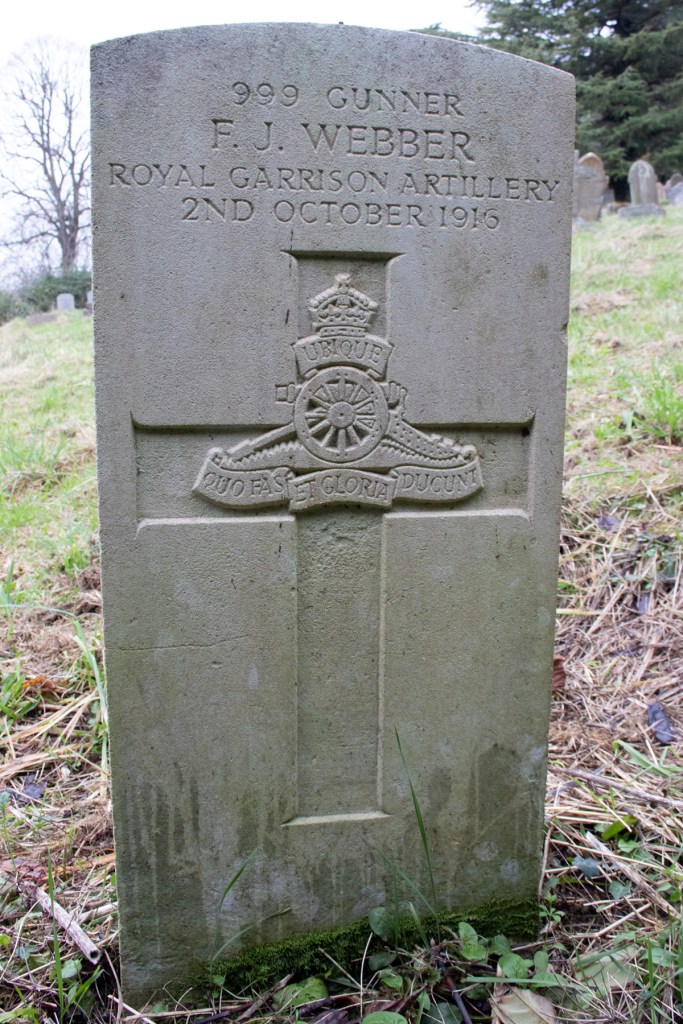
Gunner Frederick Webber

Gunner Frederick Webber

Frederick James Webber was born on 6th July 1889, and was one of nine children to Charles and Mary Webber. Charles was a machinist and wheel turner from Wolborough, near Newton Abbot in Devon, and it was in the village that Frederick and his siblings were born and raised.

The year 1902 was to prove tragic for the Webber family as Mary and two of Frederick’s siblings – Charles, who was 16, and Olive, who was 11 – all died. While there is nothing to confirm causes of death, or whether the three were related, there was a smallpox outbreak in Devon at the time, so it seems likely that the family were drawn into the tragedy.

Charles remarried three years later, to local widow Mary Harper; the couple would go on to have two children of their own. Frederick, by this point, seemed keen to make his own way in the world, and found work on the railways. The 1911 census records him as lodging with the Batten family in Penzance, Cornwall, where he was earning a living as a carriage cleaner.

On 4th September 1915, Frederick married Hannah Mary Annear (née Williams). She was nine years older than him, and was a widow with three children. The couple set up home in Redruth, Cornwall, and may have married as, with war raging across Europe, Frederick was on the verge of being called up.

Full details of Frederick’s military service are not available, but it is clear that he joined the Royal Garrison Artillery at some point in early 1916. Assigned to his adopted home county of Cornwall, he nevertheless needed training, and, for this, he was sent to the B Battery of the 1st Anti-Aircraft Brigade in the North East.

It was while here, that Gunner Webber contracted endocarditis. He was admitted to the Jeffery Hall Hospital in Sunderland, but the condition got the better of him, and he passed away on 2nd October 1916, aged just 26 years old.

Frederick James Webber was brought back to Devon for burial. He was laid to rest in graveyard of St Mary’s Church in Wolborough, where his father and family still lived.


Serjeant John Ive

Serjeant John Ive

John Tucker Ive was born on 30th January 1882, one of eleven children to George and Emily Ive. George was a stone dresser from Harefield, Middlesex, and this is where the family were born and raised.

John was evidently after a life of adventure and, on leaving school, he enlisted in the Duke of Cornwall’s Light Infantry. There is little documented about his military career, but he was based in Devonport and spent a couple of years in South Africa during the Second Boer War.

When he returned to England, John met Amy Ethel Staunton, from Stonehouse in Devon. The couple married in 1905 and went on to have a son, also called John, the following year.

When his military service came to an end, John found work as a butler, and he and Amy were employed by the same household. John Jr, meanwhile, was brought up by his maternal grandmother in Plymouth.

Global conflict was on the horizon, by now, and John soon felt the need to play his part once again. He rejoined the 2nd Battalion of the Duke of Cornwall’s Light Infantry, and was given the rank of Serjeant. He was shipped to France in August 1914, where his battalion fought at Ypres and at Mons, and he was injured during both battles.

By the time the conflict ended, Serjeant Ive had transferred to the regiment’s Labour Corps; at the start of 1919, he was preparing to be discharged from the army, but contracted pneumonia. Admitted to the Alexandra Hospital in Cosham, Hampshire, the lung condition sadly got the better of him: he passed away on 24th February 1919, at the age of 37 years old.

John Tucker Ive was brought back to Devon for burial; he was laid to rest in the graveyard of St Mary’s Church in Wolborough, Newton Abbot.


Two of John’s brothers also died in the conflict.

Private George Robert Ive served with the 2nd Battalion of the Royal Fusiliers. He died at Gallipoli on 28th June 1915, at the age of 34 years old.

Gunner Edward Ive served with the Royal Garrison Artillery. He died in the Persian Gulf on 1st May 1916, aged just 30 years old.


Serjeant William Syms

Serjeant William Syms

William George Syms was born in in the spring of 1889, the oldest of two children to George and Rose Symes (both spellings are recorded). George was a postman from Devon, and the family were born and raised in Highweek, Newton Abbot.

When William left school, he followed in his father’s footsteps becoming a postman in his home town. Life was not without its ups and downs, however, and the 1911 census record him as an inpatient, convalescing from an unknown illness in Exmouth.

In the summer of 1913, William married Amelia Oliver, a gardener’s daughter, who also from Highweek.

When war broke out William was eager to play his part, and enlisted in the early months of the conflict, alongside a number of his colleagues. He joined the Royal Engineers, and was assigned to the 1st (Wessex) Division Signal Company. He was sent to France on 22nd December 1914 and was involved on the Front Line from early on.

By the spring of 1915, he was fighting at Ypres, and was badly injured, fracturing both legs and suffering from the effects of being gassed. Serjeant Syms – as he was by then ranked – was medically evacuated to England for treatment. He was admitted to the Auxiliary Military Hospital in Manchester, but died of his injuries on 12th May 1915. He was just 26 years old.

William George Syms’ body was brought back to Devon for burial. He was laid to rest in the graveyard of All Saints Church in his home town of Highweek. Tragically, he was never to see his son, also called William, who had been born just two months before.


Lieutenant Frederick Liardet

Lieutenant Frederick Liardet

Frederick Charles Evelyn Liardet was born in Brighton, now a suburb of Melbourne, Australia, in 1888, and the eldest son of Wilbraham and Eleanor Liardet.

There is little further information about Frederick’s early life, but, when war broke out, he wanted to play his part for King and Country, and enlisted in the Devonshire Regiment.

He had an adventurous career… Having been twice wounded while on active service in France, he was appointed an instructor in the Balloon Section of the Royal Flying Corps.

Exeter and Plymouth Gazette: Tuesday 18th December 1917

On 23rd October 1915, Frederick married Kathleen Norah Liardet in Highweek, Newton Abbot, Devon. She was the daughter of a retired Lieutenant Colonel in the Royal Marine Light Infantry, and may have been a cousin (while their surname is unusual enough for there to be a connection, I have been unable to identify a specific connection). The couple went on to have a daughter, Barbara, who was born in 1917.

In 1916, while on a night flight with the Royal Flying Corps, the now Lieutenant Liardet was involved in an accident and badly injured. He returned to England to recover, he and Kathleen living with her family. While his health initially improved, he relapsed and passed away on 13th December 1917, aged just 29 years old.

Frederick Charles Evelyn Liardet was laid to rest in the graveyard of All Saints Church in his adopted home of Highweek, Devon.


Private Edgar Yea

Private Edgar Yea

Edgar Thomas Yea was born on 23rd February 1898, the youngest of four children to Enoch and Sarah Yea. Enoch was road contractor from Devon, and it was in Highweek, near Newton Abbot, that he and Sarah raised their young family.

There is little documented on young Edgar’s life: he enlisted in the Royal 1st Devon Yeomanry not long after was war declared in August 1914. He served on home soil, and was medically discharged from service after just 241 days. There is no confirmation on the cause of his removal from the army, but Private Yea’s last day of service was 11th June 1915.

At this point, Edgar’s trail goes cold again. All that can be confirmed is that he passed away at home on 6th February 1919, just a couple of weeks shy of his 21st birthday. The cause of his passing is lost to time.

Edgar Thomas Yea was laid to rest in the graveyard of All Saints Church in his home town of Highweek, Devon.