Tag Archives: Devon

Second Lieutenant Francis Willis

Second Lieutenant Francis Willis

Francis John Henry Willis – who was known as Frank – was born in the summer of 1893 in Totnes, Devon. The youngest of three children, his parents were William Willis – a solicitor’s clerk turned accountant – and Susannah, who was the headmistress of a boarding school.

Education played a strong role in Frank’s upbringing, and, by the time of the 1911 census, he was recorded as being an student of architecture and surveying. (Interestingly, in the same census his older brother, William, was noted as having an infirmity, that of his being “delicate from birth.”)

When he completed his studies, Frank found employment in Newton Abbot, where he worked as an architect for Rowell, Son and Locke. War was coming to Europe, however, and in November 1915, he enlisted in the Royal Engineers.

Frank rose through the ranks, and was given a commission in the Royal Air Force when it was formed in April 1918. Based on Salisbury Plain, the now Second Lieutenant Willis became known as an expert shot, making numerous flights without incident.

On the 20th September 1918, however, that was to change. Taking off on a routine flight, the Avro 504K that he was flying stalled and spun into ground, catching fire. Second Lieutenant Willis was killed instantly. He was just 25 years of age.

Brought back to Devon for burial, Frank John Henry Willis was laid to rest in the cemetery of his home town, Totnes.


Private William King

Private William King

William Samuel King was born in the summer of 1880, and was one of four children to Richard and Elizabeth King. Richard was a railway worker from Totnes, Devon, and this is where the family were born and raised.

When he left school, William found work as a house painter, and this is a job he continued to do through to the outbreak of the Great War. On 8th June 1908 he married Minnie Edmunds: the couple went on to have a son, Leslie, who was born in 1912. William and Minnie had, by this point, moved to Swansea, West Glamorgan, presumably as work was more plentiful here than in their Devon home. His work as a decorator seems to have been recognised, and he was admitted to the National Association Partnership, Swansea South.

On 1st December 1915, William enlisted and his service records show that he was 5ft 2ins (1.57m) tall. While it is clear that he spent his time on home soil, his service seems a bit disjointed.

Private King wasn’t formally mobilised until September 1916, when he was assigned to the 2nd/2nd Battalion of the Monmouthshire Regiment. In December he was transferred to the Royal West Kent Regiment before returned to his original battalion in February 1917. A month later, he moved to the Bedfordshire Regiment, before moving to the Middlesex Regiment a few weeks later. This also seems to have been a temporary move as, three weeks later, he was assigned to the 337th Works Company of the Labour Corps (although this was still part of the Middlesex Regiment).

The potential reason behind Private King’s haphazard service seemed to become a little clearer when, in September 1917, he was referred to Fort Pitt Hospital in Rochester, Kent. He was noted as being “very talkative, noisy [and] in a state of mental disease… he has… exalted and grandiose ideas and is difficult to restrain.” His mental health was obviously suffering, and he was discharged from military service in December 1917.

William returned home, although it was not to be for long. He passed away on 13th April 1918, at the age of 37 years old. While no cause of death is evident, it seems likely to have been connected to his ‘mania’, which had been exacerbated by his army service.

William Samuel King was laid to rest in Totnes Cemetery, not far from his parental home.


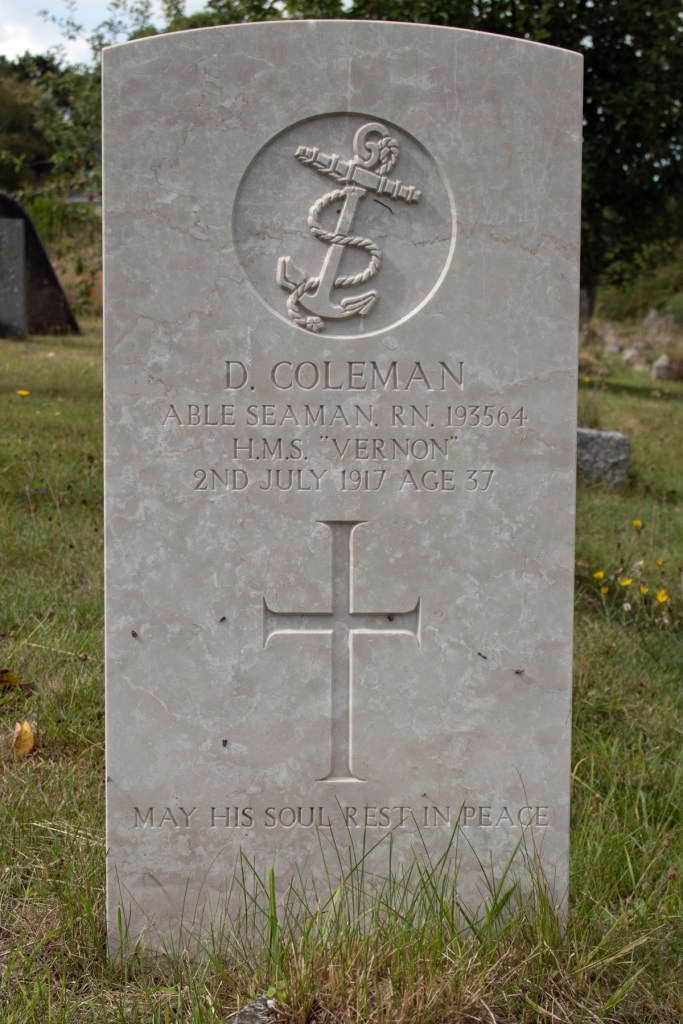
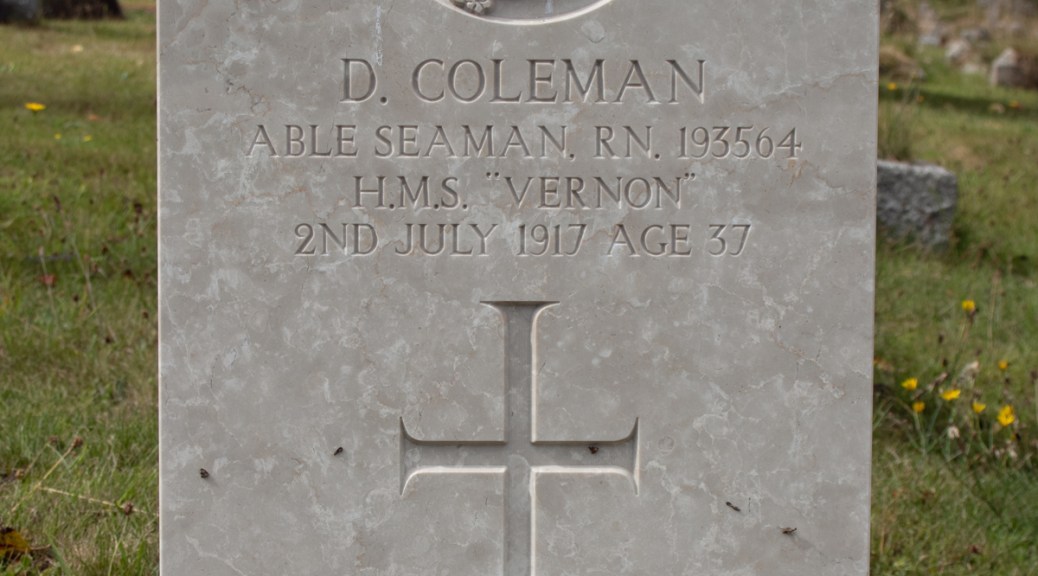
Able Seaman David Coleman

Able Seaman David Coleman

David Coleman was born in the spring of 1880, one of nine children to Jeremiah and Mary Coleman. Jeremiah was a farmer from County Cork, Ireland, and it was in his home village of Killbrittain that the family were raised.

When David left school, he found work as a labourer and mechanic and, in the spring of 1896, he left Ireland for England in search of a bigger and better life for himself.

Things may not have gone quite to plan, however, and, on 17th March 1897, he enlisted in the Royal Navy. He was too young to enrol for full service at this point, however, and so he took on the rank of Boy 2nd Class. He was initially assigned to the training ship HMS Northampton and quickly made Boy 1st Class.

Over the next year, David served on two vessels – HMS Calliope and HMS Doris. When he turned eighteen, he was officially enrolled in the Royal Navy, and given the rank of Ordinary Seaman.

David remained on HMS Doris for nearly four years, and seemed to impress his superiors. By the end of his time on board, he had been promoted again, reaching the rank of Able Seaman.

Over the next nine years, Able Seaman Coleman served on ten different ships, each time returning to HMS Vivid, the Royal Naval Dockyard in Devonport. In March 1910, with his contract complete, he was stood down to reserve status.

The same year, he married Florence Tompkins, who had been born in Newton Abbot, Devon. The couple set up home in Totnes and went on to have three children. David found work as an electrician for the local electric light works.

War was coming to Europe by this point and, in August 1914, Able Seaman Coleman was called back to duty. He served for two years on board the battleship HMS Caesar and, having previously been assigned to HMS Defiance, returned there again. In May 1916, he was assigned to HMS Vernon, one of the shore-based establishments in Portsmouth, Hampshire.

It was while he was in Portsmouth that he fell ill, and was admitted to the town’s Haslar Hospital. Details of his condition are unclear, but he was to succumb to it, passing away on 2nd July 1917, at the age of 37 years old.

David Coleman was brought back to Devon for burial: he was laid to rest in the town’s cemetery, not far from the family home.


Tragedy was to strike the Coleman family again when, early in 1918, both of David and Florence’s younger children – David, aged 5, and Mary, age 2 – passed away. Causes of death are again unclear, but it seems likely to have been one of the lung conditions that would ravage Europe as the war entered its final stage.


Private Albert Harvey

Private Albert Harvey

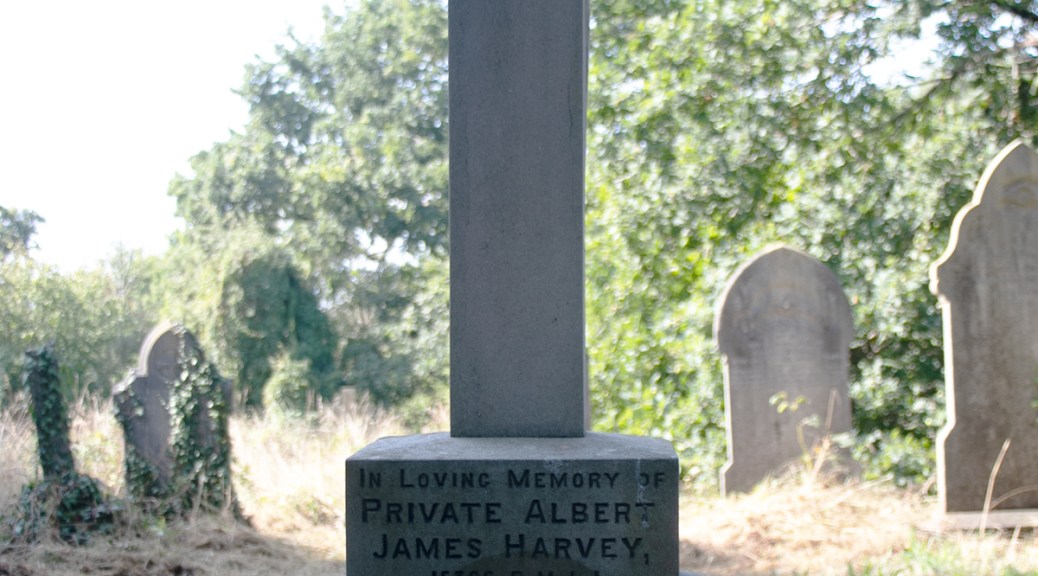
Albert James Harvey was born on 23rd May 1894 in the Gloucestershire village of Warmley. One of eleven children, his parents were James and Alice Harvey. James was a bootmaker, and most of Albert’s siblings followed him into shoemaking, but Albert bucked the trend, and found work with a baker when he left school.

He wanted bigger and better things, however, and so, on 26th April 1911, he enlisted in the Royal Marine Light Infantry. His service records record that Private Harvey was 5ft 5.5ins (1.66m) tall, with blue eyes, auburn hair and a fresh complexion. It also suggests that he added a year to his age, to ensure that he was accepted for duty.

After initially enlisting in Deal, Kent, Albert was sent to Plymouth, Devon, where he served for most of 1912. On 18th November that year, he was assigned to the dreadnought battleship HMS Conqueror, on which he was to serve for the nearly five years.

It was during his time on board Conqueror that Albert married Ethel Brewer. The daughter of a pressman, the couple exchanged vows at St Barnabas Church in their shared home village, Warmley.

Private Harvey remained serving throughout the war and, in April 1918, he was involved in the Zeebrugge Raid. This was an attempt by the Royal Navy to block the Belgian port by sinking obsolete ships in the canal entrance. During the operation, more than 200 men were killed and over 300 – including Albert – were wounded.

Private Harvey was medically evacuated to England for treatment, but his injuries were to prove too severe. He passed away in a hospital in Plymouth on 28th June 1918. He was just 24 years old.

Albert James Harvey was brought back to Gloucestershire for burial. He was laid to rest in the graveyard of St Barnabas’ Church, where he has been both baptised and married.


Private George Garrett

Private George Garrett

George Garrett was born in early 1895 in Abbotskerswell, Devon. He was the oldest of five children to George and Annie Garrett. George Sr was a labourer and the family seemed to travel with his work: his and Annie’s younger children were born in Aldershot, Plymouth and London.

When he left school, George Jr found work as an errand boy – the family were back in Devon by this point. War was on the horizon, however, and he would feel compelled to play his part. Full details of his service are not available, but it is known that he enlisted in the Devonshire Regiment, and was assigned to the 2nd Battalion.

Private Garrett arrived in France in December 1915, and was soon entrenched on the Western Front. Hi battalion was caught up in the Battle of the Somme and George was badly injured, having received a gunshot wound to his spine.

Medically evacuated to Britain, his wounds proved too severe for him to return to duty, and he was discharged from the army on 28th December 1916. It is not clear whether he returned home, but it seems likely that he remained in hospital in Exeter. He would never recover from his injuries. He passed away at the hospital on 18th April 1917, at the age of 22 years old.

George Garrett was laid to rest in the graveyard of St Andrew’s Church in Ipplepen, Devon, where his family were, at that point, living.


Private Leonard Luscombe

Private Leonard Luscombe

Leonard Luscombe was born in the spring of 1894 in the Devon village of Ipplepen. He was the fourth of five children to William and Bertha Luscombe, bakers and grocers in the village.

When he left school, Leonard found work as a clerk in a bank, but it is clear he was after bigger and better things. On 27th August 1912 he enlisted in the Royal 1st Devon Yeomanry as a Private. His service records show that he was 5ft 5ins (1.65m) tall, had good vision and was of good physical development.

Private Luscombe was sent to Salisbury Plain in Wiltshire for his training, but then returned to Devon at a base near Bovey Tracey, where he remained when war broke out in 1914. That autumn, he contracted tuberculosis, and it was to prove severe enough for him to be medically discharged from the army in February 1915.

Leonard returned to his life in Ipplepen, but his lung complaint was to dog him for the next few years. He finally succumbed to the condition on 26th October 1918, at the age of just 24 years old.

Leonard Luscombe, whose “cheerful hopefulness and intelligence gained him much popular sympathy” [Western Times: Saturday 2nd November 1918], was laid to rest in the family grave in St Andrew’s Churchyard in his home village.


Private Clarence Emmett

Private Clarence Emmett

Clarence Southwood Emmett was born in September 1899 in the Devon village of Ipplepen. The middle of five children, his parents were village butcher Thomas Emmett and his wife, Annie.

There is little information about Clarence’s early life, but when war broke out in 1914, he is evident that he wanted to play his part. He enlisted in the army as soon as he turned 18, and joined the 4th Battalion of the Wiltshire Regiment.

Sadly, full details of his time in the army, although a local contemporary newspaper sheds a little more light onto his health:

He soon contracted measles, and took a chill before he recovered. Since then he has been dangerously ill at different times, and has undergone various operations. He was recently removed to a hospital at Devonport where, until a few weeks ago, it was hoped he might recover.

Western Times: Friday 14th February 1919

Private Clarence Southwood Emmett died in the hospital on 8th February 1919. He was just 19 years of age. His body was brought back to Ipplepen, and he was laid to rest in the graveyard of St Andrew’s Church there.


Private Clarence Emmett

Private Ernest Bowden

Private Ernest Bowden

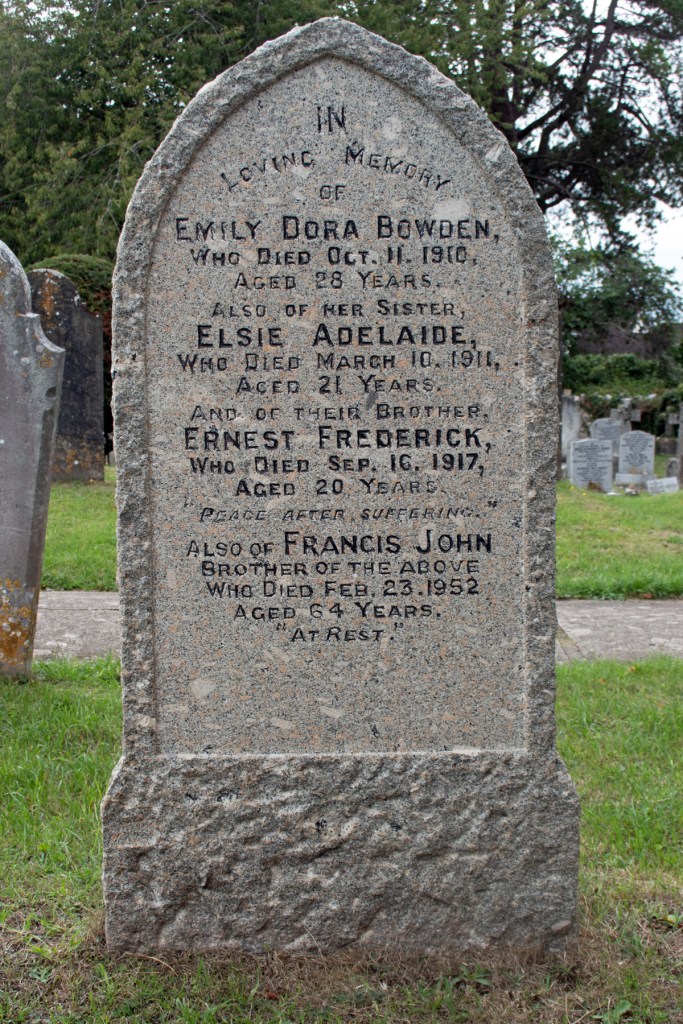
Ernest Frederick Bowden was born on 2nd November 1896 in Ipplepen, Devon. He was one of eleven children – and one of twins – to Frederick and Dora Bowden. Tragically, Dora died when Ernest was just over a year old, leaving Frederick and his older sisters to raise the family as best they could.

When he left school, Ernest found work as a page for a surgeon living in Paignton, before finding other employment as a chauffeur in Bovey Tracey. In his spare time, he was an avid bellringer at his local church.

War was coming to Europe, however, and in November 1915, he enlisted in the Gloucestershire Regiment. His service records noted that he was 19 years of age, and stood just 5ft 1.5ins (1.56m) tall. Assigned to the 14th Battalion, Private Bowden soon found himself on the front line. Arriving in France in July 1916, he spent four months there, during which he contracted tuberculosis and trench foot.

Medically evacuated to Britain for treatment, his conditions proved too severe for him to continue in the army. He was discharged from active service in December 1916.

For some months he had been at the Ivybank Dispensary, Exeter. Complications set in, and he rapidly sank just before reaching his 21st year.

Western Times: Friday 28th September 1917

Ernest Frederick Bowden had passed away on 16th September 1917, aged just 20 years old. He was laid to rest in the family grave at St Andrew’s Church, Ipplepen.


Private Alfred Bishop

Private Alfred Bishop

Alfred John Bishop was born on 25th April 1896 in the Devon village of Kingswear. The older of two children, his parents were John and Susanna Bishop. John was a farm worker, and his expertise with horses was not lost on Alfred, who became a delivery driver for a baker in Marldon, to the north of Paignton, when he left school.

On 3rd September 1917, Alfred married road contractor’s daughter Bessie Webber. Originally from Staverton, her family had settled in Ipplepen, and this is where the newlyweds made their home.

War had come to Europe by this point, and Alfred had enlisted in the Royal Army Service Corps (RASC). His background with horses came in useful, as he was assigned to the Yeomanry Remount Depot. Details of Private Bishop’s military service are lost to time, so it is unclear if he was attached to one of the RASC depots in the UK, or if he served abroad.

Alfred survived the war and, by 1919, was back home. He and Bessie had a son, Leslie, who was born on 23rd October 2020. Time with his son was to be tragically brief, however, as Alfred passed away on 14th April 1921. The cause of his death is not known, but he was just 25 years of age.

Alfred John Bishop was laid to rest in the graveyard of St Andrew’s Church in Ipplepen.


Bessie went on to marry again, to James Joint in the autumn of 1932. She passed away in Newton Abbot in 1980, at the age of 85.


Alfred’s brother James’ life was also cut short. He married Ethel Warren in 1925, and is recorded has having passed away in London in the autumn of 1935, when he was only 35 years old. Ethel was left with two young children to raise, and John and Susanna were to outlive both of their sons.


Deck Hand Philemon Richards

Deck Hand Philemon Richards

Philemon Witheridge Richards was born on 9th July 1891 in Porthleven, Cornwall. He was one of at least seven children to George and Ann Richards. George was a sailor, as were he two oldest sons and, by the late 1890s, the family had made the move to Penarth in Glamorganshire.

When he left school, Philemon followed his father and older brothers into sailing. By the time he turned eighteen, George had passed away and Philemon wanted bigger and better things. On 16th July 1909, he enlisted in the Royal Garrison Artillery. His service records show that he stood 5ft 9.5ins (1.76m) tall, had good vision and was of good fitness.

Gunner Richards was posted to No. 6 Company and remained part of the territorial force. On 1st July 1911, after twenty months’ service, he was, at his own request, discharged from the army.

The trail goes cold for a while, and Philemon seems to have returned to a life at sea. This changed, however, when war broke out and, in October 1915, he was drafted into the Royal Naval Reserve as a Deck Hand.

Philemon’s time in service seems to have been shore-based however. After an initial posting to HMS Vivid, the Royal Naval Dockyard in Devonport, he moved to HMS Victory, which was the name given to the dockyard in Portsmouth, Hampshire. He moved on again in the autumn of 1916, by which point he was based at HMS Pembroke, the Royal Navy’s shore-base in Chatham, Kent.

It was here that Deck Hand Richards fell ill. It is unclear what the condition was, but he was admitted to the Military Hospital in Chatham on 20th October 1916. His illness worsened, and he passed away there on 2nd November. He was just 25 years of age.

Philemon Witheridge Richards was brought back to Glamorganshire for burial. He lies at rest in the graveyard of St Augustine’s Church in Penarth.


Philemon’s gravestone is also dedicated to his brother, Thomas Witheridge Richards. Eighteen years Philemon’s senior, Thomas had been a sailor, and, while no records remain, it seems likely that he may also have been called into service during the First World War. He died at home on 4th July 1918, at the age of 45 years old. He was laid to rest in the same plot as his younger brother.