Tag Archives: Devonshire Regiment

Private Robert Kelway

Private Robert Kelway

Robert Jenkins Kelway was born in the autumn of 1897 in the Devon town of Torquay. The oldest of four children, his parents were Robert and Rosina Kelway. Robert Sr had been born in Paignton and, when a job working as a carter for Hollicombe Gas Works came up in around 1900, he moved the family back down the coast.

By the time of the 1911 census, the Kelways were living at 3 Hollicombe Terrace, on Torquay Road: their home was one of a row of terraced houses build specifically for the gas works employees, and all of their neighbours were employed there in one form or another.

Robert Jr was 13 years old at this point, and seemed to have completed his schooling: his entry on the census confirms he was employed as a telegraph messenger for the Post Office.

Everything was to change when war was declared and, on 22nd April 1915, Robert Jr voluntarily stepped up to play his part. Lying about his age – he said he was 19, when he was, in fact, two years younger – he was nonetheless taken on his word. His service records show that he was 5ft 5ins (1.65m) tall and weighed 141lbs (64kg). He was noted as having brown hair, blue eyes and a fresh complexion.

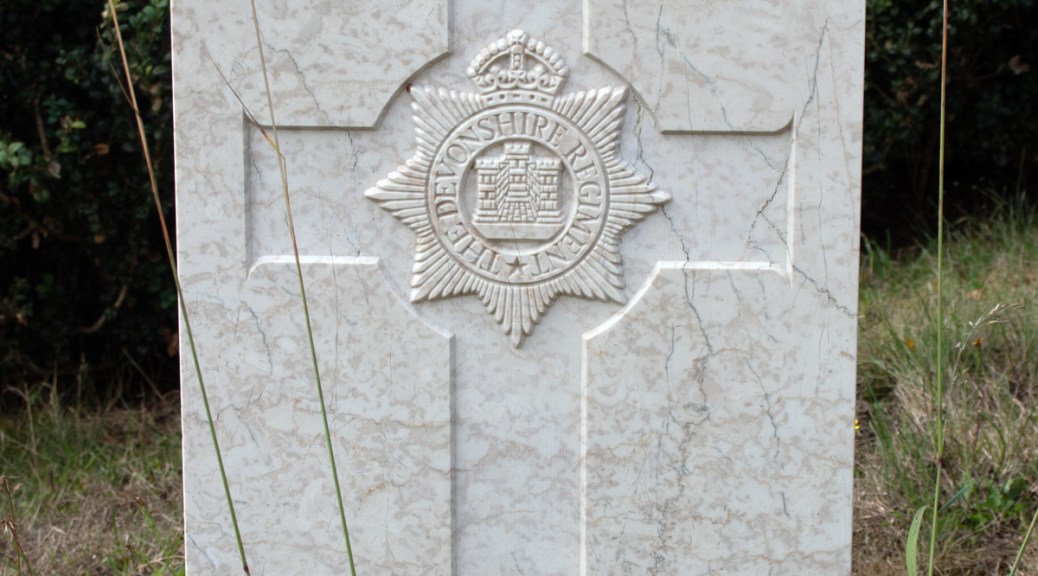
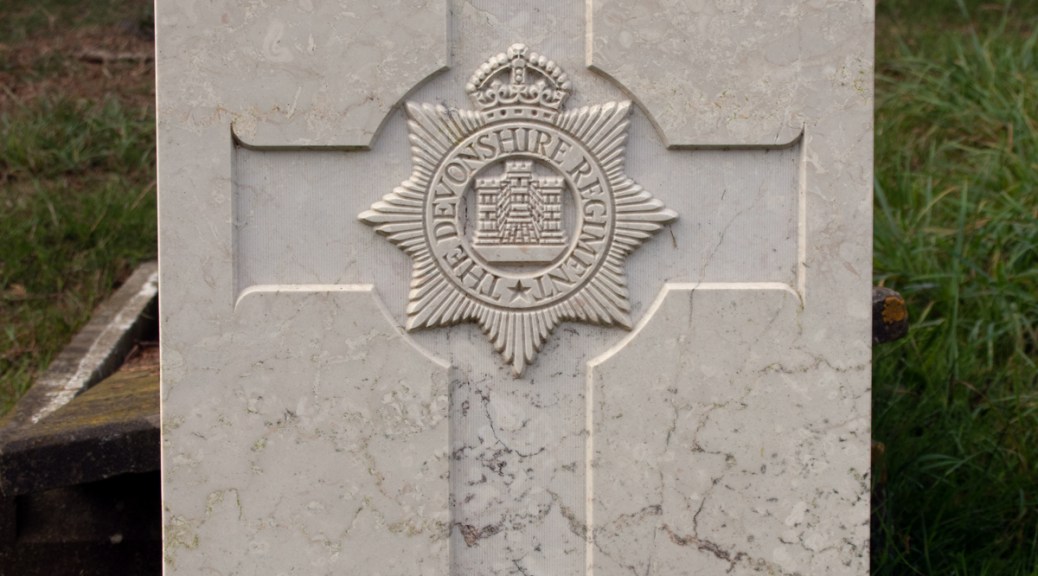
Assigned to the Devonshire Regiment, Private Kelway was initially attached to the 3rd Battalion. At the end of October 1915, however, he was transferred to the 8th (Service) Battalion, and dispatched to France. His unit was caught up in the Battle of Loos, but it was at the Somme the following year that Robert would really have cut his teeth in fighting.

Private Kelway saw out the Somme relatively unscathed, but, on 27th December 1916 his luck was to run out. He was shot in the back, damaging one of his lower vertebra, and was medically evacuated to Britain for treatment.

Robert was admitted to King George’s Hospital in South London, and it was quickly ascertained that the damage to his spine was permanent. Paralysed from the waist down, he was, not surprisingly, no longer able to continue in the army in any capacity. His discharge papers noted that he was a ‘steady, sober and honest’ person.

From this point, details of Robert’s life are sketchy. It is unclear whether he was able to return home, although he was definitely back in Devon by the spring of 1919, as this is where he died. Admitted to the Royal Devon & Exeter Hospital, he passed away from pneumonia on 18th April, aged just 21 years old.

Robert Jenkins Kelway was laid to rest in Paignton Cemetery, a short distance from where his family lived, in the Preston area of the town.

Private Melbourne Mumford

Private Melbourne Mumford

Melbourne Linas Mumford was born on 13th June 1898, and was one of seven children to William and Fanny. William was a Gunner in the Royal Artillery, and while Melbourne and his siblings were born in the Kent village of Cliffe, the family soon moved to rented rooms in Stafford Street, not far from his new barracks in Gillingham, Kent.

It seems that William’s term of service came to an end, and he moved the family to Devon, where he had been born. Fanny died in 1909, at the age of just 33, and he was suddenly left to raise the family alone. The1911 census found William and his three sons – including Melbourne – living in a cottage in Paignton. William was by now working as a nurseryman, while Melbourne’s older brother, also called William, was bringing in some money as a paperboy for Smith & Sons.

When war came to European shores, Melbourne stepped up to play his part. Full service details have been lost to time, but later documents confirm that he had enlisted in the Devonshire Regiment on 9th August 1915. Attached to the 9th (Service) Battalion, papers confirm that he was 5ft 3.5ins (1.61m) tall, and weighed 99lbs (44.9kg).

Private Mumford’s unit fought as Loos in 1915, and at the Somme in 1916, but it was at Ypres, on 7th October 1917, that he was badly injured. Melbourne was shot in the left thigh, which caused a compound fracture in his femur. Medically evacuated to Britain for treatment, he spent time hospitalised in Manchester.

Recuperation was ongoing, but was not to prove successful, and Private Mumford was eventually discharged from the army on 22nd January 1919.

Melbourne’s treatment would continue, however, and he had a further operation on his leg that summer. Tragically, however, his body had been weakened, and he passed away following the procedure, on 27th August 1919. He was just 21 years of age.

The body of Melbourne Linus Mumford was laid to rest in Paignton Cemetery, not far from the family home in Corsham Road.


Private Mumford’s Dependant’s Pension was assigned to Mrs Kate Mumford, who was recorded as his mother. This would suggest that William had remarried after the 1911 census, although there are no records to confirm this.


Private Percy Light

Private Percy Light

Percy Light was born on 19th September 1898, and was one of seven children. His parents were groom-turned-motor bus driver Harry Light and his wife, Mary. Harry had been born in Hartlepool, County Durham, while Mary hailed from Penzance, Cornwall. However, the couple raised their family in Paignton, Devon.

Percy’s trail is a challenge to follow. He enlisted in the army around the time of his mother’s death, early in 1914. He was assigned to the Devonshire Regiment and, as a Private, was attached to the 3rd (Reserve) Battalion. His unit was stationed in Britain throughout the First World War, and there is no evidence that he spent any time overseas.

In the spring of 1917, Private Light fell ill, contracting tuberculosis. The condition was serious enough for him to be medically discharged from the army and he was officially stood down on 22nd February.

Percy’s trail goes cold at this point: he returned to Paignton, and it seems that his poor health got the better of him. He passed away at home on 18th November 1917: he was just 19 years of age.

Percy Light was laid to rest in the sweeping ground of Paignton Cemetery, not far from where his father still lived.


Private Ernest Carder

Private Ernest Carder

Ernest James Triggs Carder was born early in 1880, the third of ten children to Samuel and Julia. Samuel was a shipwright from Devon and it was in Dartmouth that the family were born and raised.

Ernest – who went by his second name, James – found employment as a groom when he finished his schooling. In the spring of 1907, he married Elizabeth Seward. The couple wed in St Saviour’s Church, Dartmouth, setting up home in Gospel Lane.

James and Elizabeth went on to have three children – Samuel, Edward and Betty. The 1911 census found James working as a grocer’s waggoner, with his youngest brother, Frederick, living with them.

The times were trying for James and Elizabeth: both Samuel and Julia died in 1909; and Edward, their middle child, passed away in September 1911 at the age of just seven months. In the summer of 1915, Betty wad born, and the following April. James was called up to serve his King and Country.

On 14th June 1916, Private Carder was assigned to the Devonshire Regiment, and attached to the 3rd (Reserve) Battalion. The unit would remain on home soil throughout the conflict, but James was not to be part of it for long.

On 29th July 1916, Private Carder was found dead in a lavatory at the Granby Barracks in Devonport, with a razor near him. He had been complaining of eczema on his legs for a while, which made it difficult for him to sleep and had the knock-on effect of causing him headaches. His commanding officer, Corporal Stonelake, said that James “was not too quick, but was a man of good character and tried to do his best… each time he complained of his head he declined to see the doctor.” [Western Morning News: Tuesday 1st August 1916]

Private Carder had willingly enlisted, and appeared not to have any qualms about serving in the army. At the inquest following his death, the jury returned a verdict of taking his life while of unsound mind. He was 36 years of age.

Ernest James Triggs Carder was taken back to Paignton, where Elizabeth and the children were living. He was laid to rest in the town’s cemetery, having found peace at last.


Less than a year later, James’ youngest brother, Frederick, also died. Read more of his life here.

Boy 1st Class Ernest Hewett

Boy 1st Class Ernest Hewett

Ernest Roye Hewett was born on 18th April 1898 and was the third of twelve children to Alfred and Ada. Alfred was a coachman and groom and, while both he and Ada were born in Cornwall, it was in Budleigh Salterton, Devon, that the family were born and raised.

When he finished his schooling, Ernest found work as a butcher’s boy, but when sought bigger and better things. His oldest brother, Ralph, had enlisted in the army by the time of the 1911 census and, by that October, his next oldest brother, Leslie, had enlisted in the Royal Navy. Ernest felt a career in the military was his destiny and, on 12th September 1913, he also joined the navy.

As he was under age at this point, he was given the rank of Boy 2nd Class, and sent to HMS Impregnable, the training establishment in Devonport, for his induction. His service records show that he was 5ft 2.5ins (1.59m) tall, with brown hair, hazel eyes and a fresh complexion.

Ernest spent nine months training, moving from Impregnable to HMS Powerful, and gaining a promotion to Boy 1st Class in the process. In June 1914, he was assigned to the cruiser HMS Edgar, remaining on board for six months, by which point war had broken out.

On 18th December 1914, Lance Corporal Ralph Hewett was killed in action, aged just 20 years old. Attached to the 2nd Battalion of the Devonshire Regiment, he was caught in fighting in Northern France, and is commemorated on the Le Touret Memorial.

Ernest, by this point, had been assigned to another ship, the armed merchant cruiser HMS Viknor. Patrolling the seas off Scotland, towards the end of the month, she was tasked with locating and detaining the Norwegian ship Bergensfjord, on board which was a suspected German spy.

The vessel was located and escorted to Kirkwall in the Orkneys, and the suspect and a number of other prisoners, were taken on board the Viknor to be transported to Liverpool. The ship and crew were never to reach their destination. On 13th January 1915, she sank in heavy seas off the Irish Coast: no distress signal was made and all hands were lost.

BODY WASHED ASHORE – Another body has been washed ashore at Pallntoy Port, about six miles from Ballycastle. The body was that of a man of about 5ft 10in. in height. He was dressed in a blue jacket, and wore a service blue webbed belt, on which was the name E. F. Hewett. In the pocket of the trousers was a boatswain’s whistle.

Freeman’s Journal: 24th February 1915

Already in mourning for Ralph, Alfred and Ada were unable to bring 16-year-old Ernest Roye Hewett back home. Instead, he was laid to rest in Ballintoy parish church, County Antrim.


The heartbreak was to continue for the Hewett family. Leslie’s career had gone from strength to strength and, by the time of his older brother’s death, he had been promoted to Able Seaman. In the summer of 1915, he was assigned to the cruiser HMS Europa, remaining aboard for the next year as it patrolled the Mediterranean. In July 1916 he fell ill, having contracted malaria. This was to prove his undoing: he passed away from the condition on 21st July, at 20 years old.

Able Seaman Leslie Hewett was laid to rest in the Mikra British Cemetery in Greece. His parents had now lost their three oldest sons, and had no way to reach their final resting places.


Private Charles Edwards

Private Charles Edwards

Charles Henry Edwards was born in Padstow, Cornwall, in around 1888. One of three children, his parents were Charles and Elizabeth Edwards. Charles Sr was a farm labourer, and his son, who was one of four children, followed suit when he finished his schooling.

Charles Sr passed away in 1903: the next census record found Charles and two of his sisters living with Elizabeth. She was claiming parish relief, while her daughters were doing occasional char work to bring in a little more money.

Charles married a woman called Florence Dunn in the summer of 1911: little information is available for her, other than she was born in Devon, to Joseph and Maria. The couple set up home in Leadwell Street, Padstow, and went on to have four children: Lilian, Charles, Elsie and Alfred.

When war came to Europe, Charles stepped up to play his part. He enlisted 11th December 1915, by which point, he had found work as a cowman. He joined the Devonshire Regiment as a Private and spend the next fourteen months on home soil, moving across to the 5th Labour Company in February 1917.

At this point, Private Edwards was sent to France, and he spent most of that year overseas. He returned to Britain on 8th November, having contracted bronchitis while serving at Etaples. When he had recovered, Charles returned to duties, and was attached to the 650th Labour Coy.

Alfred, Charles and Florence’s youngest child, was born on 1st April 1918, but seemed to be a sickly boy. He passed away on 27th September, aged just six months, from a combination of influenza and bronchitis. Tragically, Charles was also unwell at this point, and he passed away just four days later from pneumonia. He was just 30 years of age.

Charles Henry Edwards was laid to rest in Padstow Cemetery. The report of his funeral does not mention Alfred, but it seems likely that father and son were buried together.


Florence lived on until 1964. She passed away in Bodmin, at the age of 78, and was laid to rest with her husband, reunited after more than four decades.


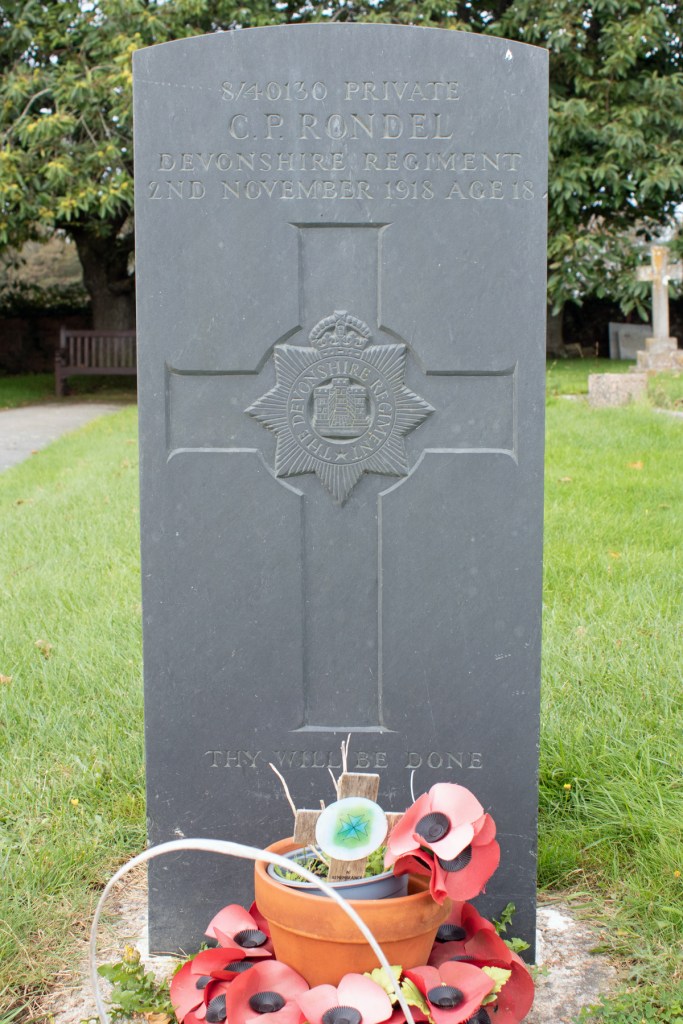
Private Clarence Rondel

Private Clarence Rondel

Clarence Philip Rondel was born in 1900 in St Lawrence, Jersey. One of twelve sibling, nine of whom survived childhood, his parents were John and Louisa Rondel. John was a farmer and by the time of the 1911 census, the family had moved to St John’s to take up a new post, a lot of the family pitching in to help out.

When war came to European shores, Clarence was keen to play his part. Too young to enlist when hostilities were declared, it was not until the spring of 1918 that he was able to join up. Private Rondel was assigned to the 53rd (Young Soldier) Battalion of the Devonshire Regiment.

Clarence was sent to England for training, and was based at the Rollestone Camp on Salisbury Plain, Wiltshire. The barracks were breeding grounds for illness and disease, and Private Rondel was not to be immune. He contracted pneumonia, and was admitted to the camp’s hospital. The condition got the better of him, and he passed away on 2nd November 1918: he was just 18 years of age.

The body of Clarence Philip Rondel was taken back to Jersey for burial. He was laid to rest in St John’s New Cemetery, not far from where his family still lived.


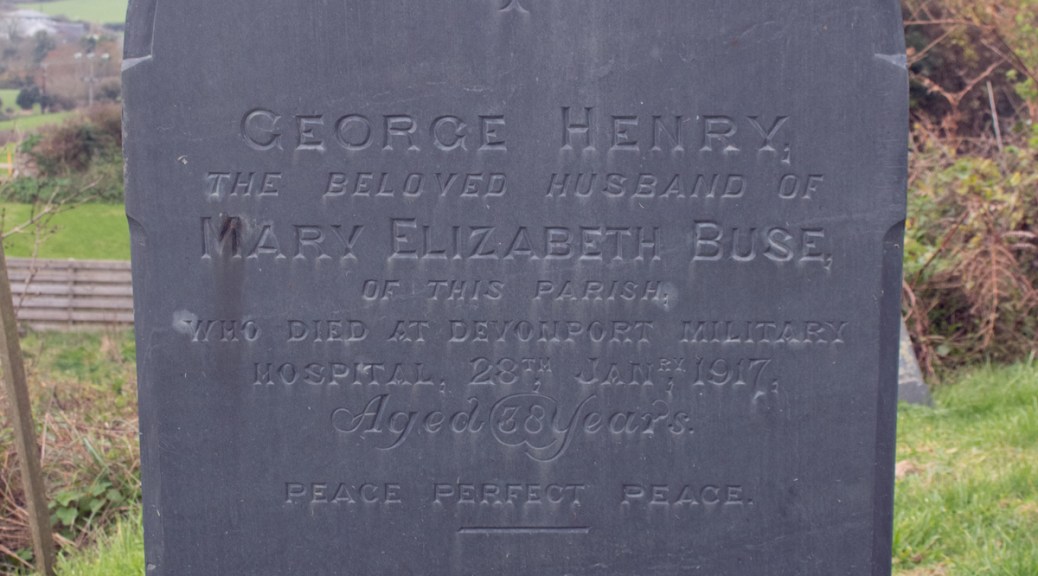
Private George Buse

Private George Buse

George Henry Buse was born in the Cornish village of St Minver in 1880. One of four children, his parents were Richard and Angelina. Richard was an agricultural labourer, but his son followed a different trade, finding employment as a stonemason.

In the summer of 1904, George married a woman called Mary. They went on to have a daughter, Olive, who was born in 1906, and set up home in Splatt, on the outskirts of the village.

When war came to Europe in the summer of 1914, George stepped up to play his part. He enlisted by the summer of 1916, and joined the 2nd Battalion of the Devonshire Regiment. Private Buse’s unit served on the Western Front, but it is unclear whether he fought overseas.

By the winter of 1916, George had fallen ill. He contracted pneumonia, and was admitted to the military hospital in Devonport, Devon. The condition was to prove too severe, however, and he passed away on 28th January 1917: he was 36 years of age.

George Henry Buse was brought back to Cornwall for burial. He was laid to rest in the peaceful graveyard of St Menefreda’s Church in St Minver.


Private Henry Preece

Private Henry Preece

The early life of Henry George Preece is a challenge to piece together.

The Commonwealth War Graves Commission give his father’s name as Edwin Preece, and suggest that the was the landlord of the George Hotel in Milverton.

The Army Register of Soldier’s Effects give the sole beneficiary of Henry’s estate as his sister Bessie.

The census record of 1911 appears to link the three members of the family, but give only a tenuous connection to Somerset. Edwin was a Coachman from Nunney, but the family – including Edwin’s wife Elizabeth, and two children, Henry and Bessie – were all living in Bayford, Hertfordshire, where the siblings had been born in 1900 and 1902 respectively.

It seems likely that the Preece family moved to Somerset not long after the census was taken, and this is potentially when Edwin took up his new role in Milverton.

War broke out in 1914, and Henry stepped up to play his part. He enlisted in the Devonshire Regiment, and was assigned to the 2nd Battalion. Full service details are lost to time, but Private Preece had joined up by April 1918.

Henry’s trail goes cold again at this point. He was admitted to a military hospital in Chatham, Kent, in the autumn1918, although the reason for this is unclear. He passed away there on 29th October: he was just 19 years of age.

The body of Henry George Preece was taken back to Somerset for burial. He was laid to rest in the graveyard of St Michael’s Church in Milverton.


Private Harry Gannett

Private Henry Gannett

Harry Udall Gannett was born in the autumn of 1900, the second of four children to Charles and Clara. Charles was an agricultural labourer from Somerset, and it was here that the family were raised.

The 1901 census found Clara living with her brothers and two children in the village of Fivehead, while Charles was living and working just a few miles away in North Curry.

Charles passed away in 1906, aged just 48, leaving his widow to raise their now four children. The next census, in 1911, found Harry living in North Curry with his aunt and uncle, Francis and Emily Lee. Francis was noted as being a thatcher and hurdle maker. Harry’s mother was living elsewhere in the village with his three siblings. She was working as a farm labourer, while her brother, Russell, was also living there, helping support the family through his work, also as a hurdle maker.

Harry was keen to play his part when war broke out. His age initially prevented him from doing so, but he had enlisted by the late summer of 1918, joining the 53rd (Young Soldier) Battalion of the Devonshire Regiment. His service records are no longer available, but his unit was based at Rollestone Camp in Wiltshire, and this is likely where he was sent to be trained.

Little further information is available for Private Gannett. He contracted influenza while billeted in the cramped army barracks and died on 13th January 1919. He was just 18 years of age.

Harry Udall Gannett was brought back to Somerset for burial. He was laid to rest in the peaceful graveyard of St Peter & St Paul’s Church in North Curry. His headstone reads “our dear nephew”, and it is likely that is was paid for by Francis and Emily Lee, the relatives who had taken him in after his father’s death.