Tag Archives: family

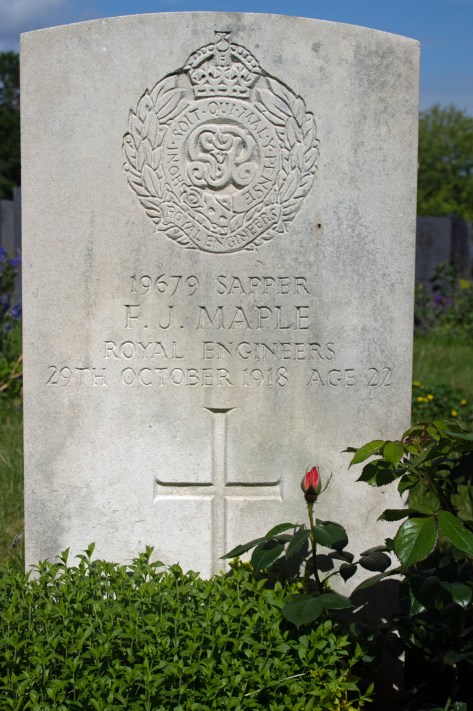
Sapper Frederick Maple

Sapper Frederick Maple

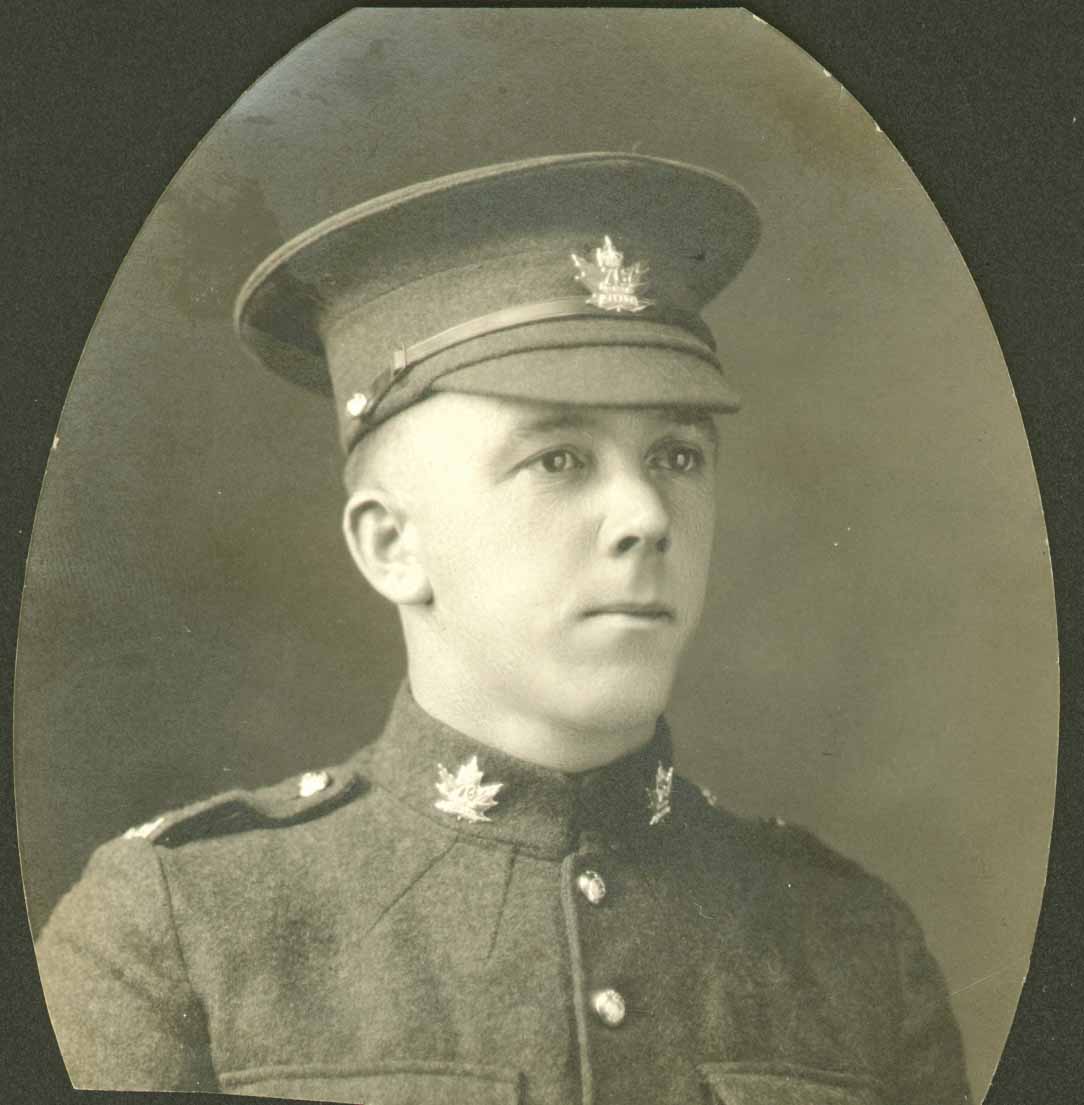
Frederick John Maple was born in 1896, the middle of three children to Royal Engineers Company Serjeant Major Frederick Maple and his wife Amelia. Frederick Jr was born in Brompton, Gillingham, Kent, but it’s interesting to note that the 1901 census gives Amelia’s place of birth as Canada, while Frederick Sr’s is not known.

Frederick Jr lost his father in 1904, and his mother five years later. At the age of just 13, he was an orphan, and this may have spurred him into finding a career. The next census – taken in 1911 – lists him as a Bugler in the Royal Engineers, barracked within walking distance of where he had grown up.

By the time war had broken out – and having come of age – the now Private Maple was assigned to the 15th Field Company. The regiment fought in a number of the key skirmishes of the war, including the Battles of Neuve Chapelle, the Somme, Loos, Ypres and Arras. Frederick went to France in March 1915, although it is not possible to confirm how or if he was involved in these battles. He was awarded the Victory and British Medals and the 1915 Star for his efforts.

Sadly, the next available document for Frederick is the Army Register of Soldiers’ Effects. This confirms that he was admitted to the 2nd London General Hospital in Chelsea, and that he passed away on 29th October 1918. Again, there is no evidence of the cause of his passing, so he may have fallen ill, or been wounded. Either way, Private Maple was just 22 years old when he died.

Frederick John Maple was laid to rest in the Grange Road Cemetery in Gillingham. When this was subsequently turned into a public park, he was commemorated in the neighbouring Woodlands Cemetery.


Private James Hayden

Private James Hayden

James Hope Hayden was born in Shorncliffe Military Camp in 1875, the son of Mary Anne Hayden. The youngest of five children, James’ father appears to have died when he was just a toddler; there are no records for him, and Mary Anne – who preferred to caller herself Annie – was listed a a widow by the time of the 1881 census.

The document confirms that Annie was lodging in a house near the Naval Dockyard in Chatham, working as a seamstress. She was living there with her landlady Anne Roberts and her five children, John, William, Annie, Charles and James, who seems to have gone by the name of Mathew.

By the time of the nest census, Annie had moved and was lodging in another house in the same road. She was still employed as a seamstress, and was sharing the rooms with her two youngest children and her brother, William.

The 1901 census finds Annie living in an adjacent road to her previous houses. Head of the household this time, she was working as a laundress. Her brother William was also living there – he was listed as an army pensioner. Mathew is the only one of her children still living with her; he had, by this time, found employment as a labourer in the dockyard.

Moving forward another ten years, and the family have moved one street over. Annie, at 69 years old, remained the head of the household, while Mathew is living there with his wife and three children.

Mathew’s wife is listed as Florence, but there is no record of their wedding, other than the census document which confirms they have been marred for ten years. Mathew is listed as an ex-soldier although again, there is no longer any documentation to confirm this.

From this point, Mathew’s/James’ life goes a bit hazy. The next available record is his army pension document. This confirms that he was a Private in the Royal Marine Light Infantry, under the name James Hope Hayden. By this time, he and Florence had had seven children, although it seems to suggest that they were not actually married.

Sadly, it also confirms that Private Hayden had passed away on 1st May 1917, having been suffering from pneumonia, contracted whilst on active service. He was 42 years old.

Mathew was laid to rest in the Grange Road Cemetery in Gillingham, Kent, under the name James. The cemetery has since been turned into a public park, and he is commemorated in the nearby Woodlands Cemetery.


Serjeant Albert Romain

Serjeant Albert Romain

Albert William Romain was born in Gillingham, Kent, at the start of 1888, the middle of three children to Henry and Florence. Henry was a Sergeant in the Royal Engineers and is seemed inevitable that his son would follow suit.

Henry died in 1896, and was buried in the Grange Road Cemetery, Gillingham (now a public park). The 1901 census recorded Albert as a pupil at the Duke of York’s Royal Military Asylum in Chelsea. This was, in fact, a school for the children of soldiers, and it is likely that Albert was sent there to be educated when his father died.

The Royal Engineers obviously proved too great a lure for the young Albert. While full details of his service are not available, he had definitely enlisted early on, and was listed as a Lance Corporal in the Tempe barracks in Bloemfontein, South Africa in the 1911 census.

When war broke out, he was called back to Europe, as was on the Western Front by November 1914. Little further information on Albert is available – during the conflict he was assigned to D Company of the Royal Engineers, but the end of the war, he had become a Sergeant in the 1st Reserve Battalion.

In November 1918, back on UK soil, he was admitted to the Fort Pitt Military Hospital in Chatham, Kent. His condition is unclear, but sadly it was to be one to which he would succumb. Sergeant Romain died on 8th November 1918; he was just 30 years old.

Albert William Romain was laid to rest with his father in the Grange Road Cemetery. He is commemorated in the Woodlands Cemetery in his home town of Gillingham, Kent.


Private William Ridley

Private William Ridley

William Frederick Ridley was born on 7th April 1887 in the New Brompton area of Chatham/Gillingham, Kent, one of eight children to John and Elizabeth Ridley. John was an engine fitter in the nearby naval dockyard and, as the key employer in the area, William followed in his father’s footsteps.

Sadly, John died in 1904, and this seems to have been what spurred his son on to a better life. In 1907 William emigrated to Canada, settling in the town of Wentworth, on the banks of Lake Ontario.

It was in Ontario that William met his future wife. Edith Wass was the daughter of a local labourer; the young couple married on 5th June 1909, and went on to have two children, John, born in 1910, and Wilfred, who was born five years later.

During this time, William was putting his engineering skills to the test; his marriage banns confirm he was a machinist. While there is nothing to confirm any specific trade, given his proximity to the coast, dockyard employment seems probable.

On the other side of the Atlantic, war was breaking out; keen to do his part for King and Country, William enlisted in the Canadian Expeditionary Force on 28th July 1915. Initially enlisting in the 76th Overseas Battalion of the Canadian Infantry, he was shipped to England a year later and transferred across to the 4th Battalion.

Once on the Western Front, Private Ridley was thrown right into the thick of things. His battalion fought at the Battle of Flers-Courcelette – part of the Battle of the Somme – and it was here, on 18th September 1916, that he was wounded.

William received shrapnel wounds to his head, hand and right leg. Initially treated on site, he was quickly evacuated back to England, and admitted to the 2nd London General Hospital in Chelsea. Sadly, however, his wounds appeared to have been too severe; Private Ridley passed away from them on 30th November 1916, aged just 29 years old.

With his widow and children still in Canada, William’s body was taken back to Kent. He lies at rest in the Woodlands Cemetery in Gillingham, close to where his mother was still living.


Larger memorial image loading...
Private William Ridley
(from findagrave.com)

Gunner William Morgan

Gunner William Morgan

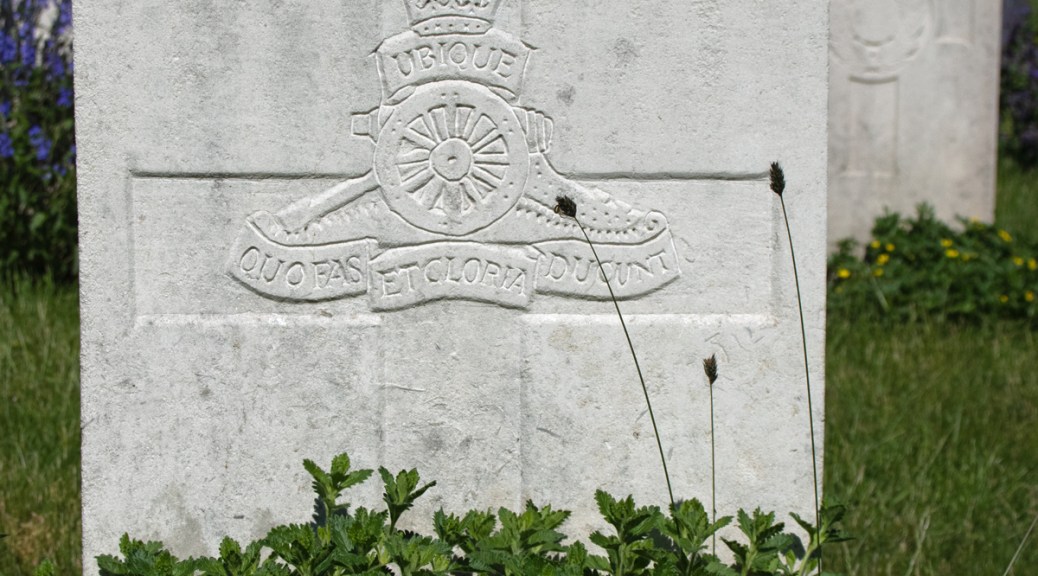
William Francis Morgan was born on 22nd January 1884 in Bengal, India. The youngest of three children, he was the son of James Morgan and his wife Mary. Both came from Ireland, marrying in 1876. They moved to London, before James was posted to India as part of his role in the Royal Horse Artillery.

Sadly James died when William was just a toddler; this prompted Mary to move the family back to England. She married again in 1887, to Edward Curling, who was a carpenter in the Royal Artillery, and the family settled on the Isle of Grain in Kent, living in the fort where Edward worked.

Surrounded by those in military service and with an army heritage himself, is it no surprise that William felt drawn to the life. In September 1898 he enlisted in the Royal Garrison Artillery. Though not yet fifteen years old, he stood 5ft 11ins (1.69m) tall and weighed in at 101lbs (46kg). He had a fresh complexion, grey eyes and light brown hair and four distinctive marks were noted – three scars on his head and one on his right knee.

Trumpeter Morgan certainly got to see a lot of the world during his time in the army. After a period on home soil, he was sent to Egypt on Christmas Eve 1901, staying there for just over a year. He moved on to India, returning to England five years later, by which time he had achieved the rank of Gunner.

War was imminent, and in September 1914 he was sent to France as part of the British Expeditionary Force. Barring a short period at home, Gunner Morgan remained on the Western Front for the remainder of the war, finally returning to the UK in January 1919.

William’s time in the army was one of two halves. He had several bouts of illness during his service, coming down with phimosis in 1901, scarlet fever and gonorrhoea in 1902, a fractured clavicle in 1903, pneumonia in 1904, rheumatism in 1906, ague in 1908, pleurisy in 1909, and had to return from France to England for an operation to remove a carbuncle between his shoulder blades in the summer of 1915.

Gunner Morgan was also pulled up for his conduct a few times too. He was punished for neglect of duty in August 1908, disobeyed orders in May 1909, was pulled up for being improperly dressed while in Portsmouth’s Highbury Arms Pub in November 1909 and went AWOL for ten hours on 31st July 1913.

There were positives to William’s service too, however. He was awarded the British and Victory Medals as well as the 1914 Star during the First World War. He was mentioned in dispatches and received the Military Medal in 1917 an the Long Service and Good Conduct Medal two years later.

Sadly, though, after Gunner Morgan’s positive and lengthy military service, his time out of the army was to be brief. Returning to England on 13th January 1919, he contracted influenza and pneumonia and succumbed to the lung conditions within weeks. He passed away on 27th February 1919, at the age of just 35 years of age.

William Francis Morgan was laid to rest in the Woodlands Cemetery, Gillingham, Kent, just minutes’ walk from where his mother now lived.


Private William Bartin

Private William Bartin

William Bartin was born in the Somerset village of Montacute in the summer of 1893 and was the oldest of four children to Georgina Bartin. Georgina married George Gaylard in 1895 and, while the 1901 and 1911 censuses record William Gaylard as George’s son, later documentation suggests that George may not have been his father. George was a carter and labourer on a farm, and when he left school, William followed suit.

By the time of the 1911 census, most of the family were working – William was listed as a groom and gardener, while his mother and the oldest of his three sisters were employed as seamstresses.

Little specific information remains of William’s military career. He enlisted as a Private in the Somerset Light Infantry under his mother’s maiden name (and his birth name), Bartin. A local newspaper after he passed provides some information:

[He] enlisted in 1914, was badly wounded and for seven months was treated in the Bethnal Green Hospital, and then sent to the Southern General Hospital, Plymouth, where for 17 months he was treated for lung trouble. He was discharged in 1917 and has been practically ever since under treatment by the Ministry of Pensions. Much sympathy is felt with the bereaved widow and child.

Western Chronicle: Friday 19th November 1920

There are no details of William’s wife or child, albeit that his pension record refuses payment to them as he married after being discharged from the army.

There are similarly no details about the cause of his death, although, based on the newspaper report, it seems likely to have resulted from the lung condition that dogged the last few years of his life.

Private William Bartin died on 17th November 1920, at the age of 27 years old. He was laid to rest in the graveyard of St Catherine’s Church in his home village of Montacute.


George Gaylard had passed away in July 1919, at the age of 47. The Western Chronicle noted that:

There mourners were as follows: Mrs G Gaylard (widow), Mr WC Bartin (step-son), Misses Lucy, Florence and Edith Gaylard (daughters)…

Western Chronicle: Friday 25th July 1919

It was tragic for Georgina to lose both her husband and son within 18 months; it is also sad to note that George’s father – also called George – was still alive, and outlived both his son and step-son.


Private Charles Leach

Private Charles Leach

Charles George Leach was born in 25th July 1872 and was the second of eight children. His parent were Gloucestershire-born painter William Leach and his laundress wife Ellen who raised the family in Greenwich, South London. William had married previously, but his first wife, Emma, had died in 1868, leaving him a widow at 40, with five children to raise. He had married Ellen shortly after, and the family grew in size.

There is little information on Charles’ young life. It seems like the family had moved down to Sussex at some point; this is where Charles met his future wife, fisherman’s daughter Ellen. By the time William died in 1909, the family had again relocated, this time moving back to Gloucestershire.

The 1911 census gives Charles and Ellen visiting Charles’ sister Alice and her husband. The couple had two children by this point, as did Alice. Charles’ mother Ellen was also living there; a family of nine living in a house in the town of Cinderford.

Details of Charles’ military life as somewhat sketchy. He did enlist, joining the Royal Army Service Corps on 6th December 1915, and certainly served in France, gaining the Victory and British Medals and the 1915 Star. However the records suggest that Private Leach was discharged from the army on medical grounds in the spring of 1916, and the refusal of a war gratuity – paid once soldiers had attained six months’ service – seems to back this up.

There is little more information available on Charles Leach. He and Ellen went on to have four children in all, and moved back to Sussex, close to her family. He passed away on 4th March 1919, at the age of 46, but no cause of death is available.

Charles George Leach lies at rest in the Broadwater Cemetery, in Worthing, West Sussex.


Serjeant Major Percy Hawkins

Staff Serjeant Major Percy Hawkins

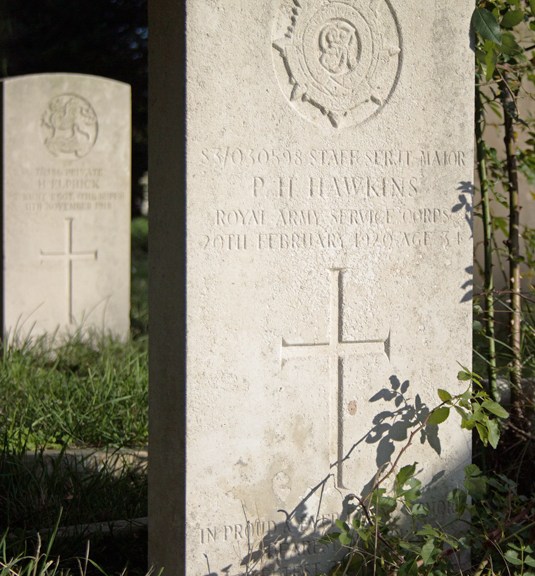
Percy Harry Hawkins was born in Waltham Green, London, in 1886. One of five children, all boys, his parents were Frederick and Elizabeth Hawkins. Frederick initially worked as a brewer’s collector – collecting rent from tenant pub managers on behalf of the brewery – before working as a tobacconist.

In July 1908, Percy married Gladys Parnell. Sadly, tragedy was to strike and, over the next couple of years both Elizabeth and Frederick passed away in 1909 and 1910 respectively.

By the time of the following year’s census, Percy and Gladys were boarding with a dispensing doctor (or GP), and his wife. Percy listed his occupation as a ‘traveller’, was probably employed as some kind of salesman.

Tragedy was to strike Percy again. Months after the couple had their first child in July 1911, Gladys also passed away, leaving him as a widower and single parent at just 26 years old.

From his later military documentation, it seems that Percy married again in August 1915, this time to a woman called Mildred, and, by September 1919, he had gone on to have three children in total; one boy and two girls.

When war broke out, Percy was quick to enlist. He joined up in Birmingham on 10th August 1914, and gave his profession as a commercial traveller. His records show that he was 28 years and 120 days old, stood 5ft 6ins (1.69m) tall and weighed 131lbs (59.5kg).

After initially joining the Royal Warwickshire Regiment, Private Hawkins was transferred to the Royal Army Service Corps, and was assigned to one of the supply companies.

Over the four years of the war, Percy served on home soil, and was promoted a number of times, rising from Private to Lance Corporal, Staff Sergeant to Quartermaster Staff Sergeant. In September 1917, he was again promoted, this time to Staff Sergeant Major, a position he held for the remainder of the conflict, and on into 1919, when he volunteered for an extra year’s service, rather than being demobbed.

In February 1920, Staff Serjeant Major Hawkins fell ill; he was admitted to the military hospital that had been set up in Brighton Pavilion, Sussex. The diagnosis was heart failure, and, sadly, it was to this that he was to succumb. He passed away on 20th February 1920, aged just 34 years old.

Percy’s family was, by this time, living down the coast in Worthing; his body was brought there for burial and he lies at rest in the Broadwater Cemetery in the town.


Serjeant George Carpenter

Serjeant George Carpenter

George Palmer Carpenter was born in Worthing, West Sussex, in 1881, one of fourteen children to James and Elizabeth Carpenter. James ran the Steyne Hotel on the seafront, and sent his boys off to the Lucton Boarding School in Henfield for their education.

A regimented life seems to have suited George. When he left school, he enlisted in army, joining the Royal Engineers as a Sapper. The 1901 census found him billeted at the Elphinstone Barracks in Portsmouth.

Sadly, there is little further documentation on the life of Sapper Carpenter. He served through to and during the Great War, attaining the rank of Serjeant. He was sent to France in May 1915, though there is little to confirm his role there, or how long he stayed.

Serjeant Carpenter was subsequently attached to G Depot Company of the Royal Engineers, which received men returned from Expeditionary Force and also men enlisted for Tunnelling Companies, Special Companies and other specialist units. By this time – presumably later on in the conflict – he was based back in England, at the regiment’s barracks in Chatham, Kent.

When the war came to a close, George continued with his army career. With conflict in Europe coming end, he was shipped to Singapore in 1917, where he served through to 1920. A Sussex newspaper picked up his story from there:

Much sympathy will be extended to Mrs Carpenter and her family, of the Steyne Hotel, consequent upon the death of Sergeant George Carpenter, of the Royal Engineers, another of our Worthing boys whose life has been laid down in his country’s service. He arrived home in a bad state of health on the 25th of February last from Singapore, where he had been on duty for three years. Suffering from gastric influenza, it was found necessary that he should undergo an operation, which was carried out at midnight on Saturday. But he sank from weakness, and died at half-past eight on Sunday morning. This is the second son of whom Mrs Carpenter has been bereaved within a year, and there is pathos in the words addressed to us by her: “I have again the sorrowful task of sending the news of the death of one of my sons this morning.

Worthing Gazette: Wednesday 24th March 1920

George Palmer Carpenter was 39 years old. He was laid to rest in the Broadwater Cemetery of his home town, Worthing, in West Sussex.


The other brother referred to in the report was George’s younger brother Norman.

He had emigrated to Canada in 1906, but returned to Europe as part of the Canadian Expeditionary Force when war broke out. Wounded in battle in May 1917, he returned to the UK for treatment and recuperation, and remained on home soil for the rest of the war.

In the spring of 1919, he was admitted to hospital with pleurisy and anaemia, and seems that he never fully recovered, succumbing to the conditions in August of that year. He was just 32 years old.


Chief Yeoman of Signals Thomas Funnell

Chief Yeoman of Signals Thomas Funnell

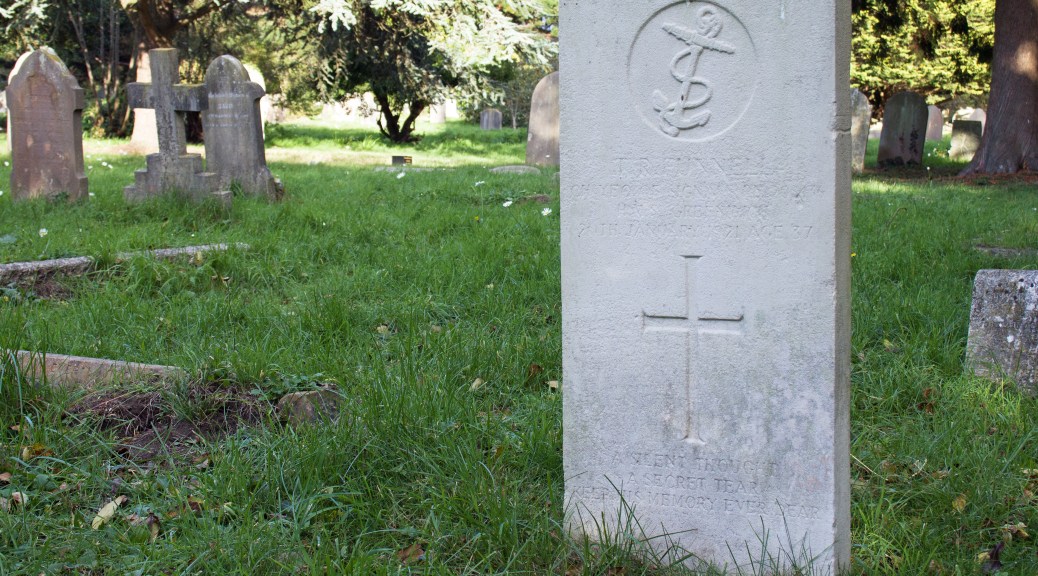
Thomas Richard Funnell was born on 7th May 1883 and was the second of five children. His father John was a cab driver, his mother Jane a laundress, and the family lived in Worthing, West Sussex. The small terraced house was close to both the central station and the one serving West Worthing, which would have given John plenty of opportunity for customers.

Thomas had a definite sense of adventure and helping his dad after he finished school was never going to be enough. He enlisted in the Royal Navy and, after an initial six months at the rank of Boy, he came of age, and began his training as a signalman.

Over the twelve years of his service, Thomas served on thirteen vessels, including the shore-based training ships. He rose through the signal ranks, eventually becoming Yeoman of Signals.

He ended his engagement in May 1913 although, with war on the horizon, this was extended to the completion of hostilities. His naval service continued through the war, and he rose to the rank of Chief Yeoman of Signals in August 1915, while aboard HMS Dido.

Away from his life at sea, Thomas met and married Frances McGregor, the daughter of a coastguard from Hampshire. They went on to have two children: Gurtrude was born in 1915, Nora in 1921. While her husband was at sea, Frances set up home in Portsmouth, where she raised the family.

When the war came to a close, Thomas was moved to shore-based vessels where, presumably, he used his years of experience to help train and develop others. In September 1920, he was assigned to HMS Greenwich. Sadly, his time there was short, on 20th January 1921, Thomas collapsed. Admitted to the Haslar Hospital in Portsmouth with a cerebral abscess he passed away. He was 37 years of age.

Rather than being buried close to his widow and family, Thomas’ body was brought back to his home town of Worthing for burial. He lies at ret in the Broadwater Cemetery to the north of the town centre.