Henry Thomas Preece was born in the summer of 1884, one of seven children to agricultural labourer Tom Preece and his wife, Sarah. Thomas had been born in the Somerset village of Nunney, and it was here that he raised his family.
When Henry left school, he chose not to follow in his father’s agricultural footsteps. By the time of the 1911 census, he was recorded as a baker and, as such, would have been at the heart of village life in Nunney.
Henry married local woman Ellen Stone in 1909, who was a dressmaker with her own account. The couple would go on to have four children between 1909 and 1916.
With war looming, Henry felt the need to play his part. He joined the King’s Royal Rifle Corps in January 1916 and, after training, was sent to France a couple of months later.
He was wounded on July 25th, when out with a wiring party erecting barbed wire obstacles. He received a gun-shot wound in the abdomen, which also injured the spinal cord and his back. He was first taken to the South African Hospital at the base, and after being there for several days he was removed to England and take to the Netley Hospital where he died…
Somerset Standard: Friday 8th September 1916
Lance Corporal Preece died on 3rd September 1916, at the age of 32 years old. His body was brought back to Nunney, where he was laid to rest in the family grave at All Saints’ Church.
Lance Corporal Henry Preece (from britishnewspaperarchive.com)
Henry Teahen (or Teahan) was born in around 1898 in Castlegregory, County Kerry, Ireland. One of twelve children – eight of whom survived infancy – his parents were John and Catherine Teahan.
John was a wayman (or road surveyor), who was born in Kerry. Catherine was born in Wandsworth and it was in London that the couple met and married. By the time Henry was born, the family had moved back to Ireland, although Catherine had made the journey back to England in the early 1900s, after John passed away.
The 1911 census found the family living in Forest Gate in the east of the capital; Henry’s oldest brother, Joseph, was head of the household and, at 24, was working as a police constable. Schoolboy Henry was there, as was his mother, two more of his brothers, one of his sisters and his niece and nephew.
War was imminent, though, and, within a week of hostilities breaking out, Henry – who had been working as a waiter – enlisted in the Royal Marine Light Infantry. Private Teahen’s service records show that he was 5ft 8ins (1.72m) tall, had a fair complexion, grey eyes and brown hair. They also give his date of birth as 22nd June 1896, although he may have adapted this, as he would have been underage at the point he joined up.
Over the next few years, he served on a number of ships, switching between the Plymouth and Chatham divisions of the regiment. Full details of his duties are not immediately apparent, although is seems that he was injured while on board HMS Valiant in February 1916 – six months before her involvement in the Battle of Jutland – receiving a contusion to his right knee.
By the closing months of the war, Private Teahen had transferred back to the Naval Dockyard in Chatham, Kent. It was while here, early in 1919, that he fell ill. Details of his condition are lost to time, but it is known that he succumbed to them, passing away on 1st March 1919; he was 21 years old when he died.
Henry Teahen was laid to rest in the Woodlands Cemetery in Gillingham, within walking distance of the dockyard at which he was based.
Henry’s older brother James, also fought in the First World War. Full details are not clear, but documents show that he enlisted in the 6th City of London Regiment (also known as the City of London Rifles).
James’ regiment fought in many of the fiercest battles on the Western Front, including Loos, Vimy, High Wood and Messines, but it was at Ypres in the late summer of 1917, that he was injured. He died of his wounds on 30th September, aged just 23 years old.
Private James Teahan was laid to rest at the Mendinghem Military Cemetery in Poperinghe, Belgium.
Henry Wate was born on 15th June 1897, the youngest of seven children (four of whom survived) to Henry and Norah Wate. Henry Sr was from the East End of London. He raised his family in a three-room tenement in White Horse Alley, just off Cowcross Street, next to the busy Farringdon Station.
By the time of the 1911 census, Henry Sr and Norah had been married for thirty years. The head of the household, Henry was working as a rad dealer, while Norah was a housewife. Of their children, William (the eldest) worked as a labourer for a bike dealer, Annie was a packer in a chocolate factory, Nellie was a waitress and Henry Jr was still at school, though only just. Henry’s niece Julia was also staying with them, and was employed as a fancy leather worker.
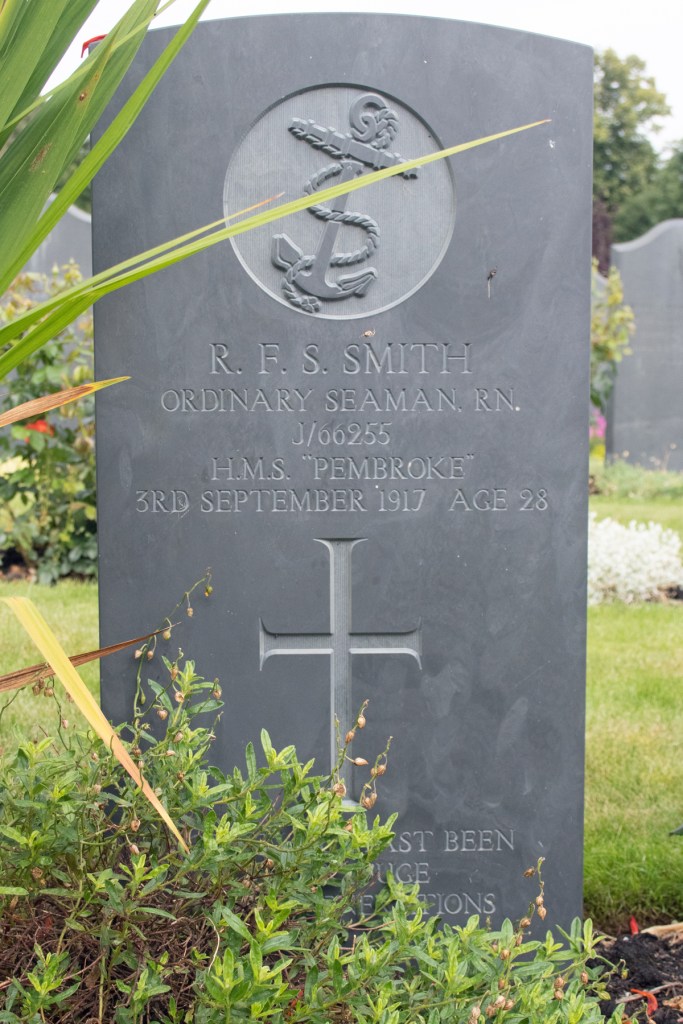
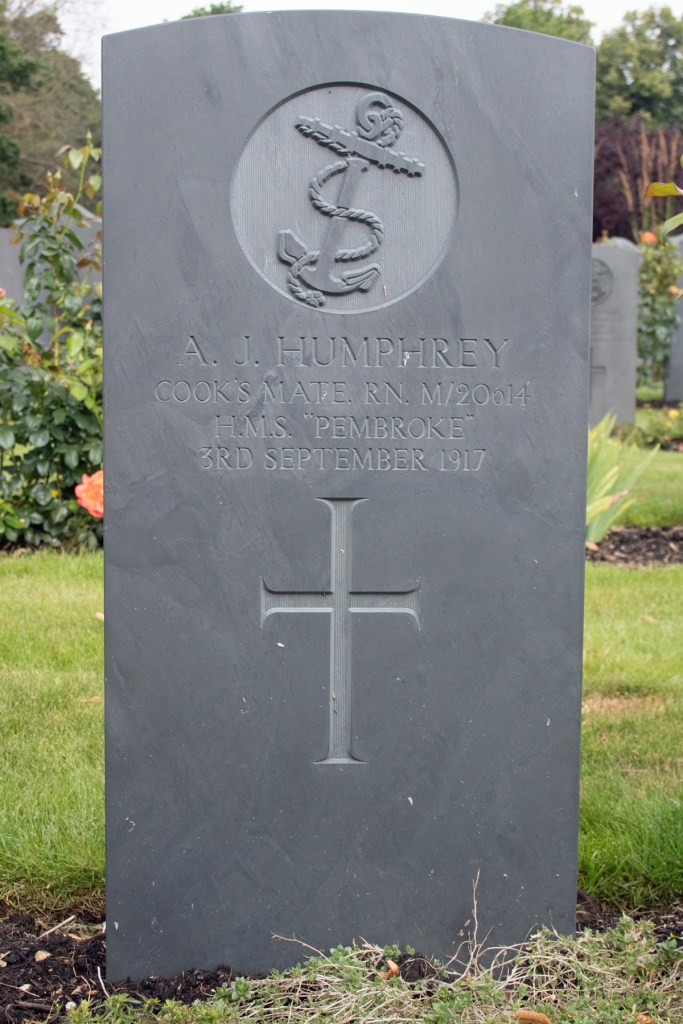
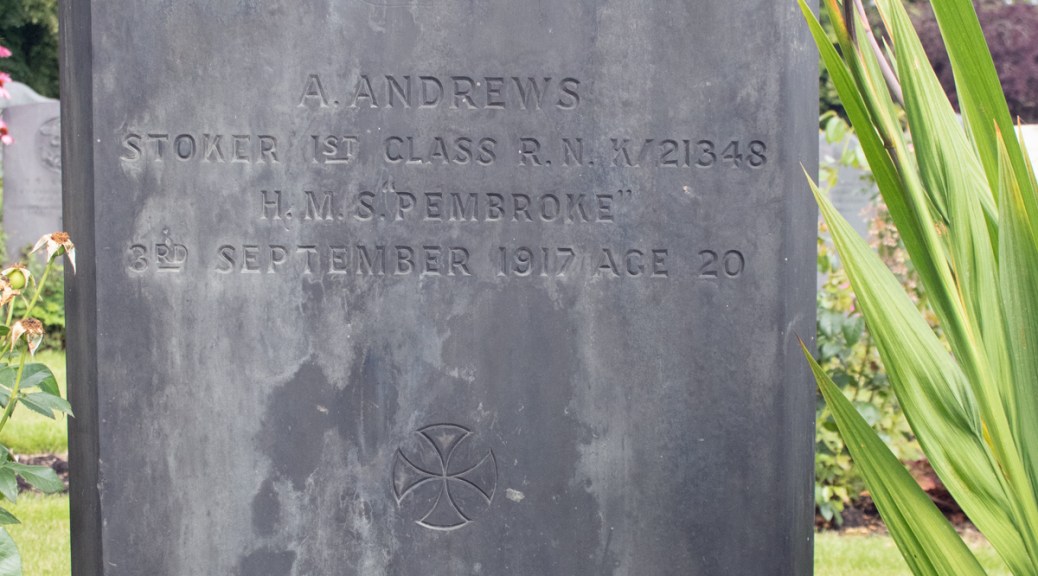
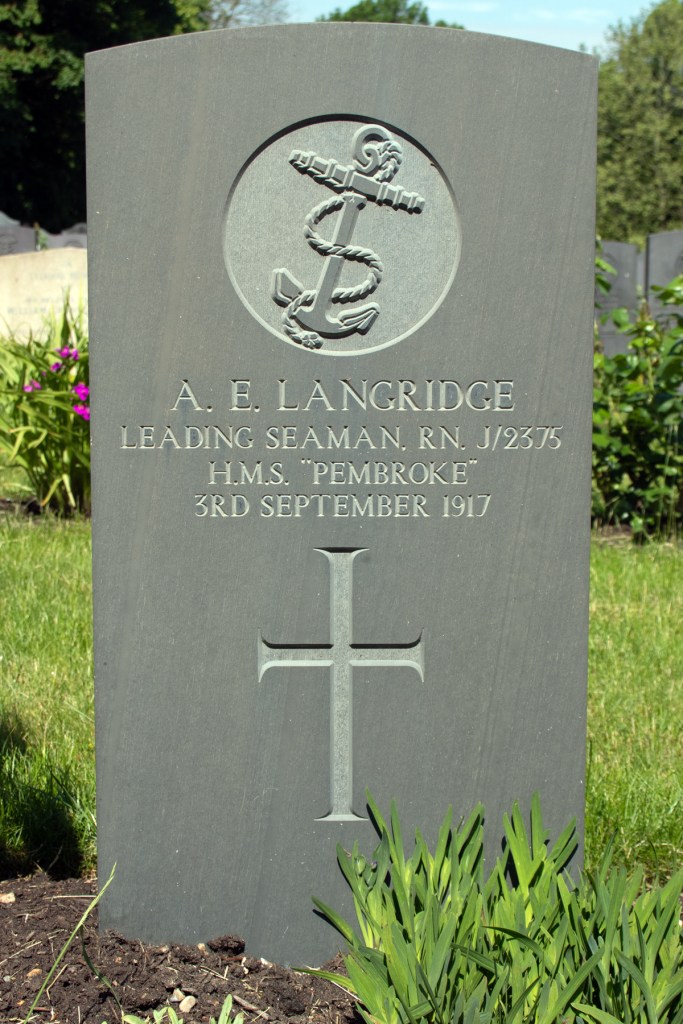
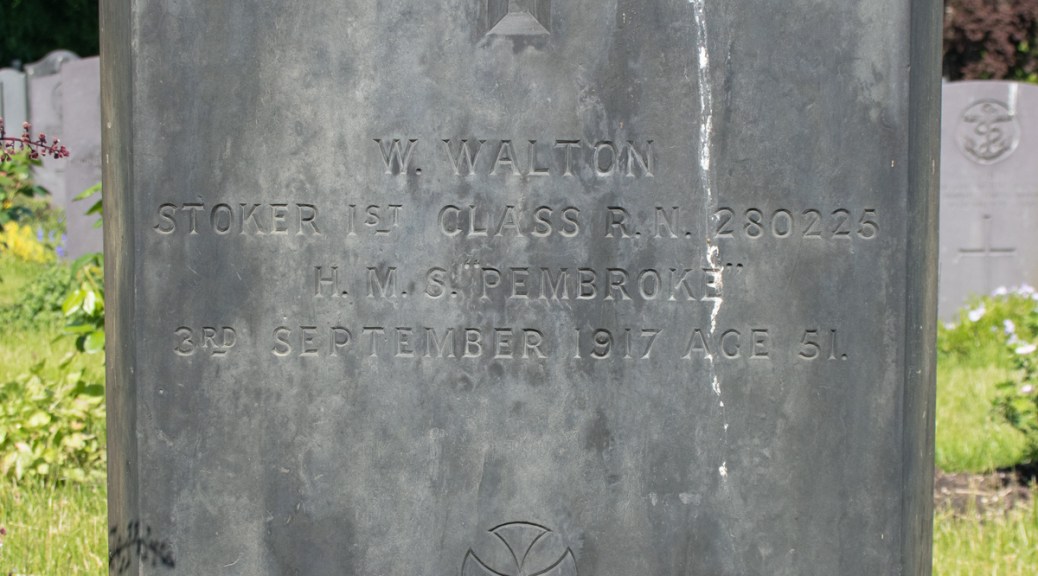
When war broke out, Henry Jr was working as a carman, carting goods to and from the nearby railway. When the call came, however, he joined up, enlisting in the Royal Navy as a Stoker 2nd Class. After a couple of months training at HMS Pembroke – the shore establishment at the Naval Dockyard in Chatham – he was assigned to HMS Wallington. This was a trawler, requisitioned by the Royal Navy to act as a boom/balloon vessel, presumably to tether barrage balloons.
In January 1917, Henry received a promotion to Stoker 1st Class. He returned to Chatham six months later. That summer, HMS Pembroke was becoming crowded and he was billeted at the Chatham Drill Hall.
On 3rd September 1917, the building took a direct hit from a German bomber. Stoker Wate, along with 97 others, was killed instantly. He was just 20 years old.
Henry Wate was laid to rest – along with the others who perished that night – in a mass funeral on 6th September 1917 at the nearby Woodlands Cemetery in Gillingham.
Full details of the night raid on Chatham Drill Hall can be found here.
Henry’s older brother William also served in the Great War. Twelve years older than his brother, William joined the Royal West Surrey Regiment in January 1915 as a Private. He was posted to France in July, and ended up serving on the Front Line for nearly four months.
In September 1915, Private Wate fell ill with heart palpitations. Shipped back to England for treatment, he was admitted to the Brook War Hospital in Greenwich, South London. The medical report confirmed that William had had rheumatic fever as a child, and had had an attack of ‘sycope’ (low blood pressure and a loss of consciousness) in 1911. The report concluded that he had heart disease and he was discharged from military service in 1916, as a result of this.
Little is known about Williams post-army life. All that can be confirmed is that he passed away from his heart condition on 23rd November 1918 aged 33. He was buried in St Mary’s Roman Catholic Cemetery in Kensal Green, North London.
George Trask was born on 22nd December 1875 and was the oldest of nine children. His parents were Absolam and Sarah Jane Trask, although it seems that the couple did not actually marry until after their first three children had been born. Absolam was an agricultural labourer and the family lived in his and Sarah’s home village of East Coker, near Yeovil in Somerset.
George was destined for a life of adventure; in May 1894, aged just 18, he enlisted in the army, joining the Royal Artillery as a Gunner. His medical examination sheds some light on his physique. He stood 5ft 7ins (1.70m) tall and weighed in at 144lbs (65.3kg). He had a fair complexion, hazel eyes and light brown hair.
Oddly, in the section on distinguishing marks – recorded to help identification should the soldier be killed – the medic only highlighted a ‘small mole midway between pubes and umbilicus’: it seems unlikely that this was the only distinguishing mark that could have been highlighted.
Gunner Trask’s initial service was spent in England. He served four-and-a-half years on the home front, before being shipped to Malta. After six months on the island, he was moved to Crete for a few months, before returning to Malta in September 1899.
George completed his initial term of seven years’ service, and elected to remain to complete a full twelve years of enlistment. As part of this, he was transferred to the Caribbean, spending two years stationed in Bermuda, before moving on to St Lucia for a further two years. By December 1905, Gunner Trask was back home in England, and it was on home soil that he remained.
Back in Somerset, George extended his term of service for another four years. Settled in his home village, he married Elizabeth Garrett on 27th December 1908; the couple would go on to have three children: Ethel (born in 1910), Lilian (1911) and George Jr (1916).
Gunner Trask’s military service continued apace. Reassigned to the Royal Garrison Artillery, he was posted in Portsmouth up until the outbreak of the war. He was awarded a third Good Conduct Medal in addition to the ones he had received in 1900 and 1904.
At this point, details of George’s military service become a little hazy. He achieved 21 years’ military service on 29th May 1915 and was awarded a further Good Conduct Medal. At this point, with the war raging, his period of duty was extended again, until the end of the conflict.
At some point during this time, he was assigned to the Royal Artillery’s School of Experimental Gunnery in Shoeburyness Essex. Sadly, there is nothing to confirm his exact role there, although, given that he was in his 40s by this point, it is likely that he acted as more of a mentor.
And it is here that the story comes to an end. Gunner Trask is noted as passing away in the Military Hospital in Shoeburyness on 31st October 1918, though there is nothing to confirm the cause of his death. He was 43 years of age.
George Trask’s body was brought back to Somerset for burial. Having travelled the world with the army, he was laid to rest in the graveyard of St Mary’s Church in his home village of East Chinnock.
George’s son George was to follow his father into military service.
Working as a press operator for a plastics company, he married Gwendoline Harper in Southend, Essex in April 1940. There is no record of whether he had enlisted at this point, but is seems likely that he had.
When the Second World War broke out, he joined the 4th Battalion of the Suffolk Regiment. After initially helping in the defence of England following the British Army’s evacuation from Dunkirk, late in 1941, he was sent first to Egypt, then to Singapore to help strengthen the garrison there.
Early the following year, the 4th and 5th Battalions fought in the defence of Singapore, before the island surrendered to the Japanese Army. At this point, Lance Corporal Trask found himself a prisoner of war.
The prisoners were put to work building the Burma railway, and suffered great hardship at the hands of their captors. Many succumbed to illness, and George was amongst them, dying from beriberi on 18th December 1943. He was just 27 years old.
George Reginald Trask was laid to rest in the Chungkai Cemetery in Thailand, 100km west of Bangkok.
Arthur William Langdon was born on 23rd December 1882, the son of Rose Langdon, from the Somerset village of Chiselborough. While Arthur’s father is lost to time, Rose married Frederick Hockey in 1886, and the couple went on to have three children – half-siblings to Arthur.
Arthur was destined for a life of adventure, and in 1902, at the age of 19, enlisted as a Rifleman in the King’s Royal Rifles, a career that was to last more than a decade.
On 13th April 1903, Arthur married Florence Beatrice Druce, who was also from Chiselborough. Noticeably absent from the marriage certificate was the name of the groom’s father; he was simply marked as ‘unknown’. The newlyweds would go on to have a son, also called Arthur, the following year.
Rifleman Langdon was soon destined for service overseas, however. After 18 months in South Africa, he returned to England for a year. He was sent to India for four years; it is likely that Florence went with him, or at least that Arthur returned home on leave during this time, as two further children – Henry and Reginald – were born in 1907 and the summer of 1910 respectively.
Arthur returned to England in February 1910, and remained on reserve home service – supplementing his income by working as a gardener – until the outbreak of the First World War. During this time he and Florence had two further children, Frederick, born in 1912, and Ivy, born just a month before war broke out.
With the start of the conflict, Rifleman Langdon was send to France as part of the British Expeditionary Force. After five months on the Western Front, he had a brief respite back in England, before being shipped back to France in May 1915, and on to Salonika in the Balkans that November.
Rifleman Langdon did not stay in Greece for long, however. Within a couple of months he was back in England and on 14th April 1916, he was discharged from the army on medical grounds. Sadly, details of the cause of his exit from the army are not detailed.
Arthur was not one to rest on his laurels, however, and continued work as a gardener and labourer. Military life wasn’t far away, though, and in June 1918, he enlisted again, this time joining the Royal Air Force as a Private.
Initially based at Long Sutton, Arthur moved to Edinburgh Castle in March 1919. Full details of his time there are lost, but he remained in Scotland until being demobbed at the end of April 1920.
Details of Arthur’s life back on civvy street are not available. All that can be confirmed is that he passed away on 28th February 1921, at the age of 38 years old. Arthur William Langdon was laid to rest in the graveyard of St Margaret’s Church in the Somerset village of Middle Chinnock, where his widow now lived.
Leonard David Patch was born on 22nd October 1892, the oldest of four children to David and Fanny Patch from Norton-sub-Hamdon in Somerset. David was a stone mason, but when his eldest son left school, he found work as a carpenter.
When war came to Europe, Leonard was one of the first from the village to volunteer. Given the small size of Norton-sub-Hamdon, it seems likely that he would have done so with friends; many of the Pals Battalions were formed like this.
Leonard joined the Somerset Light Infantry as a Private, and was assigned to the 7th Battalion. He was sent to Woking, Surrey, for training and it was while he was billeted there that he contracted measles. Moved to the Military Isolation Hospital in Aldershot, he developed pneumonia, and passed away from the lung condition on 25th February 1915. He was just 22 years of age, and had seen no military action.
Private Patch’s body was brought back to his home village, where he was laid to rest in the graveyard of St Mary’s Church, where he had been baptised two decades before.
Of Leonard’s brothers, two saw active service.
John Henry Patch, the second oldest of the siblings, served in the Royal Engineers, enlisting just ten months after his brother had died. He survived the war, married Linda Turner in Yeovil and went on to have a son, Norman. John passed away in February 1969, a few days after his 75th birthday.
Edward Lionel Patch – the third brother – served with the Devonshire Regiment. He too survived the war, marrying Honor Brown in 1923; they also had a son, called David. Edward passed away in Yeovil in 1966, aged 70 years old.
The youngest of the four brothers, Clarence William Patch, was born in 1899 and was lucky enough not to have seen military service. He married Emily Brown in 1924 and the couple had a daughter, Emmie. Sadly, she passed away as a babe-in-arms, and Emily was to follow soon after. In 1931, Clarence married again, this time to Emily Dyer; they went on to have a son, Douglas Leonard. Clarence passed away in 1945 at the age of just 46 years old.
Lawrence Allen Sweet was born on 28th May 1895, one of fourteen children to Thomas and Caroline Sweet. Thomas was a farm labourer from Somerset, and the family were raised in the village of Norton-sub-Hamdon, near Yeovil.
Lawrence found work on the farm – the 1911 census shows him living with his now-widowed mother, where he was employed as an ‘improver to poultry house and building’. Three of his older brothers were also living there, and all were employed in farm work.
War was coming to Europe, and Lawrence played his part. Full details of his military service no longer remain, but those that remain confirm that he enlisted in the Somerset Light Infantry in the spring of 1915, and was assigned as a Private to the 6th (Service) Battalion of the Somerset Light Infantry.
Sent to France on 21st May, Private Sweet saw action on the Western Front. His regiment was involved in the Battles of the Somme, Arras and Ypres and he earned the Victory and British Medals and the 1915 Star for his service.
Towards the end of 1917, Lawrence contracted pleurisy; invalided home, he was ultimately discharged from the army on medical grounds the following January.
At this point, Private Sweet’s trail goes cold. The next document confirms that he passed away on 15th December 1920, at the age of 25 years old. No cause of death is evident, but is seems likely to have been connected to his previous lung condition.
Lawrence Allen Sweet was laid to rest in the graveyard of St Mary’s Church in his home village of Norton-sub-Hamdon.
William Hann was born towards the end of 1871, the son of Harry Hann, who was a stonemason, and his wife Susan. Born in Stoke-under-Ham (now Stoke-sub-Hamdon), he was one of nine children, although sadly five of his siblings passed away at a young age.
Sadly, little of William’s early life remains documented. A newspaper article that reported on his passing, however, confirms that he served in the Royal Field Artillery, and was based in India for four years, before being shipped to South Africa to fight in the Boer War.
Back in Somerset in the early 1900s, he married a woman called Ellen, and the couple went on to have four children – Hilda, Herbert, Kate and Louisa.
At the outbreak of the [First World War], though under no obligation, [Gunner Hann] responded to the call of duty and was among the first to volunteer from Stoke. He was attached to the Indian Expeditionary Force and sent to France, and it is interesting to know that he saw some of the native soldiers whom he had bet while serving in India many years ago.
After serving in France for some time, he was transferred to Mesopotamia, and it was there that his health became impaired, which made him an easy victim of the disease which caused his death.
Western Chronicle: Friday 1st June 1917
Gunner Hann had contracted cellulitis in his right arm, which turned septic. He returned home on sick leave on 22nd May 1917, but died at home from blood poisoning just two days later. He was 48 years of age.
William Hann was laid to rest in the graveyard of St Mary’s Church, in his home village of Stoke-sub-Hamdon.
William Ernest Eglon (also known as Ernest William Eglon) was born in the Somerset village of Stoke-under-Ham (or Stoke-sub-Hamdon), in the spring of 1898. One of five children, his parents were stonemason Arthur Eglon and his glovemaker wife Sarah Elizabeth Eglon (who was better known as Bessie).
Unfortunately, little information on William’s early life remains documented. When war broke out, he was working at the Co-operative Bakery in the village. He was keen to do his bit, however, and enlisted in the Royal Army Service Corps as a Private not long after his eighteenth birthday.
Private Eglon was sent to serve in Essex, working as a baker in the Supply Section there. Within a couple of weeks of arriving, however, he was admitted to the Field Hospital in Chelmsford. He was suffering from an ear infection, and this turned out to be significant enough for him to be transferred to the Horton County of London War Hospital in Epsom.
William developed an abscess in the temporo sphenoidal region of his skull (in front of his right ear), which was operated on on the 27th May 1917. By this time meningitis had set in and, despite a second operation just over a week later, the conditions took hold.
Private Eglon passed away at 9:55am on 11th June 1917. He was just 19 years of age.
William Ernest Eglon’s body was brought back to Stoke-under-Ham for burial. He lies at rest in the family plot in the graveyard of St Mary’s Church in the village.
Cecil Frank Sims was born in the village of Manston, Dorset, towards the end of 1897. The youngest of six children, his parents were Henry and Ann Sims. Henry was a dairyman and, after his death in 1909, his wife continued in this line of the work.
Cecil was just 16 years old when war was declared, but he was keen to do his bit for King and Country as soon as he could. In May 1917, he joined the 2nd Battalion of the Royal Marine Light Infantry in Portsmouth.
Sadly, information on Private Sims dries up at this point. His service records no longer exist, and the only document that remains is his pension record. This confirms that he died on 11th February 1919 from ‘disease’, but there is no further information to be had. He was just 21 years of age.
Cecil Frank Sims was laid to rest in Yeovil Cemetery.
There is one other element that adds to Cecil’s family story. When researching the local newspapers for any reports on his funeral, an advert was posted just a few days before he passed:
Farmer’s son wanted: Willing to help on farm. Lodgings found close. Good place for willing chap, age 16 or 17 years preferred. SIMS, Poplars Farm, Yeovil Marsh.
Western Gazette: Friday 7th February 1919
It would seem that, if he was at home, Cecil’s health was weakening, and so extra support to manage the farm was being sought.