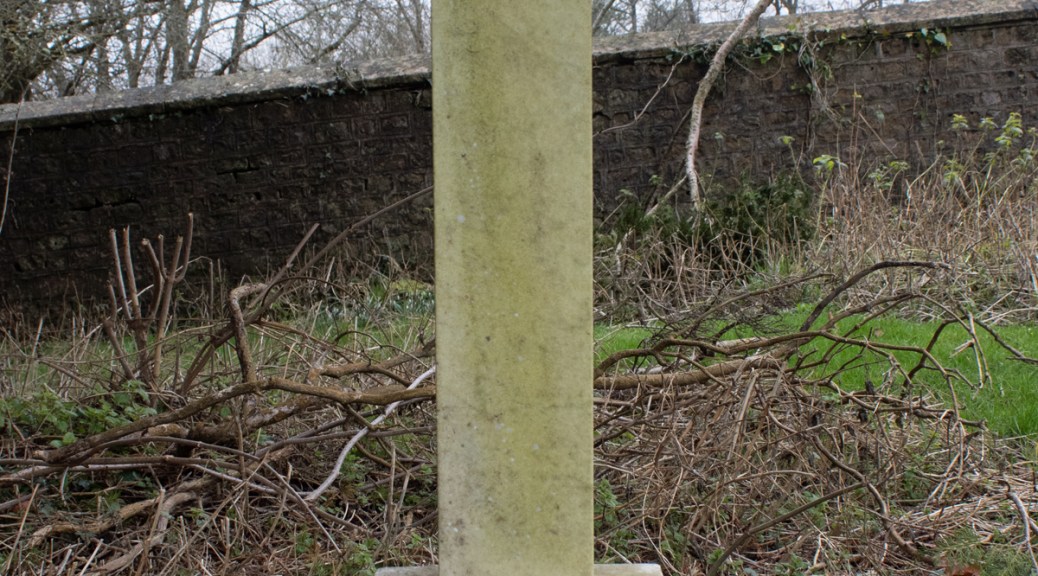
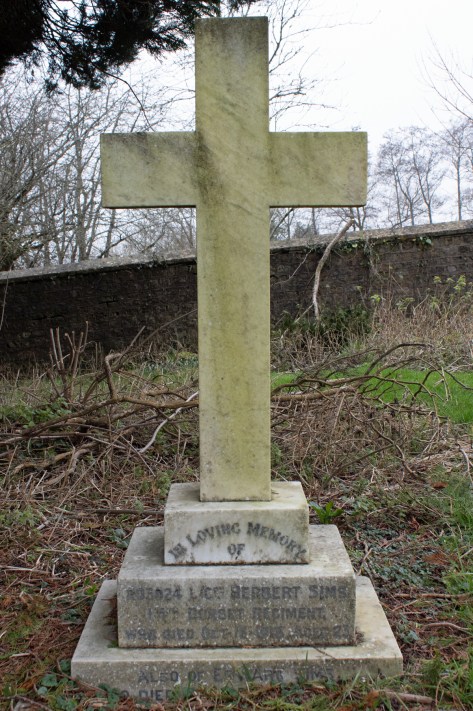
Herbert Rowland Sims was born in Warminster, Wiltshire, on 27th May 1895. One of nine children, he was the youngest son to Edward and Mary Sims. Edward was a railway signalman, and the family lived on Imber Road, to the north east of the town centre.
When Herbert finished his schooling, he found employment as a tailor’s apprentice. When war broke out, however, he was keen to play his part. His service records no longer exist, but a later newspaper report fills in some of the details.
The death took place on Wednesday in last week at the Tewkesbury Red Cross hospital of Lance-Cpl. Herbert Rowland Sims… [He] went to India on the outbreak of war with the Wilts Regiment, and subsequently volunteered for service in Mesopotamia, being transferred to the Dorsets. He contracted typhoid, and after being in hospital in Egypt he was invalided home. He was about to receive his discharge, but was again laid low by an attack of pneumonia which, after the illness contracted in Mesopotamia, proved fatal.
A memorial service was held in Tewkesbury Abbey on Saturday, the body being escorted by wounded comrades from the hospital. From the Abbey the coffin was taken to the railway station to be sent to Warminster, and on Monday the internment took place in the Minster churchyard with military honours.
[Wiltshire Times and Trowbridge Advertiser: Saturday 26th October 1918]
Herbert Rowland Sims was just 23 years of age when he died on 16th October 1918. He was laid to rest in St Denys’ Churchyard in his home town of Warminster.
Arthur Henry Shute was born on 13th February 1893 in Buckfastleigh, Devon. The younger of two children, he was the only son to Henry and Elizabeth Shute. Henry was a baker, and this trade soon took the family to Cirencester, Gloucestershire, where they had set up home by the time of the 1901 census.
Cirencester certainly suited the Shute family, and they remained at 107 Dyer Street for at least ten years. Arthur was set on learning the business, and the 1911 census found him as one of four apprentices to George Cox, a flour confectioner based in Hastings, Sussex.
New things were on the horizon, however, and Henry was evidently set on a better life for his family. On 10th May 1912, the family boarded the SS Victorian, destined for a fresh start in Canada. The Shutes eventually set up home at 118, 4 Avenue West in Calgary, Henry becoming a chef, and Arthur a baker.
Within a few years, the world was at war, and Arthur would step up to play his part. He enlisted on 13th September 1915, and wold be assigned to the Canadian Army Service Corps. His service records show that he was 6ft 0.5ins (1.84m) tall, with dark brown hair, brown eyes and a dark complexion. The document also highlighted three years’ voluntary service with the 5th Gloucestershire Regiment.
Private Shute’s unit arrived back in Britain on 6th November 1915. Sent to a base in Shorncliffe, Kent, Arthur was transferred to the 3rd Field Bakery, taking up a role suited to his skills. In March 1916, his unit was sent to France, and he remained there for the next five months.
Arthur’s time in the army seems to have been beset by illness. He was admitted to hospital on 12th August 1916, having come down with influenza, and he was medically evacuated to Britain to recuperate. Arthur would not be discharged for another six weeks, and only returned to the base in Shorncliffe on 3rd October.
From this point on, Private Shute remained on British soil, and he would remain in Shorncliffe for the remainder of the conflict and beyond the Armistice. In January 1919, he was admitted to the No. 14 Canadian General Hospital in Eastbourne, again suffering from influenza, but this time the condition would prove to be fatal. He passed away on 5th February 1919, a week short of his 26th birthday.
With his immediate family living thousands of miles away in Canada, Arthur Henry Shute’s body was taken back to the town of his birth for burial. He was laid to rest in the graveyard of Holy Trinity Church in Buckfastleigh.
Harry Holder was born in the village of Ludgvan, Cornwall, in the summer of 1885. The oldest of fourteen children, his parents were Harry and Grace Holder. Harry Sr was a market gardener, and his oldest son was to follow in his footsteps.
By the time of the 1911 census, the Holders had moved to Cheltenham, Gloucestershire. Settling in a seven-room house in Leckhampton Road, the household of eleven people had six wages coming in, split between market gardening for the men and floristry for the women.
The following year, Harry Sr took his family on the long journey to Australia for a new life. They found work on a farm near Perth, and Harry Jr was employed as an agricultural labourer when war broke out. When the call came, he stepped up to play his part and his service records suggest that he had spent four years in the territorial army back in Britain. Harry had been turned down for service because of the state of his teeth just a month before trying to enlist again. The second time, however, he was successful, and he joined the Australian Imperial Force on 13th September 1916.
Private Holder’s medical report confirmed the man he had become. At 31 years of age, he was 5ft 10.5ins (1.79m) tall, and weighed 140lbs (63.5kg). A Roman Catholic, he had brown hair, blue eyes and a fresh complexion.
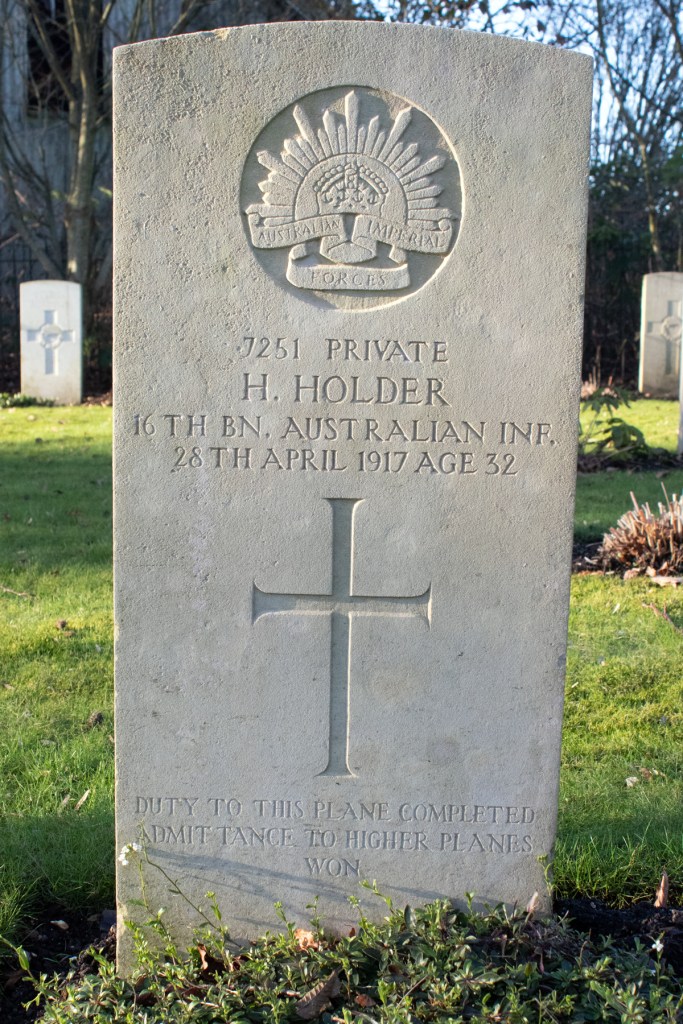
Assigned to the 16th Battalion of the Australian Infantry, Private Holder’s unit departed from Fremantle on 21st January 1917, travelling no board the ship Miltiades. Just under two months later, on 27th March, Harry arrived back in Britain, docking at Devonport, Devon, before moving with his battalion to a camp on the outskirts of Codford, Wiltshire.
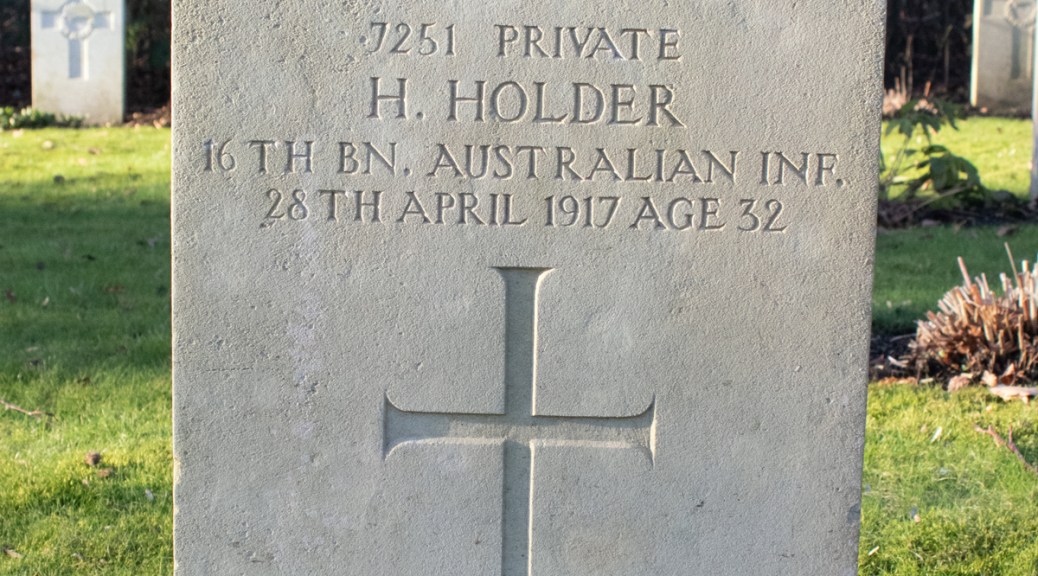
A significant proportion of the ANZAC troops became unwell within weeks of arriving at the camp, and Harry was not to avoid illness. On 27th April he was admitted to the barracks’ hospital with cerebrospinal meningitis, but the treatment was to prove too little, too late. Private Holder died on 28th April 1917: he was 31 years of age.
Harry Holder was laid to rest in a new extension to St Mary’s Churchyard in Codford, close to the base where he had breathed his last.
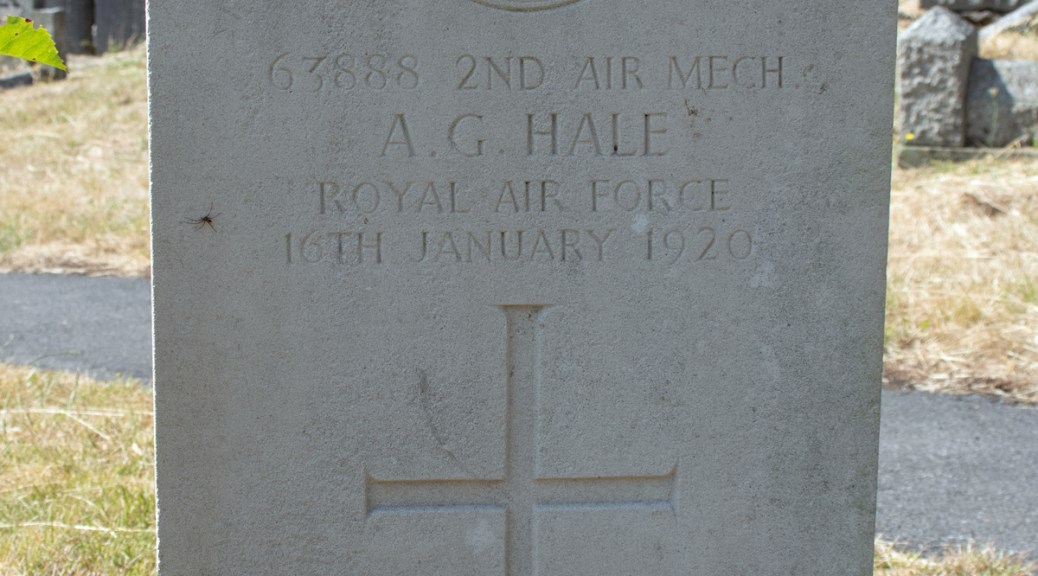
Alfred George Hale was born in Lechlade, Gloucestershire, in the spring of 1891. The youngest of four children his parents were George and Martha. George died when Alfred was just a babe-in-arms, and by the time of that year’s census, Martha was looking after her children alone.
The next census, taken in the spring of 1901, found Martha and the family living in a house on Oak Street in Lechlade. She was taking in laundry to earn a little money, while Alfred’s older brothers, George Jr and James, were employed as house boys. This meant there were three wages coming into the Hale household, but it would still have been a daily struggle for the family.
Tragedy stuck again in 1904 when James also died. Details are unclear, but it seems that he passed away in Headington, Oxfordshire, and was laid to rest in his home town. He was just 16 years of age.
By the time of the 1911 census, Alfred was the only one of Martha’s children to still be living at home. Home was the same four-roomed house on Oak Street, Lechlade. Martha was not noted as having any employment, but her son was working as a journeyman tailor.
On 10th November 1916, Alfred married Elizabeth Smith in Highworth, Wiltshire. There is tantalisingly little information about her, although it seems likely that they met during his travels with work. The couple would go on to have a child, daughter Sylvia, the following October.
1917 proved a year of upheaval for the Hale family. Six months before Sylvia’s birth, Alfred’s sister, Martha Jr, passed away. She had been a patient in the Berrywood Asylum in Northamptonshire, for a while: although the exact dates are unclear, she is recorded as a visitor to the Green family in Reading, Berkshire, in 1911, so her admission would have been after this.
Alfred had enlisted in the Royal Flying Corps by this point. It is likely that his tailoring skills were employed by the service – whose aircraft used canvas in their make-up – , and he was given the rank of Air Mechanic 2nd Class. His service records show that, when he joined up on 28th February 1917, he was 5ft 5.5ins (1.66m) tall.
Air Mechanic Hale transferred to the Royal Air Force on its foundation in April 1918, and within a matter of weeks, he found himself overseas. He remained in France until the end of the year, and was admitted to hospital on 22nd December as a result of an unconfirmed illness. His condition warranted transfer to Britain on 2nd January 1919, and was severe enough for him to be officially discharged from duty on 12th April 1919.
The funeral took place at Locksbrook Cemetery on Wednesday of ex-Private George Hale, formally 2nd Air Mechanic, RAF, who resided at 7 Kensington Gardens, Walcot [Somerset]. Deceased, after serving three years with the Colours, was demobilised in April, 1919, but still suffered from illness, due to active service. His condition grew worse, and he was received at the Pensions Hospital, Combe Park, two days before his death… He was a native of Lechlade, Gloucestershire, but had lived in Bath for about three months.
[Bath Chronicle and Weekly Gazette: Saturday 24th January 1920]
Alfred George Hale was 29 years of age when he died on 16th January 1920. He was laid to rest in the military section of Bath’s sweeping Locksbrook Cemetery. His widow, Elizabeth, and his mother, Martha – who had now outlived her husband and three of her four children – attended the funeral.
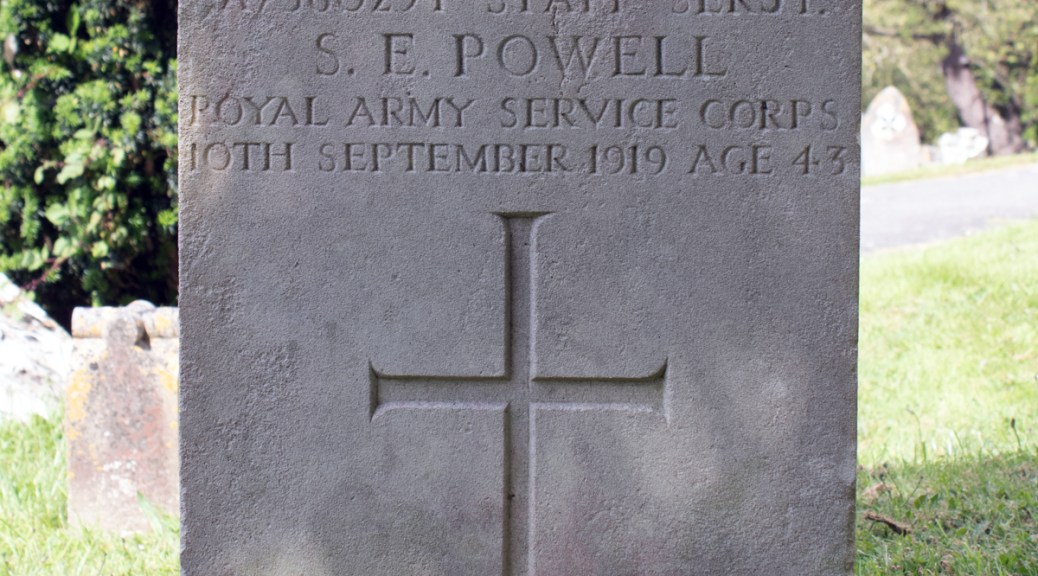
Samuel Edwin Powell was born at the start of 1876, the third of eight children to Samuel and Catherine Powell. Samuel Sr was a baker from Gloucestershire, and it was in the village of Leonard Stanley that the family were born and raised.
Much of Samuel Jr’s earlier life is undocumented, and he does not appear on either the 1891 or 1901 census returns. By the time of the next census, taken in 1911, he is recorded as living in Lewisham, Surrey.
The census noted that Samuel was employed as a commercial traveller in the chocolate industry. He was married to Stroud-born Ellen Hobbs, and had been since 1906. The couple had a son, Denis, who was a year old, and were living at 20 Hazelbank Road in Catford, with a domestic servant, Edith Price, helping Ellen while her husband was away working.
When war broke out, Samuel was called upon to play his part. He was enlisted in the Royal Army Service Corps, with the rank of Staff Serjeant, which would suggest that his absence from earlier documents was because of earlier military service.
There is little information about Samuel’s time in the army, other than that he was attached to the Clearing Office when the Armistice was declared.
The cause of Staff Serjeant Powell’s passing is not known, but the Army Register of Soldier’s Effects confirm that he died in Dorset on 10th September 1919. The connection to Dorset is unclear: he may have been serving in the area, or recuperating from an illness. He was 43 years of age.
Samuel Edwin Powell was laid to rest in Lyme Regis Cemetery, overlooking the seaside town.
Percival Osmond Bean Boyce was born in Calcutta, India, in January 1887. The oldest of seven children, his parents were Edward and Mary. While details of his early life are not readily available, it would seem that Edward had some military connections. He had been born in Calcutta in 1859, while Mary was Welsh. Most of Percival’s siblings had been born in India, although two – Cecil in 1891, and Dorothy in 1896 – had been born in Somerset.
The 1901 census recorded Percival as boarding at Keyford College in Frome, Somerset. His family do not appear on that census return, nor does he appear on any other census document. He went on to study at Bristol Grammar School, Gloucestershire, making the First XI rugby team.
In May 1915, Percival married Florence Cooper. There is little information available about her, but the couple exchanged vows in Paignton, Devon.
Percival seemed to have taken to a life at sea by this point, and was the Chief Officer of the cargo ship SS Indore. On 25th July 1918, she was torpedoed by the German submarine U-62, off the Irish coast. The Indore was beached, and two of the crew were killed. Chief Officer Boyce managed to get the ship re-floated and safely back to shore.
At this point, Percival’s trail goes cold again. He survived the war, but died in Scotland on 27th November 1918, the cause of his passing unknown. He was 30 years of age.
In a traditionally Edwardian obituary, it was noted that “great sympathy is felt for Mr JH Cooper, Chairman of Paignton District Council, in the death of his son-in-law, Mr Percival OB Boyce, master mariner, at Glasgow. Both of Mr Cooper’s daughters are now widows, and he lost a son not long since.” [Western Times: Tuesday 3rd December 1918]
Percival Osmond Bean Boyce was laid to rest in Paignton’s sweeping cemetery.
Much of George Fenn’s life is destined to be lost to time. Born in Bristol, Gloucestershire, in the summer of 1878, details of his parents are unknown. His was a common name in the late Victorian period, and census returns from the time identify at least two men born in the area around the same time.
The first document that can be directly connected to George is the 1911 census. This recorded him living at 13 Tankards Close in Clifton, where he was working as a dock labourer. His is noted as having been married to Minnie since 1902. The couple had one child, a son called William who was six years old.
When war broke out, George was quick to enlist. Full details of his service are lost, but he had certainly joined the Bedfordshire Regiment by the end of 1914. Attached to the 7th (Service) Battalion, by the start of the following year, his unit had moved to Salisbury Plain in anticipation of being sent to the Western Front.
George seems to have made his mark in the army, and he was soon promoted to the rank of Lance Corporal. In the spring of 1915, he contracted pneumonia, however, and was admitted to the military hospital in Codford, Wiltshire, close to where his unit was based.
Sadly, the condition was to prove Lance Corporal Fenn’s undoing: he passed away on 1st June 1915, at the age of 36 years of age.
George Fenn was laid to rest in the peaceful churchyard of St Mary’s, Codford, not far from where he had passed away.
George’s entry on the Army Register of Soldiers’ Effects and his Pension Ledger card shed a little more light on the family he had left behind. The first divides his belongings between his widow, Minnie, and the guardian of his child, Mrs Sarah Clarke. George’s pension ledger gives Sarah’s address as 14 Tankard’s Close, Bristol, and confirms that he was, in fact, separated from Minnie when he passed.
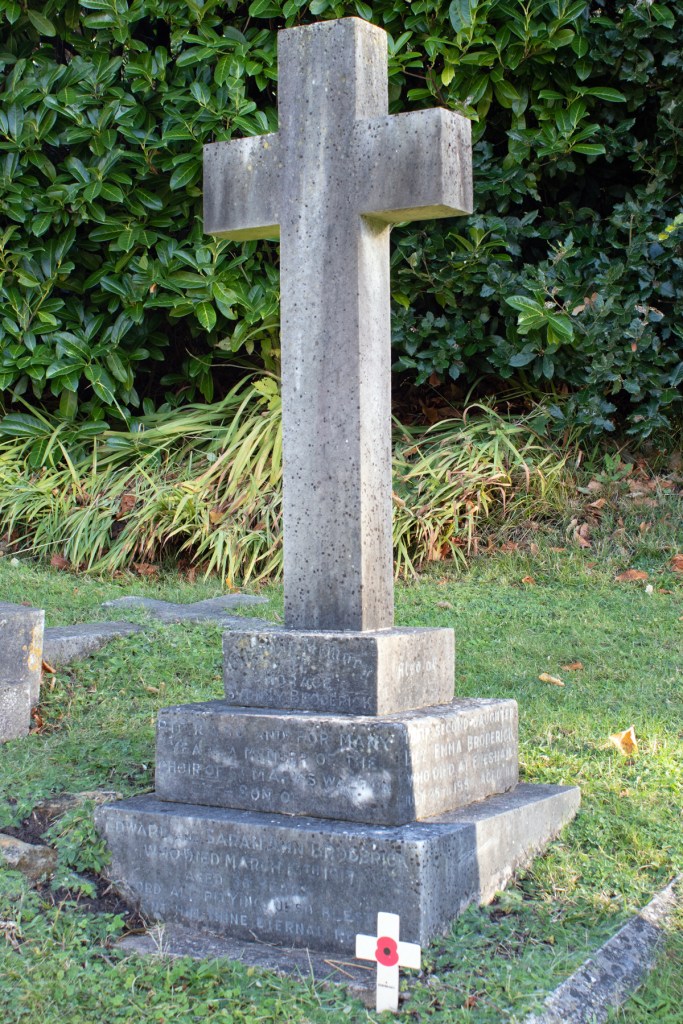
Horace Sydney Broderick was born in the summer of 1880, and was the youngest of ten children to Edward and Sarah Broderick. Edward was a clothier from Newport Pagnell, Bedfordshire, but the family were born and raised in Horfield, Gloucestershire.
By the time of the 1891 census, the family had moved to the south of Bristol, setting up home at Rugby House in Walton-in-Gordano, Somerset. Horace was still at school, and of the four other siblings living at the family home, only one, Horace’s older brother, Walter, was gainfully employed, assisting his father in the cloth trade. The Brodericks were supported by two live-in staff, a cook, Elizabeth Phipps, and a housemaid, Ada Perrett.
The next census, taken in 1901, found Horace and three of his sisters still living at Rugby House with their parents. Edward was now employing his son as a clerk to the family business, and two new staff had come on board, cook Lily Collier and housemaid Florence Hadeley.
By the time of the 1911 census, Edward and Sarah had been living in Rugby House for more than twenty years. Both now in their 70s, they still had their oldest daughters living with them, but Horace is nowhere to be found. Indeed, there is no sign of him on any of the UK census returns, and it is not until six years later that he seems to surface again.
When war broke out, Horace stepped up to enlist. He joined the Army Service Corps and, based on his service number, was employed as a Driver Mechanic. Beyond this, Private Broderick’s time in the military is lost to time.
New has been received in Bristol of the death at the Royal Herbert Hospital, Woolwich, of Pte. Horace Sydney Broderick, youngest son of the late Mr Edward Broderick (of the firm Broderick & Co,. Limited, St James’s Barton, Bristol) and of Mrs Broderick, of Walton Park, Clevedon. Deceased soldier was in his 37th year.
Bristol Times and Mirror – Thursday 15 March 1917
The report appeared in a dozen or so contemporary newspapers and, as no specific detail is given, it is likely that Horace passed away from illness, rather than injury or any unexpected cause. He died on 13th March 1917, at the age of 36 years old.
Horace Sydney Broderick’s body was brought back to Somerset for burial. He was laid to rest in the graveyard of St Mary’s Church, Walton Clevedon, next to Edward, who had passed away two years before.
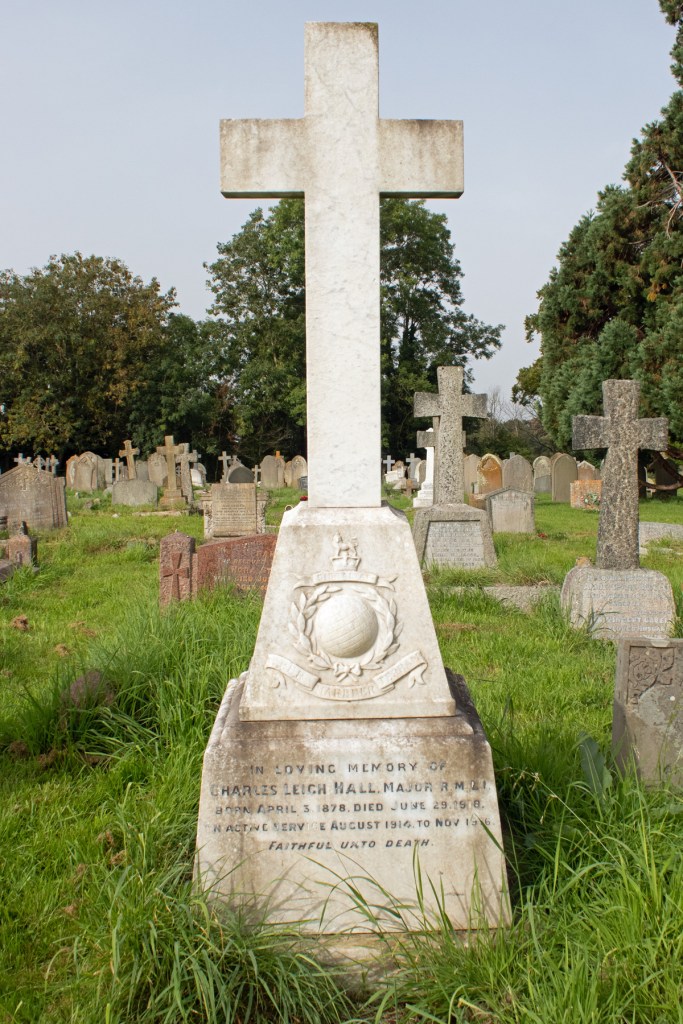
Charles Leigh Hall and his twin Maud, were born on 3rd April 1878 in Clifton, Gloucestershire. Two of eight children, their parents were Pedro and Anne Hall. Pedro, whose full name was Pedro Henrique Sinclair Hall, was better known as Henry, and was a mathematics tutor and Assistant Master at Clifton College, and it goes without saying that the Hall children had a educated upbringing.
Charles was always to be destined for great things. By the time of the 1901 census, when he was 22 years of age, he was a Lieutenant in the Royal Marines Light Infantry. Based on the cruiser HMS Amphion, he travelled the Pacific and, on the night the return was taken, was moored in Vancouver, Canada.
On 15th June 1910, Charles married Sophia Elinor Veale. Born in Caledon, South Africa, the couple wed in the village of Littleham, Devon. They set up home in Gosport, Hampshire – presumably as the now Captain Hall’s work was based from the docks there – and went on to have two children, Anthony and Nicholas.
By September 1915, Charles had been promoted again, this time to the rank of Major. His wartime service included a lot of work in Africa, including in Cameroon in 1914 – for which he was mentioned in Dispatches – German East Africa (Burundi, Rwanda and Tanzania today) in 1915 and Saadani (Tanzania) in 1916.
In October 1916, he was invalided out of the Royal Marine Light Infantry for reasons that are unclear, and returned to Britain from Simonstown, South Africa. While Charles seems not to have gone to sea any more, his experience was still respected, and, on 15th January 1917, he was promoted to Brigade Major.
The family settled back down in Portsmouth, Hampshire, and remained there for the next eighteen months. By the summer of 1918, Charles was in Bristol – either based at the docks there, or hospitalised in the city – and passed away on 29th July 1918. He was 40 years of age.
Sophia and her boys were still in Portsmouth, but Charles Leigh Hall was laid to rest in the graveyard of St George’s Church in Easton-in-Gordano, Somerset. The headstone incorrectly gives the month of death as June. Charles’ will divided his estate – £4467 (£318,000 in today’s money) – between his brother, Arthur, and Charles Garnett, a barrister, possibly as a trust for his sons.
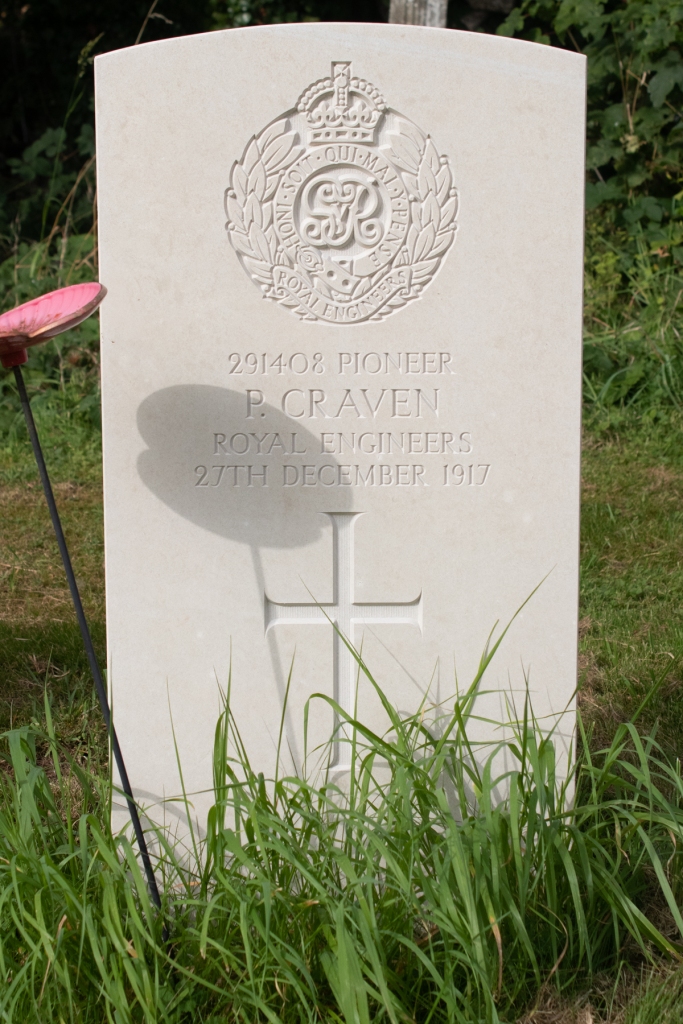
Patrick Craven was born in the summer of 1898 in Drogheda, County Louth. The oldest of three children, his parents were Francis (or Frank) and Mary Craven. Mary died in 1909, and the following year Patrick’s father remarried, to widow Kate Devin. The 1911 census found the extended family living in a cottage on North Road, Frank, Kate and their seven children.
Frank was a farm labourer, and this is work that Patrick also went into when he finished his schooling. War came to Europe in 1914, and he was to be called upon to play his part.
Patrick enlisted in the Royal Engineers on 6th June 1917. His service records confirm that he was 5ft 6ins (1.68m) tall, and weighed 127lbs (57.6kg). Pioneer Craven was assigned to the Inland Waterways Transport Division, and sent to Henbury, on the outskirts of Bristol, Gloucestershire, for training.
There was one blip on Patrick’s otherwise spotless service when, on 1st October 1917, he was confined to barracks for two days for ‘conduct to the prejudice of good order and military discipline, leaving the ranks without permission‘. Shortly after this, Pioneer Craven was assigned to a unit in Portbury, Somerset.
The wet summer of 1917 had given way to a cold, harsh winter, and the conditions were to lead to Pioneer Craven’s tragic demise on 27th December. The detailed report from the Medical Officer explained what had happened:
This man was found dead… in a small harness room at the Lodway Brewery, Pill, a room occupied by the IW&D, Portbury. I was called in to see him and pronounced him dead, the body was quite stiff and cold and death had probably taken place several hours before. When first discovered the body was fully pronated, with the mouth flattened against the floor, the hands were gripping the Army greatcoat which he had pulled over himself.
The harness room was heated by a coke stove the flue of which passed through the room to the ceiling and was cracked, allowing the fumes of the burning coke to emanate into the room. There was no ventilation except through a door communicating with the stables, which was found shut at the time the cadavre [sic] was found. The stove was situate[d] between the position where the body lay and the door, in a cul-de-sac.
One other man slept in the same room the same night, the deceased man having evidently entered the place after the former had fallen asleep. The second man was not affected by the fumes to any degree, but was lying between the stove and the door under which there was a certain amount of draught.
Sheltering himself from the cold winter night, Private Craven had passed away in his sleep from carbon monoxide poisoning. He was just 19 years of age.
Patrick Craven’s family were unable to afford to bring him back to Ireland for burial. Instead, he was laid to rest in the peaceful graveyard of St George’s Church in Easton-in-Gordano, not far from the brewery stables where he had passed.









 Death and Service