Tag Archives: Great War

Staff Serjeant Samuel Powell

Staff Serjeant Samuel Powell

Samuel Edwin Powell was born at the start of 1876, the third of eight children to Samuel and Catherine Powell. Samuel Sr was a baker from Gloucestershire, and it was in the village of Leonard Stanley that the family were born and raised.

Much of Samuel Jr’s earlier life is undocumented, and he does not appear on either the 1891 or 1901 census returns. By the time of the next census, taken in 1911, he is recorded as living in Lewisham, Surrey.

The census noted that Samuel was employed as a commercial traveller in the chocolate industry. He was married to Stroud-born Ellen Hobbs, and had been since 1906. The couple had a son, Denis, who was a year old, and were living at 20 Hazelbank Road in Catford, with a domestic servant, Edith Price, helping Ellen while her husband was away working.

When war broke out, Samuel was called upon to play his part. He was enlisted in the Royal Army Service Corps, with the rank of Staff Serjeant, which would suggest that his absence from earlier documents was because of earlier military service.

There is little information about Samuel’s time in the army, other than that he was attached to the Clearing Office when the Armistice was declared.

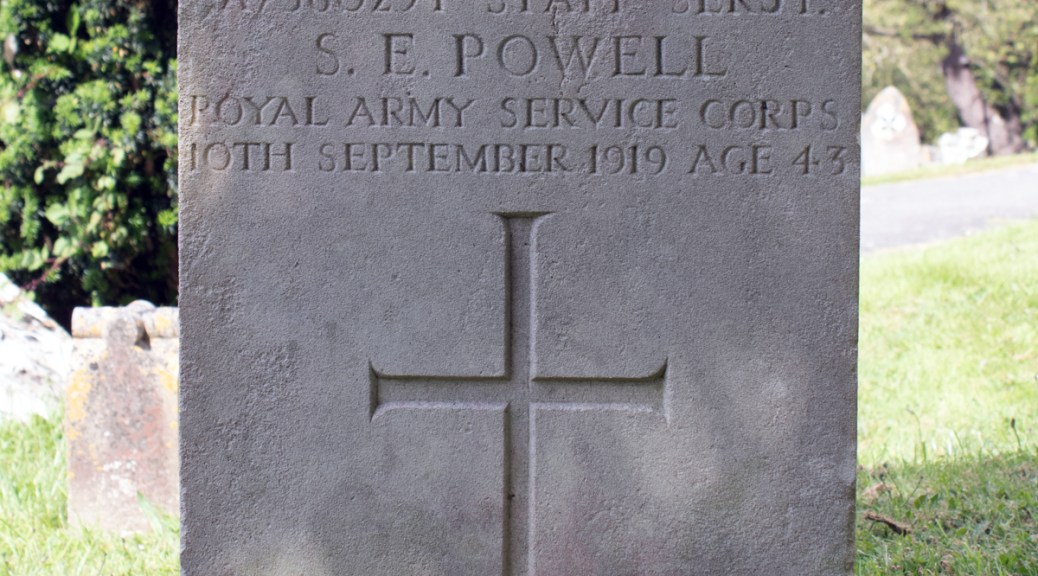
The cause of Staff Serjeant Powell’s passing is not known, but the Army Register of Soldier’s Effects confirm that he died in Dorset on 10th September 1919. The connection to Dorset is unclear: he may have been serving in the area, or recuperating from an illness. He was 43 years of age.

Samuel Edwin Powell was laid to rest in Lyme Regis Cemetery, overlooking the seaside town.


Able Seaman William Real

Able Seaman William Real

William Thomas Bradley Real was born in Lyme Regis, Dorset, on 31st December 1875. His parents were coastguard William Real and his wife, Sarah. William Jr seems to have lived with his maternal grandparents for most of his life, even though he went on to have seven younger siblings.

Sarah died in the spring of 1891, just weeks after the birth of her and William Sr’s youngest child, and William Jr took this as an opportunity to seek a career for himself. Living next to the sea, and with a coastguard for a father, a role in the Royal Navy seemed an apposite choice. He joined up on 26th May 1891, just 20 days after his mother’s funeral.

William was under age when he joined up, and so was given the rank of Boy 2nd Class. His service records show that he was 5ft 8ins tall, with brown hair, blue eyes and a fresh complexion. He was initially sent to HMS Boscawen, the training ship moored in Portland, Dorset, and remained there until January 1893. By this point his training had paid off, and he had been promoted to the rank of Boy 1st Class.

William’s first posting was on board the ironclad HMS Alexandra. Over the next year he was posted to two further vessels, and, when he came of age on 31st December 1893, he was formally inducted into the Royal Navy, and given the rank of Ordinary Seaman. Over the next 25 years, he would serve on a total of sixteen more ships, returning to HMS Vivid, the Royal Naval Dockyard in Devonport, Devon, between some of his voyages.

William’s career saw promotion – to the rank of Able Seaman on 4th February 1896. He also spent three days in the cells in August 1898, although the nature of his misdemeanour is unclear.

Away from his career William’s family life took hold. On 15th April 1911, he married Louisa French. Her parents owned and ran the George Hotel in Charmouth, Dorset. The couple went on to have a daughter, Maud, who was born in the spring of 1915.

When war was declared, Able Seaman Real was assigned to HMS Tiger. The most heavily armoured battlecruiser in the British Navy, She would go on to fight in the Battles of Dogger Bank, Jutland and Heligoland Bight, action William would have seen first hand.

By the spring of 1918, Able Seaman Real had become unwell. He was posted back to HMS Vivid on 1st May, and was admitted to the Royal Naval Hospital in Plymouth. His admission was not to be a long one: he died of heart failure just five days later, at the age of 42 years old.

The body of William Thomas Bradley Real was taken back to Dorset for burial. He was laid to rest in Lyme Regis Cemetery, overlooking the town in which he had been born.


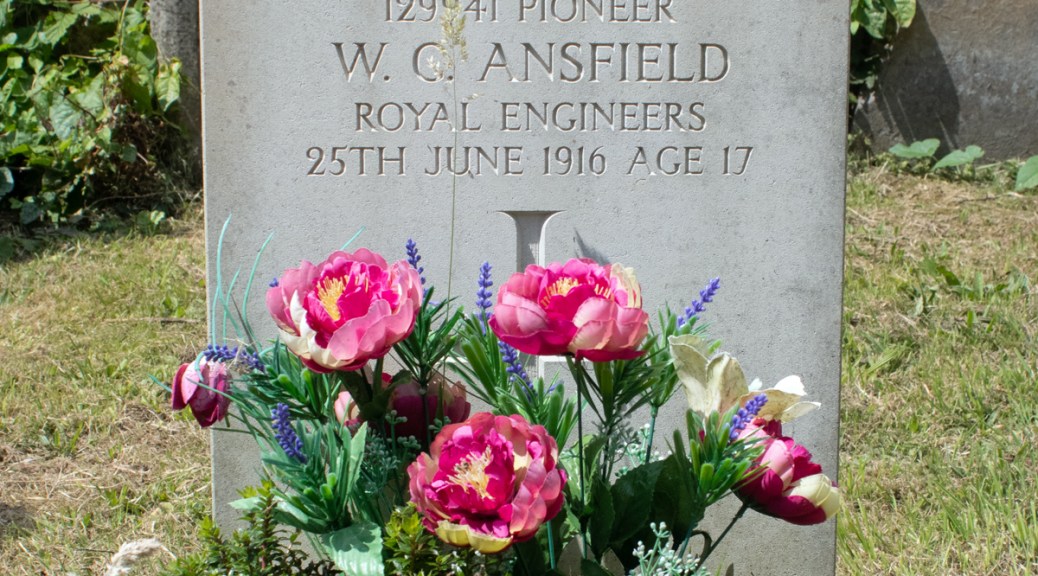
Pioneer Wilfred Ansfield

Pioneer Wilfred Ansfield

Wilfred Clarence Ansfield was born in the spring of 1899, and was the youngest of eleven children to Frederick and Frances Ashfield. Frederick was an innkeeper from West Tarring in Sussex, and the family were living in the public house he ran – possible the Vine Brewery on the Hight Street.

Frederick died at the start of 1904, and by the time of the next census, taken seven years later, Frances had moved the family to Salvington. They settled at 1 Beaconsfield Terrace, with six of the Ansfield children sharing the home with their mother. Three of Wilfred’s brothers were employed as gardeners – possibly at one of the many nurseries in the area – while he was still at school.

When war came to Europe, Wilfred was keen to serve his King and Country. Full service details have been lost to time, but it is clear that he enlisted in the Royal Engineers and, as a Pioneer, was assigned to the 3rd Provisional Company (later renamed the 642nd (London) Field Company). This was a territorial force, and it is unlikely that Wilfred saw any action overseas.

The only other document that can definitely connected to Pioneer Ansfield is the record of who his pension was assigned to. This confirmed Frances’ name and address, but also gives the cause of her son’s death, noted as ‘acute paralysis’. This could have been as a result of a tetanus infection, but nothing remains to confirm either way. Wilfred died on 25th June 1916: he was just 17 years of age.

Wilfred Clarence Ansfield was laid to rest in the graveyard of St Andrew’s Church in West Tarring, He was buried alongside Frederick, father and son reunited after twelve years.


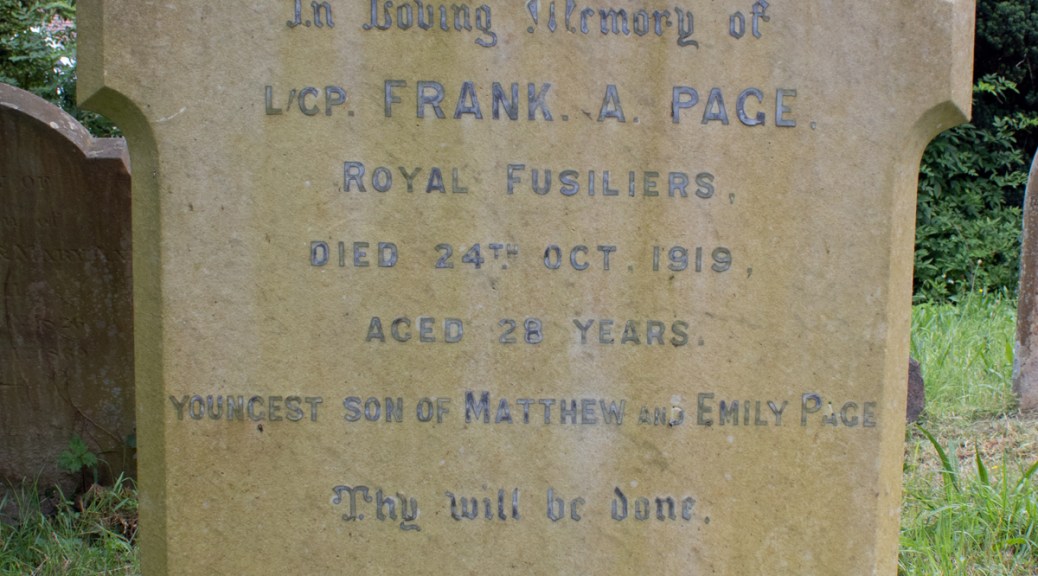
Lance Corporal Frank Page

Lance Corporal Frank Page

Frank Arthur Page was born early in 1891, and was one of seven children – and the youngest son – to Matthew and Emily Page. Matthew was a bricklayer’s labourer from Lancing in Sussex, while Emily had been born in Norfolk. It was in the village of Steyning, however, that the couple raised their family.

By the time of the 1901 census, Matthew had been invalided out of work. The family had moved to a small cottage in Lancing by this point, and Frank’s older brothers were working to bring in some money for the family.

The next census return, taken in 1911, found Matthew and Emily living Frank and his older brother Sydney at 2 Ivy Cottages in Lancing. Both of the Page siblings were working as market gardeners by this point, bringing in some money to help support the family.

War came to Europe in the summer of 1914, and Frank stepped up to serve his King and Country. Full details of his military service are lost in the mists of time, but it is clear that he enlisted in the Royal Fusiliers, and was attached to the 26th (Service) Battalion (Bankers).

Frank’s unit served in both France and Italy, although, without his documents, it isn’t possible to determine where, and for how long, he served. During his time in the army, however, he was promoted to the rank of Lance Corporal, underlining a level of dedication on his part.

Matthew passed away in the spring of 1917, and it appears that Frank was demobbed at some point after the Armistice. By the autumn of 1919, he was back in Sussex, living with his now widowed mother. His time in the army seems to have impacted on Frank’s health by this point, and he died ‘from disease’ on 24th October 1919. He was 28 years of age.

Frank Arthur Page was laid to rest in the graveyard of St James the Lesser Church in Lancing, not far from where his father had been buried.


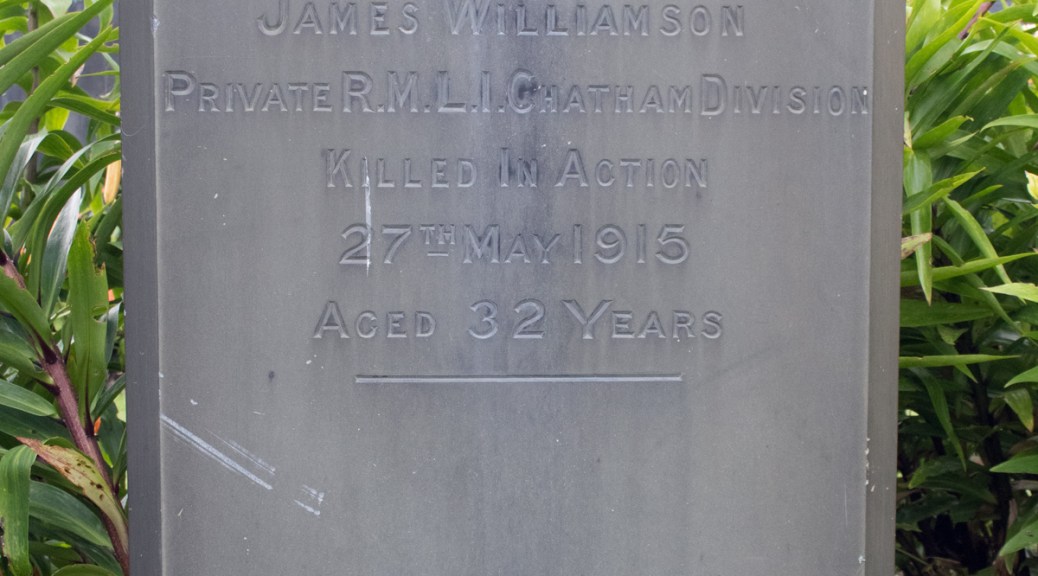
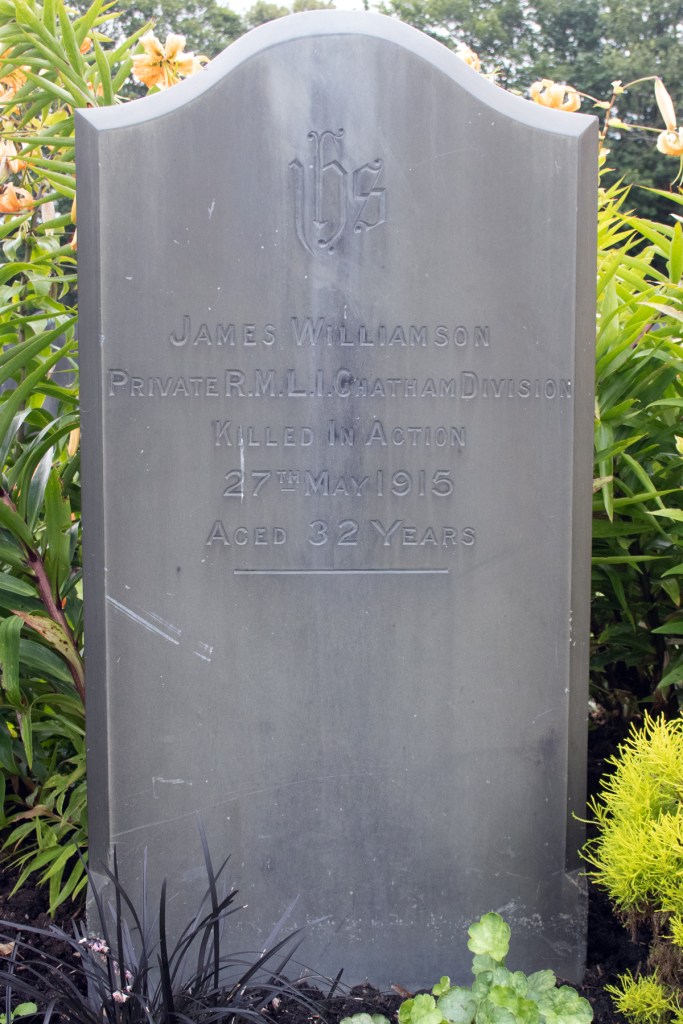
Private James Williamson

Private James Williamson

In amongst the rows of naval headstones in the Woodlands Cemetery in Gillingham, Kent, is one dedicated to James Williamson, a Private in the Royal Marine Light Infantry. He was killed in action on 27th May 1915, while attached to the ship HMS Princess Irene, and was 32 years of age when he passed.

There is little specific documentation relating to Private Williamson’s life, but what remains allows us to piece together something of the man he was.

James was born in the Dennistoun area of Glasgow in around 1883, and was one of five children to William and Jane Williamson. When he finished his schooling, he seems to have had a pull to the sea: whether this was because he was following in his father’s footsteps, or because of his home’s proximity to the river and docks is unclear.

By the time of the 1911 census, James was already serving in the Royal Marines. He was based on the cruiser HMS Philomel, which was in the Gulf of Oman on the day the census was taken, and was one of 19 Royal Marines on board our of a total compliment of 244 crew.

There is little more concrete information about Private Williamson’s life. By the spring of 1915, he had been assigned to the HMS Princess Irene, an ocean liner requisitioned during the war and converted into a mine layer. On 27th May, she was moored off Sheerness in Kent, when a series of explosions ripped her apart. More than 270 crewmen were killed: this included the 32-year-old James.

The crew whose bodies were not able to be identified were laid to rest in a communal grave in Woodlands Cemetery: James Williamson was laid to rest nearby, in a burial of his own.


Interestingly, James’ entry on the Royal Navy and Royal Marines War Graves Roll gives his next of kin as a friend, Miss J Malone of 3 Ashview Terrace, Newton Mearns, near Glasgow. There is no other information about her.


Writer 1st Class Harry Goodger

Writer 1st Class Harry Goodger

Harry Goodger was born on 15th April 1885, the fourth of five children – and the only boy – to George and Emma Goodger. George was a canal labourer from Aylesbury in Buckinghamshire, but by the time of his son’s birth, the family had settled in Tipton, Staffordshire.

Harry was initially committed to education and, by the time of the 1901 census, he was working as a school teacher. His heart seemed set on a career with more prospects, however, and so, on 2nd November 1904, he enlisted in the Royal Navy.

Harry’s service records show that he was 5ft 2ins (1.57m) tall and that he had bark brown hair, dark brown eyes and a fresh complexion. He was also noted as having a mole on his wight upper arm and another on his left breast.

Harry’s rank was Writer 3rd Class, which was the naval equivalent of a clerk. After an initial training period, he was assigned to the cruiser HMS Terrible. Over the next decade, he served on ten further ships, and was based at HMS Victory, the Royal Naval Dockyard in Portsmouth, in between voyages.

Writer Goodger slowly progressed through the ranks during his naval service. On 1st November 1908 he was promoted to Writer 2nd Class, and on 31st October 1912 was raised to Writer 1st Class. Harry seems to have needed extra support, however, and he was knocked back to Writer 2nd Class on 25th April 1913, and sent back to Portsmouth for further training. By 23rd October 1914, however, while serving on HMS Bulwark, he again received a promotion to Writer 1st Class.

By the spring of 1915, Harry had been assigned to HMS Princess Irene. She an ocean liner that has been converted to a minelayer at the start of the war.

On 27th May 1915, while Irene was moored off Sheerness, Kent, a series of explosions ripped through the ship, killing more than 350 crew. Writer Goodger was among those who perished: he was 30 years of age.

The body of Harry Goodger was buried in Woodlands Cemetery, Gillingham, Kent alongside the other victims of the disaster.


Writer 1st Class Harry Goodger
(from findagrave.com)

Harry’s surname is variously spelt Goodger and Goodyer across the documents that trace his life. While his headstone has the latter spelling, I have used Goodger, as this is what is recorded on his naval service records.


Private William Preston

Private William Preston

William Robert Preston was born on 2nd January 1888, and was the oldest of six children to William and Alice Preston. William Sr was a blacksmith from Norwich, Norfolk, and this is where the family were initially raised.

The 1901 census saw a move to Northamptonshire, however, the document confirming that the family were living at Tanner Cottages in the village of Walton.

When he finished his schooling, William Jr found work as a painter’s labourer. However, he sought bigger and better things and, on 5th June 1905, he enlisted in the Royal Marine Light Infantry. His service records show that he was 5ft 6ins (1.67m) tall, with dark brown hair, blue eyes and a fresh complexion. He was also noted as having a number of tattoos on his arms.

Private Preston was sent to barracks in Deal, Kent, for his initial training. He spent the best part of a year there, before being transferred to the Royal Naval Dockyard in Portsmouth, Hampshire, in April 1906. He was given his first ocean-going posting in January 1907, when he joined the crew of the cruiser HMS Terrible.

Over the next eight years, Private Preston served on three further ships, returning to HMS Victory, Portsmouth, in between trips. In March 1915, he was assigned to HMS Princess Irene, an ocean liner converted to a minelayer at the start of the war.

On 27th May 1915, while Irene was moored off Sheerness, Kent, a series of explosions ripped through the ship, killing more than 350 crew. Private Preston was among those who perished, but whose body was identified: he was 27 years of age.

The body of William Robert Preston was buried in Woodlands Cemetery, Gillingham, Kent alongside the other victims of the disaster.


Stoker 2nd Class Samuel Castle

Stoker 2nd Class Samuel Castle

Samuel George Castle was born on 1st November 1896 in Battersea, Surrey. The third of ten children, his parents were Samuel and Louisa Castle. His father was a gas fitter turned blacksmith and, by the time of the 1911 census, Samuel Jr was working as an errand boy for Army & Navy Stores.

When war broke out, Samuel was quick to step up and serve his country. On 6th March 1915, he gave up his job – he was by then employed as an equipment maker – to enlist in the Royal Navy as a Stoker 2nd Class.

George was sent to HMS Pembroke, the dockyard in Chatham, Kent, for his training. His service records show that he was 5ft 4ins (1.62m) tall, with black hair, brown eyes and a fresh complexion.

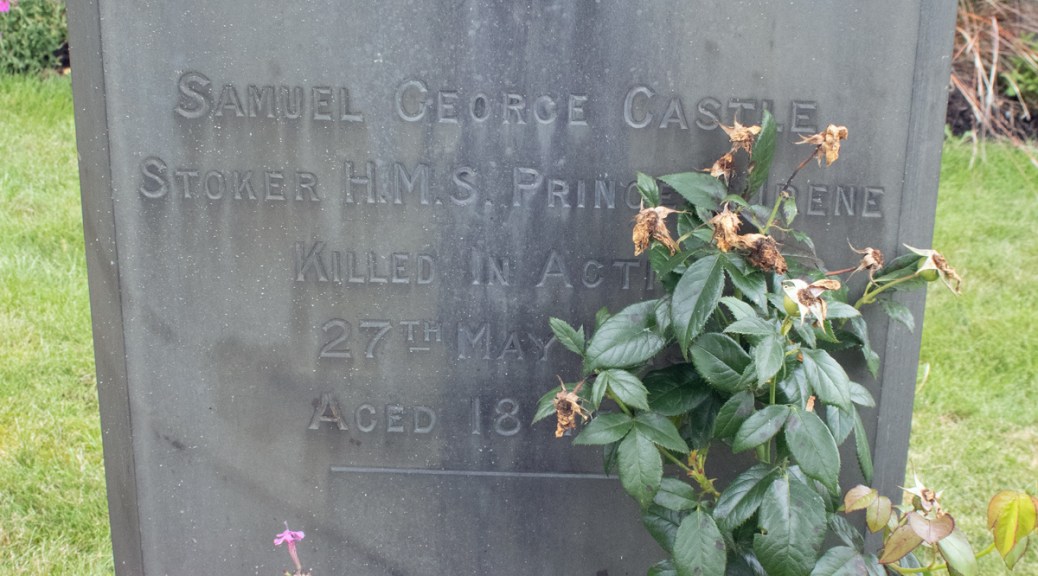
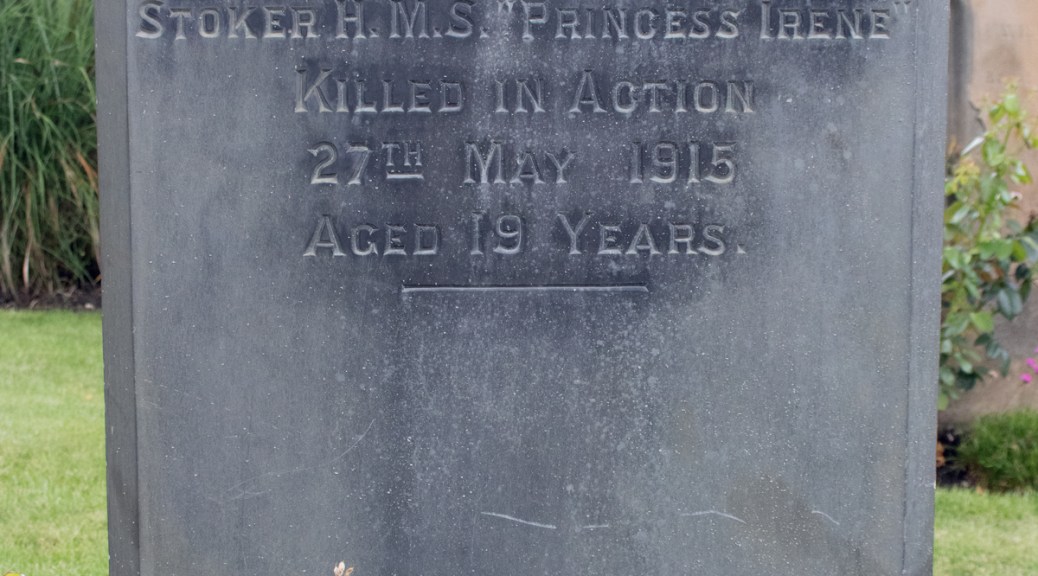
Tragically, Stoker Castle’s time in the navy would not prove a lengthy one. By the end of May he was part of the crew of HMS Princess Irene, an ocean liner that had been put into service as a minelayer when war was declared. On 27th May 1915, a series of explosions ripped through the ship, killing more than 350 crew, Samuel included. He was just 18 years of age.

Samuel George Castle was laid to rest in Woodlands Cemetery, Gillingham, alongside the other victims of the disaster.


Stoker George Marshall

Stoker George Marshall

George Patrick Marshall was born in Dublin, Ireland, on 17th March 1896. One of ten children, his parents were plumber and gasfitter Robert Marshall and his wife, Rachel.

When he finished his schooling, George found work as a messenger. By the time war broke out, however, he was working as a builder’s mate. Keen to play his part and serve his country, he decided to enlist in the Royal Navy.

Stoker 2nd Class Marshall enlisted on 7th March 1915. His service records show a little of the man he had become. He was noted as being 5ft 4ins (1.62m) tall, with brown hair, grey eyes and a fresh complexion. His first trip overseas took him to HMS Pembroke, the Royal Naval Dockyard in Chatham, Kent, where he would receive his training.

Tragically, George’s time in the navy would not prove a lengthy one. By the end of May he was part of the crew of HMS Princess Irene, an ocean liner that had been put into service as a minelayer when war was declared.

On 27th May 1915, a series of explosions ripped through the ship, killing more than 350 crew, Stoker Marshall included. He was just 19 years of age.

George Patrick Marshall was laid to rest in Woodlands Cemetery, Gillingham, alongside the other victims of the disaster.


Fireman Robert McQueen

Fireman Robert McQueen

In amongst the rows of naval headstones in the Woodlands Cemetery, Gillingham, Kent, is one dedicated to Robert McQueen. The inscription notes that he was a Fireman on board HMS Princess Irene, a liner that was conscripted by the Royal Navy as a minelayer during the First World War.

The headstone records that he died during the catastrophic explosion on 27th May 1915 that destroyed the ship, killing more than 300 people in the process. It also confirms that Robert was 23 years old when he died.

Birth records identify at least six Robert McQueens born in 1891/92, and without a place of birth, or parental names, it is not possible to definitively confirm which of these was serving on the Princess Irene on that fateful day. He was in what would become the Merchant Navy: their records are sparser than the Royal Navy equivalents, and none match the man who lies buried in Gillingham.

The life of Robert McQueen, therefore, is destined to remain lost to time, although his sacrifice will never be forgotten.