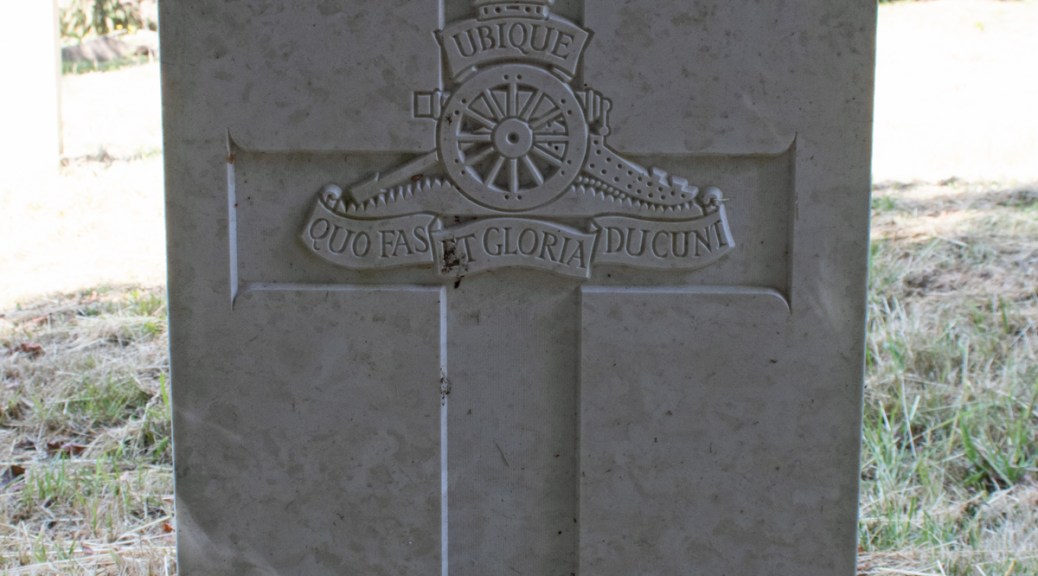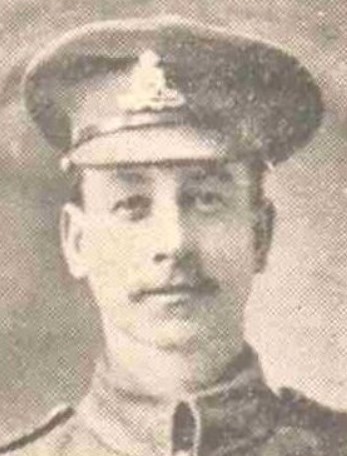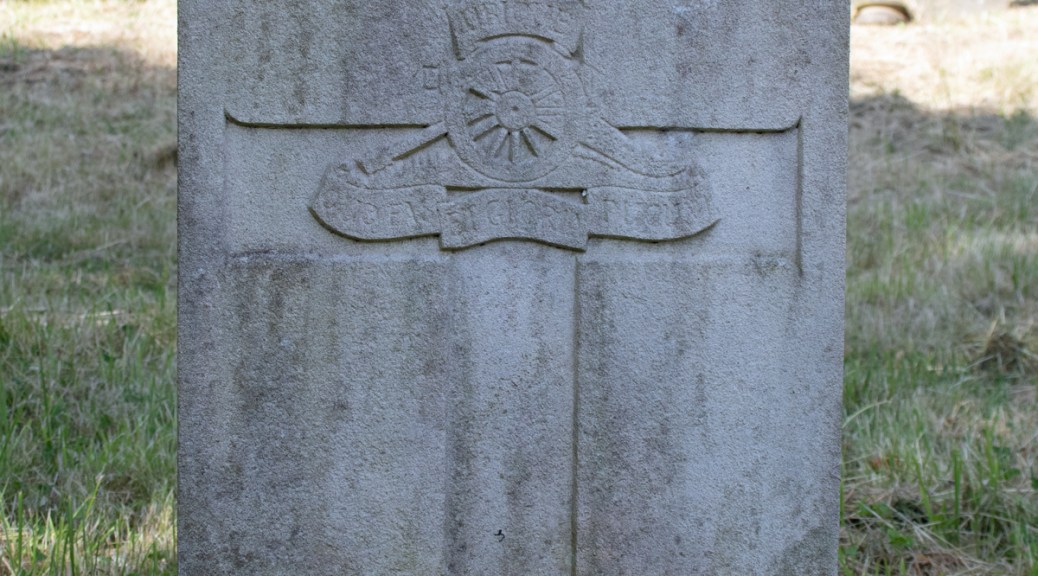
Colin Thomas Frazer Rough was born in the autumn of 1896, and was the oldest of seven children to Thomas and Zelia. Thomas was a dairyman from Devon, and the family were initially raised in Charmouth. Thomas took up work as a farmer in 1911, and this meant a move to to Axminster: having finished his schooling, Colin helped his father on the farm.
Colin was still working with his father when war broke out across Europe. He stepped up to play his part, and enlisted in the Royal Garrison Artillery 11th December 1915. His service records show that he was 19 years and three months old, and stood 5ft 8ins (1.72m) tall.
Gunner Rough was not formally mobilised until May 1916. He would spend the next two-and-a-half years on home soil, and was based in Catterick, Yorkshire.
On 31st July 1918, Colin was sent to France with his unit. Full details of his service overseas have been lost to time but it would seem that he was back on home soil by the beginning of 1919.
Gunner Rough had contracted influenza and pneumonia, and returned home to recuperate. The conditions were to prove too severe, however, and he passed away on 8th February 1919, at the age of 22 years old.
Colin Thomas Frazer Rough was laid to rest in the family plot in Axminster Cemetery. Tragically, his younger brother Alan had passed just three weeks earlier: the two were buried alongside each other.
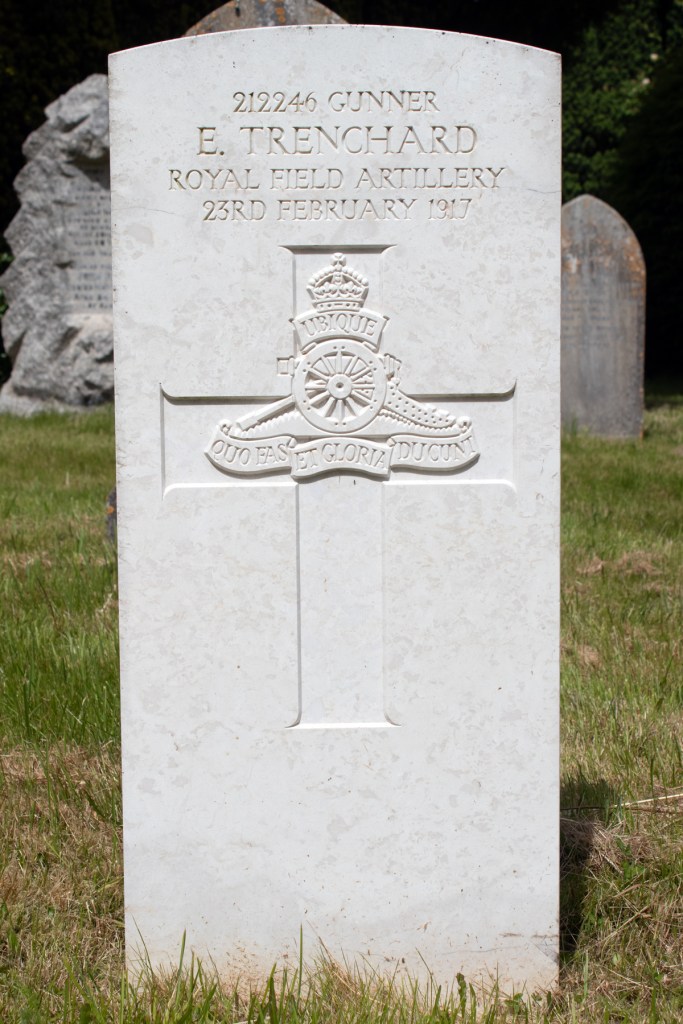
Eli Trenchard and his twin Reuben were born on 29th December 1889 in Axminster, Devon. Two of nine children, their parents were George and Mary Trenchard. George was a gamekeeper turned farmer, and the family were brought up at Uphay Farm on the outskirts of the town.
The whole family helped out on the farm and, by the time of the 1911 census, when the twins were 20, seven of the Trenchards – George, Mary, Eli, Reuben and three of their siblings – were all living in the farmhouse and employed in the business.
On 25th March 1913, Eli married Lily Gillingham. Born in Dorset, she was the daughter of the landlord of the Lamb Inn in Axminster, and working as a dressmaker in her own right. The couple moved to the village of Chardstock in Devon, and went on to have a daughter, Lilian, who was born later that year.
In 1915, Eli found himself brought to the Petty Sessions in Axminster, charged with “movingpigs from Dorset to Devon without the necessary license”[Western Times: Wednesday 27th October 1915]. Eli stated that he had purchased the pigs from his brother, Reuben, at Uphay Farm. Despite Reuben confirming this, it was subsequently determined that they had, in fact, been bought from a Mr Wells of Penn in Dorset. Eli have been convicted of a similar offence before, and was fined £10.
War was raging across Europe by this point, and Eli was called upon to play his part. He enlisted in the Royal Field Artillery in January 1917. Assigned to the 23rd Reserve Battery, Gunner Trenchard was sent to a camp near Sutton Veny in Wiltshire.
Eli’s time in the army was not to be a long one, however, and he was soon admitted to the camp hospital, suffering from pneumonia. The lung condition was to get the better of him, and Eli passed away on 23rd February 1917. He was 27 years of age.
The body of Eli Trenchard was taken back to Devon for burial. He was laid to rest in Axminster Cemetery, not far from where his widow and family still lived.
The Trenchard family were soon back in the court, however, with Lily bringing a lawsuit against her father-in-law, George, in December 1917. The widow said that Eli and his father had agreed her late husband’s immediate tenancy of two fields the month before Eli had been called up for to serve.
However, the month after his death, when she had gone to the fields to sow them for the coming season, the gates had been locked and her entrance barred. George responded by saying that he had agreed to pass the fields to his son, but only on the event of his own death. He subsequently sold the land to another farmer.
The judge in the case found that Lily had “failed to prove that an agreement had been made between [George] and his son”[Western Times: Thursday 6th December 1917] and found in the defendant’s favour.
Victor George Evans was born in the autumn of 1882, one of eleven children to George and Charlotte Evans. George was a woodsman from Aldworth in Berkshire, and it was here that he and Charlotte raised their growing family.
There is little concrete information about Victor’s early life. While his family were living on Bethesda Street in Basildon, Berkshire, at the time of the 1901 census, Victor is noticeable by his absence.
On 29th January 1910, Victor married Edith Rains in Kensington, Middlesex. She appears to have been a dressmaker’s apprentice, and had been born in Moulton, Lincolnshire. The next year’s census recorded Victor employed as a butler for the Clutton family. His boss, Ralph Clutton, was a lawyer, and the family resided at 5 Vicarage Gate, not far from Kensington Palace. This time, however, it is Edith who is missing from the census record and, given that she had given birth to their one and only child, Phyllis, the year before, it is likely that she was recuperating elsewhere, possibly with the support of her family.
When war broke out, Victor was called upon to serve his country. On 22nd December 1916, he enlisted, joining the Royal Garrison Artillery as a Gunner. His service records show that 34 years of age and stood 5ft 7.5ins (1.71m) tall.
Victor was recorded as being a messenger, and he and Edith were living with his older sister, Rachel, at 17 Adeney Road in Hammersmith, Middlesex. The document suggests, however, that Phyllis was in the care of Edith’s parents in Lincolnshire, possible to enable both her and Victor to work.
Gunner Evans was assigned to the 270th Siege Battery, and he was soon sent to France. While based near Rouen in April 1918, he was badly injured through a number of shrapnel wounds, and medically evacuated to Britain for treatment. Admitted to a hospital in Paignton, Devon, there was little that could be done, other than being made comfortable. Victor succumbed to his wounds on 28th April 1918: he was 35 years of age.
It is likely that Edith would not have been able to afford for her husband to be brought back to Middlesex for burial. Instead, Victor George Evans was laid to rest in the ground of Paignton Cemetery.
Simeon James Powell was born on 18th October 1882 in Wootton Fitzpaine, Dorset. The oldest of three children, his parents were Francis and Elizabeth Powell. Elizabeth died when Simeon was just 7 years of age, and his father remarried, and went on to have five children with his new wife, Annie.
Francis was a farmer, and Simeon found employment as an estate labourer. The 1911 census found the family living on Dodpin Farm in Monkton Wyld, a village to the north of Lyme Regis: Francis, Annie, Simeon and his three younger siblings.
On 12th June 1913, Simeon married Mary Hodder. There is little information about her, but it seems the couple set up home on the outskirts of Charmouth, Dorset. Mary was six years older than her new husband, and they didn’t go on to have any children.
War was declared in the summer of 1914, and by the following autumn, Simeon had signed up to play his part. His service records confirm that he was 5ft 11ins (1.8m) tall and weighed 188lbs (85.2kg).
Gunner Powell joined the Royal Garrison Artillery, and was formally mobilised on 31st May 1916. By November he was sent to Malta, returning to Britain in September 1917. His new posting was in Sheerness, Kent, and he would remain there for the next nine months.
In May 1918, Simeon fell ill. He had caught influenza, and when this developed into bronchitis, he was admitted to the local war hospital. His health began to deteriorate, and, on 10th June 1918, Gunner Powell passed away from a combination of bronchitis and haemoptysis. He was 35 years of age.
The body of Simeon James Powell was taken back to Devon for burial. He was laid to rest in the graveyard of St John the Baptist Church in Hawkchurch, near the family home just across the border in Dorset.
The funeral took place on Monday at Locksbrook Cemetery, with military honours, of Gunner Wm. Dallimore, B Battery, RFA, 88th Brigade, who died on Friday at the Kingswood School VA Hospital. Deceased, who was a single man, 32 years of age, living at 2 Spa Gardens, Larkhall, joined the Army only eight or ten months ago, and was brought to hospital less than a month ago, suffering from an incurable complaint…
The family mourners were Mr Frank Dallimore (brother), Private George Dallimore, 4th Somersets (brother), Mrs Frederick Dallimore (sister-in-law)…
[Bath Chronicle and Weekly Gazette – Saturday 21 August 1915]
There is little concrete information about the early life of William Dallimore. The Army Register of Soldiers’ Effects name his siblings as his beneficiaries, and so it seems that his parents had passed away before war broke out. There are no census records matching his name with the brothers confirmed in the newspaper article, and so it is impossible to get definite information about his birth or parentage.
Only the first page of Gunner Dallimore’s service records remain, but this still provides some details about him. He enlisted on 14th August 1914, a matter of weeks into the conflict, giving up his job as a painter to do so.
While his brigade would go on to serve at the Somme and Ypres, there is no evidence that William saw any action overseas. In fact, the hospital to which he was admitted was in Bath itself, so it may be that he was based near the city.
William Dallimore passed away on 13th August 1915. He was laid to rest in Bath’s sweeping Locksbrook Cemetery.
The early life of Henry Morris is difficult to pin down although later records suggest that his parents were William and Elizabeth from Bath, Somerset. A baptism record from December 1882 shows Henry Morris, with a mother called Elizabeth, but no father is noted, so there is no way to confirm any connection.
The first concrete information for Henry is the 1911 census: this records Henry Morris living with his wife, Eliza, their son, Henry Jr, and Eliza’s mother, Emma Derrick. He was working as a poulterer, employed by a fishmonger’s, with Eliza also working as a fish hawker. Henry and Eliza – who had married in 1905 – would go on to have a second child, Emma, who was born in November 1911.
When war broke out, Henry stepped up to serve his King and Country. Full service records are lost to time, but it is clear that he had enlisted by the spring of 1916, joining the Royal Field Artillery as a Gunner. Documents suggest two different units in which he served: the 26th Division Ammunition Column and the 5th (Reserve) Brigade.
By the autumn of 1916, Henry was suffering from nephritis. He was admitted to the military hospital on Endell Street, London, but his condition was to prove fatal. He passed away on 24th November 1916: he was 32 years of age. With a few discrepancies, a newspaper article gave a little more information about his life:
Henry Morris, RFA, 67 Avon Street, died this morning… He was invalided home from Salonika, and arrived in London nine weeks ago, He was married, and leaves a widow and two children… For eleven years Driver Brooks worked for Mr Broadhurst, fishmonger, York Buildings, Bath, and joined the army sixteen months ago.
[Bath Chronicle and Weekly Gazette: Saturday 25th November 1916]
Henry Morris was taken back to Somerset for burial. He was laid to rest in Bath’s sweeping Locksbrook Cemetery.
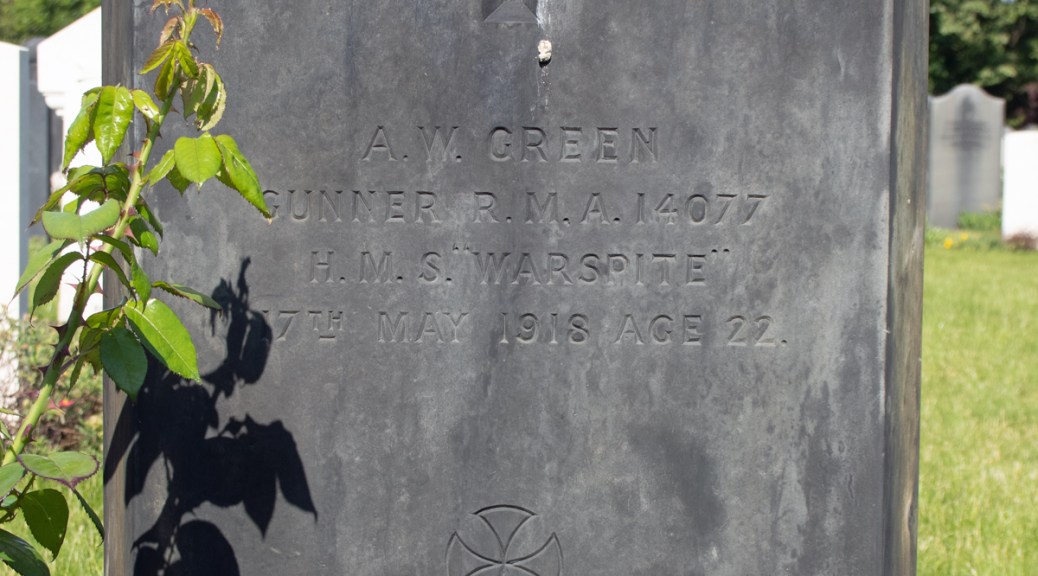
Arthur William Green was born on 27th August 1896, the middle of five children to William and Mary Green. William was a shoemaker, who was employed at the Clark’s factory in Street, Somerset, and this is where the family were born and raised.
Clark’s was the key employer in Street and, by the time of the 1911 census, five of the Green family were working for them. This included the 15 year old Arthur, whose job was a shoe cutter.
When war came to Europe, Arthur had already stepped up to play his part. He enlisted in the Royal Marine Artillery in March 1914. His service records confirm that he was 5ft 8ins (1.72m) tall, with brown hair, blue eyes and a fresh complexion. He was also noted as having a scar on the back of his neck.
Private Green was initially under age for service in the regiment, only coming of age at the end of August 1914. He initially completed his training either in Chatham, Kent, or Plymouth, Devon, becoming a Gunner on 5th February 1915. That spring he was assigned to the battleship HMS Warspite, and would remain on board for the next four years.
In February 1918, Gunner Green was assigned to the 4th Battalion of the Royal Marines. Still serving on Warspite, on 23rd April he was involved in the Raid on Zeebrugge. A combined action by the Royal Navy and Royal Marines, the aim was to block the entrance to the port of Bruges-Zeebrugge by sinking obsolete ships. A total of 1700 men were involved, and, in the ensuing battle, some 200 were killed and 400 wounded.
Gunner Green was one of those who was injured in the battle. When the Warspite returned home, he was admitted to the Royal Naval Hospital in Chatham, Kent, but his injuries were to prove too severe for him to overcome. He passed away on 17th May 1918, at the age of just 21 years old.
Arthur William Green was laid to rest in Woodlands Cemetery, Gillingham, not far from the Chatham base he had briefly known as home.
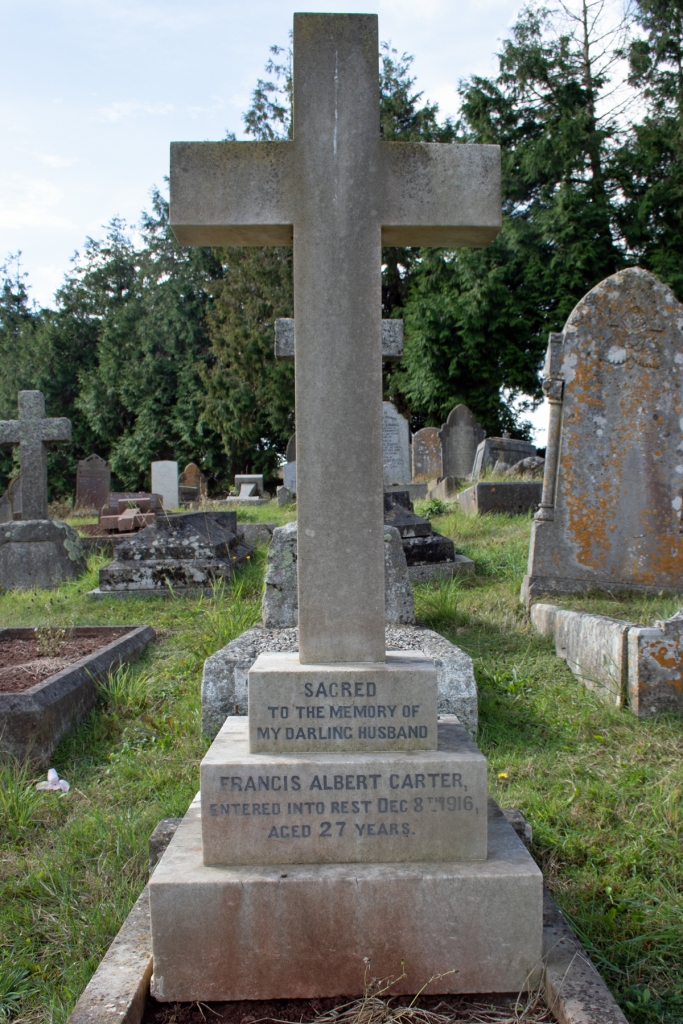
An inquest was held at Plymouth on Monday on Francis Albert Carter, 27, [Royal Garrison Artillery], late of 45 Lang-road, Paignton, auctioneer and valuer. Deceased was visiting his wife, who was staying with friends at St Hilary-terrace, St Jude’s, Plymouth, on the 8th inst., and died suddenly. Dr Ward said death was due to valvular disease of the heart. Deceased had only been in the artillery about three weeks. Deceased… was formerly in business with his brother as a house and estate agent…
[Western Times: Friday 15th December 1916]
Tracing the details of Francis Albert Carter’s life is a bit of a challenge, although the 1911 census records him living at 11 Shirburn Terrace, Torquay, Devon. At 21 years of age, he is noted as having been born in Lezayre, on the Isle of Man. He was living with his mother – the widow Sarah Carter, who was living on independent means – and his brother, 14-year-old Louis, who had been born in Halifax, Yorkshire. Francis was employed as a house agent, while Louis seems to have been his apprentice.
The previous census had recorded the family of three living in Torquay, and confirms that Sarah had been widowed by the time her youngest was four years old.
There is no information about Francis’ marriage, nor any indications as to who his wife might have been.
With regard to his time in the army, it is clear that he enlisted in the Royal Garrison Artillery as a Gunner in November 1916, and was on a break from his training when he visited his wife and her friends on the day he died.
There is little more detail available for Francis Albert Carter. He was laid to rest in Paignton’s sweeping cemetery, not far from where his mother and brother were still living.
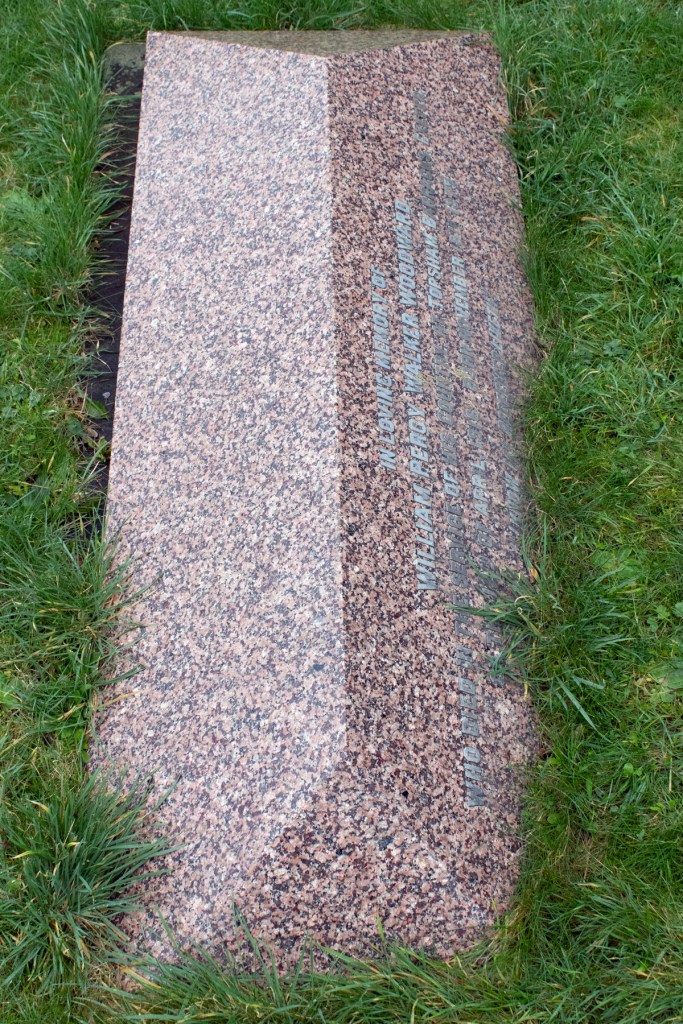
William Percy Walker Woodward was born on 18th November 1879, and was the third of six children to James and Mary Woodward. James was a manufacturer of sanitaryware and had been born in Derbyshire, but it was in Ashby-de-la-Zouch, Leicestershire that he and Mary raised their family.
James passed away in the spring of 1886, leaving Mary to raise the family on her own. His obituary in the local media underlined the business that he had built up: “Mr Woodward succeeded his father and eldest brother to the fire brick business, established by the late Mr John Hunt of Swadlincote, of 1790.In 1856 Mr Woodward added to the above trade that of glazed sewerage pipe and terra cotta earthenware, and in 1873 that of general sanitary appliances, and by industry, perseverance, and foresight developed the same into one of the largest manufactories of the kind in the Midland counties, and became well known throughout the greater part of the kingdom as a leading manufacturer of these goods. He was a large employer of labour, kind and considerate, always manifesting great interest in the welfare of his employees.” [Hinckley News – Saturday 15 May 1886]
Mary was left to raise six children, but, thanks to the business, did not do so without support. The 1891 census found the family living at High Fields in Ashby, with a cook, housemaid, children’s maid and a coachman and his family living next door. William and his siblings were all taught at home by their governess.
By the time of the next census, William seemed to have taken on the running of his late father’s business, along with two of his brothers, James and Harold. Things were to change for the Woodward family, however, as they began to go their separate ways.
The 1911 censes shows a divide: James was living on his own means in Snarestone, Leicestershire, with his young family and household retinue. Harold, meanwhile, had emigrated to Canada with another sibling, younger brother Ernest, where they had both set up as farmers.
Mary had also moved, setting up home in Weston-super-Mare, Somerset. She lived on Clarence Road South with William and her daughter, Lilian. The house – Glencathara – was twelve-roomed property, and they had a live0in cook, Emily Young, supporting them. Notably, William’s employment was listed as ‘none, on account of health’, so the move to the coast may have been brought about for medical reasons.
When war came to Europe in summer of 1914, William stepped up to play his part. His service records have been lost, but he had enlisted in the Royal Field Artillery no earlier than the autumn of 1915. He was attached to the 18th Reserve Battery, and came to be based in Topsham Barracks in Exeter.
Little is known of Gunner Woodward’s time in the army, but it was to be brief. He passed away, through causes unknown, on 13th April 1916, at the age of 36.
It is unclear where Mary was living at this point. The body of William Percy Walker Woodward was taken to Dorset for burial, and he was laid to rest in the peaceful graveyard of St Hippolyte’s Church, in Ryme Intrinseca. Interestingly, the parish records note that William was ‘a personal friend of [the] rector’.
In a corner of the peaceful St Mary’s Churchyard in Codford, Wiltshire, is a headstone dedicated to L/17062 Gunner K Marsh. He served in the Royal Field Artillery, and passed away on 5th January 1916.
Gunner Marsh’s entry in the Army Register of Soldier’s Effects gives his first name – Kei – and that of his widow – Edith. The parish record for his funeral giving an age of 34 years old, and from here it is possible to piece together some of his family’s past.
Kei was born in Burnley, Lancashire, in the autumn of 1882, and was the son of engineer Alfred Marsh. He and Edith married in 1907, and were living with her widowed mother, Sarah, and their three children, John, Sarah and Edith, by the time of the 1911 census. The house – 30 Thorn Street in Burnley – was crowded. Along with the Marshes, Sarah also had her other six children living with her: a total of eight adults and four children sharing four rooms in the small terraced house.
Kei was working as a miner by this point, but had enlisted in the Royal Field Artillery by the summer of 1915. He acted as a Gunner in the 32nd Division Ammunition Column, although it is unclear whether or not he spent any time overseas.
By the end of 1915, Gunner Marsh had been admitted to the military hospital in Codford. The cause of his admission is unclear, but it was to be one that he was to succumb to: he passed away on 5th January 1916. Kei lies at rest in the quiet Wiltshire churchyard.