Tag Archives: history

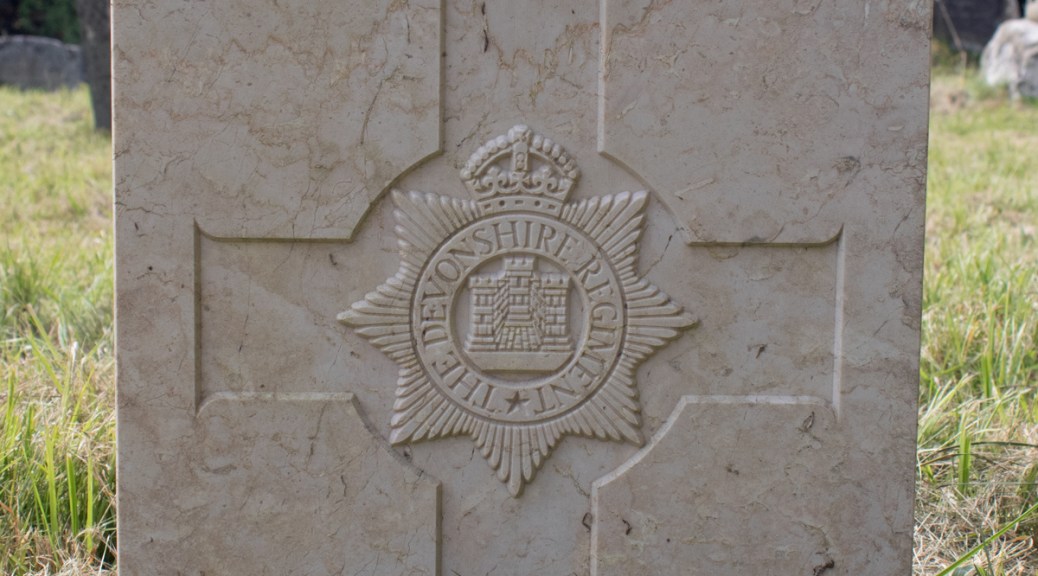
Private James Burge

Private James Burge

James Thomas Burge was born in Plymouth, Devon, in the summer of 1887. The oldest of five children, his parents were sawyer James Burge and his wife, Alice. James Sr moved the family to where the work took him: by the time of the 1901 census, the Burges had lived in and around the Plymouth area, including Devonport and Stonehouse. They settled in Ashburton, Devon, and the document found them living on Mill Lane.

When James Jr finished his schooling, he found work as a mill hand. By 1911, he had moved to Buckfastleigh, and was living with the Crook family on Silver Street. Henry Crook was a mason’s labourer, while he and his wife Bessie had three children, Hilda, Ada and Ruby. Living with them when the census was taken, were Bessie’s widowed brother Samuel, his daughter, Bessie, and three boarders, including James.

There are two intriguing things about this census document. The first is that of James’ employment. While he was recorded as being a mill hand, it is evident from his service records that he had enlisted in the 5th (Prince of Wales’) Battalion of the Devonshire Regiment by this point. He had completed training on Salisbury Plain in August 1910, and would undertake further instruction in the summer of 1911, but in between times, he remained on reserve status, and would have needed to earn money.

The second point of interest is that his service records noted that, by the time he was formally mobilised in August 1914, he was married to a woman called Hilda, who lived on Silver Street in Buckfastleigh. While there are no documents available to fully confirm this, it seems likely that this Hilda was Hilda Crook, the daughter of the family James was boarding with in 1911.

Once embodied, Private Burge’s time in the army took him around the world. By October 1914, his unit had been sent to India, and he would remain there for the next eighteen months. After a two-month stint on home soil, he returned to India, before his unit moved to Egypt in March 1917.

On 7th November 1917, while advancing on the enemy forces in Gaza James was struck in his right leg by a fragment of shell. He was wounded near the top of his fibula and, after initially being treated in the field hospital, he was evacuated to Alexandria, Egypt, for treatment. He was operated on, but from that point on had difficulty walking.

Private Burge was transferred to the 4th Reserve Depot, but his injury prevented him from undertaking many of the duties required of him. He was recommended for permanent transfer to England. Ultimately, however, his wound proved too severe, and he was formally discharged from military service on 25th February 1919.

At this point, James’ trail goes cold. He returned to Buckfastleigh, but would not be back on civvy street for long. He passed away on 22nd May 1919, at the age of 31 years old.

James Thomas Burge was laid to rest in the graveyard of Holy Trinity Church, in the Devon town he had made his home.


Captain Robert Graves

Captain Robert Graves

Robert Kennedy Grogan Graves was born on 1st January 1878. An announcement in the local newspaper confirmed that “at Baronne Court, County Tipperary, the wife of Lieutenant-Colonel W. Grogan Graves, 82nd Regiment, of a son (prematurely).” Robert was the older of two children, while his parents were William Graves, a Justice of the Peace in Ireland, and his wife, Georgianna Graves.

William died in 1890, and Georgianna moved the family to London. The 1891 census found her residing at the Golden Hotel in St Martin in the Fields, while her two boys, Robert and his younger brother, Geoffrey, were boarding students at Francis Napier’s classics school on Shooter’s Hill Road in Kidbrooke, Kent.

Robert found his calling through education. He studied medicine, and by January 1896 he was a student at St George’s Hospital in Tooting, Surrey.

By 1906 Robert had set himself up in an infirmary on Southgate Street in Gloucester, Gloucestershire. That same year, he married Kathleen Schofield: the couple went on to have two children, Robert Jr in 1912, and Bernard the following year.

Graves, Robt. Kennedy Grogan, Scison Lodge, Clevedon, Somerset (Tel. 11 Y Clevedon) – MRCS, LRCP London 1904; (St Geo.); Hon, Med, Off. Clevedon Cott. Hosp.; Med. Off Mutual Insur. N.Y. & Clevedon Hydro. Estab.; late Sen. Ho. Surg. & Asst. Ho. Surg., & Surg. Gloucester Co. Infirm., & Asst. Med. Regist. & Obst. Clerk St Geo. Hosp.

[The Medical Directory, 1910]

Robert had set himself up well during his life. The 1911 census found him and Kathleen – who was better known by her middle name, Gladys – living in their 17-room house on Linden Road in Clevedon. They afforded themselves three servants, including a housemaid, a cook and a motor driver. By the outbreak of war, Robert has an entry in the town’s Kelly’s Directory, and seemed to be a focal member of the community, joining the local Grand Lodge in September 1908.

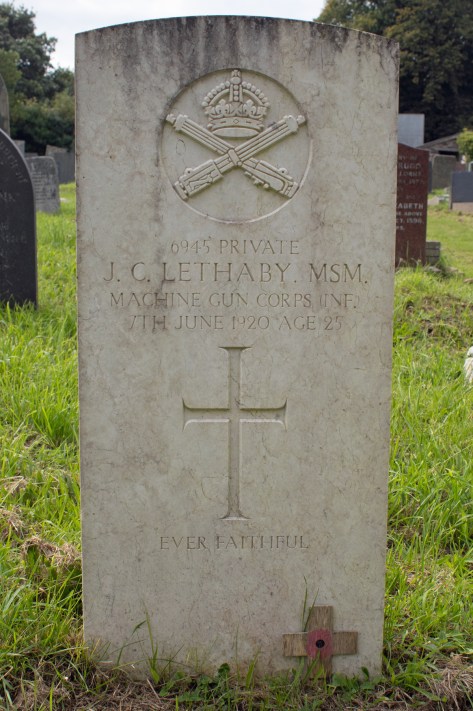
Robert’s time in the army, is hard to piece together. He joined the Royal Army Medical Corps as a Captain, and appears to have been connected to the air force. His headstone suggests that he served in Mesopotamia, but when and exactly where, however, is lost to time.

After the war, Robert returned to Britain. Leaving the Somerset coast, however, he and Kathleen appear to have set themselves up in Dorset. He died, through causes not detailed, on 12th December 1920, at 42 years of age. His entry on the probate register states:

GRAVES Robert Kennedy Grogan of 1 Charnwood Chambers Seabourne-road West Southbourne Hampshire died 12 December 1920 at The Grange Buckfastleigh Devonshire…

It is unclear whether Charnwood Chambers was his working address, with The Grange being the family’s official home, or if Buckfastleigh served as a place of convalescence.

Robert Kennedy Grogan Graves left an estate totalling £370 14s 7d (approximately £21,100 today) to Kathleen. He was buried in the graveyard of Holy Trinity church, Buckfastleigh.


Stoker 2nd Class Herbert Andrews

Stoker 2nd Class Herbert Andrews

Herbert Andrews was born on 9th December 1890 in the Devon village of Buckfastleigh. One of nine children, his parents were William and Elizabeth Andrews. William worked at a local woollen factory, and the family initially lived on Silver Street in the village before moving to Market Street by the turn of the century.

Herbert does not appear on the 1911 census, and at this point William and Elizabeth, both in their 60s, were living on their own. Interestingly, the census inadvertently reveals neither may have been able to write: the return was completed by James Dyer, who lived at 5 Plymouth Road in the village.

The next document available for Herbert relates to his military service. When war broke out, he seems to have quickly stepped up to play his part, giving up his job as a gardener to enlist in the Royal Navy on 7th January 1915. His records confirm that he was 5ft 11ins (1.8m) tall, with black hair, hazel eyes and a fresh complexion. He was also noted as having an operation scar for appendicitis.

Stoker 2nd Class Andrews was initially sent to HMS Vivid, the Royal Naval Dockyard in Devonport, for training. This did not seem to go smoothly, and on 9th May he was detained for 21 days for disobeying orders and being insolent.

On 6th June, Herbert was assigned to the battleship HMS Marlborough. Again, however, this posting did not last for long, and mental health issues may have come to the surface. By 1st July 1915, Stoker Andrews was back ashore in the Royal Naval Hospital in Plymouth, Devon. Within a matter of weeks, he was medically discharged from the navy, and was “discharged to Exminster Asylum on 1.9.15 as a dangerous lunatic.”

At this point, Herbert’s trail goes cold. He passed away on 21st August 1916, at the age of 25 years old. It seems likely that he was still admitted to the mental institution when he died, as his death was registered in Exeter.

Herbert Andrew’s body was taken back to Buckfastleigh for burial. He was laid to rest in the graveyard of the town’s Holy Trinity Churchyard, alongside his brother, Henry, who had died fifteen years before.


Private Arthur Shute

Private Arthur Shute

Arthur Henry Shute was born on 13th February 1893 in Buckfastleigh, Devon. The younger of two children, he was the only son to Henry and Elizabeth Shute. Henry was a baker, and this trade soon took the family to Cirencester, Gloucestershire, where they had set up home by the time of the 1901 census.

Cirencester certainly suited the Shute family, and they remained at 107 Dyer Street for at least ten years. Arthur was set on learning the business, and the 1911 census found him as one of four apprentices to George Cox, a flour confectioner based in Hastings, Sussex.

New things were on the horizon, however, and Henry was evidently set on a better life for his family. On 10th May 1912, the family boarded the SS Victorian, destined for a fresh start in Canada. The Shutes eventually set up home at 118, 4 Avenue West in Calgary, Henry becoming a chef, and Arthur a baker.

Within a few years, the world was at war, and Arthur would step up to play his part. He enlisted on 13th September 1915, and wold be assigned to the Canadian Army Service Corps. His service records show that he was 6ft 0.5ins (1.84m) tall, with dark brown hair, brown eyes and a dark complexion. The document also highlighted three years’ voluntary service with the 5th Gloucestershire Regiment.

Private Shute’s unit arrived back in Britain on 6th November 1915. Sent to a base in Shorncliffe, Kent, Arthur was transferred to the 3rd Field Bakery, taking up a role suited to his skills. In March 1916, his unit was sent to France, and he remained there for the next five months.

Arthur’s time in the army seems to have been beset by illness. He was admitted to hospital on 12th August 1916, having come down with influenza, and he was medically evacuated to Britain to recuperate. Arthur would not be discharged for another six weeks, and only returned to the base in Shorncliffe on 3rd October.

From this point on, Private Shute remained on British soil, and he would remain in Shorncliffe for the remainder of the conflict and beyond the Armistice. In January 1919, he was admitted to the No. 14 Canadian General Hospital in Eastbourne, again suffering from influenza, but this time the condition would prove to be fatal. He passed away on 5th February 1919, a week short of his 26th birthday.

With his immediate family living thousands of miles away in Canada, Arthur Henry Shute’s body was taken back to the town of his birth for burial. He was laid to rest in the graveyard of Holy Trinity Church in Buckfastleigh.


Ship’s Corporal 1st Class Thomas Barnes

Ship’s Corporal 1st Class Thomas Barnes

Thomas Henry Barnes was born on 19th September 1878 in the Devon village of Blackawton. One of four children, his parents were Thomas and Thirza Barnes. Thomas Sr was a farmworker who passed away in 1890: the following year’s census found Thirza and her three younger children living in Silver Street, Buckfastleigh, Devon.

Keen to earn enough money to support his mother, Thomas found work on a farm. He sought a career, however, and, on 11th March 1896, he enlisted in the Royal Navy. Six months short of the age to formally join up, he was given the rank of Boy 2nd Class, and was sent to the training ship HMS Northampton. He spent those six months wisely, however, rising to Boy 2st Class in June and was given the rank of Ordinary Seaman when he came of age in September.

By this point, Thomas had been moved to HMS Vivid, the Royal Naval Dockyard in Devonport. His service records show that he was 5ft 5.5ins (1.66m) tall, with brown hair, blue eyes and a fair complexion. He was also noted as having a tattoo of an anchor on his right arm.

Over the next few weeks, Ordinary Seaman Barnes moved from Vivid to HMS Victory, the Navy’s dockyard in Portsmouth, Hampshire, and back again. On 13th January 1897 he was given his first formal posting, on board the cruiser HMS Bellona, and from here his naval career flourished.

Thomas’ initial contract of service was for twelve years, and during this time he proved a committed and determined young man. During the term of his enlistment, he served on six ships, returning to Devonport between voyage. He did not rest on his laurels, either, and worked his way through the ranks. In August 1898 he was promoted to Able Seaman, and in May 1902 he made Leading Seaman.

Away from the sea, love was blossoming for Thomas. In January 1903 he married Alice Percy. The daughter of a paper mill fitter, she would spend her married life with her parents, while her husband was away at sea.

Leading Seaman Barnes’ career continued its upward trajectory: in April 1904 he was promoted again, this time to Petty Officer 2nd Class. When his contract came to an end in September 1908, it was inevitable that he would renew it. His service records show that, at 30 years of age, he was now 5ft 8ins (1.73m) tall.

In February 1909, Thomas was promoted to Petty Officer 1st Class: at this point he was serving on his ninth ship, HMS Ramillies. With his next move, to the armoured cruiser HMS Suffolk, came another change in rank. The now Ship’s Corporal 1st Class Barnes’ career was doing well, and his annual reviews confirmed this, regularly highlighting a character that was very good.

By August 1915, Thomas had spent nearly two years aboard the battleship HMS Temeraire. She would go on to play a role in the Battle of Jutland, but Ship’s Corporal Barnes would not be there. Disembarked to HMS Vivid on 13th August, he was subsequently admitted to the Royal Naval Hospital in Plymouth, suffering from a cerebral thrombosis. This would prove fatal: he died on 26th October 1915, at the age of 37 years old.

The body of Thomas Henry Barnes was taken back to Buckfastleigh for burial. He was laid to rest in the village’s Holy Trinity Churchyard.


Engine Room Artificer 3rd Class Gerald Bowerman

Engine Room Artificer 3rd Class Gerald Bowerman

A distressing fatality, involving the death of a member of the crew of HM destroyer “Rifleman”, and injury to two others, occurred at the harbour where his ship was on Saturday night. A party of four – one civilian and three Navy men – were on a motor cycle and side-car on their way to Provost Matthews’ Quay, from which the sailors were to join their ship. The cyclist, who was controlling the machine in the darkness of the night, failed to observe that the bridge at the dock gates was open to allow a vessel to pass out to sea. The motor cycle collided with the obstruction, with the result that the machine and side-car swerves round, and plunged headlong into the well from which the bridge swings.

The result of the accident was that Gerald Bowerman (25), engine-room artificer, fractured his skull, while his two ship-mates, Charles Morrice, chief engine-room artificer, and James Fulthorpe, engine-room artificer, were somewhat severely injured. Deceased belonged to Buckfastleigh, his residence being the Mechanics’ Arms.

[Western Times: Friday 25th September 1914]

Gerald Bowerman was born in Buckfastleigh, Devon, on 30th October 1888. The youngest of four children, his parents were James and Augusta Bowerman. James was a jack-of-all-trades, with the 1891 census noting that he worked as a grocer, coal dealer and cab proprietor, with his wife assisting in the business.

James seemed to seek out new opportunities, and, by the time of the next census, taken in 1901, the family had moved to Exeter, and were running the Red Cow Inn at the foot of St David’s Hill.

Gerald’s older brother, Harold, joined the navy in 1906, and his sibling was not to be outdone. By 1910, James and Augusta had moved back to Buckfastleigh, and were running the Mechanic’s Arms. Gerald, however, was drawn to the sea and gave up his employment as a fitter and turner to enlisted in the Royal Navy on 14th September 1910. His service records show that he was 5ft 6ins (1.68m) tall, with brown hair, brown eyes and a fresh complexion.

Engine Room Artificer 4th Class Bowerman was first sent to HMS Vivid, the Royal Naval Dockyard in Devonport, for his training. He joined the battleship HMS Bellerophon in February 1911, and she would be his home for the next two years.

After another short spell in Devonport, Gerald transferred to HMS Caesar, then to the depot ship HMS Blake, to which he was assigned on 30th August 1913. The following month he was promoted to Engine Room Artificer 3rd Class, and would remain on board Blake through to the outbreak of war the following year.

Engine Room Artificer Bowerman’s ship was based in Aberdeen when the motorcycle accident occurred. He was just 25 years of age when he died, on 20th September 1914.

Gerald Bowerman’s body was taken back to Devon for burial. He was laid to rest in the graveyard of Holy Trinity Church in his home town of Buckfastleigh.


Private Garfield Peardon

Private Garfield Peardon

Garfield Ambrose Peardon was born on 24th February 1899, the older of two children to William and Margaret. Both farm labourer William, who had been widowed in 1885, and his second wife, Margaret were from Devon. The 1891 census found the extended family – Garfield and his parents and his older half-brother, William Jr., living in Market Street, Buckfastleigh.

Ten years later, and the family had moved just up the road to Market Street. Both of Garfield’s parents were working for the local woollen mill, William as a horseman and Margaret as a serge weaver. Garfield and his younger brother, Eric, were too young to work, and were both still at school.

Garfield stepped up to play his part for King and Country, although details of his service are a bit of a mystery. He had certainly enlisted by the start of 1918, presumably as soon as he came of age. He joined the Worcestershire Regiment, and was attached to the 3rd Battalion.

Private Peardon served in France, and was likely involved in the Battles of the Somme and Lys in the spring of 1918. His pension ledger records note that, on 27th May, he was recorded as ‘missing’: this was the day of a massive German gas and artillery bombardment and, in the confusion that followed, it appears that Garfield was identified as a potential casualty.

At this point, Private Peardon’s trail goes cold. The next available document is his entry on the Army Register of Soldiers’ Effects: this confirms that he passed away on 28th January 1919 in the 2nd Scottish General Hospital in Edinburgh. This would suggest that Garfield was wounded in the attack, and medically evacuated to Britain for treatment. He was a month short of his 20th birthday when he died.

The body of Garfield Ambrose Peardon was taken back to Devon for burial. He was laid to rest in the the grounds of Holy Trinity Church, Buckfastleigh.


Private William Allen

Private William Allen

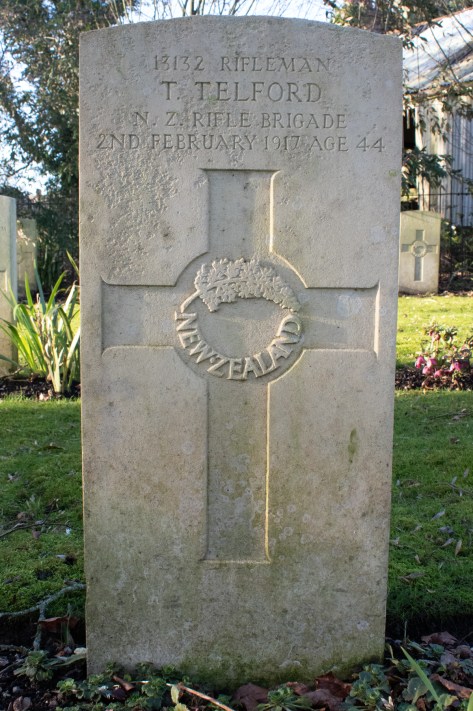
William Allen was born on 24th June 1888, and was the third of ten children to Joseph and Leah. The family lived in Oxford, on New Zealand’s South Island, and when Leah passed away in 1900, Joseph married again, and William soon had four half-siblings.

When he finished his schooling, William found employment as a labourer. At the outbreak of war, William was called to play his part, and he enlisted on 26th July 1916. His service documents note that he was small of stature, just 5ft 2ins (1.57m) tall, and weighing 120lbs (54.4kg). A Baptist, he had dark hair, brown eyes and a dark complexion.

Private Allen was assigned to the New Zealand Canterbury Regiment. His unit departed from Wellington for the ten week journey to Britain, the SS Tahiti finally docking in Devonport, Devon, on 29th January 1917. From here the battalion marched to Codford, Wiltshire, where the developing ANZAC base was located.

Tragically for William, this would be the last stage of his journey. After weeks at sea, in cramped conditions, the incoming troops found they were battling a different enemy from the one they had expected. Many fell ill, and this included Private Allen. He was admitted to the No. 3 New Zealand General Hospital, which was connected to the base, with pneumonia on 19th February 1917. Treatment proved too little, too late, however, and he passed away just four days later, on 23rd February. He was just 28 years of age.

William Allen was laid to rest in the ANZAC extension to St Mary’s Churchyard, Codford, not far from where he had breathed his last.


Private Gordon McDonald

Private Gordon McDonald

Gordon McDonald was born on 28th January 1893 in Pongaroa, New Zealand. The youngest of six children, and the only son, his parents were Scottish-born farmers John and Helen – or Ellen – McDonald.

Little information is available about Gordon’s early life. When he completed his schooling, he went into agricultural work, and this was his employment when, on 27th June 1916, he answered the call to play a part in a conflict on the other side of the globe.

Gordon’s service papers show that he would have been an imposing figure of a man. He was 6ft 3ins (1.91m) tall, and weighed 160lbs (72.6kg). A Presbyterian, he had brown hair, blue eyes and a medium complexion. He was also noted as having two scars, one on the outside of his right forearm, the other on his left thumb.

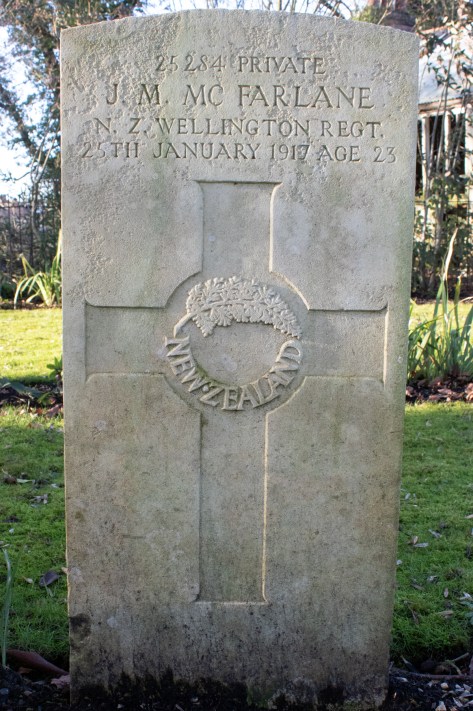
Assigned to the New Zealand Wellington Regiment, Private McDonald’s unit left the country of his birth on 16th October 1916. The SS Willochra would take two-and-a-half months to reach Britain, arriving in Devonport, Devon, on 29th December. From there Gordon and his unit were sent to Codford, Wiltshire, where their ANZAC base was set up.

Private McDonald’s time in Britain was to be tragically brief. At this point in the war, disease was rife in the Codford billets, and he was not to be immune to its effects. On 13th February 1917, he was admitted to the No. 3 New Zealand General Hospital, attached to the camp, with tubercular meningitis. The condition would prove too severe, and he passed away on 5th March 1917. He was 24 years of age.

Gordon McDonald was laid to rest in the ANZAC graveyard extension to St Mary’s Church in Codford, close to the camp where he had breathed his last.


Private Gordon McDonald
(from findagrave.com)

Private Walter Watson

Private Walter Watson

Walter Robert Watson was born in Wai-Iti, to the south of Nelson, New Zealand, on 12th November 1889. The third of four children, his parents were Edward and Eliza Watson.

When he finished his schooling, Walter found farming work, and this is what he was doing when, in the spring of 1916, he married Beatrice Godbaz. By this point war was raging across Europe, and it seems likely that the couple exchanged vows ahead of his departure for the conflict.

Walter joined up on 26th July 1916, and, as a Private, was assigned to the New Zealand Canterbury Regiment. His service records show that he was 6ft (1.83m) tall and 161lbs (73kg) in weight. A Methodist by religion, he had fair hair, blue-grey eyes and a fair complexion.

Private Watson’s unit departed for Britain on 15th November 1916. Leaving from Wellington on board the SS Tahiti, the journey would take nearly three months. The Canterbury Regiment arrived in Devonport, Devon, on 29th January 1917, and from there the unit moved to their camp on the outskirts of Codford, in Wiltshire.

Walter was feeling every mile of the journey by this point. He contracted lobar pneumonia, and was admitted to the No. 3 New Zealand General Hospital on the outskirts of the camp. The condition was to prove fatal: Private Watson passed away on 20th March 1917, at the age of just 27 years old.

Walter Robert Watson was laid to rest in the ANZAC graveyard extension to St Mary’s Church in Codford.


Private Walter Watson
(from findagrave.com)

Walter’s younger brother, Herbert, had taken a different path in life. Also a farmer, he had volunteered in the 12th Nelson Regiment. When war broke out, he was one of the first to enlist, joining the Canterbury Mounted Rifles on 15th August 1914.

By December that year, his unit had left New Zealand and arrived in Egypt. On the subsequent journey to Britain, Herbert became unwell, and he was admitted to the General Hospital in Gibraltar with dysentery. The condition would prove his undoing, and Trooper Herbert Watson passed away on 30th August 1915, at the age of just 24 years old.

Herbert Percy Watson was buried in Gibraltar’s North Front Cemetery.


Trooper Herbert Watson
(from findagrave.com)