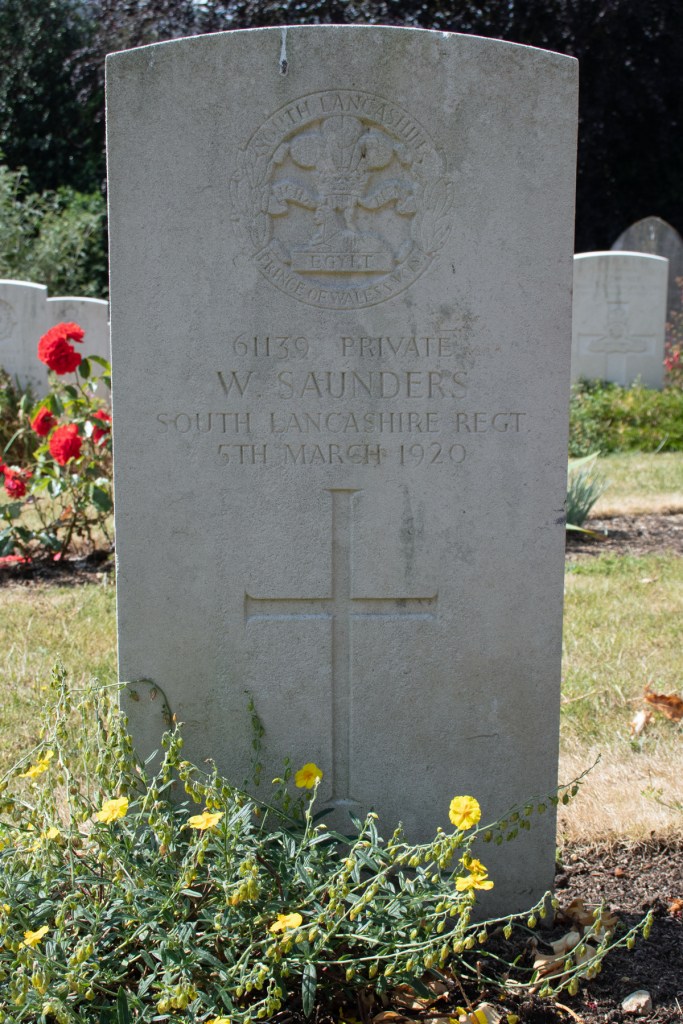
There is little concrete information about the life of Walter Saunders, and what details are available come from his limited military documents. These confirm that he was born in December 1862 in Widcombe, near Bath, Somerset.
Walter was unemployed labourer when enlisted in the army in January 1882. He joined the Somerset Light Infantry, and was attached to the 4th Battalion. His service records show that he was just under 5ft 5ins (1.64m) tall, with brown hair, hazel eyes and a fresh complexion. He was also notes as having a scar on his abdomen.
Private Saunders seems to have served in southern Asia, receiving the India medal and Burma 1885-1887 clasp. He then moved to South Africa, and was caught up in the Second Boer War. There is no further information about his initial time in the army.
When his contract came to an end, it would seem that Walter returned to the UK, finding work as a dock labourer in South Wales. When war came to Europe, though, he stepped up once more so serve his country, this time joining the South Lancashire Regiment. He was assigned to the 15th (Transport Workers’) Battalion, which served in the Mersey dockyards.
The next record for Private Saunders comes from June 1917, when he was sent to a medical board. He had been unwell for a while, it seems, and was suffering from arteriosclerosis, or hardened arteries. The medical report confirmed this was a permanent condition, and that he was no longer fit for military service.
At this point, Walter’s trail goes cold. It seems likely that he returned to Somerset, possibly still having family connections there. He passed away on 5th March 1920. He was 57 years of age.
Walter Saunders was was laid to rest in the military section of Bath’s sweeping Locksbrook Cemetery.
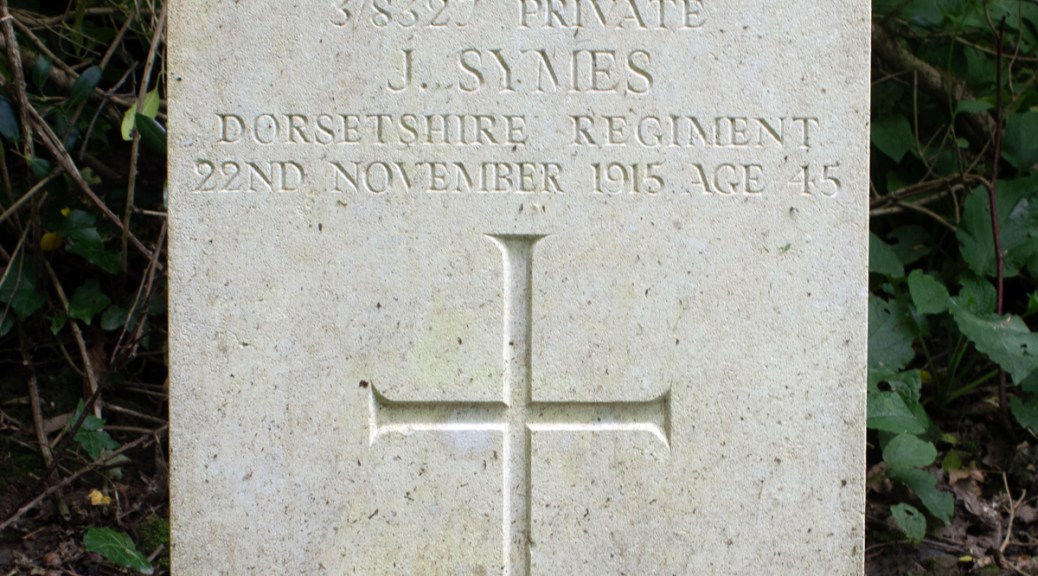
Joseph Symes was born in the spring of 1871, and was the oldest of four children to William and Sarah. William was a farm labourer from Stoke Abbot in Dorset, and it was here that the family were born and raised. They set up home with Sarah’s parents, and were recorded as living with them in the 1871 census, and with Sarah’s widowed mother in the 1881 record.
William had died by the time the 1891 census return was taken, and Sarah took up work as a mill hand. The document found her living in the village of Netherbury, a few miles to the south east of Stoke Abbott, with her three younger children, William, Alice and Mary Ann. Joseph was noticeable by his absence, but later documents confirm that he had enlisted in the Dorsetshire Regiment by this point, and was likely serving overseas.
Joseph had returned to England by the turn of the century, setting up home back in Netherbury. On 24th September 1910, he married Sarah Jane Dunsbury in Beaminster parish church. The daughter of a blacksmith, she was 13 years Joseph’s senior – 52 years old to his 39. The couple lived in Netherbury, where he was working as a mason’s labourer.
When war broke out, Joseph stepped up to play his part once more. He re-enlisted in the Dorsetshire Regiment on 1st September 1914, and was attached to the 6th Battalion. His service records confirm that he was 5ft 5.5ins (1.66m) tall and weighed 182lbs (82.6kg).
Private Symes remained on home soil during his time in the army. He switched to the 3rd (Reserve) Battalion in March 1915, which was based in and around Weymouth. In the autumn of 1915, he was admitted to the Sidney Hall Military Hospital in the town, suffering from bronchial pneumonia. The lung condition was to prove his undoing, and he passed away on 22nd November 1915, while still admitted. He was 44 years of age.
Joseph Symes was taken back to Netherbury for burial. He was laid to rest in the graveyard of St Mary’s Church in the village.
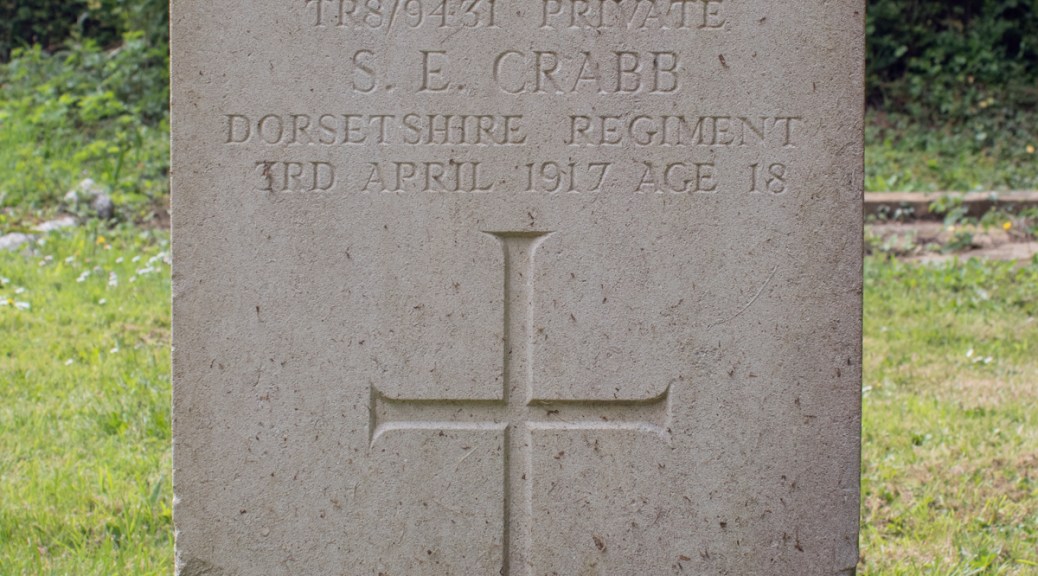
Sidney Edgar Crabb was born in the autumn of 1898 in the Dorset village of Chedington. One of ten children, his parents were shepherd-turned-farm labourer John Crabb and his wife, Mary.
Little information is available about young Sidney’s life. He was still at school when the 1911 census was taken, and was too young to enlist when war was declared in the summer of 1914. He enlisted in the Dorsetshire Regiment no earlier than October 1916, and was sent to Warminster for training.
The only other record for Private Crabb confirms his passing. He died from bronchial pneumonia while in hospital near his army camp in Warminster, Wiltshire, on 3rd April 1917. He was just 18 years of age.
Sidney Edgar Crabb’s body was taken back to Dorset for burial. He was laid to rest in the graveyard of St Mary’s Church, in his home village of Halstock. While only five of his siblings survived childhood, Sidney was the only one to pass away as a result of the conflict.
Albert William Loveless was born on 23rd February 1901, the third of four children to Albert and Matilda Loveless. Albert Sr was a hawker and marine store dealer, and the family grew up and lived in the Dorset village of Mosterton.
When he completed his schooling, Albert Jr found work as a railway porter. When war broke out, however, he was keen to play his part before the opportunity passed him by and, on 10th September 1918, he enlisted in the Royal Navy.
As he was below the age to formally enrol, Albert was given the rank of Boy 2nd Class. His service records show that he was 5ft 2.5ins (1.59m) tall, with brown hair, brown eyes and a fresh complexion.
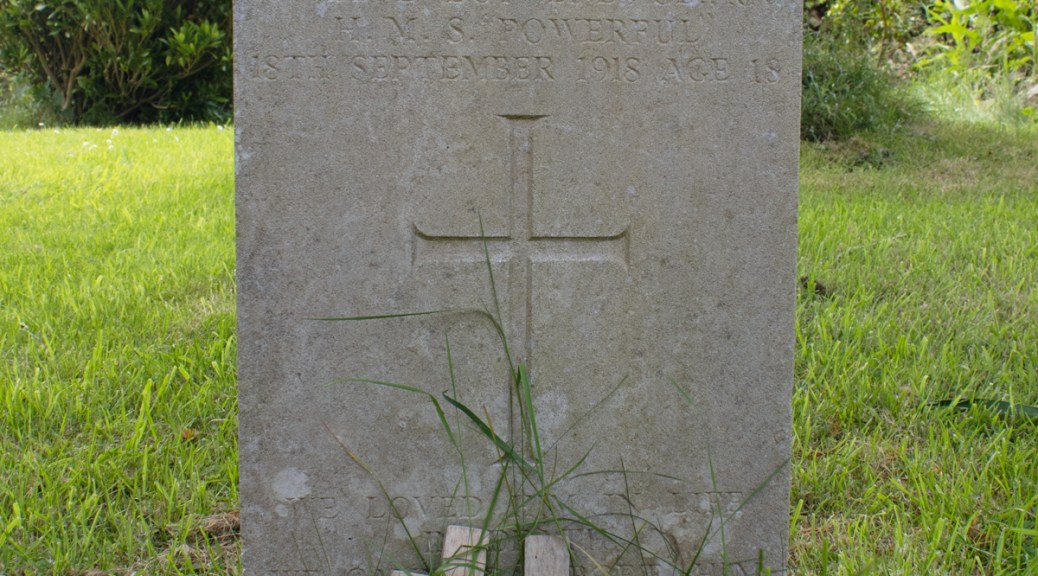
Boy Loveless was sent to HMS Powerful, a training ship based in Devonport, Devon, but sadly, his time there was to be brief. Within a matter of days, he was admitted to the Royal Naval Hospital in Plymouth, having contracted pneumonia. He passed away on 18th September 1918, having been in service for just a week. He was only 17 years of age.
The body of Albert William Loveless was taken back to Dorset for burial. He was laid to rest in the graveyard of St Mary’s Church in Mosterton, walking distance from his grieving family’s home.
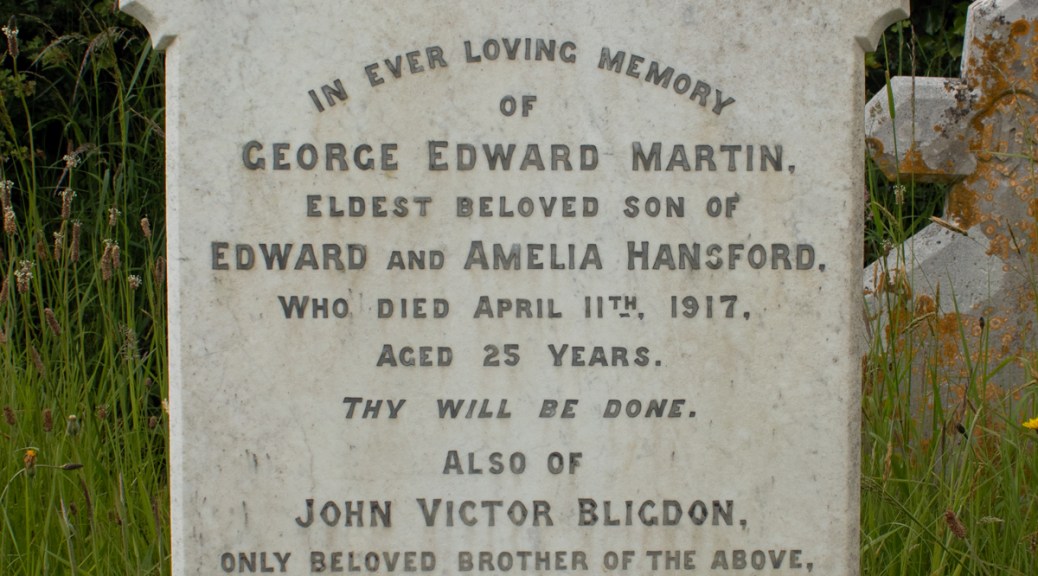
George Edward Martin Hansford was born on 25th March 1892, the second of five children – and the eldest son – to Edward and Amelia Hansford. Edward was a farmer from Netherbury in Dorset, and this is where the family were born and raised.
By the time of the 1911 census, Lower Ford Farm had become a family affair, with George and his older sister, Susannah both supporting their father in running things. War was on the horizon, however, and things were to change.
George was called upon to serve his country on 15th February 1916. He joined the Dorsetshire Regiment, and was assigned to the 2nd Battalion. He wasn’t formally mobilised until 19th January 1917, but his medical identified an underlying health condition.
Private Hansford had suffered a bout tuberculosis in 1914, and this left to his medical report confirming that his health was impacted to the point that he was medically unfit to serve in the army. Unfortunately, while awaiting the results of the report, George, who was back at home had a recurrence of the condition, and succumbed to it. He passed away on 11th April 1917, at the age of just 25 years old.
George Edward Martin Hansford was laid to rest in the graveyard of Holy Trinity Church in Salwayash, a few miles from the family home in Netherbury.
Francis James Leach was born on 27th June 1878 in the Somerset village of Martock. He was the middle of four children to John and Louisa Leach. John was a solicitor who was 17 years older than Louisa, who was his second wife, and by whom he had had two children. The 1881 census found the family living in a house called The Lawn on Church Street, supported by five servants: a nurse, an under-nurse, a cook, a housemaid and a footman.
The next census return, taken in 1891, recorded the family having moved to Seaton in Devon. Louisa was living at 7 West Cliff Terrace with five of the children and a domestic servant. John, however, is not noted on the document, although Louisa is still recorded as married, which would suggest that he had not passed away.
A later newspaper report helps build a picture of Francis’ life growing up:
…Leach was educated at Allhallows School, Honiton, was a thorough sportsman in every sense of the word, a good shot, a keen rider to hounds, a polo player, and cricketer.
[Exeter and Plymouth Gazette: Friday 7th May 1915]
When he finished his schooling, Francis felt drawn to an army career, and the newspaper confirmed his progress:
He served through the Boer War with the R Battery, Royal Horse Artillery, and was present at the relief of Kimberley and at the actions at Paardeberg, Poplar Grove, Zand River, Johannesburg, Pretoria, Diamond Hill and Wittebergen, and was awarded the Queen’s medal with six clasps and the King’s Medal with two. He was given his commission in the Shropshire Light Infantry in 1901, attained the rank of Captain last August and was appointed Adjutant of his Battalion February 2nd, 1914.
[Exeter and Plymouth Gazette: Friday 7th May 1915]
The 1911 census found Francis back with his mother. She was now living in the village of Hawkchurch, near Axminster, living in a 9-roomed house called The Vineyard. Louisa also had her daughter and two servants – a cook and a housemaid – supporting her. The census return also confirmed that Louisa was a widow, John having died some rears previously. Francis’ visit may have been a fleeting one, as his fiancée, Doris Maunsell-Smyth, was also visiting in preparation for a wedding.
Francis and Doris exchanged vows on 29th July 1911, the wedding taking place in Christ Church, Paddington, Middlesex. Their marriage certificate confirmed that the groom was an army officer, while the bride’s father, George Maunsell-Smyth, was noted simply as a gentleman.
When war broke out in the summer of 1914, Captain Leach and his unit was called up to play their part. Full details of his service have been lost to time, but he was sent to the the Western Front by December that year. Over the coming months, the battalion was involved in the Battle of Eloi and the Second Battle of Ypres.
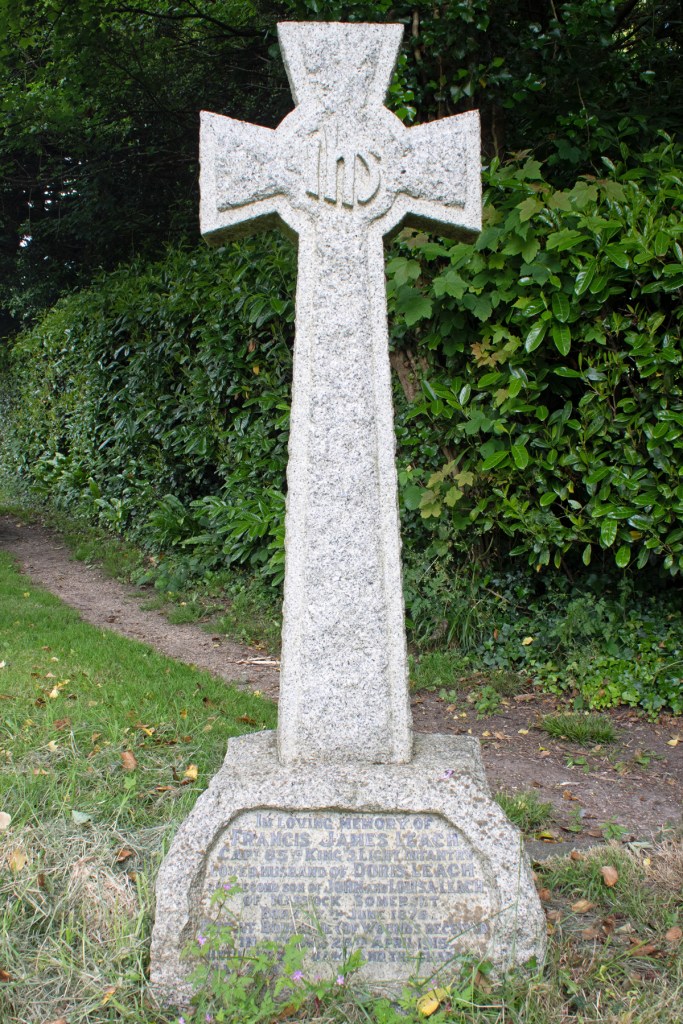
The funeral of Captain Francis Leach of the 2nd Battalion Shropshire Light Infantry, as taken place in the village churchyard amid every token of respect and sympathy. The officer died at Boulogne of wounds received in action in Flanders.
[Exeter and Plymouth Gazette: Friday 7th May 1915]
Captain Leach died of his injuries on 26th April 1915. He was 36 years of age.
Interestingly, despite a decree that the conflict’s fallen would be buried overseas if that was where they died, it seems that Captain Leach’s family were able to circumvent that ruling. Whether that was because he died in a hospital ship in Boulogne’s harbour is unclear, but had he died in the town itself, he should have been laid to rest in France.
Either way, the body of Francis James Leach was brought back to Devon for burial. He was laid to rest in the graveyard of St John the Baptist Church, Hawkchurch, not far from where his mother still lived.
Simeon James Powell was born on 18th October 1882 in Wootton Fitzpaine, Dorset. The oldest of three children, his parents were Francis and Elizabeth Powell. Elizabeth died when Simeon was just 7 years of age, and his father remarried, and went on to have five children with his new wife, Annie.
Francis was a farmer, and Simeon found employment as an estate labourer. The 1911 census found the family living on Dodpin Farm in Monkton Wyld, a village to the north of Lyme Regis: Francis, Annie, Simeon and his three younger siblings.
On 12th June 1913, Simeon married Mary Hodder. There is little information about her, but it seems the couple set up home on the outskirts of Charmouth, Dorset. Mary was six years older than her new husband, and they didn’t go on to have any children.
War was declared in the summer of 1914, and by the following autumn, Simeon had signed up to play his part. His service records confirm that he was 5ft 11ins (1.8m) tall and weighed 188lbs (85.2kg).
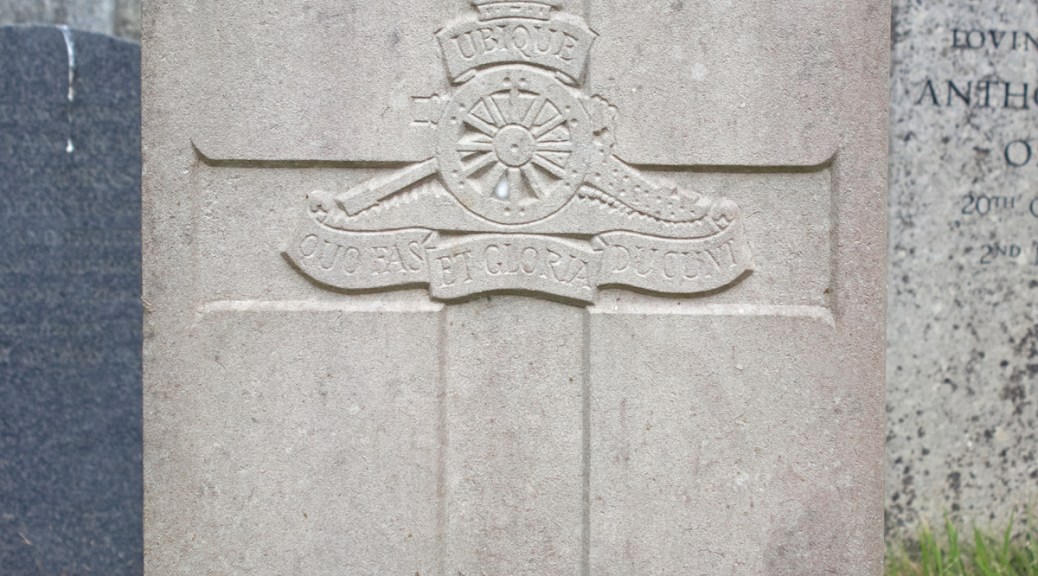
Gunner Powell joined the Royal Garrison Artillery, and was formally mobilised on 31st May 1916. By November he was sent to Malta, returning to Britain in September 1917. His new posting was in Sheerness, Kent, and he would remain there for the next nine months.
In May 1918, Simeon fell ill. He had caught influenza, and when this developed into bronchitis, he was admitted to the local war hospital. His health began to deteriorate, and, on 10th June 1918, Gunner Powell passed away from a combination of bronchitis and haemoptysis. He was 35 years of age.
The body of Simeon James Powell was taken back to Devon for burial. He was laid to rest in the graveyard of St John the Baptist Church in Hawkchurch, near the family home just across the border in Dorset.
Francis George Marchant was born in the autumn of 1894, the fourth of five children to William and Emma Marchant. William – who went by his middle name, Walter – was a gamekeeper from the village of Uplyme in Devon, and this is where the family were born and raised.
Sadly, there is little specific information about Francis’ life. When war was declared, he stepped up to play his part, joining the Coldstream Guards as a Guardsman. Attached to the Machine Gun Corps, he would have spent time overseas, but details about his time in the military are long since lost.
By the end of the conflict, Guardsman Marchant was based in Hampshire, billeted in Witley Camp. While here, for reasons unknown, he was admitted to the Connaught Military Hospital. It was here, on 4th April 1919, that he passed away: he was 24 years of age.
Francis George Marchant was taken back to Devon for burial. He was laid to rest in Uplyme’s Ss. Peter & Paul’s Church.
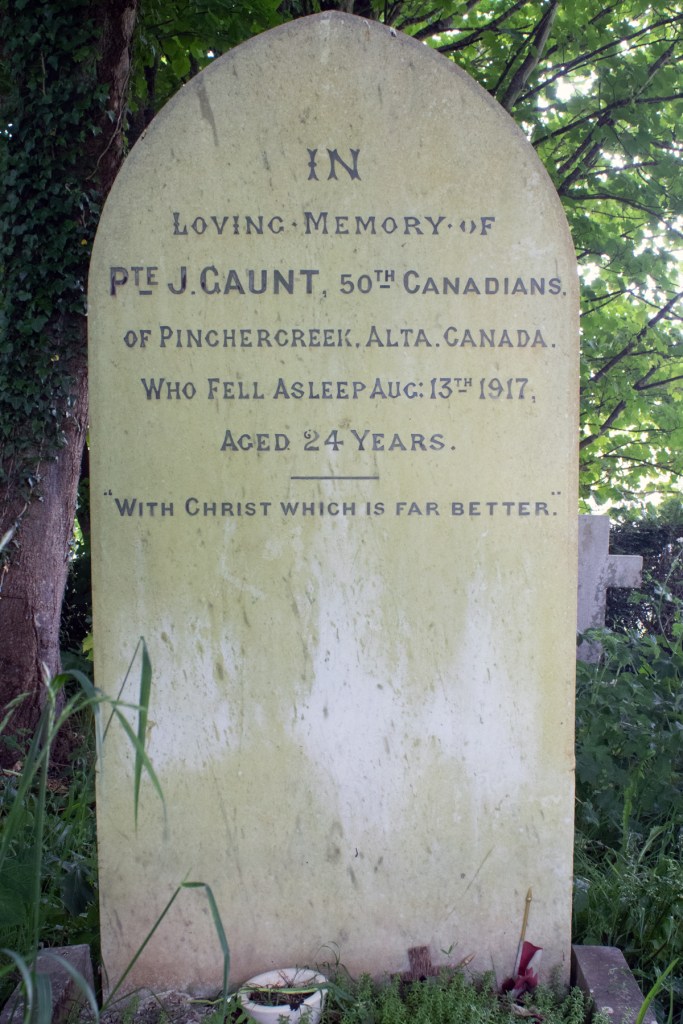
John Alfred Gaunt was born on 15th October 1893, the fourth of five children to John and Jane Gaunt. John Sr was a cattle dealer from St Ives in Huntingdonshire, and it was in the nearby village of Needingworth that the family were born and raised.
John Sr sought out opportunities to support his wife and children and, in 1902 he moved the family to Canada, settling in Pincher Creek, Alberta. There isn’t a great deal of detail available about the Gaunts’ time in North America, but it is likely that farming became their way of life.
Tragedy struck the family in October 1912, when John Sr died, at the age of 61. By this point it seems that they had moved on to British Colombia. Just six months later, Jane also died, John Jr was left an orphan while still a teenager.
Most of the family seemed to remain on the west coast – a later document shows John’s older sister Julia living in Cranbrook, British Colombia – but John was working as a farmer by this point and had either returned to Pincher Creek after his parents’ deaths, or had remained there when they went west.
When war broke out in Europe in the summer of 1914, the Empire were called upon to serve, and John was to return to the country he had left more than a decade earlier. He enlisted on 20th January 1916, joining the Canadian Expeditionary Force.
Private Gaunt’s service records show that he was 5ft 8ins (1.72m) tall, 130lbs (59kg) in weight and had light brown hair, blue eyes and a fresh complexion. It was also noted that he had a fine scar, some 3.5ins (9cm) long, on his upper left arm and had a slight defect in his speech (although this is not elaborated on).
John departed for Europe on 21st August 1916, boarding the HMS Olympic for Liverpool, Lancashire. His unit was initially based in Witley Camps near Aldershot, Hampshire, and he would remain on base until the end of the year. This included eight weeks admitted to the Connaught Hospital, when he was suffering from a bout of syphilis.
By January 1917, John was transferred to the 21st Reserve Battalion, which meant a move to Seaford, East Sussex. He transferred again to the 50th Battalion on 19th March, a move which included being shipped off to France.
Over the next couple of months, things were to change dramatically for Private Gaunt. His service records note that he was wounded on 10th May, but that he remained on duty. On 21st July, he wad admitted to the No. 11 Ambulance Station in Rouen, suffering from jaundice.
He was medically evacuated to Britain for treatment, initially to the Auxiliary Hospital in Exeter, Devon, then to Uplyme Hospital, just to the north of Lyme Regis. By this point, John was severely ill. He passed away on 13th August 1917, at the age of 23 years of age.
With the majority of his family living on the other side of the Atlantic, John Alfred Gaunt was, instead, laid to rest in the churchyard of Ss. Peter & Paul Church in Uplyme, not fat from where he had breathed his last. He is also among those servicemen to be commemorated on the Pincher Creek War Memorial.
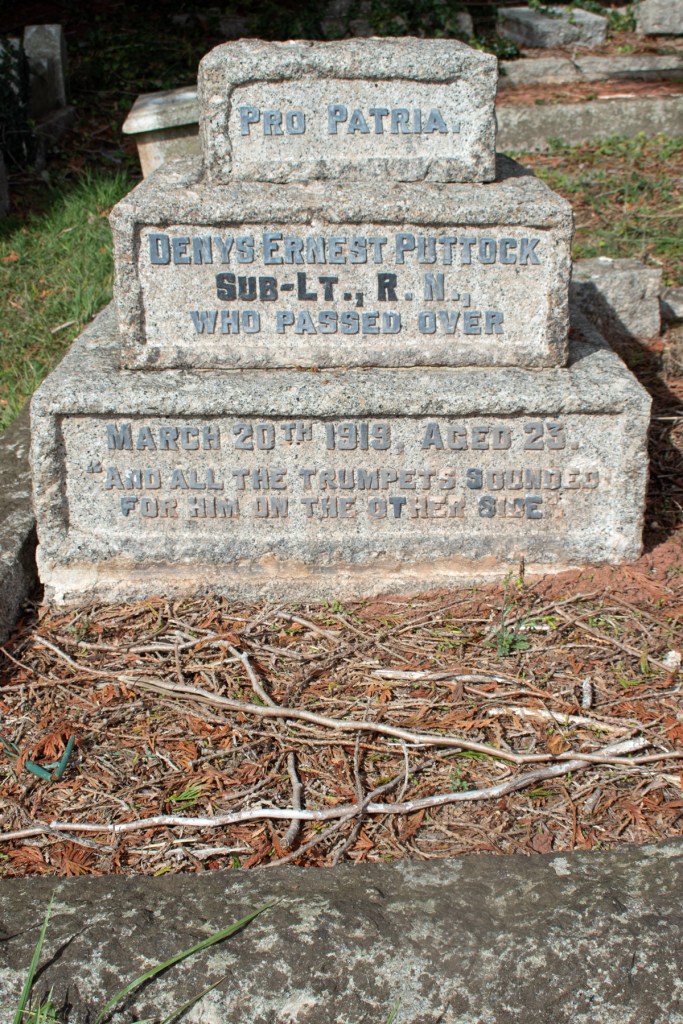
Denys Ernest Puttock was born on 14th September 1895 in the Devon village of Halwill. The middle of three children, his parents were Edward and Alice Puttock. Edward was a vicar of the village’s St Peter & St James’ Church, but died tragically early:
The Red. E Puttock, Rector of Hallwill died on Wednesday, after a brief illness… Mr Puttock had been in charge… for six and a half years. He was much beloved by those among whom he labourer and universally respected. His devotion to the due performance of all his sacred duties was unceasing and his visitations among the poor and afflicted were much appreciated by the whole parish. He was fond of all manly sports, and under his captaincy the Cricket Club at Halwill attained considerable success. Up to the day of his death he could hardly believe that he was ill, and up to the last it was hoped that his wonderful constitution might have carried him through the illness. About a fortnight since he contracted a chill. He would not be deterred from carrying out his duties, and against the advice of his friends, he persisted in taking every service at the church long after he was fit for it. On Sunday, the 24th January, although then in a high fever, he took both the morning and evening services at Halwill Church unassisted, and also the Sunday School in the afternoon. Pneumonia set in at the end of last week, and on Tuesday evening, the 2nd February, the action of the heart failed. He leaves a widow and three young children to mourn their loss.
[Exeter and Plymouth Gazette: Friday 5th February 1897]
After Edward’s death, Alice moved the children to Okehampton. The 1901 census found the family living at 4 Brondage Park, Alice by this time living off her own means. She felt that learning was important, and Denys was sent to Twyford School and St Edmund’s School in Canterbury, Kent. From here he took up a career in the Royal Navy, enlisting in September 1913.
He served in the Highflyer as a Cadet, and was Midshipman in HMS Conqueror, and later Sub-Lieutenant in the destroyers Patriot and Valorous. Long exposure to the rough weather in the North Sea during the winters of 1916 and 1917 brought on tuberculosis, which incapacitated him for further war service. He was invalided our of the Navy and spent many months in a Sanitorium.
[Exeter and Plymouth Gazette: Friday 4th April 1919]
Denys Ernest Puttock’s health was failing him, and he passed away on 20th March 1919, while still admitted. He was 23 years of age. The report of his funeral included comments from those who knew him:
His Headmaster writes: “He has not lived in vain, for he has exercised the power of unconscious influence on all those around him. He knew the secret of happiness – purity of soul and unselfishness of heart.” His Commanding Officer has written: “He was a zealous and capable young officer. Possessed of great charm of manner, he was popular with both officers and men.”
[Exeter and Plymouth Gazette: Friday 4th April 1919]
Alice, having moved to Paignton by this point, laid her son to rest in the town’s cemetery. When she passed away in 1932, she was buried alongside him.









 Death and Service