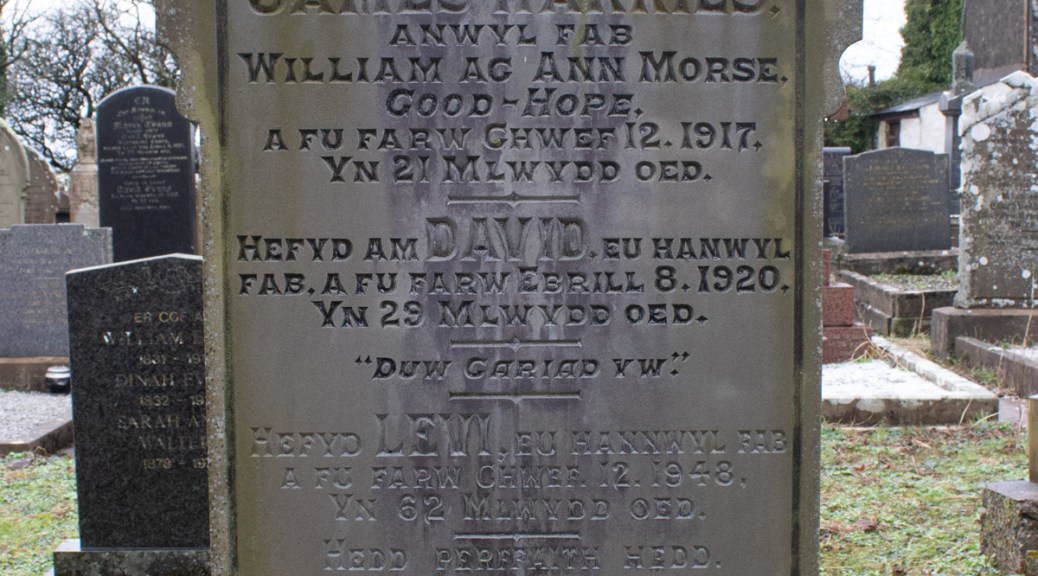
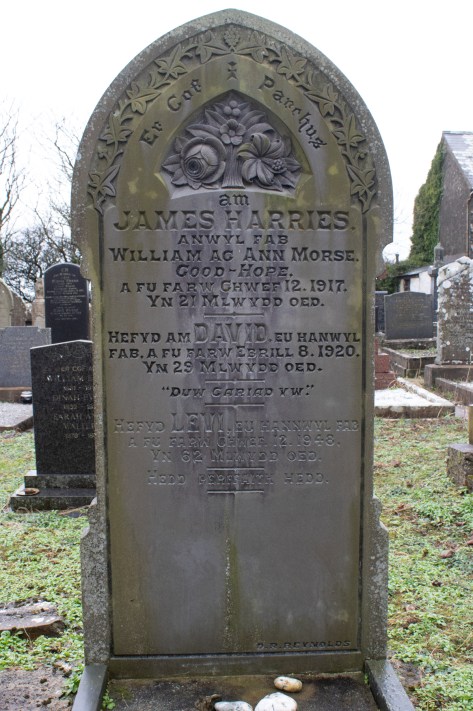
James Harries Morse was born in the autumn of 1895 in Llanwnda, Pembrokeshire. One of eleven children, his parents were agricultural labourer William Morse and his wife, Ann.
James’ schooling was completed early, and he was soon found work to keep him occupied. The 1911 census recorded him as being a cattle boy for the James family, living in on a farm not far from his family home.
When war broke out, James was keen to play his part. Details of his military service have been lost to time, but it is clear that he enlisted as a Private in the Welch Regiment, and was assigned to the 3rd (Reserve) Battalion. It’s not possible to identify where or for how long he served, and the only other documents available relate to his passing.
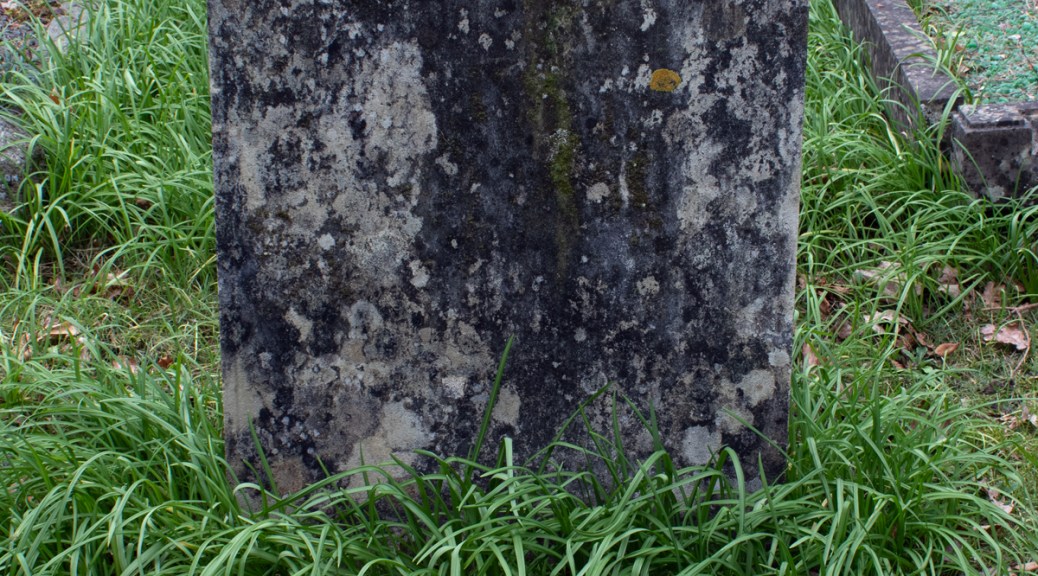
James Harries Morse died of disease on 12th February 1917: he was just 21 years of age. His body was taken back to Pembrokeshire for burial, and he was laid to rest in the family plot in Pencaer (Harmony) Baptist Burial Ground, not far from his parents’ home.
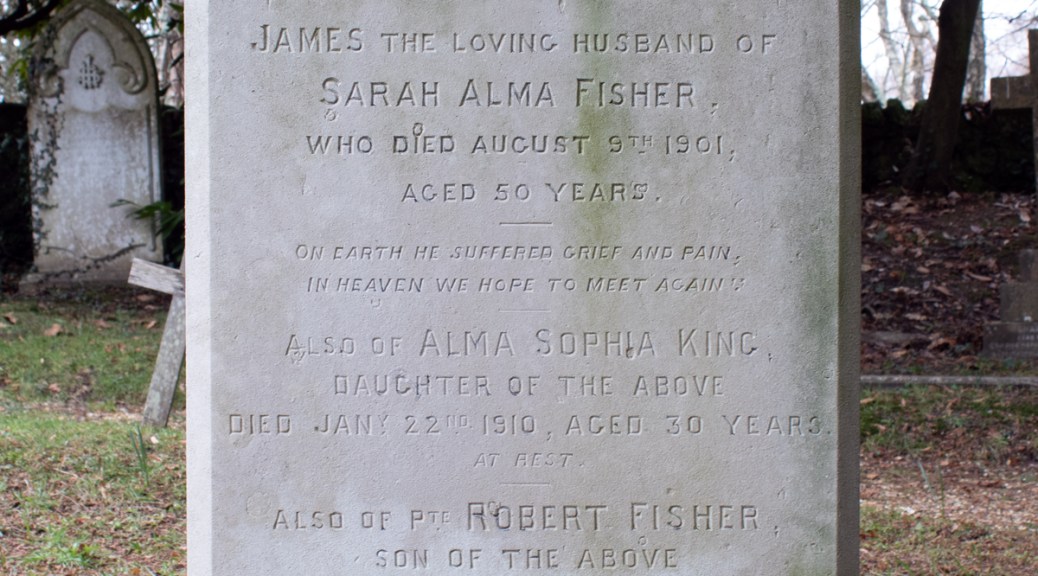
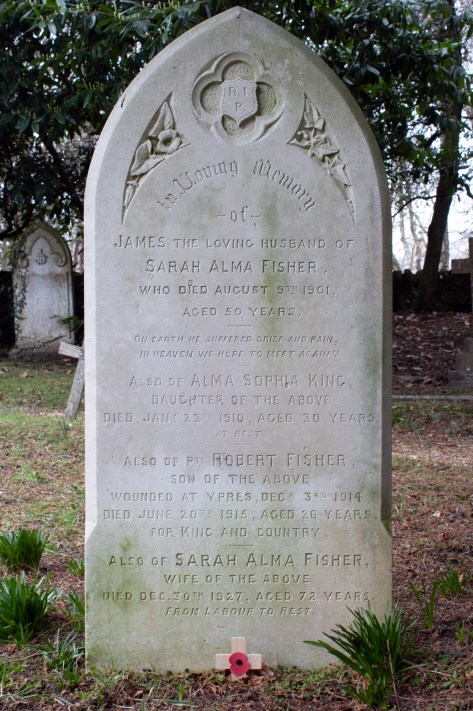
Robert Fisher was born on 12th September 1888 in Lyndhurst, Hampshire. He was the sixth of eight children to James and Sarah Fisher. James was a coachman, and the family lived on Pike’s Hill, to the north of the town centre.
James died in 1901, and Robert remained at home to support his mother and two younger sisters. The 1911 census found the family living in the same four-roomed cottage on Pike’s Hill: Robert was employed as a mail driver, while his sister Kathleen worked as a domestic servant. The family also had a lodger, William Penny, to help bring in some extra money.
When war broke out, Robert stepped up to play his part. His service documentation has been lost, but it is clear that he enlisted in the opening weeks of the conflict, and was assigned to the 1st Battalion of the Hampshire Regiment. As proof of a quick turnaround for these new recruits, Private Fisher found himself in France by mid-November 1914.
Fighting on the Western Front near Armentières, Private Fisher was wounded on 3rd December 1914. He was medically evacuated to Britain for treatment, and admitted to Netley Hospital near Southampton, Hampshire. He had been “struck in no less than seven places by shrapnel.” [Hampshire Independent: Saturday 3rd July 1915]
Eventually well enough to return home, by June 1915, Robert’s health had deteriorated. He contracted meningitis, and was admitted to the Isolation Hospital back in Southampton. The condition would ultimately prove fatal and Private Fisher passed away on 20th June 1915: he was 26 years of age.
Robert Fisher was laid to rest in the family plot in Lyndhurst Cemetery, alongside his father, and not far from where his grieving mother still lived.
Joseph Walls was born in Tortington, near Arundel, in West Sussex, on 13th November 1880. The youngest of four children, his parents were gamekeeper James Walls and his wife Annie. James moved the family to where his work took him and, by the time of the 1891 census, they had settled in the New Forest village of Sway, Hampshire.
When Joseph finished his schooling, he found work as a horseman and groom. The 1901 census found him living with his parents and older sister in a house in Brockenhurst. He seems to have taken his work seriously, and soon found himself a position as a chauffeur. The next census, taken in 1911, recorded him as working for Ann Libbey and her family in the village of Boldre.
On 18th February 1914, Joseph married Edith Perry. A carpenter’s daughter, she was working as a domestic servant when the couple exchanged vows. Their wedding certificate confirms that Joseph was ten years his new wife’s senior, and that they ceremony was witnessed by his older brother Frederick and her younger sister, Esther.
Joseph and Edith would go on to have two children: Vera was born in 1915, while Daphne came along three years later. During this time, however, war was raging across Europe, and Joseph had stepped up to play his part.
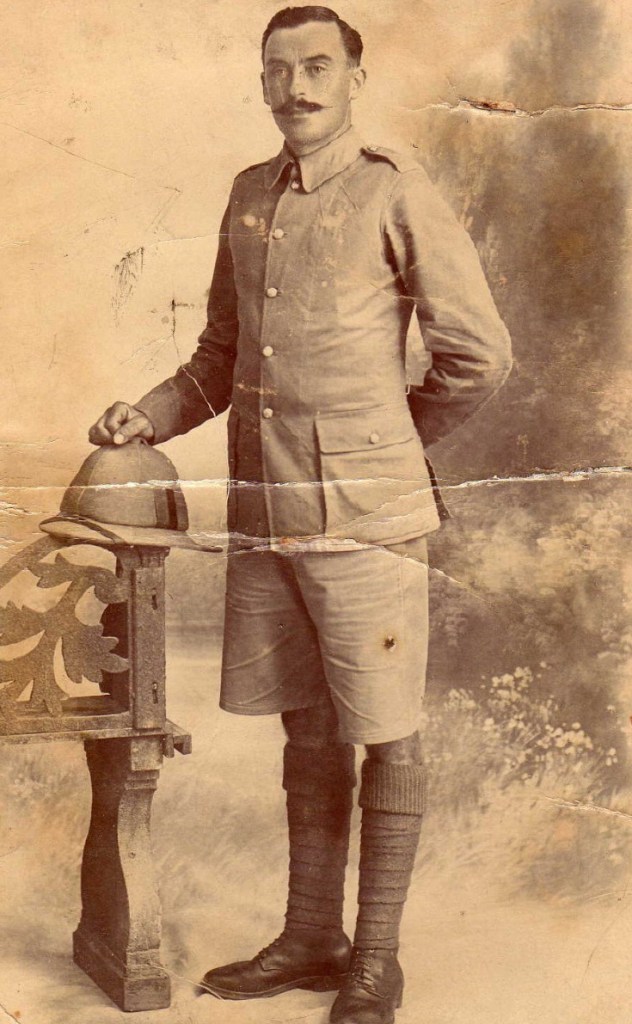
Private Walls enlisted within weeks of war being declared, on 10th December 1914. His service papers show that he was living at Hospital Cottage in Lyndhurst when he joined up. He was 5ft 8ins (1.72m) tall, with black hair, grey eyes and a dark complexion. He was also noted as being asthmatic since he was a child.
Assigned to the 1st/4th Battalion of the Hampshire Regiment, over the next few years, Private Wallis would see the world. Within days of enlisting, he was shipped out to India, where he would spend nearly three years (apart from the in the summer of 1917, when he served as part of the Mediterranean Expeditionary Force). During this time, Joseph was promoted to Lance Corporal, although by the time he left the army, he had returned to the tank of Private.
By the beginning of September 1917, Joseph was back on home soil. A spell of malaria that spring had impacted his asthma, and at the end of November, he was deemed no longer fit for war service. Private Walls was medically discharged from the army on 29th November 1917.
At this point, Joseph’s trail goes cold. He definitely returned home – Daphne was born just a few days after the Armistice – but it is unclear whether he was it enough to work.
Joseph Walls died on 14th February 1919: he was 38 years of age. He was laid to rest in Lyndhurst Cemetery, not far from where Edith and their children lived.
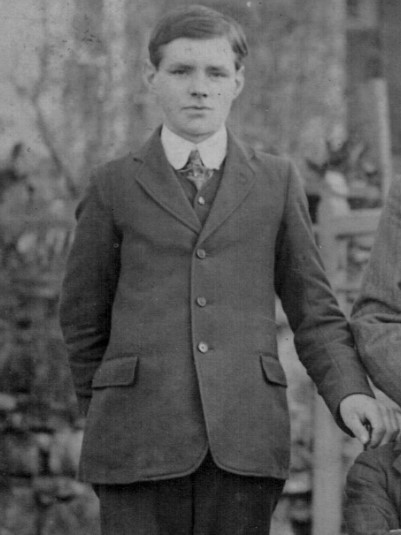
Arthur William Charles was born in Llanrhian, Pembrokeshire, in the summer of 1896. The middle of eleven children, his parents were Joseph and Phoebe Charles.
The 1901 census recorded Joseph as being a butcher and innkeeper in the village, but by the time of the next poll, the family were split. Joseph and Phoebe were now noted as being farmers, living with five of their children plus two servants at Henllys Farm. Arthur, meanwhile, was living with two of his sisters on his brother Thomas’ farm in Mathry. At 14 years of age, he was noted as being a farmer’s son, working on a farm.
When war broke out, Arthur was called upon to play his part. His service papers are long since lost, but he had enlisted in the Welch Regiment by the spring of 1916. Assigned to the 20th (3rd Rhondda) (Reserve) Battalion, he was sent to Bangor, Gwynedd, for training.
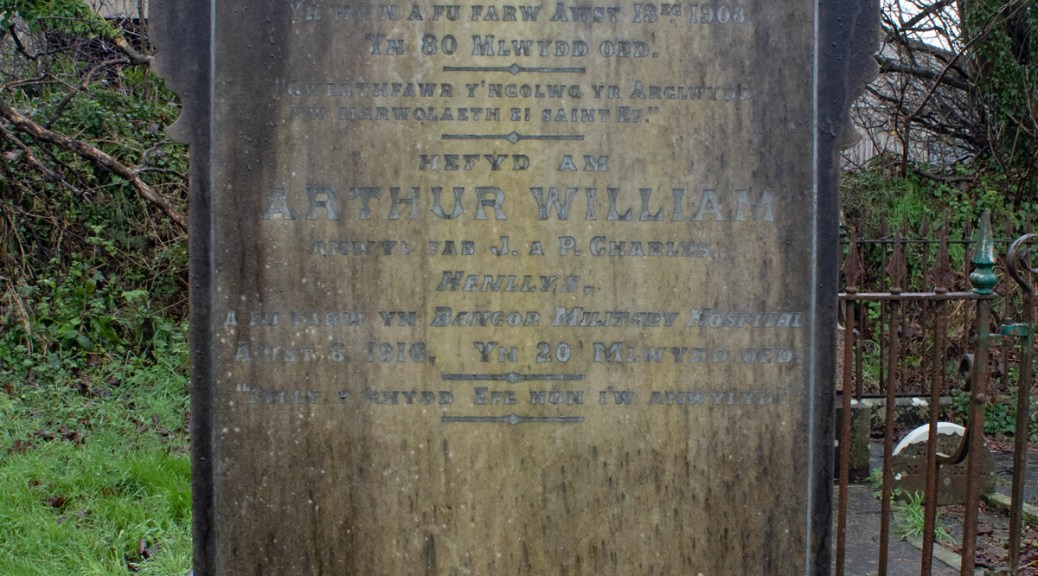
Tragically, however, Private Charles’ time there was not to be a lengthy one. He contracted cerebrospinal meningitis, and passed away on 6th August 1916: he was 20 years of age.
The body of Arthur William Charles was taken back to Pembrokeshire for burial. He was laid to rest in the Mathry Congregational Churchyard in Rehoboth.
Gwyn Lewis Thomas was born in Llanrhian, Pembrokeshire, in 1894, and was the youngest of five children to George and Jane Thomas. George was a farmer, and by the time of the 1911 census, his son had been sent to work with another farmer, William Miles, in Mathry, four miles to the east.
When war broke out, Gwyn stepped up to serve his country. He enlisted in the Royal Engineers as a Sapper and, while little information about his service, it is clear that he was sent to France on 23rd August 1915. By the end of the conflict, he had achieved the rank of Corporal, and when the Armistice was declared, he returned home to Wales.
The only other documents connected to Corporal Thomas are those relating to his passing. He died from disease on 2nd March 1920, at the age of 25 years old. His death was registered in Haverfordwest, Pembrokeshire, which would suggest that he either passed there, or that that was the registry office to his home.
Gwyn Lewis Thomas was laid to rest in Mathry Congregational Chapelyard in Rehoboth, midway between his parents’ farm and that of his former employer. His headstone is inscribed with the words Bu farw o effaith y Rhyfel Mawrth (He died from the effects of the Great War).
William McMullan was born in Okaihau, on New Zealand’s North Island, on 10th May 1896. One of three children, his parents were James and Rose McMullan.
There is little concrete information about William’s early life. By the beginning of 1916, he was working as a bushman and volunteering for the local militia. The First World War provided an opportunity to put his skills to use, and he enlisted in the New Zealand Rifle Brigade on 15th January 1916.
Rifleman McMullan’s service records show that, at 19 years and 8 months of age, he was 6ft (1.83m) tall and weighed 12st 6lbs (79kg). A Roman Catholic, he had brown hair, blue-grey eyes and a medium-dark complexion.
William left New Zealand in May 1916, bound for Britain. The journey took ten weeks and, after disembarking in Devonport, Devon, his unit marched to Sling Camp, near Bulford, Wiltshire, arriving there on 29th July. Just a few weeks later, however, Rifleman McMullan was on the move again, and he found himself on the Western Front towards the end of September.
On 16th November 1916, while fighting at the Somme, Rifleman McMullan received a gunshot wound to his thigh. A blighty wound, it saw him medically evacuated to Britain for treatment, and he was admitted to the No. 1 New Zealand General Hospital in Brockenhurst, Hampshire. A few weeks later, he was moved to Codford, Wiltshire, for recuperation at the No. 3 NZ General Hospital.
William would spend the next few weeks in Wiltshire, but after initially being discharged from hospital, he was re-admitted on 25th January 1917. He had contracted broncho-pneumonia, and this would be the condition to which he would succumb. Private McMullan passed away on 13th February, at the age of just 20 years old.
Thousands of miles away from home, William McMullan was laid to rest in the ANZAC extension to St Mary’s Churchyard in Codford, close to the camp he had most recently called home.
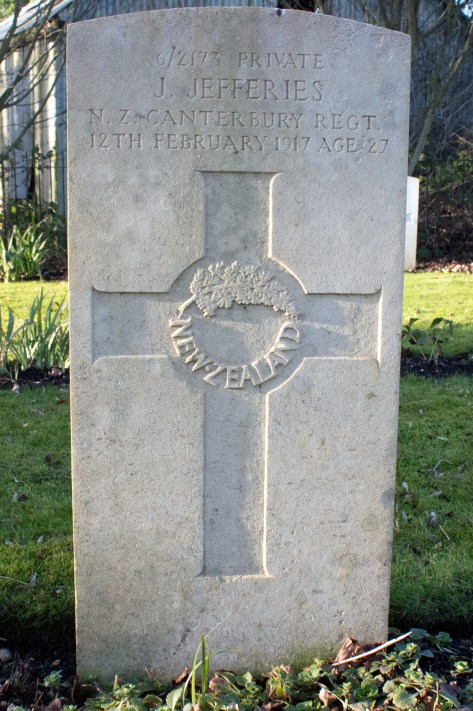
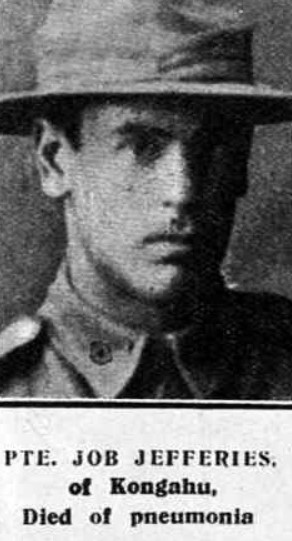
Job Jefferies was born on 12th October 1889 in the city of Timaru, on New Zealand’s South Island. The sixth of ten children, his parents were William and Ada Jefferies.
There is little information available about Job’s early life, but by the time war broke out, he had moved to Kongahu, at the northern tip of South Island. He was working as a labourer, and was employed by the Public Works Department.
Job was quick to step up and serve his country. He enlisted in the New Zealand Infantry on 12th February 1915, and was assigned to the Canterbury Regiment. His service records confirm that he was 5ft 10.75ins (1.79m) tall, and weighed 170lbs (77.1kg).
Private Jefferies left New Zealand in the summer of 1915, and his service record makes for grim reading.
On 9th August 1915, Job’s unit arrived in the Dardanelles, and he was firmly entrenched in the fighting at Gallipoli. Wounded on 5th September, he was initially treated at a casualty clearing station, before being medically evacuated first to Malta, then to Britain. He was admitted to the No. 2 Western General Hospital in Manchester, Lancashire, and would spend the next seven months there.
On 12th May 1916, Private Jefferies was on the move, leaving his base in Hornchurch, Essex, for the Western Front. He re-joined his unit on 7th July, but just nine days later was wounded at the Somme. Medically evacuated to Britain again, he spent the next couple of months being moved between hospitals. Discharged back to base in Hornchurch, Essex at the end of September, he would spend the next four months recuperating once more.
By February 1917, it would seem that Private Jefferies had been moved to Sling Camp near Bulford, Wiltshire. While there, he fell ill, and was admitted to the No. 3 New Zealand General Hospital in nearby Codford. He was suffering from pneumonia, and this time his body could take no more. Job passed away on 7th February 1917: he was 27 years of age.
Job Jefferies was laid to rest alongside his fellow soldiers in the ANZAC extension to St Mary’s Churchyard, Codford.
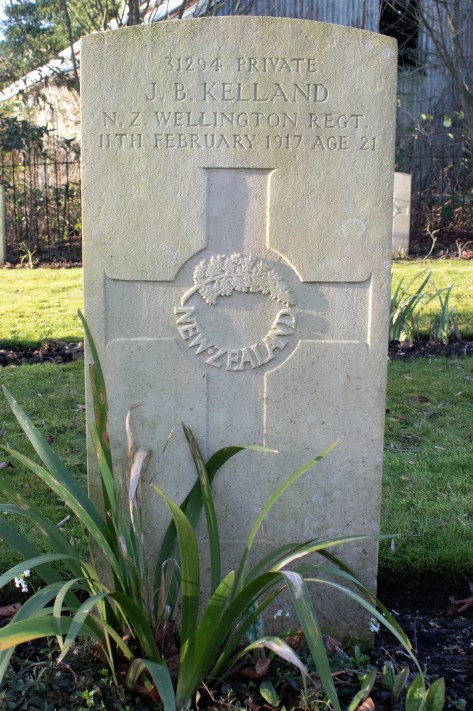
John Bodley Kelland was born on 4th June 1895 in Otakeho, on New Zealand’s North Island. The fifth of eight children, his parents were George and Mary Kelland. George died in 1902, and John’s mother married again: she and new husband Albert Bowers would have two further children.
There is little additional information available about John’s early life. He found work as a carrier when he left school, and by the time war broke out he was living in the town of Taumarunui. In his spare time, he seems to have volunteered for a local army brigade.
John formally enlisted on 24th July 1916. He joined up in Trentham, and was assigned to the New Zealand Wellington Regiment. His service records show that he was 5ft 9ins (1.75cm) tall and weighed 152lbs (68.9kg). A Roman Catholic, he had brown hair, grey eyes and a dark complexion.
Attached to B Company of the 19th Reinforcements, Private Kelland left his home country on 15th November 1916. He spent the next ten weeks on board the troop ship Tahiti, finally disembarking in Devonport, Devon, on 29th January 1917. From there his unit marched to Sling Camp near Bulford, Wiltshire, where many of the ANZAC troops were billeted.
Private Kelland’s time there was to be limited. His health had been impacted during the sea voyage, and he was admitted to the No. 3 New Zealand General Hospital in Codford, Wiltshire, on 8th February. Suffering from pneumonia, his condition worsened: he passed away on 8th February 1917, at the age of just 21 years old.
John Bodley Kelland was thousands of miles from home. He was laid to rest alongside his comrades in the newly-extended graveyard to St Mary’s Church in Codford.
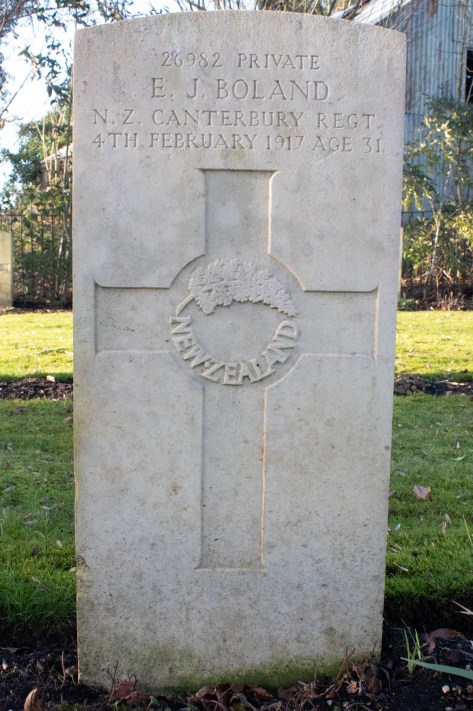
Edward James Boland was born on 14th August 1885 in the town of Darfield, on New Zealand’s South Island. Details of his early life are sketchy, but he was the fourth of nine children to Francis and Annie Boland.
When he finished his schooling, Edward found work as a farm labourer. In 1906, he married Ellen – or Nellie – Shea: their first child, son Raymond, was born the same year, and they would go on to have three more children by the time war was declared.
On 18th June 1916, Edward answered the call to serve the Empire. Enlisting in Trentham, he joined the New Zealand Canterbury Regiment as a Private. His service record notes that he was 5ft 8.5ins (1.74m) tall and weighed 144lbs (65.3kg). A Catholic, he had light brown hair, blue eyes and a fair complexion. A scar on his right thigh was also recorded as a distinguishing mark.
On 16th October 1916, Private Boland left from Wellington on board the steam ship Willochra. His unit – the 18th Reinforcements – arrived in Devonport, Devon, ten weeks later. They were then marched to their base at Sling Camp near Bulford, Wiltshire.
The journey from New Zealand, impacted Edward’s health. At the end of January 1917, he was admitted to the 3rd NZ General Hospital in Codford, Wiltshire, suffering from broncho-pneumonia. His condition deteriorated and would take his life. Private Boland died on 4th February 1917: he was 31 years of age.
As he was thousands of miles from his home, Edward James Boland was instead laid to rest in the newly extended graveyard attached to St Mary’s Church in Codford.
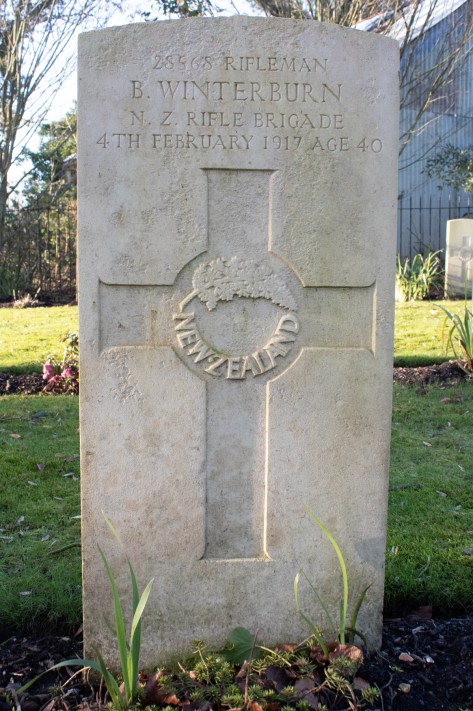
Bertram Winterburn was born in the city of Hutt, on New Zealand’s North Island, on 23rd April 1877. The oldest of eleven children, his parents were Arthur and Ada Winterburn. Arthur was a postmaster from South Island, and it would be here that he and Ada would raise their family.
There is little concrete information about Bertram’s life. The 1913 Post Office Directory records him as working as a labourer, and living in Otaki, a town back on North Island. He seems to have moved wherever the work took him, however, and, by the time war broke out, he was living in Hunterville, 110km (68 miles) further north.
Bertram stepped up to serve the empire when the call came. He enlisted in Trentham on 27th June 1916, and was assigned to the New Zealand Rifle Brigade.
Rifleman Winterburn left from Wellington on board the steam ship Willochra on 16th October 1916. His unit – H Company, 18th Reinforcements – would not arrive in Devonport, Devon, until 29th December. They were then marched to their base at Sling Camp near Bulford, Wiltshire.
The journey from New Zealand, would take its toll on the new recruits, with many falling ill before, or shortly after, they arrived. Bertram would not be immune from this and, at the end of January 1917, he was admitted to the 3rd NZ General Hospital in Codford, suffering from influenza. His condition worsened, developing into bronchitis, and this would take his life. Rifleman Winterburn died on 4th February 1917: he was 39 years of age.
Thousands of miles from his home, Bertram Winterburn was laid to rest in the newly extended graveyard attached to St Mary’s Church in Codford.









 Death and Service