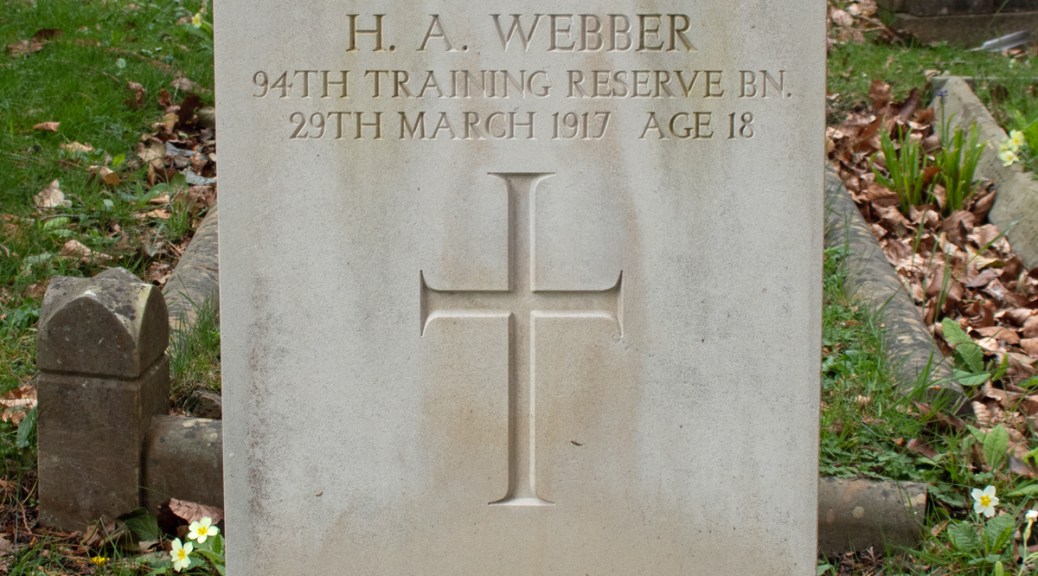
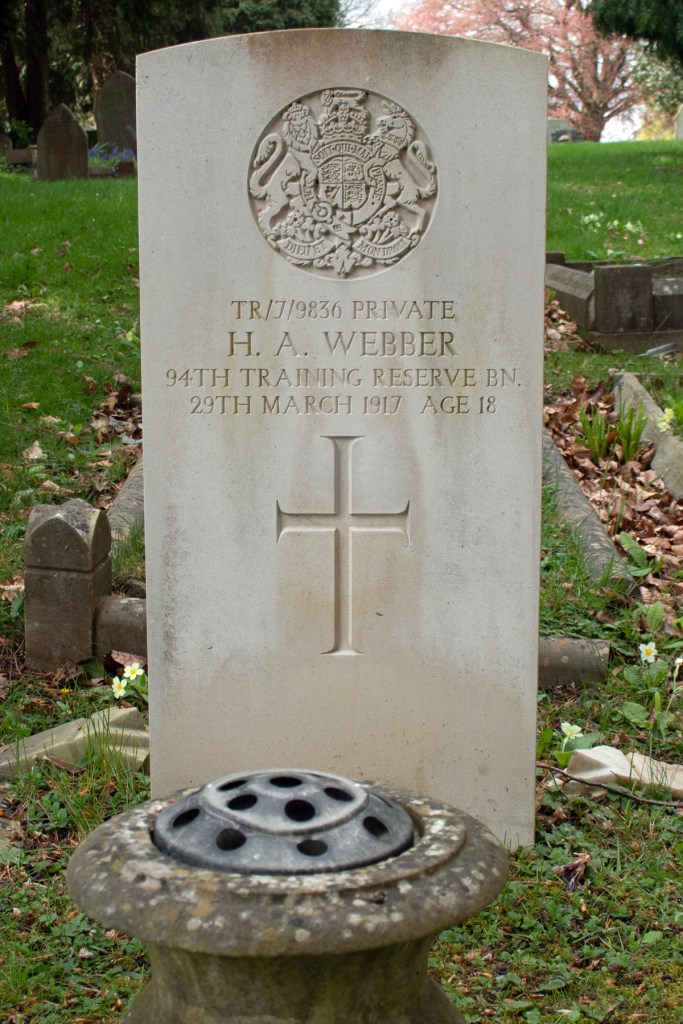
Herbert Alfred Webber was born on 22nd October 1898 in Yatton, Somerset. The younger of two children, his parents were Ernest and Ada. Ernest was a platelayer for the Great Western Railway and, by the time of the 1911 census, the family had moved to Keynsham, near Bristol. With Herbert and his sister still at school, they had taken in two boarders – railway porters Walter Prince and Victor Coombs – to help bring in a little money.
When Herbert left school, he found work at a local chemist, but as soon as he turned 18, he signed up to serve his King an Country. Assigned to the 94th Training Battalion, Private Webber was sent to the Chiseldon Camp in Wiltshire to begin his career.
Tragically, Herbert’s was not to be a long service. Within a month of arriving at camp near Swindon, he fell ill, and was admitted to an Isolation Hospital in the town. While the condition he had contracted is unclear, it was one to which he would succumb. He passed away on 29th March 1917, aged just 18 years old.
Herbert Alfred Webber was brought back to Somerset for burial. With the family having moved to Bath with Ernest’s work, he was laid to rest in the city’s Twerton Cemetery.
Private Herbert Webber (from britishnewspaperarchive.co.uk)
Hidden away above the busy A371 to the north of Axbridge, Somerset is an unassuming graveyard. Overgrown and haunting, with headstones lining the boundary of the copse, this is the cemetery for the former St Michael’s Sanatorium, now the St Michael’s Cheshire Home. In the middle of the plot, next to the central memorial, is a headstone dedicated to Sidney Gordon, notably buried somewhere else in the grounds.
Sidney Vincent Gordon was born in Upton Park, Essex, on 7th May 1897. There is little information about his early life, other than his mother’s name, May.
The 1911 census recorded Sidney as being an inmate at the Scattered Home for the West Ham Union, the workhouse that covered the area. At 13 years of age, he was one of the older of the thirteen students boarding in the home, which was overseen by Emma Caroline Simpson, the House Mother.
When Sidney completed his schooling, he managed to find employment as an undertaker’s boy. But he sought out bigger things and, on 8th June 1914, he enlisted in the Royal Navy. His service records note that he was 5ft 6ins (1.68m) tall, with brown hair, blue eyes and a fresh complexion.
Being under-age when he enlisted, Sidney was given the rank of Boy. He was first sent to HMS Pembroke, the Royal Naval Dockyard in Chatham, for training, and remained there for a couple of months. In August 1914, Boy Gordon was moved down the coast to HMS Actaeon, a torpedo school based in Sheerness, Kent.
After five months, he moved to HMS Wildfire, another part of the Sheerness base, and it was while there he turned 18, and could formally join the Royal Navy. He was given the rank of Officer’s Steward 3rd Class and remained at Wildfire until the end of 1915. After a short stint back in Chatham, Sidney was given a new posting on board the supply ship HMS Tyne, where he remained until the following May.
Officer’s Steward Gordon returned to HMS Pembroke once more, and was assigned to his final sea-going ship, the newly launched monitor, HMS Erebus. She was to be his home until June 1917, when, having become unwell, he was posted back to HMS Pembroke.
Sidney had contracted pulmonary tuberculosis, which led to him being invalided out of the Navy on 1st August 1917. At this point his trail goes cold once more, but it is likely that, by the start of 1919, his condition had led to his admission to St Michael’s.
When he died there, on 5th March 1919, Sidney was just 21 years old. Given his background, it seems probable that his mother, if she was still alive, would not have been able to afford for his remains to be brought back to Essex. Sidney Vincent Gordon was laid to rest in the sanatorium’s cemetery, in the foothills of the Mendips, finally at peace.
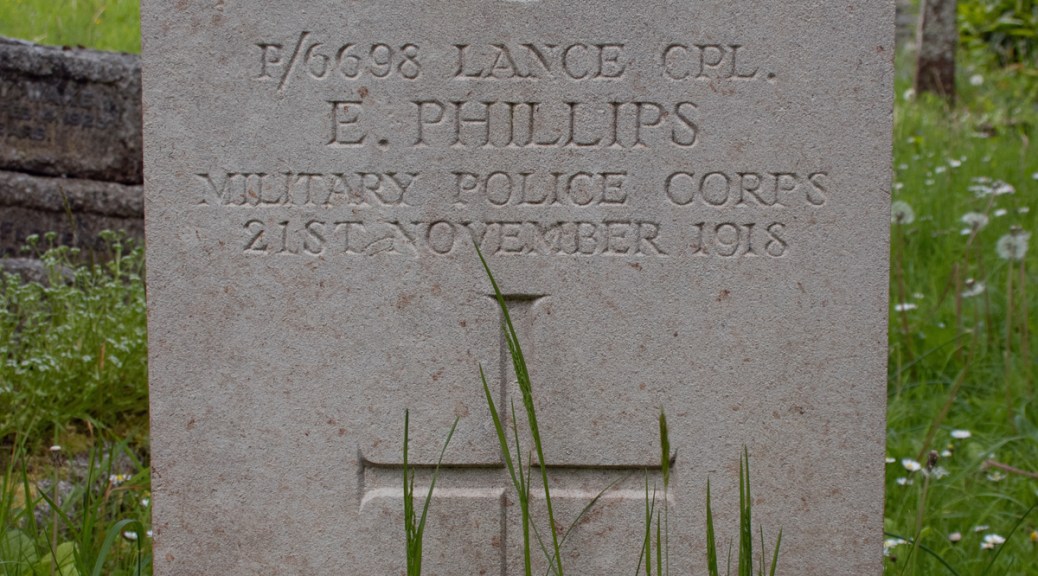
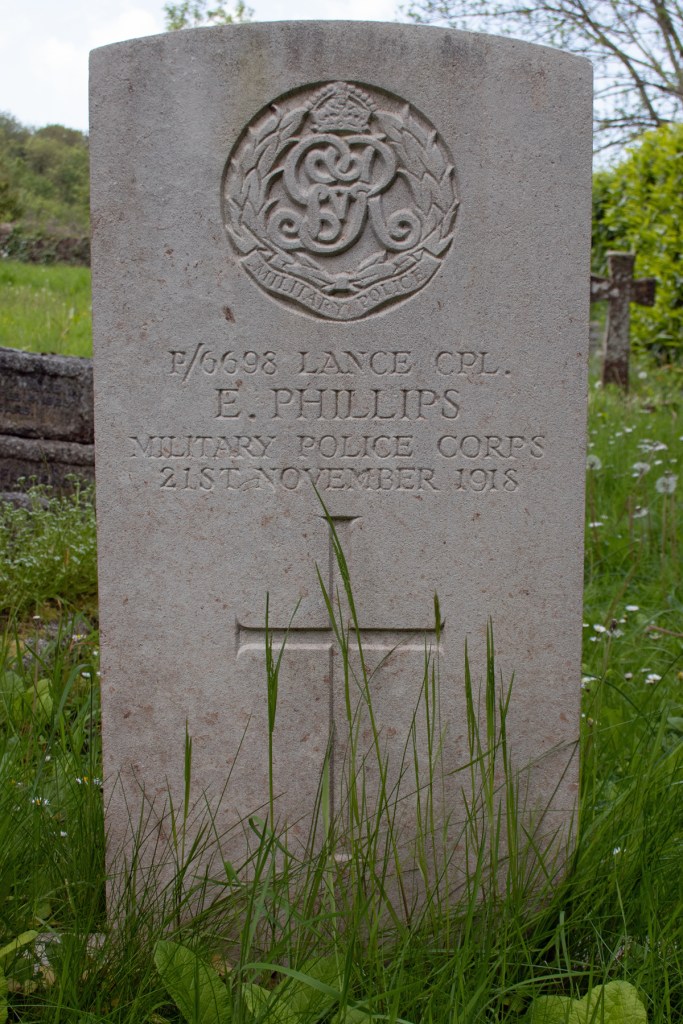
Ernest Algernon Phillips was born at the start of 1879 in the Somerset village of Winscombe. One of nine children, his parents were Arthur and Elizabeth Phillips. Arthur was a gardener, and Ernest followed suit when he finished his schooling.
By the time of the 1911 census, he was boarding with his younger sister Rose and her family – brother-in-law Leonard and nephew Leslie. Just a couple of weeks later, on 11th May 1911, Ernest married Winifred Carey. She was a coachman’s daughter from Winscombe, and the couple set up home in a cottage on the outskirts of the village.
When war broke out, Ernest felt a need to play his part. He enlisted in Bristol on 8th December 1915, but was not formally mobilised until the following June. Initially assigned to the Devonshire Regiment, he was transferred to the Worcestershire Regiment and attached to the 6th Battalion.
Private Phillips’ troop was based on home soil, and he was barracked in the garrison in Harwich, Essex, for the next six months. On 31st January 1917, he was transferred to the Military Police Corps, and given the rank of Acting Lance Corporal. Full details of his service from this point on are lost to time, but it is clear that he remained on home soil until the end of the war.
By November 1918, Ernest had fallen ill. He was admitted to the Queen Alexandra Military Hospital in London on 20th November, suffering from pneumonia. Within a matter of hours, while this seemed to have cleared, his pulse was ‘rapid, irregular and compressible.’ He was medicated, but did not respond to treatment, and passed away the following day. His death was noted as apparently being caused by clots of blood in the heart, but, at the request of his family, no postmortem examination was carried out. He was 39 years of age.
Ernest Algernon Phillips was brought back to Somerset for burial. He was laid to rest in the quiet graveyard of St James the Great Church in Winscombe.
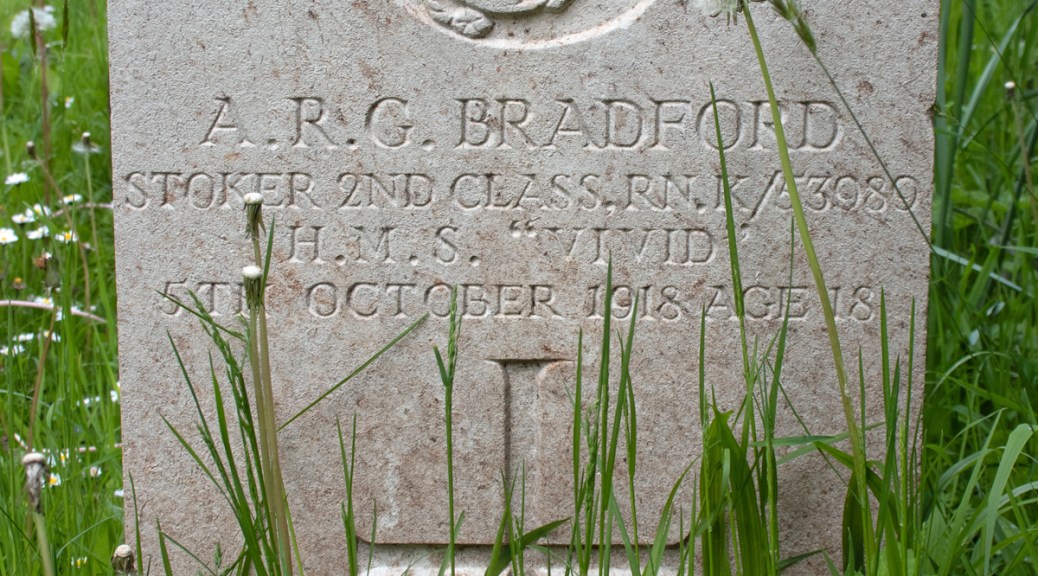
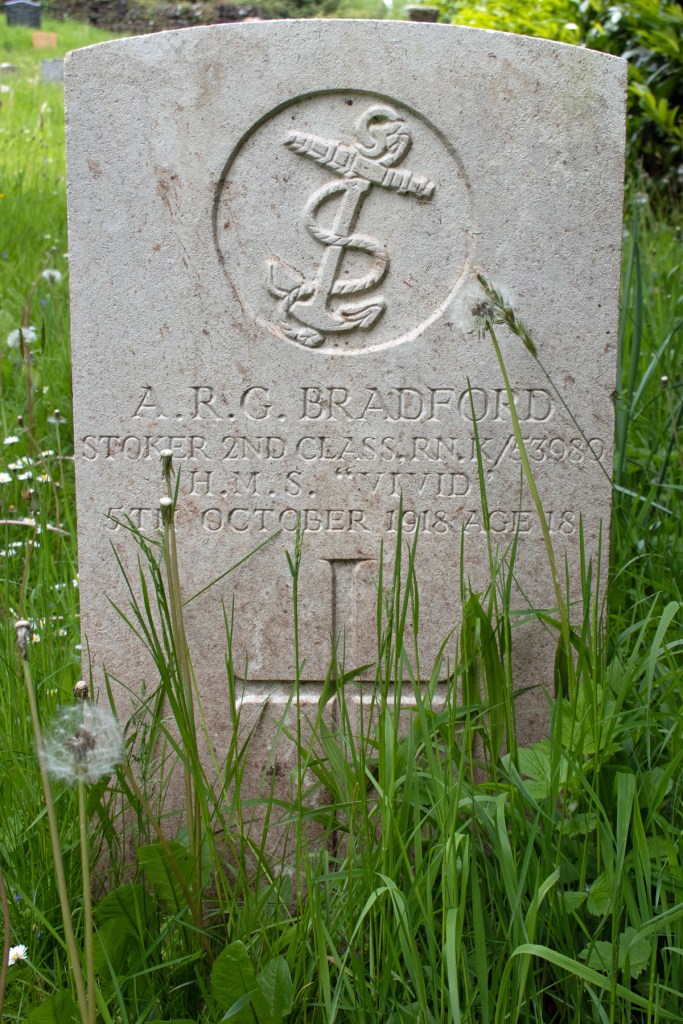
Arthur Redvers George Bradford was born in the Somerset village of Winscombe on 16th September 1900. He was second of six children to George Bradford, who was a postman, and his wife, Louisa.
When he finished his schooling, Arthur found work as a carter. War was raging across Europe by this point, however, and he was evidently keen not to miss out on the excitement. On 18th September 1918, just two days after his 18th birthday, he enlisted in the Royal Navy.
Stoker 2nd Class Bradford was noted as being 5ft 3.5ins (1.61m) tall, with brown hair, grey eyes and a fresh complexion. He was sent to HMS Vivid, the Royal Naval Dockyard in Devonport, for training, but his time there was to be tragically short.
Cramped barracks prove to be the perfect breeding ground for illness, and in early October 1918, influenza and pneumonia were rife. Around a dozen of Stoker Bradford’s colleagues died from the diseases in the time he was at the base, and, on 5th October 1918, he too was to succumb to them. He was just eighteen years old, and had been in the Royal Navy for just 17 days.
The body of Arthur Redvers George Bradford was brought back to Somerset for burial. He was laid to rest in the quiet graveyard of St James the Great Church in his home village of Winscombe.
Arthur Reuben Thomas was born in Banwell, Somerset, on 27th September 1899. The older of two children, his parents were blacksmith Edwin Thomas and his wife, Mary.
Little information about Arthur’s life is documented. At the time of the 1911 census he was still a schoolboy, and it is likely that he helped his father out in the smithy when he finished his education.
By this point war was raging across Europe, and it is likely that young Arthur was keen not to miss out. Details of any military service are lost to time, but it seems possible that he joined up as soon as his age allowed.
Private Thomas was assigned to the 53rd (Young Soldier) Battalion of the Hampshire Regiment, and sent to Rollestone Camp on Salisbury Plain, Wiltshire, for training.
Sadly, Arthur’s time in the army seems to have been a short one. He was admitted to a camp hospital in nearby Tidworth, suffering simply from ‘disease’, and it was from this that he passed away on 6th January 1918. He was just eighteen years of age.
Arthur Reuben Thomas’ body was brought back to Somerset for burial. He was laid to rest in the quiet graveyard of St Andrew’s Church in his home village of Banwell.
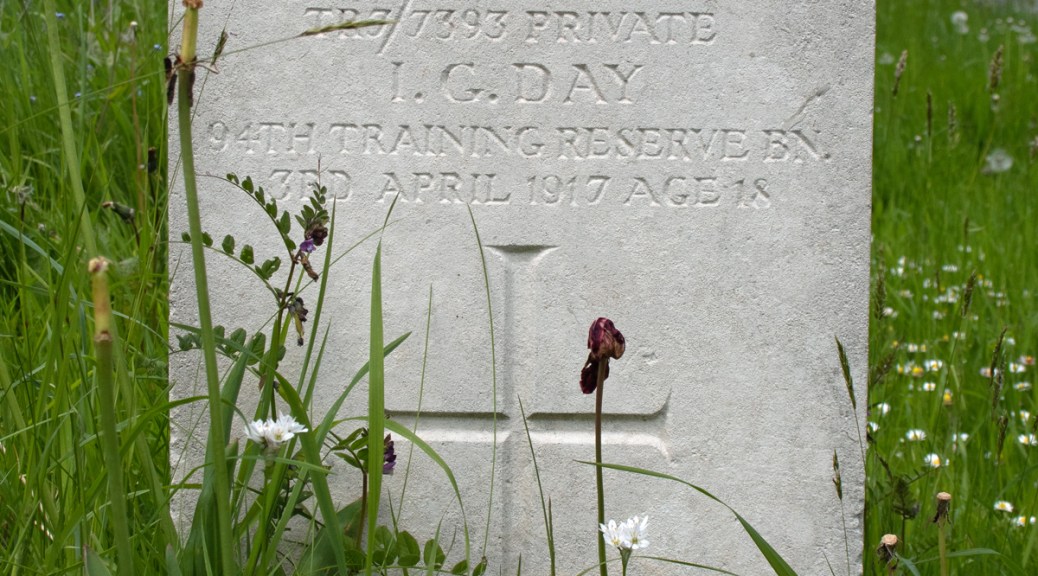
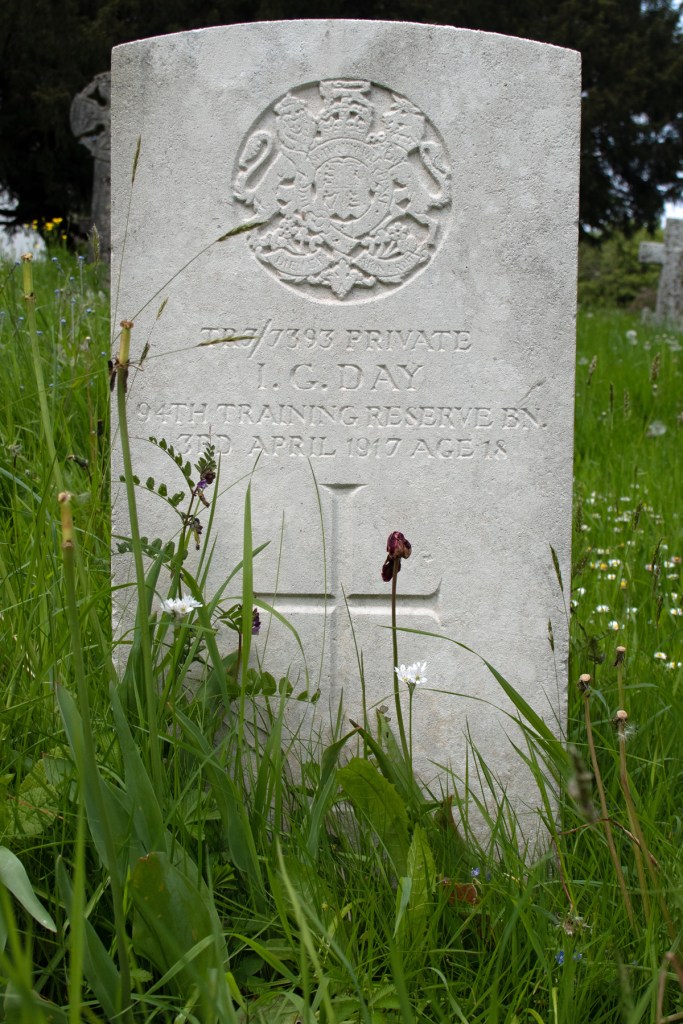
Ivan George Day was born in the summer of 1898, the oldest of three children to George and Emma Day. George was a brick and tile maker from Weare in Somerset and it was here that he and Emma raised their young family.
When Ivan finished his schooling, he found work as a postman, but, with war raging across Europe, he seemed keen to play his part. In February 1917, he enlisted in the army and was assigned to the 93rd Training Reserve Battalion. His service records show that he was just 5ft 3ins (1.6m) tall and weighed 121lbs (54.9kg).
Private Day was sent to Chiseldon Camp, to the south of Swindon in Wiltshire and, tragically, this move to cramped army barracks was to prove his undoing. Within four weeks of arriving, Ivan was admitted to the camp’s hospital, having contracted measles and pneumonia. Less than a week later, the conditions had gotten the better of him. He passed away on 3rd April 1917, at just eighteen years of age.
Ivan George Day’s body was brought back to Somerset for burial. He was laid to rest in the peaceful graveyard of St Gregory’s Church in his home village of Weare.
Tragedy was to strike the Day family again when, George died eighteen months later, aged 51 years old. Emma lived until 89 years old, passing away in Weston-super-Mare in the summer of 1955.
Ivan was not the only Somerset soldier to succumb to pneumonia at Chiseldon Camp that spring. Private Charles Oborne, died from the same condition a few days before Ivan was admitted to the hospital. Private Everett Ferriday, of the 94th Training Battalion, passed away in the same hospital on the same day as Ivan, also from pneumonia.
You can read their stories by following the links above.
Charlie Tucker was born early in 1877 in the village of Mark, Somerset. The fifth of six children, his parents were Thomas and Caroline. Charlie’s mother died when he was only a toddler, probably during, or shortly after, the birth of his younger sister, Elizabeth. This left farm labourer Thomas to raise his family alone.
The 1881 census found the Tuckers living in Wedmore, five miles to the east of Mark, where Thomas was supported by his parents, George and Elizabeth. Both died in 1890, but by this point, Thomas had married again, to a widow, Ann Harding. She had a daughter, Mary Ann, who was welcomed into the family, but then Thomas and Ann had their own child, a son called Walter.
The next census, returned in 1891, recorded the family – Thomas, Ann, Charles, Mary Ann and Walter – living in Wedmore. Charles had finished his schooling by this point, and was employed as a general labourer and the family also had a boarder, Ralph Godney, who was just 9 years of age.
The family setup continued, and the 1901 census document found Thomas and Ann living with Charlie and Walter, all of whom were doing farm work. They still seemed to be open to supporting others, however, and had another boarder, a schoolgirl called Elizabeth Grant.
In the spring of 1904, Charlie married Lily Brown. Born in Wedmore, she was the daughter, and only child, of a labourer who was employed as a servant to an Axbridge famer at the time the couple wed. Charlie and Lily set up home in Blackford, near Wedmore, and went on to have four children: Thomas, Walter, William and Kathleen.
When war broke out in 1914, Charlie stepped up to play his part. Full details of his military career are lost to time, but it is clear from what remains that he had enlisted in the Devonshire Regiment by the autumn of 1916. Private Tucker joined the 13th (Works) Battalion, and remained stationed on home soil for the duration of his service.
Little further information about Charlie’s life is evident. Over the next couple of years his health began to fail, and in the spring of 1917 he had been admitted to Bath War Hospital with carcinoma of the stomach. This was to take his life: he passed away on 11th March 1917. He was 40 years of age.
Charlie Tucker’s body was brought back to Blackford for burial. He was laid to rest in the graveyard of Holy Trinity Church.
Lily, now widowed, was left with four young children to raise on her own. Whether for a new life and new opportunities, or to escape the painful memories that Somerset brought, she made the decision to emigrate. In April 1924, she and the children arrived in Canada, and settled in Ontario.
Further information for Lily is not readily available, but her two oldest children, Thomas and Walter, made lives for themselves, and died in 1975 and 1979, respectively.
William John Solomon was born on 26th June 1891 in the Somerset village of Huntspill. One of nine children, his parents were mason and bricklayer Roland Solomon and his wife, Annie.
When he finished his schooling, William found work as a farm labourer, but, sadly, there is little else documented about his life. When war broke out, he enlisted in the Somerset Light Infantry. Details are unclear, but he served with the 8th Battalion on the Western Front and the 1st/5th Battalion in Egypt.
By 1918, William was back on home soil, but had fallen ill. His condition is not confirmed, but he passed away from it on 16th October 1918, at the age of 27 years old.
William John Solomon was laid to rest in the peaceful graveyard of St Peter’s in his home village.
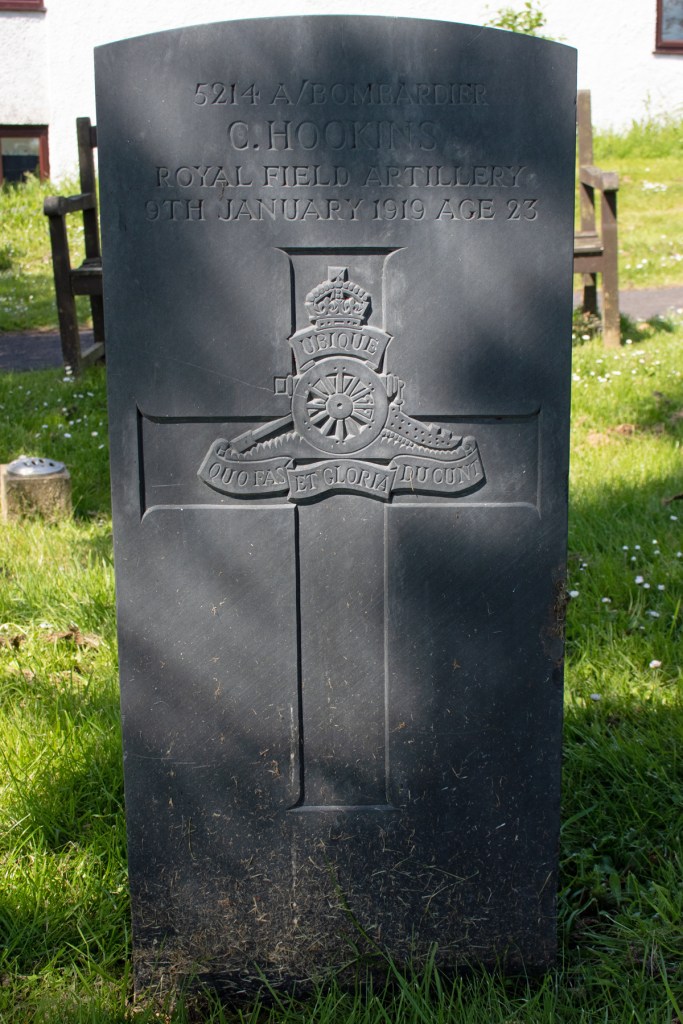
Charles Hookins was born on 15th October 1895 in Pawlett, Somerset. The eighth of nine children, his parents were William and Susan Hookins. William was a labourer in a brickyard, but when he finished his schooling, Charles went to work on his cousin’s farm in neighbouring Huntspill.
Farming was not what Charles had in his mind as a career, however, and on 7th April 1913, he joined the Great Western Railway. Initially employed as an engine cleaner, he was sent to work at the Duffryn Yard, South Wales. He soon moved on again, however, and by October 1913, he was living in Tondu, to the north of Bridgend, where he worked as an engine fireman.
War came to Europe in 1914, and, within weeks of hostilities being declared, Charles volunteered for service. He enlisted on 1st September 1914 in Bridgend, joining the Royal Field Artillery. His service records confirm that he was 19 years of age, stood 5ft 7.5ins (1.71m) tall, and weighed 135lbs (61.2kg). He was noted as having brown eyes, brown hair and a fresh complexion.
Gunner Hookins spent most of the next year on home soil training and became attached to the 57th Brigade. On 2nd August 1915 he set off for the Mediterranean, his troop unusually making their way across mainland France, rather than sailing around Spain and Portugal. They left European shores from Marseille on 7th August, and arrived at Suvla Bay on the Gallipoli peninsula just nine days later.
The 57th Brigade remained at Gallipoli for the next five months, and during this time, in November 1915, the now Acting Bombardier Hookins spent a week in the local field ambulance, through causes unknown.
Charles’ health seemed to be suffering by this point. On 17th January 1916, he was moved to Alexandria, Egypt, where he spent another week admitted to a field hospital. After a couple of months’ grace, he was transferred back to France, again disembarking at Marseille. After another week’s admission to hospital, he was invalided back to England, eventually arriving back home at the end of April.
Acting Bombardier Hookins had contracted pulmonary tuberculosis, and the risk to others, as well as his own health, led to him being discharged from military service on 15th July 1916, having served for just under two years.
Charles’ trail goes cold at this point. He returned home, but his medical condition was ultimately to get the better of him. He passed away on 9th January 1919, at the age of just 23 years old.
Charles Hookins was laid to rest in the quiet graveyard of St John the Baptist Church in his home village of Pawlett, Somerset.
Frederick William Reid was born in January 1876 in Liverpool, Lancashire. Little information is available for his early life, and his trail only really becomes traceable when he joined the Royal Irish Regiment at the age of 16 years old.
Frederick’s service records confirm that his mother was called Elizabeth, who lived in Bedminster, near Bristol. He was already volunteering for the regiment when he enlisted, and was working as a musician when he joined up. His papers confirm that he was 5ft 4ins (1.63m) tall, and weighed 112lbs (60.8kg). He had brown hair, hazel eyes and a fresh complexion.
Frederick was given the rank of Drummer when he joined up and was attached to the Royal Irish Regiment’s 3rd Depot. He spent more than seven years on home soil, rising to the rank of Corporal in May 1898. The following January he reverted to the rank of Private at his own request, but his superiors obviously saw something in him, and he was supported in a new role – Lance Corporal – just a month later.
In October 1899, however, Frederick’s life was to take a new turn, when he was sent to India with his troop.
Corporal Reid was based in Lahore, and had found the life that he was seeking. Over the next forty months, he successfully took on a variety of clerical roles. He was promoted to Lance Sergeant in October 1901 and given oversight of the Officers’ Room.
In March 1903, Frederick returned to Britain. With the move came a further promotion, to the rank of full Sergeant, again, overseeing the Officer’s Room. He seems to have been based in Gloucestershire by this point, as, on 18th November 1903, he married Isabella Jane Parke at a Registry Office in Bristol. There is no further record for the young couple, however, so the new Mrs Reid is destined to remain a mystery.
Frederick was destined to return to India, and in January 1905, that is exactly what he did. His regiment returned to Lahore, and he was given the role of Clerk Steward at one of the Lawrence Memorial Asylum. The name is misleading, as the asylums were a series of four military-style boarding schools across India. Sergeant Reid’s records do not confirm which of the four he was attached to, but it would have been Sanawar, Mount Abu, Lovedale or Ghora Gali.
Given his military background, it seems that the role of clerk was something Frederick settled into quite happily. He was recalled back to army service in November 1909, and, within seven months, he requested a discharge from the army. This was granted, as he had, by this point, completed more than eighteen years’ service.
Frederick remained in India, however, and on 28th September 1913, he married Elizabeth Marshall in Lahore. They had two children, Florence, who was born in Quetta on 2nd September 1914, and Lily, who was born on 1st January 1916 in Lahore.
War had come to the world by this point, and in spite of his age – he was 39 by now – Frederick felt it only right to step up and play his part again. On 28th October 1914, he enlisted again, and was assigned to the 1st Battalion of the Duke of Wellington’s (West Riding Regiment). His new medical noted that he was 5ft 7ins (1.7m) tall, and weighed in at 9st (57.2kg). His complexion was recorded as pale, while he had a number of tattoos on his left forearm: the crossed swords, harp and crown of the Royal Irish Regiment, along with the initials VR.
While part of the West Riding Regiment, Sergeant Reid was attached to the 3rd Mule Corps of the Indian Supply & Transport Corps. He was involved in arranging provisions for the various battalions who needed them.
By March 1916, his battalion had been sent to Salonika, and it was here that Frederick contracted tuberculosis. Medically evacuated to Britain, he was admitted to the Southwark Military Hospital. He was confirmed as no longer being medically fit for army service and was discharged on 16th August 1916. His medical report noted that he “is anxious to have sanatorium treatment, but is not an insured man, owing to having been stationed in India.”
On his discharge, Frederick moved to Weston-super-Mare, Somerset, which is where his mother was by now living. His wife and children also came to live in England and, the family settled in Pawlett, near Bridgwater.
After leaving the army, Frederick’s trail goes cold. The next confirmation of his life is that of his passing. He died on 12th October 1919, presumably from his lung condition. He was 43 years of age.
Frederick William Reid, who had been born in Liverpool, who had had two separate careers in the army, and who had lived and married in India, was laid to rest in the peaceful graveyard of St John the Baptist’s Church in Pawlett, Somerset.









 Death and Service