David William Slocombe was born on 9th November 1893, the oldest of seven children to William and Kate. William was a tin worker from Huntspill, Somerset, and it was in nearby Highbridge that the family were born and raised.
David appears to have been a bright lad, receiving a sponsorship from the King James Foundation to attend Dr Morgan’s School in Bridgwater. He spent six years there, from September 1906 to July 1912, and went on to become a customs and excise clerk when he left.
When war arrived in Europe, David was called upon to play his part. He initially enlisted on 1st December 1915, but was placed on reserve for nearly a year. His service records show that he was 22 years of age and 5ft 8.5ins (1.74m) tall. When he was finally mobilised, he was given a commission in the Royal Flying Corps.
At this point, David’s trail goes cold. Later documents confirm that he transferred across to the Royal Air Force when it was founded in April 1918, and that he rose to the rank of Lieutenant. He served in France and Italy and, by the end of the war, was attached to the 44th Training Depot Station in Oxfordshire.
By the autumn of 1918, Lieutenant Slocombe had come down with pneumonia. He was admitted to the 3rd Southern General Hospital in Bicester, and this is where he was to breathe his last. David died on 24th October 1918, aged just 24 years old.
David William Slocombe was brought back to Somerset for burial. He was laid to rest in Highbridge Cemetery.
Henry Gibbs was born in Wiveliscombe, Somerset at the start of 1871. The youngest of five children, he was the second son to John and Emma Gibbs. John was a farm labourer, but when he finished his schooling, Henry went in a different direction.
By the time of the 1891 census, Henry was boarding with his sister Lucy and her husband and young son. The extended family were living in Taunton, Somerset, where Henry was employed as a boot and shoemaker. This appears not to have satisfied him, however, and he soon found other work, enlisting in the Royal Field Artillery. While his army records are lost to time, he seems to have spent twelve years in service.
By the early 1900s Henry living back in Somerset, settling in Bishops Lydeard, to the west of Taunton. On 2nd May 1906, he married a young woman called Florence Gange. Fifteen years his junior – she was 20 years old to her husband’s 35, even though the marriage certificate gave his age as 30 – she a labourer’s daughter from the village, who was working at the Lethbridge Arms public house at the time of their marriage. The couple set up home in a small cottage, and went on to have four children: Ernest, Florence, Mabel and Arthur.
Henry’s work seems to have been transient. On his marriage certificate, he was noted as being a groom, but the next census return, taken in 1911, gave his employment as a labourer for a corn miller.
When war came to European shores, despite his growing family, Henry felt the pull to serve once more. He enlisted in the Royal Army Service Corps in the summer of 1915, with the rank of Driver. As with his previous time in the army, details are scarce, but Henry seems to have been based in Aldershot, Hampshire, or at least this is where he was based towards the end of the conflict.
Driver Gibbs had become unwell by this point, and he was suffering from oesophageal cancer. He was admitted to the military hospital in Farnham Hill, but was to succumb to the condition. He passed away on 1st September 1918, at the age of 47 years of age.
Henry Gibbs was brought back to Somerset for burial. He was laid to rest in the quiet graveyard of St Mary’s Church in his adopted home village, Bishops Lydeard.
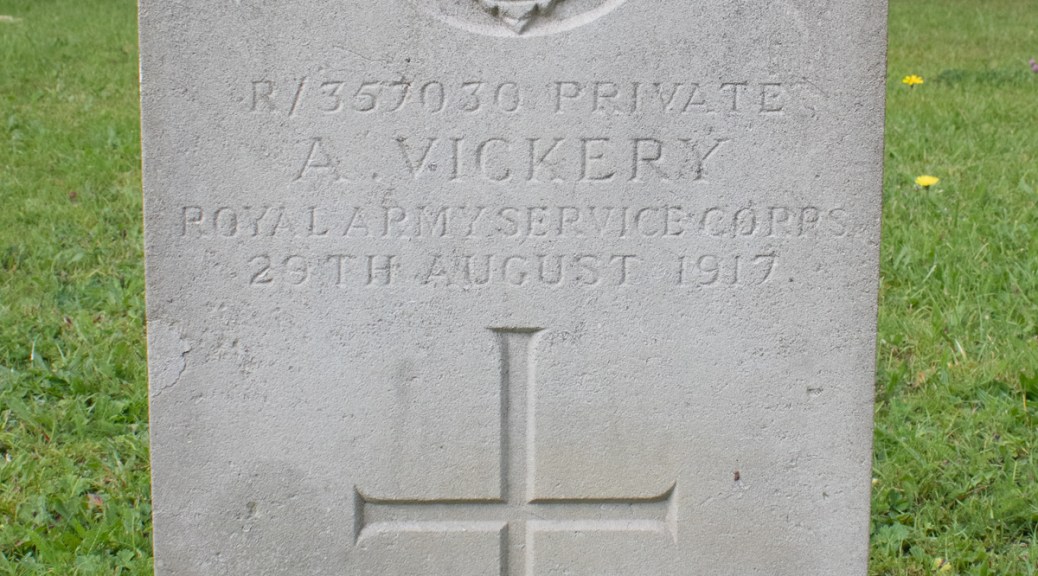
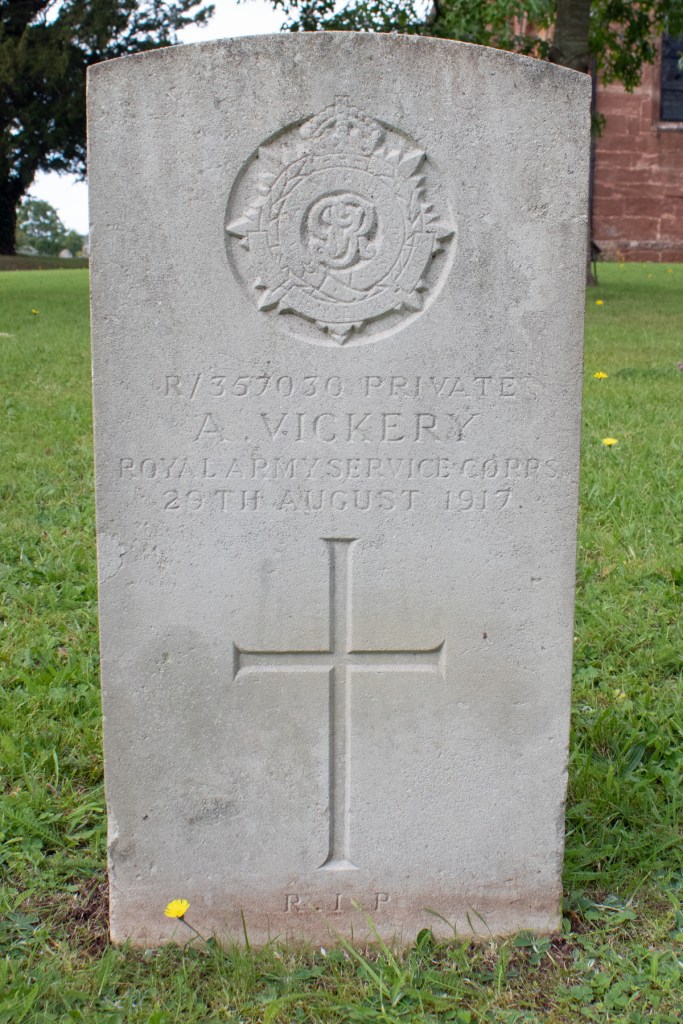
Amos Vickery was born in the autumn of 1886 in Bishops Lydeard, Somerset. He was the youngest of six children to William and Annie Vickery. William was a farm labourer, but when he finished his schooling, his son found work as a groom.
On 23rd February 1909, Amos married Alice Gratton. She was the daughter of a farm labourer from Halse, Somerset, who had taken up domestic duties in Bishops Lydeard. Not long after they were married, Amos took up new employment as publican of the Tynte Arms Inn in Enmore, and this is where he and Alice brought up their two children, Evelyn and William.
Amos’ time as a landlord seems not to have lasted long. By the time war broke out, the family had moved to Wiveliscombe, where he was working as a postman. Amos stepped up to play his part for King and Country, but was initially rejected. There are no longer any documents to confirm why this was the case, but it may have been based on any medical carried out.
Amos was finally accepted for armed service in June 1917, and was assigned to the Royal Army Service Corps. Private Vickery was attached to the Remounts Unit, and seems to have been posted around Bristol, Gloucestershire.
On Monday afternoon last the funeral took place… of the late Private Amos Vickery, ASC, who died somewhat suddenly from paralysis… at No 2 General Hospital, Bristol, at the age of 31, after a few days’ illness.
Taunton Courier and Western Advertiser: Wednesday 12th September 1917
Private Vickery’s service documents gave an official cause of death as hemiplegia and cerebral thrombosis: in effect, a stroke. He had been in the army for just ten weeks.
Amos Vickery was laid to rest in the graveyard of St Mary’s Church, Bishop’s Lydeard.
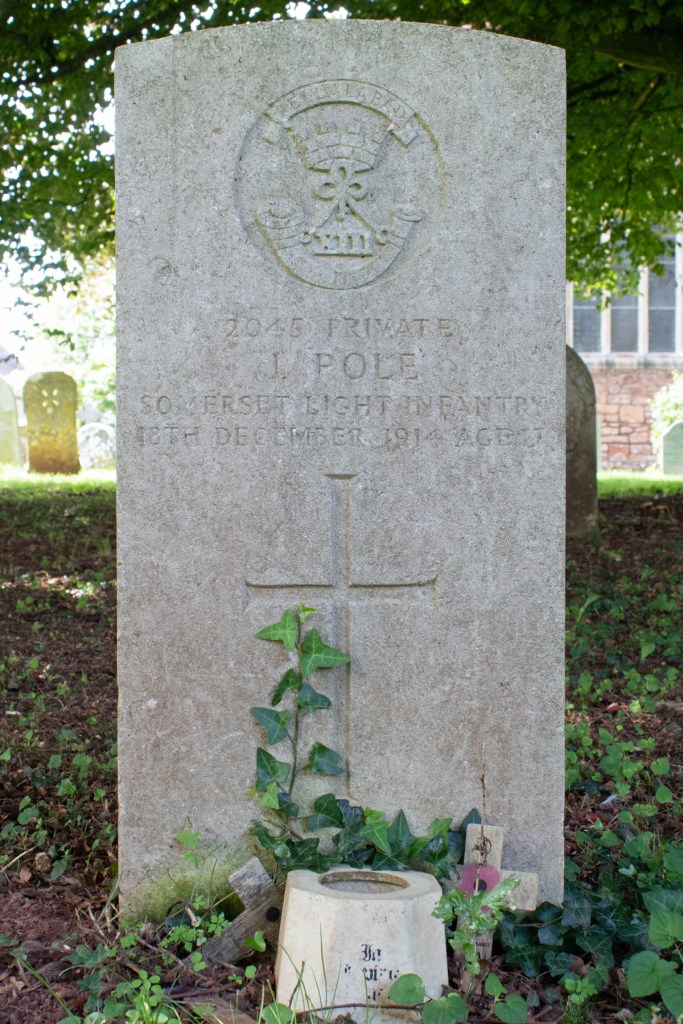
John Pole was born in Halse, Somerset, early in 1897. He was one of eleven children to Robert and Martha Pole. Robert was a basket weaver, and the family had moved to nearby Fitzhead by the time of the 1901 census.
Martha died in 1911, at the age of 51. John had finished his schooling by this point, and had found employment as a gardener. When war came to Europe, he gave that up to serve his King and Country. Details are scarce, but it is clear that he enlisted in the Somerset Light Infantry, and was attached to the 5th Battalion.
Private Pole was sent to Taunton for training, but his time in the army was not to be a lengthy one. His unit was sent to Southampton in September 1914, but it seems that he did not go with them. John contracted pneumonia, and seems to have been admitted to a military hospital in the town – possibly connected to his barracks. He died from the condition on 18th December 1914, aged just 17 years old.
John Pole’s body was brought back to Fitzhead for burial. He was laid to rest in the tranquil surroundings of St James’ Churchyard, close to where his father and siblings still lived.
Herbert Snook was born in the spring of 1895 in the village of Thurlbear, Somerset. The fourth of nine children, he was the second son of Henry and Clara Snook. Henry was employed as a stockman and cowman and by the time of the 1911 census, the family had moved to Bishop’s Lydeard, to the west of Taunton.
When Herbert completed his schooling, he found work as a postman. When war broke out, Herbert stepped up to play his part. Sadly, full details of his time in the army are no longer available, but the documents that remain give an indication about what he did.
Private Snook enlisted in the Somerset Light Infantry, and was assigned to the 8th (Service) Battalion. His unit served in France, but there is no evidence that Herbert went with them. During his time with the regiment, however, he was promoted, reaching the rank of Corporal.
In the summer of 1918, Herbert married Alice Webber. There is little information about her, but the wedding took place in Taunton. That winter, Herbert fell ill, contracting a combination of influenza and pneumonia. His health deteriorated quickly, and he passed away at his in-laws’ home on 3rd March 1919. He was just 24 years of age.
Herbert Snook’s body was taken to Ash Priors, near Bishop’s Lydeard, for burial. He was laid to rest in the tranquil graveyard of Holy Trinity Church, not far from where his family were living.
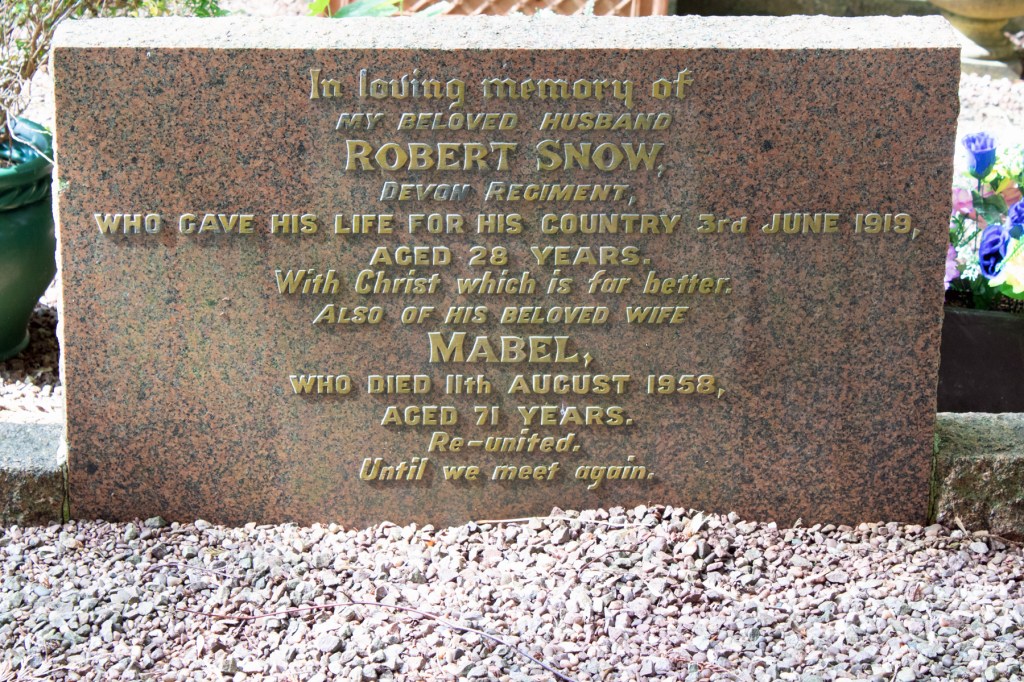
Robert Snow was born at the end of 1890 and was the fourth of six children. His parents were Somerset-born Henry and Elizabeth Snow, and the family were raised in the village of Combe Florey, near Taunton.
When Robert completed his schooling, he also found work as a farm labourer. On 10th September 1914, he married Mabel Trebble in the local parish church: the couple went on to have a daughter, Clarice, who was born in December.
By this point, war had consumed Europe. Robert was called upon to play his part and he joined the Devonshire Regiment as a Private. Little information about his military service survives, but it is clear that he was attached to the 10th (Service) Battalion, and was sent to France in September 1915.
Private Snow did not spend much time in France, however, as, just a couple of months later, his unit was transferred to Salonika in the Eastern Mediterranean. He appears to have spent most of the rest of the conflict there, as the next records relating to him show that he survived the war, and was back in Britain by March 1919.
An inquest was held at Bath War Hospital on Pte. Robert Snow, 28… who died on Tuesday evening just as he had been put under an anaesthetic prior to an operation for lumbar abscess, the man having tubercular spinal complaint. He had been at the hospital since March 29th, when he was transferred from the 2nd General Hospital Bristol. The coroner entered an inquisition of death from cardiac failure while under an anaesthetic. This was the first death of the kind at the hospital, through nearly 3,000 patients have been given anaesthetics.
Langport & Somerton Herald: Saturday 7th June 1919
Robert Snow died on 3rd June 1919. His body was taken back to Combe Florey for burial. He was laid to rest in the village’s cemetery, to be reunited with his widow, when she passed away in 1958, at the age of 71 years old.
Herbert Griffith was born in the summer of 1883 in the Somerset village of Crowcombe. One of eight children, his parents were coachman James Griffith and his wife, Selina.
Herbert’s early life is a challenge to piece together. The 1901 census recorded him as living at Weacombe House, West Quantoxhead, where he was employed as a footman.
On 16th December 1909, Herbert married Selina May Davies. Also born in Crowcombe, she was the daughter of a tailor. The couple’s marriage certificate confirms the wedding was conducted at the village church. The couple went on to have two children, Dorothy in 1912, and Geoffrey four years later.
Herbert, at this point, was living in Farnborough, Warwickshire, where he was employed as a valet. (While no document remains to confirm this, it seems possible that this was actually Farnborough Hall, home to generations of the Holbech family.)
When war broke out, Herbert seemed keen to serve his country. He enlisted in the Royal Army Medical Corps, although his full service records no longer remain, so it is not possible to confirm whether he served on home soil or overseas.
The next record relating to Private Griffith is that of his passing. He died in Southampton, Hampshire, on 22nd February 1916, as a result of a combination of bronchitis, asthma and cardiac failure. He was 32 years of age, and would never get to meet his son, who was born two weeks later.
The body of Herbert Griffith was taken back to Somerset for burial. He was laid to rest in the peaceful surroundings of the Church of the Holy Ghost in his home village, Crowcombe.
William James Stevens was born in the autumn of 1891, and was the fourth of eight children to William and Emily Stevens. William Sr was a carter on a farm in Stogumber, Somerset, and this is where the family would come to be raised.
William Jr followed his father’s trade when he finished his schooling, but stepped up to serve his King and Country when war was declared. Little information remains about his time in the army, but it is clear that he had enlisted in the Royal Field Artillery by the spring of 1916.
The only other records relating to William are those connected to his passing. He was discharged from the army on medical grounds in November 1916, and was suffering from tuberculosis. He appears to have been admitted to a hospital that winter, and died from the lung condition on 16th February 1917. He was 25 years of age.
William James Stevens was laid to rest in the tranquil surroundings of St Mary’s Churchyard in Stogumber.
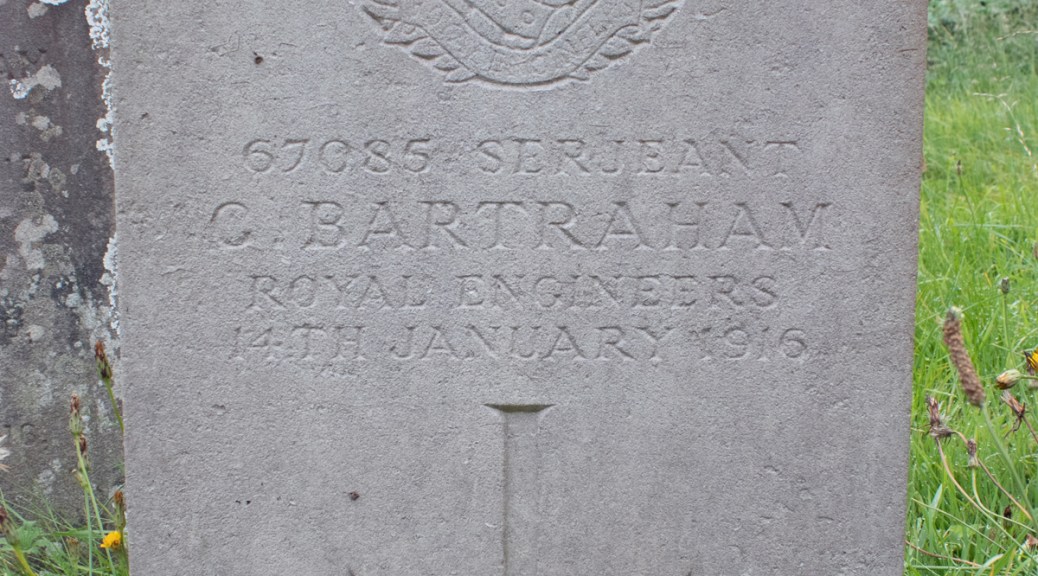
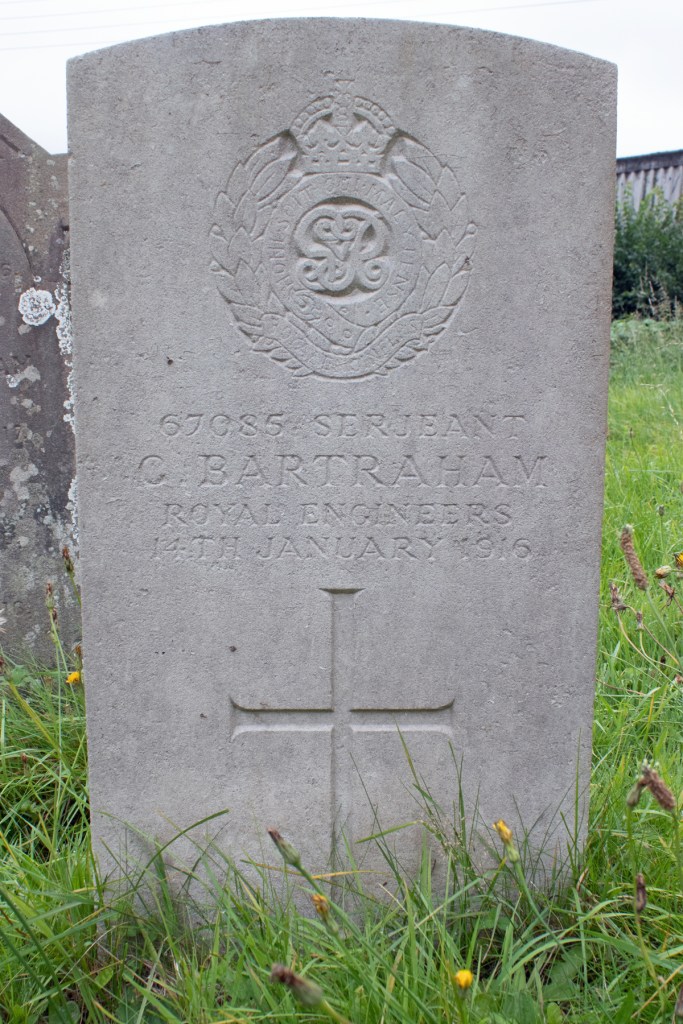
George Bartraham was born in the autumn of 1868 in the Somerset village of Sampford Brett. One of seven children, his parents were George and Sarah Bartraham. George Sr was a farm labourer and, while his son initially followed suit, he sought a life of adventure in the wilder world.
George Jr had found work as a tailor, and was apprenticed to a Charles Taylor, who lived in the village. That bigger and better life was niggling away, however, and, on 11th June 1888, he enlisted in the Royal Engineers. His service records show that he was 5ft 5.5ins (1.66m) tall, with black hair, dark eyes and a fair complexion. Sapper Bartraham was also noted as having a scar on his left foot.
George initially signed up for seven years’ service, with an additional 5 years on reserve status once that was completed. The 1891 census recorded him as being based at Fort Blockhorse in Alverstoke, Hampshire. Early in 1894, he married Mary Bowden, in Portsmouth: the couple would go on to have two children, George and Albert. The following year, Sapper Bartraham opted to remain on full service with the Royal Engineers, partially, it is fair to assume, as the pay would be better to support his family than on reserve.
By 1901, George had been moved to barracks in Pembroke Docks, Wales. Mary and the children remained in Hampshire, living with her parents in Unicorn Street, close to the town’s naval base. Wales was not to be the last stop for George, however, and in October 1902, he was sent to Ceylon, where he remained for the next three years.
During his time in the army, George did not sit on his laurels. He received a certificate as a master tailor, became skilled in submarine mining, and also received a qualification in signalling. He was promoted to Lance Corporal in 1899, and full Corporal four years later.
George returned to Britain in January 1906, and seems to have returned to a base in Hampshire. It was here, on 28th December 1908, that an altercation led to him being convicted of assault. He was charged with ‘unlawfully and maliciously wounding one Albert Edward Bartraham, by stabbing him with a pair of scissors, at Aldershot… and counts for assault occasioning actual bodily harm and common assault’ [Calendar of Prisoners, 1868-1929]
Albert was George’s older brother, and he was convicted to six months’ hard labour for the assault. Corporal Bartraham returned to base on 6th June 1909, and was discharged a few days later, having completed 21 years’ service in the Royal Engineers.
The next census record, taken in 1911, found a family divided by work or circumstance. Mary and the children remained firmly ensconced in Portsmouth with her parents, while George was living in Aldershot, where he was employed as a tailor. His employer is noted as being the Government, so it seems likely that he was still connected to the army camp there.
When war came to Europe, George was called upon to play his part once more. Promoted to the rank of Serjeant, he was attached to the 136th Fortress Company of the Royal Engineers. He arrived in Egypt in June 1915, although it is unclear how long he remained overseas.
By the start of 1916, Serjeant Bartraham was back in Britain, primarily because of ill health. He had come down with nephritis, or inflamed kidneys. Admitted to hospital in South London, he died from the condition on 14th January 1916, at the age of 47 years old.
Brought back to Somerset, George Bartraham was laid to rest in the peaceful graveyard of St George’s Church in the village of his birth, Sampford Brett.
This was a time of tragedy for the Bartraham family.
George’s father, George, had died around the same time as his son, and was buried near him.
George and Mary’s son, George, had enlisted in the Hampshire Regiment when war was declared and, by the summer of 1916, was based in Iraq. He died on 23rd September 1916, through causes unclear, and was laid to rest in Baghdad War Cemetery.
Three generations of Bartrahams, all called George, had passed away within nine months.
In the summer of 1917, Sarah Bartraham also passed away. She was laid to rest with her husband and son in St George’s Churchyard.
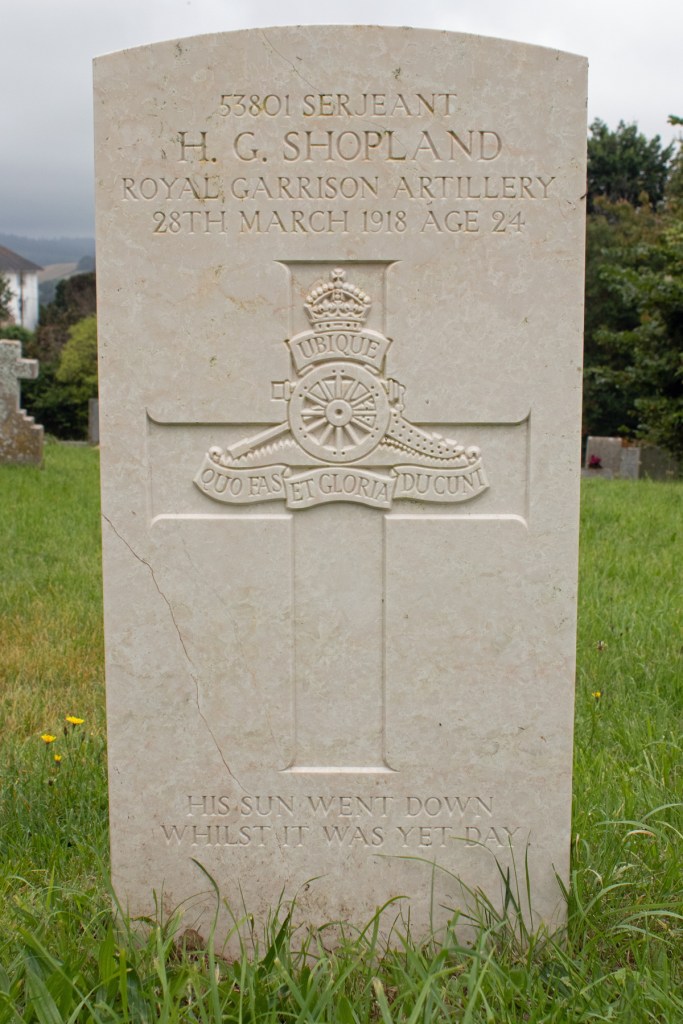
Harold George Shopland was born in the spring of 1893, the youngest of nine children to George and Mary Shopland. George was a joiner and platelayer for Great Western Railways: he died when Harold was just seven years old, which left Mary to raise the family alone. She did this with the support of the community and Harold’s older siblings.
By the time of the 1911 census, Harold, who was now 17 years of age, was the only one of her children to still be living at home: he was a stone mason’s carter, while Mary was getting by as the housekeeper for the local Wesleyan chapel.
When war broke out, Harold stepped up to play his part. Possibly keen to follow in his oldest brother’s footsteps – Private Walter Shopland had died at Bloemfontein in 1901 – he enlisted on 23rd November 1914. Harold joined the Royal Garrison Artillery as a Private, his service records confirming that he was 5ft 10ins (1.77m) tall, and weighed 165lbs (74.8kg).
Harold spent more than two years on home soil, before being sent to France in July 1917, with a promotion to Serjeant. He remained overseas, but fell ill with tuberculosis that winter, and was medically repatriated the following January. He was admitted to the Queen Mary’s Military Hospital in Whalley, Lancashire, and remained there for the next couple of months.
Harold’s condition meant that he was no longer fit for military duty, and was dismissed from service on 8th March 1918. He remained in hospital, however and his condition worsened. He passed away on 28th March 1918, at the age of 24 years old.
Mary brought Harold George Shopland’s body back to Somerset for burial. He was laid to rest in the peaceful setting of St Andrew’s Churchyard in Old Cleeve, not far from his father’s grave.