In the war grave section of Locksbrook Cemetery in Bath, Somerset, is a headstone dedicated to a Private J Curtis, of the King’s Liverpool Regiment, who passed away on 3rd January 1921. The Commonwealth War Graves Commission confirms that Joseph Curtis had transferred to the 430th Company of the Labour Corps at some point.
Little additional information is available for Joseph Curtis. Only one service document remains, his Medal Roll Index Card. This gives the dates of his service – 22nd February 1915 to 17th October 1918 – but no other identifying details.
Without a year or place of birth, it is not possible to track down any census records. As Bath was the location of both a War Hospital and one for army pensioners, his burial in a cemetery nearby is no guarantee that the city was ever his home. There is also no report of Private Curtis’ passing or funeral in any available contemporary newspapers.
The life of James Curtis is destined to remain a mystery, therefore, taken with him when he was laid to rest.
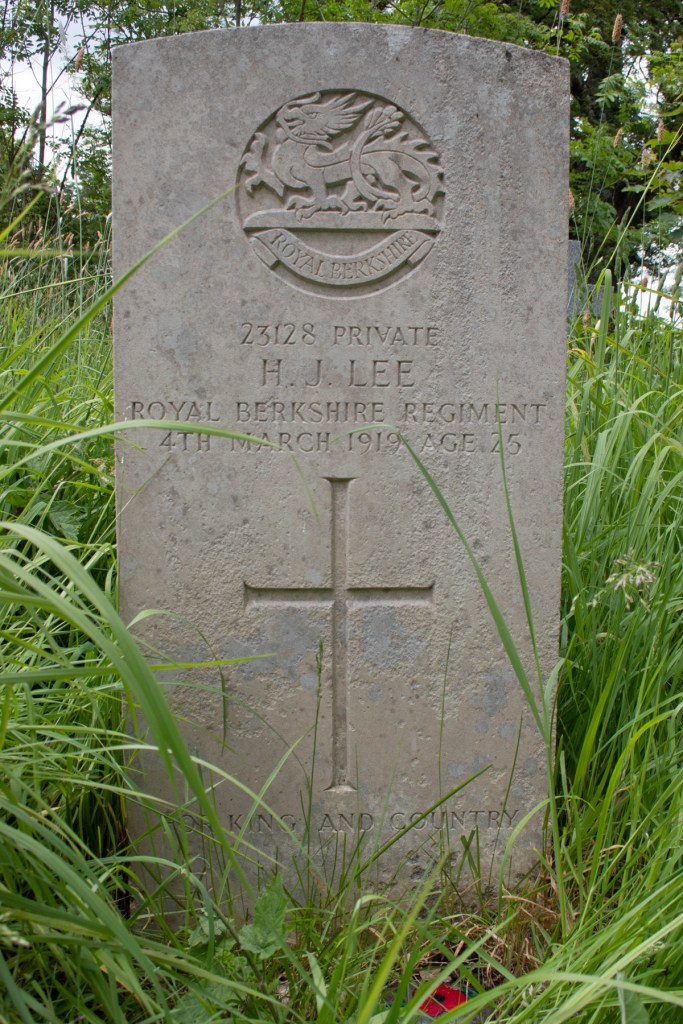
Herbert Jack Lee was born in the autumn of 1893 and was one of twelve children. His parents were Devon-born John Lee and his wife, Emily, who came from Churchstanton, Somerset, and it was here that the young family were raised. John was a bootmaker-turned-innkeeper, and the Lees lived in the village’s Rising Sun Inn.
By the time of the 1911 census, John had returned to boot-making once more. Herbert, meanwhile, had found work as a domestic gardener, bringing in a second wage to a household that included his parents and two younger siblings.
When war came to Europe, Herbert – who was better known by his middle name – stepped up to serve his King and Country. Little of his service documentation remains, but a contemporary newspaper report outlined his time in the army:
[Jack] joined the service in January, 1916, and was posted to the Wilts Regiment. He was subsequently transferred to the Royal Berks, and with them proceeded to France, returning to England suffering from trench feet at Easter, 1917. He was then posted to the Devon Regiment, and put into an Agricultural Company, and employed at Offwell, near Honiton.
Taunton Courier and Western Advertiser: Wednesday 12th March 1919
Private Lee’s health had suffered badly during the winter of 1916/17 and, in the spring of 1919, he came down with a severe bout of influenza. His body was too weakened to recover, and he passed away on 4th March 1919, aged just 25 years old.
Herbert Jack Lee was brought back to Somerset for burial. He was laid to rest in the peaceful graveyard of St Paul’s Church, in his home village of Churchstanton.
Interestingly, in the same edition of the Taunton Courier and Western Advertiser that had reported on Herbert’s funeral, was a report on the state of the Lee’s former home, the Rising Sun Inn.
…some of the rooms were very damp through water having come in… [and] was not fit to live in. The house had been very well conducted by the present tenant [Frank Gill], but… trade… had gone down by four-fifths since the war..
Taunton Courier and Western Advertiser: Wednesday 12th March 1919
Frank Gill was applying to the Licensing Board to avoid paying taxes for the year, given the drop in clientele and the number of other public houses in the area to support any customers. His case was referred on.
Much of the life of William Charles Taylor is destined to remain lost to time. His Commonwealth War Grave Commission and military records give his father as Henry Taylor, while another document suggests his mother’s initial was E, but no birth, baptism or census records match the three names given.
The document that can be directly attributed to William is his military service records. They confirm that he enlisted in Bath, Somerset, on 18th February 1916, joining the Somerset Light Infantry. The document notes that he was 21 years and 7 months old when he enlisted, and stood 5ft 7ins (1.7m) tall.
Initially assigned to the 10th Battalion of the Somerset Light Infantry, within a couple of months, Private Taylor was transferred across to the Durham Light Infantry in July 1917. He remained on home soil for the duration of his time in service, and was moved across to the Labour Corps in March 1918.
By May that year, William had become unwell. He was based in Essex at this point, and was admitted to the Warley Military Hospital in Brentwood, suffering from tuberculosis. He spent six weeks in hospital, before finally being discharged from the army as he was no fit for military service.
At this point, William’s trail goes cold once more. He seems to have returned home to Bath, finally succumbing to tuberculosis on 15th September 1918. He was just 24 years of age.
William Charles Taylor was laid to rest in Bath’s Twerton Cemetery.
Thomas Alfred Parsons was born in the summer of 1885 in Twerton, Somerset. One of six children, his parents were railway engine driver William Parsons and his wife, Mary. When Thomas finished his schooling, he found work at a labourer at a mineral water supplier, something he continued doing through to the outbreak of war.
On 27th May 1912, Thomas married Lily Howell, a labourer’s daughter, the couple tying the knot in Twerton parish church. They were living in Charlton Buildings, next to the river and now student accommodation for Bath’s universities. Lily had had a son, in November 1905: young Ronald was either Thomas’, or he was accepted as his own.
When war came to Europe, Thomas stepped up to play his part. He enlisted on 11th December 1915, although he was not formally mobilised until six months later. Private Parsons initially joined the Devonshire Regiment, but by early 1917, he became attached to the 169th Labour Corps.
Sent to France in February that year, Private Parsons only remained overseas for a matter of six months. By early September Thomas had fallen ill, contracting a combination of bronchitis and phthisis (or tuberculosis). Medically evacuated back to Britain, he was admitted to a hospital in Plymouth, Devon, but grew weaker until, on 2nd October 1917, he passed away. He was 32 years of age.
The body of Thomas Alfred Parsons was taken back to Somerset for burial. He was laid to rest in Twerton Cemetery, not far from his widow’s home.
Albert Lowman was born in Crewkerne, Somerset, in the autumn of 1876. He was the younger of two children to Charles and Sarah Lowman. The 1881 census recorded the family – Charles, Sarah and their boys Charles Jr and Albert – living in Back Lane. Charles Sr was noted as being a labourer, although in the column highlighting any medical conditions (‘deaf-and-dumb’, ‘blind’, ‘imbecile or idiot’, ‘lunatic’), is one word: “afflicted”.
Charles Sr passed away in 1886, when Albert was just 9 years old. The next census, in 1891, found Sarah working as a charwoman, while her youngest, who had left school by this point, was employed as a labourer. Mother and son also had a lodger, Alice, who was a dressmaker. Charles Jr, by this point, had left home, and was living in Penarth, Glamorganshire, where he was apprenticed to his paternal uncle, who was a tailor.
On 28th November 1896, Albert married Sarah Ann Dodge, a weaver’s daughter who was also from Crewkerne. Albert recorded his job as a drayman, although this seems to have been piecemeal employment.
The next census found more permanent work, as he was cited as being a shirt factory packer, while Sarah was employed by the factory as a machinist. Making up the household was young Charles Lowman, the couple’s first son, who was just a month old although sadly, he survived only a couple of months more before dying.
Further tragedy is highlighted by the 1911 census, as it highlights that the couple had had a further child, who had also died when just a babe-in-arms. The Lowmans were now living on Hermitage Street near the centre of the town. Albert was still a shirt packer, and, even though their cottage was small, they had two boarders and a visitor staying. The lodgers brought the couple a little rent, which meant that Sarah no longer had to work.
War was closing in on Europe and, while his full military records are lost to time, it is clear that Albert had stepped up to play his part. He had enlisted by January 1918, and was attached to the Devonshire Regiment, through which he served with the 380 Company of the Labour Corps.
Private Lowman was barracked on Salisbury Plain, Wiltshire, and in July he was admitted to the military hospital in Salisbury itself, suffering from appendicitis. He was operated on, but died following complications. He passed away on 10th July 1918, at the age of 41 years old.
Albert Lowman was brought back to Somerset for burial. He was laid to rest in the cemetery of his home town, Crewkerne.
Private Lowman’s pension ledger record shows the beneficiaries of his army service. The document identified Sarah as his widow, but also Phillis Annie Matilda Denning, the couple’s adopted daughter, who had been born in August 1904.
Sarah was not to outlive her late husband for long, however.
The death occurred with tragic suddenness on Sunday afternoon, January 7th, at her residence in Hermitage-street, of Mrs Sarah Ann Lowman… The deceased, who was of middle age, was about as usual attending to her ordinary household duties in the morning. Just before dinner hour, however, she complained of not feeling well and went upstairs to lie down. Her niece took her up a cup of how water, and she then apparently went to sleep. She awoke about 3:40pm, and then had to get out of bed owing to sickness. Upon going back into bed again she expired almost immediately. Dr Wolfenstein was called, but he could only pronounce life extinct.
Langport & Somerton Herald: Saturday 20th January 1923
Sarah was 47 years of age when she passed away. It is likely that she was laid to rest near her husband, although records to confirm this have been lost.
Albert’s brother, Charles, survived his sibling by less than six months. He had left tailoring behind him in South Wales, and instead embarked on a military career. He joined the Royal Field Artillery in 1895 and, over the course of his twelve years’ service, served in the Caribbean and the Mediterranean.
Charles married Florence Dodge in 1908, and the couple went on to have two children – Cecil and Freda. When war broke out in 1914, he stepped up once more. Having already risen through the ranks from Gunner to Bombardier and Corporal, he re-entered service as a Sergeant in the Royal Garrison Artillery.
Based in Le Harve, Northern France, Sergeant Lowman was admitted to a hospital in Harfleur, having contracted bronchial pneumonia. Sadly, he passed away while admitted, on 8th November 1918, just three days before the end of the conflict. He was 43 years of age.
Charles Lowman was laid to rest in the Sainte Marie Cemetery, near the centre of Le Harve.
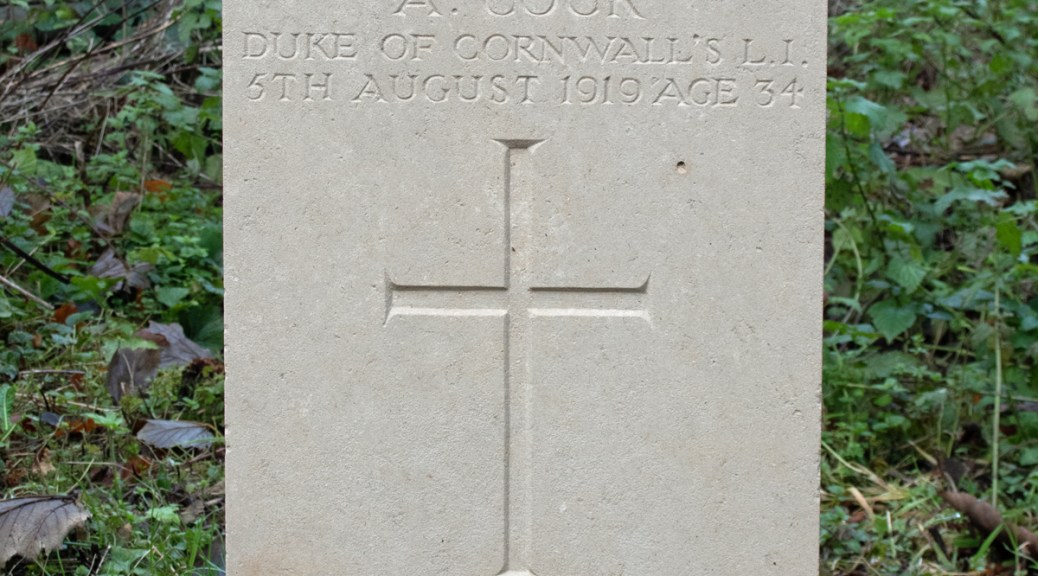
Arthur Cock was born in around 1885 in Wadebridge, Cornwall. One of eleven children, he was the son of mortar mason William Cock, and his wife, Louisa.
When he left school Arthur helper his father out in the business, but when war came to Europe’s shores, he stepped up to play his part. Sadly, his service records are lost to time, and it is a challenge to piece together his time during the conflict from a confusion of other documents.
It is clear that Arthur enlisted in the Duke of Cornwall’s Light Infantry, as this is what is engraved on his headstone. However, his Medal Roll suggests that he also served in the Gloucestershire Regiment and the Labour Corps. He seems not to have fought overseas, and was awarded the Victory and British Medals for doing his duty.
Private Cock’s entry in the Army Register of Soldier’s Effects confirms that he must have enlisted before February 1919, and that he passed away at Whitchurch Hospital.
An entry in the local newspaper, reporting on his death, reads as follows:
In loving memory of Pte. Arthur Cock, son of William, and the late Louisa Cock, of Wadebridge, who died August 5th, at Whitchurch War Hospital, Cardiff.
Cornish Guardian: Friday 8th August 1919
Interestingly, the facility Arthur had been admitted to was a psychiatric hospital, but with no other confirmation as to his passing, it is only possible to assume the cause of his death. He was 34 years old when he passed away.
Arthur Cock’s body was brought back to Cornwall for burial. He was laid to rest in the peaceful, wooded graveyard of St Breoke’s Church, next to the family grave in which Louisa had been buried three years previously.
The family grave, by this time, was tragically quite full. William was able to mourn his son, wife and six of Arthur’s siblings – Mary, William, John, Fred, Charles and Ernest – who had all passed in childhood and were laid to rest there.
Arthur’s younger brother – another William – also fought in the First World War. His service records reveal a lot about his life.
Private Cock enlisted in the Australian Imperial Force on 7th September 1914. At the time he was working as a railway porter in Morphettville, now a suburb of Adelaide, Australia. His records confirm that he was 5ft 8.5ins (1.74m) tall, and weighed 158lbs (72kg). He had brown hair, brown eyes an a fresh complexion.
William left Australia for the battlefield on 20th October 1914, and soon found himself in the Eastern Mediterranean. Sadly, this was to be the end of the line for him: he was killed on the battlefields of Gallipoli on 23rd March 1915, aged just 28 year of age.
William Cock was laid to rest in the Shrapnel Valley Cemetery in Gallipoli. He is commemorated on the headstone of the family grave back in St Breock.
William Julian was born in the spring of 1879, in the Cornish village of St Breock. He was one of five children to agricultural labourer John Julian and his wife Mary. Mary appears to have died when William was young as, by the time of the 1891 census, John was married to an Emily Julian, whose 10-year-old daughter, Fanny Jane Pinch, was also living in the family home.
At this point, it becomes difficult to accurately track young William’s life. The surname Julian is not uncommon in Cornwall at this point, and, while the 1901 census confirms he had moved out of the family home, gives a couple of potential alternatives. The most likely is a William Julian, boarding in St Germans, Cornwall, who working as a waggoner, although it is impossible to categorically connect the census return to this William Julian.
The next census, however, gives more confirmation of William’s location. He was working as a tin miner, and lodging with Richard and Jane Sweet in Withiel, Cornwall.
It is not long after this that he married Maud Brenton. The couple set up home in the hamlet of Burlawn, to the south of Wadebridge, and went on to have four children: William, born in 1912, John, born in 1914, and twins Jeremiah and Samuel, who were born in 1915.
By this point war was raging across Europe, and, while, as a miner William would have been in a protected profession, his time came to step up and serve King and Country. In the spring of 1917, he did just that, joining the Labour Corps as a Private. Little detail of his military service survives, but is is likely that he did his duty on home soil.
Private Julian’s time in the army was not to be a long one, however, and he developed haemoptysis, possibly as a result of a lung condition. This was to lead to his passing; he died on 29th August 1917, at the age of 38 years old.
William Julian was brought back to Cornwall for burial. He was laid to rest in the tranquil graveyard of St Breoke’s Church, the parish in which he was born and lived
Thomas Teague was born in the spring of 1884 in the Cornish town of Tintagel. He was one of ten children to quarryman and road labourer John Teague and his wife, Ellen. When he first left school, Thomas found work as a farm labourer. By the time of the 1911 census, he was still living in the family home, but had found more skilled work as a stone mason.
Much of the rest of Thomas’ life remains a mystery. John passed away in September 1914, and it is clear that, with war now raging across Europe, Thomas stepped up to play his part. He enlisted in the Royal Dublin Fusiliers, and was assigned to the 7th Battalion. The regiment served in Gallipoli, Salonika and Egypt, although it is not possible to identify where Private Teague served.
At some point, potentially because of health reasons, Thomas was transferred to the 655 Home Service Coy of the Labour Corps. Again, exact details of his service are unclear, but he had been promoted to the rank of Corporal, and appears to have been based in Curragh Camp, not far from Kildare, Southern Ireland.
The only other confirmed record relating to Corporal Teague is that of his passing. He died of heart disease in the camp, on the 2nd October 1917. He was 33 years of age.
Thomas Teague’s body was brought back to Cornwall for burial. He was laid to rest in the peaceful graveyard of St Materiana’s Church, overlooking his home village of Tintagel.
Thomas was buried in the family plot, alongside his father. When his mother, Ellen, passed away in 1930, she was reunited with her husband and son.
Ernest Green was born on 31st March 1881 – four days before that year’s census – in the Kent village of Aylesford. The middle of eleven children, his parent were William and Sarah Green. William was a labourer in the local clay works, and this is employment that Ernest and his brothers also entered into.
On 10th December 1904, Ernest married Emily Chapman. She was the daughter of another labourer, and the couple went on to have seven children, the oldest of whom was born in May 1905.
The family set up home in Aylesford, not far from Ernest’s parents, and life would have been set, had it not been for the intervention of the First World War.
Ernest enlisted early on, joining The Buffs (East Kent Regiment) in December 1914. His service records confirm that he was 33 years old when he enlisted, and stood 5ft 4ins (1.63m) tall. Sadly, Private Green’s service records are a little sketchy, and it is unclear whether he ever saw action overseas, although it is likely that he did at some point.
Private Green transferred to the Machine Gun Corps in February 1916, and then moved again – to the Labour Corps – in the summer of 1918. He joined the 426th Agricultural Coy, and was based in Canterbury.
Working outside through the summer and autumn, it seems that Ernest’s health may have begun to suffer and he was admitted to the Canterbury Military Hospital in December 1918, having contracted influenza. Sadly, the lung condition was to prove his undoing: Private Green passed away at the facility on 20th December 1918. He was 37 years of age.
Ernest Green was brought back to Aylesford for burial. He was laid to rest in the graveyard of St Peter & St Paul’s Church, although the exact location of his grave is not longer known. Instead, he is commemorated on a joint headstone in the First World War section of the graveyard.
Michael Barton was born in the spring of 1863 in the Kent village of Hadlow. The youngest of three children, his parents were farm labourer William Barton and his wife Annie. Michael became a farm labourer when he left school and, when William died in 1890, he remained at home to support his mother.
Annie passed away in 1905, and this proved a turning point for Michael. By the time of the next census in 1911, he was recorded in the Tonbridge Union Workhouse, one of its 600 inmates.
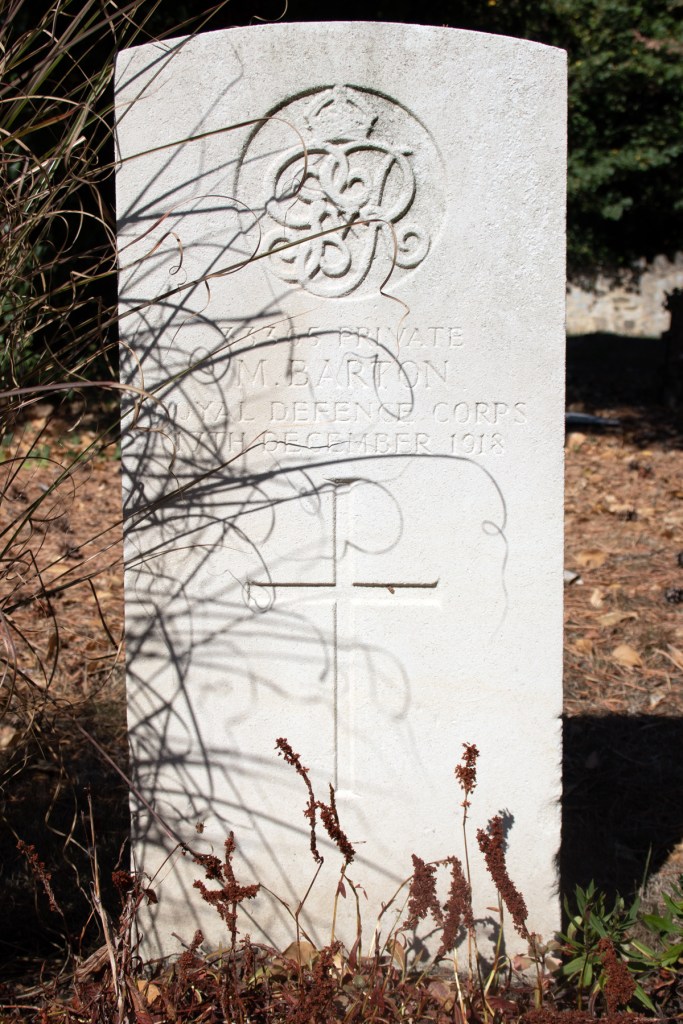
Michael’s trail is harder to pick up at this point. Despite his age, it seems that he sought a way out of his situation when war broke out and had certainly enlisted in the army by the last year of the conflict. Initially joining the Royal Defence Corps, Private Barton was soon transferred to the Labour Corps, and was assigned to 572nd Agricultural Coy.
The next document relating to Michael is that of his passing. He died on 17th December 1918 at the Preston Hall Military Hospital in Aylesford, Kent, although the cause of his death is not readily available. He was 55 years of age.
Michael Barton was laid to rest in the graveyard of St Peter & St Paul’s Church in Aylesford, not far from the hospital in which he had passed.
The Army Register of Soldiers’ Effects records that Michael’s belongings passed to a Miss Kate Burley when he died. Not one of his immediate relatives, it is likely that she was a friend or other relation.







 Death and Service