Percy Payne was born in the village of Kingston Seymour, between Weston-super-Mare and Yatton, Somerset. His parents were agricultural labourer Harry Payne and his wife, Elizabeth, and he had three brothers.
It seems that Percy’s parents may well have separated by 1911; Elizabeth is listed as a widow in the 1911 census, but Harry appears to be alive and well and living in South Wales.
According to the census records, Elizabeth was working as a charwoman, while three of her children were working to help support the family. Percy’s two older brothers were employed as a carter and a domestic servant, while Percy himself was working as an errand boy.
By the time war broke out, Percy has stepped up the ladder. His service records listed his trade as a groom, working in Congresbury, near Bristol. He enlisted in March 1916, at the age of 19 years and 8 months, and was assigned as a Private in the Northumberland Fusiliers. He spent most of that year training on home soil, before being shipped out to France at the end of December.
Illness seems to have dogged Private Payne; he returned to England after a couple of months, and was transferred to the Labour Corps fairly soon afterwards. By September 1917 a further transfer was made, this time to the Royal Army Medical Corps, before he was finally discharged from military service on 21st January 1918, suffering from tuberculosis.
Sadly, the lung condition was to prove fatal, and Percy passed away on 26th June 1918. He was just 21 years old.
Percy Payne lies at rest in the graveyard of St Mary’s Church in the village of Yatton, Somerset.
John Valentine Thick was born in 1883, the youngest of two children to John Thick and his wife Anna. John Sr was a plumber, and evidently moved around with his work. He was born in Surrey, Anna came from Berkshire; their older child, Grace was born in Hampshire, while John Jr was also born in Berkshire.
By the time of the 1891 census, John Sr had moved the family down to Blandford Forum in Dorset. Little more is known about his son’s early life, but by 1907, he was back in Berkshire, and married Henrietta Entwistle, who had grown up in Chelsea.
The young couple went on to have three children – John, Muriel and Margaret – and settled down in Reading, Berkshire. John, by this time, was working as a domestic gardener.
Little documentation exists relating to John’s military service. He enlisted in the Hampshire Regiment, and was assigned to the 1st Labour Company. Private Thick would have been part of the regiment’s territorial force, presumably using his gardening skills to help with the war effort.
While it is difficult to confirm the dates of his service, it seems that John had enlisted towards the end of 1916. It was early the following year that he fell ill, and was soon admitted to hospital with bronchitis. Sadly, this condition was to get the better of him, and Private Thick passed away on 8th March 1917. He was just 34 years old.
John Valentine Thick lies at rest in St Mary’s Cemetery in Taunton, Somerset.
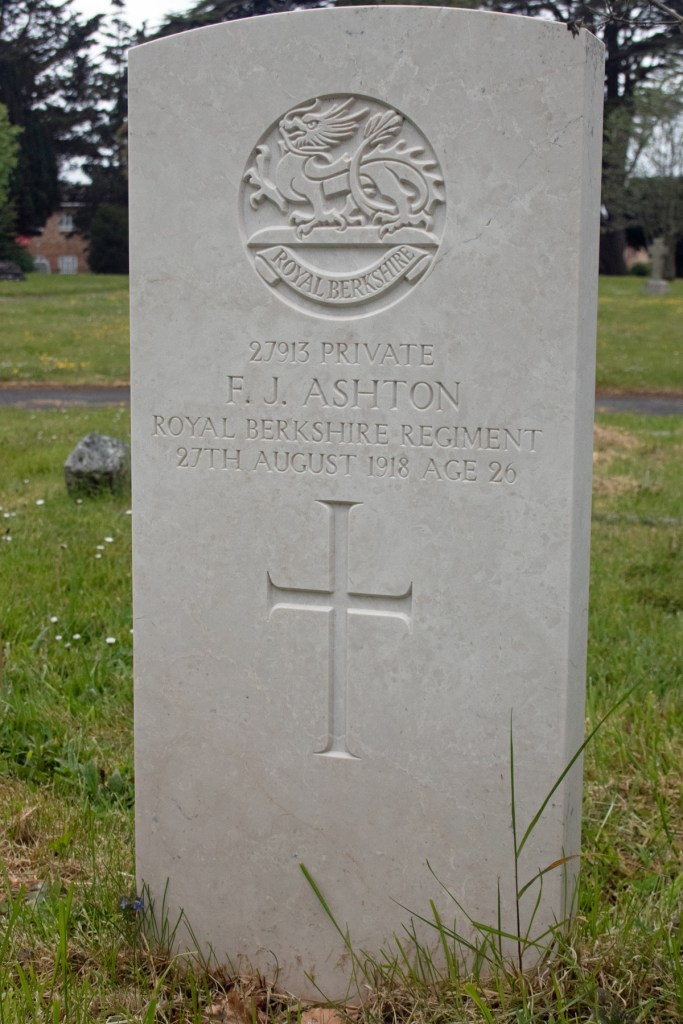
Frederick John Ashton was born in Taunton, Somerset, in 1892. He was one of eight children to scavenger and labourer Thomas Ashton and his wife Susanna.
When he left school, Frederick found work as a carter, and this is the job he was doing in 1913, when he married local woman Ethel May Lock. The young couple went on to have two children, Olive and Phyllis.
War was on the horizon, and Frederick enlisted in June 1916. Initially assigned to the Royal Berkshire Regiment, Private Ashton was shipped off to France within a couple of months.
During his time there, he was promoted to Lance Corporal, but requested being reverted back to his previous rank a few months later. By this point, he had been transferred to the Labour Corps, the regiment in which he served for the rest of his time.
In March 1918, Frederick was badly wounded, and found himself invalided back to England. He was admitted to the Northumberland War Hospital in Newcastle-upon-Tyne, where his right leg was amputated. Sadly, it appears that the treatment came too late, and Private Ashton passed away on 27th August 1918. He was just 26 years old.
Frederick John Ashton lies at rest in St Mary’s Cemetery in his home town of Taunton.
William Gulliford was born on 8th November 1877 in the village of Thurloxton, just to the north of Taunton, Somerset. William’s father – also called William – was an agricultural labourer who, with his wife Charlotte, had nine children in total.
William Jr found work as a labourer for a brewery and, by 1899, had moved to Staffordshire, met and married a local woman called Elsie Sutton. The couple settled down in Burton-on-Trent, and went on to have a daughter, also called Elsie.
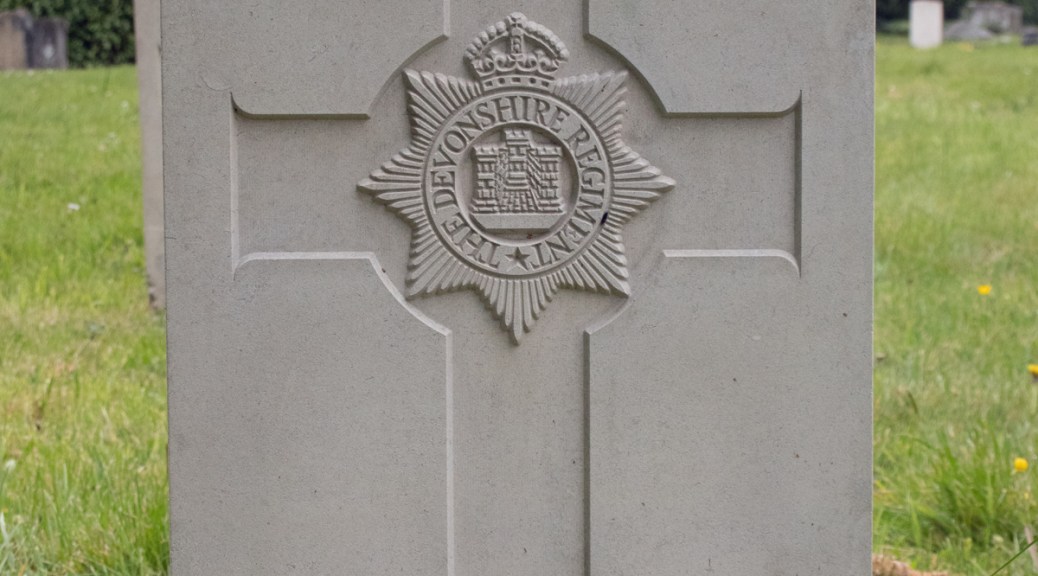
War was coming, however, and, in August 1916, William enlisted. Initially assigned as a Private in the 14th Devonshire Regiment, he was soon moved to the Labour Corps, and within a couple of months was on the Western Front as part of the British Expeditionary Force.
In November 1917, Private Gulliford was shipped back to England, suffering from ill health. He was admitted to the Military Hospital in Taunton with heart failure, and sadly passed away from this a month later. He had just turned 40 years old.
William Gulliford lies at rest in St Mary’s Cemetery in Taunton, Somerset.
Thomas Henry Winter was born in 1887, one of six children to James and Mary. James was a farmer, and the family lived in Milverton, in the Somerset countryside to the west of Taunton.
James died in 1900, and Thomas found his way into farm work as well. He met and married a local woman called Ada Thynne in February 1909, and the couple went on to have five children: Beatrice, James, Charles, Frank and Thomas.
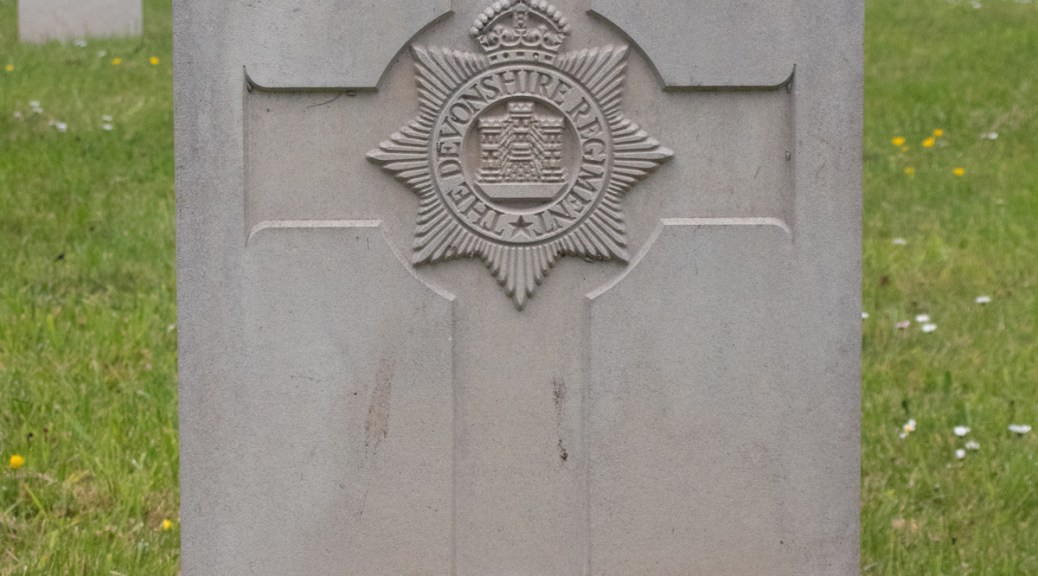
There is little confirmed information about Thomas’ military career. When he joined up, he enlisted in the 13th Battalion of the Devonshire Regiment, although, as his service records no longer exist, it is not possible to identify when this was.
Private Winter later transferred to the Labour Corps – again there are no records to confirm the dates – and this is the division in which he remained.
Illness was to dog Thomas, however; in early 1918, he contracted enteric fever (known nowadays as typhoid), and was hospitalised. Sadly, he succumbed to the disease, and passed away on 14th February 1918. He was 30 years of age.
Thomas Henry Winter lies at rest in St Mary’s Cemetery in Taunton, Somerset.
An additional tragic turn to Thomas’ story is that Ada was pregnant when he passed away. His youngest son, whom Ada named after him, would never know his father.
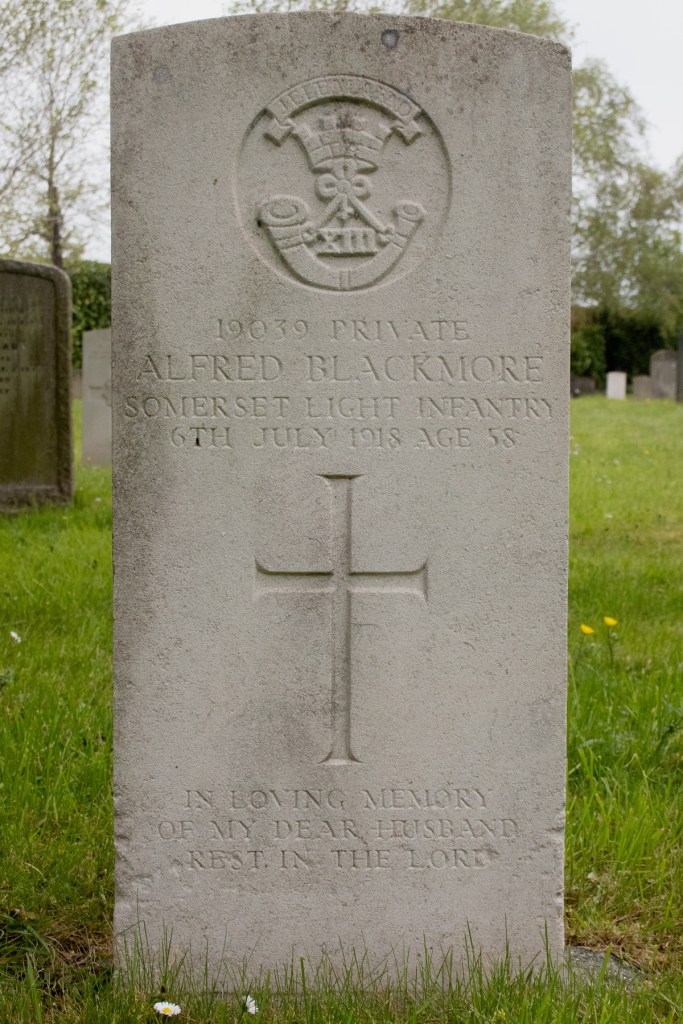
Alfred Blackmore was born on 25th October 1868 in the village of Thurlbear, near Taunton. Documentation varies and names cross over, but it appears that he was one numerous children to farm labourer William Blackmore and his wife, Mary Ann.
Details of Alfred’s early life are a bit hazy – again, in a rural location, names often cross over, so it is a challenge to totally confirm that they relate to the right person. His mother appears to have passed away by the time of the 1881 census, and Alfred was living with his father and three of his siblings and working as a farm hand.
Alfred again disappears off the radar for a while; in July 1894, he married Lucy Charlotte Yard, and the couple went on to have two daughters, Lucy and Beatrice. By 1901, the young family were living in the village of Frampton Cotterell, just to the north of Bristol, and Alfred had found employment as a marine fireman.
Ten years later, Lucy and the girls were still living in Frampton Cotterell, but Alfred was back in Taunton, lodging with a 75-year-old widow called Mary Croker and working as a labourer. This separation may have signalled the beginning of the end for the couple’s marriage.
War broke out, and it is evident that Alfred enlisted as a Private in the Somerset Light Infantry. Sadly, his service records are lost to time, but it appears that he served for at least three years.
The next time Alfred appears in documentation, it is a newspaper report on his passing, under the heading “Taunton Soldier’s Death”.
FOUND DROWNED AT BLACKBROOK
Mr F Foster Barham, coroner for West Somerset, held an inquest at the Blackbrook Inn, Ruishton, on Monday, relative to the death of Alfred Blackmore, aged 49, a private in the Labour Company at Taunton Barracks, whose body was found in the stream at Blackbrook on Saturday morning.
William Cozens, farmer… gave evidence of identification, and stated that on Friday he saw the deceased sitting by the hedge… about 400 yards from where the body was found.
William Richard Radnidge, butcher… stated that on Saturday morning he found the body in the stream dividing Ruishton from Taunton St Mary’s… His cap, belt and cape were on the bank. The deceased was lying face downward, his face and arms being in the mud below the surface.
PC Jenkins stated that at 10:45am on Saturday he received a communication from PC Wathen, in consequence of which he proceeded to Blackbrook, where he found the body lying under a hedge. He searched the body, and on it found a summons, returnable at Taunton on 29th June, for having failed to comply with a maintenance order obtained by his wife, Lucy Blackmore, on 25th September 1915, the sum of £2 13s [approx. £300 today] being due. On the back of the summons was written: “This is what my old cow has done for me.”
There was also the following letter: “When my body is found, don’t you give a farthing to my old cow. What I have got to come give to my brother, Edward Blackmore… Signed A Blackmore.” At the back of the letter was written: “Goodbye to all that I love.”
The deceased had left his lodging at nine a.m. on June 29th to attend the Taunton Police Court, but did not do so.
An officer stated that the deceased’s conduct during the three years he had been in the army had been satisfactory.
The Foreman of the jury said that according to the evidence they found that the deceased met with his death by drowning whilst temporarily insane.
Taunton Courier and Western Advertiser: Wednesday 10th July 1918
Alfred Blackmore took his own life on 6th July 1918. He was 49 years old [the war grave gives a different age].
Alfred lies at peace in St Mary’s Cemetery in Taunton, Somerset.
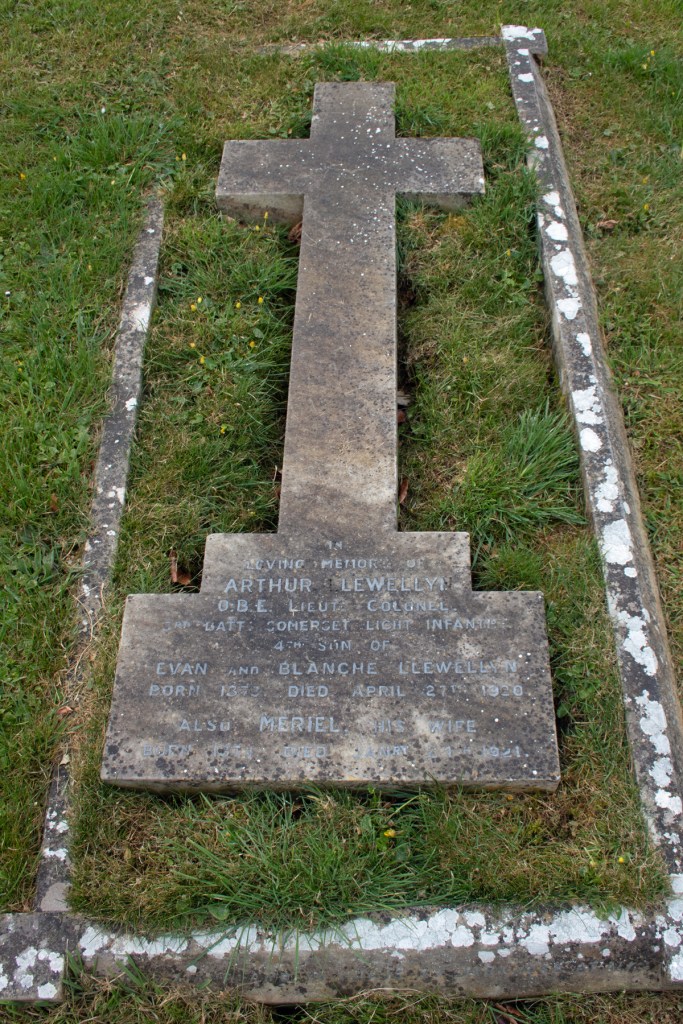
Arthur Llewellyn was born in the summer of 1873, one of four children to Evan and Mary Llewellyn. Originally from Wales, Evan was a Justice of the Peace in the Somerset village of Burrington, and the family lived in the comparative luxury of Langford Court, a mile or so from the village centre.
I use the term ‘comparative luxury’ with some sense of irony; according to the 1881 census, the family had a household staff of eight, including a governess, two nurses, housemaid, cook, kitchen maid, parlour maid and page.
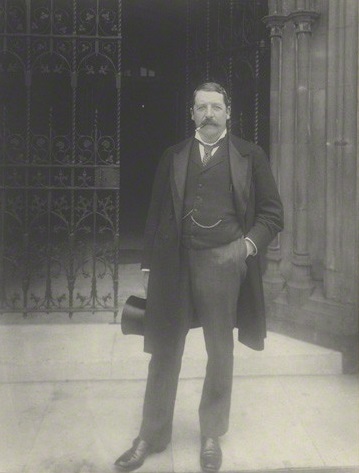
Ambition was obviously what drove Evan; he was an army office, who served in initially in the Somerset Light Infantry. In 1885, he was elected MP for North Somerset, a position he held on and off for nearly twenty years. His military service continued, however, and he led the 2nd (Central African) Battalion, King’s African Rifles in the Boer War.
Comfort ran in the Llewellyn family; according to the 1891 census, Arthur was staying with his maternal aunt, Rose Stewart. She also lived in Somerset, and, at the time the census was drawn up, she was recorded as a widow living on her own means, with her mother, mother-in-law, two nieces and Arthur, her nephew. She was not without help, however, as the house had a retinue of eight staff to support her.
Military life was an obvious draw for Arthur. He enlisted in the Somerset Light Infantry in October 1891 and, within a year, had been promoted to Second Lieutenant.
He had met and married Meriel Byrne, in 1895. The couple’s marriage certificate confirms that he had been promoted to Captain in the militia, and his residence was Buckingham Palace Road, in south west London. They were married in Holy Trinity Church, Brompton, with Meriel’s mother and Arthur’s father acting as witnesses.
The couple went on to have five children, all girls, and they settled into a comfortable life. By 1901, Meriel had set up home in Worcestershire; Arthur does not appear on that year’s census, which suggests that he may too have been fighting in South Africa.
Arthur’s mother Mary passed away in 1906, at the tender age of 39. By 1911, he had been promoted to Lieutenant Colonel in the 3rd Somerset Light Infantry, and was head of his household in Worcestershire. The family was, by this time, complete – Arthur and Meriel and their five children also had help running their home, with two nurses, a cook, parlour maid and housemaid to support them.
Evan passed away months before war was declared, at the age of 67. Lieutenant Colonel Llewellyn felt duty bound to re-enlist, and was given command of the 3rd Reserve Battalion, Somerset Light Infantry. He subsequently served as part of the Army Service Corps in France, before transferring to the Army Labour Corps in Nottingham.
According to the Evening Mail, on 27th April 1920, he “was suddenly seized with illness in the street, and died as he was being conveyed to Nottingham Hospital. He was 46 years of age.”
Arthur was brought back to Burrington in Somerset, where he was buried alongside his parents in Holy Trinity Churchyard.
Sadly, Meriel passed away nine months after her husband; she too is buried in Holy Trinity Churchyard.
Arthur’s estate passed to his brother, Owen, and totalled £12,023 15s 11d (approximately £530,000 in today’s money).
As an aside to Arthur’s illustrious story, another of his brothers is worthy of note. Hoel Llewellyn was two years older than Arthur.
Educated for the Royal Navy, he saw active service on the East Coast of Africa, 1888-90 with despatches. He also served as Artillery Officer and commanded artillery in the Matabele War, where he was recommended for the Victoria Cross. He was promoted Captain in the British South Africa Police, and Justice of the Peace in Matabeleland in1896.
Captain Llewellyn served throughout the South African War; commanding armoured trains north of Mafeking before transferring to the South African Constabulary in 1901. Hoel was eventually created a Companion of the Distinguished Service Order for his service in South Africa.
He was wounded while serving with the Mediterranean Expeditionary Force in the Great War. Hoel was subsequently promoted to the rank of Colonel and appointed Provost-Marshal of Egypt and the British Mediterranean Expeditionary Force.
In 1908, he had been made Chief Constable of Wiltshire, a role he was to hold for 37 years. He was key to pioneering the use of police dogs, and went on to become the oldest serving person to hold the Chief Constable role in the county.
Evan Henry Llewellyn
Another aspect of the Llewellyn family is that Evan was obviously a source of political drive for the family; his great-great-grandson is David Cameron, UK Prime Minister from 2010 to 2016.
Sidney John Warren was born in January 1890, one of eleven children to shipwright George Warren and his wife Elizabeth. The family lived in Salmon Parade, on the riverside in Bridgwater, where George would have plied his trade. By the time of the 1911 census, Sidney had found work as a grocer’s assistant, and was living with his parents and the youngest of his brothers, Edward.
While exact details of Private Warren’s military career are not available, documents confirm that he enlisted in the Somerset Light Infantry. Assigned to the 4th Battalion, he was based in India and Mesopotamia during the conflict. No details are available of his time there, but at some point, he transferred to the Labour Corps back in Somerset.
And there Sidney’s trail goes cold. He survived the war, but passed away on 27th November 1918, suffering from pneumonia. He was just 28 years old.
Sidney John Warren lies at rest in the family grave at St John’s Cemetery in his home town of Bridgwater in Somerset.
Roland Roberts was born in September 1896, one of three children – all boys – to Albert and Minnie Roberts.
Minnie, who was originally from Yeovil, had married Walter Shury, a Londoner, in 1874, and the couple had six children together. Walter then went on to have four children with Alice Norwood, and the couple married in 1898. Minnie, meanwhile, had met Albert Roberts, who was from Dundalk in Ireland, and, while no marriage seems to be confirmed, the couple had three boys, including Roland. (It is pure speculation, but as Minnie’s maiden was also Roberts, this might have provided a good enough cover for any divorce or re-marriage.)
Albert had been a Band Sergeant in the 4th Hussars, and continued that passion by becoming a music teacher Travel was also definitely in his blood: the couple’s first child, Willie, was born in South London, Roland was born in Somerset, and his younger sibling, Glencoe, was born in Penzance, Cornwall. Albert’s musical success led him to become bandmaster for the Penzance Town Band. Sadly, it was not all positive for him; in 1901, Minnie passed away, and in the same year, Willie also died, at the tender age of six.
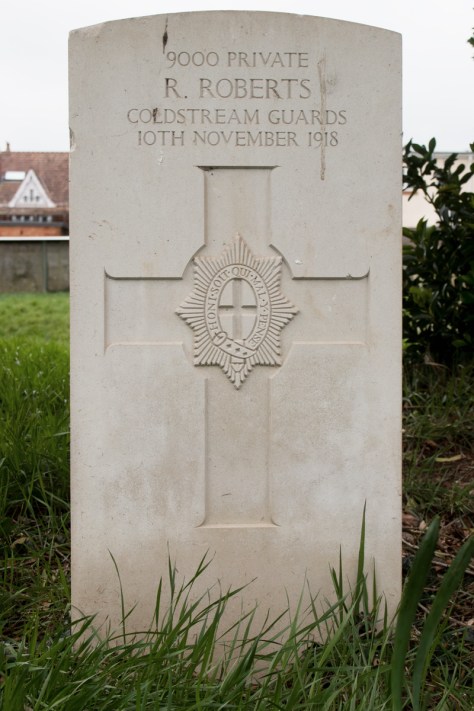
It was the military that drew Roland in, and, in 1910, aged just 14 years old, he enlisted in the Coldstream Guards. According to the following year’s census, he was stationed at the Ramillies Barracks in Aldershot, and held the rank of Boy.
Differing from the naval rank of the same name, lads of 14 or over could serve in any regiment as musicians, drummers, tailors, shoemakers, artificers or clerks, and all were ranked as boys. It seems likely, therefore, that his father’s enthusiasm for music served him well.
When war broke out, he was of fighting age, and, as part of the “Old Contemptibles”, he was involved in the Battle of Mons, the first major confrontation for the British Expeditionary Force.
During the war, Private Roberts took part in some of the most severe fighting on the Western Front, was wounded three times, as well as being gassed. He was also recommended for the DCM for gallantry in action.
He transferred to the Labour Corps, and spent time doing land work in Somerset. It was here that Roland met and married Gladys Pyne, whose family was from Bridgwater, and the couple tied the knot in March 1918.
Sadly, it was during this war service that Private Roberts contracted influenza and pneumonia and he passed away as his in-laws’ home on 10th November 1918, the day before the Armistice was signed. He was just 22 years old.
The local newspaper reported on Roland’s continued gallantry in its article on his funeral:
[Roland] held the medal of the Royal Humane Society for saving a woman’s life.
He was also the hero of an incident that occurred in Bridgwater a few weeks ago, when he succeeded in checking the career of an infuriated bull through pluckily catching the animal by its horns.
His disposition was always most cheerful, and although suffering from his [war] wounds a good deal, he never complained.
The Cornishman: Wednesday 27th November 1918
Roland Roberts lies at rest in the Wembdon Road Cemetery in his adopted home town of Bridgwater, Somerset.
Henry Edward Mees was born in Shepton Mallet, in June 1888. Henry was one of six children, and lived in Somerset with his father – Frederick and his mother Emma. Frederick was a gardener who worked as a groundsman for the local cemetery.
After leaving school, Henry found work as a clerk for a local auctioneer. Of his two brothers, the elder has found a trade in carpentry, while his younger sibling helped his father.
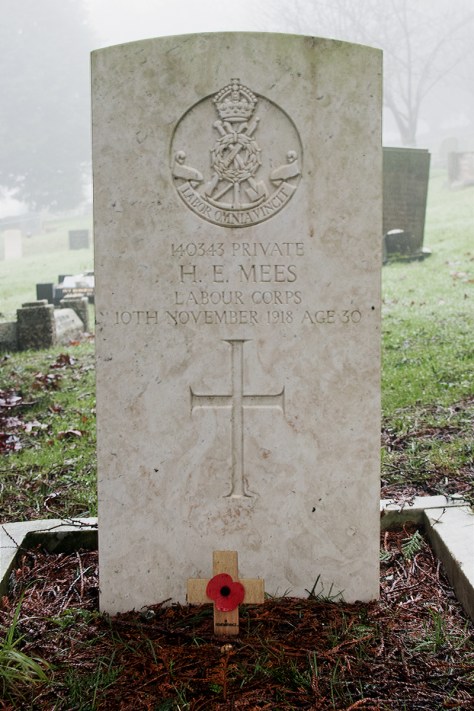
Henry’s service records are scant; he enlisted in the Labour Corps, although there is no confirmation of when this happened. Private Mees joined the 615th Home Service Employment Company and was based in England.
The HSE Companies categorised the employment of the men serving with them, whether they were cooks, caretakers, clerks, policemen, butchers or telephone operators, and used the men to the best of their skills. It is likely, therefore, that Private Mees continued in his clerk role, albeit in a different line of work from auctioneering.
Sadly, few further details of Henry’s life remain documented. He is listed as having been admitted to the War Hospital in Bath, and he died from influenza on 10th November 1918. He was 30 years old.
Henry Edward Mees lies at rest in the cemetery of his home town, Shepton Mallet, sadly tended by his father as part of his day-to-day job.